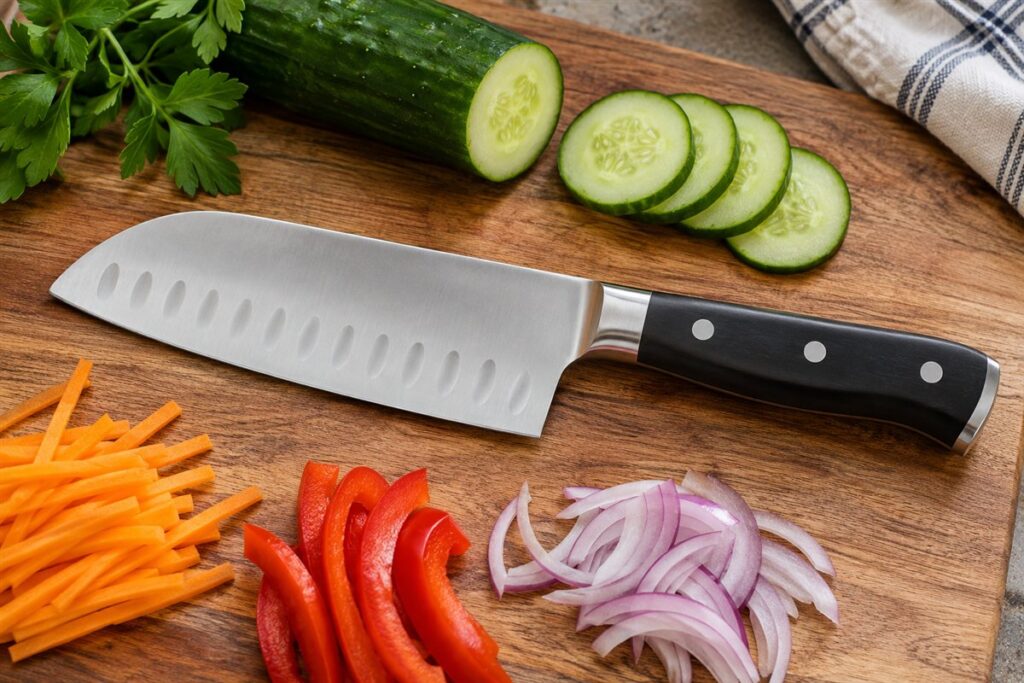
A santoku is a Japanese-style all-purpose kitchen knife with a flatter edge and a shorter, wider blade than a typical chef knife. It handles slicing, dicing and mincing, and many cooks reach for it first. A search for the best santoku knives turns up Japanese-made and German-made options, with and without a granton edge.
The six knives below range from budget to mid-range, and several come in a 7 inch size. We have not used these knives ourselves. Sizes and edge types can change by version, so confirm the blade length, steel and edge on the current listing before buying. In the santoku vs chef knives debate, the santoku is lighter and shorter, while a chef knife has more belly for rocking.
As an Amazon Associate we earn from qualifying purchases. Links below are affiliate links, and they do not change the product information we give.
What to Look For
| Feature | Why it matters |
|---|---|
| Blade length | A 7 inch blade is common; check the listing for the exact length |
| Edge type | A granton edge has scallops that help food release; a plain edge slices smoothly |
| Steel | Japanese steels often hold an edge longer; German steels are often tougher |
| Handle | Fit and balance matter more than looks over a long prep session |
Specs at a Glance
| Knife | Origin | Blade | Notes |
|---|---|---|---|
| Victorinox Fibrox Pro | Swiss | Check the listing for length | Non-slip handle; granton edge versions sold |
| Wusthof Classic | German | 7 in class | Forged; hollow edge |
| Shun Classic | Japanese | 7 in class | Layered steel; D-shaped handle |
| Global G-46 | Japanese | 7 in class | One-piece stainless steel; granton edge |
| Mercer Genesis | German-style steel | 7 in class | Forged; granton edge version available |
| Tojiro DP | Japanese | Check the listing for length | Layered steel; plain edge |
The 6 Best Santoku Knives
1. Victorinox Fibrox Pro Santoku
A Swiss-made value knife with a non-slip handle, widely used in professional kitchens. Versions with a granton edge are sold, so pick the one you want.
Suits: budget-minded cooks. Strengths: low cost and a grippy handle. Weaknesses: plain looks. Skip it if you want a Japanese-style steel.
View Victorinox Fibrox Pro Santoku on Amazon
2. Wusthof Classic Hollow Edge Santoku
A German forged santoku with a hollow edge to reduce sticking and a full tang handle in the classic Wusthof style.
Suits: cooks who like a heavier knife. Strengths: a classic forged build. Weaknesses: a higher cost than budget lines. Skip it if you want a very light knife.
View Wusthof Classic Hollow Edge Santoku on Amazon
3. Shun Classic Santoku
A well-known Japanese santoku with a layered steel blade and a D-shaped handle.
Suits: a Japanese-style santoku. Strengths: a fine edge. Weaknesses: needs careful care. Skip it if you want a rugged knife for bones.
View Shun Classic Santoku on Amazon
4. Global G-46 Santoku
A one-piece stainless knife with a dimpled handle. The G-46 is Global’s granton edge santoku, with a sleek, light feel.
Suits: a lightweight option. Strengths: a sleek one-piece build. Weaknesses: the handle can feel slick when wet. Skip it if you want a wood handle.
View Global G-46 Santoku on Amazon
5. Mercer Culinary Genesis Santoku
A forged German-style santoku from a restaurant supply brand, with a non-slip handle and a bolster for balance. It is a practical choice for a first forged knife.
Suits: budget to mid-range. Strengths: good value for a forged blade. Weaknesses: less refined than premium lines. Skip it if you want a premium finish.
View Mercer Culinary Genesis Santoku on Amazon
6. Tojiro DP Santoku
A Japanese-made santoku with a layered steel blade and a plain edge, often cited as a value pick from Japan. It is a good way to try a Japanese knife without a large spend.
Suits: a first Japanese knife. Strengths: a sharp edge for the money. Weaknesses: a basic handle. Skip it if you want a granton edge.
View Tojiro DP Santoku on Amazon
Care and Setup
- Hand wash and dry the knife right after use.
- Store it in a block, on a magnet or in a sheath.
- Use a wood or plastic board, not glass or stone.
- Hone it often and sharpen it when it dulls.
Mistakes to Avoid
- Putting a knife in the dishwasher.
- Using a santoku to cut through bone.
- Skipping the honing step.
- Buying on looks without checking blade length.
Santoku Knife FAQ
What is the best Japanese santoku knife?
Shun, Global and Tojiro are all Japanese makers. Compare the steel, edge and handle against your own preference.
Are there good santoku knives under 100?
Victorinox, Mercer and Tojiro are generally priced on the lower side, but check the current price on the listing.
What does a granton edge do?
The scallops along the blade create small air pockets that help slices release from the knife.
Is a 7 inch santoku the right size?
It is a common size and suits most cutting boards. If you have large hands or cut big produce, a longer blade may feel better.
The Short Version
For value, the Victorinox. For a forged German knife, the Wusthof. For a Japanese classic, the Shun. For a one-piece build, the Global. For budget forged, the Mercer. For a Japanese value pick, the Tojiro.