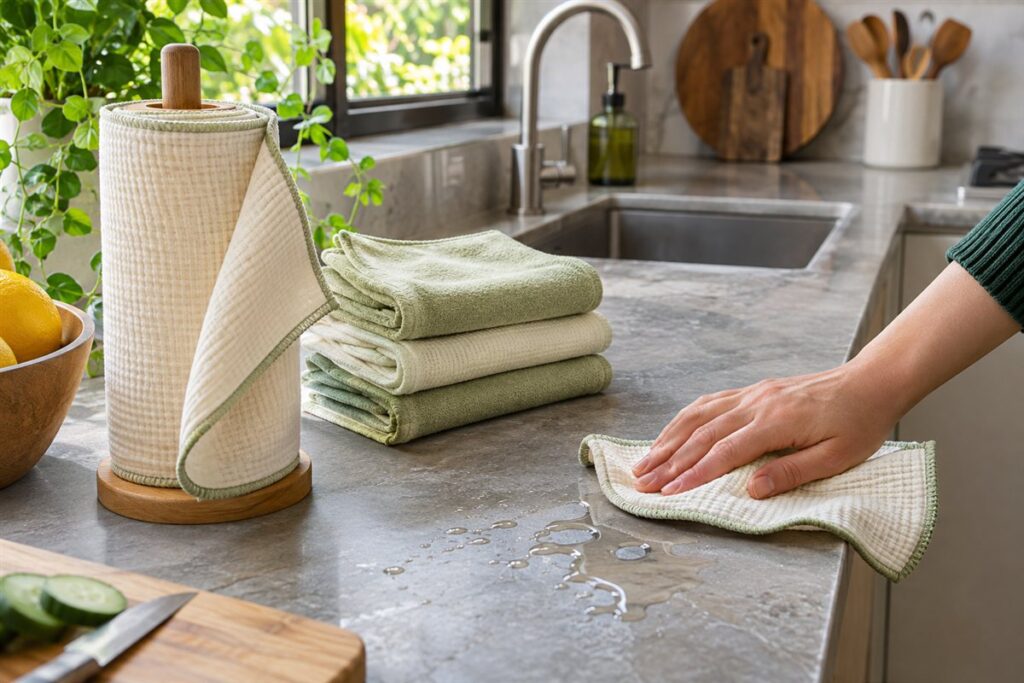
Reusable paper towels, often called unpaper towels, are cloths you wash instead of throw away. They come as cotton sheets, bamboo rolls, cellulose sponge cloths or snap-together rolls, and each one gives a different feel. If you grab a roll of paper towels for every spill, switching to a washable cloth can cut a steady household cost.
The six below span the main types: Swedish-style cellulose cloths, cotton flannel unpaper sheets and bamboo rolls. We have not used these products ourselves, and sheet counts, sizes and colors vary, so confirm the details on the current listing before you buy.
As an Amazon Associate we earn from qualifying purchases. Links below are affiliate links, and they do not change the product information we give.
What to Look For
| Feature | Why it matters |
|---|---|
| Material | Cellulose, cotton and bamboo each absorb and wash differently |
| Format | A roll feels like paper towels; loose cloths are simpler to wash |
| Washability | Look for machine-washable sheets that can be reused many times |
| Absorbency | Check whether it handles spills, grease or just light wiping |
| Storage | A holder or basket keeps used sheets from piling up |
Specs at a Glance
| Product | Material | Format | Notes |
|---|---|---|---|
| Skoy Cloth | Cellulose and cotton | Sponge cloth | Swedish-style reusable cloth |
| Marley’s Monsters UnPaper Towels | Cotton flannel | Sheets | Snap or fold for storage |
| Swedish Wholesale Swedish Dishcloths | Cellulose and cotton | Flat cloths | Sold in multipacks |
| Bambooee Reusable Bamboo Towels | Bamboo | Perforated roll | Tear-off sheets |
| Papaya Reusable Paper Towels | Cellulose and cotton | Printed cloths | Thin, flat sheets |
| E-Cloth General Purpose Cloth | Microfiber | Cloth | Works with water |
The 6 Best Reusable Paper Towels
1. Skoy Cloth
A Swedish-style cloth blending cellulose and cotton. It soaks up spills and is designed to be rinsed and reused many times before it is retired.
Suits: countertop spills. Strengths: quick absorbency and fast drying. Weaknesses: stiff when dry. Skip it if you want a soft cotton feel.
2. Marley’s Monsters UnPaper Towels
Cotton flannel sheets that replace paper towels, with a pattern and a snap closure on many versions so they can be rolled up. This is the choice that feels closest to a cloth you would use at a table.
Suits: a full paper towel switch. Strengths: soft, washable cotton. Weaknesses: bulkier laundry. Skip it if you want a disposable feel.
View Marley’s Monsters UnPaper Towels on Amazon
3. Swedish Wholesale Swedish Dishcloths
Flat cellulose and cotton cloths sold in packs. They are thin, dry fast and are commonly used for dishes and counters.
Suits: a low-cost trial. Strengths: a pack of multiple cloths. Weaknesses: not as soft as cotton. Skip it if you want a cloth for windows.
View Swedish Wholesale Swedish Dishcloths on Amazon
4. Bambooee Reusable Bamboo Paper Towels
A bamboo fiber roll with perforated sheets, meant to mimic a paper towel roll while being washable. This is the closest match for the “bamboo paper towels” idea.
Suits: a roll-based habit. Strengths: a familiar tear-off roll. Weaknesses: bamboo wear varies. Skip it if you want cotton.
View Bambooee Reusable Bamboo Towels on Amazon
5. Papaya Reusable Paper Towels
Printed, compostable-style reusable cloths made from cellulose and cotton. They are sold as a cleaner-looking alternative to dishcloths.
Suits: countertop wiping. Strengths: attractive prints. Weaknesses: may hold less than a thick cotton sheet. Skip it if you want a roll.
View Papaya Reusable Paper Towels on Amazon
6. E-Cloth General Purpose Cloth
A microfiber cloth made to clean with water alone. It is not a paper towel lookalike, but it replaces many paper towel jobs such as wiping glass and counters.
Suits: chemical-free cleaning. Strengths: picks up grime well. Weaknesses: not the best for liquid spills. Skip it if you want a sheet-style towel.
View E-Cloth General Purpose Cloth on Amazon
Care and Setup
- Keep a small bin or basket for used cloths.
- Wash with a regular load and dry fully before reuse.
- Rinse cellulose cloths and let them air dry between uses.
- Store clean sheets where you used to keep the roll.
Mistakes to Avoid
- Using reusable cloths for raw meat juices and then reusing without washing.
- Washing with fabric softener, which hurts absorbency.
- Skipping a holder and leaving damp cloths in a heap.
- Expecting one cloth to replace every paper towel job.
Reusable Paper Towels FAQ
Are reusable paper towels worth it?
They can cut down on rolls you buy, though you add some laundry. They suit people who go through paper towels fast.
What are the best alternatives to paper towels?
Cotton unpaper sheets, Swedish cloths, bamboo rolls and microfiber all work. Mixing two types covers more jobs.
Can you wash bamboo towels?
Many are made to be machine washed. Follow the care label on the listing.
How many reusable towels should I own?
A good starting point is enough for two or three days of use, so you can wash a batch while another set is ready. Keep a small basket or bag for the used ones so nothing sits damp on the counter.
Questions to Ask Before You Buy
- How much counter or drawer room can I give to a stack of cloths that are drying?
- Do I have a washing machine routine that suits cotton, bamboo or blended fabric?
- Will I use them for spills only, or also for wiping greasy surfaces and windows?
- Does the household agree on which cloth is for food and which is for the floor?
- Is a roll format or a flat stack easier for how I work?
- What does the maker’s listing say about washing temperature and fabric softener?
Fitting Them Into a Daily Routine
Switching away from disposable sheets is mostly a habit change. Most people find it easiest to keep one small basket or lidded bin near the sink for used cloths, so nothing ends up damp in a drawer. A second basket for clean ones, kept within arm’s reach of where you would normally tear a sheet, helps the change stick. Decide in advance whether stained cloths get a separate cycle, because mixing them with kitchen linens can leave odours or marks behind.
It also helps to treat different cloths as having different jobs. A set kept for raw meat juices or pet messes should look different from the set used for plates and counters, whether by colour, pattern or size. Hang cloths to dry flat or over a rail rather than bunching them, since trapped moisture is the usual cause of a musty smell.
Who Should Skip Them
If you rarely have time for extra laundry, or you often deal with messes you would rather throw away, a reusable cloth may end up unused in a drawer. Households with very limited washing access, such as shared laundry rooms with long waits, may also find the routine tiring. Anyone who needs a disposable option for hygiene reasons should stay with that, and follow the guidance from the relevant professional. Reusable cloths suit people who are happy to rinse, wash and rotate them regularly. Always read the maker’s listing and instructions before washing a new fabric for the first time.
The Short Version
For a cellulose cloth, the Skoy. For cotton sheets, the Marley’s Monsters. For a multipack, the Swedish Wholesale. For bamboo, the Bambooee. For prints, the Papaya. For water-only cleaning, the E-Cloth.