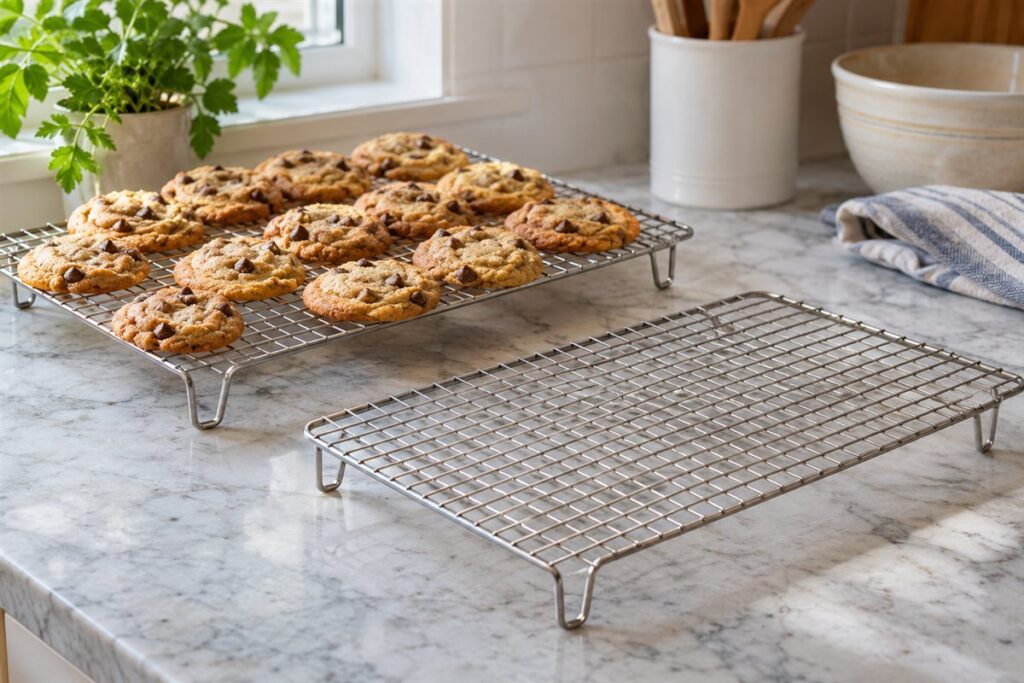
A cooling rack lifts hot baked goods off the counter so air can circulate underneath, which stops the bottoms from turning soggy. It is one of the simplest tools in a baker’s kit. This guide covers why it matters, what to look for and how to use it, with a cooling walkthrough, common scenarios, mistakes with their reasons and a troubleshooting table.
Why Airflow Matters
A cookie or loaf left on a pan or flat surface traps steam beneath it. That moisture softens the crust and can make the base damp. A rack lets steam escape from all sides, so cookies crisp up, cakes cool evenly and bread keeps its crust.
Racks are also handy for glazing and icing, since drips fall through to a tray below, and for holding roasted meat or crisp-baked foods in the oven on a sheet pan.
What to Check Before Choosing
| Factor | Why it matters | What to check |
|---|---|---|
| Size | Must hold your largest bake | Compare with your cake pans and loaf sizes |
| Grid pattern | Tighter grids hold small cookies; open ones allow more air | Look at the wire spacing |
| Frame strength | A thin rack bends under heavy loads | Press gently on the center |
| Feet | Raised feet allow air below | Check height and stability |
| Oven use | Not all racks can go in the oven | Read the maker’s heat limit |
| Finish | Affects cleaning and rust resistance | Check material and care instructions |
Using a Rack Step by Step
- Rest a hot pan on the rack for the time the recipe suggests.
- Move cookies with a spatula once they firm up enough to hold their shape.
- Place cakes on the rack after turning them out, top side up if you can.
- Wait until everything is fully cool before frosting or wrapping.
- Place a baking sheet underneath when you glaze to catch drips.
Care and Storage
- Soak and scrub stuck-on bits with a stiff brush, since grids hold crumbs.
- Dry well to prevent rust on steel racks.
- Store flat or on edge, or choose a stackable design to save room.
- Avoid cutting on a rack with coated wires.
Rack Styles at a Glance
- Single-layer racks are simple and easy to store.
- Tiered or stackable racks let you cool several trays in a small space.
- Round racks fit cake pans and pizza pans.
- Folding racks take up less room in a drawer.
A rack with crossbars gives extra strength, but close-set wires hold small cookies better.
A Cooling Routine for Different Bakes
Each kind of bake wants a slightly different handling on the rack. Your recipe’s directions come first, and these are general habits.
Cookies
Leave them on the hot sheet for the short time the recipe names, so they set enough to lift, then move them to the rack in a single layer. Stacking warm cookies traps steam and softens them.
Cakes in pans
Rest the pan on the rack for the time the recipe states, then run a thin knife around the edge, turn the cake out and place it right side up on the rack. Fully cool layers before frosting, or the frosting will slide and melt.
Loaves and quick breads
Turn them out after the recommended rest and cool them on their sides or tops as the recipe suggests. Slicing too soon can leave the crumb gummy because steam is still escaping.
Yeast bread
Move it to the rack as soon as it comes out of the oven. The crust stays crisp when steam leaves from the bottom as well as the top.
Pies and tarts
Cool on a rack so air reaches the base. For fillings made with eggs, cream or dairy, follow food-safety guidance on cooling and chilling.
Using a Rack in the Oven
- Check the maker’s heat limit. If it does not mention oven use, treat the rack as cooling only.
- Pair it with a rimmed sheet pan. The pan catches drips and keeps the rack from sliding around.
- Place food on the rack. Bacon, roasted vegetables or breaded foods get air on all sides.
- Allow clearance. Make sure the rack and pan fit on the oven shelf without touching the heating elements.
- Let it cool before washing. Hot metal in cold water can warp and splash.
- Clean promptly. Baked-on grease is harder to remove once it sets.
Common Scenarios
Holiday cookie baking with limited space
Stackable racks let you cool several trays in a small footprint. Make sure cookies are cool enough to hold their shape before stacking racks above them.
Glazing a bundt cake
Set the cake on the rack over a sheet pan, then pour the glaze so drips fall away and the cake does not sit in a pool of sugar.
Cooling a roast
If the rack is made for oven use, it can lift meat out of juices while it rests. Follow food-safety guidance on serving and holding temperatures.
Cooling a large sheet cake
Choose a rack that is as large as the pan, or use two racks side by side so the cake is supported evenly and does not crack.
Mistakes to Avoid
- Leaving baked goods in the pan too long. Steam condenses on the sides and bottom, which softens the crust.
- Using a rack that is too small. Overhanging cakes can crack or bend when unsupported.
- Frosting before the bake is fully cool. Heat melts the frosting and leaves it slipping off.
- Putting a non-oven rack in the oven. Coatings and solder can fail under heat.
- Cutting on coated wires. Knives can scratch the finish, and flakes can end up in food.
- Storing the rack damp. Steel rusts, so dry it fully.
Quick Troubleshooting
| Symptom | Likely cause | What to try |
|---|---|---|
| Cookies fall through the rack | Wire spacing too wide | Use a tighter grid or place parchment on top |
| Marks on the underside of a cake | Wires press into soft cake | Cool it a few minutes longer in the pan before turning out |
| Rack wobbles | Feet uneven or frame bent | Check on a flat surface and replace if bent |
| Rust spots | Left damp | Scrub, dry well and follow the maker’s care advice |
| Food sticks to the wires | Not greased for sticky foods | Lightly grease the rack, or use parchment, if the maker allows |
Small Glossary
- Grid
- The pattern of crossed wires that forms the cooling surface.
- Cooling zone
- The area around baked goods where air circulates and steam leaves.
- Carryover
- Cooking that continues from retained heat after food leaves the oven.
- Tiered rack
- A rack with several levels to cool multiple trays at once.
- Oven-safe
- Stated by the maker as able to withstand oven heat up to a limit.
FAQ
Can I use a rack inside my oven?
Only if the maker says it can handle oven heat. Some racks are made for roasting on a sheet pan, others only for cooling.
How many racks do I need?
One large rack suits casual baking. Two or three make holiday cookie batches much easier.
Why do my cookies still go soft on a rack?
They may be stacked while warm, stored before they are fully cool, or baked in humid conditions. Cool in a single layer, then store in an airtight container.
Is a round rack better than a rectangular one?
A round rack fits round pans and pizzas, but rectangular racks hold cookies and sheet cakes more easily. Many bakers keep one of each.
What is the best way to clean a rack?
Soak it in warm soapy water, use a stiff brush on the grid and dry it fully. Follow the maker’s care guide, especially for coated racks.
The Short Version
A cooling rack improves texture by letting air reach every side of your baking. Choose one big enough for your largest bake, check the frame for strength, and clean and dry it carefully. Cool in a single layer, and follow recipe and food-safety guidance for filled or egg-based bakes.