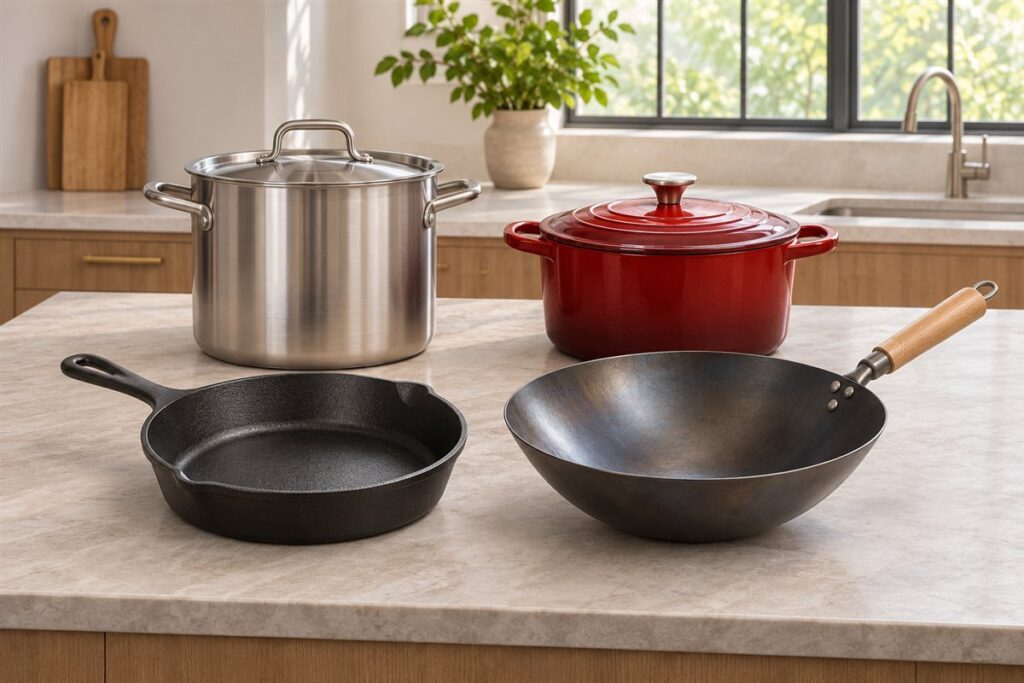
The best cookware material is the one that matches your stove, your cooking habits and the amount of care you are willing to give. Begin by listing what you cook most often, then use the factors below to narrow the field.
Begin With Your Cooking Habits
Write down your five most common meals. If they are eggs, pancakes and reheated leftovers, a coated pan will serve you well. If they are seared meats, roasted vegetables and sauces, you will want something that tolerates high heat. If you simmer soups and stews, pay attention to pot capacity and lid fit.
Decision Criteria
| Factor | Why It Matters | What to Check |
|---|---|---|
| Stove type | Induction needs magnetic metal | Hold a magnet to the base or read the maker’s guide |
| Heat response | Affects control when cooking delicate foods | Thin, light pans react fast; thick pans react slowly |
| Weight | Heavy pans are harder to lift and pour | Handle one in a shop if you can |
| Upkeep | Some metals need seasoning or hand washing | Read the care instructions |
| Oven use | Handles and lids limit temperature | Look for the maker’s stated oven limit |
| Reactivity | Some metals react with acidic foods | Check whether the cooking surface is coated or sealed |
Match Material to Task
- Stainless steel: Everyday searing, sauces and general cooking.
- Cast iron: Steady heat, frying and baking.
- Carbon steel: Quick response, stir frying and pan searing.
- Nonstick and ceramic coated: Eggs, fish and low maintenance mornings.
- Enameled cast iron: Braises, soups and bread baking.
- Copper and aluminum: Fast, even heating, often paired with a lining.
Build a Small Core Set
Few kitchens need a full matched set. A practical core might include a stainless skillet, a nonstick skillet, a medium saucepan and a large pot with a lid. Add specialty pieces only after you notice a gap.
Think about who else uses your kitchen. A heavy pan that suits you may be awkward for another family member, and a coated pan may not survive a house where metal tools are common. Choose materials that fit the habits of everyone who cooks.
Finally, check the handle and lid. A riveted metal handle usually tolerates the oven better than plastic, and a lid that fits well saves energy and keeps moisture in. These small details often matter as much as the main material.
Heat Conductivity and Evenness
Materials move heat differently, and that shapes how a pan behaves. Aluminum and copper conduct heat quickly, so they respond fast to changes in the burner. Stainless steel conducts less well on its own, which is why many pans have an aluminum or copper core or a thick base. Cast iron heats slowly but holds heat well, which suits searing and steady frying.
Evenness is about how well heat spreads across the base. A thin pan can develop hot spots, scorching food in the middle while the edges stay cool. A thicker base spreads heat more evenly but reacts more slowly when you turn the burner down. Neither is better in every case.
- Fast response: delicate sauces, eggs, quick changes in heat.
- Steady heat: searing, frying, long simmers.
Check the product description for construction details such as clad layers or encapsulated bases, and think about whether you want speed or stability.
Maintenance Effort by Material
Every material asks something from you. Stainless steel is low maintenance and tolerates metal tools, though food can stick if heat is not managed. Nonstick and ceramic-coated pans are easy to clean but need gentle tools and moderate heat, and coatings wear over time. Cast iron needs drying and oiling, and carbon steel needs a seasoned surface and similar upkeep. Enameled cast iron is easier to care for but can chip if knocked.
Be honest about your habits. If you often leave pans soaking or run everything through the dishwasher, pick materials that tolerate that, and check the maker’s guide. If you enjoy caring for your cookware, seasoned iron can reward you.
Consider how long you want a pan to last. Coated pans are generally considered more replaceable, while well-kept stainless and iron can last for many years. Match the upkeep to your patience.
Food Reactivity and Flavor
Some metals react with acidic or salty foods. Bare aluminum and unseasoned iron can interact with tomatoes, wine or citrus, giving a metallic taste or discoloring the food. Many aluminum pans are anodized or coated to reduce this, and stainless steel and enameled surfaces are generally nonreactive. Copper pans are usually lined for this reason.
If you cook acidic dishes often, lean toward nonreactive surfaces such as stainless, enameled or coated pans. If you mostly sear and fry, reactivity is less of a concern. Seasoned iron handles short acidic cooking, but long simmers can strip some seasoning.
Check the cooking surface, not just the exterior, because many pans have a different material inside. Read the listing to see what touches your food. Questions about specific coatings are best answered by the maker’s documentation.
Budget Tiers and Value
Cookware spans a broad range, and more spending does not always mean better results for you. Entry-level pieces cover basic tasks, though thinner bases may cause hot spots. Mid-tier options often add thicker construction, better handles and a sturdier finish. Premium lines may use multi-layer construction, specialty finishes or longer warranties.
A smart approach is to put money where it counts. A skillet or saucepan used daily is worth a better build, while a rarely used stockpot can be simpler. Nonstick pans tend to be replaced more often, so consider a moderate option there.
- Check the warranty terms and what they cover.
- Look at the weight, which often reflects thickness.
- Read the care guide before buying, not after.
Open-stock pieces let you build slowly, while sets can be convenient but may include items you will not use.
Common Material Mix-Ups
A few misunderstandings come up often. Many people assume heavier always means better, but weight can be a drawback for some users. Others assume all nonstick coatings are alike, when they differ in tolerance for heat and tools. Some believe cast iron cannot be washed with water, when most care guides allow quick washing and thorough drying.
Another trap is buying for a look. A matching set may look attractive but may not suit how you cook. And an induction-ready label should be confirmed for each piece rather than assumed.
Finally, remember that oven limits depend on handles and lids as well as the pan. Check each part. When you are unsure, rely on the maker’s documentation, and choose the material that fits your habits rather than the one that sounds most impressive.
FAQ
Is one material right for everything?
No single material does it all. Each one trades off heat response, upkeep and durability.
How do I know if a pan works on induction?
Check the maker’s guide for an induction symbol, or see whether a magnet clings firmly to the base.
Which cookware material is best for beginners?
Many beginners do well with a stainless steel skillet and a nonstick one for eggs, since these cover many tasks. Choose based on what you cook most and how much upkeep you want.
Is ceramic coated cookware the same as nonstick?
Both offer a slick surface, but the coatings differ, and so do care and heat limits. Read the maker's guide for each pan.
Does a heavier pan cook better?
A heavier pan often holds heat better, but it can be tiring to lift. Choose a weight you can handle comfortably.
Can I use metal utensils on cookware?
It depends on the surface. Stainless and iron generally tolerate metal tools, while coated pans usually call for wood, silicone or nylon.
What is clad cookware?
Clad cookware bonds layers of different metals, often with a conductive core, to improve heat spreading. Check the listing for how far the layers extend.
How do I know when to replace a pan?
Replace pans that are warped, deeply scratched, flaking or have loose handles. These problems affect cooking and can be a safety issue.
The Short Version
Choose by stove type first, then by cooking habits, weight and upkeep. A small mixed collection usually beats a large matched set.