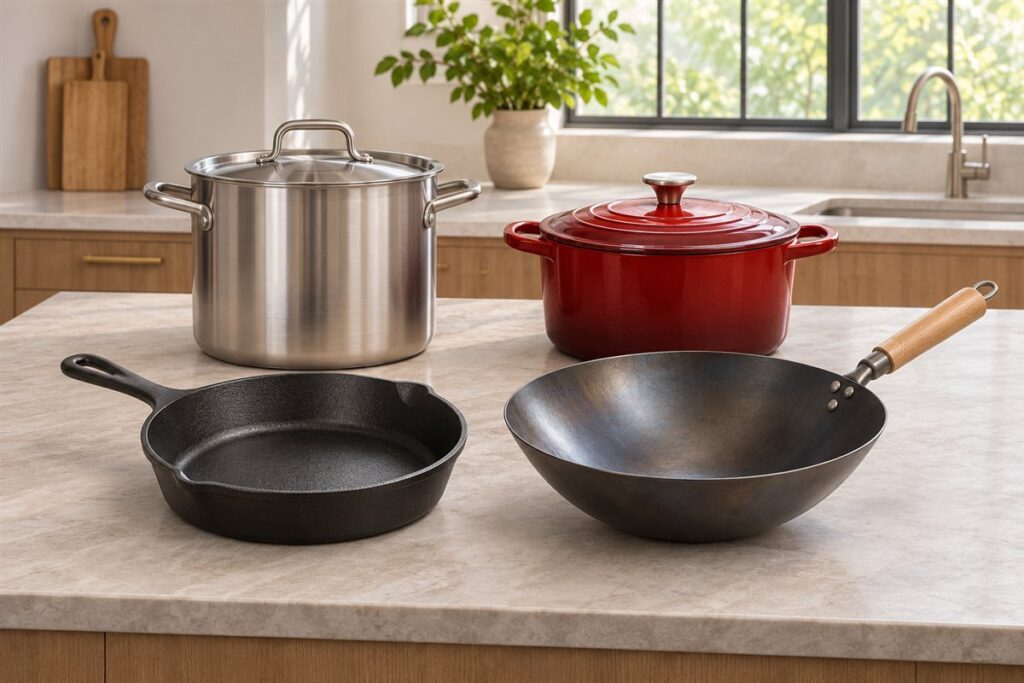
Whether a pan can go in the oven depends on every part of it, not just the metal. Handles, lids and coatings often have lower heat limits than the body, so always look for the maker’s stated oven temperature before you use a pan in the oven.
Materials and Typical Oven Use
| Material | Oven Use | Watch For |
|---|---|---|
| Cast iron | Generally suitable | Very hot handle; heavy |
| Enameled cast iron | Generally suitable | Lid knob may limit heat |
| Carbon steel | Generally suitable | Handle may be riveted metal or not |
| Stainless steel | Often suitable | Plastic or silicone handles and lids |
| Nonstick or ceramic coated | Varies | Coating limits, often lower than metal |
| Glass and stoneware bakeware | Suitable if marked | Sudden temperature changes |
Parts That Limit the Heat
- Handles: Metal handles tend to tolerate high heat. Plastic, silicone and wood do not, or have lower limits.
- Lids: Glass lids may have a lower limit than the pot, and plastic knobs can melt.
- Coatings: Nonstick and ceramic layers can degrade at high temperature.
- Rivets and bonded parts: Check the guide, since some adhesives limit heat.
How to Check Before Using
- Read the care leaflet or the maker’s website for a stated oven temperature.
- Look at the underside of the pan for a printed limit.
- Check every part: body, handle, lid and knob.
- If any part has no stated limit, keep it out of the oven or remove the part when allowed.
Safe Handling Habits
Treat every oven-bound pan as hot. Use dry mitts, because a damp cloth conducts heat quickly. Remember that a handle that sat in the oven stays hot for a long time, so some cooks drape a towel or sleeve over it as a reminder. Do not move a hot glass dish to a cold or wet surface.
These are general tips only. Follow the maker’s manual and safety instructions for your cookware and oven.
Think about the type of recipe. Roasting vegetables, finishing a seared steak, baking cornbread and braising all call for different temperatures, so match the pan to the heat. Remember that a lid left on can trap steam and make the handle hot as well. Silicone grips on handles can sometimes be removed, which may raise the oven limit, though only if the maker says it is allowed. When in doubt, move the food to a dish that is clearly marked for oven use.
Why Stove-to-Oven Cookware Is Worth Having
Many of the best techniques move a pan from the burner into the oven. You can sear meat on the stove for a browned crust, then finish it gently in the oven so the center cooks through without burning the outside. Braises, frittatas, baked pasta, cornbread and one-pan chicken all follow this pattern.
That is why an oven-capable pan is so useful. It saves transferring food to a second dish and keeps the browned bits in the pan for making a sauce. When you shop, look for pans that clearly state an oven limit for the whole piece, not just the body. A listing that says “oven safe” without a temperature is incomplete. Look for the number, and check whether it applies with the lid on or off.
Reading Heat Ratings Correctly
Heat ratings are stated by the maker and often differ by part. A pan might list one limit for the body and a lower one for the lid or handle. Always use the lowest limit that applies to any part you are putting in the oven.
- Check whether the rating covers the broiler, which can reach higher temperatures than baking.
- Note whether the rating applies for a short time or for long cooking.
- Look for separate guidance for lids, since some are rated lower than their pots.
- If the rating is given in one temperature scale, convert it carefully to match your oven.
When the information is missing, contact the maker or retailer rather than guessing. A written limit in the manual or on the website is the answer to rely on.
Avoiding Thermal Shock and Warping
Rapid temperature changes can damage cookware. Glass and stoneware are especially sensitive, and may crack if a hot dish meets a cold counter or wet surface. Metal pans can warp if they are heated or cooled too quickly.
- Let a hot pan cool on a dry trivet, a wooden board or a rack.
- Do not add cold liquid to a very hot dish unless the maker says it is fine.
- Preheat gradually instead of putting an empty pan over high heat.
- Do not move a pan straight from the freezer to a hot oven unless the guide allows it.
A pan that rocks on a flat surface may be warped. Warped cookware heats unevenly and is less stable, so consider replacing it.
Handles, Grips and Add-On Covers
Handles are where most oven mistakes happen. A metal handle that is part of the pan generally tolerates oven heat, but it will become very hot. A silicone sleeve or cover can protect your hand on the stove, but it may have a lower limit than the pan beneath it. Some sleeves are removable, which can allow oven use if the maker says so.
Wooden and plastic handles are usually not for oven use. Lids with plastic knobs may need the knob removed or replaced with a metal one, but only if the maker offers that option. Keep a clearly visible reminder, such as a folded towel over the handle, after you take a pan out. Hot handles do not look any different from cool ones.
Care That Keeps Oven Pans in Good Shape
Pans that spend time at high heat need regular attention. Clean off baked-on food promptly, since built-up residue can burn and smoke the next time. Follow the maker’s guidance on soap, seasoning and drying. Bare cast iron and carbon steel need oil and thorough drying to prevent rust, while enameled surfaces need gentle cleaners to avoid scratching.
Inspect your pans occasionally. Look for loose rivets, chips in enamel, flaking coatings and cracks in glass. Any of these is a reason to stop using the piece in the oven. When replacing, choose a pan whose stated oven limit matches your cooking, such as roasting at high heat, and keep the manual or a photo of the limit for reference.
Checking Oven Use Alongside Other Cooking Methods
Many cooks use a pan on several heat sources, and what works on one may not work on another. A pan that is rated for the oven might not suit induction, a grill or an open fire, and the reverse is also true. Look at the product description to see which uses the maker lists.
- Induction: needs a magnetic base. The oven rating is separate from induction compatibility.
- Microwave: metal pans do not belong in a microwave. Glass and ceramic may, if the maker says so.
- Grill or campfire: only if the maker explicitly approves it. Open flame and coals can exceed the pan’s limits.
- Freezer to oven: usually not allowed for glass or stoneware, so check before attempting it.
If a pan has several different parts, such as a removable handle or a lid that doubles as a second pan, check each part for its own limits. Write down the lowest limit on a label or in your notes so you do not need to look it up each time.
FAQ
Can I use the broiler?
Only if the maker says so. Broilers can exceed normal baking temperatures, so check first.
Can nonstick go in the oven?
Some can, within a stated limit. Read the guide for your pan.
Is stainless steel always oven safe?
The metal often is, but handles, lids and bonded parts may not be. Check the maker's stated limit for the complete piece.
Can glass lids go in the oven?
Some can, within a stated limit that may be lower than the pot's. If the lid has no stated rating, leave it off or use foil if the maker allows.
Is it safe to put a cold pan in a preheated oven?
For most metal pans, yes. Glass and stoneware are more sensitive, so follow the maker's guide on preheating and avoid sudden temperature changes.
Can I use cookware in the oven if it has a silicone handle sleeve?
Only if the maker says so. Some sleeves can be removed for oven use, while others are not designed to go in the oven at all.
What does oven safe to a temperature mean for a lid and pot together?
Check the manual to see if the rating applies to the whole set. If the lid has a different limit, use the lower number.
Can I use my skillet under the broiler?
Only if the maker says it can handle broiler heat. Broilers can reach high temperatures, and handles and coatings may not tolerate them.
How can I tell if a pan has a printed oven limit?
Look at the underside of the pan and any stickers or labels. If you cannot find one, check the maker's website or contact them.
The Short Version
Check the stated oven limit for the whole piece, including handle and lid. When no limit is given, keep it on the stove.