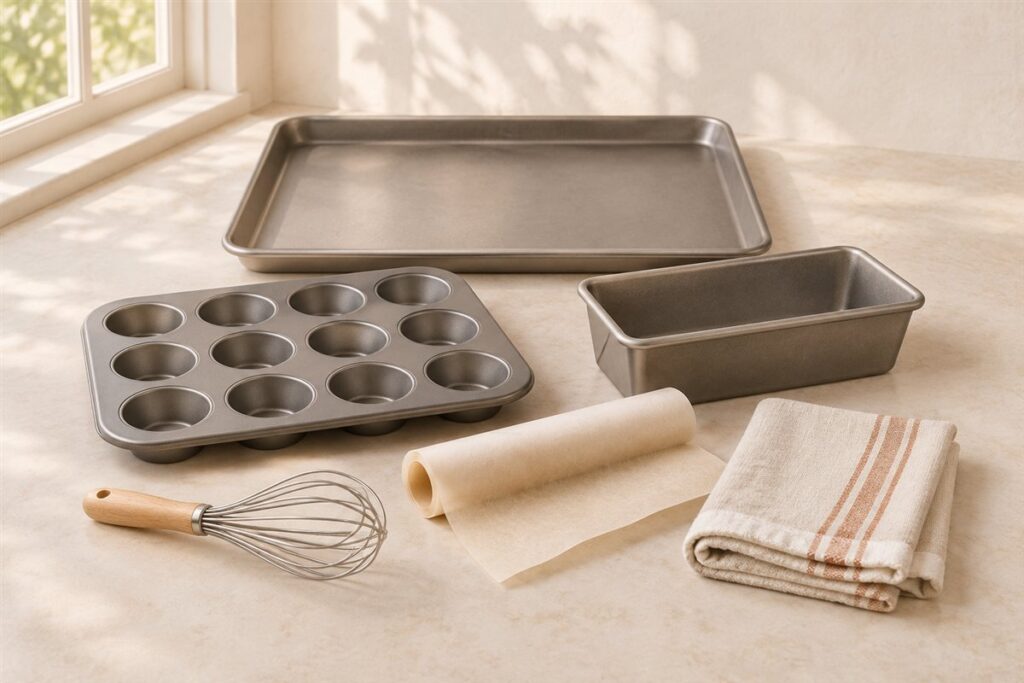
Parchment paper is a disposable, flexible sheet that works for almost any baking job, while a silicone baking mat is a reusable liner that sits flat on the pan. Both stop food from sticking and make cleanup easier. Your choice depends on how often you bake and what you are making.
What Each Liner Is
Parchment is paper with a nonstick coating, sold in rolls or precut sheets. You tear or cut it to fit, then throw it away. It can be folded into pouches, cones for piping and circles for cake pans.
A silicone mat is a thin, flexible sheet, often reinforced with a fine mesh. You wash it and use it again many times. Follow the maker’s guide for heat limits and care.
Head to Head
| Factor | Parchment paper | Silicone mat |
|---|---|---|
| Reuse | Usually once or a few times | Many times |
| Shaping | Cut, fold, line any pan | Fixed size |
| Browning | Even, good crisping | Slightly paler bottoms |
| Cleanup | Toss it out | Wash by hand or as allowed |
| Storage | Roll or box | Roll or lay flat |
| Cutting on it | Not recommended | Avoid knives, which can damage it |
Best Uses
- Choose parchment for lining cake pans, roasting vegetables, wrapping fish in a pouch and baking at high heat within the paper’s limit.
- Choose a silicone mat for sticky candy, macarons, bread dough that you shape on the mat, and repeated cookie batches.
- Choose parchment when you need a custom shape or a quick one-off job.
- Choose a mat when you want to cut down on paper waste.
How to Use and Care for Them
- Lay the liner flat on a cool pan before adding food.
- For parchment, press it into the corners or use a dab of batter or oil to keep it from curling.
- Keep paper away from open flames and the oven’s heating element.
- Wash a silicone mat in warm soapy water and dry it completely.
- Store the mat flat or loosely rolled, not folded sharply.
You Can Use Both
You do not have to choose one for good. Many bakers keep a roll of parchment and a mat or two. Use parchment when you need a fast, custom fit, and the mat for sticky, repeated work. If you are not sure, try one liner on your next batch of cookies and compare the results to see which you like better.
Buying Parchment Wisely
Parchment comes in rolls, flat precut sheets and shaped rounds for cake pans. The right format depends on what you bake. Rolls are flexible and let you cut any length, but they curl and can be annoying to flatten. Precut sheets lie flat and fit standard baking sheets, which is helpful if you line pans often. Pre-shaped rounds save time for layer cakes.
- Check the stated heat limit on the package, since it varies by product.
- Look at whether the paper is bleached or unbleached if that matters to you. The two perform similarly, and the choice is largely about appearance.
- Check that the paper is coated on both sides if you plan to flip it or reuse it.
- Choose a width that fits your pans without much trimming.
Avoid wax paper as a substitute in the oven. It is not made for baking heat and may smoke or melt.
Picking a Silicone Mat
Silicone mats vary in size, thickness and finish. The first check is fit. Mats are made in sizes meant for common baking sheets, so measure your pan and compare it with the listing. A mat that is too large will buckle, while one that is too small leaves bare metal at the edges.
Next, look at the build. Mats with a reinforced fabric core tend to be sturdier and lie flatter. Thin ones can curl or slide. Some mats have printed guides for macarons, pastry or pie dough, which can be useful if you do these tasks often, but plain mats suit more general work. Always confirm the maker’s heat limit and care instructions before first use.
How Different Foods Behave on Each Liner
Different foods respond to liners in distinct ways, and knowing this helps you choose.
- Cookies: parchment gives crisper bottoms and slightly more spread control, while a mat can give a softer, paler base.
- Roasted vegetables: parchment helps with browning, while a mat can trap moisture, so food may brown less.
- Sticky candy and caramel: a mat is easier to peel from, and parchment can also work for lighter jobs.
- Delicate pastry and macarons: either works, but a mat gives a very consistent surface.
- Greasy foods such as bacon: parchment is easy to discard, while a mat needs thorough washing.
Try both on the same recipe and compare the bottoms. Your oven, pan and recipe all affect the result.
Common Mistakes With Both Liners
A few simple errors cause most liner problems. Placing parchment too close to the top heating element can scorch it, and a long overhang beyond the pan can brown or catch fire in some ovens. Trim the paper to the pan size.
With mats, the main mistakes involve heat and cutting. Do not exceed the stated limit, and avoid cutting food on the mat, because knives can damage it. Do not place a mat directly on the oven floor or rack unless the maker says so, and do not use it under a broiler unless it is approved.
Another common error is lining a pan with something that blocks airflow, like a mat on a rimmed insulated sheet, which can slow browning. If bottoms come out pale, try a different pan or place the sheet on a lower rack.
Caring for Mats and Reducing Waste
A silicone mat can hold on to oils and flavors. Wash it with warm soapy water after each use and dry it fully before storing. If it feels sticky or greasy after washing, the maker’s guide may suggest a soak or a gentle cleaner. Avoid abrasive scrubbers.
Replace a mat that is torn, warped or permanently stained in a way that affects food. For parchment, use a sheet more than once only for dry bakes at moderate heat, and replace it when it darkens or cracks. Some parchment is labeled as compostable, but check the package and local guidance rather than assuming. Using both liners thoughtfully reduces waste and keeps your baking sheets easy to clean.
Matching a Liner to the Recipe
The choice of liner can be easier when you start from the recipe. Delicate, sticky or sugary bakes tend to benefit from a mat, while high-heat roasting and custom-shaped lining jobs tend to suit parchment.
- Sheet-pan dinners: parchment keeps cleanup easy and allows good browning.
- Bread and rolls: either works, though parchment lets you slide a loaf onto a hot stone, if the maker allows.
- Brittle and toffee: a mat handles sticky sugar well, within its heat limit.
- Cake layers and brownies: parchment fits the shape of the pan and lifts the bake out.
- Meringues: both work, but parchment is easy to peel from light, dry bakes.
If a recipe says to grease the pan, check whether the liner still needs it. Many do not. When in doubt, follow the recipe and the liner’s package instructions.
FAQ
Can I reuse parchment paper?
Sometimes, for dry bakes like cookies at moderate heat, until it looks dark or brittle. Replace it when it does.
Do silicone mats work at any temperature?
No. Each has a stated limit, so check the maker’s guide before using one for high heat.
Can I use parchment paper in an air fryer?
Only if the air fryer maker allows it and the paper is weighed down by food, since loose paper can lift into the heating element. Check the manual for your model.
Is parchment paper the same as wax paper?
No. Parchment is made for oven use within its heat limit, while wax paper is coated in wax that can melt or smoke in the oven.
Do silicone mats make cookies spread more?
Mats are smooth and can let some doughs spread more than on parchment. If this bothers you, chill the dough before baking.
Can I cut parchment to fit a round cake pan?
Yes. Trace the pan on the paper, cut slightly inside the line, and press it into the base. Precut rounds are available if you do this often.
Why does my silicone mat feel greasy?
Oils can leave a film on silicone. Wash it with warm soapy water, and check the maker's guide for any recommended deeper cleaning.
Can I roll out dough on a silicone mat?
Yes, many mats are suitable for rolling dough and some have measuring guides. Avoid cutting on the mat with a sharp knife.
Can a silicone mat go in the microwave or freezer?
Some can, but it varies. Look at the maker's care instructions before using one for anything other than the oven.
The Short Version
Parchment is flexible, disposable and good for lining all kinds of pans. A silicone mat is reusable and good for sticky or repeated bakes. Many bakers keep both on hand.