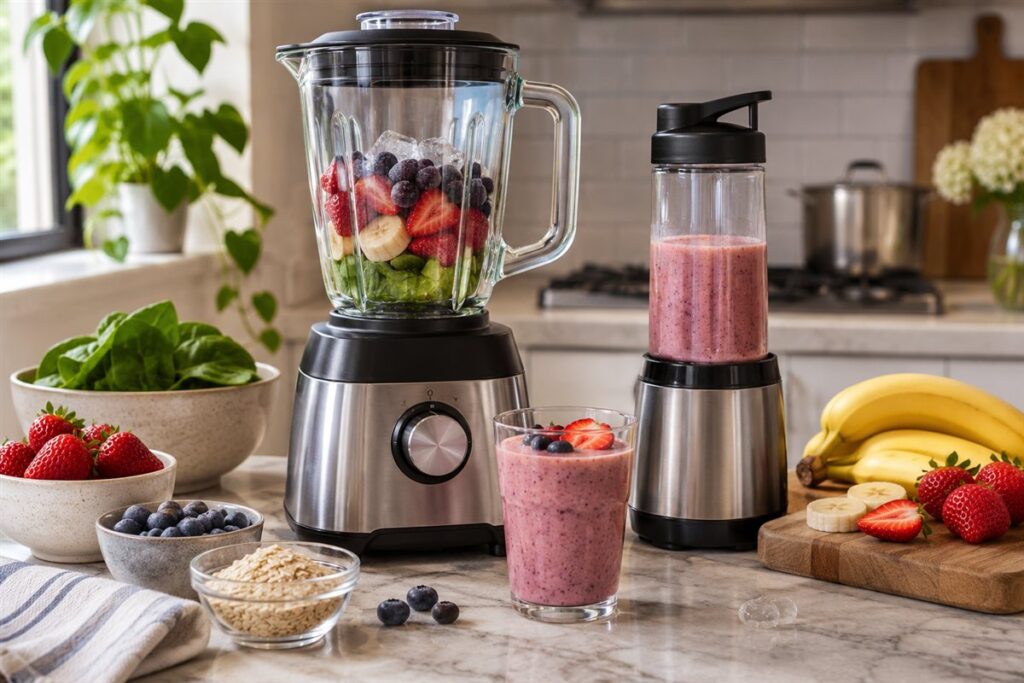
Choose a blender by deciding what you will blend most often. Countertop blenders suit smoothies, soups and big batches, personal blenders suit single servings, and immersion blenders suit soups right in the pot. Jar size, motor strength and ease of cleaning matter more than a long list of settings. The sections below add a worked walkthrough, realistic scenarios and a troubleshooting table.
Three Main Styles
Countertop blender
A base with a motor and a tall jar. It is the most flexible style and handles smoothies, frozen fruit, sauces and soups. It takes more counter space and is heavier to move.
Personal blender
A compact base with a cup that doubles as a travel bottle. It is great for one serving and quick to wash, but the small size limits what you can blend at once.
Immersion (stick) blender
A handheld wand that you put into a pot or bowl. It purees soup without moving it to a jar, so it is easy to store and clean. It is less suited to ice or large amounts of frozen fruit.
Decision Criteria
| Factor | Why it matters | What to check |
|---|---|---|
| Jar capacity | Sets batch size | The maximum fill line, not just the total volume |
| Jar material | Weight, scratches and heat | Glass, plastic or steel; the maker’s note on hot liquids |
| Motor power | Ice and frozen fruit need strength | The maker’s advice about ice and thick mixtures |
| Blade design | Affects how well food circulates | Sturdy blades and a jar shape that pulls food down |
| Controls | Ease of use | Simple speed dial, pulse and presets |
| Noise | Powerful blenders are loud | Whether the maker offers a cover or a quieter model |
| Cleaning | Residue collects around the blade | Self-clean mode and dishwasher advice |
Hot Liquids and Lids
Blending hot soup can build pressure inside a closed jar. Only blend hot food if the maker says the jar and lid allow it, and follow the instructions about fill level and venting. When in doubt, blend in small batches with the lid vented, or use an immersion blender in the pot.
Using It Well
- Add liquid first, then soft ingredients, then ice or frozen items on top.
- Fit the lid firmly before you turn it on.
- Begin at a low speed and increase gradually.
- Switch off and unplug before reaching near the blade.
Blades are very sharp, so handle them carefully and follow the maker’s safety instructions.
Worked Example: Turning Soup Into a Smooth Puree
Suppose you have a pot of cooked vegetable soup and want it smooth. There are two routes, and the right one depends on the tool you own.
With an immersion blender
- Take the pot off the heat and let it settle for a moment so the surface stops bubbling.
- Choose a pot deep enough that the soup will not splash. A narrow, tall pot is better than a wide, shallow one.
- Lower the blending head fully into the soup before switching on, and keep it submerged.
- Move the wand slowly in small circles and up and down until the texture suits you.
- Switch off and lift the wand out before removing it, then rinse the head right away.
With a countertop blender
- Check the maker’s guide to see whether the jar and lid are meant for hot food and what the maximum hot fill is.
- Let the soup cool a little, then pour it in small batches, filling the jar only partway.
- Vent the lid as the maker directs, cover the vent with a folded cloth if the guide suggests it, and hold the lid in place.
- Begin at the lowest speed and raise it gradually.
- Pour each batch into a clean pot and warm it again before serving.
Common Scenarios
A single person making a morning drink
A personal blender is quick to use and clean, and the cup can double as a bottle. Make sure the cup is not too small for the amount of liquid and fruit you use.
A family cooking soups and sauces
A countertop blender with a sturdy jar, or an immersion blender for pot use, covers this well. If you often make large pots, an immersion blender saves a lot of pouring.
A small kitchen with little storage
An immersion blender takes up a fraction of the space. Check whether it comes with a beaker or attachments you would not use.
Someone who makes frozen drinks
Look at the maker’s notes about ice and a jar shape that draws food toward the blade. A tamper can help if the maker includes one.
Mistakes to Avoid
- Filling above the maximum line. Contents can push up the lid, and the motor works harder than it should.
- Beginning on high speed. Ingredients can fly upward, and thick mixtures can leave an air pocket around the blade.
- Blending hot liquids with the lid sealed. Steam expands and can force the lid off.
- Putting a hand or utensil in the jar while the base is plugged in. Unplug first.
- Letting residue dry on the blade. It is much harder to clean after a few hours.
Quick Troubleshooting
| Symptom | Likely cause | What to try |
|---|---|---|
| Blades spin but food does not move | Air pocket around the blade, or mixture too thick | Stop, stir with a safe tool once unplugged, and add a little liquid |
| Motor smells hot or stops | Overload or overheating protection | Switch off, let it cool as the maker advises and use smaller batches |
| Leaking from the base | Worn or misfitted seal | Check the gasket and how the jar is seated, and see the maker about spares |
| Chunks remain | Uneven pieces or short blending time | Cut food smaller and blend a little longer |
Glossary
- Pulse: A short burst of power that you control with the button, useful for chunky textures.
- Tamper: A tool pushed through the lid to move food toward the blade.
- Gasket: The ring that seals the blade assembly or lid.
- Fill line: The maximum level the maker advises for the jar.
- Blending head: The shaft and blade end of an immersion blender.
Care and Upkeep Over Time
Rinse the jar right after use, since dried residue is the main cleaning problem. Wash the lid, seal ring and any small parts by hand or as the maker allows, and let them dry fully before reassembly so odors do not build up. Wipe the base with a damp cloth and never immerse it. Check the seal ring now and then for cracks or stretching, because a worn ring can leak. Keep the blade assembly tight, and stop using the jar if it is cracked or the blade wobbles. Store the lid off or loosely placed so air can circulate.
FAQ
Do I need a very powerful blender?
Only for tough jobs like nut butters and ice. For soft fruit and sauces, a modest motor is often enough.
How do I clean a blender quickly?
Fill it partway with warm water and a drop of dish soap, blend briefly, then rinse. Check the maker’s guide first.
Can I use a blender for dry foods?
Some can, and some jars are meant for it. Check the maker’s guide before grinding dry items such as oats or nuts, since the wrong jar can wear faster.
Glass or plastic jar?
Glass resists scratches and odors but is heavy. Plastic is lighter but can mark over time. Choose the one you find easiest to lift and wash.
The Short Version
Choose countertop for flexibility, personal for single servings and immersion for soups. Match the jar size to your usual batch and follow the maker’s guidance for hot liquids.