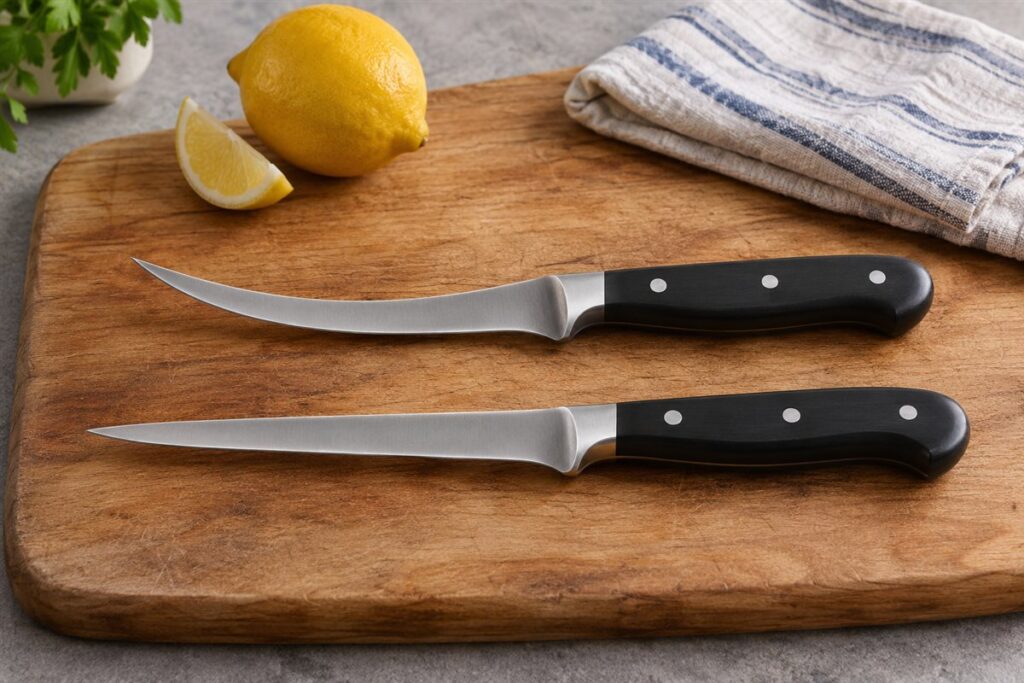
A boning knife has a narrow, pointed blade for cutting meat away from bone, trimming fat and removing skin. The main choice is between a flexible blade and a stiffer one. Your decision should follow the type of meat you work with most. The sections below add a worked walkthrough, realistic scenarios, a troubleshooting table and a glossary.
Flexible or Stiff Blade
A flexible blade bends to follow curves, which suits fish and poultry. A stiff blade offers more control and power for pork, beef and thicker joints. Many cooks find a semi-flexible blade a good middle ground. Compare the descriptions carefully, since makers use different words for flexibility.
Features at a Glance
| Feature | Why it matters | What to check |
|---|---|---|
| Blade length | Short blades give control, longer ones reach farther | Five to six inches is common for home use |
| Flexibility | Changes how the blade follows bones | Match to poultry, fish or red meat |
| Tip shape | A sharp tip helps around joints | Check that it is pointed but not fragile |
| Handle texture | Grease and water make hands slippery | Look for a grippy, textured handle |
| Guard | Keeps fingers from sliding onto the blade | Look at the handle shape |
Using It Carefully
- Chill the meat so it stays firm, but let it sit on the board without wobbling.
- Use a cutting board with a damp cloth under it to stop it moving.
- Hold the knife firmly, with your other hand clear of the blade path.
- Follow the bone with the tip and use short strokes instead of forcing the blade.
- Wipe the blade and board as you go, and keep the knife edge away from your body.
- Wash by hand, dry right away and store it with a guard or in a block.
Sharp blades can cause serious cuts. Follow the maker’s instructions and use common sense, particularly with wet hands.
Keeping It Sharp
A sharp edge needs less force, which makes slips less likely. Use a honing steel often and sharpen as the maker advises. Thin, flexible blades are easy to damage on bone, so cut around bones rather than through them.
Honing and sharpening are different jobs. A honing rod realigns an edge that has bent slightly in use, and it can be done before each session. Sharpening removes a little metal to create a new edge, and it is needed far less often. Because a boning blade is narrow and thin, avoid heavy grinding; follow the maker’s advice, or use a sharpening service if you are unsure. A knife that has been dulled by bone contact will tear the meat and tempt you to push harder, which is exactly when slips happen.
Think about how often you will use it. If you buy whole chickens, break down roasts or fillet fish, a boning knife earns its space and speeds up the work. If you mostly buy boneless cuts, a good chef’s knife and a paring knife may be enough. Cooks who butcher at home often keep a separate cutting board for raw meat, and wash it right after use. Choose a handle that is comfortable when wet, since grease makes smooth handles slippery.
Worked Example: Boning a Chicken Thigh
A bone-in thigh is a good way to learn the knife’s movements. The steps below describe a general approach; the maker’s guide and a trusted butchery source will add detail.
- Set a clean board on a damp cloth and place the thigh skin side down, so the bone is facing you.
- Locate the long bone with your fingertips. Make a shallow cut along its length, letting the tip of the knife ride against the bone, not cutting deeply into the meat.
- Run the tip along both sides of the bone with short, gentle strokes, keeping the blade angled toward the bone and away from your hand.
- Work around the joint at each end by turning the point of the blade and scraping the meat free in small movements.
- Lift the bone out once it is freed. Trim any gristle or excess fat with the tip.
- Cook the meat according to food-safety guidance for poultry, wash the board, knife and your hands with hot soapy water straight after handling raw meat, and keep raw meat away from ready-to-eat foods.
Common Scenarios
Breaking down whole chickens
A flexible blade follows the curves around the breastbone and wing joints. Keep the blade tip pointed toward the bone and away from your hand.
Trimming a roast
A stiffer blade gives the control to remove silver skin and excess fat in long, steady strokes. Chilled meat holds its shape better.
Skinning and filleting fish
A thin, flexible blade slides along the backbone and under the skin. Some cooks prefer a dedicated fillet knife for this, so check which suits your habits.
Occasional use at home
If you only bone meat a few times a year, a sharp utility knife or chef’s knife may be enough. A boning knife is mainly worth it if you do this task regularly.
Mistakes to Avoid
- Cutting toward your hand or holding the meat in front of the blade. A slip sends the edge directly at your fingers.
- Using a flexible blade to pry or twist. Thin blades can snap or bend at the tip.
- Working on a slippery board. The board should not slide during a cut.
- Putting the knife in a sink of soapy water. A hidden blade is a hazard to the next person who reaches in.
- Storing the knife damp. Moisture dulls and can mark a blade over time.
Quick Troubleshooting
| Symptom | Likely cause | What to try |
|---|---|---|
| Blade tears the meat | Dull edge or too much force | Hone and sharpen as the maker advises and use lighter strokes |
| Knife slips on the handle | Grease or water on the grip | Dry your hand, wipe the handle often and consider a grippier handle |
| Meat is hard to cut around joints | Blade too long or too stiff for the cut | Use a shorter or more flexible knife |
| Tip has chipped | Contact with hard bone | Cut around bones, and contact the maker or a sharpening service for repair |
Glossary
- Boning: Removing bones from meat, poultry or fish.
- Silver skin: A thin, shiny membrane on some cuts that is usually trimmed away.
- Honing: Realigning the edge on a rod, which is different from sharpening.
- Tang: The part of the blade that extends into the handle.
- Bolster: The thick junction between blade and handle that can act as a guard.
FAQ
Can a chef’s knife do the job?
Often yes for simple trimming, but the narrow point of a boning knife gives better control near bones.
Do I need one for fish?
A flexible one is helpful, but some cooks use a separate fillet knife.
What length should I choose?
Shorter blades are easier to control in tight spaces, while longer blades suit larger cuts. Choose the length you can hold comfortably and control precisely.
Is a curved blade better?
A slight curve can help follow the shape of a bone, while a straight blade suits push cuts and trimming. Neither is wrong, so go with the shape that feels natural to you.
How do I wash it safely?
Wash by hand, holding the spine side toward your palm and wiping away from the edge. Dry it right away and put it in a block or sheath.
The Short Version
Choose a flexible boning knife for fish and poultry and a stiffer one for heavier meats. Look for a grippy handle, keep the edge sharp and cut with care, always away from your hands.