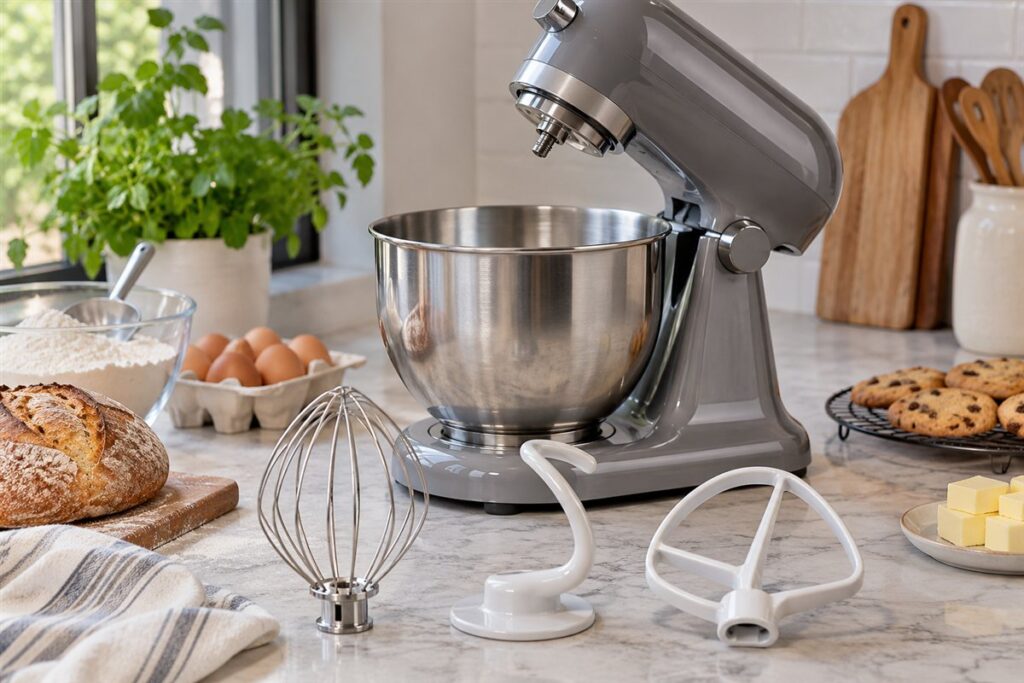
To choose a stand mixer, begin with how much dough and batter you usually make, then match that to bowl capacity, motor strength and the design of the head. Tilt-head models suit most home bakers, while bowl-lift models are built for heavier, larger batches. This guide covers the main decisions, a worked sizing example, everyday scenarios and the upkeep that keeps a mixer reliable.
Be Honest About How You Bake
A mixer that gets used weekly for bread has different needs from one that comes out twice a year for cakes. Think about your typical recipe: a single batch of cookies, a double batch of bread dough, or whipped cream for a crowd. Write down the largest batch you make, because that decides the bowl size you need.
Decision Criteria
| Factor | Why it matters | What to check |
|---|---|---|
| Bowl capacity | Limits how much dough or batter you can mix | Quarts listed by the maker and the recipe volume you need |
| Head design | Affects access to the bowl and stability | Tilt-head for easy access, bowl-lift for sturdier heavy mixing |
| Motor power | Heavy dough strains weak motors | The maker’s guidance on maximum dough amounts |
| Speed range | Gentle stirring to fast whipping | A low speed that does not fling flour |
| Attachments | Decide what the mixer can do | Flat beater, whisk and dough hook; any attachment hub |
| Footprint | Mixers are heavy and tall | Counter space and cabinet height |
| Bowl material | Affects weight, cleaning and chilling | Stainless steel or glass; dishwasher guidance |
Tilt-Head or Bowl-Lift
A tilt-head mixer raises the motor head so you can add ingredients and swap bowls easily. It is usually lighter and fits under many cabinets. A bowl-lift mixer holds the head fixed and raises the bowl on arms, which gives a more rigid structure for stiff dough. If you make bread often or in large batches, that rigidity helps, though these mixers are heavier and taller.
Motor, Gearing and Stability
Motor figures on their own say little about how a mixer handles dough. The gears that transfer power, the weight of the base and the way the head locks all affect how steady the machine is under load. A heavier base resists the pulling and shaking of kneading, and a locked head keeps the beater at a constant height above the bowl. When a maker lists maximum dough amounts, treat them as the real guide to strength, and give yourself some margin. Running a mixer close to its limit every week is harder on it than occasional heavy use. If you mainly make cakes and cookies, you will rarely stress the motor, and a lighter machine is a perfectly sound choice.
Attachments and Extras
- A flat beater for cakes and cookie dough.
- A wire whisk for cream and egg whites.
- A dough hook for bread.
- A pouring shield, which keeps flour in the bowl.
- A hub for optional add-ons such as pasta rollers or food grinders, if you will use them.
Read the maker’s manual for safe use, including how to keep fingers and utensils away from moving parts, and unplug the machine before changing attachments.
A Worked Example: Sizing for Your Biggest Batch
- Identify the largest recipe you make. Suppose it is a bread dough that calls for a certain weight of flour.
- Find the maker’s limit. The guide usually gives a maximum flour or dough amount for the dough hook. Use that, not the bowl volume alone.
- Compare. If your recipe is close to the limit, choose a stronger or larger model, because running at the limit all the time wears the machine.
- Check the bowl for light mixtures. Whipped cream and egg whites expand, so allow extra room beyond the initial volume.
- Consider the batch you may make later. A holiday double batch may need a larger bowl than weeknight baking.
- Check the space. Measure height with the head raised, and find out where the mixer will live.
Common Scenarios
Occasional baker making cakes and cookies
A tilt-head with a medium bowl does the job. It is lighter to lift and easy to access.
Weekly bread baker
A bowl-lift or a strong tilt-head with a clear dough limit suits stiff mixtures. Look for stability on the counter during kneading.
Cook who wants a multi-use tool
A model with an attachment hub gives access to pasta rollers, grinders and other add-ons. Only buy attachments you will use.
Small kitchen with low cabinets
Measure the height with the head raised, because a tall mixer may not clear a wall cabinet when open.
Mistakes to Avoid
- Buying by bowl size alone. A big bowl on a weak motor cannot knead heavy dough.
- Overloading the dough hook. Exceeding the maker’s limit strains the motor and gears.
- Beginning on a high speed. Flour and splashes fly out, so bring the speed up gradually.
- Forgetting to scrape the bowl. Unmixed pockets of flour or butter hide at the base and sides.
- Leaving it plugged in while changing tools. Unplug first to prevent accidental switching on.
Care and Upkeep
Wipe the body with a damp cloth, avoiding the vents and attachment hub, and never submerge the base. Wash the bowl and beaters according to the maker’s guide, since some coated attachments are not meant for the dishwasher. Dry the attachment hub area, and keep the bowl-lift or tilt mechanism free of dried batter. If the machine changes sound or the head wobbles, stop and check the manual. A cover or a clear spot on the counter keeps dust off.
Quick Troubleshooting
| Symptom | Likely cause | What to try |
|---|---|---|
| Beater hits the bowl | Clearance off or loose bowl | Reseat the bowl and check the maker’s adjustment advice |
| Mixer walks on the counter | Heavy dough and light base | Reduce the load and use a non-slip mat |
| Unmixed pockets at the base | Beater too high or bowl not scraped | Stop and scrape the bowl, then continue |
| Motor slows or hums | Overloaded dough | Divide the dough and mix in two batches |
| Flour flies out | Speed too high at the beginning | Use a low speed and a pouring shield |
Glossary
- Tilt-head: a mixer whose head lifts back on a hinge.
- Bowl-lift: a mixer where the bowl is raised on arms.
- Flat beater: the paddle used for batters and creaming.
- Dough hook: the spiral tool used for kneading.
- Attachment hub: the port that accepts optional accessories.
- Creaming: beating butter and sugar until light and airy.
FAQ
Do I need a stand mixer if I own a hand mixer?
Not always. A hand mixer is fine for light batters. A stand mixer frees your hands and handles thick dough better.
How do I know whether the bowl is big enough?
Compare the quarts to your biggest recipe. Doughs need more room than batters, so check the maker’s maximum for bread dough.
Is more wattage always better?
Not necessarily. Gearing and build affect how well a motor handles dough, so use the maker’s dough limits as the guide rather than a single number.
Can I knead small batches in a big mixer?
Often poorly, because the hook may not reach a small amount of dough. Check the manual for minimum amounts.
How long should a mixer last?
That depends on the build and use. Staying within the maker’s limits and cleaning it properly are the best ways to extend its life.
The Short Version
Choose a tilt-head for general baking and a bowl-lift for large, stiff doughs. Match bowl capacity and motor guidance to your biggest batch, and check the attachments you will actually use. Follow the maker’s dough limits and unplug before changing tools.