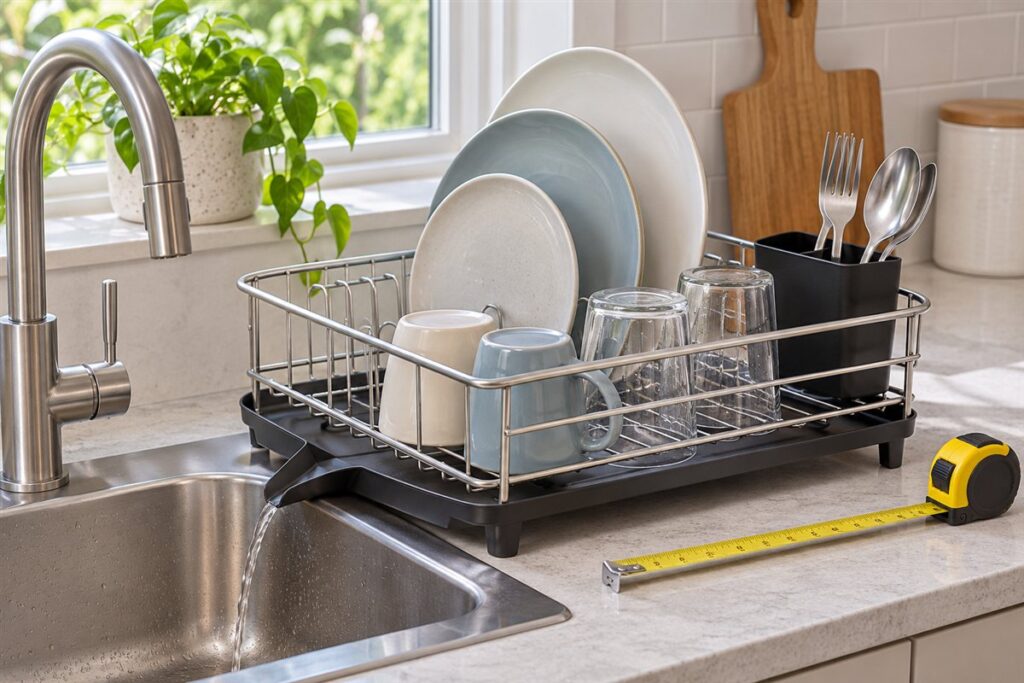
The best dish rack is the one that fits your sink area, drains water back to the basin and holds the amount of dishes you wash by hand. Begin by measuring the space, then compare drainage, material and layout. The steps below make it simple.
Step 1: Measure Your Space
- Measure the free width and depth of the counter beside your sink.
- If you are considering an over-sink rack, measure the sink opening and the height to the tap.
- Note how much of the counter you can give up when the rack is in use.
- Think about whether you want the rack out all the time or stored away.
Step 2: Choose a Style
| Style | Good for | Keep in mind |
|---|---|---|
| Countertop with tray | Most kitchens | Uses counter space, needs emptying or draining |
| Over-sink | Small counters | Must fit your sink width, may block tap use |
| Roll-up mat | Very small spaces | Holds fewer dishes |
| Foldable | Occasional use | Check sturdiness when open |
| Multi-tier | Large households | Taller, may need cabinet clearance |
Step 3: Check Drainage
Water that pools under dishes can lead to stains and smells. Look for a tray with a slope and a spout that sends water into the sink. Some racks have a swivel spout, which suits different sink positions. Without drainage, you will need to empty the tray by hand.
Step 4: Consider Material and Care
- Stainless steel: Strong and resistant to rust, as stated by makers, but can show water spots.
- Coated steel: Smooth finish. Chips in the coating can expose metal, so check it over time.
- Plastic: Light and easy to wipe, though it can discolor or sag.
- Bamboo or wood: Looks good, but needs thorough drying.
Wipe the rack and tray regularly, and wash them with warm soapy water. Check the maker’s guide for dishwasher use.
Step 5: Look at the Layout
- A plate section with sturdy slots holds dishes upright.
- A cup holder keeps glasses off the tray.
- A utensil caddy with drain holes dries forks and spoons.
- A knife slot should keep blades safely upright, with handles up. Follow the knife maker’s safety advice.
A Worked Example: A Two-Person Kitchen
Consider two people who wash by hand most evenings, with a counter of modest depth beside a single-bowl sink.
- Count what you wash on a normal evening. Four plates, four bowls, a few glasses, a pan and utensils is a typical load for two. List what must stand upright and what can lie flat.
- Measure the counter beside the sink and write down the width and depth you can spare. Check the height under any wall cabinet.
- Choose a style to match. A countertop rack with a sloped tray and spout suits this space. If the counter is too shallow, consider an over-sink model and measure the sink opening.
- Check the spout direction. It must reach the sink basin when the rack is in its usual place, or water will end up on the counter.
- Check the plate slots. They should hold your largest plate and your bowls without leaning.
- Decide on the cutlery cup. It should sit where you can reach it and have holes so water drains.
Common Scenarios
Small apartment, tiny counter
An over-sink rack or a roll-up mat saves counter space. Check the sink width and the clearance for the tap and a pan.
A big household
A multi-tier rack or a large countertop model gives space for many items at once. Check its height against wall cabinets.
Occasional hand washing
A foldable rack or a mat that tucks away between uses makes more sense than a permanent one.
A kitchen with a dishwasher
You may need only a small rack for pots, knives and delicate items. A compact tray with a spout is enough.
Mistakes to Avoid
- Buying without measuring. A rack that blocks the tap or hangs over the edge is annoying to use.
- Ignoring the drainage route. Water spilling on the counter can damage surfaces and spread smells.
- Overloading. Stacking too many items blocks airflow, so dishes stay wet and may slide.
- Putting knives in loose. A blade lying in a rack is a hazard, so store it upright with the handle up or dry it by hand.
- Leaving it wet for days. Moisture leads to film, mildew and spots.
Keeping It Fresh
Empty the tray each day and wipe the rack so soap film and mineral spots do not build up. Once a week, wash the whole set with warm soapy water. If you see rust spots or a flaking coating, replace the rack.
A Short Buying Checklist
- Measure the counter, the sink opening and the height under cabinets.
- Count the plates, bowls and cups you wash on a normal day.
- Check that the spout reaches the sink and that the tray slopes toward it.
- Look at the feet, which should hold the rack steady on a wet counter.
- Read the maker’s care notes on materials and the dishwasher.
- Think about where the rack will go when it is not in use.
Take a moment to picture the rack full of your own dishes. If the tallest plate or the largest bowl will not stand in a slot, or if cups will not tilt to drain, the rack is the wrong shape for your kitchen, however well it fits the counter.
Quick Troubleshooting
| Symptom | Likely cause | What to try |
|---|---|---|
| Water pools in the tray | Spout blocked or tray tilted the wrong way | Clear the spout and check the rack’s orientation |
| Dishes stay wet | Crowding or poor airflow | Space items out and tilt cups and bowls |
| White marks on metal | Mineral deposits | Wipe with diluted white vinegar and dry |
| Musty smell | Damp tray or mildew | Wash thoroughly and dry before reuse |
| Rack slides | Smooth feet on a wet counter | Dry the counter or add non-slip feet |
Short Glossary
- Drip tray: The shallow base that catches runoff.
- Swivel spout: A movable outlet that directs water into the sink.
- Over-sink: A rack that spans the sink opening.
- Limescale: A chalky mineral film left by hard water.
- Utensil caddy: A holder for cutlery with drain holes.
- Tier: A level in a multi-level rack.
FAQ
Is a dish rack sanitary?
Keep it clean and dry, empty the tray often and let dishes dry fully. Follow local advice for kitchen hygiene.
Can I hang one on the wall?
Wall mounted racks exist. Check the weight limit and mounting instructions from the maker.
How big should a dish rack be?
Size it to the amount you wash in one session and the space you can spare. A rack that takes your largest plates upright, plus a place for cups and cutlery, covers most daily needs.
Is an over-sink rack better than a countertop one?
It depends on your layout. Over-sink racks free counter space but need enough sink width and clear tap access. Countertop styles are easier to move but use counter space.
How often should I clean the rack?
Empty and wipe it daily, and wash it fully every week or so. Wash sooner if you notice film, spots or a smell.
The Short Version
Measure first, then choose a style that fits your sink and counter. Look for sloped drainage, a sturdy build and a layout that matches your dishes. Clean it regularly, and keep knives upright or out of the rack.