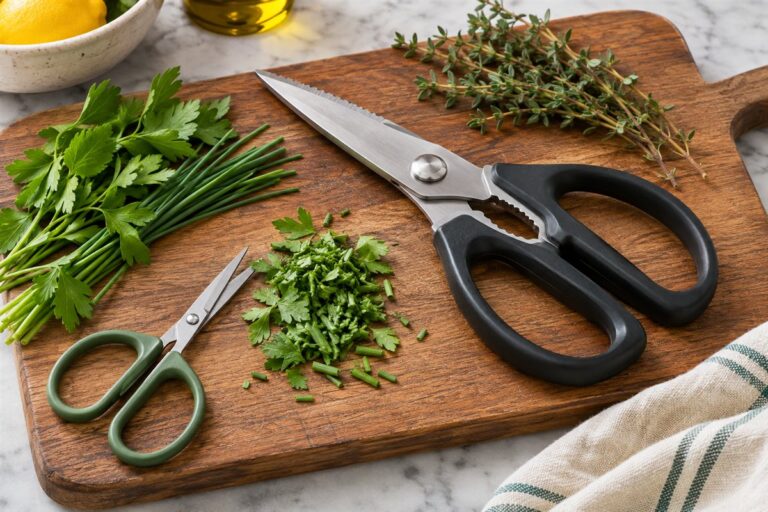
Kitchen shears are one of the most used tools in the drawer. They snip herbs, trim poultry, open packaging and cut pizza or bacon, all without a board. The best kitchen shears for everyday use are sharp, comfortable and easy to clean, often with blades that come apart.
The six pairs below cover come-apart designs, herb-friendly blades and sturdy general-purpose models from known makers. We have not used these products ourselves, so please confirm sizes, finishes and details on the current listing before you buy. Blade length and material claims are the makers’ own, and the dishwasher advice is best read in the manual.
As an Amazon Associate we earn from qualifying purchases. Links below are affiliate links, and they do not change the product information we give.
What to Look For
| Feature | Why it matters |
|---|---|
| Come-apart blades | Blades that separate are easier to clean thoroughly |
| Handle comfort | Soft or wide handles reduce hand strain |
| Blade strength | Stainless steel blades resist rust and stay sharp |
| Extra features | A bottle opener or nut cracker is handy but not essential |
| Left-hand use | Check whether the handles suit both hands |
In this guide
Specs at a Glance
| Shears | Blade | Handle | Notes |
|---|---|---|---|
| OXO Good Grips Kitchen and Herb Scissors | Stainless steel | Soft, non-slip | Herb comb; check the version |
| KitchenAid all-purpose shears | Stainless steel | Plastic or steel handle | Comes with a sheath |
| Wusthof Come-Apart shears | Stainless steel | Plastic handle | Separates for cleaning |
| Shun multi-purpose shears | Stainless steel | Textured handle | Come-apart; check the version |
| Fiskars kitchen shears | Stainless steel | Soft-grip handle | Check the version |
| Zwilling Pro shears | Stainless steel | Plastic handle | Check the version |
The 6 Best Kitchen Shears for Everyday Use

Top pickBest for herbs and light jobs
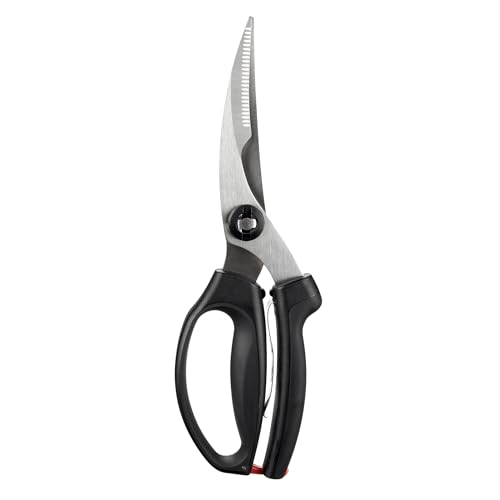
1. OXO Good Grips Kitchen and Herb Scissors
Scissors with a soft, non-slip handle and a design for herbs and general kitchen work. The come-apart feature or herb comb varies by version, so check the listing. It is a friendly pick for daily snipping.
Suits: herbs and light jobs. Strengths: a comfortable handle and an easy-clean design. Weaknesses: not as tough as heavy poultry shears. Skip it if you cut bones regularly.


Best for general jobs
2. KitchenAid All Purpose Kitchen Shears
A general-purpose pair that comes with a protective sheath. It handles many daily tasks and is easy to store in a drawer, which makes it a handy first pair for a new kitchen. Check the listing for the blade details.
Suits: general jobs. Strengths: a sheath and a familiar brand. Weaknesses: less specialized features. Skip it if you want a come-apart design.
Best for poultry and meat prep
3. Wusthof Come-Apart Kitchen Shears
A German-made pair that separates into two halves for cleaning. A good choice if you use shears on poultry and raw meat. The sturdy handles give leverage, and the split design makes it simple to rinse every surface.
Suits: poultry and meat prep. Strengths: blades that come apart and sturdy construction. Weaknesses: a premium-leaning range. Skip it if you want a basic pair.
View Wusthof Come-Apart Shears on Amazon
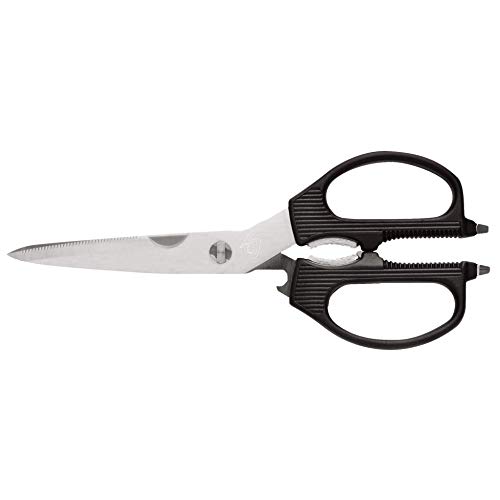
Best for cooks who like fine blades
4. Shun Multi-Purpose Shears
A Japanese-style pair that comes apart for cleaning, from a maker known for sharp knives. It handles many everyday cuts, from herbs to packaging to cooked meat. Check the listing for the handle style and care advice.
Suits: cooks who like fine blades. Strengths: sharp edges and a premium feel. Weaknesses: a premium-leaning range. Skip it if you want a plain pair.
Best for lasting everyday jobs
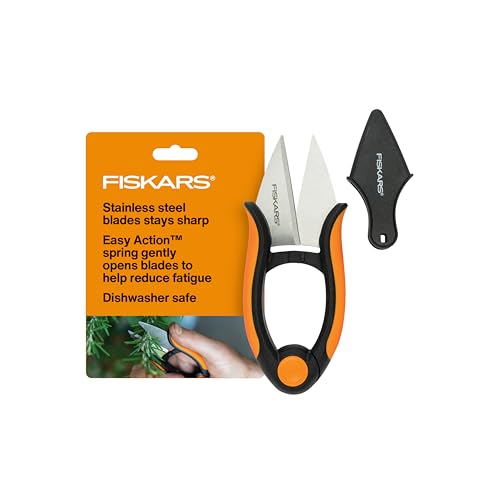
5. Fiskars Kitchen Shears
A sturdy pair from a company with a long history in scissors. The soft-grip handle suits long jobs, and the blades are meant for general use such as packaging, string and food. It is a good back-up pair for the drawer.
Suits: lasting everyday jobs. Strengths: a long scissor heritage and a comfortable grip. Weaknesses: not always come-apart. Skip it if you want a Japanese-style edge.
View Fiskars Kitchen Shears on Amazon
Best for heavy kitchen tasks
6. Zwilling Pro Kitchen Shears
A heavy-duty pair from a major cutlery maker. The strong blades are meant for poultry, packaging and other tasks, and the weight gives you leverage for tougher jobs. Check the listing for the care instructions.
Suits: heavy kitchen tasks. Strengths: strong blades and a solid feel. Weaknesses: a bulkier feel. Skip it if you mostly snip herbs.
View Zwilling Pro Shears on Amazon
Care and Setup
- Take apart come-apart shears and wash both halves after cutting raw meat.
- Dry the blades fully to prevent rust.
- Oil the pivot lightly if it feels stiff.
- Store with the blades closed or in a sheath.
Mistakes to Avoid
- Cutting wire or bone with light-duty shears.
- Putting non-dishwasher-safe shears in the dishwasher.
- Leaving raw meat residue between the blades.
- Storing shears loose in a drawer.
The Everyday Jobs Kitchen Shears Handle
Many cooks reach for shears before a knife, because they work without a board and without much cleanup. Common jobs include snipping herbs straight into a pot, trimming fat from meat, cutting bacon or pizza, cutting up dried fruit, trimming flower stems for the table, and opening packaging. Poultry work is another strong suit: shears cut through skin and thin joints more easily than a knife.
Think about which of those you do. If you mostly snip herbs and open packages, a lightweight pair with sharp, fine blades is enough. If you often cut up raw chicken, you will want sturdier blades, strong handles and ideally a design that comes apart for washing. If you will use them in several ways, a general-purpose pair is a good compromise.
- Light duty: herbs, packaging, string and paper.
- General purpose: poultry, bacon, pizza and vegetables.
- Heavy duty: small bones and tough joints, only if the maker says it is intended.
Be careful with what shears are not meant to do. Cutting wire, hard bone or metal can chip the blades and loosen the pivot. Keep a separate pair of ordinary scissors for craft and non-food jobs, so that your kitchen shears stay clean and sharp.
Blade Edges, Pivot and Cutting Action
Good shears cut cleanly all the way from the heel of the blade to the tip. Two features create this: a sharp edge and a tight, smooth pivot. If the pivot is loose, the blades push material apart instead of shearing it, and you will see food caught between them. If it is too tight, the shears feel stiff and tire your hand.
Blade edges come in two main types. A smooth edge slices cleanly through herbs and soft foods. A micro-serrated edge grips slippery items like chicken skin and fish, and stays effective longer for some uses, but it can be harder to sharpen at home. Some shears have a notched section near the pivot for gripping bones or twisting off jar lids, though the details vary and the claims belong to the makers.
Blade length matters. Longer blades cut more in one pass but can feel unwieldy for small jobs, while shorter blades give precision. Check the listing for the blade length overall and the handle design. A spring between the handles that opens the blades automatically can reduce hand fatigue on repeated cuts, but it also adds a part that may need cleaning. A locking mechanism keeps the shears closed in a drawer, which is a useful safety feature.
Handles, Hand Size and Left-Hand Use
Because you grip shears and squeeze repeatedly, handle shape deserves attention. Look for handles large enough for your fingers without pinching, with a soft or textured grip that stays secure when wet. Handles that are too small make you squeeze harder and tire faster, while very large ones can reduce control.
Left-handed users should check carefully. Many shears are shaped for right-handed use, and using them in the left hand can make the blades push apart instead of together, reducing cutting power. Some models have symmetrical handles that work for either hand, and a few are made specifically for left-handed users. The listing should say, but if it does not, ask the seller.
- Check that the handle loops are comfortable with your fingers wrapped around them.
- Look for a handle design with a finger rest or a textured thumb area.
- Consider weight; heavier shears feel solid but can be tiring for long tasks.
If you have arthritis or limited grip strength, spring-assisted shears and soft, wide handles may be easier to use. You may also want to try shears in a shop first if you can, because comfort is personal and difficult to judge from specifications.
Cleaning and Food Safety With Shears
Shears get used on raw meat and ready-to-eat food, which means cleaning is a food-safety matter. Raw poultry can leave residue between the blades and around the pivot, where a quick rinse does not reach. Come-apart shears, where the blades separate, allow you to wash both halves fully, which is the main reason people like them. If your shears do not separate, open them fully and scrub between the blades with a brush and hot soapy water, paying attention to the pivot area.
Use separate shears for raw meat and for herbs if you can, or wash them thoroughly between uses. Dry them completely, because moisture trapped in the pivot can lead to rust. A drop of food-safe oil on the pivot now and then, if the maker approves, keeps the action smooth.
- Follow the maker’s guidance on the dishwasher. Hand washing generally keeps edges sharper and handles in better shape.
- Rinse off acidic foods like citrus promptly.
- Store the shears closed, or in a sheath or block, so the blades do not get damaged and nobody gets cut.
Check for nicks or loose parts regularly. A damaged blade can harbor bacteria in crevices and should be replaced.
Sharpening, Maintenance and Replacement Signs
Dull shears crush and tear rather than cut, so they are more dangerous because you need more force. Many shears can be sharpened with a tool made for scissors, or by a professional service. Use a method suited to the blade type and follow the maker’s guidance, because a poor sharpening job can ruin the edge angle. Micro-serrated blades are often best left to the maker or a specialist.
Between sharpenings, keep the pivot clean and adjusted. If the screw is adjustable, snug it until the blades meet cleanly without binding. If it is riveted, you cannot adjust it, so a loose pivot means replacement.
Replace the shears if you notice:
- The blades no longer meet along their whole length, even after cleaning and adjusting.
- Chips or nicks that cannot be sharpened away.
- Rust that pits the metal, or a handle that has cracked or come loose.
- A pivot that grinds or feels gritty.
When choosing a replacement, think about what failed. If the handles tired you, look at ergonomics. If cleaning was a pain, prefer come-apart. Budget-conscious buyers can start with a simple pair, while those who use shears daily may prefer a sturdier build. Check the warranty on the listing.
What Kitchen Shears Do Better Than a Knife
Kitchen shears are scissors built for food and food packaging. They shine at jobs where a knife is awkward: snipping herbs straight into a dish, cutting through the joints of a chicken, trimming fat, cutting pizza and opening stubborn packages. They also reduce the use of a cutting board, which means fewer dishes. Understanding where they fit helps you pick a pair that suits your habits.
- Cutting up poultry and trimming joints.
- Snipping herbs, chives and scallions.
- Cutting bacon, dried fruit and soft cheeses.
- Trimming pastry, parchment and string.
- Opening packaging, bags and sealed pouches.
Not every pair handles every job. A heavy-duty pair may be better for poultry, while a lighter pair suits herbs and general use.
Come-Apart and Fixed Designs Compared
| Design | Strengths | Trade-offs |
|---|---|---|
| Come-apart blades | Easy to clean thoroughly, the blades separate at the pivot | Reassembly takes a moment; check the lock |
| Fixed blades | Simple, no loose parts | Harder to clean around the pivot |
| Multi-purpose with bottle opener or nutcracker | Extra functions | More features can mean more crevices |
Because shears touch raw foods, being able to open them for cleaning is a real advantage. Look for blades that come apart cleanly and go back together without wobble.
Handles, Grip and Left-Handed Use
Handles decide how comfortable shears are over repeated cuts. Large loops suit bigger hands and gloves, while smaller loops suit smaller hands. Soft grips reduce pressure on the fingers, and a notch or a spring can help the blades open after each cut. If you are left-handed, check whether the shears are symmetrical or designed for right hands, because the blade alignment affects cutting performance.
- Hold the shears and open and close them a few times.
- Check the handle fit with wet or greasy hands.
- Look for a locking mechanism if you store them in a drawer.
- Check the weight and balance.
- Consider whether a bone notch is useful for poultry.
Food Safety and Cleaning
Shears used on raw meat or poultry need thorough cleaning before they touch other foods. Follow official food safety guidance, and wash them in hot soapy water, paying attention to the pivot. If they come apart, separate the blades and wash each side. Check the maker’s instructions to see whether they are dishwasher safe, and dry them thoroughly to prevent rust. Keep a separate pair, or clean carefully between uses, if you cut raw meat and fresh herbs in the same session.
Storage and Sharpness
Store shears where the blades are protected, such as in a block slot, a drawer with a sheath or on a magnetic strip. Keep them out of reach of children. Dull shears squash food rather than cutting it, so look at the edge from time to time. Some shears can be sharpened with a method the maker describes, while others are best replaced when dull. Do not use shears for tasks they were not made for, such as cutting wire or thick plastic, which can damage the edge.
Blade Materials, Edges and Sharpening
Shear blades are usually stainless steel, sometimes with a serrated edge on one blade to grip slippery foods. A micro-serrated edge helps with poultry skin and herbs, while a smooth edge cuts cleanly through paper and string. Over time, the edges dull, and how you handle that depends on the design. Some shears can be sharpened by opening them fully and using a sharpening stone or by running them through a sharpener, if the maker approves. Others are intended to be replaced when dull.
- Check the maker’s guidance on sharpening before trying it.
- Avoid cutting hard materials, such as bones thicker than the shears are made for, wire or plastic.
- Wipe the blades dry after washing to prevent rust spots.
- Check the pivot screw if the shears feel loose, and tighten it only if the maker says it is adjustable.
- Oil the pivot lightly with a food-safe oil if the manual suggests it.
A properly cared for pair can last for many years, and one good pair can serve for years.
Handling and Safety Around the Kitchen
Shears are scissors, and they cut fingers as well as chicken. Keep fingers clear of the blades, cut away from your body and do not carry shears with the blades open. A locking mechanism or a sheath keeps them safe in a drawer. Keep them out of reach of children, and teach family members to hand them over handle first. If a pair has a plastic cover or a clip, use it when you store them.
After cutting raw poultry or meat, wash hands and the shears thoroughly before moving on to other foods. Follow official food safety guidance, and replace shears that have chips, loose parts or cracked handles that cannot be cleaned properly.
Choosing for Different Hands and Uses
Hand strength varies. People with arthritis or weaker grip may prefer shears with spring-assisted handles, large loops and soft grips, which reduce effort. Those with small hands may find a lightweight pair easier to control. Heavy-duty poultry shears have longer handles and stronger blades, which give more leverage but are bulkier. Consider whether a single pair can do all your jobs, or whether a light pair for herbs and a heavy pair for poultry would suit you better. Try them in the shop if you can, and check the return policy if you buy online.
Kitchen Shears FAQ
Are come-apart shears worth it?
Yes, because you can clean between the blades after raw meat.
Can I put shears in the dishwasher?
Check the maker’s guidance. Hand washing keeps edges sharper.
What can I cut with kitchen shears?
Herbs, poultry, bacon, pizza and packaging, among other things.
How do I sharpen shears?
Use a sharpener meant for scissors, or ask a professional.
Can kitchen shears cut through chicken bones?
Some can cut thin poultry bones and joints, but not all. Check what the maker says about bones. Using light-duty shears on thick bone can damage the blades and the pivot.
What is the difference between kitchen shears and regular scissors?
Kitchen shears are made for food, with sturdier blades, food-safe materials and often come-apart or easy-clean designs. Regular scissors are built for paper and fabric and are harder to clean thoroughly.
Are shears with a spring easier to use?
A spring opens the blades after each cut, which reduces effort on repeated snips. It does add a part to keep clean, and some people prefer shears without one.
Why do my shears leave food stuck between the blades?
The pivot may be loose, the edge may be dull, or the blades may have residue built up. Clean thoroughly, adjust the pivot if possible, and sharpen if needed.
How do I stop the blades from rusting?
Dry them completely after washing, keep them away from standing water and store them closed in a dry place. A thin layer of food-safe oil on the pivot can help if the maker allows.
Can I use kitchen shears on herbs?
Yes, they are well suited for snipping herbs into dishes. Light, sharp blades give the cleanest cuts, and some shears include an herb comb or stripper. Wash them well afterward.
Are left-handed shears necessary?
Not always, but handle shape matters. If standard shears feel awkward or push the blades apart in your left hand, look for symmetrical handles or a left-handed model.
Start With Your Own Routine, Not the Product List
Every pick in this guide can do its job. The question that decides satisfaction is narrower: which one fits the way you actually work, in your space, with your habits, week after week? A kitchen shears lives in the utensil drawer or block, ready for daily cutting jobs around the kitchen, and it earns that place by making opening packaging, trimming herbs, cutting parchment, portioning poultry and doing the dozens of small cutting jobs that are awkward or wasteful with a knife feel easier rather than by winning a comparison on paper.
Before comparing models, spend a moment on honest observation. Watch yourself through one normal session and notice where you hesitate, improvise or work around a limitation. Those friction points, not the headline features, are what your purchase should fix. Shoppers who skip this step often buy for an imagined routine, then find the new item sits unused while the old workaround continues out of habit.
It also helps to name your priority order out loud. Is it comfort, speed, easy cleaning, compact storage, durability or appearance? No kitchen shears leads on every count, and a clear order turns a long list of similar options into a short decision. The sections below work through that decision in the order experienced buyers tend to make it: fit for the task first, then daily handling, then care, then the small frustrations that decide whether an item is still loved after a year.
The Jobs That Should Drive Your Choice
Rank these common jobs by how often you do them, and let the top two or three steer your choice of kitchen shears. A design that shines at a job you do twice a year, while struggling with the job you do every evening, is the wrong design for you however strong its reputation.
- Snipping chives, spring onions and soft herbs straight over the dish.
- Trimming fat, cutting up a chicken or portioning poultry for the pot.
- Cutting parchment or baking paper to fit a tin without tearing it.
- Opening packaging, cutting string and breaking down boxes for recycling.
- Trimming pastry, cutting pizza or flatbread, and portioning soft foods for children.
Notice, too, how these jobs interact. The same session often chains several of them together, so transitions matter: how quickly you can set up, adjust, clean mid-task or put the item away with wet or busy hands. In a real kitchen, that flow is worth as much as raw performance on any single job, and it is the part of ownership that listings describe least well.
Finally, consider who else shares the task. A second cook, a teenager learning to help, or an older relative with different strength and reach can change which design is safest and most comfortable. The best choice for a shared kitchen is usually the one that is forgiving for the least experienced user while still satisfying the main one.
Buying Criteria in More Depth
The opening checklist in this guide covers the basics. The points below go deeper on the details that separate a satisfactory kitchen shears from one you would buy again, and each one can be checked against a listing, a photo or a maker’s description before you order.
Come-apart cleaning versus fixed simplicity
Blades that separate let you wash the pivot area properly, which matters after poultry work, but they must rejoin with a firm, wobble-free action. Fixed shears are simpler and often sturdier in feel. Decide based on how often you cut raw meat, because that is the job that most rewards full separation.
Edge style for your common jobs
A micro-serrated edge grips slippery items such as poultry skin, string and packaging, while a smoother edge gives cleaner cuts on herbs and paper. Many everyday shears blend the two; think about which jobs you do weekly rather than occasionally.
Handle fit for your hand and grip strength
You will use these with wet, greasy or floury hands. Handles should be large enough for a full grip, shaped so they do not pinch, and textured or soft enough to hold when damp. If two people with different hand sizes share them, a generous, simple handle shape usually suits both.
Pivot tightness and cutting action
Good shears cut along the whole blade, including near the tips, without the blades splaying apart on thicker items. A pivot that can be tightened, or that is built to stay firm, keeps that action as the shears age.
Steel and corrosion habits
Shears live a wet life. Steel that resists staining, a design that dries easily at the pivot, and honest care guidance matter more than any claim about hardness. If you know you will sometimes leave them in the sink, choose the design most forgiving of that habit and then improve the habit anyway.
Taken together, these criteria reward designs that respect your time. Performance gets an item onto the shortlist, but handling, cleaning and storage decide whether it stays in daily use. When two picks seem equal, choose the one that is easier to live with on an ordinary tired evening, because that is when good design proves itself.
Which Style Suits Which Cook?
General advice only goes so far, so match yourself to the closest situation below. These are patterns drawn from how households actually use kitchen shears, and each one points to a different balance of strengths among the picks in this guide.
The everyday family cook
Your shears open packets, cut up food for children, trim herbs and portion the occasional chicken. A comfortable grip, a grippy edge and easy cleaning matter more than heavy-duty bone cutting, and a pair that lives in the drawer you open most will be used daily.
The keen poultry cook
Regular spatchcocking and jointing ask for strong blades, a secure pivot and handles that let you apply force without slipping. Come-apart cleaning becomes close to essential, because the pivot area meets raw poultry every time.
The baker and meal-prepper
Parchment, packaging, herbs and portioning cooked proteins dominate. A clean-cutting edge and precise tips matter more than raw power, and shears that double for opening flour bags and cutting liners will earn their drawer space.
A cook with weaker grip or smaller hands
Look for lighter shears with a comfortable, possibly spring-assisted action where available, and test the opening width against your comfortable reach. The right fit reduces fatigue far more than blade size increases it, especially across a long prep session.
If you recognise yourself in two situations, weight the one that describes your most frequent week rather than your most ambitious project. Kitchens reward equipment chosen for the ordinary pattern of life, with special projects handled by patience and technique when they arrive.
Common Frustrations and How to Fix Them
Most disappointment with kitchen shears comes from a handful of repeatable problems, and most of them have simple causes. Work through these before concluding that an item is faulty or that you chose badly.
The shears crush herbs instead of cutting them
Bruised herbs usually mean a dull or dirty edge, or cutting a bundle that is too thick at once. Clean and dry the blades, take smaller bunches, and keep the herbs dry, because wet leaves slide and fold rather than cut. Reserve a very sharp pair for herbs if you cut them daily.
Blades stick or feel gritty after poultry
Separate the blades if the design allows, wash the pivot faces individually with hot soapy water, and dry them fully before rejoining. Fat and residue trapped at the pivot are the usual cause, and they are also the reason come-apart designs exist.
The shears struggle with packaging and slip on plastic
Use the part of the blade nearest the pivot for tough packaging, where leverage is greatest, and keep the serrated section for slippery material. If the blades splay apart under pressure, the pivot may need tightening or the job may belong to a stronger pair.
Rust spots appear near the pivot
Dry shears thoroughly after washing, open them while they dry so the pivot faces air, and store them dry rather than in a damp utensil pot. Light surface marks can often be cleaned off as the maker directs; deep pitting means the pair is nearing replacement.
A useful habit is to change one thing at a time. Adjust the setup, the load, the placement or your technique, then test with the same task. Changing everything at once hides the cause, and you lose the lesson that would have made the next session easier.
Care Habits That Keep It Working Well
Longevity is mostly a care story. A kitchen shears that is cleaned promptly, dried properly and stored sensibly will outlast a neglected premium model, and it will feel better to use every single time. Build these habits into the routine the item belongs to, rather than treating them as separate chores.
- Wash shears promptly after raw meat or poultry, separating the blades where possible, and sanitise as you would any tool that touches raw protein.
- Dry the pivot area deliberately, because it is the last place to dry and the first place to corrode.
- Hone or sharpen only by methods the maker allows for that blade style, and never force shears through bone or frozen food they are not designed for.
- Store shears in a drawer insert, sheath or block slot where the edges cannot knock against knives and other tools.
- Tighten or adjust the pivot only as the maker directs, and stop using shears whose blades wobble, cross or no longer meet cleanly.
Care also includes attention. Once a month, look the item over properly: check moving parts, fasteners, surfaces and anything that flexes, heats, seals or bears weight, as relevant to the design. Small wear caught early is usually a cleaning or adjustment matter. The same wear ignored becomes the failure that people later blame on quality.
Sensible Safety, Without the Fuss
None of this is complicated, but it deserves a deliberate moment because kitchen accidents usually happen during familiar tasks done on autopilot. Keep these points in mind when you use kitchen shears, and share them with anyone else who uses yours.
- Cut away from your holding hand, keep fingers behind the handles, and never use shears to pry, lever or open tins and jars.
- Keep shears closed and stored out of children’s reach, and hand them to another person handle-first and closed.
- Do not use kitchen shears on frozen food, thick bone or wire unless the maker explicitly rates that pair for it.
- Wash and store shears immediately after poultry work so they are not left open in a sink where a hand can meet the blade unseen.
Safety and comfort are linked more than people expect. An item that fits your hand, your space and your strength is one you control without strain, and control is what keeps a routine task routine. If a design regularly forces an awkward grip, a stretch or a workaround, treat that as a safety signal as well as a comfort complaint.
Small Habits That Make a Big Difference
Keep shears in the drawer you open first, not in a block across the room. Shears are a convenience tool, and convenience tools only earn their name when they are closer than the knife they replace for small jobs.
Teach everyone in the household what the kitchen shears are for, and what they are not for. Most damage happens when a good pair is borrowed for wire, thick plastic or garden jobs it was never designed to cut.
A pair of shears makes portioning cooked food for children, older relatives or packed lunches quick and tidy, straight in the serving dish. That everyday usefulness, more than any heavy-duty claim, is why shears become indispensable.
When you replace a worn pair, keep the old one, clearly marked, for packaging and recycling duty if its blades are still sound. The new pair then stays clean and sharp for food, and the old pair absorbs the jobs that dull edges fastest.
Above all, give a new kitchen shears a fair settling-in period. The first session with any new tool feels unfamiliar, and unfamiliar is easily mistaken for worse. After several uses, when setup and handling have become automatic, you will know its real strengths and limits, and your judgement will be based on evidence rather than first impressions.
More Questions, Answered
What jobs should I give shears instead of a knife?
Give shears the jobs where a board is awkward or unnecessary: snipping herbs over the pan, trimming packaging, cutting parchment, portioning poultry and breaking down soft foods in the dish they cooked in. Keep the knife for clean slicing, heavy board work and anything needing a flat, controlled cut. Used this way, each tool does what it is genuinely better at.
How do I cut up a chicken safely with shears?
Work on a stable board, keep the bird dry enough to grip, and cut close to the pivot for power on joints and backbone. Follow the natural lines of the joints rather than forcing through thick bone, wash everything thoroughly afterwards, and stop if the shears flex or slip, because that is the tool telling you the job exceeds its design.
Are dishwasher cycles really bad for shears?
Heat, detergent and knocking against other items are hard on edges, handles and pivots, and many makers advise hand washing for exactly those reasons. Hand washing also forces the pivot area to be cleaned properly, which matters for food safety. If you do use a dishwasher for a pair rated for it, open and dry the pivot as soon as the cycle ends.
How can I tell when shears need sharpening or replacing?
Test on a piece of parchment or a herb stem: a good edge cuts cleanly along the whole blade, including the tips. Crushing, folding or needing several attempts means the edge or the pivot needs attention. Sharpen or service first if the maker supports it; replace when blades are pitted, the pivot will not stay firm, or the handles are cracked.
Should I keep two pairs of shears?
Many busy kitchens do: one pair reserved for raw meat and poultry, and one for herbs, packaging and cooked food. It simplifies food safety, keeps a clean pair always available during big cooking sessions, and lets each pair be chosen for its job. If you keep one pair, strict washing between raw and ready-to-eat jobs is the rule that makes it work.
What should I check in the first week with new shears?
Cut the range of your real jobs: herbs, parchment, packaging, cooked protein and, if it is in your routine, a chicken. Note grip comfort with wet hands, how the pivot cleans, and whether the tips cut cleanly. Those first impressions, across your actual work, tell you whether the pair suits your hand and your kitchen.
A Week of Real Use, Day by Day
It is easier to judge kitchen shears by a week than by a first impression. On the first day, everything is setup: finding the right spot, learning the controls or the feel, and noticing what your hands reach for automatically. Do not judge harshly on day one. Unfamiliarity slows everyone down, and the item is competing with habits built over years. What matters on day one is only whether anything is genuinely awkward, unsafe or ill-fitting, because those problems rarely improve with practice.
By the middle of the week, the real jobs arrive: snipping chives, spring onions and soft herbs straight over the dish, and trimming fat, cutting up a chicken or portioning poultry for the pot. This is where the details discussed earlier, such as come-apart cleaning versus fixed simplicity and edge style for your common jobs, stop being listing language and become your own experience. Notice how much attention the item demands. The best kitchen tools fade into the background while you think about the food, the paperwork or the people you are cooking for, and they only ask for attention at the moments that genuinely need it, such as a check, an adjustment or a clean.
Towards the end of the week comes the unglamorous test: opening packaging, cutting string and breaking down boxes for recycling, followed by putting everything away when you are tired. Clean-up and storage are where enthusiasm goes to die, and a kitchen shears that is pleasant to clean and easy to put away will still be in daily use months later, while a slightly more capable one that is a chore to wash will quietly migrate to the back of a cupboard. Weigh that end-of-day feeling heavily in your final judgement, because you will feel it hundreds of times.
The weekend usually brings the ambitious version of the routine: trimming pastry, cutting pizza or flatbread, and portioning soft foods for children. Treat that session as information rather than a verdict. If the item handles your biggest regular job with patience and sensible technique, it fits your life. If it only struggles on a job you do once a year, that is an acceptable trade, provided the everyday jobs feel effortless. Buying for the annual extreme at the expense of the weekly routine is one of the most common and most expensive mistakes in kitchen shopping.
A Simple Decision Worksheet
If you are still torn between two or three picks in this guide, work through these questions in writing. Short, honest answers reveal a preference that feature lists tend to hide, and they take less time than another round of reading listings.
- Which of my weekly jobs will this kitchen shears touch most often, and does this pick handle that job gracefully?
- Where exactly will it live, what are the measurements of that spot, and have I checked them against the listing?
- Who else will use it, and is it comfortable and safe in their hands as well as mine?
- What does cleaning it actually involve after my messiest regular task, and am I willing to do that every time?
- Which strength am I paying for that I may never use, and which everyday convenience am I giving up to get it?
- If it disappointed me in six months, what would the most likely reason be, and can I test for that reason now?
- Does it work with what I already own, in space, in style and in routine, or will it demand further purchases to make sense?
The last question on that list deserves emphasis. A kitchen shears does not exist alone; it joins a kitchen that already has a layout, a set of habits and a collection of other tools. The pick that cooperates with what you have, in size, in cleaning routine and in where it is stored, will almost always serve you better than a marginally stronger pick that fights your kitchen at every step.
When to Choose the Simpler Pick, and When to Step Up
Choose the simpler, lighter or more basic pick when your routine is occasional, your space is tight, or several people with different habits will share it. Simplicity is not a compromise in those situations; it is the feature that keeps the item in use. A straightforward kitchen shears that everyone understands, cleans without thinking and stores without a puzzle will outperform a sophisticated one that only one person in the house is willing to operate.
Step up to the more capable or more durable pick when the routine is frequent, the loads are genuinely demanding, or the item will be a fixture of your kitchen for years. Frequency changes the maths completely: a small daily advantage in comfort, speed or cleaning, multiplied by hundreds of uses, is worth far more than a dramatic advantage you will feel twice a year. That is also why keen cooks are right to prioritise handle fit for your hand and grip strength and pivot tightness and cutting action even when a basic model looks similar on paper.
Whichever direction you choose, keep the decision reversible where you can. Retain packaging until you have completed a full week of real use, keep receipts and warranty details together, and note the date you started using the item. Those small acts of organisation turn a purchase into a managed decision, and they make any later conversation with a seller or maker straightforward and factual.
The Short Version
For herbs and light jobs, the OXO Good Grips. For a sheath, the KitchenAid. For come-apart poultry work, the Wusthof. For fine blades, the Shun. For a scissor heritage, the Fiskars. For heavy tasks, the Zwilling Pro.