Tongs are the workhorse of the kitchen, handy for turning meat, serving salad and lifting pasta. A premium stainless steel tongs set gives you sturdy, rust-free arms, a reliable lock and tips that grip without slipping. Look for a set that includes more than one length if you cook at both the stove and the grill, since a single pair rarely suits every task.
The six options below cover single pairs and multi-length sets from established makers. We have not used these products ourselves, so please confirm sizes, finishes and details on the current listing before you buy. Lengths, finishes and tip materials vary, and non-stick pans usually need silicone tips.
As an Amazon Associate we earn from qualifying purchases. Links below are affiliate links, and they do not change the product information we give.
What to Look For
| Feature | Why it matters |
|---|---|
| Steel quality | Heavier gauge steel resists bending |
| Lock | A smooth lock keeps tongs closed in a drawer |
| Tip design | Scalloped edges grip food; silicone tips protect non-stick pans |
| Length | Longer tongs suit grills; shorter ones suit serving |
| Cleaning | Dishwasher-safe tongs are convenient, but hand washing keeps the finish |
In this guide
Specs at a Glance
| Tongs | Material | Lock | Notes |
|---|---|---|---|
| All-Clad locking tongs | Stainless steel | Locking | Premium build; check the length |
| OXO Good Grips stainless steel tongs | Stainless steel | Locking | Non-slip handles; check the length |
| Rosle locking tongs | Stainless steel | Locking | German-made; check the version |
| Winco utility tongs | Stainless steel | Locking | Food service staple |
| Zwilling Pro tongs | Stainless steel | Locking | Check the length |
| Cuisipro tongs | Stainless steel | Locking | Check the version |
The 6 Best Premium Stainless Steel Kitchen Tongs

Top pickBest for cooks who like fine tools
1. All-Clad Stainless Steel Locking Tongs
Polished stainless tongs from the cookware maker, with a smooth lock and a solid feel. A premium option for cooks who want matching gear, and the weight makes them feel steady when turning heavy cuts. Check the listing for the length and finish.
Suits: cooks who like fine tools. Strengths: a solid feel and a smooth lock. Weaknesses: a premium-leaning range. Skip it if you want a basic pair.


Best for everyday cooking
2. OXO Good Grips Stainless Steel Locking Tongs
Stainless steel tongs with non-slip grips and an easy lock. The brand is known for comfortable handles and dependable kitchen tools. Check the listing for the length and whether the tips are scalloped, since options vary.
Suits: everyday cooking. Strengths: a comfortable grip and a reliable lock. Weaknesses: handles are not all steel. Skip it if you want an all-metal tool.

Best for buyers who value design
3. Rosle Stainless Steel Locking Tongs
German-made stainless tongs known for their design and finish. A good fit for those who want a heritage kitchen brand, with a design that holds up to years of regular use. Check the listing for the length and finish.
Suits: buyers who value design. Strengths: a refined build and a smooth action. Weaknesses: a premium-leaning range. Skip it if you want something basic.
View Rosle Locking Tongs on Amazon
Best for heavy use
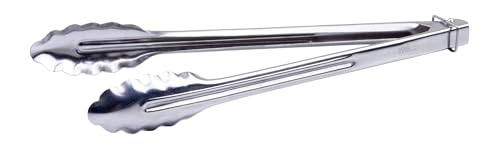
4. Winco Stainless Steel Utility Tongs
A food service staple in several lengths, valued for toughness rather than looks. Plain and rugged, and it is a good pick for large cookouts or batch cooking. Check the listing for the length and tip style.
Suits: heavy use. Strengths: a tough build and many lengths. Weaknesses: plain looks. Skip it if you want a polished finish.

Best for cooks who like matching tools
5. Zwilling Pro Stainless Steel Tongs
Stainless tongs from a major cutlery maker, with a firm grip and a classic style. The heft gives control when flipping steaks or lifting roasts. Check the listing for the length and finish.
Suits: cooks who like matching tools. Strengths: a firm hold and a refined look. Weaknesses: less colorful options. Skip it if you want silicone tips.
View Zwilling Pro Tongs on Amazon

Best for general cooking
6. Cuisipro Stainless Steel Tongs
Locking stainless tongs from a brand known for kitchen tools. Check the listing for the version and length. The lock helps keep the tongs tidy in a drawer, and the scalloped tips grip food with ease.
Suits: general cooking. Strengths: a locking design and a neat finish. Weaknesses: options vary. Skip it if you want a very long pair.

Care and Setup
- Wash and dry them after use to protect the finish.
- Check the maker’s guidance on the dishwasher.
- Oil the hinge if it feels stiff.
- Avoid scraping non-stick pans with steel tips.
Mistakes to Avoid
- Using steel tips on non-stick pans.
- Buying tongs too short for a grill.
- Letting the lock jam with food debris.
- Using tongs as a lever.
Steel Gauge, Spring Tension and Feel
The first thing you notice about a good pair of tongs is how they feel as you squeeze them. Premium tongs are made from heavier-gauge stainless steel, so the arms resist flexing when you lift a heavy steak or a full portion of pasta. Thin steel bends or twists under load, and the tips can fail to meet evenly, which makes picking up small items frustrating.
Spring tension is the other half of the feel. Tongs should open when released and close with moderate pressure. A spring that is too stiff tires your hand during long use, and one that is too weak will not hold food securely. Look for a smooth action with no sticking or grinding, and a pivot or scissor mechanism that is solid rather than loose.
- Check for a seam or spring design that is smooth and easy to clean.
- Consider whether the arms are one piece of metal or welded sections.
- Pick up a tong in a store if you can, and squeeze it a dozen times to feel the effort.
The listing may name the steel grade or the thickness, and these details are the maker’s. Look for clear information rather than vague terms like heavy duty. If the listing does not say, rely on the care and warranty information the maker gives.
Tip Shapes and Pan Compatibility
Tong tips determine how well food is gripped and what cookware you can use them on. Scalloped or serrated edges grip slippery foods and meat well. Flat tips are good for turning delicate fish or vegetables. Narrow, pointed tips can pick up small items like asparagus or tiny pieces, while wide, spoon-like tips serve salads and pasta.
Metal tips can scratch non-stick and enamel surfaces, so use tongs with silicone or nylon tips on those pans, or use a different tool. Stainless steel tips are the best choice for cast iron, stainless pans and grills, where scraping is not an issue. Some tongs come with removable silicone sleeves or tips, which gives you both options, but check that the sleeves stay secure and are rated for the heat you will use.
- Grilling: longer arms, sturdy tips and high heat tolerance.
- Stovetop and sautéing: medium length and a good grip on food.
- Serving: shorter tongs with broad, smooth tips.
If you buy a set, look at which tip styles are included, since a set with two identical pairs is less useful than one with different sizes and tip shapes. Check the listing for heat limits on any silicone components, and be aware that the stated limits are the maker’s own.
Locking Mechanisms and Storage
A locking mechanism keeps tongs closed, which is helpful in a crowded drawer. The common types include a sliding ring, a pull-down loop at the end of the arms, and a push-button or flip lock. Each has trade-offs. Sliding rings are simple and secure, but may slide open unexpectedly if loose. Loops are easy to use with one hand, but may catch on other tools. Push-button locks are quick but can stick if food debris gets in.
Test the lock for ease of use. You should be able to engage and release it with one hand, even with greasy fingers. A lock that is hard to operate will end up being ignored, and tongs that spring open in a drawer take up room and can snag other utensils.
Also consider storage options. Many tongs have a hole in the handle for hanging on a hook, which can free up drawer space. If you store them in a utensil crock, check the length so that they do not tip it over. For sets of different lengths, a drawer organizer with long compartments keeps them neat. Keep tongs away from knives and sharp edges that can scratch the finish, and make sure they are completely dry before storing.
Handle Comfort, Heat and Safety
Because tongs get used near flames and hot oil, handle design matters. Stainless steel conducts heat, so check how the handles stay cool. Some tongs have a long arm that keeps your hand away from the heat, and others have silicone or heat-resistant coverings on the grip area. A comfortable handle has a smooth surface, a non-slip texture and enough width to rest your fingers without pinching.
Length is important for safety. Longer tongs keep your hand away from flames and splatter, which suits grilling and frying. Shorter ones give more control and are easier to maneuver in a small pan. A common approach is to own two or three lengths to cover serving, cooking and grilling. Check the listing for the overall length, which may include the handle.
- Keep tongs away from direct flame beyond what the maker allows.
- Do not use them as a lever or hammer, which can bend or break the arms.
- Use caution with hot oil and steam; open the tongs away from your face when lifting food from hot liquid.
If your tongs have silicone-covered handles, check the heat limit and avoid leaving them resting on a hot grill or pan edge. Hand size also matters: if your hands are small, very wide or heavy tongs may feel awkward.
Care, Longevity and Signs of Wear
Premium stainless tongs can last for years with simple care. Wash them soon after use, especially after acidic or salty foods, and dry them completely to prevent spotting. Many are dishwasher-safe, but repeated cycles with harsh detergent can dull the finish or loosen a spring. Follow the maker’s guidance, and hand wash if in doubt.
Clean the hinge area where food collects. A small brush helps remove debris from the pivot and lock. If the hinge feels stiff, a drop of food-safe oil can help, as long as the maker allows. Avoid scouring pads that scratch the surface, since scratches can trap food and dull the look.
Signs of wear to watch for include:
- Arms that no longer meet evenly at the tips.
- A spring that has lost its tension or a pivot that has become loose.
- A lock that will not hold or sticks.
- Pitting, rust spots or sharp edges where the finish has worn away.
When deciding between a premium pair and a basic one, think about how often you use them. If you reach for tongs every day, a better build can be worth it. If you only use them occasionally, a simpler pair may do. Check the warranty on the listing and read the care notes, since the details differ by maker.
Choosing Tongs by Task: A Practical Checklist
Tongs seem simple, yet the right length, tip shape and spring tension change how the tool feels in your hand. Before picking a premium stainless steel set, think about the jobs you ask tongs to do.
- Grilling and barbecue: longer tongs keep your hand away from heat, and sturdy tips help turn heavier cuts.
- Stovetop searing and sauteing: medium tongs offer control over a hot pan and are easier to handle near the burner.
- Salad and serving: smaller tongs with smooth edges grip leaves and pasta without crushing them.
- Baking and toasting: short, fine-tipped tongs can lift small items.
- Nonstick cookware: check whether the tips have silicone or nylon coverings, since bare steel can scratch.
- Storage: look for locking mechanisms or hanging loops, and check where they fit in your drawer.
A set often includes several lengths, which makes sense for a kitchen with varied needs. If you cook mostly on the stovetop, a pair of nine to twelve inch tongs may be enough. If you grill regularly, add a longer pair. Think about quantity and avoid buying extra pairs you will not use.
Scalloped Tips Versus Silicone Tips: A Comparison
The tip design affects how tongs hold food and how they treat your cookware. The table sets out the main differences.
| Point | Bare steel tips | Silicone-capped tips |
|---|---|---|
| Grip | Firm on heavier food | Gentle on delicate food |
| Cookware | Can scratch nonstick surfaces | Friendly to coated pans |
| Heat | Handles high temperatures well | Check the heat limit stated |
| Cleaning | Simple, dishwasher friendly in many cases | Check crevices and follow the care sheet |
| Durability | Long lasting | Caps can wear over time |
Many cooks keep both types. Bare steel suits grills, roasting pans and stainless cookware, and silicone-capped tongs are the safer pick for coated pans.
Technique Tips for Better Control
Hold tongs near the back of the arms for leverage, and let the spring do some of the work. Pre-open them slightly before approaching food, and use the tips to pinch rather than squeeze the food in the middle. When turning meat, lift cleanly instead of stabbing it, so juices stay in. Keep a separate pair for raw and cooked foods, or wash them thoroughly between uses, and follow official food safety guidance.
When tongs feel stiff, check whether the locking mechanism is catching, or whether the spring has debris in it. Clean the hinge area regularly. If the tongs feel loose, check for bent arms.
Cleaning and Storage of Steel Tongs
Wash tongs soon after use, paying attention to the hinge and the tips where food collects. Most stainless steel tongs are dishwasher safe, but check the maker’s care instructions, especially for sets with silicone parts or wooden elements. Dry thoroughly to avoid water spots. Store them locked closed in a drawer or hang them from a hook near the cooking area.
Discard any tongs with sharp edges, cracks, bent arms that no longer close properly or damaged coatings.
How to Read a Tongs Set Listing
Look for the length of each pair, the steel grade if stated, the weight and the tip design. Check the locking mechanism type and whether it is easy to operate with one hand. See whether coatings are present and what temperature limit the maker states. Read the care instructions and warranty summary.
Which Set Suits Which Cook
A set of tongs can be built around very different kitchens. These scenarios show how to match the tools to your habits.
- Weeknight cook: a pair of medium tongs and a small serving pair cover most dinners without clutter in the drawer.
- Backyard griller: long tongs with a sturdy locking mechanism keep your hand clear of the heat and let you turn heavier cuts with confidence.
- Entertainer: a few small tongs for serving salad, bread and appetizers look good on a table and keep guests from using their fingers.
- Baker: short, fine-tipped tongs help move small items and handle delicate pastry.
- Gift buyer: a matching set with a hanging loop and a clean finish makes a practical present, as long as the recipient’s cookware is compatible.
Think about your drawer as well. A set with many pairs that locks closed takes less space than a tangle of loose tools, and tongs that nest or stack neatly are easy to find in a hurry. If you tend to lose lids and small parts, choose a design with few moving pieces.
Mistakes That Wear Tongs Out Early
Using tongs as a pry bar, leaving them resting on a hot grill edge and tossing them into the dishwasher without checking the care sheet are the most common causes of damage. Another is storing tongs under heavy items, which can bend the arms and weaken the spring. Treat them as precision tools and they will repay you with years of service.
If the tongs have a wooden or silicone component, check how the maker says to clean it. Heat can warp some coatings, and water can swell wood. Look for gaps in the hinge where food can hide, and brush them out regularly.
A Short Glossary of Tongs Terms
- Scalloped edge: a rim shaped like small waves that helps grip food.
- Locking ring: a sliding band that holds the tongs closed for storage.
- Spring tension: the force with which the arms open, which affects how tiring the tongs are to use.
- Heat limit: the highest temperature the maker states the tool or its coating can handle.
Why Tongs Are the Tool Cooks Reach For Most
Ask experienced cooks which tool they would keep if the drawer were emptied, and tongs are named again and again. They turn steaks, lift pasta, move asparagus one spear at a time, retrieve a jar lid from a pot of water, and hold a hot pan steady while the other hand works. A spatula pushes; tongs grip. That difference is why a good pair changes how confidently you cook at high heat, where food needs moving at the right second rather than when a fork or spatula can manage it.
Stainless steel is the natural material for that job. It tolerates the heat of a grill or a ripping-hot pan without melting, scorching or picking up flavors, it does not stain from tomato sauce or turmeric, and it goes in the dishwasher without complaint. Premium stainless tongs add better finishing to that base promise: smoother edges that do not tear delicate food, a spring with a decisive action, and a lock that works with one hand instead of fighting you.
The picks in this guide are all variations on that theme, which means the decision is about details rather than categories. Length decides how close your hand works to the heat. The shape of the tips decides what you can pick up: broad scalloped edges for burgers and chops, finer tips for turning individual shrimp or lifting a soft egg. The tension of the spring decides whether an hour of grilling leaves your hand fresh or aching.
It is also worth saying what tongs are not. They are not a substitute for a spatula on a delicate fish fillet that needs support from below, nor for a spoon when sauce is involved. Part of using tongs well is knowing the moment to put them down. But across a week of cooking, no other single tool covers as many small jobs, which is why buying a genuinely good pair, rather than a flimsy one that twists, is money spent where your hands will notice it daily.
Length, Tips and Tension: The Three Decisions
Length is the first decision because it is matched to the heat source. Shorter tongs give control for stovetop work, where the pan is close and precision matters more than distance. Longer tongs earn their keep at the grill, over a deep pot, or anywhere your hand would otherwise hover over rising heat. Many cooks keep two lengths for exactly this reason. The FAQ below covers sizing in more detail; the principle is to buy for the cooking where your hand feels the heat most.
Tip shape is the second decision. The classic scalloped edge grips rounded food securely and is the all-purpose choice. Flatter, wider tips slide under food and suit turning cutlets or quesadillas. Fine, pointed tips give a pincer grip for small or delicate items. Since every pick in this guide uses the classic tong form, the differences are in how the edges are finished: smooth, well-finished edges release food cleanly, while rough or sharp edges can tear coatings on pans and shred soft food.
Tension is the third decision, and the one you can only judge by description and reputation. The spring should open the tongs fully with a positive snap and close with moderate pressure. Too stiff, and your hand tires during a long grill session; too soft, and the tongs feel vague and drop food. Premium makers earn their reputation here, because spring quality is invisible in a photograph and obvious within a minute of real use.
The lock deserves a word of its own. A locking mechanism keeps tongs closed in a crowded drawer or utensil crock, saving real space, and the best designs lock and unlock one-handed, often by pointing the tips down or up and squeezing. A lock that needs two hands or sticks halfway will be left unused, and unlocked tongs in a drawer sprawl over everything else.
The Picks Above, Compared in Plain Terms
All six picks are stainless steel locking tongs, so the comparison is about emphasis. The All-Clad tongs bring the cookware brand’s usual polish: a refined finish and a balanced feel aimed at cooks who want one handsome pair for stove and table. The OXO Good Grips model is the ergonomics pick, built around comfortable handling for long sessions, from a brand that designs handles before anything else. The Rosle tongs come from a maker known for precision-made kitchen tools, with the tidy engineering that implies. The Winco tongs are the working, no-nonsense option, the style of tong that equips busy kitchens where tools are used hard and replaced without ceremony. The Zwilling Pro tongs carry the knife maker’s attention to steel and finish. The Cuisipro tongs round out the list from a brand known for thoughtful small tools.
Because the form is shared, your cooking should arbitrate. Grill-heavy households should weight length and spring stamina, which is where the established tool brands compete hardest. Stovetop cooks who saute nightly should weight tip finish and balance, since the tongs will turn small food at close range. Anyone cooking for a crowd, turning dozens of pieces in a session, should weight comfort, which pushes the ergonomics-led designs forward.
Consider also how many pairs you need. One pair is the minimum; two is the practical standard in a busy kitchen, because one pair is always in the wash when the second job appears, and because raw and cooked food should never share tongs mid-cook. A common pattern is a premium pair for cooking and a sturdier, simpler pair as the utility backup for the grill basket, the jar of pickles and the dishwasher rotation.
Finally, think about where they will live. Tongs stored in a crock by the stove get used; tongs in a deep drawer get forgotten at the critical moment. A lock that works smoothly is what makes crock or drawer storage tidy, so if your kitchen stores tools in a drawer, treat the locking action as a headline feature rather than a footnote.
Technique: Getting More From the Tongs You Own
Good tongs reward good technique. Hold them like an extension of your hand, gripping far enough back that the tips respond precisely, and test the grip on something forgiving before the expensive steak: a folded kitchen towel tells you how much pressure the tips need. Squeeze gently and let the scalloped edges do the holding; crushing pressure damages delicate food and tires your hand.
Turn food once, decisively, rather than worrying it around the pan. Tongs make it tempting to fidget, moving pieces every few seconds, but most food cooks better left alone to build a crust, then turned in one confident motion. Use the tongs to nudge and check a corner rather than flipping out of nervousness.
For pasta, tongs are the serving and tossing tool as well as the cooking one: lift, let the water drain back, and turn the strands in the sauce rather than stirring with a spoon that cuts them. For salads and roasted vegetables, the same gentle grip tosses without bruising. For plating, tongs give the control to place food where you intend it, which is why they appear in professional kitchens at the pass as much as at the stove.
Respect the limits at high heat. Stainless tongs handle grill temperatures that would destroy other materials, but the hand holding them does not, so match length to the fire and keep a towel between you and a hot handle zone. And never use tongs as a lever to pry at a stuck pan or a grill grate; the tips are aligned for gripping, and bending them out of true ruins the precision you paid for.
Care That Keeps the Action Crisp
Stainless tongs ask for little: wash, dry, store locked. The details that matter are at the hinge and the spring, where food residue and moisture collect. A rinse soon after cooking with sticky glazes or marinades prevents buildup that makes the action gritty, and the dishwasher handles the rest for most models, though you should confirm the care guidance on the listing for the pair you choose.
If the action stiffens over time, a thorough wash and complete drying usually restores it; grit in the hinge is the common cause. If the tips stop meeting evenly, check whether a tip has been bent by being used as a pry or trapped in a drawer. Minor misalignment is often visible by closing the tongs and looking along them. Aligned tips are the whole tool, so treat anything that threatens them, dropping them tip-first onto tile included, as the enemy.
Water spots and light discoloration from heat are cosmetic and harmless on stainless steel. What you should not ignore is rust spotting, which on quality stainless usually means residue sitting on the surface rather than the steel itself failing; a prompt wash and dry after salty or acidic jobs keeps it away. Store tongs locked and dry, and a premium pair should keep its snap for many years of daily cooking.
One last habit: keep the cooking pair and the raw-food pair apart during a session, and wash tongs that touched raw meat before they touch anything cooked. Tongs move between foods more than any other tool, which makes them the easiest route for cross-contamination in a busy kitchen. A second pair, or a wash mid-session, closes that gap.
Tongs Beyond the Obvious: The Jobs Nobody Mentions
Once a good pair lives by the stove, it picks up work far from the pan. Tongs retrieve toast and bagels from a slot toaster without risking fingers, lift a hot corn cob or baked potato from its pot, and fish a dropped egg shell out of a bowl with a precision fingers cannot match. They turn sausages in a crowded skillet, arrange oven fries in a single layer, and pull a strand of spaghetti from boiling water to test it, which is still the most reliable doneness check for pasta.
In the wider kitchen, tongs serve as a short set of helping hands: reaching a jar from the back of a high shelf, holding a bag open while the other hand pours, gripping a hot Mason jar while it is filled for preserving, or steadying a chicken while it is trussed or carved. Cooks who keep chickens or grill whole fish use them to reposition food that cannot be touched by hand for heat or hygiene reasons.
They also earn their place outdoors. At a barbecue, tongs are the serving tool, the turning tool and the fire-management tool for moving items around the grate’s hot and cool zones. That zoning, pushing food to a cooler patch when flames flare, is a core grilling skill, and it is done entirely with tongs.
None of these jobs requires a special feature. They require tongs that are long enough, aligned, and always in the same place. That is the quiet argument for buying a quality pair and storing it well: the tool’s value compounds across dozens of small tasks a week, not just the headline job of turning steaks.
Choosing Between the Six for Common Kitchens
For the mixed home kitchen that sautés on weekdays and grills on weekends, the middle path is a comfortable, mid-length pair from an established tool maker, with a second pair added later for the grill. For the apartment cook with one pan and a small drawer, the lock and the overall length when closed matter as much as the grip, and a compact, smoothly locking pair wins. For the dedicated griller, length and spring stamina dominate, and the sturdier working designs come into their own.
For cooks with hand or wrist complaints, handle comfort is not a luxury feature; it is the feature. A pair that needs less force to close, held for a whole session of turning, decides whether grilling for a crowd is pleasant or punishing. For cooks who plate carefully and cook delicate food, tip finish and alignment dominate, since torn edges on a piece of fish are visible on the plate.
There is no wrong pick in the six for a general kitchen, which is the point of a shortlist. There are only better and worse matches for a hand, a heat source and a storage drawer. Decide which of those three is most particular in your kitchen, and let it cast the deciding vote.
A Note on Buying Once, Properly
Tongs are cheap to buy badly and surprisingly costly to buy repeatedly: a flimsy pair twists, its spring tires, its lock jams, and it is replaced within a year or two, usually mid-service and always with irritation. A premium stainless pair, by contrast, is close to a buy-once tool. The steel does not wear in any meaningful home timeframe, the spring is the only moving part, and the design has been stable for decades because it works.
That is the honest frame for this shortlist. You are not choosing between six different tools; you are choosing which maker’s version of a settled design fits your hand, your heat source and your drawer. Spend the attention on those three fits, and the purchase will disappear into daily use, which is the highest compliment a kitchen tool can earn.
Stainless Steel Tongs FAQ
What length do I need?
Choose longer tongs for the grill and a shorter pair for serving.
Are premium tongs worth it?
They tend to last longer, feel better in the hand and hold their shape under heavier food, though a basic pair still does the job for light tasks.
Do I need silicone tips?
Yes, for non-stick pans.
Can I put them in the dishwasher?
Many are dishwasher safe, but check the maker’s guidance.
How many pairs of tongs do I need?
Many cooks like two or three: a long pair for the grill, a medium pair for cooking and a short one for serving. If you only want one, choose a medium length that works for most tasks.
Will steel tongs scratch my pans?
They can scratch non-stick and enamel surfaces. Use silicone-tipped or nylon tongs on those, and keep steel tongs for cast iron, stainless steel and grills.
Why do my tongs squeak or feel stiff?
Food debris or dried residue in the hinge is the usual cause. Clean the pivot with warm soapy water and a small brush, dry it, and add a drop of food-safe oil if the maker allows.
Are scalloped edges better than flat ones?
Scalloped edges grip meat and slippery foods well, while flat edges are better for turning delicate items. Which is better depends on what you cook most.
Can I use tongs for serving as well as cooking?
Yes, but many cooks keep separate pairs for raw food and serving to avoid cross-contamination. If you use one pair, wash it between tasks.
How do I stop tongs from springing open in the drawer?
Use the lock, and check that it holds firmly. If it does not, clean it or consider a pair with a more secure lock design. Hanging them on a hook is another option.
How do I get rid of spots on stainless steel tongs?
Wash with warm soapy water, then dry right away. A paste of baking soda and water or a stainless-safe cleaner can lift stubborn spots. Avoid abrasive pads.
Can stainless tongs scratch nonstick pans?
Metal tips can mark nonstick coatings, so for nonstick cookware many cooks keep a separate pair of tongs with coated or nylon tips for that pan alone. The stainless picks in this guide are aimed at stainless pans, cast iron, grills and sheet trays, where metal is the right material. If your cooking is mostly nonstick, treat these as your grill and heavy-duty pair and add a coated pair for the coated pans.
How do I stop tongs from slipping on wet or oily food?
Dry the food’s surface first where the recipe allows, since a pat-dried steak or scallop grips far better than a wet one. Grip with the scalloped edges rather than the very tips, and take the weight with a slight lift-and-settle rather than a fast snatch. If a piece keeps slipping, it is usually surface moisture or grease, not the tongs, and a second of draining over the pan fixes it.
Are locking tongs better than non-locking?
For storage, yes: locked tongs take a fraction of the drawer space and do not spring open over everything else. For cooking, the lock should be out of the way, and the designs in this guide lock and release with a simple one-handed motion. If you store tongs hanging or in a crock and never fight a drawer, the lock matters less, but there is rarely a downside to having it.
How many pairs of tongs does a home kitchen need?
Two is the practical answer for most households: one in use, one clean, and a safe separation between raw and cooked food during a single cook. A third, longer pair dedicated to the grill is a common and sensible addition for households that grill often. Beyond that, extra pairs add clutter faster than capability.
Can I use kitchen tongs at the table?
Yes, and the polished picks in this guide are finished well enough for serving salads, bread, roasts and grilled vegetables at the table. Serving with tongs is tidier than passing a platter with a fork and spoon, especially for slippery or sauced food. Just give the cooking pair a wash before it goes to the table if it has been at the stove.
What should I check when premium tongs arrive?
Close them and look along the tips: they should meet evenly along their length. Work the lock a few times one-handed. Feel the spring through a dozen open-and-close cycles for smoothness and consistent tension. Check the edges of the tips for rough finishing. Those four checks, done in the first minute, tell you more about a pair of tongs than any photograph on a listing.
Do tongs belong in the dishwasher?
Stainless steel tongs generally handle the dishwasher well, and every pair in this guide is stainless. Confirm the care note on the listing for your model, dry them promptly if your water leaves spots, and avoid packing them where the tips are forced apart by heavier items. Hand washing is never wrong and takes seconds, which is why many cooks wash the in-use pair by hand during cleanup.
Why do my tongs feel twisted when I grip hard food?
Thin or lightly built tongs flex at the arms when they grip something heavy or resistant, and the tips then cross instead of meeting. That flex is the clearest dividing line between budget and premium tongs, and it is why the picks here are all substantial stainless designs. If your current pair twists, the upgrade you will feel most is arm stiffness, not any feature on the listing.
Should tongs hang, live in a crock, or go in a drawer?
Any of the three works if it puts them within reach of the stove. A crock keeps them visible and grabbable mid-cook; a drawer with the lock engaged keeps a small kitchen tidy; hanging suits kitchens with rail space. The only poor answer is a deep, cluttered drawer where the tongs are under other tools when the pan is already hot. Choose the storage you will actually keep up, and let the lock do its work if they live in a drawer.
Can tongs replace a pasta fork or salad servers?
For most home cooking, yes. Tongs toss pasta in sauce more gently and effectively than a pasta fork, and they serve salad with better portion control than servers. Dedicated tools still have their fans for presentation at a formal table, but in the kitchen itself, one good pair of tongs quietly covers both jobs, which is part of why cooks rate them so highly.
What is the quickest test of a new pair?
Pick up a single ice cube, then a raw egg in its shell, then something heavy like a jar of pickles by its body. If the tongs handle the slippery, the fragile and the heavy without drama or flex, they will handle dinner. It takes half a minute and tests grip, alignment and arm stiffness in one go.
Is one long pair enough if I mostly cook indoors?
For stovetop-only cooking, a mid-length pair is usually the better single choice, because extra length costs precision at the pan. Keep the long pair for the grill and the deep stockpot, and the everyday pair at the length your stove work wants. Two lengths, each in its place, beat one compromise.
The Short Version
For a polished option, the All-Clad. For a comfortable grip, the OXO. For design, the Rosle. For toughness, the Winco. For a cutlery-style pair, the Zwilling Pro. For a locking everyday pair, the Cuisipro.