If you are setting up your first kitchen, a nonstick set is a friendly place to start. Food releases easily, cleanup is quick, and you need less oil while you are still learning heat control. The best beginner sets include the pots and pans you will really use and leave out gimmicks. Look for a handful of well-made pieces with sturdy handles rather than a huge box of lids, utensils and tiny pans that crowd the cupboard.
The six sets below suit a first apartment, a dorm-style kitchen or a fresh start. We compare them on what comes in the box, handles and everyday ease of use. We have not used these products ourselves, so please confirm the details, including the piece count, on the current listing before you buy.
As an Amazon Associate we earn from qualifying purchases. Links below are affiliate links, and they do not change the product information we give.
What to Look For
| Feature | Why it matters |
|---|---|
| Core pieces | A frying pan, a saucepan and a stockpot cover most beginner meals |
| Handles | Comfortable, heat-resistant handles make early mistakes safer |
| Lids | Glass lids let you watch food without lifting |
| Cleanup | Easy-release surfaces forgive sticking while you learn |
| Cooktop | Check compatibility with your stove, especially induction |
In this guide
Specs at a Glance
| Set | Material | Size | Notes |
|---|---|---|---|
| T-fal Initiatives | Aluminum | Multi-piece; check count | Heat indicator on some pans |
| Amazon Basics nonstick | Aluminum | Multi-piece; check count | Glass lids |
| Farberware dishwasher safe | Aluminum | Multi-piece; check count | Dishwasher safe per the maker |
| Rachael Ray Brights | Aluminum | Multi-piece; check count | Colorful handles |
| Sensarte ceramic | Aluminum, ceramic-style coating | Multi-piece; check count | Induction compatible on some sets |
| Blue Diamond | Aluminum, diamond-infused ceramic | Multi-piece; check count | Ceramic-style coating |
The 6 Best Nonstick Cookware Sets for Beginners
Top pickBest for first kitchens
1. T-fal Initiatives Nonstick Cookware Set
An entry-level aluminum set from a well-known brand, with a nonstick interior and handles shaped for comfort. Many pans include a heat spot that changes color to show when the pan is ready.
Suits: first kitchens. Strengths: simple, familiar pieces. Weaknesses: thinner aluminum than premium sets. Skip it if you want heavy cookware.
View T-fal Initiatives set on Amazon

Best for basic setups
2. Amazon Basics Non-Stick Cookware Set
A simple multi-piece set sold under Amazon’s own label, covering the basic pots and pans with matching lids. It suits anyone who wants a no-nonsense kitchen starter.
Suits: basic setups. Strengths: a complete bundle. Weaknesses: basic finish. Skip it if you want a name-brand pan.


Best for busy households
3. Farberware Dishwasher Safe Nonstick Cookware Set
A set that the maker lists as dishwasher safe, which is attractive if you want the easiest possible cleanup. It comes with a range of pieces and lids.
Suits: busy households. Strengths: easy cleaning. Weaknesses: repeated dishwasher use can wear coatings. Skip it if you prefer hand washing.

Best for people who like color
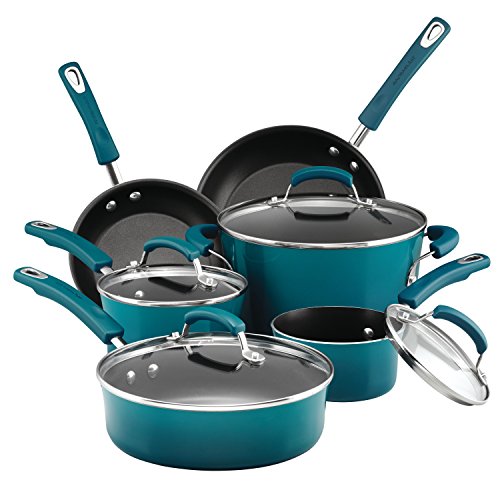
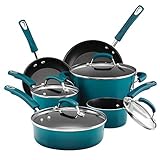
4. Rachael Ray Brights Nonstick Cookware Set
A colorful aluminum set with soft, rubberized handles in bold shades. It aims to make a first kitchen feel cheerful and has pieces suited to everyday family meals.
Suits: people who like color. Strengths: comfortable handles. Weaknesses: the bright look is not for everyone. Skip it if you prefer neutral tones.

Best for a ceramic starter set
5. Sensarte Nonstick Ceramic Cookware Set
A ceramic-style nonstick set sold with a range of pans and pots, often in light colors. The listing describes the coating as free of certain chemicals, so check the wording there.
Suits: a ceramic starter set. Strengths: a stylish finish. Weaknesses: coatings need gentle care. Skip it if you cook on very high heat.

Best for light daily cooking
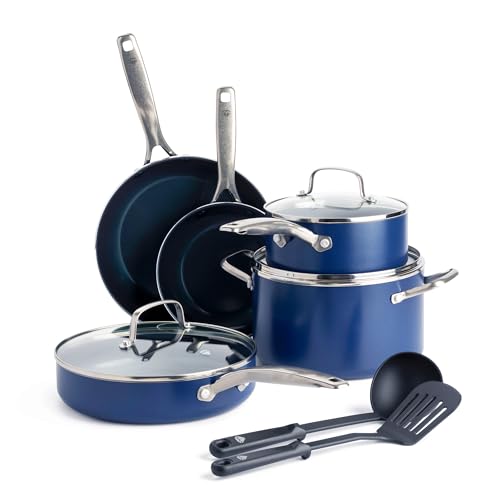
6. Blue Diamond Ceramic Nonstick Cookware Set
A ceramic nonstick line with a diamond-infused coating, as described by the maker, and a lightweight aluminum body. It is built for people who want a modern look at the stove.
Suits: light daily cooking. Strengths: a lightweight body. Weaknesses: check the oven limit before use. Skip it if you want heavy cookware.

Care and Setup
- Wash new pieces before first use.
- Start with medium heat and adjust upward only if needed.
- Use silicone, nylon or wood tools.
- Let the pan cool before cleaning.
- Replace pieces that begin to flake.
Mistakes to Avoid
- Preheating an empty pan on high.
- Using metal utensils.
- Stacking pans without a pan protector.
- Buying a set with too many pieces you will never use.
- Skipping the label on oven limits.
Building a First-Kitchen Piece List Before You Shop
Set descriptions often count lids, utensils and tiny accessories as “pieces,” which makes a large number look like a bargain. Before you compare boxes, write down what you actually cook in a normal week. A new cook usually leans on a handful of tasks: eggs and pancakes, a sauce or a pot of pasta, a stir-fry or sauteed vegetables, and perhaps a soup. That translates to two frying pans in different sizes, one or two saucepans with lids, and a stockpot or Dutch-oven style pot.
When you read a listing, count only the pans and pots, then check their sizes. A small frying pan is good for a couple of eggs, while a larger one handles a full meal for two. A saucepan that is too small becomes frustrating the first time you boil pasta or heat a can of soup.
It also helps to note what you already own. If you have a good stockpot from a family hand-me-down, a set with a stockpot is duplicating it, and you may prefer a smaller set or a pair of individual pans. If your kitchen has no pots at all, a full set saves you from hunting for each piece separately. Check the product listing for a clear breakdown of every item and its diameter or capacity, and treat any set that only gives a total count with caution.
Finally, think about how many people you cook for. A solo cook rarely needs the biggest pot in a set, whereas a household of four will use it constantly. Matching the set to your real routine is more useful than chasing the biggest box.
Learning Heat Control on Nonstick Surfaces
Nonstick pans reward patience with heat. Most beginners start by turning the burner to high, which is the fastest way to shorten a coating’s life and scorch food before it cooks through. As a general habit, start at low to medium heat, let the pan warm for a short time, and only raise the heat if the food is not responding. Check your set’s manual, since makers differ in the maximum temperature they recommend.
A useful routine is to add a small amount of oil or butter once the pan is warm, then add food. Food that is dropped into a cold pan can stick to some surfaces and slows browning. Listen for a gentle sizzle rather than a violent crackle; a loud, smoking pan is too hot for most nonstick cookware.
Some sets include a heat indicator or similar feature that signals when the pan has warmed up. If your set has one, treat it as a guide and still pay attention to how the food behaves. Without an indicator, a simple test is to hold your hand a short distance above the surface and feel for even warmth.
- Match the pan size to the burner so heat is even and handles stay cooler.
- Do not heat an empty pan for long periods.
- Lower the heat before adding cold or wet ingredients to reduce splatter.
- Let a hot pan cool before washing it to avoid stressing the base.
These habits cost nothing and extend the usable life of almost any nonstick set.
Utensils That Protect the Coating
A set that arrives with a few spatulas is convenient, but you should still check what the utensils are made of and whether they suit the pans. Wooden, silicone and nylon tools are the common choices for nonstick cookware, and metal tools are usually discouraged because they scratch. Always read the care guidance that comes with your set, because some makers state that their surface tolerates metal while many do not.
Silicone tends to handle higher temperatures and cleans easily, while wood is gentle but needs hand washing and drying so it does not crack. Nylon is affordable, yet some nylon tools can soften or warp if left resting on a hot pan edge. A slotted turner is handy for eggs and fish, a flat-edged spatula suits pancakes, and a wooden spoon covers stirring sauces.
Avoid cutting food in the pan with a knife, and avoid stacking pans without protection. If you store pans nested together, place a paper towel, a thin cloth or a pan protector between them so the base of one does not rub on the cooking surface of another. The same applies to hanging pots, where the cooking surface should not knock into other cookware.
If you are on a budget, buy one good silicone turner and one wooden spoon and skip any extras you will not use. The few tools you reach for daily matter more than a full utensil crock.
Cabinet Space, Weight and Storage
Small kitchens punish bulky cookware. Before ordering, measure the shelf or cabinet where the set will live, including its height. Pots with long handles and lids can eat space quickly, and a set that does not nest cleanly may need a separate rack or hanging rail. Look at the listing to see whether pieces stack, whether lids are designed to sit flat, and whether handles detach or fold.
Weight is also worth thinking about. Aluminum-based sets tend to feel lighter than heavy clad pans, which can make them easier for new cooks to lift and pour from. A lighter pan can be easier on wrists, though a very thin pan may heat unevenly. If you have a limited grip or strength, check how comfortable the handles look and whether they are riveted or attached another way, then read the maker’s care notes.
Think about where lids go too. Glass lids are useful for watching food but add height and can be fragile in a crowded cabinet. A pot lid rack inside a cabinet door or a simple shelf riser can organize things cheaply.
If you share a kitchen or move often, a compact set that fits inside itself is practical. Choosing a set that fits your space avoids the common situation where cookware sits in a box on the counter because it has nowhere to go.
When to Move Beyond a Starter Set
A beginner set is meant to teach you what you like, not to last forever. Expect to replace nonstick pans eventually, since coatings wear with use regardless of the brand. Watch for signs such as food sticking even with oil, visible scratches or flaking, a warped base that spins on the burner, or discoloration that will not wash away. Once flaking appears, retire the pan instead of trying to keep using it.
As your skills grow you may find that a nonstick surface is not right for everything. Searing meat, building a pan sauce or cooking at high heat is usually done in other materials, and many cooks keep one or two nonstick pans for eggs and delicate foods while adding a stainless or cast-iron pan for the rest. This is a natural path, and a starter set that covers the basics gives you time to figure out what to add.
Ask yourself a few questions before upgrading: which pan do I use most, which do I never touch, and what kind of cooking is frustrating me? Replace the pieces that wear out first, which are typically the frying pans, instead of replacing the whole set. If you do upgrade, consider your cooktop type again, since moving to induction or a new range can change which pans will work.
A Checklist for Your First Set
Buying cookware for the first time can feel overwhelming. A short checklist turns a wall of options into a manageable decision.
- Check what kind of cooktop you have, and read the maker’s note on compatibility.
- Count how many people you cook for, and choose pot sizes that suit them.
- Decide whether you want a dishwasher-friendly set or are happy to wash by hand.
- Look at the handles, and think about whether they feel secure and comfortable.
- Check the lids, and whether you prefer glass for watching food or solid for durability.
- Read the care notes before you buy so you know what routine the set demands.
A little time spent here prevents the frustration of a set that does not suit your stove or your habits.
Traditional Coating or Ceramic Coating: A Plain Comparison
Nonstick sets generally fall into two families. The table compares them in general terms, and the maker’s own materials will give specifics for any set.
| Coating style | Typical feel | Points to consider |
|---|---|---|
| Traditional nonstick | Slick surface, familiar to most cooks | Follow the maker’s heat limits closely |
| Ceramic-style nonstick | Smooth and often lighter in color | Surface performance may change with use |
| Hard anodized body | Sturdy base under the coating | Often heavier in hand |
| Lightweight aluminum body | Easy to lift and move | May feel less solid on the stove |
Neither family is perfect, and what matters most is how you treat the pans. Gentle heat, soft utensils and careful washing extend the life of any coating.
First Month Habits for New Cooks
The first weeks with new pans set patterns that last. Wash the set by hand or in the dishwasher according to the maker’s directions before using it. Warm the pan gently, add your ingredients and keep the flame or setting moderate rather than high.
Use wooden, silicone or nylon utensils, and avoid sharp tools that scratch the surface. Let the pan cool before washing so that the coating is not stressed by sudden temperature change. Store pans with a soft layer between them, such as a cloth or paper towel.
Keep a small notebook of what worked on your stove, because every cooktop runs a little differently. Over a few weeks you will learn the settings that suit your favorite dishes.
Reading the Maker’s Care Notes
Every set comes with guidance about temperature limits, oven use and cleaning. Treat those notes as the final word, and keep them somewhere you can find them later. If a pan shows deep scratches, flaking or warping, consult the maker about whether it should keep being used, and replace it when the maker advises.
Sorting Out What You Truly Need to Buy
Large sets look generous, but a beginner often uses only a few pieces. A frying pan in a medium size, a saucepan with a lid and a larger pot for pasta or soup cover most everyday meals. Extra pieces such as a small skillet or a steamer insert are useful only if you know you will reach for them.
Look at the contents list and ask whether each piece matches a dish you already cook. If a set includes utensils, check whether they suit the pans, and whether you would rather choose your own. Count how many lids come in the box, since some pieces share a lid.
It is entirely reasonable to begin with a smaller set and add pans later as your cooking grows. A modest beginning with items you love is better than a cupboard full of unused metal.
The First Month With a Beginner Set: What You Will Actually Learn
A first nonstick cookware set teaches cooking by feedback. In the first week, most beginners learn that a pan can be too hot far more easily than it can be too cold, that eggs forgive a gentle burner and punish an impatient one, and that food releases when it is ready rather than when the cook is in a hurry. Sets like the T-fal Initiatives, Amazon Basics, Farberware, Rachael Ray Brights, Sensarte ceramic and Blue Diamond ceramic sets all cover the same basic ground of frying pans, saucepans and a larger pot, yet the learning curve feels slightly different with each. A pan with a clear heat indicator, a comfortable handle or a lid you can see through removes one small uncertainty at a time, and for a new cook those small certainties are the difference between enjoying dinner and dreading it.
By the second week, patterns appear. Breakfast wants the small frying pan. Pasta night wants the big pot and a saucepan for the sauce. Soup, curry and chilli want the deepest pan in the set, and almost every beginner discovers that the piece they underestimated, usually the medium saucepan, is the one in the sink every single day. This is why piece lists should be read with your own meals in mind. A set that matches the meals you already cook twice a week will feel generous. A set chosen for impressive variety can feel oddly incomplete if its sizes cluster around dishes you never make.
By the end of the first month, a beginner usually knows which pan runs hot, which lid rattles, which handle feels secure with a mitt, and which piece they wish were bigger. That knowledge is the real product. It turns the next purchase, whether that is a single better frying pan, a stockpot or a baking tray, into an informed choice instead of another guess. Treat the starter set as a teacher as much as a tool, and it will have done its job even before you think about upgrading anything.
A Sensible Order to Learn the Core Dishes
- Eggs, three ways: scrambled low and slow, fried with patience, and an omelet that teaches heat control and timing.
- Pasta with a simple sauce: boiling, draining, and bringing sauce and pasta together in the pan.
- A one-pan rice dish: measuring, simmering with a lid, and resting before serving.
- Soup from scratch: softening vegetables, adding liquid, and judging seasoning gradually.
- Pancakes or flatbreads: learning when a surface is properly preheated and when to flip.
- A stir-fry: preparing everything before the pan gets hot, and cooking in batches so food fries instead of steaming.
- Grilled sandwiches and quesadillas: moderate heat, patience, and an even golden crust.
Buying Criteria in More Depth
Counting Pieces Honestly
Set sizes are counted in the way that flatters the box, and lids and utensils often count as pieces. A generous headline number may describe a modest collection of pans. Read the list literally and count only the cooking vessels, then check their sizes. Two frying pans of nearly the same diameter are less useful than one small and one large. A saucepan pair in genuinely different sizes covers porridge for one and sauce for a family. The big pot should hold a family pasta night without boiling over at the slightest excuse. Beginners are better served by fewer, well-spaced sizes than by a crowd of near-duplicates, because each distinct size teaches a distinct job.
Traditional and Ceramic Coatings for a New Cook
Traditional nonstick coatings, as on the T-fal, Amazon Basics, Farberware and Rachael Ray sets in this group, are famously forgiving: food releases easily, washing is simple, and the surface tolerates a beginner’s uneven heat reasonably well when used at moderate temperatures. Ceramic-style coatings, as on the Sensarte and Blue Diamond sets, appeal to buyers who prefer that type of surface and often bring a lighter-coloured interior that makes it easy to see browning. Both types dislike the same things: fierce empty preheating, metal utensils, abrasive cleaning and cooking sprays that bake into a film. A beginner’s honest habits matter more than the label. Choose the coating you will treat properly, at the heat the maker recommends, and either family will serve a first kitchen well.
Handles, Lids and the Confidence Factor
New cooks handle pans nervously, and equipment should reduce that nervousness rather than add to it. A handle that stays comparatively cool on the hob, feels secure in a small hand and does not twist in its fixings makes a real difference. Glass lids let a beginner watch rice absorb water and soup come to a simmer without lifting the lid and losing the steam the dish depends on, though glass usually has a lower oven limit than the pan beneath it. Helper handles on the largest pot matter more than they appear to, because a full pot of pasta water is the heaviest thing a new cook will ever carry across a kitchen. Check fixings, lid fit and balance while the set is still returnable, not months later.
Cooktop Fit Is Not a Detail
Before any set is ordered, stand at your own hob and look at it. Induction hobs need pans with a magnetic base, and not every nonstick set has one, so test the listing carefully and, once the set arrives, confirm each pan registers on the hob. Gas hobs forgive almost any base but punish handles that sit over a neighbouring flame. Smooth electric hobs reward flat bases and punish warped ones, which rock, spin and heat unevenly. A set that does not suit the hob will frustrate every meal cooked on it, and no coating quality can compensate for that basic mismatch.
Heat, Utensils and the Habits That Keep a Set Nonstick
Most beginner nonstick damage happens in the first minute of cooking, when an empty pan is left over a high flame while ingredients are still being chopped. Prepare first, cook second. Put the pan on a moderate heat, give it a short warm-up, add a little oil or butter, and add food when the fat shimmers or the butter foams. If food is browning faster than it is cooking through, the answer is almost always to turn the heat down and give it time, not to add more heat. Nonstick pans were designed for the low-to-middle of the dial, and nearly everything a beginner cooks, from eggs to chicken pieces, is happier there.
Utensils are the second habit. Wooden spoons, silicone spatulas and nylon tools will never gouge the surface, and a soft turner slides under pancakes and fish without a fight. Keep metal tools for other pans, or better, keep them out of the nonstick drawer entirely so nobody has to make a decision mid-recipe. The same applies at the sink: a soft sponge and warm soapy water clean a healthy nonstick surface in moments. If something has stuck, soak it briefly rather than scrubbing, because a surface that needs force to clean is usually a surface that was overheated or overloaded, and the soaking fixes the symptom without harming the coating.
Storage completes the routine. Stack pans with a cloth or a piece of kitchen paper between the surfaces, hang them if you have the rail space, and do not use a frying pan as a storage box for utensils. These are thirty-second habits, but they are the entire difference between a starter set that still releases eggs after years of service and one that is being apologised for within months.
Comparing the Six Sets in Practice
T-fal Initiatives is the classic beginner recommendation in this group, a set built around easy release and, on many of its pans, a heat indicator that takes the guesswork out of preheating. For a cook who burns things because the pan was secretly hotter than they thought, that small feature teaches good habits quickly. Amazon Basics takes the opposite approach: plain, inexpensive coverage of the essentials with no teaching aids, which suits a buyer setting up a first flat, a spare kitchen or a student house where simplicity matters most. Farberware’s dishwasher-positioned set will appeal to households that know, honestly, that hand-washing is where good intentions go to die, though the maker’s care notes should still be read before the dishwasher becomes a daily habit.
Rachael Ray Brights brings colour and a cheerful, coordinated look, which matters more than purists admit: equipment people enjoy looking at gets used, washed and put away rather than abandoned. Sensarte’s ceramic set suits the buyer who prefers a ceramic-style surface and a more modern, minimal appearance, while Blue Diamond’s ceramic set is aimed at the beginner who wants that same surface family with a tougher-sounding, everyday character. Between the ceramic pair, the deciding factors are the sizes included, the hob compatibility and the handles, rather than any headline claim. Between the traditional sets, decide by the teaching features, the piece spacing and how the set will be washed in your real life, not your ideal one.
When a Starter Set Stops Being Enough
| Frustration | What it usually means | Sensible next step |
|---|---|---|
| Everything crowds in the frying pan | The largest pan is too small for your household now | Add one larger pan rather than replacing the whole set |
| Sauces scorch at the edges | Thin base or heat kept too high | Cook lower; later, add one heavier saucepan |
| No pan for proper searing | Nonstick is not made for fierce heat | Add a steel or iron pan for that single job |
| Big soups feel risky | The largest pot lacks headroom | Add a stockpot sized for your batch cooking |
| One pan’s surface is worn | That piece has reached its limit | Replace that piece only, and review the heat habits |
| Lids never match the pan in use | Set lids were counted generously | Note the diameters and add a universal or matching lid |
Growing out of a starter set gradually is a sign the set worked. Replace the piece that frustrates you weekly, keep the pieces that still serve you daily, and resist the urge to start again from zero. A kitchen built one informed piece at a time ends up suiting its cook far better than any single box can.
Kitchen Routines a Beginner Set Teaches You
Beyond recipes, a first set quietly teaches the routines that make any kitchen run well. These habits, learned on forgiving nonstick pans, will serve you with every pan you ever own afterwards.
- Mise en place: prepare and measure before the pan heats, so nothing burns while you chop.
- One pan at a time: finish a step before starting the next, and the hob stays calm instead of chaotic.
- Taste as you go: seasoning is adjusted in small steps, not rescued at the table.
- Rest cooked food: meat, rice and pancakes all improve with a short, patient pause.
- Wash as you cook: a nonstick pan rinsed during a natural pause is a pan that never piles up.
- Put things back: a set stored in the same place is a set you can use half-asleep at breakfast.
- Write on recipes: note the pan, the heat and the timing that worked, in pencil, on the page.
- Clean the hob too: spills wiped the same day never become the baked-on archaeology of next month.
Troubleshooting Beginner Dinners
Almost every early cooking disappointment has a simple cause and a kinder explanation than a lack of talent. Work through the common ones before blaming the set or yourself.
- If eggs brown at the edges, the heat was high and the pan sat empty too long before cooking.
- If rice is crunchy, the lid was lifted, the heat was fierce or the resting time was skipped.
- If a sauce tastes flat, it probably needs salt in stages and a final taste, not more ingredients.
- If vegetables are soggy, they were crowded and steamed; cook in batches with room to spare.
- If chicken is pale, the surface was wet or the pan was not yet properly warm when it went in.
- If pasta sticks together, the water was too little or the first stir after adding it was skipped.
- If soup scorches underneath, the heat stayed high after the simmer was reached; turn it down earlier.
- If everything takes longer than the recipe says, your hob and pans are simply different; note your own timings.
Shopping for Food to Match a Beginner Set
A starter set cooks best when the shopping supports it. Buying ingredients that suit the pans you own prevents the frustration of recipes that demand equipment you do not have yet.
- Choose one-pan and one-pot recipes for weeknights, and save project cooking for weekends.
- Buy vegetables in sizes that fit your largest pan without heroic chopping or crowding.
- Keep a base of eggs, rice, pasta and tinned staples that your set handles confidently.
- Pick proteins in portions that suit your frying pan, rather than one piece that overwhelms it.
- Freeze in flat portions that reheat gently in a saucepan or a covered frying pan.
- Try one new ingredient at a time, cooked in a pan and a method you already trust.
- Keep soft utensils, oil, salt and a timer within reach of the hob permanently.
- Let the market, not the recipe book, suggest the week’s vegetables, and cook them simply.
Sharing a Kitchen With a Beginner Set
In shared houses and family kitchens, a set survives on agreements as much as on care. A few small, cheerful rules protect the pans without turning anyone into the kitchen police.
- Agree that metal tools live in a different drawer from the nonstick pans.
- Leave a soft sponge by the sink, so the scouring pad is never the nearest option.
- Show housemates the moderate-heat rule once, kindly, rather than correcting them nightly.
- Keep one older pan for communal high-heat experiments if your household cooks adventurously.
- Stack the set with cloths between pans, and make that the household’s normal way.
- Rinse and dry pans after use, whoever cooked, so the next person starts with clean tools.
- Replace a worn piece together when it is done, rather than letting it linger and frustrate everyone.
- Remember the set is a teacher for every beginner in the house, not only its owner.
Where Beginners Usually Go Next
After some months with a starter set, most cooks develop clear, personal priorities. Following those priorities, one purchase at a time, builds a kitchen that fits its cook far better than any second box could.
- A larger frying pan, if crowding has become your weekly frustration at breakfast or dinner.
- A stockpot, if soups, pasta nights and batch cooking have outgrown the set’s largest piece.
- A heavy saucepan, if sauces and grains scorch in a thin base more often than you accept.
- A steel or iron pan, when you are ready to learn proper searing at higher heat.
- A baking tray and a loaf pan, when the oven starts to interest you as much as the hob.
- A better knife and board, because preparation is half of cooking and your set cannot fix it.
- A second lid in your most-used size, the smallest purchase that removes a daily annoyance.
- Nothing at all, if the set still cooks your meals happily; contentment is also a strategy.
Cooking for One, Cooking for Many
A beginner set has to stretch in both directions, and learning how it behaves at the extremes teaches more than any single recipe in the comfortable middle.
- For one, the smallest pan heats fastest and washes easiest; use it without apology.
- Scale a sauce down by watching consistency, not by halving every timing blindly.
- For many, cook in batches and hold food warm in a low oven where the maker allows it.
- Double soups and stews rather than frying pans full of crowded ingredients.
- Let guests serve from the pot at the table when the largest pan is fully committed.
- Note which extreme your life uses more, and let it guide your first single upgrade.
The Quiet Importance of a Timer and a Notebook
Two cheap tools will improve a beginner’s cooking more reliably than any extra pan: a timer that interrupts daydreaming, and a notebook that remembers what actually happened.
- Set the timer when food goes on, even when you intend to stand and watch it.
- Write the heat setting beside the timing; the pair together is the real recipe note.
- Record which pan you used, because results move with the pan as much as the recipe.
- Note one sentence about the result, honest and brief, while the taste is fresh.
- Review the notes before repeating a dish, and change one variable at a time.
- After a month, the notebook becomes a personal cookbook written for your own hob.
Confidence: The Real Beginner Milestone
There is a recognisable week when cooking changes character: the pans stop being mysterious, the heat settings become habits, and dinner stops depending on luck.
- You preheat without thinking and chop while the pan warms, in the right order.
- You hear when food is frying properly and when it is steaming instead.
- You reach for the right pan first time, because each piece now owns its jobs.
- You season gradually and taste without being reminded by the recipe.
- You wash the pans kindly as a reflex, not as a resolution.
- You start adapting recipes, which is the moment the set has done its teaching.
A Note on Leftovers and Second-Day Cooking
A beginner set earns quiet praise on the second day, when yesterday’s cooking becomes today’s easiest meal. Soups, curries, pasta sauces and rice dishes all reheat gently in the set’s saucepans and deeper pans, provided the heat stays moderate and a splash of water loosens anything that has thickened in the fridge. Store leftovers in shallow containers so they cool promptly, reheat only the portion you need, and bring sauces back to a gentle simmer while stirring, because a nonstick base rewards patience here too. Learning to cook once and eat twice is one of the most valuable habits a first set can teach, saving money, time and the temptation of far less satisfying emergency meals.
Nonstick Cookware for Beginners FAQ
How many pieces do I need?
A frying pan, a saucepan with a lid and a stockpot cover most beginner cooking. Extra pieces are optional, and you can always add a specialty pan later once you know what you cook most.
Do I need oil with nonstick?
A little oil or butter improves browning, adds flavor and helps the coating last longer, since it reduces direct contact with the hot surface.
Can I use these on induction?
Only if the listing says so. Many aluminum sets need a magnetic base.
How long will a beginner set last?
Careful use can extend a set’s life for several years, but coatings do wear.
Should I buy a set or individual pans?
A set is convenient and often covers pots and pans in one purchase, which suits an empty kitchen. If you already own some cookware, buying one or two individual pieces can avoid duplicates. Compare the sizes in the set to what you actually cook.
Are glass lids oven safe?
It depends on the set. Some makers rate lids for lower oven temperatures and others do not recommend oven use at all, so check the manual or listing. Do not assume the lid shares the same limit as the pan.
Can I put nonstick cookware in the dishwasher?
Only if the maker says it is dishwasher safe. Even then, many cooks hand wash to protect the coating and handles from harsh detergent. Check the care instructions that come with your set.
Why does food stick to my new nonstick pan?
Common causes include heat that is too high, cooking spray residue, or not warming the pan before adding food. A thin film of oil buildup can also create sticking. Washing gently and lowering the heat usually helps.
Is it safe to cook acidic foods in these pans?
Many nonstick pans handle tomato sauce and similar foods, but long simmering of acidic recipes may be discouraged by some makers. Read the care guide for your set and follow its advice.
What size frying pan should a beginner start with?
A medium pan suits one or two people, and a larger one helps when cooking for a family. A set with two sizes is a practical choice for a first kitchen.
How do I know if my cooktop works with a set?
Look for a stated induction or cooktop compatibility note on the listing. A magnet that sticks firmly to the base of the pan is a rough indication for induction, but the maker's information is more reliable.
What should I cook first in a new nonstick set?
Start with forgiving food: eggs at gentle heat, pancakes, a simple pasta sauce and a soup. These dishes teach you how each pan heats and where its hot spots are, without the pressure of an expensive ingredient or a tight timing window.
Why does my pan feel hotter in the centre?
Most hobs deliver more energy at the centre of the ring or element, and thin bases spread that heat less evenly. Preheat a little longer at a lower setting, and move food around the pan rather than leaving it in one spot.
Can I cook for guests with a beginner set?
Yes. Choose dishes that suit the pans: pasta, curry, soup, stir-fries cooked in batches and anything that holds well while you serve. Avoid recipes that demand fierce searing or very large pans, and the set will not embarrass you.
How do I know if a pan in my set is induction suitable?
Check the maker’s listing for each piece, and test with a magnet on the base: a magnet that holds firmly suggests a magnetic base. Once the set arrives, confirm each pan is recognised by the hob before you start cooking.
Should a beginner set live in the dishwasher?
Even where a maker allows it, hand-washing is kinder to coatings and handles and takes very little time on a healthy nonstick surface. Save the dishwasher for the days you truly need it, and always follow the set’s own care notes.
What is the one extra item worth buying alongside a starter set?
A set of soft utensils, if you do not already own them, protects every pan in the box from the first meal onwards. After that, a trivet or two and a spare lid in your most-used diameter cover most early frustrations.
The Short Version
For a familiar starter, the T-fal Initiatives. For a plain bundle, the Amazon Basics. For easy cleanup, the Farberware. For color, the Rachael Ray Brights. For ceramic, the Sensarte. For a light ceramic option, the Blue Diamond.