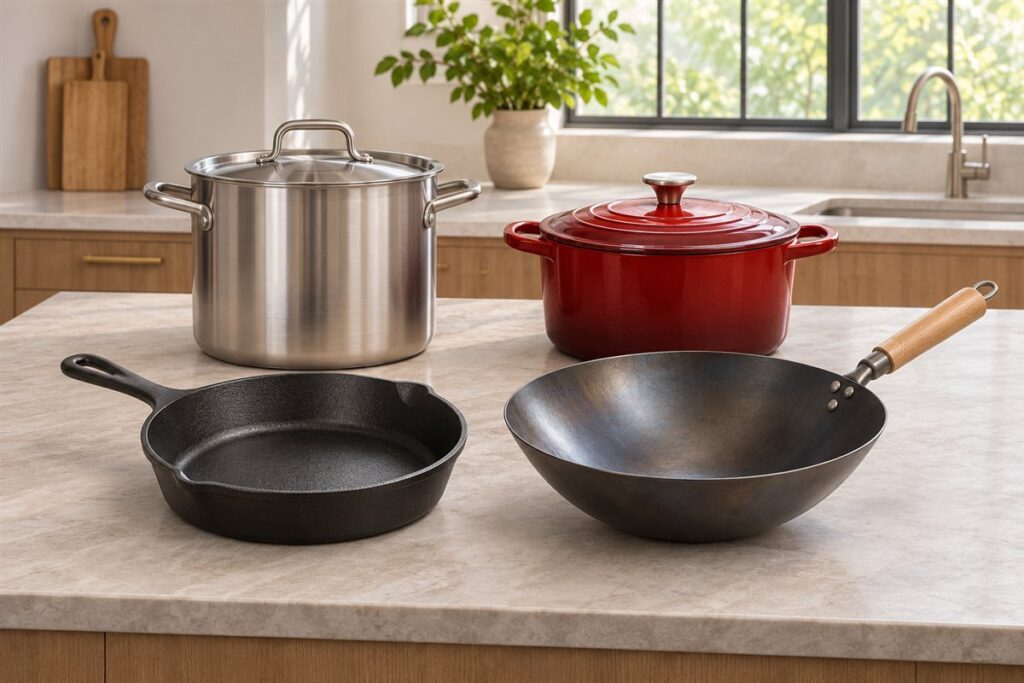
A useful cookware set covers the tasks you repeat. Piece counts can be inflated by lids and small accessories that do not add another cooking vessel. Building a small set from the meals you actually cook gives you pans you will reach for every week.
What to do
List your ordinary meals and the vessels used simultaneously. Compare actual pan sizes, lids and compatibility with your cooker and storage space.
Keep a note for a week or two of what you cook and which pans come out. You will probably find that a few pieces do most of the work and others stay in the cupboard.
A sensible core group
For many households, a small group covers most cooking:
- A frying pan or skillet: for eggs, searing and quick sautes.
- A saucepan with a lid: for grains, sauces, boiling and reheating.
- A larger pot with a lid: for pasta, soups, stews and batch cooking.
Add a baking tray or roasting tin if you use the oven often. Only add more when a recurring task cannot be done with these, such as needing two saucepans at once.
A mistake to avoid
Do not choose by the highest piece count alone. Two sets with the same count can provide very different useful pans.
When you read a listing, count the pans and pots only, and treat each lid, utensil or insert as an accessory. A set advertised as many pieces may include only a handful of cooking vessels.
A detail worth checking
Identify which vessels are needed at the same time. One versatile pan cannot replace two simultaneous cooking tasks, so a practical set depends on the whole meal rather than a list of possible uses.
Think about a typical weeknight dinner: perhaps a protein in a pan, a side in a pot and a sauce in a small pan. That is three vessels on three burners, which tells you the minimum you need.
Try this practical check
Map one week of normal cooking to a saucepan, frying pan and larger vessel where appropriate. Add another item only for a task the current group cannot handle.
Also check the practical limits: how many burners you have, how much cupboard space is free, and whether the cookware suits your hob type. A set that does not fit the cooker is not a bargain at any price.
Common questions
How many pieces do I really need?
It depends on how you cook. Many people manage with three or four well-chosen pieces. Add more only for specific tasks you do repeatedly.
Is it better to buy a set or individual pieces?
A set can be economical if you will use most of it. Buying individually lets you choose the exact sizes and materials you want. Compare what you would use in each case.
Should all the pieces match?
Not necessarily. Matching looks neat and nests well, but mixing materials can suit different tasks. Just make sure each piece suits your hob.
Keeping a Simple Cooking Log
The most reliable way to learn what you need is to record what you cook. For two weeks, write down each meal and the vessels used: frying pan, saucepan, stockpot, roasting tin or baking tray. Note anything you wanted but did not have, such as a second burner pan, a lid that fit, or a pan large enough for a family batch. This record turns vague impressions into evidence.
After the log, look for patterns. Which pans came out most often? Which ones were used together? Did you reach for a pan only because it was clean, rather than because it was right for the job? You may find that you use a medium pan for most things, and that a large pot is needed only for weekend batches. These patterns tell you where to spend and where to save.
Include foods you cook less often but still care about, such as a roast, a pasta night or baking. A single use per month can justify a pan if it is hard to substitute, but not if a baking dish you already own would do. Note the quantities too. A household of one rarely needs a very large pot, while a family of five may want two medium pans in use at once. Keep your log with your shopping notes, and revisit it a few weeks later to confirm the pattern holds. You will make a more confident decision, and avoid buying pieces that sit unused.
Choosing Materials by the Jobs You Do
Each cookware material suits different tasks, so your meals should guide your choices. Stainless steel handles searing, sauces and oven use, and is durable, though food can stick without good heat control. Nonstick surfaces are easy for eggs and delicate fish, but they wear and require gentler tools. Cast iron and carbon steel hold heat and sear well, but are heavier and need seasoning. Enameled cast iron suits braises and soups, and is heavy.
A small set does not need every material. Many cooks combine a stainless saucepan and pot with one nonstick or carbon steel frying pan. If you cook eggs daily, a nonstick pan earns its place. If you sear often, a heavier pan is a better investment. Think about care too: if you dislike seasoning routines, avoid bare iron, and if you prefer to put things in the dishwasher, check the care guidance on each item.
Check compatibility with your cooktop. Induction requires magnetic bases, and glass or ceramic tops prefer flat, smooth bases. Check oven limits for handles and lids if you move pans into the oven. Mixing materials is fine, but each piece should earn its place. Avoid duplicating roles unless you regularly need two at once. Ask whether a single high-quality piece could replace several mediocre ones, and consider how long you expect to keep it.
Sizes That Fit Your Household and Your Burners
Size matters as much as type. A frying pan that is too small forces batches, while one that is too large for your burner heats unevenly. For one or two people, a medium frying pan, a small to medium saucepan and a mid-sized pot are often enough. Larger households need bigger capacity, and may benefit from a deeper pan for family-sized portions.
Measure your burners and the space between them. Large pans may block neighboring burners, limiting how many pans you can use at once. Check the diameter of the base, not just the rim, as the listing may use either. A pot that holds your usual pasta amount without boiling over should have extra capacity above the water line. Think about how much you cook for leftovers or freezing, which increases the volume you need.
Handle lengths and lid shapes affect how pans fit on the stove and in cupboards. Nesting designs save storage, while long handles may poke into walkways. Weigh the pan when full, not just empty, as a heavy pot of liquid can be hard to lift. If someone with limited strength will use the cookware, choose lighter sizes with good handles. Compare capacity in quarts or liters, and consider the same size across different shapes. Check that every item fits in your sink for washing, and in your dishwasher if you use one.
Adding Pieces One at a Time
A small set can grow gradually, based on real gaps. Start with the core vessels, and live with them for a few weeks. When you find yourself repeatedly wishing for something specific, such as a second saucepan for a side dish or a roasting pan for oven meals, add it. This approach stops impulse purchases and keeps the cupboard organized.
Prioritize additions by how often they would be used and whether they replace an awkward workaround. A lidded sauté pan can double as a shallow braiser, and a Dutch oven handles soups, stews and bread. A small saucepan is useful for melting butter or heating sauce without taking over a large burner. A baking sheet and a roasting tin serve oven cooks, while steamer inserts or colanders can be added if you cook vegetables that way.
Before buying, check whether you already own something that serves. A baking dish, a heavy casserole or a skillet from another set may fill the gap. Consider borrowing, buying second-hand or waiting for a need to prove itself. Keep notes of your wish list so you can compare options when the time comes. Pay attention to lids, which can be shared across pans if sizes match. Over time, you will build a set that reflects how you actually cook, rather than a catalog assortment that leaves gaps and clutter.
Care Habits That Keep a Small Set Working
With fewer pieces, each one is used more, so care matters. Follow the maker’s instructions for each material. Preheat gently, use the right amount of oil and avoid sudden temperature changes that can warp pans. Let pans cool before washing, and use appropriate tools: wood or silicone on coated surfaces, and nonabrasive sponges for most finishes.
Clean promptly to prevent stuck-on residue. Soak when needed, and use gentle methods to lift stuck food. Dry thoroughly to avoid water spots or rust on iron and carbon steel. Store pans carefully, with protectors or cloth between stacked surfaces if scratches are a concern, and hang or nest them neatly where possible.
Inspect your cookware periodically. Signs that it is time to replace a piece include a coating that is flaking, a warped base that rocks on the cooktop, loose handles, deep scratches that expose metal underneath a nonstick finish, and rust that cannot be removed. Repair or replace loose handle screws where the maker allows it. When replacing, revisit your cooking log to check whether your habits have changed. A small set with good care can serve for many years, and keeping it tidy makes it easier to use daily.
Common Questions
What size should my first saucepan be?
A medium saucepan with a lid suits grains, sauces and reheating for most small households. Choose a capacity that covers your typical portions with room above the contents.
Do I need a lid for every pan?
Not always, but a lid is useful for simmering, steaming and braising. Lids can be shared between pans of the same diameter, so check that sizes match.
Is it worth buying a set for a first apartment?
A set can make sense if you are starting from nothing and it contains the vessels you will use. Count the pans and pots, not total pieces, and compare with your cooking log.
Can I mix cookware brands?
Yes. Matching looks tidy and nests well, but different brands can be combined. Ensure each piece suits your cooktop and fits storage.
How do I know if cookware is compatible with induction?
Check the listing for induction compatibility, or hold a magnet to the base. If it sticks firmly, the pan is likely to work, but follow the cooktop's guidance.
Should I buy a Dutch oven early?
Only if you cook soups, stews, braises or bread regularly. Otherwise a large pot may do. Add one when a recurring job demands it.
When should I replace a nonstick pan?
When the coating flakes, scratches deeply or food sticks despite correct use. Follow the maker's guidance on heat and tools to extend life.
Related reading
6 Best Cookware Sets: What Is Really in the Box (2026)