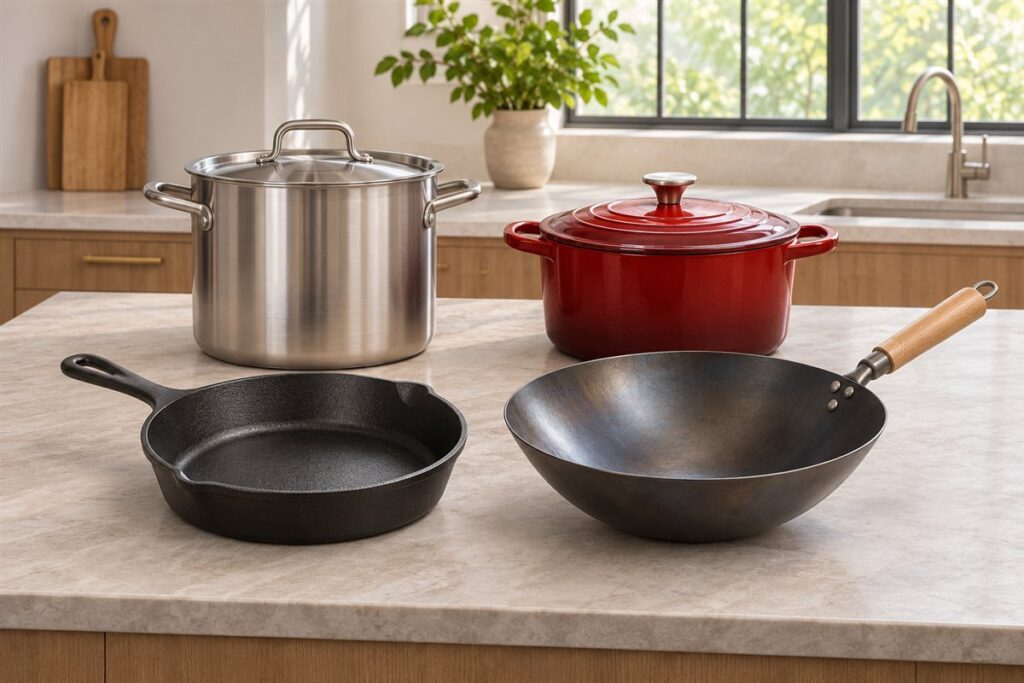
A lid changes the vessel’s height and handling. Check the exact lid and knob rather than assuming any same-width lid is interchangeable. The pot and lid work as one assembly, and the combination is what has to fit your oven and your routine.
What to do
Compare model compatibility, overall closed height and temperature limits for every component. Make sure the oven shelf position allows safe removal.
Read the maker’s information for the pot, the lid and the knob separately. They are sometimes made from different materials with different limits.
Check each part of the assembly
- Lid seating: the lid should sit evenly on the rim without rocking.
- Knob material and limit: some knobs have a lower heat limit than the pot, so check what is stated.
- Closed height: measure from the base to the top of the knob, since that is the tallest point.
- Lid weight: a heavy lid is harder to lift one-handed, so plan where it will rest.
- Handles: check that mitts fit around the pot and lid handles at the same time.
If you are replacing a lid, use the maker’s matching part, or confirm compatibility in writing.
A mistake to avoid
Do not extend the pot body’s use rating to a substituted lid or knob. Components can have different requirements.
A lid from another set might look similar and still not seal or withstand the same temperature. When in doubt, leave it out.
A detail worth checking
Check the closed assembly with the oven rack in the intended position. A lid knob can be the highest point, and sufficient interior height should not be assumed from pot depth alone.
Also consider the oven door and any element near the top. Leave comfortable clearance so you can slide the pot in and out without scraping.
Try this practical check
Measure the vessel with its lid on and compare it with the intended oven position. Record the approved assembly in your cookware notes.
With the oven off and cool, set the closed pot on the rack and slide it in and out. Check that your mitts fit and that the lid does not catch on anything above.
Common questions
Can I use a lid from another Dutch oven?
It may fit, but compatibility and heat limits can differ. Follow the maker’s guidance rather than relying on a similar width.
Does a tight lid matter?
A well-seated lid holds in heat and moisture, which helps with braising. A poorly fitting one lets steam escape, so cooking may need more attention.
What if the knob loosens?
Check the maker’s instructions for tightening or replacement. A loose knob is a handling risk with a hot, heavy lid.
Capacity and Shape for Your Household
The lid is only useful if the pot beneath it suits your cooking. Capacity is usually listed in quarts or liters, and the right amount depends on how many people you feed and what you make. A smaller pot suits two people and side dishes, while a larger one is better for family stews, whole chickens, and bread boules. If you often cook for guests or want leftovers, choosing slightly larger gives more room.
Shape matters as much as size. Round pots sit evenly on a burner and are the usual choice for soups, stews and braises. Oval pots fit long cuts of meat and a whole fish, but they can overhang a single burner and heat unevenly. Wide, shallow pots brown more surface area at once, while tall, narrow ones retain more liquid and suit long simmers.
Think about weight too. Cast iron Dutch ovens are heavy even when empty, and the lid adds more. Picture lifting the full pot from the oven with mitts, and moving it to a trivet. If you have limited strength, a smaller pot or a model with generous side handles is easier to manage. Measure the interior of your oven and storage space before choosing, and remember that the lid and its knob add to the height. A pot that fits the cupboard, the oven rack and your lifting ability will be used often.
Enameled or Bare Lid Surfaces
Dutch ovens come with different finishes, and the lid usually matches the pot, though not always. Enameled lids have a glassy coating that resists rust and cleans easily, but the rim of the lid can be bare or lightly coated and may need drying and light oiling according to the maker. The enamel can chip if the lid is dropped or knocked against the pot, so lift it straight up and set it down gently.
Bare cast iron lids need seasoning and thorough drying. They tolerate a wide range of temperatures, but they can rust if stored damp. If the lid and pot are bare, a paper towel between them allows air to flow in storage.
Some lids have stainless or other metal knobs, while others have phenolic or other plastic knobs with lower heat limits. This is why reading the specification for each part matters. A pot may be fine at a high oven temperature while the knob is not. Replacement knobs are sometimes sold separately and are designed to fit a particular thread size, so check the maker’s guide. If you plan to bake bread at high heat, make sure the lid, knob and pot are all rated for that temperature before you start. Surface type affects care, tools and even how a lid looks after years of use.
Lid Designs and Moisture Control
Not all lids manage moisture the same way. A flat lid with a tight seal keeps most of the steam inside, which makes it good for braising and slow cooking where you want tender meat and plenty of liquid. A domed lid creates more room for steam to circulate and condense.
Some lids have small bumps, ridges or spikes on the underside meant to collect condensation and drip it back over the food. These are often described as self-basting. Whether they make a noticeable difference depends on the recipe and your habits, so treat the claim as a feature to evaluate rather than a guarantee.
A lid that sits slightly ajar, or a vented lid, lets steam escape and concentrates flavor. Many recipes ask you to remove the lid during the last part of cooking to thicken a sauce or to brown the surface. Cooking with the lid tilted is a common method for managing simmering levels.
Check how well the lid seats on the rim. A lid that rocks, rattles or leaves a visible gap can allow steam to escape, which changes liquid levels and cooking time. If you replace a lid, match the maker’s design for the specific pot. A well-matched lid helps you cook the same way every time.
Handling Hot Lids Safely
A Dutch oven lid can be the hottest, heaviest and most awkward part of the setup, so build safe habits. Always use dry, thick oven mitts, and check that they fit around the knob or handle without slipping. Wet mitts conduct heat quickly and can cause burns.
When you lift a hot lid, tilt it away from your face so steam escapes in the other direction. Hot steam can scald, and condensation can drip back across your hand or arm. Set the lid down on a heat-safe trivet or a folded dry towel instead of a cold counter or a wet surface, since sudden temperature changes can crack enamel.
Plan where the lid goes before you start. Clear a spot beside the stove, and make sure the path from oven to counter is free of pets, children and clutter. If the lid has a knob, remember it stays hot long after cooking, so mark it mentally and do not touch it with bare hands. On a stovetop, avoid leaving the pot unattended with the lid on for long periods without checking liquid levels. Allow the pot to cool before moving it to the sink, and follow the maker’s guidance on cleaning. These habits prevent most kitchen accidents involving heavy cookware.
Cleaning and Storing the Set
Wash the pot and lid by hand with warm water, mild soap and a soft sponge or brush unless the maker says otherwise. Let them cool first. Pay special attention to the underside of the lid, where condensation and grease can leave a film, and to the rim where the lid meets the pot. Dry both thoroughly, including the knob area, since trapped water can cause rust on bare iron and exposed rims.
Stubborn stuck-on food usually responds to a soak in warm soapy water or a gentle simmer of water in the pot, followed by a plastic scraper. Avoid harsh abrasives on enamel, and do not use cleaning methods that the maker discourages.
When storing, leave the lid slightly ajar or place a paper towel or cloth between the lid and pot so air can circulate and the surfaces do not scratch each other. Stack other items on top only if the pot and lid can bear the weight, and avoid stacking so high that a fall could chip enamel. If the pot lives on a shelf, ensure the shelf supports the combined weight. Keep the manual or a note of the care steps somewhere easy to find. A little attention after each use keeps the set working smoothly.
Common Questions
What size Dutch oven should I choose?
Match the capacity to how many people you usually feed and the dishes you make. A larger pot gives room for bread and big braises, while a smaller one is easier to lift and store.
Can I bake bread in a Dutch oven?
Many cooks do, but check that the pot, lid and knob are all rated for the high oven temperature your recipe needs. Replacement knobs or plastic parts may have lower limits.
Why does steam escape around my lid?
The lid may not seat evenly, or the rim may be chipped or dirty. Check for a clean, level fit and consult the maker if the gap persists.
Should I preheat the pot with the lid on?
Follow the recipe and the maker's guidance. Some recipes call for preheating the pot and lid, while others start cold, and preheating an empty coated pot may not be advised.
Can I use metal utensils inside an enameled Dutch oven?
Many makers recommend wood, silicone or nylon tools to protect the enamel. Check the care sheet for your pot.
How do I clean the underside of the lid?
Wash it with warm soapy water and a soft sponge, and dry it fully. If grease has built up, a soak or a gentle simmer in the pot can loosen it.
When should I replace a lid?
Replace it if it is cracked, if the enamel is chipped on the rim in a way that affects the seal or safety, or if the knob will not stay tight. Use the maker's matching part.
Related reading
6 Best Dutch Ovens: Enameled and Bare Cast Iron Compared (2026)