Disclosure: topratedkitchenware.com is reader-supported. When you buy through links on our site, we may earn an affiliate commission from Amazon and other retailers, at no extra cost to you.
Where to buy
If you are shopping for the best food processors for nut butters, the six models below are the shortlist this guide is built around. Prices and availability change often on Amazon, so use the links to check the current listing before you buy. Orders are placed on Amazon, and the listing there carries the full manufacturer detail for each model.
- Best for Recipe Testing: Cuisinart Mini Food Processor 3-Cup — Check on Amazon
- Hamilton Beach 10-Cup Food Processor — Check on Amazon
- BLACK+DECKER 8-Cup Food Processor — Check on Amazon
- Cuisinart Core Custom 4-Cup Mini Chopper — Check on Amazon
- Cuisinart Elemental 4-Cup Chopper/Grinder — Check on Amazon
- KitchenAid 3.5 Cup Food Chopper — Check on Amazon
Read the full guide ↓
Searching for the best food processors for nut butters — plural — is a slightly different hunt from choosing a machine for a single jar. This is the guide for the maker who keeps a rotation: peanut butter for the week, almond butter for baking, a spiced cashew batch for sauces, maybe a chocolate-hazelnut jar that never lasts long. That habit changes what matters. Variety rewards machines that are quick to clean between batches, sized for several modest jars rather than one enormous one, and happy to run flavour experiments — a pinch of cinnamon, a handful of cacao, toasted coconut — without committing a cupboard’s worth of nuts to every idea.
The six picks here reflect that pattern honestly. One full-size ten-cup machine anchors the rotation for the big weekly batch; a mid-size eight-cup covers the middle; and four compact choppers — the size most line-ups would treat as an afterthought — turn out to be the variety maker’s best friends, because a four-cup bowl is exactly the scale of a flavoured experiment, a seed butter for one allergic household member, or a fresh jar of something you only eat a little of. Small, here, is not a compromise. Small is the point.
If your question is narrower — one machine, one kind of butter, maximum capability — our companion guide to the Best Food Processors For Nut Butter argues that case in the singular. This guide assumes you have already caught the variety habit, or can feel it coming, and it ranks these six machines by how gracefully they support a shelf of different jars rather than a single perfect one.
Key Takeaways
- Variety changes the brief: quick cleanup between batches and right-sized bowls matter more than one huge capacity.
- A rotation works best as a system — one full-size anchor for the weekly staple, compacts for flavours and experiments.
- Small bowls shine for flavoured batches, seed butters, and recipe tests where a big commitment of nuts makes no sense.
- Flavourings go in at the end of each batch, once the base butter is glossy, so one base method produces many jars.
- Label and date every jar; a rotation of homemade butters stays delicious only if the oldest jar gets eaten first.
- Follow the Amazon links to check the latest price on Amazon for any machine you are considering.
In this guide
Quick Picks
Read this list as a system rather than a ladder. The Hamilton Beach is the anchor for staple batches, the BLACK+DECKER the flexible middle, and the four compacts divide the flavour work between them — testing, second batches, and small jars of the varieties you eat slowly.
| Pick | Badge | Why it earns its place |
|---|---|---|
| Cuisinart Mini Food Processor 3-Cup | Best for Recipe Testing | A three-cup tester that lets a new nut, roast, or flavour idea prove itself before you commit real quantities. |
| Hamilton Beach 10-Cup Food Processor | Best Overall for Batch Variety | The ten-cup anchor with a built-in scraper, sized for the weekly staple batch your rotation revolves around. |
| BLACK+DECKER 8-Cup Food Processor | Best Mid-Size for Rotation Batches | An eight-cup, four-hundred-fifty-watt middle machine for the second-string butters in useful quantities. |
| Cuisinart Core Custom 4-Cup Mini Chopper | Best Second Bowl for Flavoured Batches | A four-cup auto-reversing chopper that works beautifully as a dedicated second bowl for flavoured batches. |
| Cuisinart Elemental 4-Cup Chopper/Grinder | Best for Small Flavoured Batches | A four-cup chopper-grinder with a BladeLock system, made for small flavoured and spiced batches. |
| KitchenAid 3.5 Cup Food Chopper | Best Compact All-Rounder | A three-and-a-half-cup chopper with two speeds and pulse, the compact all-rounder for everyday small jars. |
How These Picks Were Chosen
Selection for this guide started from the rotation habit and worked backwards to the machines. We compared listings for bowl sizes across the full range, cleanup features — dishwasher-safe parts above all, because a variety maker washes bowls constantly — and blade behaviours that suit thick mixtures, such as auto-reversing designs and locking blades that make pouring a finished butter safer and cleaner. The result deliberately over-weights compact machines compared with a single-jar guide, because the evidence of the use case points that way: most flavoured and experimental batches are small.
We also weighed sequencing. A rotation is a workflow: the staple batch runs in the big bowl, flavour batches run in compacts, and the machine that is slowest to clean becomes the bottleneck of the whole system. That is why dishwasher-safe parts appear in so many of these listings, and why we call out details like the Elemental’s BladeLock — a blade that stays secured when you pour — which sounds minor until you are decanting your fourth small batch of the afternoon with oily hands.
As with every guide in this series, this is research-led work: specifications and manufacturer descriptions compared against the known behaviour of nut butters, with no invented hands-on claims. Where a listing states a figure — the BLACK+DECKER’s four hundred fifty watts, the bowl capacities throughout — we cite it as listed. The companion dry-side guide, Best Food Processors For Nut Flour, covers the same compact machines performing the opposite trick: stopping at powder instead of pushing through to butter.
The 6 Best Food Processors for Nut Butters
Think of these six as roles in one kitchen system. Each review names the role, the batches it suits, and the limit that keeps it in that role — because in a rotation, a machine used within its role is a delight and a machine stretched beyond it is a bottleneck.

Cuisinart Mini Food Processor 3-Cup
Badge: Best for Recipe Testing
Strengths
- Three-cup bowl keeps a tiny test load engaged with the blade instead of lost and bouncing
- Auto-reversing SmartPower blade switches between chop and grind directions
- Brushed chrome mini rinses clean in moments between experimental batches
Trade-offs
- Miniature scale only — it tests and prototypes, it does not supply a household
- Long hard grinds ask a lot of a mini motor; rest it between stages
- Twenty-four ounces overfills quickly once nuts and flavourings combine
Key specs from the listing: Capacity: 3 cups (24 oz). Blade: auto-reversing SmartPower, chop and grind modes. Finish: brushed chrome.
Every rotation needs a laboratory, and the Cuisinart Mini is this system’s. Three cups is the scale at which a new idea costs almost nothing: a handful of pecans and a pinch of sea salt, a small test of a darker roast, a trial of maple and cinnamon before the flavour graduates to a full batch. Because the bowl is small, a small load stays in the blade’s working zone and actually butters, instead of rattling around a big bowl refusing to engage — the reason tiny tests fail on full-size machines and succeed here.
The auto-reversing SmartPower blade, which changes direction between chop and grind behaviour, suits these small thick mixtures well, and the whole machine rinses clean in moments, which is what makes experimentation a habit rather than an event. The boundaries are the obvious ones: this is a prototype bench, not a supply line, and its motor deserves rests on hard nuts. Used as the rotation’s research department — every new variety starts here, winners get promoted to the bigger bowls — it may become the most-used machine in this entire list.
Best for: recipe testing, small trials, and prototyping new varieties / Not suited for: supplying a household’s main butter

Hamilton Beach 10-Cup Food Processor
Badge: Best Overall for Batch Variety
Strengths
- Ten-cup bowl handles the weekly staple batch with room to circulate
- Built-in bowl scraper keeps thick paste in the blade’s path without stopping
- Stainless steel all-rounder for the slicing and shredding the rest of the week needs
Trade-offs
- The anchor is big: counter space and washing-up scale to match
- No headline motor figure in the listing, so judge it on bowl and scraper
- A ten-cup bowl needs a real load; tiny flavour tests belong in the compacts
Key specs from the listing: Capacity: 10 cups. Feature: easy-clean bowl scraper built in. Jobs named: slicing, shredding, mincing, pureeing. Finish: stainless steel. Model: 70730.
The Hamilton Beach 70730 is the anchor: the machine that makes the staple. In most rotations one butter does the heavy lifting — the peanut or almond jar that goes on toast, into smoothies, and through baking all week — and that batch deserves the ten-cup bowl, with room for a generous load to circulate, fold, and turn glossy without crowding. The built-in bowl scraper is the feature that quietly earns its keep here, sweeping climbing paste back into the blade’s path during the long middle stage instead of demanding stop-and-spatula interruptions.
Around the staple batch, it remains the week’s general processor, with slicing, shredding, mincing, and pureeing named in its listing. The honest costs of an anchor are size and commitment: it takes counter room, its bowl is a real wash, and it needs a real load — the tiny end of the rotation belongs in the compacts below, not rattling around in here. Every system needs one machine that can simply produce; in this line-up, that job is this one’s, and the scraper makes it better at the job than its plain specification suggests.
Best for: the weekly staple batch at the heart of a rotation / Not suited for: tiny flavour tests, which belong in the compacts

BLACK+DECKER 8-Cup Food Processor
Badge: Best Mid-Size for Rotation Batches
Strengths
- Eight-cup bowl suits second-string butters in useful, jar-plus quantities
- Four-hundred-fifty-watt motor with grind and puree among its named jobs
- Attachments to shred, slice, mince, and puree make it a genuine second station
Trade-offs
- Four hundred fifty watts asks patience on hard raw nuts
- Eight cups is neither the biggest anchor nor the nimblest tester
- Fewer refinement features than the premium compacts in this list
Key specs from the listing: Capacity: 8 cups. Power: 450W. Blade: stainless steel. Jobs named: shred, slice, mince, grind, puree.
The BLACK+DECKER is the rotation’s middle management: an eight-cup bowl and a four-hundred-fifty-watt motor with grind and puree named among its jobs, plus attachments to shred, slice, and mince. Its natural assignments are the second-string butters — the cashew batch for sauces, the sunflower-seed jar, the mixed-nut butter that uses up the ends of bags — in quantities bigger than a compact’s but short of the anchor’s full production run. Eight cups is a genuinely useful in-between size that many line-ups lack.
Patience is the operating requirement. Four hundred fifty watts will take hard nuts through the stages, but it will take its time, and the rested-burst rhythm — run, scrape, rest, run — is how this machine likes to work. Roasted nuts ease its job considerably. In exchange, you get a second full processing station at a modest tier, which in a variety kitchen is worth a great deal: while the anchor is mid-batch or in the dishwasher, the middle machine keeps the rotation moving. Households building a two-machine system on a budget could do far worse than pairing this with one of the compacts.
Best for: second-string butters in useful mid-size quantities / Not suited for: impatient grinding of hard raw nuts at full load

Cuisinart Core Custom 4-Cup Mini Chopper
Badge: Best Second Bowl for Flavoured Batches
Strengths
- Four-cup bowl is the ideal scale for a flavoured batch you will eat within weeks
- Auto-reversing stainless steel SmartPower blade for even work on thick mixtures
- Dishwasher-safe parts keep a second-bowl machine from becoming a washing burden
Trade-offs
- Four cups caps every batch; a popular flavour will need doubling in two runs
- Mini format prefers rested, shorter runs over marathon sessions
- No discs or full-size attachments — a specialist bowl, not a station
Key specs from the listing: Capacity: 4 cups. Blade: auto-reversing stainless steel SmartPower. Care: dishwasher-safe parts. Finish: white/stainless steel. Model: MCH-4.
The Core Custom 4-Cup is the dedicated second bowl, and four cups turns out to be the flavoured batch’s natural size: enough butter to enjoy for a few weeks, not so much that a spiced or sweetened variety outstays its welcome. Its auto-reversing stainless steel SmartPower blade keeps small, thick, increasingly flavoured masses moving evenly, which matters once additions like cacao or toasted coconut change the mixture’s behaviour mid-grind.
Dishwasher-safe parts are the unsung headline here. A second-bowl machine only earns its role if cleaning it is effortless, because it will be cleaned more often than any other appliance in the rotation — after the cinnamon batch, before the plain batch, so flavours do not ghost into each other. The limits match its siblings: four cups is a ceiling, long sessions want rests, and there are no full-size attachments. But as the rotation’s flavour department — the bowl where the interesting jars come from — it is precisely the right tool, and households that entertain will find guests remember these batches most.
Best for: dedicated flavoured batches in a two-machine system / Not suited for: the staple batch or any large-quantity production

Cuisinart Elemental 4-Cup Chopper/Grinder
Badge: Best for Small Flavoured Batches
Strengths
- Four-cup chopper-grinder format suits spiced and flavoured small batches precisely
- BladeLock system secures the SmartPower blade for safer, cleaner pouring
- Compact silver design stores easily alongside a full-size machine
Trade-offs
- Four-cup scale only, with the same rested-run discipline as any compact
- The grinder brief means no full-size processing jobs around it
- Silver finish shows oily smears and rewards a prompt wipe
Key specs from the listing: Capacity: 4 cups. Blade: SmartPower with BladeLock safety system. Finish: silver. Model: ECH-4SV.
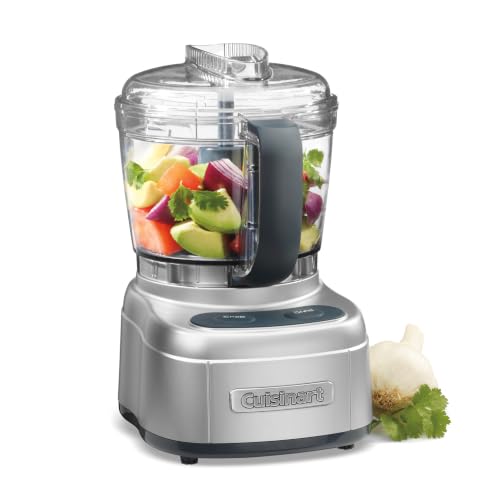
The Elemental 4-Cup Chopper/Grinder brings one detail the other compacts do not: BladeLock, a system that secures the SmartPower blade so it stays in place when you pour. Anyone who has decanted oily nut butter while fishing a loose blade out of the jar will understand immediately why this matters, and in a variety workflow — where pouring small batches is the whole rhythm — it may be the most practically valuable feature in this guide. The four-cup bowl is the same flavoured-batch sweet spot as its Core Custom sibling.
The grinder half of its name suits the spiced end of the rotation particularly well: spice blends ground in the same session, seeds reduced before they join a butter, small dry additions prepared exactly where they will be used. Its limits are the compact family’s usual ones — four cups, rested runs, no full-size ambitions — and the silver finish will show oily evidence of every batch until wiped. Choose it when your rotation leans spiced, seeded, and experimental, and when clean pouring sounds less like a luxury than it does to everyone who has tried the alternative.
Best for: spiced and seeded small batches, with clean pouring / Not suited for: any job needing full-size capacity or discs

KitchenAid 3.5 Cup Food Chopper
Badge: Best Compact All-Rounder
Strengths
- Three-and-a-half-cup bowl is a natural single-jar size for everyday varieties
- Two speeds plus pulse give control from coarse-crunchy to smooth finishes
- Dishwasher-safe bowl and easy cord wrap suit a machine used several times a week
Trade-offs
- Small batches only; a rotation’s staple still needs a bigger bowl
- Two speeds are control, but there is no program to run a long grind for you
- A colour finish like Empire Red is a long-term counter commitment
Key specs from the listing: Capacity: 3.5 cups. Blade: stainless steel multi-purpose. Controls: 2 speeds plus pulse. Care: dishwasher-safe work bowl. Feature: easy cord wrap. Finish: Empire Red. Model: KFC3516ER.
The KitchenAid 3.5 Cup Chopper closes the list as the compact all-rounder, and its distinguishing talent is control: two speeds plus pulse, where most minis offer a single take-it-or-leave-it action. For nut butters that control is texture control. Pulse work lets you stop a batch at the coarse, crunchy end on purpose, fold in chopped nuts at the finish for a proper crunchy style, or ease a delicate seed butter through its final stage without overworking it. The three-and-a-half-cup bowl is a natural single-jar size for the varieties a household eats steadily but slowly.
The practical details suit frequent use: a dishwasher-safe work bowl, a stainless steel multi-purpose blade, and an easy cord wrap that keeps a small machine tidy in a drawer between sessions. Empire Red is a cheerful commitment — you will be looking at it for years, which for most KitchenAid buyers is rather the point. Its ceiling is the family’s usual one: small jars, rested runs, and no pretensions toward the staple batch. Within the rotation, it is the everyday variety maker, the one that lives closest to hand.
Best for: everyday small jars and deliberate crunchy textures / Not suited for: anchor duties or bulk production
Comparison Table
In a rotation, the comparison that matters is role against role: which bowl anchors, which bowl experiments, and how fast each one returns to a clean, ready state.
| Pick | Bowl and format | Blade and controls | Stands out for | Listing |
|---|---|---|---|---|
| Cuisinart Mini Food Processor 3-Cup | 3-cup mini bowl | Auto-reversing SmartPower blade; chop and grind | Recipe testing and prototypes | Check on Amazon |
| Hamilton Beach 10-Cup Food Processor | 10-cup full-size bowl | Built-in bowl scraper; stainless steel design | The staple anchor batch | Check on Amazon |
| BLACK+DECKER 8-Cup Food Processor | 8-cup bowl | 450W motor; grind and puree among named jobs | Second-string mid-size batches | Check on Amazon |
| Cuisinart Core Custom 4-Cup Mini Chopper | 4-cup mini bowl | Auto-reversing SmartPower blade; dishwasher-safe parts | Dedicated flavoured batches | Check on Amazon |
| Cuisinart Elemental 4-Cup Chopper/Grinder | 4-cup chopper-grinder bowl | SmartPower blade with BladeLock; silver finish | Spiced batches, clean pouring | Check on Amazon |
| KitchenAid 3.5 Cup Food Chopper | 3.5-cup bowl | Stainless blade; 2 speeds plus pulse; cord wrap | Everyday jars, crunchy textures | Check on Amazon |
How to Choose a Food Processor for a Rotation of Nut Butters
Choose for the system, not the single jar. A rotation typically has three batch scales — the staple, the regular second-string, and the small flavoured or experimental batch — and the happiest kitchens match a bowl to each scale rather than forcing one machine through all three. That is why this guide spans ten cups down to three. Before buying anything, write down the butters you realistically expect to keep: most households land on one staple, two regulars, and a rotating cast of small experiments, and that list maps directly onto the anchor, middle, and compact roles in the reviews above.
Cleanup speed is a variety feature, full stop. Every batch change is a wash: oils carry flavour, and yesterday’s spiced batch will ghost into today’s plain one if the bowl is merely rinsed. Dishwasher-safe bowls and blades turn batch changes into a non-event, and details like a locking blade make the oily decanting stage cleaner and safer. When comparing listings, a variety maker should weight these details as heavily as motor figures — the machine that returns to service fastest is the machine the rotation actually revolves around.
Power still matters, but distribute your expectations. The anchor and middle machines carry the long grinds, so their stamina shapes the system; the compacts carry short, small work where technique and bowl fit beat wattage. Note what each listing actually claims — a stated four hundred fifty watts on the mid-size machine, blade systems on the compacts — and match the hardest job in your rotation, probably a raw almond staple, to the strongest bowl you own. Everything softer can cascade down to whichever machine is clean.
Flavour discipline is part of equipment choice too. Additions — salt, spices, cacao, sweeteners, crunchy chopped nuts — always join at the end, when the base butter is glossy, because early additions change how the grind behaves and can seize or stall a batch. A compact bowl makes late additions easier to fold in evenly, and pulse control, like the KitchenAid’s, makes the crunchy finish deliberate rather than accidental. If your rotation leans heavily flavoured, prioritise the compacts; if it leans plain and plentiful, prioritise the anchor.
Finally, think about freshness economics. Homemade butters have no stabilisers, so a giant batch of a slow-eaten variety will spend its life separating and slowly staling, while the same variety made small and often is always at its best. The compact-heavy shape of this guide is a freshness argument as much as a convenience one. Readers applying the same whole-ingredient logic across their cooking will find the pattern extended in our guide to the Best Food Processors For Pasta Filling, where small, fresh batches beat bulk there too.
How to Run a Nut Butter Rotation: Batch Workflow
A rotation runs on a simple production order: staple first, in the big bowl, while it is clean and the kitchen is fresh; then the mid-size regulars; then the small flavoured batches in the compacts, which wash fastest and carry flavours into each other least problematically when sequenced from plainest to most spiced. Working in that order means the strongest flavours — cinnamon, cacao, chilli — are always the last things through any shared equipment.
Each individual batch follows the same stage craft as any nut butter: roasted nuts, the crumb and powder stages, the stubborn ball, the collapse into gloss, flavourings only at the end. The workflow below adds the rotation layer — sequencing, labelling, and storage — that turns several good batches into a system that stays good.
- Plan the session: list the jars you will make, ordered from plainest to most strongly flavoured.
- Roast the nuts for each batch, and let them cool only slightly — warm nuts grind more willingly.
- Run the staple batch in the largest bowl; decant, label with the variety and the date, and get the bowl washing.
- Run the mid-size regular batches next, scraping and resting between stages as each nut type demands.
- Run flavoured and experimental batches last, in the compacts, adding spices, cacao, or crunchy pieces only once the base butter is glossy.
- Wash compact bowls between flavours, even briefly — oils carry yesterday’s cinnamon into today’s plain jar.
- Store jars cool and dark, oldest at the front, and eat the rotation in date order.
- Note what worked — nut, roast, additions, texture — while it is fresh; your next session will thank you.
Sequencing flavours is the rotation’s quiet craft. Plain before spiced, mild before chocolate, everything before chilli: oils remember, and a bowl that held a spiced batch will season the next one unless washed properly. The compacts’ quick washing is what makes correct sequencing painless, and it is the practical reason this guide recommends owning more than one small bowl if your variety habit grows.
Storage discipline finishes the job. Date every jar, keep the oldest at the front, and treat separation as normal — a stir restores a natural butter completely. Varieties with additions, especially anything sweetened or chocolate-based, are best eaten youngest, while a plain staple keeps its composure longest. The rotation stays a pleasure when no jar is ever a mystery, which is a labelling habit, not an equipment purchase.
Troubleshooting
Problem: A plain batch tastes faintly of cinnamon from the previous session → flavour carried over in oily residue → wash bowls, blades, and lids thoroughly between flavoured and plain batches, and sequence plain batches before spiced ones within a session.
Problem: One variety keeps separating and going stale before it is finished → the batch is too big for how slowly you eat it → move that variety down a bowl size next session and make it small and fresh instead.
Problem: The session stalls because everything is waiting on one bowl → the system has a bottleneck → run the staple in the anchor while compacts handle flavours in parallel, and start washes the moment each batch is decanted.
Building Flavours: From One Base Butter to a Shelf of Varieties
Every variety in a rotation starts life as the same plain butter, which is good news: master one base method and the flavour repertoire is just a set of endings. Salt and a touch of honey make the classic; cinnamon and maple make the breakfast jar; cacao and a little sweetener make the dessert spread; toasted coconut folded through makes the one guests ask about; chilli and lime zest, in a savoury-leaning batch, make a sauce base that transforms noodle dishes. Each is added at the glossy stage, in a compact bowl, in a quantity you can correct next time.
The discipline is to change one thing at a time and write it down. A rotation built on notes improves every session; a rotation built on vibes repeats its mistakes with confidence. Small bowls are what make this experimentation affordable — a failed experiment costs a handful of nuts, and a successful one gets promoted, with its notes, to a bigger bowl next time. That test-small, scale-what-works logic is the same thinking behind our guide to the Best Food Processors For Potatoes and other single-job guides in this series: the right bowl for the batch in front of you.
Seed Butters and Mixed Jars: Expanding the Rotation
A rotation earns its keep most for households managing preferences and allergies, where a seed butter — sunflower or pumpkin seed — is not a novelty but a necessity. Seeds behave like forgiving nuts: they grind through the same stages, often faster, and their butters take flavour beautifully. The compact bowls shine here, because the seed jar is often for one person and is best made fresh in small quantities, in a dedicated bowl that never carries nut residue into an allergic member’s food.
Mixed jars are the other expansion: the ends of three bags of nuts become one house blend, cashews soften an almond batch’s stubbornness, and a proportion of peanuts can rescue the texture of almost any mixture while lowering its cost in ingredients. Keep the base method identical, note the proportions, and treat the first mixed batch as a prototype in the mini before it joins the regular rotation. The system absorbs new members gracefully when each one is tested small first.
The Rotation on a Budget: Building the System in Stages
A rotation does not have to be bought in one afternoon, and for most households it should not be. The sensible first purchase is the machine your current habit needs most: if you already make a weekly staple, that is the anchor; if you are still discovering whether homemade butters suit your life, it is a single compact, which will test the habit for the price of a few jars of the premium shop-bought kind. Live with the first machine for a month of real use. The gap it leaves — the batch that was too big, the flavour test that was too committing, the second jar that had to wait for a wash — will tell you exactly which role to buy next, and you will buy it with evidence instead of enthusiasm.
The second purchase is usually a compact, because that is where rotations grow: a dedicated flavour bowl, a tester, a seed-butter unit for one household member. The third, if it comes, is the anchor upgrade or the mid-size second station. Bought in that order, every machine in the system has a job it was chosen for, nothing duplicates idly, and the total spent stays below the cost of one flagship bought on spec and half-used. Systems built by evidence look, in the end, remarkably like the six roles laid out in this guide — because the roles come from the work, and the work does not change.
There is also a social arithmetic to staging that solo makers overlook. A rotation built gradually becomes a small, generous economy: the experimental jar that did not suit your household suits a neighbour exactly, the staple made slightly too large becomes the gift that starts someone else’s habit, and the compact bought for testing becomes the most borrowed tool on the street. None of that requires planning — it emerges from owning right-sized equipment and using it often. But it is worth noticing, because it reframes the staged system from a compromise into the natural shape of the thing: equipment that grows with use, shared knowledge, and jars that travel. The makers who build their rotations this way tend to keep them for years, long after a single grand purchase would have been sold, stored, or forgotten — because every piece in the system was earned by a real need, and real needs do not go out of fashion.
What a Shelf of Jars Teaches You About Your Kitchen
A few months into a rotation, the jars start reporting on the household. The staple that empties twice as fast as expected is telling you it should be made in the bigger bowl, or flavoured and promoted. The beautiful experimental jar that lingers, separating quietly at the back, is telling you it was a pleasure to make and a duty to eat — make it half-size, in the smallest compact, or retire it with thanks. The seed butter that vanishes is a household need announcing itself. Rotations reward this kind of attention because every signal arrives as a simple, physical fact: an empty jar or a full one.
That feedback loop is the real argument for the system this guide describes. One machine making one butter gives you one fact at a time. A small fleet of right-sized bowls, each running its role, gives you a running picture of what your kitchen actually eats — and lets you adjust batch sizes, flavours, and shopping to match. The equipment is modest; the information is not. Makers who read their shelves rarely waste nuts, rarely run out of the jar that matters, and rarely buy another appliance they do not need.
There is a final, practical habit the shelf teaches: the monthly clear-eyed review. Once a month, line the jars up, oldest first, and plan the week’s cooking around what needs finishing — the spiced jar becomes a sauce, the slow flavoured batch becomes a baking ingredient, the staple gets its next session scheduled before it runs out rather than after. Ten minutes of looking prevents the two failures every rotation eventually threatens: running out of the jar you live on, and discovering a forgotten jar you no longer trust. The review costs nothing, uses no equipment at all, and quietly keeps the whole system — bowls, batches, flavours, and shopping — aligned with the household it feeds.
Keep the review honest and it stays useful: a jar that nobody reaches for is data, not failure, and the rotation that results from listening to it will be smaller, fresher, and eaten with more pleasure than the ambitious one it replaced.
Common Buying Mistakes
The first rotation mistake is making every variety in staple quantity. Slow-eaten flavours made big will separate, stale, and quietly put you off the whole habit. Match each variety to the bowl that fits how fast you eat it — which usually means the interesting jars are the small ones.
Second, skipping the wash between flavours. Oils are flavour carriers, and a rotation run through one unwashed bowl converges on a single muddy taste. The compacts in this guide wash in moments; there is no excuse the equipment accepts, and your plain almond butter will taste of cinnamon until you learn this once.
Third, adding flavourings during the grind. Early additions change the mixture’s behaviour, can seize a batch, and bury the flavour you were aiming for. Base butter first, glossy and finished — then season. The order is the method, in every bowl size.
Finally, mystery jars. An unlabelled rotation becomes a fridge-door lottery within a fortnight. Variety and date on every lid takes seconds and is the difference between a system and a shelf of anonymous jars nobody trusts.
Final Recommendation
A rotation is a system, so buy the system: an anchor for the staple, a middle bowl for the regulars, and compacts for the flavours and experiments that make the whole habit joyful. No single machine in this list is the whole answer, and the guide has not pretended otherwise — the answer is the combination, matched to the jars you actually keep.
Start with the Cuisinart Mini Food Processor 3-Cup if you want the safest all-round choice from this list. It is the only full-size bowl here, its scraper is built for exactly the thick mixtures a staple batch becomes, and around the staple it covers the week’s general processing without complaint. Build outward from it as your variety habit grows.
If that first choice does not fit your kitchen, the BLACK+DECKER 8-Cup Food Processor is the alternative we would look at next. Start smaller if your habit is young: the BLACK+DECKER as a mid-size foundation, or a single compact — the Core Custom for flavoured batches, the KitchenAid for texture control, the Elemental for clean pouring, the Mini for pure experimentation — and add the anchor when the staple batch outgrows them. However you assemble it, sequence plainly, label honestly, and make the interesting jars small and often.
Frequently Asked Questions
How many different nut butters does a typical rotation include?
Most households settle into one staple eaten daily, two regulars eaten weekly, and a small rotating cast of flavoured or seasonal jars. That pattern maps neatly onto the bowl sizes in this guide: a full-size anchor, a mid-size machine, and compacts for the small, interesting batches.
Should I buy one big processor or several small ones for variety?
For a genuine rotation, the system beats the single machine: small bowls make small batches properly, wash in moments, and keep flavours separate, while one full-size bowl anchors the staple. A single big machine forces every experiment to be a big commitment and every test load to bounce in an oversized bowl.
How do I stop flavours from carrying over between batches?
Wash bowls, blades, and lids properly between flavoured and plain batches — nut oils carry flavour — and sequence each session from plainest to most spiced, so any trace residue runs in a harmless direction. Dishwasher-safe compacts make this discipline painless.
When do flavourings like cinnamon or cacao go in?
Always at the end, once the base butter is glossy and finished. Early additions change how the grind behaves and can seize or stall a batch, and their flavour dulls with extended processing. Fold additions through with brief pulses, taste, and adjust — that final stage is where a variety is actually created.
Can I include seed butters in the same rotation?
Yes — sunflower and pumpkin seeds grind through the same stages as nuts, often faster, and take flavour well. For an allergic household member, dedicate a compact bowl to seed butters only, so nut residue never reaches their jar. Small, fresh, dedicated batches are what compacts do best.
How long do homemade nut butters keep?
Kept cool, dark, and sealed, plain butters hold their quality longest; flavoured and sweetened varieties are best eaten youngest. Date every jar, store oldest at the front, and stir any separated oil back in — separation is natural in butters with no stabilisers, not a sign of failure.