A home espresso machine should fit your counter, your routine and your patience. Some models grind, tamp and brew with help from the machine, while others leave all of it to you. The right choice depends on how involved you want to be each morning.
The six machines below include assisted grinder machines and simpler pump models. We have not used these products ourselves, so confirm every detail on the current listing before you buy. Check the machine size, the tank size and whether a separate grinder is required.
As an Amazon Associate we earn from qualifying purchases. Links below are affiliate links, and they do not change the product information we give.
What to Look For
| Feature | Why it matters |
|---|---|
| Involvement | Some machines assist; others are fully manual |
| Grinder | Built-in grinders save space and effort |
| Temperature control | Thermal stability makes shots repeatable |
| Footprint | Check height and depth before buying |
In this guide
Specs at a Glance
| Machine | Type | Grinder | Notes |
|---|---|---|---|
| Breville Barista Express Impress | Semi-automatic with assisted tamping | Built-in grinder | Assisted tamping and a built-in grinder |
| De’Longhi La Specialista Opera | Semi-automatic | Built-in grinder | Grinder and tamping help in the body |
| Rancilio Silvia Pro X | Semi-automatic, upgraded | No grinder | Sturdy build and refined control |
| Lelit Mara X | Heat exchanger with E61 group | No grinder | Thermal stability and an E61 group |
| Breville Duo-Temp Pro | Semi-automatic | No grinder | A pressure gauge and a steam wand |
| Calphalon Temp iQ | Semi-automatic | Built-in grinder | Built-in grinder and a steam wand |
The 6 Best Home Espresso Machines

Top pickBest for users who like help
1. Breville Barista Express Impress
An updated Barista Express with an assisted tamping system that helps with dose and pressure. It lowers the chance of a bad first shot. Check the listing for the water tank size and what is included.
Suits: users who like help. Strengths: assisted tamping and a built-in grinder. Weaknesses: it is large. Skip it if you want maximum manual control.
View Breville Barista Express Impress on Amazon

Best for users who want guidance
2. De’Longhi La Specialista Opera
A machine with a built-in grinder and a guided approach to dose and tamp. It aims to give consistent results at home, with less guesswork on grind and tamp. Check the current listing for the drink options and the tank size.
Suits: users who want guidance. Strengths: grinder and tamping help in the body. Weaknesses: it is bulky. Skip it if you want a minimal machine.
View De’Longhi La Specialista Opera on Amazon

Best for serious hobbyists
3. Rancilio Silvia Pro X
An upgraded take on a well-known Italian machine with improved temperature control. It targets hobbyists who want to grow. Pair it with a good grinder. Check the listing for the boiler design and features. The frame is tough and many parts can be replaced, so it can serve for years with care.
Suits: serious hobbyists. Strengths: sturdy build and refined control. Weaknesses: it is a premium purchase. Skip it if you want an automatic machine.

Best for enthusiasts
4. Lelit Mara X
A heat exchanger machine with an E61 group and thermal stability features. It is meant for home users who want a refined machine without a huge size. A grinder is needed. Check the listing for details.
Suits: enthusiasts. Strengths: thermal stability and an E61 group. Weaknesses: it needs a separate grinder. Skip it if you want a plug-and-play machine.
Best for home users who want a simple machine
5. Breville Duo-Temp Pro
A semi-automatic machine in the Breville range with a pressure gauge and a steam wand. It is a simpler path to home espresso. A separate grinder is needed. Check the listing for the accessories in the box. It is a popular entry point for people who plan to learn on a moderate machine before upgrading.
Suits: home users who want a simple machine. Strengths: a pressure gauge and a steam wand. Weaknesses: it needs a separate grinder. Skip it if you want a built-in grinder.
View Breville Duo-Temp Pro on Amazon
Best for all-in-one buyers
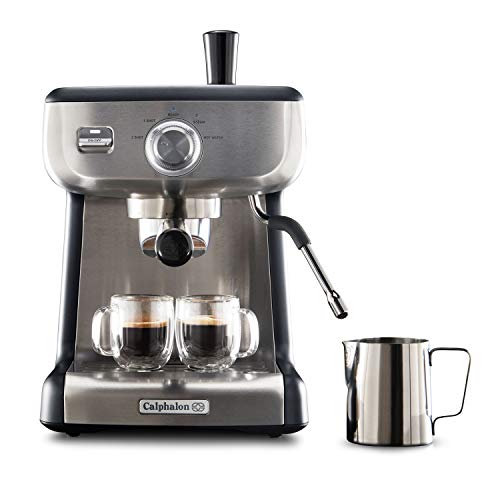
6. Calphalon Temp iQ Espresso Machine
A semi-automatic machine with a built-in grinder, aimed at users who want a single appliance. It offers temperature options and a steam wand. Check the listing for the features and tank size. It suits people who do not want a separate grinder taking up counter space.
Suits: all-in-one buyers. Strengths: built-in grinder and a steam wand. Weaknesses: it takes counter space. Skip it if you want a classic Italian build.
View Calphalon Temp iQ on Amazon
Care and Setup
- Descale on the maker’s schedule.
- Clean the portafilter basket daily.
- Wipe the steam wand after use.
- Empty the drip tray often.
Mistakes to Avoid
- Buying a machine without room for a grinder.
- Letting milk dry on the wand.
- Skipping descaling.
- Ignoring the warm-up time.
How Much Involvement Do You Want
The most useful question to ask about a home espresso machine is not how much it can do but how much you want to do. Every machine sits somewhere between full automation and full manual control, and a mismatch is the main reason people stop using a machine after the first few months. Some owners enjoy weighing beans, adjusting the grind and steaming milk by hand. Others want a good drink in a minute or two before work.
Consider three buyer types:
- The routine seeker wants the same drink each morning with little effort. Assisted machines with a built-in grinder and guided tamping reduce the number of decisions.
- The hobbyist enjoys tinkering and wants room to improve. A machine with a standard portafilter, good temperature stability and a separate grinder gives that room.
- The household with mixed tastes needs speed and simplicity so that everyone can make a drink without training.
Be honest about your time. A machine that requires fifteen minutes of preparation will be used on weekends only, however good the shots are. On the other hand, a machine with a ceiling on control may feel limiting after a year. If you are unsure, pick the middle path, where the machine helps with dosing or tamping but still lets you change the grind and recipe. Also think about who else will use it, since a partner or guest may find a complicated setup frustrating.
Boiler Types and Heat-Up Time
How a machine heats its water affects speed, steam power and consistency. The common designs are thermoblock, single boiler, heat exchanger and dual boiler. A thermoblock heats water as it passes through, so it warms up quickly and suits compact machines, though temperature stability can be modest. A single boiler uses one tank of water for both brewing and steaming, which means you wait between making a shot and steaming milk, because the boiler has to change temperature.
A heat exchanger machine keeps a boiler at steam temperature and passes brew water through a tube inside it, so you can brew and steam at about the same time. It often needs a short cooling flush before a shot. A dual boiler has separate boilers for brewing and steaming, offering the steadiest temperature and the best multitasking, but it is larger and takes longer to warm.
- Quick mornings: favor a design that heats quickly, and check the listing for the stated warm-up time.
- Several milk drinks in a row: look for a heat exchanger or dual boiler.
- Occasional use: a thermoblock or single boiler is usually enough.
Heat-up time claims vary and depend on how the maker measures them, so treat them as a guide. Also consider whether the machine has a temperature control, since a small adjustment can make a large difference with different roasts.
Counter Space and Kitchen Fit
A home espresso setup takes more room than the machine alone. Plan for the machine, a grinder if one is not built in, a knock box or bin for used grounds, a tamping mat, a milk jug and somewhere to keep beans. Many people underestimate this and end up with clutter or a machine that is awkward to use.
Measure carefully:
- Width and depth of the machine, including the space for the portafilter handle to swing.
- Height under your cabinets, because tall machines often need clearance to fill the water tank from the top.
- Cup clearance between the group head and the drip tray, to fit your cups and a scale.
- Access to the tank, whether at the back, side or top.
- Cord length and the position of the nearest outlet.
Weight matters if you plan to move the machine to clean behind it. Heavy machines stay put but are a chore to lift. Also think about ventilation and heat. Some machines release warmth from the top, where many people store cups, so check whether a cup warmer is built in. If space is tight, a machine with a built-in grinder saves room, while a separate grinder gives you the option to upgrade later. Always confirm dimensions on the current listing.
Water Quality and Maintenance Schedule
Water makes up most of an espresso, and it also affects how long your machine lasts. Hard water leaves mineral scale in boilers and pipes, while very soft or distilled water can taste flat and confuse some level sensors. Check your machine’s manual for recommended water, and consider a filter designed for it.
A simple maintenance plan keeps things running:
- Daily: flush the group, wipe the group head and steam wand, rinse the basket and portafilter, and empty the drip tray.
- Weekly: soak the portafilter parts in an espresso machine cleaner, and wash the drip tray and tank.
- Periodically: backflush if your machine has a suitable valve, and follow the maker’s guidance.
- On schedule: descale using a product the manufacturer approves, and replace water filters and gaskets as directed.
Coffee oils turn rancid, and old residue can taint shots, so cleaning matters as much as descaling. Keep a small brush and cleaning tablets or powder on hand. If you travel for long stretches, empty the tank and follow the manual’s storage advice. Check the warranty terms, since some makers require approved cleaning products and regular maintenance to keep coverage.
Budget Tiers and Upgrade Paths
Home espresso machines can be grouped by what you gain as you spend more, without needing exact figures. At the entry level, you usually get a compact machine with basic controls, a simple steam wand and limited temperature stability. These are fine for learning and for people who make a few drinks a week. In the middle, you often gain a more stable temperature, better steam, stronger build and sometimes a built-in grinder or assisted dosing.
At the upper end, expect heavier construction, commercial-style groups, dual boilers, precise temperature control and parts that can be serviced. These reward users who want fine control and will keep the machine for years.
- Spend on the grinder before extras on the machine, since grinding quality limits results.
- Consider the cost of accessories: tamper, scale, milk jug, cleaning supplies and filters.
- Check how easy it is to get replacement parts, such as gaskets, shower screens and baskets.
- Think about resale or hand-down value if you may upgrade later.
Signs you have outgrown a machine include wanting steadier shot temperature, struggling with steam when making several drinks, or finding that the controls limit your recipes. If you are only occasionally disappointed, a better grinder or fresher beans may improve results more than a new machine.
Home Espresso Machines FAQ
How long does a home espresso machine take to warm up?
It varies. Many compact machines heat in under a minute, and heavier machines take longer.
Is an assisted machine worth it?
It helps beginners get consistent results, though experienced users may prefer manual control.
Should I choose a machine with a grinder?
It saves space and keeps setup simple, but a separate grinder gives more room to upgrade. Choose based on your counter and how deep you want to go.
Do I need filtered water?
Filtered water can reduce scale buildup and improve taste. Check your machine’s manual.
How long should I leave the machine on before making a shot?
Follow the manual. Compact machines may be ready in a minute or two, while heavier machines often benefit from a longer warm-up so the group head and portafilter reach a stable temperature.
Can I use any coffee beans?
Most beans work, but espresso roasts are often chosen for balance with milk. Very oily beans can clog grinders, so check the machine and grinder manuals.
What accessories do I need beyond the machine?
A tamper, a scale, a milk jug, a knock box and cleaning supplies are common essentials. Check what the machine includes in the box.
Is a pressure gauge useful?
It can show how the machine is performing during a shot and help diagnose problems. It is not essential, but many learners find it a helpful guide.
How loud are home espresso machines?
Pump noise varies by model, and grinders add their own sound. If noise matters, read the listing and think about when you use it.
Can I use plant milk with a home machine?
Yes, but results vary by brand and type. Look for versions made for frothing and expect to adjust your technique.
Should I leave the machine plugged in all day?
Follow the manufacturer's guidance. Many machines have auto shutoff, and unplugging or switching off when you are away saves energy and reduces wear.
Dialing In: Grind, Dose, Yield and Time
Buying a good machine does not guarantee a good shot. Espresso depends on a handful of variables, and learning how they interact is the real skill. This process is called dialing in, and it applies whether you own a simple Duo-Temp or a prosumer machine like the Lelit Mara X.
The four variables
- Dose: the weight of ground coffee in the basket.
- Yield: the weight of liquid espresso in the cup.
- Time: how long the shot takes, from pump start to finish.
- Grind size: how fine the coffee is, which controls how quickly water passes through.
A sensible starting recipe
Many people begin with a ratio near one part coffee to two parts liquid, such as 18 grams in and about 36 grams out, over roughly 25 to 30 seconds. This is a starting point, not a rule. Different beans and roast levels often prefer different ratios.
Reading the result
If the shot runs fast and tastes sour or thin, the grind is probably too coarse. If it drips slowly and tastes harsh or bitter, it is probably too fine. Change one thing at a time, usually the grind, and taste after each adjustment. Writing down each attempt saves frustration.
Assisted machines and models with built-in grinders, such as the Breville Barista Express Impress, reduce some of these variables by dosing and tamping for you, but you still need to taste and adjust. A scale that measures to a tenth of a gram helps on any machine.
Milk Drinks and Steaming Ability
If most of your drinks include milk, steaming performance deserves as much attention as the espresso itself. Not every machine steams the same way, and the difference shows up in how quickly you can make a latte and how silky the texture turns out.
A manual steam wand gives the most control. You angle the pitcher, introduce a little air and then swirl the milk to create smooth microfoam. This takes practice but allows latte art and a range of textures. Some machines include an automatic milk system that adjusts temperature and texture, which is convenient but offers less flexibility.
Boiler design affects how soon you can steam after pulling a shot. Single-boiler machines often require a short wait to switch temperatures, while dual-boiler and heat-exchanger designs let you brew and steam in quick succession. If you regularly make drinks for two or more people, that difference becomes meaningful.
Whatever machine you choose, a few habits help. Start with cold milk in a cold pitcher, purge the wand before and after use, and wipe it right away so dried milk does not clog the tip. Whole milk generally gives the creamiest result, but oat and some barista-style plant milks also steam well.
Pairing a Machine with a Grinder
The grinder is often described as more important than the machine. Fresh, consistent grounds make an affordable machine perform better, while inconsistent grounds ruin a premium one.
A burr grinder with fine adjustment is essential. Blade grinders produce uneven particles and cannot reach a consistent espresso grind. Look for a model with small steps between settings, since a tiny change in fineness shifts the flow of the shot significantly.
If you buy a machine without a grinder, such as the Rancilio Silvia Pro X or the Lelit Mara X, set aside part of your budget for a quality grinder. A machine with a built-in grinder saves space and money, but it limits your ability to upgrade just the grinder later.
Single-dosing, where you weigh the beans for each shot and grind only what you need, keeps coffee fresher and reduces waste. A grinder that supports this workflow is a good fit if you drink one or two shots a day.
Electrical Requirements, Plumbing and Placement
Home espresso machines draw significant power, especially when heating up. Most standard North American models plug into a normal 120-volt outlet, but they can trip a circuit if other high-draw appliances share it. Avoid running a toaster or kettle on the same circuit, and plug the machine into the wall instead of a cheap extension strip.
Check the machine’s reservoir capacity, because it determines how often you will refill. Larger tanks suit households that make many drinks. Some prosumer models can be plumbed directly into a water line with an adapter, which removes refilling, but this requires a filter, a shutoff valve and often a professional’s help.
Allow space around the machine for heat to disperse, and make sure the surface is stable and water-resistant. A drip tray that fills quickly will need emptying often, so keep a towel and a small knock box close by.
One more practical point: give yourself a realistic learning window. Most people need a few weeks of regular shots before results become consistent, and wasted coffee during that period is a normal cost of the hobby. Buy fresh beans in small quantities, keep a simple log of dose, yield, time and taste, and resist changing several things at once. A machine that is easy to clean and use daily will serve you better than one you avoid because setup feels like a project.
Frequently Asked Questions
What ratio should I use for espresso?
A common starting ratio is 1 part dry coffee to about 2 parts liquid espresso by weight, such as 18 grams in and 36 grams out. Many baristas adjust this by roast level and taste. Darker roasts often work with a shorter ratio, while lighter roasts may benefit from a longer one.
Why does my espresso taste sour?
Sour espresso is usually under-extracted, meaning the water passed through the coffee too quickly. Try a finer grind, a slightly longer shot or a slightly higher dose. Also check that the machine has warmed up fully, since low brewing temperatures contribute to sourness. Change one variable at a time.
What is a bottomless portafilter used for?
A bottomless portafilter has no spouts, so you can see the coffee flow directly. It reveals channeling and uneven extraction, which makes it a helpful learning tool for dialing in. It is less forgiving than a spouted one, so many people use it for practice and diagnostics.
Can a home espresso machine make Americanos and lattes?
Yes. An Americano is espresso with hot water added, which you can pour from a kettle or the machine, if it has a hot water outlet. A latte adds steamed milk, so you need a steam wand or automatic milk system. Most home machines handle both.
Going Deeper: What This Guide Means by a Good Espresso Machine
This article was written for a home espresso machine matched to a real kitchen and a real household, not a showroom. Keep that real-kitchen test in mind as you re-read the six machines, because a model that suits a showroom counter can be the wrong answer for an actual household, however well made it is. The honest way to use this guide is to decide what your home session must deliver — drinks the household wants, on the mornings you have — then judge each option against that, not an abstract best. It is worth slowing down here, because this is the point where a good home purchase either becomes a daily pleasure or becomes clutter under the cupboards.
Start with household frequency. A home machine used twice a day lives a different life from one used twice a month, and the features that matter change with that rhythm. Frequent use rewards easy cleaning, predictable behaviour and parts you can replace easily when the household depends on it. Occasional use rewards simplicity and forgiving operation, because a weekend user never builds daily muscle memory. Be honest about which user your household is: many disappointed owners bought for the enthusiast they hoped to become, then resented a routine their mornings could not support.
Next, think about the whole system around the home machine, not the machine alone. The kitchen counter it sits on, beans from a roaster whose roast dates you can see and buy little and often, the water from your tap, and the time your household genuinely has all shape the result as much as the headline product does. A modest home setup used carefully outperforms an ambitious one used in a rush. When you compare the picks, keep asking what each one demands of the rest of your kitchen and household, because that demand is part of the real cost of ownership.
Comparing the Picks With Each Other, Not With Perfection
The six picks in this guide were chosen to cover different kinds of household, so a head-to-head reading is more useful than a ranking. Use the comparisons below as questions to carry back into the individual reviews above, your own kitchen in mind. Where two picks seem close, the deciding factor is usually workflow: how the session starts, what you have to watch, and how much clearing up waits at the end for whoever is on duty. Those differences still shape your mornings in six months, long after first impressions become household routine.
Set the Breville Barista Express Impress beside the De’Longhi La Specialista Opera and ask what each assumes about you. The Breville Barista Express Impress makes most sense when its way of working matches your household’s: the pace it sets, and the decisions it leaves in your hands. Notice your reaction to the Breville Barista Express Impress routine above: pleasure there is real information, not a distraction. If it sounded like homework, believe that too, and look again at the De’Longhi La Specialista Opera, whose appeal may be precisely that it asks less of you when you have least to give. A home machine you use happily and often beats a theoretically finer one that gathers dust.
Set the De’Longhi La Specialista Opera beside the Rancilio Silvia Pro X and ask what each assumes about you. For a home, the De’Longhi La Specialista Opera earns its place when its routine fits your kitchen’s life — its tempo, its upkeep and the choices it hands back to you. If the De’Longhi La Specialista Opera routine above left you keen rather than daunted, that is real information about fit. If it sounded like homework, believe that as well, and revisit the Rancilio Silvia Pro X, which may suit your household better by asking less on tired mornings. For a household, the machine that gets used beats the machine that merely impresses guests.
Set the Rancilio Silvia Pro X beside the Lelit Mara X and ask what each assumes about you. The Rancilio Silvia Pro X suits households whose habits mirror its own: the rhythm it keeps and the decisions it leaves to whoever is making drinks. Trust the feeling the Rancilio Silvia Pro X routine above produced; it is real information about how you will use it. If it read like homework, trust it and look again at the Lelit Mara X: at home, the machine that asks less often gets used more. A forgiving machine used daily makes better coffee than a finer one avoided since the second week.
Set the Lelit Mara X beside the Breville Duo-Temp Pro and ask what each assumes about you. The Lelit Mara X makes most sense when its way of working matches your household’s: the pace it sets, and the decisions it leaves in your hands. If the Lelit Mara X routine above sounded like something you would repeat happily, file that as real information. If it sounded like homework, believe that too, and look again at the Breville Duo-Temp Pro, whose appeal may be precisely that it asks less of you when you have least to give. Households improve on the machine they enjoy, not the one with the longest feature list.
Set the Breville Duo-Temp Pro beside the Calphalon Temp iQ Espresso Machine and ask what each assumes about you. For a home, the Breville Duo-Temp Pro earns its place when its routine fits your kitchen’s life — its tempo, its upkeep and the choices it hands back to you. If the Breville Duo-Temp Pro routine above sounded pleasant rather than chore-like, that reaction is real information. If it sounded like homework, believe that as well, and revisit the Calphalon Temp iQ Espresso Machine, which may suit your household better by asking less on tired mornings. The right home machine is the one still in daily use when the novelty wears off.
Set the Calphalon Temp iQ Espresso Machine beside the Breville Barista Express Impress and ask what each assumes about you. The Calphalon Temp iQ Espresso Machine suits households whose habits mirror its own: the rhythm it keeps and the decisions it leaves to whoever is making drinks. If working through the Calphalon Temp iQ Espresso Machine routine above felt easy, trust it — that reaction is real information. If it read like homework, trust it and look again at the Breville Barista Express Impress: at home, the machine that asks less often gets used more. A machine that invites one more drink today is worth more than a finer one that invites excuses.
One more comparison habit is worth adopting: compare the picks at their worst, not their best, in a real home. Every home machine here can produce a good result on a good day. What separates them is what happens on a tired weekday, with a new bag of beans, a distracted parent or partner, and no time to start again. The pick whose failure mode is a slightly ordinary drink, rather than a wasted batch or a mess, is often the right one for a busy household. Read the honest-limitation notes in each review above with that weekday in mind, and the household shortlist usually narrows itself.
A Careful Espresso Session, Step by Step
Technique advice is easy to give and hard to use in the abstract, so here is the home espresso session broken into the order that experienced users actually follow. You need not memorise the routine. Run through it deliberately a few times and it becomes a rhythm, and rhythm is what makes home results repeatable. While you work, watch the stream slow and change colour, listen to the pump over the kitchen noise, and taste for balance, not numbers. Those senses, trained over a handful of home sessions, will tell you more than any single gadget or guess.
Work on measuring the counter and the cupboard height before the machine is even ordered. Done deliberately rather than roughly, measuring counter and cupboards first makes the rest of the session easy to judge. When a result disappoints, a routine built on measuring counter and cupboards first lets you name the step that drifted; without one, every session is a fresh mystery and progress is mostly luck. The extra moments on measuring counter and cupboards first are repaid in results you can repeat.
Work on setting up a small station so beans, tools and cups live within reach. Take care with setting up a reachable station instead of rushing it, because that care makes the session readable. A steady approach to setting up a reachable station means a poor result points at a step you can name, instead of leaving every session a guessing game. Time spent setting up a reachable station buys results you can reproduce deliberately.
Work on learning the machine’s warm-up rhythm and fitting it to your mornings. Handled on purpose instead of approximately, learning the warm-up rhythm is what makes the rest of the session legible. Consistency in learning the warm-up rhythm turns improvement into method: a bad result identifies its own culprit rather than leaving you to luck. Extra care with learning the warm-up rhythm pays back in drinks you can repeat.
Work on pulling shots and steaming in the order your household actually drinks. Done deliberately rather than roughly, working in the household’s drinking order makes the rest of the session easy to judge. When a result disappoints, a routine built on working in the household’s drinking order lets you name the step that drifted; without one, every session is a fresh mystery and progress is mostly luck. The extra moments on working in the household’s drinking order are repaid in results you can repeat.
Work on keeping the water tank filled and the drip tray emptied before they force the issue. Take care with keeping tank filled and tray emptied instead of rushing it, because that care makes the session readable. A steady approach to keeping tank filled and tray emptied means a poor result points at a step you can name, instead of leaving every session a guessing game. Time spent keeping tank filled and tray emptied buys results you can reproduce deliberately.
Work on agreeing house rules for wiping the wand, so the machine survives shared use. Handled on purpose instead of approximately, agreeing house rules for the wand is what makes the rest of the session legible. Consistency in agreeing house rules for the wand turns improvement into method: a bad result identifies its own culprit rather than leaving you to luck. Extra care with agreeing house rules for the wand pays back in drinks you can repeat.
Finally, end the home session properly. Tidy up while everything is still easy to clean, jot down what you changed and what it did, and leave the counter ready for the next household session. That habit separates households who improve steadily from those who plateau: the next session starts from knowledge instead of a vague memory. Over a few months those short notes become the most valuable guide your household owns, because they describe your machine, your beans and your taste, not a stranger’s.
Troubleshooting: When the Result Is Not What You Expected
Every owner of a home espresso machine meets the same handful of disappointments. The reassuring part is that each problem has only a handful of plausible causes, and calmly working through them fixes most household cases without new purchases. Alter a single variable at a time, and let it prove itself over several household drinks before touching another. Two adjustments at once leave you knowing the result changed but not why, which is how households end up chasing their tails for weeks.
Consider a machine that fits the counter but not the cupboards above it. Before blaming the equipment, check the basics in order — bean freshness and quality, quantities, temperatures, and whether everything was properly prepared and clean — because the counter-fit, cupboard-clash machine usually starts there. One of the four usually explains the counter-fit, cupboard-clash machine. If the basics are sound, change the one variable the reviews above link most closely to the counter-fit, cupboard-clash machine, and repeat the session otherwise identically. If the counter-fit, cupboard-clash machine survives several honest attempts, consult the manual’s troubleshooting pages or the maker’s support, notes in hand.
Consider the first drink of the day delayed by a cold machine. Resist blaming the machine until you have checked freshness, quantities, temperatures and cleanliness in that order, since the cold-machine first drink rarely begins with the hardware. Usually one of the four sits behind the cold-machine first drink. With the basics confirmed, adjust only the factor the reviews above tie to the cold-machine first drink, keeping the rest of the session identical. Should the cold-machine first drink persist through a few fair attempts, take your notes to the maker’s support.
Consider household members each using the machine a different way. Work through the basics first: fresh, suitable ingredients, honest quantities, proper temperatures and a clean, prepared machine, because the everyone-does-it-differently problem is usually one of them in disguise. Mostly, one of the four explains the everyone-does-it-differently problem. Once the basics check out, vary just the variable the reviews connect with the everyone-does-it-differently problem and rerun the session unchanged otherwise. When several careful attempts leave the everyone-does-it-differently problem unchanged, consult the manual or the maker, notes ready.
Consider a water tank that is awkward to reach and therefore rarely cleaned. Before blaming the equipment, check the basics in order — bean freshness and quality, quantities, temperatures, and whether everything was properly prepared and clean — because the awkward, rarely cleaned tank usually starts there. One of the four usually explains the awkward, rarely cleaned tank. If the basics are sound, change the one variable the reviews above link most closely to the awkward, rarely cleaned tank, and repeat the session otherwise identically. If the awkward, rarely cleaned tank survives several honest attempts, consult the manual’s troubleshooting pages or the maker’s support, notes in hand.
Consider great weekend drinks and rushed, worse weekday ones. Resist blaming the machine until you have checked freshness, quantities, temperatures and cleanliness in that order, since great weekends, rushed weekdays rarely begins with the hardware. Usually one of the four sits behind great weekends, rushed weekdays. With the basics confirmed, adjust only the factor the reviews above tie to great weekends, rushed weekdays, keeping the rest of the session identical. Should great weekends, rushed weekdays persist through a few fair attempts, take your notes to the maker’s support.
Ownership Over Months and Years, Not Just the First Week
The first week with a new home machine is the worst guide to owning it. Novelty hides friction, and enthusiasm covers for routines that will not survive a busy month of school runs and deadlines. Judge your purchase again after a season of ordinary household use. Is the whole household still reaching for it? Is cleaning still happening properly, or has it become a wipe and a promise nobody owns? Can the household restock its consumables easily? Good home ownership is mostly small, regular attention: seals, filters, tubes, surfaces and moving parts all age better cleaned little and often than rescued occasionally.
Keep the manual in the kitchen drawer, and read its maintenance pages once before you need them. Makers write those pages from the failures they see returned to them, so they map what goes wrong in real homes when care slips. Note which parts are consumable, which anyone in the house can replace, and what the maker asks you not to open or soak. If a part will wear out, check it is available before it fails, not during the week the household needs the machine most. A simple record of deep cleans and part changes stops shared maintenance becoming guesswork.
Before You Buy: A Final Round of Questions
Where in the kitchen will it live? Measure the space, including the room above and in front of it, and think about heat, steam, splashes or noise reaching whatever sits nearby — including people. Who else will use it, and will its routine make sense to them without you standing over it on a weekday? What does it need that your household does not own, and are you content to buy, store and clean those extras? What does the maker say about cleaning and servicing, and does that schedule fit a busy household’s patience? None of these questions is glamorous, which is why they deserve asking before money changes hands on a home machine.
More Questions Readers Ask
How do I choose a machine for a household with mixed tastes?
The honest answer on choosing for mixed tastes depends on your routine, but owners report a consistent pattern. Start from the basics emphasised throughout this guide — fresh, suitable ingredients, a clean, properly prepared machine, one routine repeated — and choosing for mixed tastes gets easier to judge. Most disappointment over choosing for mixed tastes traces to a basic, not the machine. Give a change a few sessions before judging; single results mislead, patterns are evidence, on choosing for mixed tastes as elsewhere.
What warm-up habits suit a busy household best?
Your routine frames warm-up habits for busy households, but owners report a consistent pattern. Anchor on the basics this guide repeats: fresh ingredients, a clean machine, the same routine each time, and warm-up habits for busy households usually answers itself. Usually warm-up habits for busy households goes wrong because a basic slipped, not because the machine failed. Judge a change over several sessions: single results mislead, patterns do not, especially on warm-up habits for busy households.
Can one machine serve both milk drinkers and purists well?
No universal answer exists on one machine for purists and milk drinkers, yet owners report a consistent pattern. The reliable starting point is the one used throughout: fresh, suitable ingredients, everything clean and prepared, one routine, applied to one machine for purists and milk drinkers. Most frustration with one machine for purists and milk drinkers starts with a basic, not the equipment. Let changes run a handful of sessions before ruling; patterns beat one-off results on one machine for purists and milk drinkers.
How often should a shared machine be deep cleaned?
The honest answer on deep-cleaning a shared machine depends on your routine, but owners report a consistent pattern. Start from the basics emphasised throughout this guide — fresh, suitable ingredients, a clean, properly prepared machine, one routine repeated — and deep-cleaning a shared machine gets easier to judge. Most disappointment over deep-cleaning a shared machine traces to a basic, not the machine. Give a change a few sessions before judging; single results mislead, patterns are evidence, on deep-cleaning a shared machine as elsewhere.
What footprint mistakes do buyers most often make?
Your routine frames common footprint mistakes, but owners report a consistent pattern. Anchor on the basics this guide repeats: fresh ingredients, a clean machine, the same routine each time, and common footprint mistakes usually answers itself. Usually common footprint mistakes goes wrong because a basic slipped, not because the machine failed. Judge a change over several sessions: single results mislead, patterns do not, especially on common footprint mistakes.
When is a second, simpler option better than one big machine?
No universal answer exists on one big machine versus a simpler second, yet owners report a consistent pattern. The reliable starting point is the one used throughout: fresh, suitable ingredients, everything clean and prepared, one routine, applied to one big machine versus a simpler second. Most frustration with one big machine versus a simpler second starts with a basic, not the equipment. Let changes run a handful of sessions before ruling; patterns beat one-off results on one big machine versus a simpler second.
The Short Version
For assisted tamping, the Barista Express Impress. For guidance, the Opera. For refinement, the Silvia Pro X. For thermal stability, the Lelit Mara X. For a simple machine, the Duo-Temp Pro. For an all-in-one, the Calphalon Temp iQ.


