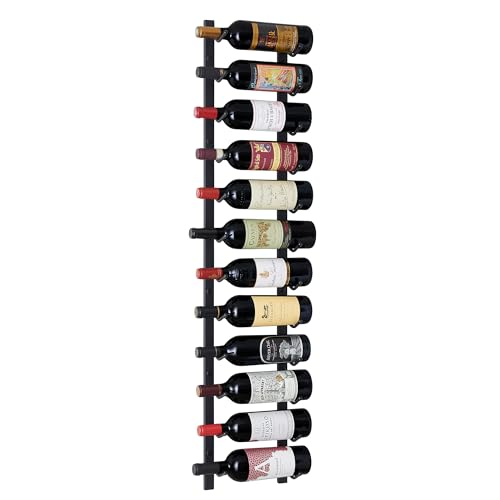
A wall mounted wine rack stores bottles on their sides against a wall, saving floor space and turning a blank stretch of plaster into a display. Some racks are minimal metal rails, others combine wood shelves with glass holders, and a few look like wall art.
The six racks below span a modern geometric metal style, a rustic wood piece and a few multi-bottle designs. We have not used these products ourselves, so confirm bottle capacity, assembly needs and wall-fixing hardware on the current listing before you buy.
As an Amazon Associate we earn from qualifying purchases. Links below are affiliate links, and they do not change the product information we give.
What to Look For
| Feature | Why it matters |
|---|---|
| Capacity | Choose a bottle count that fits your habits rather than your hopes |
| Bottle size | Wide bottles such as sparkling wine may not fit narrow cradles |
| Material | Metal is slim and strong; wood is warmer but heavier |
| Mounting | Studs or heavy-duty anchors are a must for loaded racks |
| Storage | Bottles last longer lying down away from light and heat |
| Style | A rack is visible every day, so the finish should suit the room |
In this guide
Specs at a Glance
| Rack | Material | Capacity class | Notes |
|---|---|---|---|
| Wallniture Torino | Metal | Several bottles | Modern style |
| Sorbus Wall Mounted Wine Rack | Metal and wood | Several bottles | Includes glass holder |
| Wine Enthusiast Wall Mounted Rack | Metal | Several bottles | Tidy, simple frame |
| Umbra Vine Wall Wine Rack | Metal | Few bottles | Designed for small spaces |
| YouDeNova Wooden Wall Wine Rack | Wood | Several bottles | Rustic look |
| Spectrum Diversified Wall Wine Rack | Metal | Few bottles | Space saver |
The 6 Best Wall Mounted Wine Racks
Top pickBest for modern dining areas
1. Wallniture Torino Wall Mounted Wine Rack
A modern metal rack with a geometric layout that doubles as wall decor. It is aimed at apartments and dining nooks. It can be hung horizontally or in a staggered pattern, depending on your wall.
Suits: modern dining areas. Strengths: a sleek geometric design. Weaknesses: drilling is needed. Skip it if you want a classic wood rack.
View Wallniture Torino Wine Rack on Amazon
Best for small bars
2. Sorbus Wall Mounted Wine Rack with Glass Holder
A rack that offers bottle cradles with a rail for stemware, usually in metal and wood. It works as a compact bar station. Bring a stud finder, since a full rack carries real weight.
Suits: small bars. Strengths: bottle and glass storage together. Weaknesses: capacity is modest. Skip it if you need dozens of bottles.
View Sorbus Wall Mounted Wine Rack on Amazon
Best for kitchen display
3. Wine Enthusiast Wall Mounted Wine Rack
A metal wall-mounted rack from a wine accessories brand, with a tidy frame that holds bottles in a neat row. It sits well in a kitchen. It looks best on a wall with space around it rather than crowded by frames.
Suits: kitchen display. Strengths: a clean frame and a trusted brand. Weaknesses: check bottle sizes. Skip it if you hold oversize bottles.
View Wine Enthusiast Wall Rack on Amazon
Best for small spaces
4. Umbra Vine Wall Wine Rack
A small, design-forward rack that holds a handful of bottles with a fluid, vine-like look. It brings some style to a narrow wall. Small racks like this are easy to place beside a doorway or a kitchen pass-through.
Suits: small spaces. Strengths: a decorative form. Weaknesses: limited capacity. Skip it if you need to store many bottles.
View Umbra Vine Wall Rack on Amazon
Best for rustic interiors
5. YouDeNova Wooden Wall Wine Rack
A rustic wood rack that holds bottles on its side with a warm, farmhouse look. It suits bars and kitchens with natural finishes. Wood grain and color vary, so expect each rack to look slightly different.
Suits: rustic interiors. Strengths: a warm, natural style. Weaknesses: wood needs gentle care. Skip it if you prefer modern metal.
View YouDeNova Wooden Rack on Amazon
Best for small kitchens
6. Spectrum Diversified Wall Mounted Wine Rack
A compact metal rack that holds a few bottles in a small footprint. It is a practical pick when you only keep a couple of favorites on hand. Pairing it with a small shelf nearby gives you room for glasses and an opener.
Suits: small kitchens. Strengths: a space-saving build. Weaknesses: limited bottle capacity. Skip it if you want a large display.
View Spectrum Diversified Wall Rack on Amazon
Care and Setup
- Dust the rack and bottles with a dry cloth.
- Keep the rack away from direct sunlight and oven heat.
- Check wall fixings after the first week of use.
- Wipe wood with a lightly damp cloth, not a soaking one.
- Rotate bottles so labels face outward.
Mistakes to Avoid
- Skipping wall anchors for a loaded rack.
- Placing it above a radiator or stove.
- Mounting too high to reach safely.
- Ignoring bottle diameter before buying.
- Filling a new rack completely before testing it.
Cradle, Rail and Cube Designs
Wall-mounted wine racks hold bottles in a few different ways, and the design affects how secure and visible the bottles are. Cradle or cup designs hold each bottle by the neck or shoulder and show the label, which makes them attractive as display pieces. Horizontal rail or bar designs hold bottles lying on their sides across two supports, which suits corked bottles. Cube or grid designs hold bottles in individual compartments, giving each bottle its own space and keeping them from touching.
Think about how you handle bottles. Rail designs make it easy to slide a bottle in and out, while cradle designs may need a lift and a tilt. Cube designs make a tidy pattern and are good for mixed bottle shapes, but they can be deeper and take more wall space. Some racks combine bottle storage with a shelf for glasses or a small ledge for a corkscrew, which is convenient but increases the weight on the wall.
Consider what you store. Standard still-wine bottles fit most designs, but sparkling wine bottles are wider and heavier, and magnums or unusual shapes do not fit narrow cradles. If you collect wines in different formats, look for adjustable or generous openings, and check the listing for the stated bottle diameter. A rack that only holds a few bottles may be ideal if you buy wine to drink within weeks, whereas a rack that holds many bottles suits long-term storage plans.
Weight, Wall Strength and Fixings
A full wine bottle weighs a surprising amount, and a rack of several bottles puts a serious load on the wall. Before buying, estimate the total weight by multiplying the bottle count by the weight of a typical bottle, then add the rack itself. Compare that total with any weight rating on the listing, and treat the rating as a maximum, not a target. Leave a comfortable safety margin, particularly if you plan to fill the rack.
The wall matters as much as the rack. Solid timber studs or masonry give the strongest hold, while plain plasterboard with inadequate anchors is risky. Use a stud finder or tap test to locate studs, and use fixings suited to your wall type. Concrete and brick walls need masonry plugs and the correct drill bit. If the rack comes with generic screws, check that they match your wall material, and replace them if they do not.
- Fasten at every mounting hole provided; do not skip some to save time.
- Use a level and mark the holes before drilling.
- Avoid drilling near pipes, wiring and switches; check with a detector if unsure.
- Test the mounted rack with a couple of bottles first, then add more gradually.
If you are unsure about your wall, ask a qualified installer, and rent-safe options may be a better choice.
Choosing a Location That Is Kind to the Wine
Where you hang the rack affects how the wine ages and tastes. Heat is the main enemy. Avoid walls near ovens, radiators, heating vents, dishwashers and sunny windows, since high temperatures and swings can spoil wine over time. Sunlight and strong artificial light can also degrade wine, which is why bottles are often made of tinted glass. A cool, dim and steady spot is best, such as an inner wall in a hallway, dining room or basement.
A kitchen is a convenient but difficult location, because cooking heat and humidity change often. If the rack must go in the kitchen, choose a wall far from the stove and out of direct light. For wine you plan to drink in the next few weeks, a display rack in a living area is fine. For bottles you want to keep for months or years, a darker and more stable place is more suitable, and a rack is only part of the answer.
Keep corked bottles lying on their sides so that the cork stays in contact with the wine, which helps prevent it from drying out. Screw-cap bottles are less sensitive to position. Consider vibration, too: a rack on a wall shared with a washing machine, a busy door or a speaker may shake the bottles. Also be aware of humidity, since a very dry room can dry corks and a damp room can damage labels and wood. If you are unsure about an environment, keep valuable bottles somewhere more controlled.
Planning Capacity and the Look on the Wall
It is easy to buy a rack that is too small or too large. Think about how many bottles you typically keep. A small rack suits a household that buys a few bottles at a time and drinks them within weeks, whereas a larger rack makes sense if you buy by the case or collect. Remember that bottles in a display rack are always visible, so a half-empty rack can look untidy, and a very large one can dominate a small room.
Think about the layout on the wall. Measure the width and height of the space, and leave room around the rack so that bottles can be reached without hitting shelves or corners. Position the rack at a height where you can see and lift bottles easily, usually between chest and eye level for the most-used rows. Avoid mounting the top row so high that you must stretch, as lifting a full bottle at arm’s length risks a drop.
You can also combine racks with other items. A rack above a console table or sideboard creates a bar area, and a narrow rack fits in a hallway or beside a doorway. Match the finish to the room, such as black metal for a modern look, natural wood for warmth or a mix for contrast. Take care with matching finishes and hardware if you plan to add more racks later, since products from different makers may not line up neatly.
Caring for the Rack and Spotting Problems Early
A wall rack needs little care, but a few habits keep it safe. Dust the rack and the bottles regularly with a dry or slightly damp cloth, and wipe up spills quickly, especially on wood, where wine can stain and warp the finish. Use a cleaner suited to the material: mild soapy water for painted metal and a wood-safe cleaner for natural wood. Dry the rack fully and avoid abrasive pads that scratch finishes.
Inspect the mounting from time to time. Check that the screws are tight, look for gaps between the rack and the wall, and watch for hairline cracks in the plaster around the fixings. A rack that tilts, creaks or pulls away from the wall is a warning sign, so remove the bottles right away and fix the problem. In humid rooms, check metal parts for rust, and in dry rooms, check wood for cracks or splitting.
Replace a rack when joints loosen and will not tighten, welds crack, wood splits, the finish flakes in ways that could contaminate bottles or the fixings no longer hold. Handle bottles carefully when removing them, using two hands for a full bottle. If you are rearranging, remove all the bottles before moving the rack. And whenever you buy a rack, keep the instructions and the hardware bag, since matching spare screws are hard to find later.
Wall Mounted Wine Rack FAQ
Do wall racks keep wine fresh?
They store bottles on their side, which suits corked bottles, but placement matters more than the rack. Avoid heat and light.
How many bottles are safe to hang?
Check the maker’s weight guidance and use studs for heavier loads.
Can renters use them?
Most need drilling, so renters may prefer freestanding racks or ask for permission first.
Metal or wood?
Metal is slimmer and stronger. Wood looks warmer but is heavier and needs a dry wall.
How much weight can a wall wine rack hold?
It depends on the rack and the wall. Check the listing for a weight rating, add up the bottle weight and mount into studs or suitable masonry fixings for a safe margin.
Is it okay to store wine on a kitchen wall?
It is fine for wine you will drink soon, if the spot is away from the stove and sunlight. For long-term storage, a cooler and steadier location is better.
Do all bottles fit in every rack?
No. Sparkling wine bottles and large formats are wider, and may not fit narrow cradles. Check the listing for bottle diameter or opening size.
Should bottles lie flat?
Corked bottles are usually stored on their side so the cork stays moist. Screw-cap bottles are less sensitive to position.
Can I mount a wine rack on plasterboard?
Only with fixings rated for the load, and preferably into studs. If you are unsure, ask a qualified installer.
How do I protect wood from spills?
Wipe spills immediately and dry the area. A suitable sealant can help, but check the maker's instructions first.
Does a wall rack keep wine at the right temperature?
No. It only holds the bottles. Temperature and light depend on where you hang it, so choose a cool, shaded spot.
How full should I make the rack?
Add bottles gradually and leave a safety margin below the rated load. A rack that looks overfull can also be awkward to use.
Display Ideas: Grouping, Spacing and Lighting
A wall rack is both storage and decoration, so how you arrange it matters. A single rack with a row of bottles reads as a clean line, while several racks grouped together create a feature wall. If you hang more than one, keep consistent spacing between them, usually a few inches, so they look planned rather than scattered. Aligning the top edges or centering the group over a piece of furniture such as a console table or a sideboard gives the arrangement a visual anchor.
Think about what else will share the wall. Racks that hold both bottles and stemware add height and variety, and a small shelf on top gives you a place for a decanter or a candle. Avoid crowding the rack with unrelated decor, which can make the wall feel busy.
- Group bottles by color or label style for a tidy look, or mix them for a casual feel.
- Leave empty slots at the edges so you can add bottles later without the rack looking half full.
- Use warm, low-heat lighting, such as small LED accent lights, to highlight the bottles without warming them.
Do not point spotlights directly at the labels for long periods, since strong light can fade labels and affect the wine over time.
Installing the Rack: Tools, Layout and Checking Level
A careful installation makes the difference between a rack that looks good for years and one that sags. Gather the basics before you begin: a stud finder, a level, a pencil, a drill with bits suited to your wall type, and the fasteners that come with the rack or better ones suited to the wall. Read the instructions to confirm the weight limit and the recommended spacing between fixings.
Start by deciding the height. Mark the position with painter’s tape so you can step back and judge it. Use the stud finder to locate studs and mark them, since screwing into a stud gives the strongest hold. If studs do not line up with the rack, choose anchors rated for more than the loaded weight, and install them according to the instructions.
- Hold the rack in place and check that it is level before drilling.
- Mark each hole with a pencil, then drill pilot holes.
- Fasten the rack and test it by pressing gently down and out before adding bottles.
- Load bottles slowly, starting with the lowest ones, and watch for movement.
If you are unsure about the wall construction, ask a professional. A fall of several bottles is both a mess and a risk.
Add-Ons: Glass Holders, Shelves and Cork Storage
Many wall racks include extras, and others can be matched with accessories. A stemware rail holds glasses upside down by the foot, which keeps them dust free and close to the bottles. Check the gap between the rail and the shelf so the glasses clear the bottles and do not collide when you reach for one.
A top shelf is useful for a decanter, a corkscrew or a small plant. Make sure the shelf can carry the added weight and that anything on it will not fall onto the bottles. Cork storage is another feature that some designs include, usually as a clear tube or a small box that fills as you open bottles. It is a small detail, but it adds personality.
When you compare racks, consider whether the accessories are fixed or removable. Removable parts give you flexibility if your needs change, while fixed features make installation simpler. Also check that the finish of the add-ons matches the rest of the rack. A mismatch between metal and wood, or between two shades of black, can stand out more than expected. Choose accessories that you will actually use, rather than ones that add clutter.
Fitting Different Bottle Sizes and Shapes
Standard 750 milliliter wine bottles are the benchmark for most racks, but not all bottles are the same. Bordeaux bottles have straight shoulders and a narrower diameter, while Burgundy and many Rhone bottles are wider with sloping shoulders. Champagne and sparkling wine bottles are heavier and wider still, and some magnums, half bottles or oddly shaped craft bottles may not fit well in a standard cradle.
Measure the widest bottle you plan to store and compare it with the stated opening or cradle width. If you collect varied bottles, look for racks with generous openings or adjustable fittings. Check the depth as well, because the rack should support enough of the bottle’s body to keep it stable.
For heavy sparkling bottles, check the weight rating and use the strongest mounting method available. Some racks are better suited to display and to short-term storage than to long-term cellaring. Where the bottles will sit for years, a cool, steady environment and a deeper rack are better choices. Placing bottles with a slight downward tilt of the neck keeps the cork moist in cork-sealed bottles, and screw cap bottles are less sensitive to position.
Going Deeper: How to Judge Wall Mounted Wine Racks in Real Use
Most buyers compare the obvious points first and only later notice the practical details that decide whether a purchase still feels right after a month. For wall mounted wine racks, the deciding factor is rarely a single feature in isolation. It is the combination of how the item fits your dining room or cellar wall, how forgiving it is when you are in a hurry, and how much upkeep it asks for between uses. Readers who start from those three questions usually narrow this list down to one or two sensible options very quickly, without needing to study every specification in detail.
Start with fit. Measure the space you actually have, not the space you imagine after a tidy-up, and compare it honestly with the footprint, height and clearance each option needs. With wall mounted wine racks, a small mismatch in fit tends to cause daily friction: doors that do not open fully, items stored at an awkward angle, or a setup that has to be moved every time you use it. If a pick only works when everything else in the dining room or cellar wall is rearranged around it, treat that as a genuine drawback rather than a minor inconvenience.
Next, think about bottle weight and wall anchoring. This is the area where cheaper and more considered designs separate most clearly over time. Pay attention to how the materials feel in the hand, whether edges, joints and moving parts look finished rather than merely adequate, and whether the maker explains care in plain language. A product that is honest about its limits in the description usually behaves predictably in the home, while vague claims tend to hide the compromises you will discover later.
Finally, consider rhythm. How often will you use it, in what quantity, and alongside what else? Someone reaching for wall mounted wine racks every day needs durability and speed above novelty, while an occasional user can reasonably prioritise appearance or compact storage. Neither priority is wrong, but mixing them up is the most common reason a well-reviewed product ends up unused in a cupboard. Match the pick to the rhythm first, and let the smaller features settle the tie afterwards.
Comparing the Picks Side by Side in Practice
Between the Wallniture Torino Wall Mounted Wine Rack and the Sorbus Wall Mounted Wine Rack with Glass Holder, the practical question is which set of trade-offs suits your dining room or cellar wall better. The Wallniture Torino Wall Mounted Wine Rack makes most sense when its particular strengths line up with the way you already work, while the Sorbus Wall Mounted Wine Rack with Glass Holder is the easier recommendation when you want the more forgiving option for mixed, everyday use. Neither displaces the other outright; they simply reward different habits. If you find yourself torn between them, choose based on the task you repeat most often, not the impressive edge case you might try once or twice a year.
Between the Wine Enthusiast Wall Mounted Wine Rack and the Umbra Vine Wall Wine Rack, the practical question is which set of trade-offs suits your dining room or cellar wall better. The Wine Enthusiast Wall Mounted Wine Rack makes most sense when its particular strengths line up with the way you already work, while the Umbra Vine Wall Wine Rack is the easier recommendation when you want the more forgiving option for mixed, everyday use. Neither displaces the other outright; they simply reward different habits. If you find yourself torn between them, choose based on the task you repeat most often, not the impressive edge case you might try once or twice a year.
Between the YouDeNova Wooden Wall Wine Rack and the Spectrum Diversified Wall Mounted Wine Rack, the practical question is which set of trade-offs suits your dining room or cellar wall better. The YouDeNova Wooden Wall Wine Rack makes most sense when its particular strengths line up with the way you already work, while the Spectrum Diversified Wall Mounted Wine Rack is the easier recommendation when you want the more forgiving option for mixed, everyday use. Neither displaces the other outright; they simply reward different habits. If you find yourself torn between them, choose based on the task you repeat most often, not the impressive edge case you might try once or twice a year.
Between the Sorbus Wall Mounted Wine Rack with Glass Holder and the YouDeNova Wooden Wall Wine Rack, the practical question is which set of trade-offs suits your dining room or cellar wall better. The Sorbus Wall Mounted Wine Rack with Glass Holder makes most sense when its particular strengths line up with the way you already work, while the YouDeNova Wooden Wall Wine Rack is the easier recommendation when you want the more forgiving option for mixed, everyday use. Neither displaces the other outright; they simply reward different habits. If you find yourself torn between them, choose based on the task you repeat most often, not the impressive edge case you might try once or twice a year.
Between the Wallniture Torino Wall Mounted Wine Rack and the Umbra Vine Wall Wine Rack, the practical question is which set of trade-offs suits your dining room or cellar wall better. The Wallniture Torino Wall Mounted Wine Rack makes most sense when its particular strengths line up with the way you already work, while the Umbra Vine Wall Wine Rack is the easier recommendation when you want the more forgiving option for mixed, everyday use. Neither displaces the other outright; they simply reward different habits. If you find yourself torn between them, choose based on the task you repeat most often, not the impressive edge case you might try once or twice a year.
Across the whole list, a pattern emerges: the picks that earn their place longest are not always the most elaborate. They are the ones whose size, handling and care routine disappear into the background of the dining room or cellar wall. When two options seem evenly matched on paper, prefer the one you can clean, store and explain to a guest in a sentence. Simplicity that survives contact with real life beats a longer feature list that demands constant attention.
Matching a Pick to Common Situations
Everyday, unhurried use
For routine use at home, consistency matters more than peak performance. Choose the option above that you can set up the same way every time, with the fewest steps between deciding to use it and actually using it. In a dining room or cellar wall, that usually means favouring straightforward handling and easy cleaning over specialised extras. Keep the item where it is used, keep any accessories together in one place, and the habit will sustain itself without effort.
Entertaining and guests
When guests are involved, presentation and predictability take over. Pick the option that looks settled on the table or counter, works without explanation, and does not require you to disappear for ten minutes of preparation. Practise with it once beforehand if it is new to you. With wall mounted wine racks, the version you have used calmly three times will always serve guests better than the theoretically superior version you are still learning on the night.
Small spaces and shared homes
In a compact or shared dining room or cellar wall, storage and footprint deserve as much weight as performance. Measure cupboards, shelves and worktop depth before ordering, and think about where the item lives on the days it is not used, which for most households is most days. A slightly simpler pick that stores neatly will be used far more often than a larger one that has to be fetched, assembled and put away again each time.
Building a longer-term setup
If this purchase is the first piece of a larger setup rather than a one-off, favour compatibility and replaceable parts over a closed, all-in-one design. Check whether accessories, refills or matching pieces are easy to find, and whether the style will sit comfortably alongside what you plan to add later. Buying with the second and third purchase in mind avoids the familiar pattern of replacing the first item entirely within a year.
Setup, First Use and the First Fortnight
Unbox carefully and keep the packaging until you have completed a first full use. Lay out every part, read the maker’s instructions once from start to finish before beginning, and wash or wipe down anything that will contact food, drink or glassware as directed. For wall mounted wine racks, most early disappointment traces back to a skipped setup step rather than a faulty product, so the unglamorous ten minutes of preparation is worth taking seriously.
During the first fortnight, pay attention to three things: how long setup and cleanup actually take when you are not concentrating, whether anything loosens, sticks, stains or behaves differently from the first day, and whether the storage spot you chose still makes sense. Small adjustments made in week one, such as moving the item closer to where it is used or changing the order of steps, usually fix frustrations that otherwise get blamed on the product itself.
Keep a simple note of what works. It sounds excessive for a household purchase, but a few lines about quantities, timings or settings that suited you will save repeated trial and error, especially for items used in batches or for guests. Households that share the dining room or cellar wall benefit even more, because the note turns one person’s learning into everyone’s starting point.
Care, Cleaning and Keeping It Working Well
Routine care for wall mounted wine racks is mostly about little and often. Wipe spills and moisture promptly, clean in the way the maker describes rather than reaching for the strongest product in the cupboard, and let everything dry fully before storing it away. Trapped moisture and leftover residue cause more long-term damage, odour and staining than ordinary use ever does, and both are avoided by the same unhurried two minutes at the end.
Inspect the working parts periodically: seals, threads, joints, blades, hinges or contact points, depending on the design you chose. Early wear is usually visible long before it becomes failure, and replacement of a small consumable part is far cheaper and less wasteful than replacing the whole item. Keep spare consumables with the item itself so a change never has to wait for a delivery.
Avoid the common care mistakes: soaking materials that should only be wiped, stacking or storing while still damp, using abrasive pads on finished surfaces, and forcing a part that resists. Resistance is information. Stop, check alignment and instructions, and only then proceed. Almost every design in this category rewards a gentle hand and punishes improvisation with stripped threads, clouded surfaces or bent fittings.
Before You Buy: A Final Checklist
Run through these questions honestly before ordering. Have you measured the space, including clearance to open, lift or pour? Do you know how the item is cleaned, and are you genuinely willing to do it at the frequency your household needs? Does it suit the quantity you typically handle, rather than the largest gathering you might host once a year? Have you checked what is included in the box, and what is sold separately? If any answer is no, resolve it now; every one of these questions is much cheaper to answer before checkout than after delivery.
It is also worth deciding in advance what would make you return or exchange the item. A clear personal threshold, such as it must fit the intended spot without modification, or it must be manageable to clean on a weekday evening, turns a vague sense of disappointment into a quick, calm decision inside the returns window. Buyers who set that threshold beforehand rarely keep unsuitable items out of inertia, and rarely send back good ones over a fixable setup issue.
Taken together, the picks above cover the sensible ground for wall mounted wine racks: options for daily reliability, for presentation, for small spaces and for building out a fuller dining room or cellar wall over time. Choose the one whose strengths match the job you repeat most, set it up carefully, keep the care routine simple and consistent, and it should serve you well for a long time without demanding attention it has not earned.
Extra Notes on Living With This Choice
One more consideration that experienced owners raise about wall mounted wine racks is how the choice behaves across seasons and occasions rather than on a single day. In a busy dining room or cellar wall, demands shift: weekday use is quick and functional, weekend use is slower and more social, and occasional larger gatherings test capacity and patience in ways ordinary use never does. The strongest pick for you is the one that degrades gracefully across all three modes, staying pleasant when rushed and still satisfying when you have time to do things properly.
Think as well about who else will use it. A product that only works in the hands of the person who researched it is a fragile purchase in a shared home. Clear handling, obvious storage and forgiving cleaning make it far more likely that everyone uses the item correctly, which in turn keeps it in good condition for longer. When comparing the final two candidates on your shortlist, this shared-use test is a reliable tiebreaker.
Finally, give any new purchase a fair trial before judging it. First uses are slower and clumsier with almost every design in this category, and technique improves quickly. Judge the item on your third or fourth use, with the setup settled and the routine familiar. That is the experience you are actually buying for the years ahead, and it is the fairest basis on which to compare it with the alternatives described above.
Related guides
- 6 Best Wine Cradles and Pouring Holders for Serving Bottles (2026)
- 6 Best Wine Racks for Kitchens: Counter, Wall and Stackable (2026)
- 8 Best Pull-Out and Tiered Spice Racks (2026)
Frequently Asked Questions
How high should I mount a wall wine rack?
Most people place the rack so bottles sit at a comfortable reach, often with the top row around eye level or slightly below. Avoid putting it so high that heavy bottles are hard to lift down, and keep it away from heat sources such as an oven or a sunny window.
What tools do I need to hang a wine rack?
A stud finder, level, pencil, drill and the right fasteners for your wall are the basics. Use studs where possible, or anchors rated well above the loaded weight. Painter’s tape helps you mark placement before you drill.
Can I store champagne bottles on a wall rack?
Only if the rack’s openings are wide enough and its weight rating covers the heavier bottles. Champagne bottles are wider and heavier than standard wine bottles. Check the specifications, mount into studs, and consider display-only use for anything stored long term.
How far apart should I space multiple wall racks?
A few inches between racks usually looks tidy, and consistent spacing is more important than the exact number. Leave enough room to lift bottles out without bumping the next rack. Mark the layout with painter’s tape on the wall before drilling.
The Short Version
For modern style, the Wallniture. For a bar station, the Sorbus. For a trusted accessory brand, the Wine Enthusiast. For small walls, the Umbra Vine. For a rustic look, the YouDeNova. For a compact footprint, the Spectrum Diversified.

