Hard water leaves limescale in boilers, valves and lines, which slows heating and eventually damages an espresso machine. A softening cartridge swaps hardness minerals for harmless ones, while descalers clear scale that has already formed. The best setups use both.
The six picks below cover resin-based cartridges for compatible machines, a mineral recipe and two descaling products. We have not used these products ourselves, so confirm that each filter matches your machine and your water hardness on the current listing before you buy.
As an Amazon Associate we earn from qualifying purchases. Links below are affiliate links, and they do not change the product information we give.
What to Look For
| Feature | Why it matters |
|---|---|
| Fit | A cartridge must match your machine’s tank or filter holder |
| Softening | Ion exchange resin cuts scale-forming hardness |
| Hardness | Test your water before choosing how aggressive to go |
| Descaling | A descaler cleans existing scale; a softener helps prevent it |
| Machine rules | Some makers forbid certain acids or additives |
| Upkeep | Cartridges expire; descalers are used on a schedule |
In this guide
Specs at a Glance
| Option | Type | Role | Notes |
|---|---|---|---|
| De’Longhi DLSC002 Water Softener | Filter cartridge | Prevention | For compatible De’Longhi machines |
| Breville Claro Swiss Water Filter | Filter cartridge | Prevention | For compatible Breville machines |
| Jura Claris Blue | Filter cartridge | Prevention | For compatible Jura machines |
| Third Wave Water Classic Profile | Mineral packets | Brew water recipe | Add to distilled water |
| Durgol Swiss Espresso | Liquid descaler | Cleaning | For scale already formed |
| Urnex Dezcal | Descaler | Cleaning | Widely used for coffee gear |
The 6 Best Water Softening Options for Espresso Machines
Top pickBest for compatible De’Longhi machines
1. De’Longhi DLSC002 Water Softener Filter
A cartridge that sits in the water tank of compatible De’Longhi machines and aims to cut scale. It is made for owners who want a simple routine. Look for the exact model code in your user manual before ordering a filter.
Suits: compatible De’Longhi machines. Strengths: a fit-for-purpose design. Weaknesses: limited to certain models. Skip it if your machine is another brand.
View De’Longhi DLSC002 Water Softener on Amazon
Best for compatible Breville machines
2. Breville Claro Swiss Water Filter
A cartridge for compatible Breville espresso machines, using a resin to soften water and filter taste. It fits the tank and is replaced on a schedule. Follow the replacement reminder on the machine so you do not forget.
Suits: compatible Breville machines. Strengths: designed for the machine. Weaknesses: needs periodic replacement. Skip it if your model is not supported.
View Breville Claro Swiss Filter on Amazon
Best for compatible Jura machines
3. Jura Claris Blue Filter Cartridge
A cartridge for compatible Jura machines, built to treat hard water and reduce scale. The machine can track its use in some models. Its use is limited to the machine families that the maker lists.
Suits: compatible Jura machines. Strengths: a tight machine fit. Weaknesses: only for Jura owners. Skip it if you have a different brand.
View Jura Claris Blue Cartridge on Amazon

Best for coffee fans who want a controlled recipe
4. Third Wave Water Classic Profile Packets
A mineral blend you add to distilled water, designed to create a balanced brewing recipe. It is not a softener, but it gives you control over hardness. You can mix it with a known low-mineral base water for repeatable results.
Suits: coffee fans who want a controlled recipe. Strengths: a precise mineral balance. Weaknesses: an extra step with each fill. Skip it if you want a fit-and-forget filter.
View Third Wave Water Classic Profile on Amazon

Best for periodic maintenance
5. Durgol Swiss Espresso Descaler
A liquid descaler made for espresso machines, intended to clear existing limescale. Follow the machine maker’s descaling guidance with it. Read the machine manual first, because some makers recommend specific descalers only.
Suits: periodic maintenance. Strengths: a purpose-made formula. Weaknesses: not preventive. Skip it if you want ongoing scale protection.
View Durgol Swiss Espresso Descaler on Amazon
Best for cafes and homes
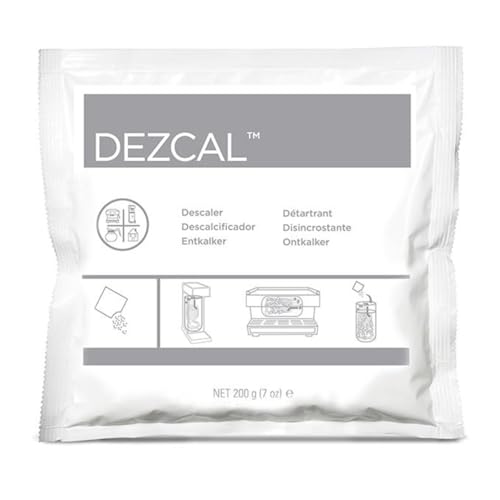
6. Urnex Dezcal Activated Scale Remover
A widely used descaling powder in coffee shops, mixed with water to dissolve scale in machines and kettles. Follow the label for your equipment. Use gloves and keep it away from stone countertops, which acids can mark.
Suits: cafes and homes. Strengths: a trusted name in coffee care. Weaknesses: read compatibility notes. Skip it if your machine bans acid descalers.
View Urnex Dezcal Scale Remover on Amazon
Care and Setup
- Test your water hardness before choosing a cartridge.
- Replace softening cartridges on schedule, not when scale appears.
- Descale on the maker’s timetable.
- Rinse the system thoroughly after descaling.
- Use filtered water for rinses too.
- Keep a log of descaling and cartridge dates near the machine so nothing is missed.
Mistakes to Avoid
- Using the wrong descaler for your machine.
- Leaving old cartridges in place.
- Mixing descalers with other chemicals.
- Thinking a softener replaces descaling.
- Using fully soft water for machines that prefer some minerals.
- Mixing leftover descaler residue into the next brew by skipping the rinse cycles.
Hardness, Alkalinity and What Your Water Is Made Of
Water is more than a single measure. Hardness describes the amount of dissolved calcium and magnesium, which precipitate as limescale when water is heated. Alkalinity, sometimes called buffering capacity, describes how well the water resists changes in acidity. Both matter for espresso, but in different ways. Hardness drives scale in boilers and lines, and alkalinity influences how the coffee tastes and how the machine reacts to acids.
Very hard water scales a machine faster. Very soft or demineralized water can taste flat and may cause problems with machines that rely on conductivity sensors in the tank or boiler. Some machines will not detect the water level properly if the water has too few minerals, so check the manual for any limits.
Start by finding out what you have. Your water supplier may publish a report, and a test kit can give an estimate at home. Test the water you will actually use, whether it comes from the tap, a jug filter or a bottle. Record the result, and use it when you compare cartridges, since many list the range they suit. Test again if your supply changes or if you notice scale appearing faster than expected.
How Cartridges Work and How to Check the Fit
Most machine-specific cartridges use ion exchange resin. As water flows through, the resin swaps calcium and magnesium for other ions that do not form scale. Some cartridges also include carbon, which reduces chlorine taste and odor, and some are designed to reduce scale without removing as many minerals. Read the listing to see what a cartridge does, because a filter that improves taste may not reduce scale much.
Fit is crucial. Cartridges are made for specific machines and sit in the tank or in a holder inside. Check your model number in the user manual and compare it with the compatibility list on the listing. A cartridge that is close but not the same may not seal properly, allowing unfiltered water to bypass it. Look at the dimensions and the connection type if the listing gives them.
Prepare a new cartridge as instructed. Many need to be soaked or flushed before use to remove loose resin and air. Some machines have a setting for the filter that must be adjusted when you install one, which allows the machine to track its use and prompt replacement. Skipping this step can lead to an expired filter being used for too long.
Replace cartridges on schedule, since an exhausted resin cartridge stops softening and can even release minerals back into the water.
Recipe Water and Controlling Minerals
Some coffee enthusiasts prefer to build their own water. They start with very low-mineral water and add measured minerals to reach a target profile. This gives control over both scale risk and flavor, and it removes much of the variation from tap water. It is an extra step with each refill, and it requires care with measuring.
If you try this, check your machine’s guidance first. Some makers warn against water that is too pure, since sensors may not read it correctly, and some warn against specific additives. Use only products made for coffee, and follow the instructions. Mix in a clean container, and fill the tank with the mixed water.
Another approach is to blend water. Mix filtered or softened water with a portion of tap water to reach a middle hardness. This is simple and cheap, but it requires testing to find the right ratio. A test kit lets you check the result and adjust.
Whatever you choose, aim for consistency. A stable water profile gives repeatable taste and predictable scale behavior. Keep notes on what you use and how the machine behaves over several months. If you see scale building in the tank or at the nozzles, adjust the approach.
Descaling Safely and Effectively
Even with a softener, descaling is part of ownership. Descalers use acids to dissolve mineral deposits, and different acids suit different machines. Some makers approve a specific product and warn that others may damage seals or leave residue. Always check the manual before choosing, and follow the instructions for dilution, contact time and rinsing.
Protect yourself and your surroundings. Wear gloves and eye protection if the label advises it, and keep descaler away from stone, wood and metal surfaces that acids can mark. Work in a ventilated area, and keep products away from children and pets. Never mix descaling products with other cleaners, and do not combine different acids.
Follow the process in order. Remove any filter before descaling if the manual says so, since the solution can damage a cartridge. Run the solution through the machine as directed, and allow time for it to work. Then rinse thoroughly with fresh water, running several tanks if needed, until no taste or smell remains. Check by tasting a small amount of the rinse water.
If the machine has a built-in program, use it, and do not interrupt it. If you must stop, follow the instructions for resuming. Record the date and note any problems, such as slow flow or warning lights that persist.
Spotting Scale Trouble Early and Planning a Schedule
Scale builds slowly, so early signs are subtle. Watch for slower flow, longer heat-up times, louder pump noise, weaker steam, a change in taste or white flakes in the cup. Check the tank and the spouts for deposits. If you see these signs, descale sooner than planned and review your water treatment.
Create a schedule that matches your water and use. A household that makes many drinks each day with hard water needs more frequent care than one that makes a couple of cups with softened water. Use the maker’s schedule as a baseline, and adjust based on what you see. Put reminders in a calendar, or write dates on a note near the machine.
Keep a small kit of supplies: spare cartridges, descaler, a test kit, a soft brush and a cleaning cloth. Having supplies on hand means you can act as soon as needed. If you travel, empty the tank before a long absence, and rinse it on return.
Finally, know when to ask for service. Persistent scale in internal parts, error messages that do not clear after descaling, or leaks may need professional help. Do not force a stuck valve or open sealed components. A machine that is well cared for will reward you with steady performance and a longer life.
Espresso Machine Softener FAQ
Do I need a softener if I have a filter?
Many filters do not soften. Check whether the cartridge uses ion exchange resin.
Will soft water change the taste?
It can, because minerals shape flavor. Balanced water often tastes best.
How often should I descale?
Follow the maker’s schedule, which depends on use and water hardness.
Can I use vinegar?
Many makers advise against it. Use a recommended descaler instead.
How do I know if my water is hard?
Check your water supplier's report or use a home test kit. Visible scale on kettles and taps is another clue.
Can I use bottled water instead of a filter?
It can work, but bottled waters differ widely in mineral content. Check the label, and avoid water that is too pure for your machine unless the maker allows it.
Do carbon filters stop scale?
Carbon mainly improves taste and removes chlorine. It does not usually reduce scale, so check whether the cartridge also uses ion exchange resin.
How often should I replace a cartridge?
Follow the maker's schedule or the machine's reminder, since it depends on water hardness and use. Replace it on time even if the machine seems to be working well.
Can citric acid be used to descale?
Some makers approve it and others advise against it. Check your manual, and use only a product and method that your machine's maker allows.
Is a whole-house softener good for espresso?
It reduces hardness, but it can raise sodium and leave water too soft for some machines. Check the manual and consider testing the output water.
What if the machine does not recognize the filter?
Check that the cartridge is the right model and is seated properly, and that you have set the filter option in the machine's menu. Consult the manual if the problem persists.
What Scale Does Inside the Machine
Scale is mostly calcium carbonate that comes out of solution when hard water is heated. It forms a pale, crusty layer on any hot surface, and in an espresso machine those surfaces are the boiler or thermoblock, the heating element, the narrow tubes and the valves. A thin layer insulates the element, so the machine takes longer to reach temperature and uses more energy. A thick layer narrows the tubing, which lowers flow and pressure, and flakes can break loose and block the brew group or the steam wand.
The damage often arrives gradually and without a clear warning. Shots may run slow or taste flat, the pump may sound louder, and the steam wand may spit or lose power. By the time the machine stops working outright, the buildup can already be extensive. This is why prevention, in the form of treated water, is generally cheaper than cleaning and repair.
Different machine designs show different vulnerabilities. Thermoblock and thermojet machines have narrow passages that clog sooner. Larger boilers have more volume and more room before problems appear, but they accumulate sediment at the bottom that is harder to reach. Machines with a plumbed-in line can draw hard water continuously, so a filter on the inlet protects the whole system.
Mineral Balance: Not Too Hard, Not Too Soft
It is tempting to remove all minerals, but pure water causes its own problems. Water with nearly no dissolved minerals is poor at extracting flavor from coffee, and it can taste thin or sour. Some machines also use conductivity sensors in the tank or boiler to detect water levels, and very low mineral content can trigger false errors. For these reasons, the goal is to reduce the hardest scale-forming minerals while leaving enough in the water for flavor and sensing.
Buffer, usually described as alkalinity or carbonate hardness, protects against acidity. Water with low alkalinity is aggressive and can attack metal components over time, while water with very high alkalinity produces scale fast and flattens the taste of the shot. A moderate range is the target, and the right numbers differ between machine makers. Always compare your water test against the figures in your machine’s manual, which are more reliable than general advice.
- Test your water with strips or a drop kit before choosing a method.
- Check the manual for a target hardness range or a recommended filter.
- Retest after a few weeks of using any treatment to confirm it works.
- Do not mix methods without understanding what each one removes.
Daily Habits That Reduce Scale
Water treatment works best alongside simple habits. Fill the tank with fresh water instead of topping off old water, because stale water sitting in a warm tank grows biofilm and can taste off. Empty and rinse the tank weekly. Run a purge or a short flush before the first shot of the day so any water that sat in the lines is cleared out.
Do not leave a machine heated for hours when it is not in use if the model allows it to sleep. Constant heat concentrates minerals as water evaporates. For machines with an auto-off function, use it. When you are away for more than a few days, drain the tank and let the machine rest dry.
Keep notes. A small log of when you changed the filter, ran a descaling cycle and noticed any change in flow or noise helps you spot trends. It also supports warranty claims, since many makers ask for proof of regular maintenance.
Cost Over Time: Filters, Descalers and Repairs
Compare methods by cost per month rather than per package. A cartridge such as the De’Longhi, Breville or Jura options in this guide has a rated life, usually measured in liters or weeks, and costs the same each cycle. Third Wave Water packets are a recipe water approach, where you add a mineral blend to distilled or purified water, and the cost scales with how much coffee you make. Descalers like Durgol or Dezcal are periodic costs, bought as needed.
Repair costs frame the whole decision. A descaling treatment is cheap, a technician visit is not, and replacing a clogged boiler can approach the price of a new machine. Spending a little on prevention every month protects a much larger investment.
Finally, check compatibility before committing. Cartridge filters are matched to specific models, and using the wrong one can fail to fit or give no protection. Recipe water only suits machines that accept distilled or low-mineral water, and some manufacturers warn against it. When in doubt, ask the maker.
If you rent or share a kitchen, the same logic applies in a lighter form. Ask who maintains the machine, keep the descaling schedule on a note beside it and agree on which water goes in the tank. Many scale problems start with a visitor topping off the tank from the tap, so a labeled jug of treated water is a small habit that protects the machine.
Going Deeper: How to Judge Water Softeners For Espresso Machines in Real Use
A useful way to judge the options above is to picture an ordinary week of use rather than the first unboxing. For water softeners for espresso machines, the deciding factor is rarely a single feature in isolation. It is the combination of how the item fits your espresso machine care, how forgiving it is when you are in a hurry, and how much upkeep it asks for between uses. Readers who start from those three questions usually narrow this list down to one or two sensible options very quickly, without needing to study every specification in detail.
Start with fit. Measure the space you actually have, not the space you imagine after a tidy-up, and compare it honestly with the footprint, height and clearance each option needs. With water softeners for espresso machines, a small mismatch in fit tends to cause daily friction: doors that do not open fully, items stored at an awkward angle, or a setup that has to be moved every time you use it. If a pick only works when everything else in the espresso machine care is rearranged around it, treat that as a genuine drawback rather than a minor inconvenience.
Next, think about scale prevention and cartridge life. This is the area where cheaper and more considered designs separate most clearly over time. Pay attention to how the materials feel in the hand, whether edges, joints and moving parts look finished rather than merely adequate, and whether the maker explains care in plain language. A product that is honest about its limits in the description usually behaves predictably in the home, while vague claims tend to hide the compromises you will discover later.
Finally, consider rhythm. How often will you use it, in what quantity, and alongside what else? Someone reaching for water softeners for espresso machines every day needs durability and speed above novelty, while an occasional user can reasonably prioritise appearance or compact storage. Neither priority is wrong, but mixing them up is the most common reason a well-reviewed product ends up unused in a cupboard. Match the pick to the rhythm first, and let the smaller features settle the tie afterwards.
Comparing the Picks Side by Side in Practice
Between the De’Longhi DLSC002 Water Softener Filter and the Breville Claro Swiss Water Filter, the practical question is which set of trade-offs suits your espresso machine care better. The De’Longhi DLSC002 Water Softener Filter makes most sense when its particular strengths line up with the way you already work, while the Breville Claro Swiss Water Filter is the easier recommendation when you want the more forgiving option for mixed, everyday use. Neither displaces the other outright; they simply reward different habits. If you find yourself torn between them, choose based on the task you repeat most often, not the impressive edge case you might try once or twice a year.
Between the Jura Claris Blue Filter Cartridge and the Third Wave Water Classic Profile Packets, the practical question is which set of trade-offs suits your espresso machine care better. The Jura Claris Blue Filter Cartridge makes most sense when its particular strengths line up with the way you already work, while the Third Wave Water Classic Profile Packets is the easier recommendation when you want the more forgiving option for mixed, everyday use. Neither displaces the other outright; they simply reward different habits. If you find yourself torn between them, choose based on the task you repeat most often, not the impressive edge case you might try once or twice a year.
Between the Durgol Swiss Espresso Descaler and the Urnex Dezcal Activated Scale Remover, the practical question is which set of trade-offs suits your espresso machine care better. The Durgol Swiss Espresso Descaler makes most sense when its particular strengths line up with the way you already work, while the Urnex Dezcal Activated Scale Remover is the easier recommendation when you want the more forgiving option for mixed, everyday use. Neither displaces the other outright; they simply reward different habits. If you find yourself torn between them, choose based on the task you repeat most often, not the impressive edge case you might try once or twice a year.
Between the Breville Claro Swiss Water Filter and the Durgol Swiss Espresso Descaler, the practical question is which set of trade-offs suits your espresso machine care better. The Breville Claro Swiss Water Filter makes most sense when its particular strengths line up with the way you already work, while the Durgol Swiss Espresso Descaler is the easier recommendation when you want the more forgiving option for mixed, everyday use. Neither displaces the other outright; they simply reward different habits. If you find yourself torn between them, choose based on the task you repeat most often, not the impressive edge case you might try once or twice a year.
Between the De’Longhi DLSC002 Water Softener Filter and the Third Wave Water Classic Profile Packets, the practical question is which set of trade-offs suits your espresso machine care better. The De’Longhi DLSC002 Water Softener Filter makes most sense when its particular strengths line up with the way you already work, while the Third Wave Water Classic Profile Packets is the easier recommendation when you want the more forgiving option for mixed, everyday use. Neither displaces the other outright; they simply reward different habits. If you find yourself torn between them, choose based on the task you repeat most often, not the impressive edge case you might try once or twice a year.
Across the whole list, a pattern emerges: the picks that earn their place longest are not always the most elaborate. They are the ones whose size, handling and care routine disappear into the background of the espresso machine care. When two options seem evenly matched on paper, prefer the one you can clean, store and explain to a guest in a sentence. Simplicity that survives contact with real life beats a longer feature list that demands constant attention.
Matching a Pick to Common Situations
Everyday, unhurried use
For routine use at home, consistency matters more than peak performance. Choose the option above that you can set up the same way every time, with the fewest steps between deciding to use it and actually using it. In a espresso machine care, that usually means favouring straightforward handling and easy cleaning over specialised extras. Keep the item where it is used, keep any accessories together in one place, and the habit will sustain itself without effort.
Entertaining and guests
When guests are involved, presentation and predictability take over. Pick the option that looks settled on the table or counter, works without explanation, and does not require you to disappear for ten minutes of preparation. Practise with it once beforehand if it is new to you. With water softeners for espresso machines, the version you have used calmly three times will always serve guests better than the theoretically superior version you are still learning on the night.
Small spaces and shared homes
In a compact or shared espresso machine care, storage and footprint deserve as much weight as performance. Measure cupboards, shelves and worktop depth before ordering, and think about where the item lives on the days it is not used, which for most households is most days. A slightly simpler pick that stores neatly will be used far more often than a larger one that has to be fetched, assembled and put away again each time.
Building a longer-term setup
If this purchase is the first piece of a larger setup rather than a one-off, favour compatibility and replaceable parts over a closed, all-in-one design. Check whether accessories, refills or matching pieces are easy to find, and whether the style will sit comfortably alongside what you plan to add later. Buying with the second and third purchase in mind avoids the familiar pattern of replacing the first item entirely within a year.
Setup, First Use and the First Fortnight
Unbox carefully and keep the packaging until you have completed a first full use. Lay out every part, read the maker’s instructions once from start to finish before beginning, and wash or wipe down anything that will contact food, drink or glassware as directed. For water softeners for espresso machines, most early disappointment traces back to a skipped setup step rather than a faulty product, so the unglamorous ten minutes of preparation is worth taking seriously.
During the first fortnight, pay attention to three things: how long setup and cleanup actually take when you are not concentrating, whether anything loosens, sticks, stains or behaves differently from the first day, and whether the storage spot you chose still makes sense. Small adjustments made in week one, such as moving the item closer to where it is used or changing the order of steps, usually fix frustrations that otherwise get blamed on the product itself.
Keep a simple note of what works. It sounds excessive for a household purchase, but a few lines about quantities, timings or settings that suited you will save repeated trial and error, especially for items used in batches or for guests. Households that share the espresso machine care benefit even more, because the note turns one person’s learning into everyone’s starting point.
Care, Cleaning and Keeping It Working Well
Routine care for water softeners for espresso machines is mostly about little and often. Wipe spills and moisture promptly, clean in the way the maker describes rather than reaching for the strongest product in the cupboard, and let everything dry fully before storing it away. Trapped moisture and leftover residue cause more long-term damage, odour and staining than ordinary use ever does, and both are avoided by the same unhurried two minutes at the end.
Inspect the working parts periodically: seals, threads, joints, blades, hinges or contact points, depending on the design you chose. Early wear is usually visible long before it becomes failure, and replacement of a small consumable part is far cheaper and less wasteful than replacing the whole item. Keep spare consumables with the item itself so a change never has to wait for a delivery.
Avoid the common care mistakes: soaking materials that should only be wiped, stacking or storing while still damp, using abrasive pads on finished surfaces, and forcing a part that resists. Resistance is information. Stop, check alignment and instructions, and only then proceed. Almost every design in this category rewards a gentle hand and punishes improvisation with stripped threads, clouded surfaces or bent fittings.
Before You Buy: A Final Checklist
Run through these questions honestly before ordering. Have you measured the space, including clearance to open, lift or pour? Do you know how the item is cleaned, and are you genuinely willing to do it at the frequency your household needs? Does it suit the quantity you typically handle, rather than the largest gathering you might host once a year? Have you checked what is included in the box, and what is sold separately? If any answer is no, resolve it now; every one of these questions is much cheaper to answer before checkout than after delivery.
It is also worth deciding in advance what would make you return or exchange the item. A clear personal threshold, such as it must fit the intended spot without modification, or it must be manageable to clean on a weekday evening, turns a vague sense of disappointment into a quick, calm decision inside the returns window. Buyers who set that threshold beforehand rarely keep unsuitable items out of inertia, and rarely send back good ones over a fixable setup issue.
Taken together, the picks above cover the sensible ground for water softeners for espresso machines: options for daily reliability, for presentation, for small spaces and for building out a fuller espresso machine care over time. Choose the one whose strengths match the job you repeat most, set it up carefully, keep the care routine simple and consistent, and it should serve you well for a long time without demanding attention it has not earned.
Extra Notes on Living With This Choice
One more consideration that experienced owners raise about water softeners for espresso machines is how the choice behaves across seasons and occasions rather than on a single day. In a busy espresso machine care, demands shift: weekday use is quick and functional, weekend use is slower and more social, and occasional larger gatherings test capacity and patience in ways ordinary use never does. The strongest pick for you is the one that degrades gracefully across all three modes, staying pleasant when rushed and still satisfying when you have time to do things properly.
Think as well about who else will use it. A product that only works in the hands of the person who researched it is a fragile purchase in a shared home. Clear handling, obvious storage and forgiving cleaning make it far more likely that everyone uses the item correctly, which in turn keeps it in good condition for longer. When comparing the final two candidates on your shortlist, this shared-use test is a reliable tiebreaker.
Finally, give any new purchase a fair trial before judging it. First uses are slower and clumsier with almost every design in this category, and technique improves quickly. Judge the item on your third or fourth use, with the setup settled and the routine familiar. That is the experience you are actually buying for the years ahead, and it is the fairest basis on which to compare it with the alternatives described above.
A Practical Detail Worth Deciding Early
Keep a simple log beside the machine noting filter or cartridge changes, descaling dates and any change in taste or flow. Espresso equipment rarely fails suddenly; it drifts, and a written record is what turns that drift into an early, cheap correction instead of a repair. The log also settles arguments about whether a change actually helped, because you can compare the weeks before and after rather than relying on memory.
None of this changes which pick suits you on paper, but it often changes which one still suits you after a season of use. Weigh it alongside the comparisons above, and let it break any remaining tie in favour of the option that fits the way your household genuinely lives.
Frequently Asked Questions
Can I use distilled water in my espresso machine?
Only if the manufacturer allows it. Distilled water has almost no minerals, which can cause flat taste and may confuse water-level sensors in some machines. Many people mix distilled water with a mineral packet to reach a balanced recipe.
How do I test water hardness at home?
Use test strips or a drop titration kit sold for aquariums or coffee, dip or add drops as directed, and compare the color or count to the chart. Your local water utility also publishes hardness figures, though they can vary by area and season.
What does scale in an espresso machine look like?
Scale appears as white or tan crust on the shower screen, steam wand, heating element or inside the water tank. You may also notice flaking particles in a cup, slow flow and louder pump noise. Heavy buildup inside tubing is not visible.
Do water filters need to be replaced even if the machine works?
Yes. A filter has a limited capacity and loses effectiveness over time, even when the machine still seems fine. Replace it on the schedule in the manual or when the indicator says so. An exhausted filter can let hard water through.
The Short Version
For De’Longhi machines, the DLSC002. For Breville, the Claro Swiss. For Jura, the Claris Blue. For a custom recipe, the Third Wave Water. For tough scale, the Durgol. For a trusted descaler, the Urnex Dezcal.


