Disclosure: As an Amazon Associate, topratedkitchenware.com earns from qualifying purchases. Prices and availability change; check Amazon for the latest.
A ceramic burr coffee grinder crushes beans between two ceramic grinding surfaces instead of steel ones. In practice, nearly all of the grinders in this category are hand-cranked, compact and designed for home brewing, travel and small kitchens. Ceramic burrs do not rust, they hold up well to regular use, and they tend to generate less heat during a short grind session.
The six grinders below cover the main options, from a classic glass-jar mill to slim stainless travel grinders and a compact adjustable model. We have not used these products ourselves, so descriptions here are general. Please confirm details such as capacity, burr material and included parts on the current listing before you buy, since makers update their designs from time to time.
As an Amazon Associate we earn from qualifying purchases. Links below are affiliate links, and they do not change the product information we give.
In this guide
Quick Picks
- Hario Skerton Pro
- Hario Mini-Slim Plus
- Porlex Mini Stainless Steel Coffee Grinder
- Porlex Tall Stainless Steel Coffee Grinder
- Kyocera Ceramic Coffee Mill
- JavaPresse Manual Coffee Grinder
What to Look For
| Feature | Why it matters |
|---|---|
| Burr stability | A burr that wobbles gives uneven grounds, so a supported shaft helps consistency |
| Adjustment | Click settings you can count make it easy to repeat a grind |
| Capacity | Small bodies suit a cup or two; larger ones suit a full pot or press |
| Body material | Stainless steel resists knocks; glass and plastic are lighter and cheaper |
| Handle | A comfortable, secure handle makes cranking faster and less tiring |
| Cleaning | Burrs that lift out simply are easier to brush clean |
The honest limit of ceramic hand grinders is speed. They reward patience, and most are best suited to brewing methods like pour-over, French press, AeroPress and drip, with some able to go finer for espresso-style brewing with practice. Check the listing for the range each model is designed to handle.
Specs at a Glance
| Grinder | Burr | Body | Notes |
|---|---|---|---|
| Hario Skerton Pro | Ceramic conical | Glass jar with plastic and metal parts | Stabilized burr shaft; larger catch jar |
| Hario Mini-Slim Plus | Ceramic conical | Plastic body with a small container | Slim and light; small capacity |
| Porlex Mini | Ceramic | Stainless steel | Slim; fits inside an AeroPress |
| Porlex Tall | Ceramic | Stainless steel | Larger than the Mini |
| Kyocera Ceramic Coffee Mill | Ceramic | Mixed materials | Adjustable; compact |
| JavaPresse Manual Coffee Grinder | Ceramic conical | Stainless and plastic parts | Click settings; compact |
The 6 Best Ceramic Burr Coffee Grinders
Top pickBest for home hand-grinding
1. Hario Skerton Pro
The Skerton Pro is an updated take on a long-running Japanese hand mill. It has ceramic conical burrs, a glass catch jar and a crank on top. The improvement over earlier Skerton models is a more stable burr shaft, which helps the grind stay consistent instead of wandering.
It suits home brewers who want a sturdy, affordable-tier hand grinder for a couple of cups at a time. The jar gives a larger catch capacity than slim travel grinders, so it works for a French press or a small pour-over.
Check the listing for the jar size and what is included, such as a lid or brush. As a trade-off, glass can break if dropped, and the grinder is bulkier than the slim models, so it is a poorer match for a backpack.
Suits: home hand-grinding. Strengths: a stabilized burr and a roomy jar. Weaknesses: glass fragility and bulk. Skip it if you want a grinder for a backpack.
View Hario Skerton Pro on Amazon

Best for single cups and small spaces
2. Hario Mini-Slim Plus
The Mini-Slim Plus is a slim, lightweight hand mill with ceramic burrs and a small catch container. It is a popular entry-level grinder for people who want to move from pre-ground coffee to fresh beans without spending much or taking up space.
It suits single-cup brewers, desk coffee drinkers and anyone with a small kitchen. The body is narrow enough to hold comfortably, and it stores in a drawer or bag with ease.
On the listing, look for the stated capacity and the adjustment method, because small capacity means grinding in more than one round for larger brews. The fair trade-off is that the slim body can feel less stable than stainless alternatives, and consistency is generally good for the price but not at the level of premium grinders.
Suits: single cups and small spaces. Strengths: light, slim and simple. Weaknesses: small capacity. Skip it if you brew for several people.
View Hario Mini-Slim Plus on Amazon
Best for travel and camping
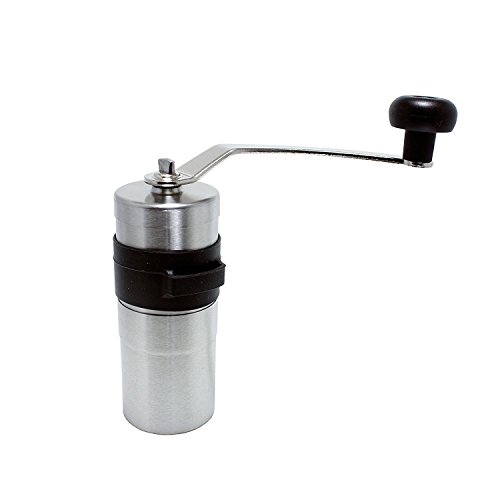
3. Porlex Mini Stainless Steel Coffee Grinder
The Porlex Mini is a slim, all-metal-bodied hand grinder with ceramic burrs, designed in Japan and well known among travelers. Its narrow shape is small enough that many people pair it with an AeroPress, which makes a compact travel coffee kit.
It suits campers, commuters and anyone who wants a durable pocket-size grinder. The stainless body handles knocks better than glass or thin plastic, and the click adjustment lets you repeat a setting between sessions.
Check the listing for the capacity and for how the grind is adjusted, since the small body holds only enough beans for one or two cups. The trade-off is time and effort: the compact size means a longer crank for the same amount of coffee, and the slim handle takes a little getting used to.
Suits: travel and camping. Strengths: a stainless body and compact size. Weaknesses: small batches and slower grinding. Skip it if you want speed.
Best for larger doses with the Porlex build
4. Porlex Tall Stainless Steel Coffee Grinder
The Porlex Tall uses the same basic design as the Mini, with ceramic burrs and a stainless steel body, but in a taller form that holds more beans. It is aimed at people who like the Porlex build quality but want a larger hopper and catch space.
It suits households that brew a couple of cups at once, or travelers sharing coffee. It is still a hand grinder, so expect a manual crank, but it handles bigger doses with fewer refills than the Mini.
Check the listing for capacity and dimensions, since a taller body may not fit inside the same accessories as the Mini does. The trade-off is size: it is less pocket-friendly, though still far more portable than most electric grinders.
Suits: larger doses with the Porlex build. Strengths: more capacity and stainless construction. Weaknesses: less compact. Skip it if you need the smallest grinder.

Best for simple daily hand grinding
5. Kyocera Ceramic Coffee Mill
Kyocera is known for ceramic cutting and grinding components, and its hand coffee mill takes advantage of that background with ceramic burrs and an adjustable grind. It is a straightforward, compact hand grinder that fits everyday kitchen use.
It suits people who like a no-nonsense tool and want a brand with a ceramics heritage. Look for how the adjustment dial works, how the catch container attaches and whether a brush or lid is included.
The main thing to confirm is the exact model and what is in the box, since Kyocera has offered several variations over the years. As a trade-off, the grinder can feel plainer than some competitors, and its capacity is modest, so it is best for one or two cups at a time.
Suits: simple daily hand grinding. Strengths: ceramic expertise and a compact build. Weaknesses: modest capacity and model variations. Skip it if you want premium finishes.
View Kyocera Ceramic Coffee Mill on Amazon
Best for first-time hand grinders
6. JavaPresse Manual Coffee Grinder
The JavaPresse is a compact hand grinder with ceramic conical burrs and click-style adjustment settings. It is a widely sold option aimed at home brewers and travelers who want something easy to use and easy to repeat.
It suits people who like to dial in a grind by counting clicks, whether for a French press, pour-over or AeroPress. The straightforward design makes it a friendly first hand grinder.
On the listing, check the stated capacity and which brew styles the maker recommends. The trade-off is that mass-market hand grinders in this style vary in feel and consistency, so reading recent customer feedback on grind uniformity and handle comfort is worth the time.
Suits: first-time hand grinders. Strengths: countable click settings. Weaknesses: consistency varies by user feedback. Skip it if you want a premium build.
JavaPresse Manual Coffee Grinder
Ceramic Versus Steel Burrs
Ceramic burrs are hard, do not rust and do not pass a metallic taste into the grounds. They are also less likely to react with moisture, which is useful if you rinse parts or store the grinder in a humid kitchen.
The trade-off is that ceramic can chip if a small stone or a hard foreign object ends up in the beans, and it is generally not the first choice for very heavy commercial use. Steel burrs are tougher against impacts and are common in high-end grinders, so neither material is universally better.
For a home hand grinder that you crank a few times a day, ceramic is a sound and well-proven choice. Handle the burrs gently when cleaning, avoid dropping them, and do not force a stuck burr.
Choosing a Grind Size
Match your grind to your brewer. French press works best with a coarse grind, similar to coarse sea salt. Pour-over and drip use a medium grind, and an AeroPress can use anything from medium-fine to medium depending on your recipe.
If your coffee tastes sour or thin, the grind may be too coarse. If it tastes bitter or harsh, try going coarser. Change one setting at a time and keep notes so you can find your sweet spot.
Espresso-fine grinding is possible with some hand mills, but it is the hardest range to dial in on a budget-friendly grinder. If espresso is your main goal, check that the listing specifically supports fine adjustment before you buy.
Care and Maintenance
- Brush out grounds after each use, especially around the burr and the catch container.
- Do not wash ceramic burrs with soap unless the maker says it is fine, and dry them fully.
- Avoid grinding anything other than coffee beans, such as spices, which leave strong flavors.
- Store the grinder dry and away from heat to protect the plastic and rubber parts.
- Check the burr nut now and then, since vibration can loosen it.
Occasional deep cleaning with a dry brush keeps old oils from turning rancid. A quick wipe of the outside keeps the grinder pleasant to handle.
Setup and First Use
Before your first grind, wash any removable container and lid as the maker directs, and run a small handful of cheap beans through to clear out dust from manufacturing. Discard those grounds rather than brewing with them.
Many hand grinders adjust by tightening or loosening a nut under the burr. Turn it all the way snug, then count clicks or turns back to your target setting, and write that number down. Starting from the same zero point every time is what makes a setting repeatable.
Hold the body steady with one hand, keep the crank at a comfortable height and turn at an even pace. Rushing tends to wobble the shaft and give a less uniform grind, while a steady rhythm is easier on your wrist and on the burrs.
Mistakes to Avoid
- Expecting electric-grinder speed from a hand mill.
- Buying a tiny grinder when you brew for several people.
- Over-tightening the adjustment, which can strain the burr.
- Grinding oily dark beans without cleaning the burr regularly.
- Dropping a glass-jar model on a hard floor.
- Ignoring the recommended grind range for your brewer.
Ceramic Burr Coffee Grinder FAQ
Are ceramic burrs better than steel?
Neither is universally better. Ceramic resists rust and keeps its edge in home use, while steel is tougher against impacts and common in premium grinders.
Can a ceramic hand grinder make espresso?
Some can grind finely enough, but results depend on the model and your patience. Check the listing’s stated grind range before choosing one for espresso.
How long does it take to grind a cup?
It varies by grinder, dose and grind size, but expect about a minute or more of steady cranking. Finer grinds take longer.
Can I wash the burrs with water?
Follow the maker’s care guide. Many makers suggest a dry brush, and if you rinse, dry every part completely before reassembling.
Do ceramic burrs wear out?
They wear slowly with home use, but they can chip if hard debris gets into the beans. Pick over your beans if you notice anything unusual.
Which size should I pick?
Choose a slim model for one cup and travel, and a larger jar or taller body if you regularly brew for two or more people.
Is pre-ground coffee worse?
Fresh grinding generally preserves more aroma, since ground coffee loses flavor quickly. A hand grinder is a low-cost way to improve everyday cups.
Why does my grind look uneven?
Some unevenness is normal in budget-friendly hand grinders. A loose burr or a wobbling shaft can make it worse, so check that the parts are tightened as the maker advises.
Burr Design, Axle Support and Why Wobble Matters
The quality of a hand grinder’s grind depends heavily on how steady the burr stays while you crank. If the central shaft can wander, the gap between the burrs changes from moment to moment, and you get a mix of fine powder and coarse chunks. Designs that support the shaft at both ends, usually at the top and bottom of the burr chamber, hold the burr more stable than designs that hold it at one end only.
Read product descriptions for mentions of a top bearing, a bushing or a stabilized shaft. These details are often more informative than the number of grind settings. Ceramic burrs are hard but brittle, so stable mounting also protects them from knocks and from stress while grinding hard beans.
Adjustment Systems: Clicks, Dials and Rings
Hand grinders adjust the grind size by moving one burr closer to or farther from the other. Some use a click mechanism, where each step has a distinct stop, which makes it easy to return to a favorite setting. Others use a continuous dial or a threaded ring, which offers finer control but is harder to repeat precisely unless you note the position.
Where the adjuster sits matters as well. External adjusters are convenient and can be changed between brews. Internal ones, found under the burr or inside the body, may require disassembly and make switching between methods tedious. If you brew with several methods during the week, an easy external adjustment saves time. If you stick to one method, a simple internal one is usually adequate.
Ergonomics: Handle, Grip and Body Shape
A grinder that is comfortable to hold makes the daily task less of a chore. Handle length affects leverage: a longer handle makes the turning easier but is more awkward to pack. A grippy body, whether textured, rubberized or wide enough to hold securely, reduces slipping, especially when your hands are wet or cold. Narrow stainless bodies are easy to pack but can be slippery, while wider ones are easier to hold steady between your knees or on the counter.
Consider how you will use it. At home, you might hold it in one hand and crank with the other, or rest it on the counter. When camping or traveling, you may brace it against your body, and a slim shape is easier to handle. Handles that fold or detach save space in a bag but add moving parts that can loosen.
Capacity and Dose Planning
Hand grinders hold a limited amount of beans. A small capacity suits single cups and light travel, while larger hoppers handle two or more cups at once. Work out how much coffee you brew per session and choose a hopper that holds it with a little to spare. Overfilling can make the burr chamber harder to turn, and a very small capacity forces you to grind in multiple batches.
Weigh your beans rather than relying on scoops, since density varies by roast. A kitchen scale makes your brewing more consistent and helps you decide if the capacity fits your routine.
Travel, Camping and Noise
One of the strengths of a hand grinder is that it is quiet compared to an electric one and needs no power. That makes it suitable for early mornings, shared accommodations and campsites. For travel, check that the grinder disassembles cleanly into a compact package and that parts are secure enough not to rattle loose. Pack it with the burr assembly protected so that it does not take a hit in a bag. Carry a small brush to clear grounds from the threads, which can jam if neglected.
Cleaning and Grounds Retention in Daily Use
Hand grinders collect fine coffee dust and oils in places that are not obvious, and managing that buildup keeps flavor clean. Static makes small particles cling to the catch container, so a gentle tap after grinding helps release them. A small brush clears the burr chamber, and a soft cloth cleans the outside. Avoid soaking ceramic burrs and avoid rinsing parts with water unless the manufacturer allows it, since moisture can cause problems for assembled mechanisms and rust for any steel components.
Retention, the grounds that stay in the grinder after you finish, is another consideration. Narrow chambers and angled surfaces can hold a gram or two, which matters if you switch between beans or brew very small doses. Knocking the grinder lightly and brushing it between uses reduces the effect. Every few weeks, a thorough clean prevents stale oils from affecting taste. A quick routine makes the difference between a grinder that stays reliable and one that becomes a chore to maintain.
Hand Grinding as a Daily Ritual: Who Thrives and Who Quits
A hand grinder asks for a minute or two of effort in exchange for its quietness, its small footprint and its freedom from sockets, and whether that trade delights or dooms the purchase depends entirely on the owner’s temperament and mornings. People who enjoy a small physical ritual, who make one or two cups at a unhurried pace, often find grinding by hand becomes the calmest moment of the coffee routine, a pause that smells wonderful and asks nothing of anyone else in a sleeping house. People brewing for a household, against a clock, with a kettle already boiling, tend to discover their true feelings about hand grinding within the first fortnight.
Be honest about dose, too. A single cup’s worth of beans is a pleasant task in almost any hand mill; grinding for a large pot, or for several people’s espresso, multiplies the effort and the time in a way that changes the character of the tool from ritual to chore. Match the grinder to the largest job you will ask of it weekly, not the smallest, and if that job is big and daily, let the hand grinder be your travel and quiet-hours tool alongside an electric one at home, a partnership many coffee lovers settle into happily.
Light Roasts, Hard Beans and the Effort Nobody Mentions
Bean hardness changes hand grinding dramatically. Dense, lightly roasted beans resist the burrs and demand noticeably more force and more turns than softer, darker roasts, and listings rarely warn the buyer whose taste runs to bright, light coffee. If that is your taste, favour a mill with a longer handle for leverage, a grip your hand can hold securely, and a body you can brace comfortably against the counter or your hip. Grinding technique helps: a steady, even pace tires the arm less than determined bursts, and keeping the shaft vertical reduces the wobble that makes the grind uneven and the work harder.
Espresso-fine grinding is the extreme case, demanding the most turns at the highest resistance, and it is where hand mills divide into those genuinely designed for it and those that merely reach the setting. If espresso is your daily drink, read the maker’s guidance about fine grinding carefully and expect the routine to be a commitment. Many espresso lovers accept it gladly for the silence and the quality; nobody should discover it by surprise on a workday morning.
Dialling In a New Coffee With a Hand Mill
Every new bag of beans asks the grinder a fresh question, and a methodical answer saves coffee. Start at the maker’s suggested setting for your brew method, make one cup, and taste it with the specific question of grind in mind: a coarse, under-extracted cup tastes thin and sour and asks to go finer; a bitter, drying cup asks to go coarser. Change the setting in small steps, one or two clicks where the design counts clicks, and change nothing else at the same time, so the improvement can be credited to the adjustment that caused it.
Write the result down on the bag or in a note on your phone: the setting, the dose, and a word about the taste. Hand grinders reward this record-keeping disproportionately, because their settings are otherwise easy to lose when the mill is cleaned, lent, packed for a trip or adjusted by another person in the household. A grinder whose best settings are recorded is a tool that performs on demand; one whose settings live in memory alone restarts the dialling-in process every few weeks, wasting beans and patience in equal measure.
Consistency From Cup to Cup
Once a setting is found, consistency comes from the small disciplines: the same dose weighed or measured the same way, beans stored so they do not age unevenly through the bag, and a grinding motion kept steady rather than heroic. Expect the last beans of a bag to behave slightly differently from the first as they age, and do not chase that drift with constant adjustment; a click either way across a bag’s life is normal husbandry, while daily fiddling usually means something else, dose or water or an ageing burr, is asking for attention.
Static is the hand grinder’s small daily nuisance, scattering fine particles and clinging grounds to the catch cup. A drop of water stirred through the beans before grinding, a widely used trick, calms most of it, and a tap and a brush after grinding recover the rest. Build those seconds into the routine rather than fighting them, and the mill stays a pleasure to use in a clean kitchen.
Ceramic Burrs Over Years of Use
Ceramic burrs earn their reputation on steadiness: they resist wear in ordinary home service, they do not rust, and they keep their edges through the kind of daily use a household mill actually sees. Their weakness is brittleness rather than wear. A dropped burr, or a small stone that arrives hidden in a bag of beans, can chip ceramic in a way that steel would survive with a dent. Treat that as a handling rule rather than a flaw: never drop the burr set during cleaning, shake beans into the mill with a glance at what is in the scoop, and a ceramic mill will give years of consistent service.
When a ceramic mill’s grind quality fades, suspect cleanliness before wear. Old coffee oils and compacted fines coat the burrs and the adjustment threads, narrowing the effective settings and adding stale flavour to fresh beans. A thorough dry clean, brushing every surface and clearing the threads, restores most mills completely. Replace burrs when the edges are visibly chipped or when a cleaned, correctly assembled mill still produces a noticeably uneven grind at settings that once worked well, and order the replacement by the exact model, since burr sets that look alike are rarely interchangeable.
Assembly, Alignment and the Wobble You Can Fix
Many hand-mill disappointments trace back to reassembly rather than design. After cleaning, the burr, spring, washer and adjustment nut must return in their original order and orientation, and a mill rebuilt carelessly will grind unevenly and adjust strangely until it is opened again. Work on a clean cloth so small parts cannot roll away, photograph the stack as you dismantle it the first time, and tighten the adjustment to a known setting before the first test grind. Five careful minutes here save a bag of beans being sacrificed to a washer sitting upside down.
Some play in a hand mill’s shaft is normal and priced into the design; grinding with a steady, vertical motion minimises its effect. Excessive wobble that grows over time, though, suggests a worn bearing surface or a bent component, and it shows in the cup as a mix of dust and boulders that no setting can cure. At that point the choice is repair, replacement burrs and shaft parts where the maker offers them, or honourable retirement, and the deciding factor should be whether the mill’s best days produced coffee you genuinely loved.
Matching a Hand Mill to a Brew Method
Pour-over and filter brewing forgive a hand mill’s minor inconsistencies, which is why the pairing is so popular: the method rewards freshness and a reasonable grind, and the mill’s portability suits the unhurried ritual. French press asks for a coarse, even grind and a mill whose coarse settings do not produce excessive fine dust to slip through the mesh and muddy the cup. Moka pots sit in the middle ground, wanting a medium-fine grind and benefiting from the control a click-adjustable mill provides when a coffee tastes sharp or flat.
Aeropress-style brewing is the hand mill’s happiest playground, tolerant of a range of grinds and small enough in dose that the grinding stays a pleasure. Cold brew is the opposite test of patience, coarse but voluminous, and households that make it often will feel the effort most; grinding in two relaxed batches the night before is the veteran’s answer. Whichever method is yours, choose the mill whose comfortable range covers your method’s setting with room on either side, because a grinder working at the very end of its adjustment range has nowhere to go when a new bean asks for a little more or a little less.
The Travel Kit, Considered as a Whole
A hand mill travels as part of a kit, and the kit should be planned together: the brewer it feeds, the vessel it grinds into, a small brush, and the beans measured or carried in a sealed container. The best travel mills are the ones whose catch cup doubles as a measure, whose handle removes or folds so nothing snags in a bag, and whose settings survive being jostled, or can be restored from the note you kept of them. Rehearse the kit once at home before a trip, because a combination that works on your own counter, with your own kettle and your own morning patience, is the only kind worth packing.
Buying a Hand Grinder as a Gift, and Buying One Used
A ceramic hand mill is a kind gift for the coffee lover who has everything electric, because it adds a capability, quiet early-morning coffee and travel coffee, rather than duplicating a machine they own. Give it with a small bag of beans suited to its strengths and a note of the setting to start from, and the recipient’s first cup will be good enough to convert the gift from a curiosity into a routine. For a beginner, choose the mill with the clearest adjustment and the most forgiving range; for an enthusiast, choose the one whose build and burr quality reward the precision they will bring to it.
Used mills deserve a careful inspection rather than suspicion. Check the burr edges for chips by eye and by fingertip, confirm the adjustment moves smoothly through its range, look for cracks in a ceramic burr and for coffee residue so old it has hardened into the threads, and test-grind a small dose if you can. A sound used mill, cleaned thoroughly, is an excellent purchase; a chipped burr is not, whatever the discount, because the burr is the mill in every way that reaches the cup.
The Quiet Economy of Grinding by Hand
There is a simple satisfaction in a tool with no cord, no motor to fail and no appetite for counter space, and hand grinders keep that satisfaction honest by also making very good coffee. The mills in this guide were chosen for the quality of their grind and the sanity of their design, and any of them, matched to the right brew method and the right owner’s mornings, will earn its small place in the kitchen many times over. Choose the one whose effort you will enjoy rather than endure, keep its burrs clean and its settings recorded, and it will repay you in the currency that matters here: a fresh, quiet, well-made cup, wherever you happen to wake up.
Hand Grinding in a Household That Sleeps
The hand mill’s silence is not a minor feature; in many homes it is the entire reason for the purchase. An electric grinder at dawn can wake a baby, a partner on a different shift, or a whole small flat, while a hand mill makes no more sound than a spoon in a mug. That silence changes behaviour: coffee can be made at the hour the drinker actually wants it, rather than at the hour the household can tolerate the noise, and early risers describe the quiet grinding as part of the pleasure, a few unhurried minutes that belong to them before the house wakes and the day begins its demands.
Silence also travels. In a shared house, a hostel, a camper or a hospital-side stay near a relative, the ability to make real coffee without announcing it is a kindness to everyone within earshot. Owners who bought a hand mill for travel often report that it earned its keep at home first, in the early mornings, which is a useful expectation to set when choosing among the mills in this guide: buy the one you would happily use at six in the morning in your own kitchen, and it will serve everywhere else as well.
Grinding for Two, and the Social Cup
Hand grinding for a guest is a small performance, and most guests enjoy it: the beans measured, the mill turning, the smell arriving before the coffee does. Keep the social version of the routine graceful by grinding while the kettle heats and the conversation is still in the kitchen, rather than disappearing into a long silence of effort. For more than two cups, grind in a relaxed sequence and let the first cup’s brewing overlap the second’s grinding, and the whole thing feels like hospitality rather than labour.
If guests are frequent and numerous, though, take the hint the arithmetic offers and let the hand mill return to its best work, the single quiet cup, while a larger solution handles the crowd. Tools kept to the work they suit stay loved; tools forced into every job get blamed for the jobs they were never shaped for, and a fine ceramic hand mill deserves better than to be resented at a dinner party.
Storing a Mill So It Is Ready, Not Buried
A hand grinder lives or dies by being within reach. Kept in a drawer beneath other gadgets, it will be skipped on busy mornings in favour of pre-ground coffee, and its advantages will quietly evaporate. Kept on the counter in a small, defined spot, or in the front of the cupboard where the mugs live, it becomes part of the kitchen’s geography and gets used as automatically as the kettle. Store it assembled, at a neutral setting, with its brush, and empty of old grounds; a mill stored clean is a mill that can be picked up and trusted without a preliminary investigation, which is exactly the relationship a daily tool should offer.
The Mill on the Counter: A Small Object With a Long Shadow
There is a reason hand grinders appear in so many kitchen photographs and morning rituals shared between friends: they are beautiful in the unshowy way of tools designed around a hand, and they ask their owner to participate in the coffee rather than merely receive it. That participation is the product as much as the grind is. Choose the mill whose weight, grip and motion feel right in your own hand during the first week, keep it where it will be reached for without thought, and it will become one of those rare purchases that improves a daily routine out of all proportion to its size, its silence and its simplicity.
What a Week of Hand Grinding Teaches You About Your Coffee
Electric grinding hides information that hand grinding delivers to your fingers. Through a mill’s handle you feel the beans’ density change from the first turn to the last, you notice when a roast is harder than the previous bag, and you learn, without deciding to learn it, how much coffee a dose really is by the time it takes to grind it. That tactile education improves every other part of a coffee routine, because the person making the drink understands the material in a way that button-pressing never teaches. Many owners who later return to an electric grinder for weekday speed report that their hand-grinding months permanently improved the coffee the electric one makes.
That is the deepest argument for the mills in this guide, beyond silence, portability and price: they make their owners better at coffee. A month of grinding by hand, with settings recorded and cups tasted attentively, is an education that no accessory can be bought to replace, and it stays with you through every machine and method that follows.
A Beginner’s First Bag, Ground Well
If your first hand mill is on its way, give its first bag of beans a fair chance to impress you. Choose a coffee you already know from a café or from pre-ground, so your palate has a reference, brew it by the method you know best, and change the grind in small steps across the first several cups rather than hunting for perfection in the first one. By the end of that bag you will know the mill’s settings, its effort and its temperament, and you will have a recorded starting point for every bag that follows. That is how a small tool becomes a trusted one: not in a single triumphant cup, but across one honest bag, ground quietly, by hand, a little better each morning.
Caring for the Handle, the Lid and the Little Parts
A hand mill’s burrs get the attention, but its small parts decide its daily manners: a handle knob that spins freely, a lid that seats without a fight, a catch cup that fits snugly enough not to shed grounds across the counter. Keep those parts clean and dry, check the knob’s fixing occasionally, and never force a lid or a cup that has grounds trapped in its thread. The mill that feels well kept in the hand gets used with pleasure, and pleasure, in a tool this manual, is a performance specification in its own right.
Frequently Asked Questions
How do I know what grind setting to start with on a new hand grinder?
Start by following the manufacturer’s guidance for your brewing method, then adjust in small steps. If coffee tastes sour or weak, grind finer; if bitter or harsh, grind coarser. Record the setting that works so you can return to it after cleaning.
Is it hard to use a hand grinder every morning?
It takes a couple of minutes for a typical cup and some effort, especially with finer settings. Handle length, grip and burr sharpness all affect how easy it feels. Many people find the routine pleasant, but a heavy daily user might prefer an electric model.
Why does my hand grinder feel stiff or jam?
Common causes include a setting that is too fine, oily or very dark beans clogging the burrs, loose parts, or grounds packed in the threads. Open the grinder, clear any debris, and try a coarser setting. Avoid forcing the handle, which can damage ceramic burrs.
Can I take a hand coffee grinder in carry-on luggage?
Hand grinders are commonly carried in luggage, but rules are set by the airline and security authority. A detachable handle and compact body help. Check the current guidance for your route, and pack it so the burrs are protected from impact.
The Short Version
For a roomy home hand mill, the Hario Skerton Pro. For a slim, entry-level grinder, the Hario Mini-Slim Plus. For travel in stainless steel, the Porlex Mini. For more capacity in the same style, the Porlex Tall. For a simple ceramics-focused tool, the Kyocera Ceramic Coffee Mill. For easy click-based adjustment, the JavaPresse Manual Coffee Grinder.