Disclosure: topratedkitchenware.com is reader-supported. When you buy through links on our site, we may earn an affiliate commission from Amazon and other retailers, at no extra cost to you.
Where to buy
If you are shopping for the best coffee makers with no carafe, the six single serve machines below are the verified shortlist this guide is built around — every one of them brews straight into your mug or travel cup, so there is no pot to wash, scorch or replace. Prices and availability change often, so use the links to check the latest price on Amazon before you buy, and read the full guide below for which format suits your mornings.
- Best Overall: Keurig K-Express Single Serve K-Cup Pod Coffee Maker, Mint — Check on Amazon
- Hamilton Beach FlexBrew Advanced 4-in-1 Single Serve Coffee Maker — Check on Amazon
- Ninja Single Serve Coffee Maker (PB051) — Check on Amazon
- Keurig K-Elite Single Serve K-Cup Pod Coffee Maker, Brushed Silver — Check on Amazon
- Keurig K-Express Single Serve K-Cup Pod Coffee Maker, Black — Check on Amazon
- Keurig K-Express Single Serve K-Cup Pod Coffee Maker, Warm Stone — Check on Amazon
Read the full guide ↓
The appeal of the best coffee makers with no carafe is easiest to understand at the sink, washing yesterday’s pot. A carafe exists to hold coffee for later, and everything about it — the hot plate that slowly cooks what sits on it, the glass that chips, the second wash-up of the day — is a tax paid by people who mostly drink one cup at a time. Brew directly into the mug and the tax disappears: coffee is made when it is wanted, at the size it is wanted, and the only vessel to rinse is the one you drank from. That is the entire design philosophy of this list. Every pick is a single serve machine, and the differences between them are about how they handle water, pods and grounds — not about pots, because there are none.
Who actually benefits? Solo drinkers first, obviously, but also staggered households, where nobody drinks at the same time and a shared pot is always either empty or stewed; small kitchens where a carafe machine’s footprint buys nothing; and offices and guest rooms where coffee is occasional and a standing pot would be a hygiene question rather than a convenience. If your household genuinely drinks pot after pot together at breakfast, a carafe machine remains the right tool and this guide will not pretend otherwise — the durable-pot end of the market is covered elsewhere in this cluster. Everyone else is paying for capacity they pour away.
One more honest framing before the picks: no-carafe brewing trades batch convenience for per-cup freshness, and it changes your costs. Pod machines make each cup effortless and each cup comparatively expensive; grounds-capable single serve machines like the FlexBrew and Ninja below narrow that cost gap while keeping the no-pot format. The reviews that follow keep that trade in view for every pick, because choosing a no-carafe machine is really choosing how you want to pay for coffee — in money per cup, or in the small daily effort of measuring grounds.
Key Takeaways
- All six picks brew directly into a mug or travel cup — no glass pot, no thermal carafe, no hot plate anywhere in this guide.
- Reservoirs replace the carafe as the capacity question: 42 to 56 oz tanks on most picks mean several cups between refills, brewed fresh each time.
- The Hamilton Beach FlexBrew and Ninja PB051 also brew grounds, cutting per-cup cost versus pod-only machines.
- The Keurig K-Elite is the premium-feeling pod pick; the three K-Express finishes are one platform in three colours.
- No-carafe brewing suits solo and staggered drinkers best; households that drink a pot together at one sitting should keep a carafe machine.
In this guide
Quick Picks
| Pick | Badge | Why it is here | Listing |
|---|---|---|---|
| Keurig K-Express Single Serve K-Cup Pod Coffee Maker, Mint | Best Overall | Fresh cup-by-cup Keurig brewing with a 42 oz reservoir and Strong Brew. | Check on Amazon |
| Hamilton Beach FlexBrew Advanced 4-in-1 Single Serve Coffee Maker | Most Versatile | Pods and grounds, hot and iced, from a 45 oz removable reservoir. | Check on Amazon |
| Ninja Single Serve Coffee Maker (PB051) | Best for Big Cups and Brew Styles | 56 oz reservoir, four brew styles, cups up to 24 oz, pods and grounds. | Check on Amazon |
| Keurig K-Elite Single Serve K-Cup Pod Coffee Maker, Brushed Silver | Best Premium Pod Pick | Keurig’s premium single serve tier in brushed silver; no carafe, all pods. | Check on Amazon |
| Keurig K-Express Single Serve K-Cup Pod Coffee Maker, Black | Best Value in the K-Express Family | The proven K-Express platform in black: reservoir capacity without a pot. | Check on Amazon |
| Keurig K-Express Single Serve K-Cup Pod Coffee Maker, Warm Stone | Best for Bright Kitchens | K-Express carafe-free brewing in a warm pale finish for bright kitchens. | Check on Amazon |
How These Picks Were Chosen
Picks were selected from a verified coffee maker pool in which every machine’s brand, model and headline features were confirmed against its Amazon listing before inclusion. The first filter was absolute: the machine had to brew without a carafe, dispensing directly into a cup. Beyond that, machines were compared on reservoir size and removability, brew-size range, whether they accept grounds as well as pods, strength and style controls, and how much counter they occupy — the factors that decide daily satisfaction once the pot is gone.
Specifications in the mini spec boxes come only from the verified listing data; where a listing does not state a figure, this guide leaves it out rather than estimating. This is research-led guidance, not a hands-on laboratory test, and the reviews are written that way: they weigh verified specifications, manufacturer descriptions and the well-established behaviour of each format, and they name an honest limitation for every pick, because a no-carafe machine that suits a solo drinker can be exactly wrong for a family breakfast.
The 6 Best Coffee Makers with No Carafe, Reviewed

Keurig K-Express Single Serve K-Cup Pod Coffee Maker, Mint
Badge: Best Overall
Strengths
- 42 oz removable reservoir replaces the pot as your capacity
- Strong Brew button rescues lighter pods and milky cups
- Travel mug friendly, so the no-carafe idea extends to the commute
Trade-offs
- Pod-only as listed — no grounds basket to cut cup costs
- Mint is a distinctive finish that will not suit every kitchen
- Three brew sizes cover normal mugs, not oversized vessels
| Detail | From the verified listing |
|---|---|
| Format | Single serve K-Cup pod brewer |
| Brew sizes | 3 brew sizes |
| Reservoir | 42 oz removable reservoir |
| Feature | Strong Brew button |
| Cup fit | Travel mug friendly |
| Pods | Works with all K-Cup pods |
If the no-carafe idea has a natural flagship, it is a machine like this: a 42 oz removable reservoir standing where a carafe’s worth of water used to be brewed all at once, now dispensed one fresh cup at a time in three sizes. The K-Express in Mint makes the format’s case cleanly. Your morning cup brews in moments, a second cup for a partner brews fresh rather than poured from a stewing pot, and at the end of the day there is a drip tray to empty instead of a carafe to scrub. The Strong Brew button is the detail that elevates it above the simplest pod machines, giving lighter roasts and milk-bound drinks a concentration lever that pod coffee often lacks.
It suits solo drinkers and couples with staggered starts — the exact households a carafe serves worst. The limitations are the platform’s: pods only, as listed, so per-cup cost stays at pod levels, and the three-size range assumes ordinary mugs. The Mint finish is fresh and deliberate in pale kitchens and a statement elsewhere; the same machine exists in other colours within this guide’s wider family, so choose the finish on your kitchen, and the platform on this review.
Best for: Solo drinkers and staggered couples who want fresh cups on demand with reservoir convenience / Not suited for: Pot-together breakfast households, or grounds drinkers watching per-cup cost

Hamilton Beach FlexBrew Advanced 4-in-1 Single Serve Coffee Maker
Badge: Most Versatile
Strengths
- Brews pod packs and ground coffee — the no-carafe cost-saver
- 45 oz removable reservoir, the second-largest here
- Hot and iced modes in one counter-friendly machine
Trade-offs
- Two brewing systems mean more parts to rinse than a pod-only machine
- Fast-brewing single serve still means one cup at a time
- Black-only finish in this verified listing
| Detail | From the verified listing |
|---|---|
| Format | 4-in-1 single serve; hot and iced |
| Reservoir | 45 oz removable |
| Brews | Pod packs and ground coffee |
| Speed | Fast brewing, per the listing |
| Finish | Black |
The FlexBrew Advanced is the pick that answers the standard objection to no-carafe pod machines — the cost of the pods — by simply also brewing grounds. Its 4-in-1 design takes pod packs when speed matters and ground coffee when budget or freshness matters, dispenses hot or iced, and draws from a 45 oz removable reservoir that keeps a household in fresh individual cups without a pot in sight. For a mixed household this is the peace treaty: one person keeps their pod routine, the other measures grounds, and neither has to wash a carafe or drink from one.
The compromises are mechanical. Two brewing paths mean a pod holder and a grounds basket both exist in your life, both need rinsing, and the machine asks slightly more attention than a pod-only box. Fast brewing is still sequential brewing: a round of drinks for guests takes one cup at a time. But judged on the keyword’s promise — no carafe, no compromise on freshness, flexibility on cost — this is the most complete answer in the guide, and households unsure which side of the pod divide they will land on should start here.
Best for: Mixed households split between pods and grounds who want one carafe-free machine / Not suited for: Minimalists who want a single brewing path and almost nothing to rinse

Ninja Single Serve Coffee Maker (PB051)
Badge: Best for Big Cups and Brew Styles
Strengths
- Largest reservoir here at 56 oz, still carafe-free
- Four brew styles give pod and grounds drinks real range
- Cup sizes up to 24 oz suit the biggest travel mugs
Trade-offs
- The most counter presence of any pick in this guide
- Style options reward tinkerers more than one-button drinkers
- Premium-tier positioning within this shortlist
| Detail | From the verified listing |
|---|---|
| Format | Single serve combo machine |
| Reservoir | 56 oz removable |
| Brew sizes | Up to 24 oz cup sizes |
| Styles | 4 styles of brewing |
| Brews | K-Cup pods and grounds |
The Ninja PB051 stretches the no-carafe concept furthest: a 56 oz removable reservoir — family-sized water storage with not a pot in sight — feeding cup sizes up to 24 oz across four brew styles, from both K-Cup pods and grounds. It is the pick for the drinker whose ‘cup’ is a large travel mug, whose household spans espresso-style drinkers and classic-coffee drinkers, and who wants those differences handled by settings rather than by separate machines. The style range is the real differentiator: where simpler machines vary only size, the Ninja varies the character of the brew itself.
That ambition costs counter space and simplicity. This is the largest presence in the guide, and its menu of styles is wasted on a household that presses one button at dawn and thinks no more about it. It also sits at the premium end of this shortlist’s qualitative range. But for big-cup, mixed-taste households it solves problems the smaller picks cannot: capacity without a carafe, range without a second machine, and grounds capability to keep the pod bill honest.
Best for: Big-mug drinkers and mixed-taste households wanting styles, size and capacity without a pot / Not suited for: Tiny counters, or one-button drinkers who will never touch the style settings

Keurig K-Elite Single Serve K-Cup Pod Coffee Maker, Brushed Silver
Badge: Best Premium Pod Pick
Strengths
- Keurig’s upmarket single serve line in a brushed silver finish
- Full K-Cup library compatibility like every Keurig here
- The countertop presence of a flagship rather than a basic brewer
Trade-offs
- Verified listing is brief — this guide claims no specs it does not state
- Pod-only format, so per-cup costs stay at pod levels
- Premium positioning buys finish and feel more than new drink types
| Detail | From the verified listing |
|---|---|
| Format | Single serve K-Cup pod brewer |
| Brand line | Keurig K-Elite |
| Finish | Brushed Silver |
The K-Elite is the pick for the reader who has fully converted to carafe-free pod life and wants the machine to feel like it. As Keurig’s upmarket single serve line, finished here in brushed silver, it is aimed at kitchens where the brewer is a permanent, visible appliance and its materials are part of the room. It runs the same K-Cup library as the K-Express models — the pod ecosystem does not change as you move up the range — so the decision here is about the ownership experience: a flagship-tier machine from the platform’s own top shelf, in a finish that pairs with stainless appliances.
Honesty about the data matters in this review: the verified listing for this model is unusually brief, confirming the machine, the line and the finish, and this guide deliberately builds no spec box fantasies on top of it. What can be said is what the platform guarantees — single serve K-Cup brewing with no carafe — and what the K-Elite badge has consistently signified in Keurig’s range: the premium tier. If itemised specifications are how you decide, the K-Express reviews above give you more verified detail per dollar of deliberation. If you buy appliances by tier and finish, this is your pick.
Best for: Committed pod drinkers who want Keurig’s premium tier and a stainless-friendly finish / Not suited for: Spec-sheet shoppers — the verified listing for this model is deliberately unpadded here

Keurig K-Express Single Serve K-Cup Pod Coffee Maker, Black
Badge: Best Value in the K-Express Family
Strengths
- Same 42 oz reservoir and Strong Brew as the Best Overall pick
- Black finish matches the widest range of kitchens
- Travel mug friendly for the commute-cup routine
Trade-offs
- Identical platform to the Mint pick — finish is the only difference
- Pod-only brewing as listed
- Black shows dust and dried splashes between cleans
| Detail | From the verified listing |
|---|---|
| Format | Single serve K-Cup pod brewer |
| Brew sizes | 3 brew sizes |
| Reservoir | 42 oz removable reservoir |
| Feature | Strong Brew button |
| Cup fit | Travel mug friendly |
| Pods | Works with all K-Cup pods |
Everything that makes the Mint K-Express the Best Overall pick lives here too, because this is the same verified platform — 42 oz removable reservoir, three brew sizes, Strong Brew button, travel-mug clearance — in the finish that matches the most kitchens. The no-carafe case bears repeating in this context: the reservoir is your batch capacity now, except the coffee is brewed per cup, so the second and third cups of a morning taste like the first instead of like a pot kept warm. For households converting from a drip machine, this is the gentlest landing: familiar Keurig operation, no pot, no hot plate, no scorched leftovers.
Choose Black if your appliances are black or stainless and you want the brewer to disappear into the scheme; choose Mint if you want it to stand out pleasantly. There is no brewing argument between them, and this guide will not manufacture one. The shared platform limits apply: pods only as listed, three sizes aimed at normal mugs, and pod-level running costs. Within those limits it is the straightforward, proven version of carafe-free coffee.
Best for: Converters from drip machines who want proven, carafe-free pod brewing in a go-with-everything finish / Not suited for: Grounds drinkers, or anyone expecting a difference from the Mint version beyond colour
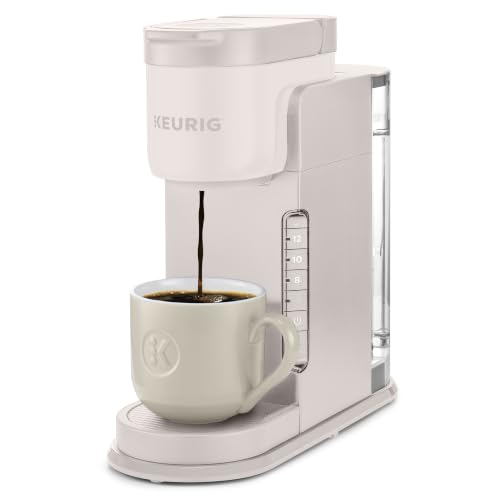
Keurig K-Express Single Serve K-Cup Pod Coffee Maker, Warm Stone
Badge: Best for Bright Kitchens
Strengths
- Full K-Express specification in a pale, warm finish
- Light colour hides the dust that black finishes advertise
- Same Strong Brew and travel-mug practicality
Trade-offs
- Colour is the sole distinction from two other picks in this guide
- Pod-only, three-size platform limits are unchanged
- Pale surfaces show coffee splashes near the drip area
| Detail | From the verified listing |
|---|---|
| Format | Single serve K-Cup pod brewer |
| Brew sizes | 3 brew sizes |
| Reservoir | 42 oz removable reservoir |
| Feature | Strong Brew button |
| Cup fit | Travel mug friendly |
| Pods | Works with all K-Cup pods |
The Warm Stone K-Express completes this guide’s trio of finishes on the same platform, and its review can be the most honest in the list: the brewing is the K-Express brewing — reservoir-fed, three sizes, Strong Brew on demand, straight into your mug with no carafe involved — and the reason to choose this one is that your kitchen is pale, warm and bright, and a black or mint machine would sit in it like a borrowed object. Appliances you see daily should look like they belong; that is a real criterion, and it is the only criterion separating this pick from the Best Overall.
In daily no-carafe life it behaves identically to its siblings: fresh cups on demand, a reservoir that turns refilling into an occasional sink trip, and a drip tray as the only wash-up. The pale finish hides dust gracefully and shows coffee splashes honestly, which most owners will call a fair trade. If your kitchen is dark or stainless-led, the Black version is the same machine in a better-fitting coat. Decide the platform once — this guide’s verdict is that it is the right platform for most no-carafe shoppers — then dress it for your room.
Best for: Bright, warm-toned kitchens wanting the K-Express platform without a dark appliance block / Not suited for: Anyone hoping a different finish means different features
Comparison Table
| Pick | Water handling | What it brews | Stands out for | Listing |
|---|---|---|---|---|
| Keurig K-Express Single Serve K-Cup Pod Coffee Maker, Mint | 42 oz removable reservoir | K-Cup pods only, as listed | Strong Brew button | Check on Amazon |
| Hamilton Beach FlexBrew Advanced 4-in-1 Single Serve Coffee Maker | 45 oz removable reservoir | Pod packs and grounds | Hot and iced modes | Check on Amazon |
| Ninja Single Serve Coffee Maker (PB051) | 56 oz removable reservoir | K-Cup pods and grounds | 4 brew styles; up to 24 oz | Check on Amazon |
| Keurig K-Elite Single Serve K-Cup Pod Coffee Maker, Brushed Silver | Reservoir detail not stated in verified listing | K-Cup pods | Premium-tier brushed silver finish | Check on Amazon |
| Keurig K-Express Single Serve K-Cup Pod Coffee Maker, Black | 42 oz removable reservoir | K-Cup pods only, as listed | Strong Brew button | Check on Amazon |
| Keurig K-Express Single Serve K-Cup Pod Coffee Maker, Warm Stone | 42 oz removable reservoir | K-Cup pods only, as listed | Warm Stone finish | Check on Amazon |
How to Choose a Coffee Maker with No Carafe
Start by confirming the format truly fits your household rhythm. No-carafe machines brew sequentially: each cup takes its own short cycle, which is nothing for one or two drinkers and a queue for six guests. The honest test is your busiest realistic morning, not your average one. If that morning is two people leaving at different times, no-carafe is an upgrade in freshness and wash-up. If it is a family converging on one breakfast, keep a batch brewer for that ritual and consider a small single serve for the rest of the day — many households happily run both, which is why our guide to Best Coffee Makers With Removable Water Reservoir treats reservoir-fed machines as their own category.
Next, decide your fuel. Pod-only machines (the Keurigs here) minimise effort and maximise per-cup cost and packaging waste. Grounds-capable machines (FlexBrew, Ninja) cut running costs and let you buy coffee by the bag, at the price of measuring and rinsing. There is no universally right answer, but there is a wrong one: buying pod-only while resenting pod prices, or grounds-capable while knowing you will never rinse a basket at 6 a.m. Be honest about which person you are at dawn, and the fuel decision makes itself.
Finally, size the reservoir and the cup range to your real vessels. Reservoir capacity decides refill frequency — 42 oz is a couple of days for a solo drinker; 56 oz stretches a household. Cup-size range decides whether your actual mug fits the programme: measure your favourite travel mug’s capacity before buying, because a machine capped below it will annoy you daily. Strength and style controls are the last filter: milk drinkers and light-roast fans benefit most from a Strong Brew or style options, while black-coffee drinkers with a favourite pod may never touch them.
How to Live Carafe-Free: Daily Routine, Cleaning and Care
Life without a carafe is mostly life without a washing-up task, but single serve machines have their own small disciplines. Keep the reservoir water fresh — top it up rather than letting water sit for a week — and run the machine’s rinse or a plain water cycle after sweetened drinks. The drip tray is the new carafe in one respect: it collects every overflow and splash, and it rewards a weekly empty and rinse rather than a monthly archaeological dig.
- Start the day by checking the reservoir level; most no-carafe disappointments are just an empty tank discovered mid-brew.
- Centre your mug and confirm its size matches the brew size selected — overflow is the drip tray’s whole biography.
- Remove used pods the same day; a damp pod left overnight is the fastest route to stale flavours in the next cup.
- For grounds models, knock out and rinse the basket after use rather than letting grounds dry into it.
- Wipe the dispensing area weekly, and empty and rinse the drip tray at the same time.
- Descale on the maker’s schedule for your water hardness, with fresh-water rinses afterwards, to protect temperature and flow.
Two habits protect flavour in this format specifically. First, warm large ceramic mugs with a quick hot-water cycle in winter — a small, fast brew loses more heat to a cold mug than a pot’s worth of coffee ever did. Second, if you brew back-to-back cups for two people, brew the milder drink first: the second cup inherits a trace of the first through the shared path, and a strong dark roast will ghost a delicate tea far more than the reverse. Neither habit costs anything; both are the kind of detail that separates owners who love these machines from owners who merely tolerate them.
Troubleshooting
Problem: the second cup tastes weaker than the first → the reservoir may be running low or the machine needs descaling; top up with fresh water, then descale if flow and temperature still feel tired.
Problem: coffee splashes outside the mug → the mug is too short for the dispensing height or not centred; use a taller vessel, remove the drip tray for travel mugs where the design allows, and centre the cup.
Problem: a stale taste lingers between different drinks → run a plain hot-water cycle between strongly flavoured pods and the next drink, and remove used pods promptly instead of leaving them in the holder.
What You Give Up with a Carafe — and What You Get Back
Honesty about trade-offs sells this format better than hype. You give up: the ability to pour six cups in one motion, the table-ready pot for a lingering brunch, and the lowest possible cost per cup that batch drip brewing offers. You get back: coffee that is always minutes old, a counter with one less breakable object, a sink without a daily carafe scrub, and mornings where each person drinks what they actually want — different roasts, different strengths, a tea in the middle — instead of negotiating a shared pot. For households of one or two, and staggered households of any size, that exchange is heavily in your favour.
The guest scenario deserves a straight answer too, since it is the first objection raised. A round of coffees for visitors takes a few minutes of sequential brewing, during which the first cups are at least fresh rather than stewed. Most owners find guests treat the pod library as a feature — choosing their own drink is more fun than accepting the house pot. If you host large brunches weekly, that calculus changes, and the dual-format thinking in Best Coffee Makers With Single Serve — machines and routines that keep a single-cup option alongside other brewing — is worth a read before you commit.
Pods, Grounds and the Real Cost of a Cup
Since two picks here brew grounds and four are pod-led, the running-cost question runs through this whole guide, and it deserves numbers-free honesty: pods cost more per cup than bagged coffee by a wide and persistent margin, and they generate packaging with every drink. What pods buy is time, consistency and variety without commitment — a cupboard of different drinks, each sealed until used. Grounds buy freshness and economy at the cost of a minute’s effort and a rinse. Neither is the virtuous choice in the abstract; each is right for the household that will actually sustain it.
The hybrid machines exist precisely because many households contain both kinds of drinker, or the same drinker on different days — pods on workdays, grounds on weekends. If that description fits, weight the FlexBrew and Ninja reviews above more heavily than their badges alone suggest. And if you lean grounds-ward for filter reasons as much as cost, Best Coffee Makers With Reusable Filters goes deeper on the reusable-filter side of single serve brewing.
The First Week Without a Pot: Adjusting the Household Routine
Households converting from a carafe machine usually take about a week to stop reaching for a pot that is not there, and the adjustment has a predictable shape. Days one and two are delight: fresh cups, no washing-up, novelty intact. Days three and four surface the friction — the morning two cups are wanted at once, the guest who needs serving, the partner who liked pouring a refill without thinking. By the end of the week the household has usually invented its own choreography: cups brewed in mild-to-strong order, the reservoir checked with the evening dishes, travel mugs staged the night before. Guides rarely mention this week because it is not about the machine; but it is when the format is actually adopted or quietly abandoned, and knowing it is normal helps households push through to the routine on the other side.
Two small purchases smooth the week, neither of them expensive. A second drip tray rotation is unnecessary, but a simple mat under the machine catches the learning-curve overflows, and a small caddy for pods or grounds beside the machine ends the cupboard commute that makes the old pot feel, briefly, more convenient. What does not help is keeping the carafe machine on the counter ‘just in case’ for the whole month: the counter crowds, the comparison stays alive, and the new routine never becomes the default. Box the old machine for a fortnight instead. If it is genuinely missed, it can return with honours; most households find, opening the box later, that they are donating it.
No-Carafe Brewing for Guests, Gatherings and Slow Weekends
The scenario every no-carafe sceptic raises is the gathering, so it deserves a practical playbook rather than a shrug. For four to six guests, a reservoir machine becomes a self-serve station: fill the tank, set out the pod library or the grounds and a measure, line up the mugs, and let people brew their own — which most guests enjoy more than being handed the house standard, because everyone secretly has a preference they would not have imposed on a host. The host’s job shrinks to keeping the reservoir topped and the drip tray emptied, both thirty-second tasks that can happen between conversations rather than instead of them.
For the slow weekend brunch — the carafe’s strongest cultural claim — the honest answer is that single serve changes the ritual rather than ending it. Coffee arrives in courses instead of in a pot: a first round with the cooking, a second, different round with the eating, perhaps a decaf or tea round after, each fresh and each chosen. Households that loved the pot as table furniture can keep a beautiful serving jug for water or juice and discover the table does not miss the coffee pot at all. What the format cannot do is the banquet pour for twelve in ninety seconds; if that is your regular life rather than your annual one, keep a batch brewer for it and let the single serve machine own the other three hundred mornings.
Counter Planning: Where a Carafe-Free Machine Belongs
Removing the carafe changes the machine’s footprint logic in ways worth planning around. A batch brewer needs height for its lid, depth for its pot swing and a parking space for the carafe itself; a single serve machine needs mug clearance, tank access and a landing zone for the cup. Reservoir models should sit where the tank can lift clear — check the headroom above the exact spot, not the counter generally — and fill-per-cup models belong near the sink or a water jug, since every cup begins with a pour. In small kitchens, the format’s real gift is that it can colonise spots a pot machine never could: a pantry shelf with a socket, the end of a desk run, a utility counter.
Think also about the splash geography. Single serve dispensing is a short, lively stream into an open mug, and the area immediately around the cup collects micro-splashes that a carafe’s enclosed pour never produced. A washable mat under and in front of the machine, wiped weekly with the drip tray, keeps the station looking intentional rather than encrusted. Households with pale counters and dark coffee learn this in week one; households that plan for it never have to. The machine is the appliance, but the station is the product — plan both and the format delivers everything it promises.
Safety, Heat and the Small Print of Pot-Free Brewing
A format guide owes its readers the unglamorous details, and no-carafe brewing has three that matter. The first is heat discipline: a single fast brew arrives genuinely hot and lands in an open mug, so households with small children should place the machine where the dispensing moment is supervised and the mug’s landing zone is out of toddler reach — the absence of a heavy glass pot removes one hazard and the open, immediate cup introduces a smaller one. The second is surface protection: repeated mug placement and the occasional overflow mark unprotected wood and pale stone over months, which is why the mat advice elsewhere in this guide is practical rather than decorative. The third is electrical common sense that applies to every countertop brewer: a machine with a reservoir lives permanently near water, so its socket, its cable route and its distance from the sink’s splash zone deserve the same thought as its brew features.
None of this is a warning against the format — a carafe machine carries its own list, headed by a litre of hot coffee in a breakable vessel on a warming plate. It is, rather, the completion of the format’s picture: the pot’s risks were familiar enough to be invisible, and the new format’s smaller risks deserve one visible paragraph. Households that plan placement with heat, surfaces and sockets in mind get the version of no-carafe life the reviews promise — fresher cups, an emptier sink and a counter that stays calm — while households that skip the planning meet the format’s few frictions unprepared and blame the machine for the geography.
A Short Note on Resale, Gifting and Second Counters
No-carafe machines have an afterlife other formats envy, and it is worth a paragraph in a complete guide. Because they are self-contained, plumbed to nothing and sized for a mug, a machine retired from a kitchen counter graduates naturally: to a grown child’s first flat, to a workplace desk, to a guest room, to a holiday let where a carafe machine would be a liability and a kettle-and-instant arrangement an apology. If you are buying with any thought of hand-me-downs, the simpler machines travel best — fewer modes to explain, fewer parts to lose — while reservoir models gift best to households, where their convenience compounds across drinkers. Either way, descale and wash the machine before it changes homes, and pass on the one-page version of its routine; the second owner’s first week decides whether the machine is used or stored, exactly as yours did.
The same logic makes these machines unusually safe gifts within the format: the giver is not choosing a coffee, only a way of making it, and the recipient’s own pods or grounds supply the taste. A carafe machine as a gift imposes a household pattern; a single serve machine imposes only a cup. If the recipient’s pattern is unknown, that restraint is the gift’s intelligence — and it is one more reason the format keeps absorbing households that a pot, however excellent, would never have fitted.
Common Buying Mistakes
- Buying no-carafe for a pot-drinking household. Sequential brewing cannot serve a six-person breakfast gracefully; be honest about your busiest morning.
- Forgetting to measure your travel mug. If your daily vessel exceeds the machine’s largest brew size, you will improvise badly every single day.
- Choosing pod-only while hating pod prices. The FlexBrew and Ninja exist for you; grounds capability is cheaper than a year of resentment.
- Letting reservoir water go stale. Fresh cups deserve fresh water; top up little and often rather than filling and forgetting for a week.
- Skipping descale because there is no carafe to inspect. Scale builds invisibly in single serve machines and announces itself as weak, cool coffee.
Final Recommendation
The K-Express in Mint takes the Final Recommendation for most readers: it is the cleanest expression of the format — reservoir-fed, strength-adjustable, travel-mug ready, and finished in a colour that brightens a counter. The FlexBrew is the better buy for mixed pod-and-grounds households, the Ninja for big mugs and brew-style explorers, and the K-Elite for buyers who want Keurig’s premium tier. The Black and Warm Stone K-Express models are the same recommendation in different coats. Whichever you choose, you are choosing fresher cups and an emptier sink — and for the households this format suits, that trade is not close. If your next question is how the single-cup side pairs with other routines, Best Coffee Makers With One Cup Mode picks the thread up from the one-cup angle.
Start with the Check on Amazon listing for the Keurig K-Express Single Serve K-Cup Pod Coffee Maker, Mint if it matches your routine, and compare it against the Check on Amazon listing for the Hamilton Beach FlexBrew Advanced 4-in-1 Single Serve Coffee Maker before you decide.
Related guides
- Best Inulated Carafe Coffee Makers
- Best No Carafe Coffee Makers
- Best Making Coffee Makers
- Best Miniature Coffee Makers
Frequently Asked Questions
Is coffee from a no-carafe machine as good as from a pot?
For the first cup, it is usually better: it is minutes old rather than kept warm. The format’s weakness is volume and ceremony, not quality — a shared pot wins at a crowded breakfast table, and loses on freshness everywhere else.
How many cups can these machines make before refilling?
Divide the reservoir by your cup size. The 42 oz Keurig models cover roughly four to five typical mugs, the 45 oz FlexBrew slightly more, and the 56 oz Ninja the most — each brewed fresh, which is the point of the format.
Can I brew a travel mug directly?
Yes — travel-mug clearance is an explicit feature of the K-Express models, and the Ninja brews sizes up to 24 oz. Measure your mug’s capacity and height before buying to be sure it matches the machine you choose.
Do no-carafe machines waste less coffee?
They waste less brewed coffee, because nothing is poured away from a pot. Pod models trade that saving against per-pod packaging, while grounds-capable picks like the FlexBrew and Ninja avoid most of both kinds of waste.
What maintenance replaces carafe washing?
A weekly drip-tray rinse, a wiped dispensing area, prompt removal of used pods or grounds, and descaling on schedule. Most owners find the total effort clearly lower than daily carafe scrubbing.
Should a two-person household keep a carafe machine as well?
Only if you regularly drink together at the same moment — a weekend brunch pot, for example. Many couples find staggered fresh cups cover everything, and the carafe machine quietly leaves the counter within a year.


