Disclosure: topratedkitchenware.com is reader-supported. When you buy through links on our site, we may earn an affiliate commission from Amazon and other retailers, at no extra cost to you.
Where to buy
Every pick in this guide to the best home brew coffee makers comparison chart is sold through Amazon, where you can check the latest price on Amazon, confirm the finish in stock and read the current product page for the exact feature list. The short list below is the whole guide in miniature — follow the detailed reviews further down before deciding, or go straight to a pick you already recognise.
- Ninja Single Serve Coffee Maker (PB051) — Best First Buy.
- Keurig K-Elite Single Serve K-Cup Pod Coffee Maker, Brushed Silver — Best for Bright Kitchens.
- Keurig K-Express Single Serve Coffee Maker, Black — Best No-Pod Pick.
- Keurig K-Express Single Serve Coffee Maker, Warm Stone — Best Dorm Pick.
- Elite Gourmet 14 oz Single-Serve Coffee Maker (EHC111A) — Best Hot and Iced.
- Keurig K-Mini Mate Single Serve Coffee Maker, Black — Best Classic Look.
Read the full guide ↓ for the strengths, trade-offs and honest limitations behind each name on that list.
Introduction: Finding the best home brew coffee makers comparison chart
The best home brew coffee makers comparison chart is a tool, and like any tool it rewards readers who know what it can and cannot do. A chart compresses six machines into rows and columns so differences jump out — reservoir against reservoir, format against format — but compression always discards something, and what a chart discards is context: how a feature behaves in a real kitchen, for a real household, on a tired Tuesday. This guide gives you both layers. The chart is here, built only from verified listing information, and around it sits the explanation a grid cannot contain: how to read each column, which rows decide real purchases, and where the numbers stop and judgement begins.
The six machines charted are the current home single serve field in miniature: a large-capacity Ninja combo brewer, Keurig’s step-up K-Elite, the K-Express platform in two finishes, a simple Elite Gourmet grounds brewer and the compact K-Mini Mate. If you want the reasoning at greater length, the companion guide to Best Home Brewing Coffee Makers works through the same machines discursively; if you want the wider market first, start with Best Home Coffee Makers. This page is for chart-first readers who still want the chart explained honestly.
A word on what is not in the chart, because its absence is deliberate. There are no prices, because prices move and a chart that embeds them rots. There are no star ratings or review counts, because fixed numbers borrowed from a moment in time mislead every reader who arrives later. And there are no invented specifications: where a verified listing is brief, the chart says what is known and the review directs you to the product page. A smaller chart that is entirely true beats a larger one padded with guesses, every time.
Key Takeaways
- Read a comparison chart column by column: inputs, reservoir and cup ceiling are the deciding columns; finish is a preference column.
- This chart contains no prices and no ratings — both change constantly, and a chart embedding them misleads later readers.
- The Ninja PB051 tops the capacity columns (56 oz reservoir, up to 24 oz cups); the K-Mini Mate wins the footprint column by design.
- K-Express rows that differ only in finish are the same machine — the chart lists them separately because they are sold separately.
- Where a verified listing is brief (the K-Elite), the chart says so instead of borrowing specifications from other models.
In this guide
Quick Picks
The table below condenses the best home brew coffee makers comparison chart shortlist. Badges are used consistently here and in the detailed reviews, so you can jump between the summary and the full review of any pick without losing track of why it earned its place.
| Pick | Badge | Format | Best for | Check |
|---|---|---|---|---|
| Ninja Single Serve Coffee Maker PB051 | Best First Buy | Single serve combo machine, K-Cup pods and grounds | Best First Buy | Check on Amazon |
| Keurig K-Elite (Brushed Silver) | Best for Bright Kitchens | Single serve, K-Cup pods | Best for Bright Kitchens | Check on Amazon |
| Keurig K-Express (Black) | Best No-Pod Pick | Single serve, K-Cup pods | Best No-Pod Pick | Check on Amazon |
| Keurig K-Express (Warm Stone) | Best Dorm Pick | Single serve, K-Cup pods | Best Dorm Pick | Check on Amazon |
| Elite Gourmet 14 oz Single-Serve (EHC111A) | Best Hot and Iced | Single serve, grounds with reusable filter | Best Hot and Iced | Check on Amazon |
| Keurig K-Mini Mate (Black) | Best Classic Look | Single serve, K-Cup pods | Best Classic Look | Check on Amazon |
How These Picks Were Chosen
Building this chart meant applying one rule to every cell: if the information is not in the pick’s verified listing, it does not go in the grid. Formats, brew sizes, reservoir capacities, named features and finishes were taken from the verified titles for each model. That discipline produces a chart with an occasional honest gap — the K-Elite’s verified title confirms its line, format and finish without enumerating features — and those gaps are shown as gaps, with the product page named as the place to close them. A chart’s credibility is worth more than its completeness.
Row selection followed the same logic as the companion comparison: machines were included for the difference they bring to the grid. A dual-format row, a grounds-only row, a compact row and a maximum-capacity row teach a chart-reader more than six near-identical rows would. Colour variants of the K-Express are charted as separate rows because retailers list them separately and buyers choose between them, but the chart and reviews both state plainly that the platform is shared. This is a research-led chart, compiled from verified sources rather than hands-on measurement, and it presents itself as exactly that. Readers interested in how independent testers build their own charts will find useful context in Best Home Coffee Makers Consumer Reports.
The 6 Best Options for Best home brew coffee makers comparison chart
The reviews below are the chart with its context restored. Each pick gets its badge, its verified specification points, three strengths and three trade-offs, and a reading of which chart columns it wins, which it concedes, and for whom that pattern is the right one.

Ninja Single Serve Coffee Maker PB051
Badge: Best First Buy
Strengths
- The largest reservoir here at 56 oz, plus the largest cup size at up to 24 oz
- Four brew styles give more control over the cup than a standard pod machine
- Pods and grounds in one machine, so format freedom matches the FlexBrew
Trade-offs
- The biggest capability here comes with the biggest presence on the counter
- Four styles are only useful if you actually experiment — creatures of habit may use one
- Grounds brewing adds a small measuring and cleaning routine to pod convenience
At a glance
- Format: Single serve combo machine, K-Cup pods and grounds
- Brew styles: 4 styles of brewing
- Cup sizes: Up to 24 oz
- Reservoir: 56 oz, removable
- Finish: Black
- Model: PB051
The Ninja PB051 is the maximalist answer in this line-up: pods and grounds, four brew styles, cup sizes up to 24 oz and a 56 oz removable reservoir — the largest water capacity and the largest single serving of any pick in this guide. Those numbers solve real problems. The reservoir ends refill fatigue in a multi-person home. The 24 oz ceiling covers the oversized travel mug that smaller machines simply cannot fill in one cycle. And four brew styles acknowledge something most pod machines ignore, which is that the same household often wants a normal cup on Tuesday and something stronger or richer at the weekend. Ninja’s wider reputation is for over-delivering on specification at a given tier, and the PB051 follows that pattern on paper: it is the pick for the buyer who reads a comparison chart and wants the row with the fewest gaps. The honest cost is size and complexity. This is not the machine for a cramped dorm desk, and its talents are wasted on anyone who presses one button the same way forever.
The Ninja PB051 is owned the way a range cooker is owned: as the kitchen’s designated heavy lifter. The 56 oz reservoir stretches refills across the busiest multi-cup stretches, the 24 oz ceiling ends the two-cycle travel mug ritual, and the four styles give the household experimenter a sanctioned playground that keeps the experimenting inside one machine. Its footprint means the counter is arranged around it rather than it fitting around the counter, a commitment owners should make consciously. In return, it is the pick in this guide least likely to be outgrown: households change, mugs get bigger, tastes diversify, and the PB051’s headroom absorbs all three.
On the chart, Ninja Single Serve Coffee Maker PB051 is the row with the fewest gaps — which is a genuine advantage, provided your counter and your routine can use what fills those cells.
Best for: multi-cup homes wanting the biggest reservoir, biggest cup size and most brew styles / Not suited for: tiny counters, dorm desks and one-button minimalists

Keurig K-Elite (Brushed Silver)
Badge: Best for Bright Kitchens
Strengths
- The K-Elite name sits above the K-Express in Keurig’s own line-up, aimed at buyers wanting the step-up model
- Brushed Silver is the most conventional premium-look finish among these picks
- Full K-Cup compatibility, with the ecosystem depth that comes with the Keurig name
Trade-offs
- The verified listing title for this pick is brief, so buyers should confirm the exact feature set on the product page before ordering
- Premium positioning within a pod range still means pod running costs
- Single serve format — one cup at a time, however upmarket the finish
At a glance
- Format: Single serve, K-Cup pods
- Brand line: Keurig K-Elite
- Finish: Brushed Silver
The K-Elite in Brushed Silver is the step-up Keurig in this selection: the model line Keurig positions above the K-Express family, in the finish most buyers associate with a premium countertop appliance. A note on method matters here, because the verified title for this pick is unusually short — it confirms the K-Elite name, the single serve K-Cup format and the Brushed Silver finish, and this guide deliberately builds no specification claims beyond that. The product page is the place to confirm the current feature list before buying, and that two-minute check is worth doing on any step-up model. What can be said confidently is about positioning and ecosystem. A K-Elite buyer is paying for Keurig’s higher tier rather than its entry point, and for the deepest pod catalogue in the business — every roast, brand collaboration and seasonal blend in the K-Cup world is made for machines like this. Brushed Silver also ages gracefully in a kitchen full of stainless appliances, where coloured finishes can clash.
Ownership of the K-Elite begins with a homework step this guide repeats deliberately: read the live product page, confirm the current feature set for the Brushed Silver model, and set the machine up against that list rather than against assumptions borrowed from other Keurigs. From there, ownership is the Keurig pattern at its most established — the deepest pod catalogue in the category, controls in the family idiom, and a finish that sits comfortably among stainless appliances without demanding to be a centrepiece. The step-up buyer’s real dividend is ecosystem depth: seasonal blends, brand collaborations and replacement availability all favour the platform with the largest installed base, and the K-Elite sits squarely on it.
The chart row for Keurig K-Elite (Brushed Silver) only makes sense once you know it is a step-up line with a briefly-worded verified listing: confirm the live feature list before letting its row decide anything.
Best for: buyers stepping up within the Keurig range who want a stainless-look finish / Not suited for: buyers who need a fully confirmed feature list before spending on a step-up model

Keurig K-Express (Black)
Badge: Best No-Pod Pick
Strengths
- A 42 oz removable reservoir means several cups between refills, unlike fill-every-time mini machines
- The Strong Brew button gives a simple way to push a pod toward a bolder cup
- Three brew sizes cover a small mug through to a travel mug without guesswork
Trade-offs
- Pod-only brewing, so there is no built-in option for loose grounds in the box as described
- It brews one cup at a time, which is slow when several people want coffee at once
- The different K-Express colours are the same machine, so the finish is a style choice, not a performance upgrade
At a glance
- Format: Single serve, K-Cup pods
- Brew sizes: 3 brew sizes
- Reservoir: 42 oz, removable
- Feature: Strong Brew button
- Travel mug friendly
- Finish: Black
The K-Express in Black is the straightforward centre of the Keurig single serve range: a removable 42 oz reservoir, three brew sizes and a Strong Brew button, in the finish that disappears into almost any kitchen. The reservoir is the detail that matters most day to day. Machines that ask you to add water for every cup are fine for occasional use, but a reservoir you fill once and draw from several times changes the morning from a small chore into a single button press. Removing the reservoir to fill it at the sink, rather than carrying a jug to the machine, also keeps water off the counter. The Strong Brew button is the other genuinely useful feature. Pod coffee can taste thin when a larger brew size simply runs more water through the same pod, and a strength option is the manufacturer’s answer to that problem. It will not turn a pod into a slow bar extraction, and it should not be judged that way. Judged as what it is — a fast, repeatable cup with one lever for strength — it is a well-judged design.
Ownership of the Black K-Express settles into a pattern within a week: reservoir filled at the sink every few days rather than every morning, drip tray emptied when the mug starts sitting crooked, and a wipe of the splash zone folded into the normal counter wipe. The black finish hides coffee drips well and shows pale dust and limescale flecks instead, so its cleaning prompt is visual rather than urgent. Pod storage is the only real estate negotiation — a drawer or a counter caddy — and households that solve it once stop thinking about the machine entirely, which is the definition of a successful appliance.
Keurig K-Express (Black) is the chart’s baseline row: the platform against which capacity, format and control columns for the others are judged.
Best for: households wanting the standard reservoir pod routine in a neutral finish / Not suited for: anyone who needs a full pot for a table, or who wants to brew loose grounds
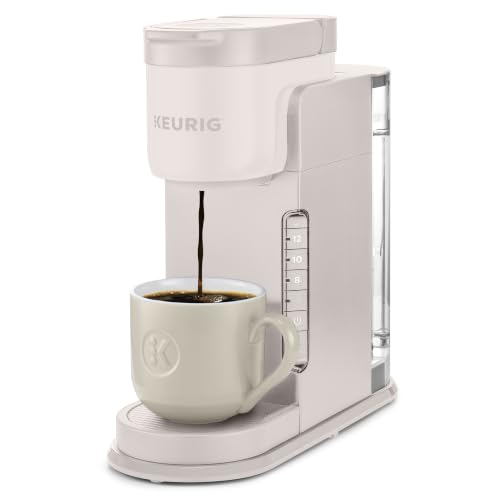
Keurig K-Express (Warm Stone)
Badge: Best Dorm Pick
Strengths
- Identical proven K-Express layout to the Black version, in a softer Warm Stone finish
- 42 oz removable reservoir suits a household making several cups a morning
- Strong Brew button and three sizes give simple control without menus
Trade-offs
- You are paying for a colour, not for extra brewing ability, versus other K-Express finishes
- Pod-only format keeps running costs and waste tied to capsules
- One cup at a time is a real limit for a busy shared kitchen at peak time
At a glance
- Format: Single serve, K-Cup pods
- Brew sizes: 3 brew sizes
- Reservoir: 42 oz, removable
- Feature: Strong Brew button
- Travel mug friendly
- Finish: Warm Stone
Choose the Warm Stone K-Express when you like everything about the standard K-Express — the 42 oz removable reservoir, the three brew sizes, the Strong Brew button and travel mug clearance — but do not want another matte black appliance on the counter. Finish sounds like a trivial reason to pick one machine over another until you remember that a coffee maker is one of the few appliances that never gets put away. It sits in your eyeline every morning, and a warmer, lighter tone genuinely suits pale worktops, wood cabinetry and rental kitchens where a black block can look heavy. Mechanically there is nothing to separate this machine from its Black and Evergreen siblings, and this guide will not pretend otherwise. That honesty is actually a point in its favour: you are buying into a widely sold layout with a deep pod ecosystem and controls a guest can work out without instructions. What you are choosing here is purely how the same reliable routine looks in your kitchen.
Living with the Warm Stone finish is a small lesson in how colour changes housekeeping. The pale, warm tone shows coffee splashes honestly, which sounds like a flaw and behaves like a feature: the machine gets wiped little and often, and never reaches the state of grime that dark machines can hide until it is advanced. Mechanically the ownership rhythm is the shared K-Express one — reservoir at the sink, pods in a drawer, a strength button that becomes the household default within days. Owners who choose this finish tend to place the machine prominently, and prominent machines get maintained; the two facts are connected.
In the grid, Keurig K-Express (Warm Stone) duplicates a neighbouring row in every engineering column — its separate row exists for finish, and the chart is honest about that.
Best for: buyers who want the K-Express routine in a softer, lighter kitchen scheme / Not suited for: buyers choosing on features alone, since the finish is the only difference here

Elite Gourmet 14 oz Single-Serve (EHC111A)
Badge: Best Hot and Iced
Strengths
- Reusable filter for grounds removes the need to keep buying pods
- One-touch operation is about as simple as a coffee maker gets
- Dishwasher-safe parts and auto shut-off suit low-effort, safety-conscious use
Trade-offs
- 14 oz is a single modest serving, with no reservoir for back-to-back cups
- 600W is modest power, so it is built for simplicity rather than speed records
- Grounds brewing means measuring and emptying grounds, which pod users may find fussy
At a glance
- Format: Single serve, grounds with reusable filter
- Capacity: 14 oz
- Power: 600W
- Controls: One-touch operation
- Also for: Loose-leaf tea
- Features: Auto shut-off, dishwasher-safe parts
- Includes: Travel mug (per listing title)
The Elite Gourmet EHC111A takes the opposite approach to the pod machines around it: a reusable filter, your own grounds, one button. That simplicity is its whole argument. There is no pod inventory to manage, no proprietary format to stay loyal to, and the same little machine will brew loose-leaf tea, which quietly makes it one of the more versatile picks in this line-up for a one-person household. The 14 oz capacity and travel mug positioning tell you exactly who it is for — one person, one serving, straight into the mug they will drink from. Auto shut-off matters more on a small machine like this than on a flagship, because small machines live in dorm rooms, offices and spare rooms where a forgotten appliance is a genuine worry. Dishwasher-safe parts close the loop: the parts that touch coffee can go in the wash instead of being rinsed at the sink. What it asks in return is a spoonful of effort per cup — grounds in, grounds out — and patience with a modest 600W element.
The Elite Gourmet’s ownership rhythm is the rhythm of the kettle: fill, brew, empty, done. There is no reservoir to refresh and no pod drawer to stock, but there is a filter to empty while the grounds are still warm and easy, and owners who build that ten-second habit into the pour never meet the machine’s one real punishment, which is yesterday’s grounds forgotten until tomorrow. The dishwasher-safe parts mean the weekly clean can be genuinely weekly rather than aspirational. In small homes it often ends up living in a cupboard between uses — a fate reservoir machines cannot share — and comes out without ceremony when wanted.
The Elite Gourmet 14 oz Single-Serve (EHC111A) row is the chart’s reminder that not every machine plays the same game: its columns are about effort and input freedom rather than capacity.
Best for: one-person households who prefer their own grounds and the simplest possible controls / Not suited for: multi-cup households or anyone who finds measuring grounds a chore
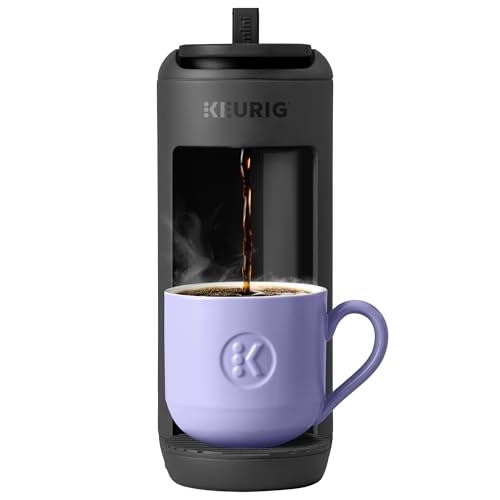
Keurig K-Mini Mate (Black)
Badge: Best Classic Look
Strengths
- Compact footprint fits counters where a reservoir machine will not
- Full access to the K-Cup pod range despite the small size
- Simple format that suits dorms, offices, caravans of the desk-bound kind and spare rooms
Trade-offs
- Brews up to 12 oz at a time, so larger mugs and second cups mean a second cycle
- No large reservoir convenience — small machines trade capacity for size
- Pod-only, with the usual capsule cost and waste considerations
At a glance
- Format: Single serve, K-Cup pods
- Brew size: Up to 12 oz per cup
- Design: Compact, portable
- Positioning: Small spaces, dorms and offices
- Finish: Black
The K-Mini Mate exists for the counters the K-Express cannot help: the dorm desk, the office corner, the tiny rental kitchen where every centimetre of worktop is already spoken for. It brews up to 12 oz from a K-Cup pod, which covers a normal mug honestly, and it does so in a body designed to be portable rather than parked for life. That portability cuts both ways and the trade should be understood before buying. A compact single serve machine is something you add water to far more often, and it will never anchor a family breakfast. What it does instead is put a real pod coffee, from the full K-Cup catalogue, into spaces where the alternative is instant coffee or a walk to a shop. For a student, a home worker in a box room, or anyone furnishing a first small flat, that is not a compromised version of coffee at home — it is the version that actually fits their home.
The K-Mini Mate asks its owner for water every time and gives back counter space in exchange, and the fairness of that trade reveals itself in the first fortnight. In a dorm or office corner the refill is trivial — a mug of water from the nearest tap — and the machine’s smallness means it is never in the way of the room’s real purpose. Its portability also changes ownership: it travels to wherever the coffee drinker currently lives, from term-time room to first flat, in a way a plumbed-in routine never does. The habit to build is keeping two or three pods beside it, so the small machine never meets an empty morning.
Keurig K-Mini Mate (Black) anchors the small end of every size column in the chart, and for the spaces it is designed for, that is a winning row rather than a losing one.
Best for: small spaces, dorms, offices and anyone whose counter cannot host a reservoir machine / Not suited for: families brewing several cups in a row every morning
Comparison Table
Here is the chart itself. Five columns carry the decision: the pick, what goes into it, how much water it holds, the point that distinguishes it, and the route to its current product page. Everything else in this guide exists to help you read these five columns well.
| Pick | Inputs | Reservoir / capacity | Standout point | Check |
|---|---|---|---|---|
| Ninja Single Serve Coffee Maker PB051 | K-Cup pods and grounds | 56 oz removable | 4 brew styles, up to 24 oz cups | Check on Amazon |
| Keurig K-Elite (Brushed Silver) | K-Cup pods | See product page | Step-up Keurig line, Brushed Silver | Check on Amazon |
| Keurig K-Express (Black) | K-Cup pods | 42 oz removable | Strong Brew button | Check on Amazon |
| Keurig K-Express (Warm Stone) | K-Cup pods | 42 oz removable | Warm Stone finish | Check on Amazon |
| Elite Gourmet 14 oz Single-Serve (EHC111A) | Grounds, reusable filter | 14 oz serving | Also brews loose-leaf tea | Check on Amazon |
| Keurig K-Mini Mate (Black) | K-Cup pods | Up to 12 oz per brew | Compact, portable body | Check on Amazon |
Two readings of the same chart produce two different shortlists, and both are correct. Read down the inputs column and the dual-format and grounds machines rise; read down the capacity column and the Ninja and reservoir Keurigs rise. Your household’s reading is the one that starts from the column matching your binding constraint. The narrative version of this grid lives at Best Home Brewing Coffee Makers.
How to Choose the Right Pick Among the Best home brew coffee makers comparison chart
Column one: inputs. This is the chart’s most consequential column because it describes a commitment, not a feature. Pods mean a catalogue and a per-cup cost; grounds mean freedom and a small daily effort; both means the machine stays useful whatever your household’s habits become. When two rows tie everywhere else, the inputs column breaks the tie, because you will live with it for thousands of cups.
Column two: water. Reservoir capacity and brew-size range sit together in most charts and should be read together. Capacity (42 oz, 45 oz, 56 oz across this shortlist, against the mini machines’ brew-by-brew filling) decides how often you visit the sink. Brew range decides whether your largest mug can be filled in one cycle — the Ninja’s up-to-24 oz ceiling is the chart’s outlier and, for travel-mug households, possibly its deciding cell. A chart that shows capacity without ceiling, or ceiling without capacity, is only half a chart.
Column three: the standout point. Every honest chart has a column that resists neat categories, and it is often the one that sells the machine: a dedicated iced mode, four brew styles, a strength button, a finish you love. Read this column last and weigh it by use, not novelty — a standout you use daily outranks three you use monthly. Buyers whose kitchens need a grinder in the same footprint should note that none of these rows offers one, and look instead toward Best Home Coffee Makers With Grinder territory.
What no column can hold. Noise at dawn, the feel of a lid, how a reservoir handle suits your hand, whether the drip tray fits your dishwasher — charts flatten these to nothing, and ownership is full of them. Use the chart to reach a shortlist of two, then use the detailed reviews, the maker’s pages and your own kitchen measurements to finish the job. That two-step — grid, then judgement — is the entire method of this guide.
How to Use a Comparison Chart Without Being Fooled by One
A five-step chart routine. 1) Cross out any column describing something you will never use — iced modes for hot-only drinkers, giant cup ceilings for espresso-cup households. 2) Circle your binding constraint (space, inputs, capacity) and sort the rows by it. 3) Check the surviving rows against your actual mug and your actual counter measurements. 4) Read one detailed review for each survivor, looking specifically for trade-offs the chart compressed away. 5) Confirm the finalist’s current feature list and finish availability on its product page before ordering — charts age, listings update.
Keeping the chart’s winner performing. Whichever row wins, the ownership routine is shared: fresh reservoir water, prompt drip-tray emptying, a wiped splash zone, descaling on schedule, and — for grounds machines — a reusable filter emptied and washed rather than rinsed and forgotten.
Troubleshooting. Problem: the machine that won the chart disappoints in the cup → the chart never promised flavour; revisit size and strength settings, since dilution is the usual culprit. Problem: a specified feature seems missing → check the current product page; listings are revised and the chart reflects its verification date. Problem: brewing slows within months → descale before concluding the chart steered you wrong; scale makes every brand look bad.
Why This Chart Has No Prices and No Star Ratings
Readers sometimes experience the missing columns as a lack. They are a policy, and the reasoning is worth two paragraphs. Prices for identical machines differ by retailer, finish and week; a chart printed with one retailer’s Tuesday price misinforms Wednesday’s reader and slanders or flatters machines at random. The honest chart entry is the one this guide uses: check the latest price on Amazon, where the number is live and the finish in stock is the finish priced.
Ratings rot faster and mislead worse. A fixed star figure freezes a moving average, blends different model years, and tells you nothing about whether the reviewers shared your household, your mug or your taste. What a chart can legitimately carry is verifiable engineering — format, capacity, features as listed — plus clearly-labelled judgement, which is what the badges and reviews here provide. Readers who want to understand how professional test organisations handle the same problem will find the discussion in Best Home Coffee Makers Consumer Reports instructive.
The Rows Charts Leave Out, and Why They Matter
Every chart is an act of exclusion. This one leaves out batch brewers entirely, because a 12-cup drip machine answers a different question — yet for a household that hosts brunch, the excluded row is the right purchase, and no single serve chart should talk them out of it. It leaves out espresso machines, French presses and pour-over kettles, all legitimate home coffee, none of it comparable on these columns without violence to the categories.
Knowing a chart’s borders is part of reading it well. Inside its borders — mainstream home single serve machines — this chart aims to be complete and accurate. At its borders, it points outward: to batch guides for pot drinkers, to grinder-equipped models for fresh-ground households, and to the wider market survey for everyone still deciding which category of machine their home actually needs.
How This Chart Was Verified, and How to Re-Verify It
A chart is only as good as its verification, so the method belongs on the page. Each row of this chart was built from the pick’s verified listing information — the manufacturer’s own product title data, which states format, brew sizes, reservoir capacity, named features and finish. Nothing was taken from retailer descriptions, review sites or sibling models. That is why the chart’s language sometimes sounds restrained: it claims a strength button where the listing names one, a capacity where the listing states one, and — in the K-Elite’s case — a line, a format and a finish, because that is what its verified listing states. Restraint is not missing information; it is information about the information.
Listings are living documents, and a responsible chart tells its readers how to re-verify it. Open the pick’s product page from any row of the table. Check the title and feature bullets against the chart’s cells for your chosen machine: format first, then capacity, then named features. If a cell and the page disagree, believe the page — manufacturers revise bundles, finishes and occasionally features, and the page describes the unit that will actually be dispatched. Report-worthy discrepancies are rare in this category, but the habit of checking is what separates chart-assisted buying from chart-obedient buying.
One more verification habit is worth adopting from this page: verify the variant, not just the model. The K-Express rows demonstrate why — four finishes, one platform, separate listings. A buyer who verifies ‘K-Express’ in general and orders whichever finish is cheapest has verified the coffee and randomised the kitchen. Check the finish name on the page against the finish you chose, check that the reservoir and size claims match the platform description, and the chart has done its full job: it narrowed the field, you confirmed the unit, and the purchase that arrives is the purchase you compared.
Common Buying Mistakes
Reading the chart as a ranking. Rows are ordered for readability, not merit; the best row is the one matching your constraint column. Comparing finishes on performance. Identical platforms in different colours brew identically — any chart implying otherwise is padding. Trusting a chart’s age. Listings change; verify the finalist’s live page, especially where this chart flags a brief listing. Letting one outlier cell decide. A 24 oz ceiling is decisive for travel-mug users and irrelevant to everyone else. Skipping the trade-off column in the reviews. Charts compress weaknesses away; the reviews restore them, and they are half the information.
Final Recommendation
The chart’s most complete row is Ninja Single Serve Coffee Maker PB051, and for households whose constraint is capacity or cup size it is the correct first choice. Buyers who prefer a step-up name should take Keurig K-Elite (Brushed Silver) as their finalist — with the explicit homework of confirming its current feature list on the product page, as this guide flags wherever the verified listing is brief. And readers whose favourite column is finish should choose freely between the K-Express colours, represented here by Keurig K-Express (Warm Stone): the coffee is identical, so let the kitchen decide. Grid first, judgement second, product page last — in that order, a chart serves you instead of steering you.
A Last Word on Charts and Confidence
Charts confer confidence, and confidence is worth auditing before it is spent. This chart’s confidence rests on a stated foundation — verified listing information, gathered identically for six machines, with gaps shown as gaps — and that foundation supports comparing specifications, not prophesying five years of mornings. Spend the confidence accordingly: let the chart eliminate the machines whose format, capacity or footprint cannot work in your home, and let it shortlist the two or three whose rows survive. Then switch instruments. Read the trade-offs, measure the counter, check the live page, and imagine the chore routine in February. A chart that has narrowed six machines to two has done excellent work; asking it to do the last step too is how good charts produce bad purchases. The two finalists a good chart produces are rarely separated by specifications at all; they are separated by the life around them — the mug, the counter, the household, the hand that fills the reservoir — and those are things only the buyer can measure, which is precisely why the last step belongs to the buyer and not to the grid.
Related guides
Frequently Asked Questions
How should I read a coffee maker comparison chart?
Column by column, starting from your binding constraint. Inputs decide your long-term costs and choice, reservoir and cup ceiling decide daily convenience, and standout features only matter in proportion to how often you will use them.
Why are there no prices in this chart?
Because a printed price is wrong within days and differs by finish and retailer. Each row links to the live product page instead, where the current price and stock for the exact finish are shown.
Why are there no star ratings in this chart?
Fixed ratings freeze a moving, mixed average and imply a precision taste does not have. This chart carries verifiable specifications and labelled editorial judgement instead, which age far more honestly.
Is the biggest machine in the chart the best one?
It is the most capable on capacity columns — the Ninja’s 56 oz reservoir and 24 oz cup ceiling lead the grid. Whether that capability is ‘best’ depends on your counter space and how many cups your household actually stacks into a morning.
Two rows look identical in the chart. Are they?
If they are K-Express finishes, yes: one platform, several colours. The chart lists them separately because they are sold separately, and states the shared platform openly rather than inventing differences.
What should I do after narrowing the chart to two machines?
Read both detailed reviews with attention to trade-offs, measure your counter and your tallest mug, then confirm the finalist’s live product page for its current feature list and finish availability before ordering.
Can a chart tell me which coffee will taste best?
No chart can. Taste depends on the coffee, the size and strength settings and your palate. A chart can only guarantee you are comparing the right machines; the cup itself is decided by the coffee you put in and the settings you choose.


