Disclosure: topratedkitchenware.com is reader-supported. When you buy through links on our site, we may earn an affiliate commission from Amazon and other retailers, at no extra cost to you.
Where to buy
The best paella cookers in a home kitchen are rarely the giant pans over open flame that festival photographs celebrate — they are the machines that produce a convincing paella-style rice on an ordinary Tuesday. This guide is upfront about its approach: the six verified picks below are electric rice cookers and multicookers used for paella-style cooking at home. They cannot form the true socarrat crust of a wide pan over fire, and we say so plainly. What they can do is cook saffron rice and its toppings with a consistency a stovetop pan rarely matches. Each name links to its Amazon listing so you can check the latest price on Amazon.
- Zojirushi NS-ZCC10 Neuro Fuzzy Rice Cooker and Warmer — Check on Amazon
- Zojirushi NS-TSC10 Micom Rice Cooker and Warmer (5.5-Cup)
- Dash Mini Rice Cooker (2-Cup, Ceramic Nonstick)
- BLACK+DECKER 16-Cup Rice Cooker (RC516)
- Aroma ARC-363-1NGB Rice Cooker, Steamer and Multicooker (Black)
- Aroma 20-Cup Digital Rice Cooker, Slow Cooker and Steamer (ARC-150SB)
Read the full guide ↓
Purists will tell you that the best paella cookers are wide, thin pans over orange-wood fire in Valencia, and the purists have a point — which this guide will not dodge. A rice cooker cannot replicate socarrat, the toasted crust at the bottom of a true paella, because a sealed electric pot cooks with steam and gentle, even heat rather than fierce direct flame. If socarrat is non-negotiable for you, you need a paella pan and a burner, and no electric appliance review should pretend otherwise.
And yet: paella-style rice — saffron-stained grains cooked in a rich stock with vegetables, seafood, chicken or sausage distributed through it — is one of the great home dishes, and electric cookers make it remarkably well. The grains stay separate, the saffron distributes evenly, nothing scorches while you are setting the table, and the whole performance scales from a single portion to a crowd. That is the honest territory of this guide: the best paella cookers for the paella-style cooking most households actually do, reviewed with their limits named. Cooks who love rice-based centrepieces will find a kindred approach in Best Pasta Cookers, where another proud tradition meets modern countertop machines.
One more honesty note. Paella divides opinion like few dishes — what goes in it, what never goes in it, what it may be called. This guide takes the pragmatic home position: cook a delicious saffron rice with good ingredients, respect the technique where the machine allows it, and call the result paella-style with a clear conscience.
Key Takeaways
- No electric cooker makes true socarrat — the toasted bottom crust needs a wide pan over direct flame. These picks make paella-style rice, and make it well.
- Grain quality decides the dish: the fuzzy-logic and Micom Zojirushi models produce the most separate, evenly cooked saffron rice here.
- The 20-cup Aroma ARC-150SB is the most versatile pick — its verified listing names rice cooker, slow cooker and steamer in one machine.
- The 16-cup BLACK+DECKER feeds a paella crowd; the Dash Mini makes an honest single-serving version for one.
- Bloom saffron in warm stock before it meets the rice, and let the finished dish rest — the two cheapest quality upgrades in paella-style cooking.
In this guide
Quick Picks
| Pick | Badge | Why it earns its place |
|---|---|---|
| Zojirushi NS-ZCC10 Neuro Fuzzy | Best Overall for Paella-Style Rice | Neuro Fuzzy precision for saffron rice that stays separate and evenly coloured — the quality benchmark of this line-up. |
| Zojirushi NS-TSC10 Micom | Best Mid-Size | Micom control and a family-friendly 5.5-cup size for weeknight paella-style dinners. |
| Dash Mini Rice Cooker | Best for One | A personal paella-style bowl for one: small, quick and portion-honest. |
| BLACK+DECKER 16-Cup Rice Cooker | Best for a Crowd | Sixteen cooked cups with a steaming basket — seafood and vegetables steam over a crowd-size saffron rice. |
| Aroma ARC-363-1NGB Multicooker | Best Compact Multicooker | A compact steamer-multicooker for small paella-style batches for one to three people. |
| Aroma ARC-150SB 20-Cup Multicooker | Best Large Multicooker | Twenty cups cooked plus slow cook and steamer functions — the big, flexible centrepiece for paella nights. |
How These Picks Were Chosen
We built this line-up from verified listings, judging each machine on the qualities paella-style cooking actually demands. Grain control came first: paella rice must absorb a large volume of flavoured stock without turning to porridge, so fuzzy-logic and Micom machines that sense and adjust during cooking scored highest. Capacity came second, because paella is social food and the spread from a one-person Dash to a twenty-cup Aroma reflects real serving needs. Steamer baskets mattered more than usual — steaming seafood or vegetables above the rice in the final stage is the electric cooker’s neatest paella trick. Every capacity and function quoted is from the verified listing of that model.
The method is research-led comparison, not a claim of side-by-side paella trials in identical machines. We also kept the category honest: the pool contains no paella pans or burners, so rather than inventing them, the guide defines its scope as paella-style electric cooking and states the socarrat limitation in the takeaways, the reviews and the questions at the end. Readers planning the full flame version for a garden party will find the big-format thinking in Best Pig Cookers coverage useful — different dish, same crowd-feeding logistics.
The 6 Best Paella Cookers for Paella-Style Rice at Home
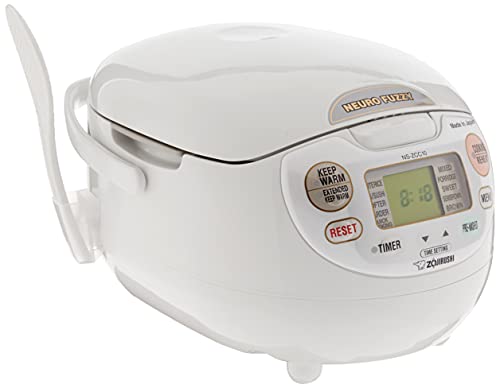
Zojirushi NS-ZCC10 Neuro Fuzzy Rice Cooker and Warmer
Badge: Best Overall for Paella-Style Rice
Strengths
- Neuro Fuzzy logic is renowned for consistent grain texture
- Automatic keep-warm and delay timer support set-ahead cooking
- A specialist machine from a brand built on rice cookers
Trade-offs
- A rice specialist — no slow cook or sauté in the listing
- Premium-tier positioning in its class
- White finish needs wiping to stay bright
Key specs (from the verified listing)
- Technology: Neuro Fuzzy logic
- Keep warm: automatic
- Timer: delay timer
- Colour: white
Zojirushi built its reputation on rice, and the NS-ZCC10 shows why: Neuro Fuzzy logic that continually adjusts temperature and time during the cycle, automatic keep-warm, and a delay timer so the rice finishes when dinner does. This is a specialist instrument. The verified listing promises excellence at grains and warmth-holding, and nothing else — no sauté, no slow cook, no steamer theatrics. Judge it as a specialist and it is superb: households that eat rice daily notice the difference in texture consistency that fuzzy-logic control delivers, batch after batch. Judge it as a multicooker and it will disappoint, because it never claimed to be one. The white finish is classic Zojirushi and wipes clean easily. For grain-centred cooking where the base itself is the main event, this is the connoisseur pick of the group.
For paella-style rice, grain quality is destiny, and the NS-ZCC10’s Neuro Fuzzy control is the best grain technology in this guide. Saffron stock is unforgiving: too little absorption and the rice is soupy, too much and it is chalky. A cooker that adjusts heat and time as the grains drink produces the separate, tender, evenly golden result the dish needs, batch after batch, without you hovering. The delay timer also suits paella’s rhythm — load the rice and stock, time it for your guests, and add quick-cooking toppings near the end. It has no steamer theatrics and no socarrat, but as a saffron-rice engine it is the benchmark here.
Best for: households that judge paella-style rice by grain quality first / Not suited for: cooks who need a steamer or slow-cook function in the same machine

Zojirushi NS-TSC10 Micom Rice Cooker and Warmer (5.5-Cup)
Badge: Best Mid-Size
Strengths
- Micom control gives precise, repeatable grain cooking
- Handy 5.5-cup size for small-to-mid households
- LCD controls and delay timer are easy to live with
Trade-offs
- Mid-size capacity will not cover large gatherings
- Rice-focused feature set, like its sibling
- Fewer functions than similarly sized multicookers
Key specs (from the verified listing)
- Capacity: 5.5 cups (1.0 litre)
- Technology: Micom (microcomputerised) control
- Controls: LCD, with delay timer
The NS-TSC10 is Zojirushi in a slightly smaller, LCD-controlled package: five and a half cups, one litre, Micom computerised control and a delay timer. Where the Neuro Fuzzy model is the flagship statement, the TSC10 is the everyday precision tool — big enough for a family side dish or a couple of days of grains for two, small enough to live on the counter. Micom control keeps cooking repeatable: the same grains, the same water, the same result, which is what regular rice eaters actually want from a machine. The listing keeps the promise narrow — a rice cooker and warmer with good controls — and that narrowness is a virtue for buyers who are tired of appliances that do nine things adequately. It will not braise or sauté. It will make the grains it was built for, very well, for years.
The TSC10 brings the same Zojirushi discipline to a five-and-a-half-cup size that matches a family paella-style dinner: enough saffron rice for four to six side portions or a main for three to four, with LCD controls that make timing the topping additions easy. Micom control keeps the absorption consistent, which matters when the liquid is precious saffron stock rather than plain water. It is the weeknight pick — the machine a household will actually use for a Thursday paella-style rice rather than saving for occasions. Like its sibling, it is a grain specialist, so vegetables and proteins are best steamed, grilled or cooked in stages around it.
Best for: family paella-style dinners on weeknights / Not suited for: large gatherings or multi-function cooking

Dash Mini Rice Cooker (2-Cup, Ceramic Nonstick)
Badge: Best for One
Strengths
- Truly personal size — the smallest cooker in this pool
- Ceramic nonstick pot removes for easy washing
- Handles oatmeal and quinoa as well as rice
Trade-offs
- Two cooked cups is a single serving, not a side for sharing
- No capacity for entertaining or batch cooking
- Basic feature set by design
Key specs (from the verified listing)
- Capacity: 1 cup uncooked / 2 cups cooked
- Pot: removable, ceramic nonstick
- Keep warm function
- Also cooks: oatmeal, quinoa and grains
- Colour: black
The Dash Mini is exactly what it sounds like: a personal rice cooker that takes one cup uncooked and returns two cups cooked, in a removable ceramic nonstick pot with a keep-warm function. The listing also names oatmeal and quinoa, which is the honest frame for this machine — it is a single-serving grain station for a dorm room, a small apartment, an office kitchenette or one person who cooks for one. The ceramic pot lifts out, rinses clean and goes back in seconds. Nothing about the Dash pretends to scale: it cannot feed a family, host a dinner or batch-cook a week of lunches. But portability and portion honesty are features too. For the cook who eats alone most nights and hates washing a full-size pot for a single serving, this little machine solves a real problem neatly.
A paella for one sounds like a contradiction, but the Dash Mini makes it a weeknight reality: a single portion of saffron rice with a few prawns, peas and peppers, cooked in a personal pot with a keep-warm function and washed up in a minute. The removable ceramic pot is the right size for the job and the portion honesty is the point — no giant batch tempting you all week, no pan to scrub. It cannot entertain and does not try to. For solo cooks who love the flavours of paella, it delivers them at exactly the right scale.
Best for: solo cooks who want paella flavours in one portion / Not suited for: sharing, entertaining or batch cooking

BLACK+DECKER 16-Cup Rice Cooker (RC516)
Badge: Best for a Crowd
Strengths
- Big batch capacity with one-touch simplicity
- Steaming basket cooks a second food over large grain batches
- Removable bowl keeps cleanup manageable at this size
Trade-offs
- Too large for one- or two-person everyday cooking
- One-touch means no fine program control
- Needs storage space when not in use
Key specs (from the verified listing)
- Capacity: 16 cups cooked / 8 cups uncooked
- Bowl: removable, non-stick
- Accessory: steaming basket
- Operation: one touch
The RC516 is BLACK+DECKER scaled up: sixteen cups cooked from eight cups uncooked, one-touch operation, a removable non-stick bowl and a steaming basket riding on top. It is built for the meals small cookers cannot touch — extended-family dinners, meal-prep Sundays, community events, big pots of grains with vegetables or proteins steaming above. One-touch operation keeps that scale simple; there is no menu to mis-set when you are cooking for a crowd. The removable bowl matters at this size, because sixteen cups of cooked grains leaves a pot that needs a proper wash, not a wipe. The trade-offs are the mirror of its strengths: it is too much machine for a solo weeknight, one-touch control gives no fine tuning, and it needs a home in a cupboard between big jobs. For households that regularly cook grains at volume, it earns that space.
Paella is party food, and the sixteen-cup BLACK+DECKER is the party machine in this line-up. Eight cups uncooked becomes a feast of saffron rice, while the steaming basket cooks mussels, prawns or vegetables above the grains so they arrive at the table hot and just-cooked rather than boiled to sadness in the rice. One-touch operation is a hosting feature: set it, greet people, serve. The removable bowl handles the generous washing-up that crowd cooking creates. It offers no fine control, so season the stock boldly before it goes in — the machine’s job is volume and reliability, and it does both.
Best for: crowd-size saffron rice with steamed toppings / Not suited for: small households or fine program control

Aroma ARC-363-1NGB Rice Cooker, Steamer and Multicooker (Black)
Badge: Best Compact Multicooker
Strengths
- Steamer and multicooker roles in a small body
- Black finish hides everyday marks well
- Right-sized for one to three people
Trade-offs
- Six cooked cups caps its batch size
- Simpler controls than digital Aroma models
- No delay timer named in the verified listing
Key specs (from the verified listing)
- Capacity: 3 cups uncooked / 6 cups cooked (2–6 cups range)
- Functions: rice cooker, steamer, multicooker
- Colour: black
The ARC-363-1NGB is Aroma’s small black multicooker: three cups uncooked, six cups cooked, with steamer and multicooker roles listed alongside rice. That combination — small size plus more than one job — is its whole appeal. It can steam vegetables or dumplings while the grains cook, handle a small soup or oatmeal batch, and then disappear into a cupboard. The black finish is practical, shrugging off the splashes that show on white appliances. It is not a digital machine and the listing names no delay timer, so scheduling is manual. Capacity is the firm boundary: two to six cups covers singles, couples and small sides, not gatherings. Within that boundary it is one of the better value shapes in this pool — several cooking methods, honest size, nothing wasted on features a small household will never open.
The little Aroma multicooker fits paella-style cooking for one to three people with a useful trick: its steamer lets toppings cook above a small batch of saffron rice in the same cycle. Six cooked cups is a main dish for two with leftovers, or sides for a small table. The black finish forgives saffron splashes, which anyone who has cooked with saffron and turmeric-adjacent spices will appreciate. It lacks a delay timer and digital finesse, so timing is in your hands. As a compact, affordable-shape route into paella-style home cooking, it covers the essentials without wasted size.
Best for: one to three people starting paella-style cooking / Not suited for: programmed timing or large batches

Aroma 20-Cup Digital Rice Cooker, Slow Cooker and Steamer (ARC-150SB)
Badge: Best Large Multicooker
Strengths
- Slow cooker function is named in the verified listing
- Huge 20-cup cooked capacity for crowds and batch days
- Steamer adds a second cooking layer over big batches
Trade-offs
- Big machine — counter and storage space required
- Digital controls take a first read of the manual
- Overkill for daily one-person cooking
Key specs (from the verified listing)
- Capacity: 20 cups cooked / 10 cups uncooked
- Functions: digital rice cooker, slow cooker, food steamer
- Exterior: stainless steel
- Colour: black
The ARC-150SB is the pool’s quiet overachiever: a twenty-cup digital machine whose verified listing names three jobs — rice cooker, slow cooker and food steamer — in a stainless steel exterior. That slow-cooker function is significant; it makes this one of the few rice-cooker-shaped machines here that can legitimately run a long, gentle braise as well as a mountain of grains. Ten cups uncooked is party scale, and the steamer lets a second food ride the same cycle. Digital controls organise those roles properly. Size is the honest cost: this is a large appliance that wants a permanent home, and a solo cook will use a fraction of its capacity most days. For big households, batch cookers and anyone who wants slow cooking plus serious grain volume in one footprint, it is arguably the most versatile verified pick in this entire group.
The ARC-150SB is the most capable paella-night machine here, for a simple reason: its verified listing names a slow cooker and a food steamer alongside the twenty-cup rice cooker. That combination maps onto a whole evening — a slow-cooked accompaniment started hours ahead, a mountain of saffron rice, and seafood or vegetables steamed above it at the end. Twenty cups cooked is genuine crowd capacity, and digital controls organise the stages. It is a large appliance that wants counter space and a household that cooks big. For paella nights with a dozen appetites, it is the centrepiece pick.
Best for: big paella nights needing rice, steaming and slow cooking together / Not suited for: daily cooking for one or two people
Comparison Table
| Pick | Capacity | Standout trait | Badge | Link |
|---|---|---|---|---|
| Zojirushi NS-ZCC10 Neuro Fuzzy | Neuro Fuzzy logic | Neuro Fuzzy logic | Best Overall for Paella-Style Rice | Check on Amazon |
| Zojirushi NS-TSC10 Micom | 5.5 cups (1.0 litre) | Micom control, LCD | Best Mid-Size | Check on Amazon |
| Dash Mini Rice Cooker | 1 cup uncooked / 2 cups cooked | Ceramic pot, keep warm | Best for One | Check on Amazon |
| BLACK+DECKER 16-Cup Rice Cooker | 16 cups cooked / 8 cups uncooked | Steaming basket, one-touch | Best for a Crowd | Check on Amazon |
| Aroma ARC-363-1NGB Multicooker | 3 cups uncooked / 6 cups cooked (2–6 cups range) | Steamer and multicooker | Best Compact Multicooker | Check on Amazon |
| Aroma ARC-150SB 20-Cup Multicooker | 20 cups cooked / 10 cups uncooked | Slow cooker plus steamer | Best Large Multicooker | Check on Amazon |
How to Choose the Best Paella Cookers for Home Paella-Style Cooking
Choose by grain technology first, because paella-style rice lives or dies on absorption. A cooker that merely boils until a timer ends will give you uneven saffron rice — wet in the middle, tight at the edges. Fuzzy-logic and Micom machines adjust as they cook, and for stock-heavy rice that adjustment is the difference between a dish and a near-miss. If your budget of attention stretches to one premium feature, spend it there: the Zojirushi pair exist in this guide precisely because their control systems suit flavoured, absorbent rice. If your paella-style cooking is occasional and social rather than weekly and exacting, the simpler one-touch and multicooker models trade a little grain perfection for size, steaming and ease — a fair trade for a party.
Choose by gathering size second. Paella is the rare dish people cook specifically for a table full of people, so count your real table: the Dash serves one, the compact Aroma two to three, the TSC10 a family, and the sixteen- and twenty-cup machines a crowd. Remember that toppings take space too — a cooker filled to the brim with rice has no room for the seafood and vegetables that make the dish, so leave headroom or steam toppings separately in the basket models. Finally, decide how you feel about socarrat before you buy anything. If the crust is the dish for you, stop here and buy a pan and burner with our blessing. If the saffron rice, the toppings and the company are the dish, an electric cooker will serve you happily for years. Our Best Portable Cookers guide covers the smaller end of this same machine family for readers whose cooking travels.
How to Cook Paella-Style Rice in an Electric Cooker
The method below adapts paella technique to what an electric cooker does well: even absorption, gentle steaming and reliable resting. It works across the sizes in this guide — scale the quantities to your machine, keeping the rice in a relatively shallow, even layer rather than a deep pile.
The non-negotiables are bloomed saffron, hot stock and a rest at the end. Everything else is flexible.
- Bloom the saffron: steep the threads in a little warm stock for at least fifteen minutes. This coloured, fragrant liquid is the soul of the dish; dry threads tossed into a pot distribute badly.
- Build the base flavour: soften onion and pepper first — in a pan, or in stages if your cooker allows — with garlic and a little smoked paprika. Electric cookers reward a flavour base made before the rice goes in.
- Add rice and hot saffron stock: use short-grain rice if you can, stir once to distribute, then leave it alone. Stirring during cooking releases starch and turns paella-style rice toward risotto.
- Cook undisturbed on the rice setting: let the machine manage absorption. Resist opening the lid to check; the steam you release is part of the cooking liquid.
- Steam the toppings at the end: arrange quick-cooking seafood, peas or vegetables on top or in the steamer basket for the final stage so they cook in the fragrant steam without being boiled.
- Rest before serving: switch off or let keep-warm hold briefly, then rest the pot, covered, for around ten minutes. The grains firm up, the saffron evens out, and the dish becomes itself.
- Serve from the pot with lemon wedges and something green and sharp alongside — the richness of saffron rice wants a bright neighbour.
Problem: the rice is wet and porridge-like → too much stock for the rice, or the lid was lifted repeatedly. Measure stock conservatively — electric cookers lose almost no liquid — and next time reduce slightly; this time, rest the pot uncovered for a few minutes so surface moisture settles.
Problem: pale, uneven colour → the saffron was not bloomed, or the rice was stirred mid-cook and the colour pooled. Always steep saffron in warm stock first, add it evenly, and stir once at the start only.
Problem: seafood is rubbery → it cooked for the whole cycle. Delicate toppings belong in the final stage only, steamed on top of the rice; firm vegetables can go earlier, prawns and mussels cannot.
The Socarrat Question, Answered Honestly
Socarrat — the crisp, toasted layer of rice at the bottom of a pan paella — is the most argued-over crust in European cooking, and it is fair to ask whether this entire guide is a compromise. The answer is: a declared one. Socarrat forms when a shallow layer of rice meets fierce, direct heat at the end of cooking and the bottom grains toast in the pan’s oil. A sealed electric cooker, cooking gently and evenly with steam, physically cannot do that. What it produces instead is uniformly tender, separate, saffron-rich rice — closer to the top two-thirds of a great pan paella, every spoonful. Many home cooks, burned by scorched stovetop attempts, quietly prefer it.
If you want both worlds, the hybrid route works: cook the rice in the electric cooker for reliability, and if you own a suitable pan, a portion can be finished briefly over high heat for a toasted base. But do not buy an electric cooker expecting a hidden socarrat mode — there is none, in this guide or anywhere else. Buy it for consistency, scale and ease, and it will not disappoint you. The same honesty-first approach governs our look at Best Pellet Cookers, where the defining feature of the category is examined rather than assumed.
What Goes in a Paella-Style Rice — and What to Leave Out
Home paella-style cooking is healthiest when it respects a simple structure: a flavour base of onion, pepper and garlic; short-grain rice; saffron stock; and toppings chosen as one coherent idea — all seafood, or chicken and sausage, or a garden of vegetables — rather than everything in the fridge. Mixed surf-and-turf versions exist and can be delicious, but a single theme cooks more evenly and tastes more deliberate. Peas, roasted peppers and lemon are the classic finishing notes. Chorizo is the famous controversy: beloved in many home versions, rejected by Valencian traditionalists. In your own kitchen the rule is simpler — if you love it, slice it thin, crisp it for the base, and enjoy the argument at the table.
Vegetable versions deserve special respect in an electric cooker, because the machine’s gentle steam suits artichokes, green beans, peppers and mushrooms beautifully, and a well-made vegetable saffron rice is no one’s consolation prize. Readers building plant-based menus often cross-reference Best Pod Sous Vide Cookers for precision-cooked vegetable preparations to serve alongside — a very different technique that pairs surprisingly well with a big, relaxed pot of saffron rice.
Saffron, Stock and the Details That Decide the Dish
Paella-style cooking rises or falls on two liquids and one spice, and the electric cooker changes how each behaves. Saffron first: it is the most expensive ingredient in the dish and the easiest to waste. Threads should be steeped in warm stock until the liquid is deeply golden — that infusion, added evenly, is what colours every grain. Tossed in dry, the same threads perfume three spoonfuls and ignore the rest. Quality matters more than quantity; a modest pinch of real saffron, properly bloomed, outperforms a heavy hand of tired spice. Store it sealed, dark and dry, and buy it in small amounts you will actually use while it is vivid.
Stock second: in a pan, stock reduces and concentrates as the rice cooks; in a sealed electric cooker, almost nothing evaporates, so the stock you add is the stock you taste. That makes seasoning a decision you take before the lid closes. Taste the saffron stock on its own — it should be slightly bolder than you want the finished rice, because the grains will absorb and soften its edges. A stock that tastes timid at this stage guarantees a timid dish, and no finishing trick fully rescues it. Homemade stock is lovely; a good bought stock, honestly seasoned, beats a watery homemade one. The cooker’s consistency then works for you: the same stock, the same rice and the same machine will repeat a result you liked, which is how home cooks actually develop a signature version of this dish.
The third detail is the rice itself. Short-grain varieties drink deeply and stay distinct — the texture the dish is built on. Rinse decisions divide cooks; for paella-style rice, most traditionalists do not rinse, keeping the surface starch that helps the grains take up stock and hold their separation. What everyone agrees on is the rest at the end: ten undisturbed minutes in which the grains finish absorbing, the colour evens and the texture sets. Serving straight from a just-opened cooker gives you the draft version of the dish. Serving after the rest gives you the published one.
Scaling Paella-Style Cooking: From Two People to a Garden Full
The social geometry of paella is part of its charm — one generous dish, eaten together, straight from the cooking vessel — and electric cookers scale that geometry in both directions better than pans do. At the small end, the Dash Mini and the compact Aroma make the dish a weeknight possibility for one or two people, which pan paella never is: nobody fires a burner and a wide pan for a single portion, but a personal cooker of saffron rice with a few prawns is a Tuesday. That small end matters more than it looks, because it is where a cook practises — seasoning the stock, learning the absorption, finding their version — before the high-stakes version for guests.
At the large end, the sixteen- and twenty-cup machines turn paella-style rice into genuine event food, with two practical rules. First, cook the rice in the cooker and the showpiece toppings — a platter of grilled vegetables, seafood cooked at the last moment — as parallel acts, combining them at the table rather than forcing one vessel to do everything at once. Second, hold and serve from the cooker itself: keep-warm turns the machine into the serving dish, the modern echo of the pan in the middle of the table, and second helpings stay at temperature through a long evening. Between those poles sits the family scale of the Zojirushi TSC10, where most households will live most of the time.
What scaling should never change is the order of operations: bloomed saffron, seasoned stock, undisturbed cooking, rested rice. A cook who keeps that order can move from the Dash to the twenty-cup Aroma and produce the same dish at any size — which is, in the end, the real promise of the electric approach to this most traditional of rice dishes. The theatre of the pan is irreplaceable, and this guide has never claimed otherwise. But the flavour, the colour and the company are all reproducible on a countertop, and for most homes, most of the time, that is the paella that actually happens.
A Short History of Paella, for Cooks Who Like Context
Paella began as a field lunch: farm workers around Valencia cooking rice in a wide, shallow pan over an open fire, with whatever the land offered that day — beans, snails, rabbit, vegetables. The pan gave the dish its name, its shape and its social form: one vessel, eaten communally, outdoors. Seafood versions came later, from the coast; the mixed versions came later still, from restaurants and home kitchens that refused to choose. Every stage of that history explains a feature of the dish — the wide pan for evaporation and crust, the short-grain rice for absorption, the communal serving for a working lunch shared in the field. Understanding that the dish was born as practical outdoor cooking, not ceremony, is oddly liberating for the home cook with an electric machine.
Because the tradition itself was always adaptive. The workers who invented paella used the heat source they had and the ingredients at hand; the idea that the dish froze in a single correct form would have puzzled them. What they would recognise in a modern kitchen is the intent: rice cooked with care in a flavourful liquid, toppings chosen from what is good, and people gathered around the result. The electric cooker changes the heat source and surrenders the crust — a real loss, named honestly throughout this guide — while keeping the intent fully intact. Cook your saffron rice with good stock, good ingredients and good company, and you are closer to the spirit of the original field lunch than a joyless, technically perfect pan cooked for an audience of critics.
One last practical note for hosts: paella-style rice is unusually forgiving about timing at the table. Because the cooker holds it warm and the grains continue to settle rather than deteriorate, a batch that finishes twenty minutes before your guests sit down is not a problem to solve but an advantage to enjoy — the cook can greet people, pour drinks and lay the table while the dish completes itself. Few centrepiece dishes offer that calm. It is one more reason the electric approach, for all its honesty about the missing crust, has earned a permanent place in so many households that love this food.
Common Buying Mistakes
- Buying an electric cooker expecting socarrat. It cannot happen in a sealed, steam-driven pot. Buy electric for consistency and scale; buy a pan and burner for the crust. Confusing the two guarantees disappointment.
- Stirring the rice during cooking. Stirring releases starch and turns the texture toward risotto. Stir once when the stock goes in, then trust the machine and leave the lid shut.
- Adding seafood at the start. Prawns and mussels need minutes, not a full rice cycle. Steam them on top at the end or they will be rubbery no matter how good the rice is.
- Skipping the saffron bloom. Dry threads tossed into the pot give patchy colour and wasted saffron. Fifteen minutes in warm stock transforms both colour and aroma.
- Filling the cooker to the brim. Rice swells and toppings need room. An overfilled cooker cooks unevenly and leaves nowhere for the seafood to steam. Leave headroom or cook in two batches.
Final Recommendation
Buy the Zojirushi NS-ZCC10 if grain quality is your priority: its Neuro Fuzzy control produces the most convincing saffron rice in this line-up, and paella-style cooking is, at heart, a rice examination. Families who cook it weekly in family quantities should look at the TSC10 for the same discipline in a friendlier size.
Cook for crowds and the answer changes: the twenty-cup Aroma ARC-150SB, with slow cooking and steaming flanking its rice capacity, runs an entire paella night from one machine, while the sixteen-cup BLACK+DECKER is the simpler crowd feeder. Solo cooks get the Dash and a perfect portion. None of these will give you socarrat — but all of them will give you saffron rice worth gathering around, and that is the promise this guide actually makes.
Start with the Zojirushi NS-ZCC10 Neuro Fuzzy if you want the safest first choice for this guide’s purpose. If its main trade-off is the one thing you cannot live with, the Zojirushi NS-TSC10 Micom is the alternative we would buy instead — check the latest price on Amazon for both before you decide.
Frequently Asked Questions
Can a rice cooker really make paella?
It makes paella-style rice: saffron rice cooked in flavoured stock with toppings, with separate tender grains and even colour. What it cannot make is the toasted socarrat crust of a pan over flame. If you accept that one honest difference, the results are genuinely excellent and far more consistent than most stovetop attempts.
What rice should I use for paella-style cooking?
Short-grain rice is the traditional and best choice because it absorbs lots of stock while staying distinct. Medium-grain works acceptably in an electric cooker. Long-grain rice is the weakest option — it absorbs less flavour and gives a looser, less authentic texture.
How much stock does rice-cooker paella need?
Less than a pan version, because a sealed electric cooker loses almost no liquid to evaporation. Start conservatively — closer to the cooker’s normal rice-to-liquid guidance, enriched with your saffron stock — and adjust on your second batch. A wet first attempt is the most common beginner result.
Can I cook seafood in the same cycle as the rice?
Yes, if you time it: firm vegetables can go in early, but prawns, mussels and fish belong in the final stage, arranged on top or in a steamer basket so they steam gently. Cooked for the full cycle, seafood turns rubbery regardless of the machine.
Which pick in this guide is best for a big paella night?
The Aroma ARC-150SB for versatility — twenty cups cooked, plus steamer and slow-cooker functions for the rest of the menu. The BLACK+DECKER 16-Cup is the simpler alternative if you want one-touch crowd rice with a steaming basket and nothing else to manage.
Is paella-style rice in a cooker just risotto with saffron?
No — the technique differs in the way that matters. Paella-style rice is not stirred, absorbs its stock fully and rests into separate grains. Risotto is stirred constantly into creaminess. Keep your spoon out of the cooker and the distinction takes care of itself.


