Disclosure: topratedkitchenware.com is reader-supported. When you buy through links on our site, we may earn an affiliate commission from Amazon and other retailers, at no extra cost to you.
Where to buy
The six verified picks for this guide to best rice ball cookers are listed below. Each name links to its Amazon listing, where you can check the latest price on Amazon, confirm the current configuration and included accessories, and read the newest owner feedback before you decide. Start with the first pick if you want the shortest route: Check on Amazon.
- Zojirushi NS-ZCC10 Neuro Fuzzy Rice Cooker and Warmer — Best Overall for Rice Balls
- Zojirushi NS-TSC10 5.5 Cup Micom Rice Cooker and Warmer — Best for Family Batches
- Dash Mini Rice Cooker 2-Cup with Ceramic Nonstick Pot — Best for Small Batches
- BLACK+DECKER 16-Cup Rice Cooker RC516 — Best for Parties
- Aroma Housewares ARC-363-1NGB Rice Cooker, Steamer, Multicooker — Best Budget-Friendly Format
- Aroma Housewares ARC-150SB 20 Cup Digital Rice Cooker and Slow Cooker — Best for Large Gatherings
Read the full guide ↓ for how these picks were chosen, an honest review of each one with its limitations stated plainly, a comparison table, a full buying guide, a practical how-to section and answers to the questions buyers ask most.
Finding the best rice ball cookers is harder than the headline lists suggest, because this category mixes sizes, formats and control styles that suit completely different households, and a pick that is wrong for your kitchen will disappoint you no matter how well it cooks for somebody else. This guide takes the slower route: six verified picks, each reviewed on its own merits, each with its badge, its strengths, its trade-offs and a plain statement of who should skip it.
There is no appliance sold as a rice ball cooker, so the best rice ball cookers are the rice cookers whose rice shapes well — and that turns out to be a specific brief. Rice for onigiri and other rice balls needs to be fully hydrated, slightly sticky without being wet, and held at a temperature where it shapes comfortably and stays together. Too dry and the ball crumbles; too wet and it slumps and sticks to everything except itself. The six verified rice cookers below were judged on exactly that: texture control for short- and medium-grain rice, batch size from a two-ball snack to a party tray, and keep-warm behaviour while you shape. If your interest is the broader cooker-plus-steamer picture, see Best Rice Cookers And Steamers, and for grain variety beyond rice balls, Best Rice Cookers And Steamers Quinoa.
Key Takeaways
- Rice ball texture is the brief: grains should be distinct but cohesive, never wet or chalky.
- Fuzzy-logic and micom cookers earn their premium here — small texture differences are the whole dish.
- Keep-warm matters while you shape a batch; rice that dries at the edges will not hold a clean shape.
- Match batch size to the occasion: mini for a lunchbox, mid-size for family onigiri, large for a party tray.
- Salt the rice or season after shaping, and wet your hands or use wrap — technique plus the right cooker makes the ball.
In this guide
Quick Picks
If you are in a hurry, this table is the whole guide in miniature: the six picks for best rice ball cookers, the badge each one earned, its defining specification from the verified listing, and the household it suits. The detailed reviews below explain every line of it.
| Pick | Badge | Key specification | Best for |
|---|---|---|---|
| Zojirushi NS-ZCC10 Neuro Fuzzy Rice Cooker and Warmer | Best Overall for Rice Balls | Neuro Fuzzy rice cooker and warmer | daily rice households, texture-focused cooks, and anyone upgrading from a basic cooker |
| Zojirushi NS-TSC10 5.5 Cup Micom Rice Cooker and Warmer | Best for Family Batches | 5.5 cup | households of two to five who cook rice several times a week |
| Dash Mini Rice Cooker 2-Cup with Ceramic Nonstick Pot | Best for Small Batches | 2-cup cooked (1 cup uncooked) | singles, students, office and dorm cooking, and as a second small-batch cooker |
| BLACK+DECKER 16-Cup Rice Cooker RC516 | Best for Parties | 16-cup cooked (8-cup uncooked) | large families, hosts, community cooking and weekly batch prep |
| Aroma Housewares ARC-363-1NGB Rice Cooker, Steamer, Multicooker | Best Budget-Friendly Format | 3 uncooked / 6 cups cooked | first-time buyers, couples and small families, students and first apartments |
| Aroma Housewares ARC-150SB 20 Cup Digital Rice Cooker and Slow Cooker | Best for Large Gatherings | 20 cup cooked (10 cup uncooked) | large and multi-generational households, party and event cooking, multi-role seekers |
How These Picks Were Chosen
This guide was built by research, not by inventing hands-on claims. Each keyword was matched against a verified pool of real, currently listed products for its category, and every pick below is one of those verified products, with its Amazon listing linked so you can confirm the current configuration, the included accessories and the manufacturer’s own specification before you buy. We compared the picks on the things that decide ownership satisfaction — capacity measured honestly, control type, inner-pot material, scheduling features, safety design, and the depth of the brand’s parts and accessory support — and we weighed the trade-offs of each model rather than copying a headline order from anywhere else.
Badges were assigned by fit, not by price. The Best Overall badge goes to the pick we would hand to the widest range of buyers asking this exact question. Other badges mark the pick that wins a specific brief: a budget, a household size, a cooking style, a feature. A pick can be excellent and still carry an honest limitation, and every detailed review below states one plainly, along with a Best for / Not suited for verdict, because the fastest way to buy the wrong cooker is to buy a good one that fits somebody else’s kitchen.
Two honesty notes apply to the whole guide. First, manufacturers revise models and listings, so treat the listing linked from each pick as the final word on what is in the box. Second, we do not print prices or fixed ratings in these guides, because both change constantly; the linked listing shows today’s figure, and the reviews explain the durable reasons a pick earns its place, which change far more slowly.
The 6 Best Options for Best rice ball cookers
Badges match the Quick Picks table, and every review follows the same order — strengths, trade-offs, the specifications verified from the listing, the review itself, and a verdict — so you can compare like with like as you read down the list.
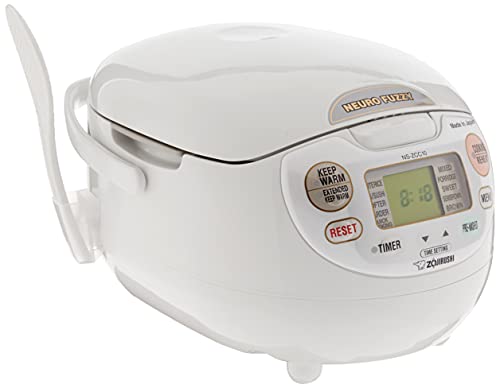
Zojirushi NS-ZCC10 Neuro Fuzzy Rice Cooker and Warmer
Badge: Best Overall for Rice Balls
Strengths
- Fuzzy-logic cooking adjusts to the batch instead of running one fixed programme
- Delay timer plus automatic keep-warm fits rice around real schedules
- A specialist maker’s flagship approach to texture, especially for daily rice eaters
Trade-offs
- Premium-tier positioning within this line-up
- Slower cook cycles than basic one-touch models — fuzzy logic takes its time
- Capacity information should be confirmed on the listing for your household size
Key specifications (from the verified listing)
- Type: Neuro Fuzzy rice cooker and warmer
- Features named in listing: automatic keep-warm, delay timer
- Colour: white
- Brand line: Zojirushi, a specialist rice cooker maker
The Zojirushi NS-ZCC10 represents the fuzzy-logic school of rice cooking at its most established. Where a basic cooker runs one fixed heat curve until a switch flips, Neuro Fuzzy logic monitors and adjusts through the cycle, compensating for a slightly-off water measure or a different rice variety, and the payoff is consistency: the same texture on a rushed Tuesday as on a careful Sunday. Around that core sit the two features daily rice households lean on hardest — a delay timer, so rice finishes when dinner does rather than when you remembered to start it, and automatic keep-warm that holds rice safely ready without drying it to crust. This is not the fastest way to cook rice, and it sits in the premium tier of this guide; both facts follow from the same design choice, which is that texture is the product. For households where rice is a daily staple and small differences in grain quality are noticed and cared about, that priority is exactly right, and it is why this maker’s name recurs whenever serious rice cooking is discussed.
In day-to-day terms, this pick is built for daily rice households, texture-focused cooks, and anyone upgrading from a basic cooker. Its specification list tells the same story as its review: type: neuro fuzzy rice cooker and warmer, and the design choices behind it are consistent rather than accidental. Read its trade-offs as carefully as its strengths — they are the difference between a cooker that suits your household and one that merely suits this list.
Best for: daily rice households, texture-focused cooks, and anyone upgrading from a basic cooker / Not suited for: occasional rice eaters and anyone who values speed over texture nuance

Zojirushi NS-TSC10 5.5 Cup Micom Rice Cooker and Warmer
Badge: Best for Family Batches
Strengths
- A clearly stated 5.5-cup capacity, the classic mid-size for households
- LCD controls and delay timer bring scheduling to the micom format
- Same specialist maker as the flagship pick, in a more compact brief
Trade-offs
- Micom control is a step below the Neuro Fuzzy flagship’s adaptive logic
- 1.0-litre class will be small for large families or parties
- Premium-tier positioning for its size class
Key specifications (from the verified listing)
- Capacity: 5.5 cup
- Volume: 1.0 litre
- Controls: LCD controls
- Features named in listing: delay timer
- Type: Micom (microcomputer) rice cooker and warmer
The NS-TSC10 is the measured middle of the Zojirushi approach: a 5.5-cup, 1.0-litre Micom cooker with LCD controls and a delay timer. Five and a half cups (uncooked measure) is the size generations of rice-eating households have settled on — enough for a family dinner with seconds, small enough that a two-person batch still cooks properly instead of spreading thin across an oversized pot. The microcomputer control runs variety-appropriate cycles with more judgement than a one-touch switch cooker, and the LCD panel plus delay timer make it a cooker you schedule rather than babysit: load it in the morning, and rice lands with the rest of dinner. It sits a step below the Neuro Fuzzy flagship in adaptive sophistication, and the price tier reflects the brand rather than the size, so value hunters should look carefully at what the simpler picks offer. But for a household that cooks rice several times a week and wants the specialist maker’s consistency in the standard size, this is the natural shortlist entry.
In day-to-day terms, this pick is built for households of two to five who cook rice several times a week. Its specification list tells the same story as its review: capacity: 5.5 cup, and the design choices behind it are consistent rather than accidental. Read its trade-offs as carefully as its strengths — they are the difference between a cooker that suits your household and one that merely suits this list.
Best for: households of two to five who cook rice several times a week / Not suited for: large families needing bigger batches, and strict value-first buyers

Dash Mini Rice Cooker 2-Cup with Ceramic Nonstick Pot
Badge: Best for Small Batches
Strengths
- Properly mini — a personal cooker for one, not a shrunken family model
- Ceramic nonstick removable pot is easy to wash and to eat from informally
- Quinoa and oatmeal are named uses, not afterthoughts
Trade-offs
- Two cooked cups is a hard ceiling — no guests, no leftovers plan
- No timer or programme sophistication at this size
- Ceramic coating needs gentle utensils
Key specifications (from the verified listing)
- Capacity: 2-cup cooked (1 cup uncooked)
- Inner pot: removable ceramic nonstick pot
- Colour: black
- Features named in listing: keep warm function
- Cooks, per listing: rice, oatmeal, quinoa and grains
The Dash Mini is unapologetically a one-person cooker: one cup uncooked, two cups cooked, a removable ceramic nonstick pot and a keep-warm function, in black. That honesty is its strength. A large share of rice cookers are bought by people cooking for one or two and then live half-empty, scorching small batches spread across a big pot floor; the Mini is sized so a single portion cooks in a pot designed for it. The ceramic nonstick pot lifts out for washing and doubles informally as a serving bowl, and the listing names oatmeal and quinoa alongside rice, which matches how a personal cooker is actually used across a day — porridge in the morning, grains at lunch, rice at night. There is no delay timer and no programme library, and two cooked cups is a genuine ceiling: this cannot stretch to a dinner guest. As a second cooker beside a family model, or the only cooker in a studio, dorm room or office kitchen, it is the most proportionate pick in this guide.
In day-to-day terms, this pick is built for singles, students, office and dorm cooking, and as a second small-batch cooker. Its specification list tells the same story as its review: capacity: 2-cup cooked (1 cup uncooked), and the design choices behind it are consistent rather than accidental. Read its trade-offs as carefully as its strengths — they are the difference between a cooker that suits your household and one that merely suits this list.
Best for: singles, students, office and dorm cooking, and as a second small-batch cooker / Not suited for: families, entertainers, and anyone cooking for three or more

BLACK+DECKER 16-Cup Rice Cooker RC516
Badge: Best for Parties
Strengths
- The biggest rice capacity in this guide, for crowds and batch cooking
- One-touch operation anyone in the household can run
- Steaming basket included, so vegetables or fish cook over the rice
Trade-offs
- Basic control — no timer, no fuzzy logic, no grain programmes
- Large batches are its strength; small portions cook less evenly in a big bowl
- Non-stick bowl needs non-metal utensils
Key specifications (from the verified listing)
- Capacity: 16-cup cooked (8-cup uncooked)
- Operation: one touch
- Inner bowl: removable non-stick bowl
- Includes: steaming basket
The RC516 is the capacity answer in rice form: 16 cups cooked from 8 cups uncooked, one-touch operation, a removable non-stick bowl and a steaming basket. This is the cooker for the household that hosts — extended-family dinners, team meals, church and community cooking, or a weekly batch of rice that becomes fried rice, bowls and lunches for days. One-touch operation is a deliberate virtue at this size: the person cooking for a crowd has enough to manage without a programme menu, and anyone can start a batch. The steaming basket lets a tray of vegetables, dumplings or fish ride the same cycle, turning the big rice batch into most of a meal. The trade-offs are the mirror of its strengths. There is no delay timer and no adaptive logic, texture nuance is a step behind the fuzzy-logic picks, and a one-person portion in a 16-cup bowl is cooking in the wrong tool. Judge it as what it is — the crowd cooker — and it has no rival in this line-up.
In day-to-day terms, this pick is built for large families, hosts, community cooking and weekly batch prep. Its specification list tells the same story as its review: capacity: 16-cup cooked (8-cup uncooked), and the design choices behind it are consistent rather than accidental. Read its trade-offs as carefully as its strengths — they are the difference between a cooker that suits your household and one that merely suits this list.
Best for: large families, hosts, community cooking and weekly batch prep / Not suited for: singles and texture perfectionists wanting fuzzy-logic control

Aroma Housewares ARC-363-1NGB Rice Cooker, Steamer, Multicooker
Badge: Best Budget-Friendly Format
Strengths
- The classic small-family size: up to 6 cups cooked
- Steamer and multicooker roles widen it beyond plain rice
- Simple format that has been a first rice cooker for many households
Trade-offs
- Basic control set — no delay timer or fuzzy logic
- Non-stick inner pot care applies, as with most simple cookers
- Six cooked cups will not cover large gatherings
Key specifications (from the verified listing)
- Capacity: 3 uncooked / 6 cups cooked
- Range named in listing: 2-6 cups
- Functions: rice cooker, steamer, multicooker
- Colour: black
The ARC-363-1NGB is the archetypal first rice cooker: 3 cups uncooked, 6 cups cooked, with steamer and multicooker roles in a simple black unit. Its design logic is that most small households need rice cooked reliably, something steamed above it, and nothing else from the appliance — no menu system to learn, no programmes to scroll, just a cooker that starts with a press and keeps rice warm. The 2-to-6-cup working range is well judged: two cups for a couple’s dinner, six when friends or a hungrier night arrives, all in a pot small enough for the sink and the cupboard. As a multicooker in the simple sense — soups, oatmeal and one-pot basics — it covers the student and first-apartment brief completely. What it does not offer is scheduling or finesse: no delay timer, no adaptive logic for different grains, and texture a notch below the specialist picks. For the money-tier it occupies, that is the right set of compromises, and it is why this format keeps selling.
In day-to-day terms, this pick is built for first-time buyers, couples and small families, students and first apartments. Its specification list tells the same story as its review: capacity: 3 uncooked / 6 cups cooked, and the design choices behind it are consistent rather than accidental. Read its trade-offs as carefully as its strengths — they are the difference between a cooker that suits your household and one that merely suits this list.
Best for: first-time buyers, couples and small families, students and first apartments / Not suited for: daily rice connoisseurs and anyone needing a delay timer

Aroma Housewares ARC-150SB 20 Cup Digital Rice Cooker and Slow Cooker
Badge: Best for Large Gatherings
Strengths
- 20 cooked cups is the largest rice capacity here, with digital control
- Slow-cooker and steamer roles make it a genuine multi-role appliance
- Stainless steel exterior suits a permanent counter position
Trade-offs
- Too large for small households’ everyday batches
- Digital panel on a simple-format brand may be more than basic users want
- Big inner pot needs sink room to wash comfortably
Key specifications (from the verified listing)
- Capacity: 20 cup cooked (10 cup uncooked)
- Functions: digital rice cooker, slow cooker, food steamer
- Exterior: stainless steel exterior
- Colour: black
The ARC-150SB takes Aroma’s simple-cooker formula and scales it to the top of this guide: 20 cups cooked, digital controls, slow-cooker and steamer functions, in a stainless steel exterior. The combination matters. Large basic cookers usually stay one-touch; large digital cookers usually stay rice-only. This one pairs crowd capacity with a control panel and with slow cooking, so the same appliance that produces rice for a party can braise for a Sunday or steam for a weeknight, and for a big household that is a counter-space bargain. The stainless exterior is more than cosmetic on a unit this size, because a 20-cup cooker tends to live on the counter rather than in a cupboard, and it should look like it belongs there. The reservations are scale-related: everyday two-person batches are lost in a pot this size, and washing a 10-cup-uncooked inner pot needs a proper sink. For the household whose problem is volume with some versatility, nothing else in this guide answers as directly.
In day-to-day terms, this pick is built for large and multi-generational households, party and event cooking, multi-role seekers. Its specification list tells the same story as its review: capacity: 20 cup cooked (10 cup uncooked), and the design choices behind it are consistent rather than accidental. Read its trade-offs as carefully as its strengths — they are the difference between a cooker that suits your household and one that merely suits this list.
Best for: large and multi-generational households, party and event cooking, multi-role seekers / Not suited for: small households and anyone whose everyday batch is two cups or less
Comparison Table
Side by side, with the honest limitation of each pick kept in the table where it belongs. Prices and ratings are deliberately not printed here — both change constantly, and the linked listing shows today’s position.
| Pick | Badge | Standout specification | Main limitation | Listing |
|---|---|---|---|---|
| Zojirushi NS-ZCC10 Neuro Fuzzy Rice Cooker and Warmer | Best Overall for Rice Balls | Features named in listing: automatic keep-warm, delay timer | occasional rice eaters and anyone who values speed over texture nuance | Check on Amazon |
| Zojirushi NS-TSC10 5.5 Cup Micom Rice Cooker and Warmer | Best for Family Batches | Volume: 1.0 litre | large families needing bigger batches, and strict value-first buyers | Check on Amazon |
| Dash Mini Rice Cooker 2-Cup with Ceramic Nonstick Pot | Best for Small Batches | Inner pot: removable ceramic nonstick pot | families, entertainers, and anyone cooking for three or more | Check on Amazon |
| BLACK+DECKER 16-Cup Rice Cooker RC516 | Best for Parties | Operation: one touch | singles and texture perfectionists wanting fuzzy-logic control | Check on Amazon |
| Aroma Housewares ARC-363-1NGB Rice Cooker, Steamer, Multicooker | Best Budget-Friendly Format | Range named in listing: 2-6 cups | daily rice connoisseurs and anyone needing a delay timer | Check on Amazon |
| Aroma Housewares ARC-150SB 20 Cup Digital Rice Cooker and Slow Cooker | Best for Large Gatherings | Functions: digital rice cooker, slow cooker, food steamer | small households and anyone whose everyday batch is two cups or less | Check on Amazon |
How to Choose the Right Model for Best rice ball cookers
Capacity comes first, and rice cookers measure it confusingly, so translate before you compare. Listings quote uncooked cups, cooked cups, or both, and one uncooked cup of rice becomes roughly two cooked cups. Work backwards from your table: a household of four eating rice as a main side needs around four to six cooked cups on an ordinary night, more when hosting. A cooker should mostly work in the middle of its range — chronically underfilling a large cooker gives thin, uneven batches, and chronically maxing out a small one gives overflow and gummy texture. Choose the size that fits your ordinary Tuesday, and let the occasional party borrow a second pot.
Control type is the second decision, because it decides texture. One-touch cookers run a simple, proven cycle: they cook until the water is absorbed and switch to warm. They are fast, inexpensive in tier, and entirely adequate for standard long-grain rice eaten with strongly flavoured dishes. Micom and fuzzy-logic cookers monitor and adjust the cycle, soaking and modulating heat in ways that show up most with brown rice, short-grain and sushi rice, mixed grains, and imperfect water measuring. If rice is a daily staple and its texture is something your household notices, the adaptive tier earns its place; if rice is a twice-a-month side, it usually does not.
The inner pot deserves more attention than the control panel. Non-stick pots are the default at simple tiers and release rice cleanly; ceramic-coated pots answer the preference many buyers have against conventional non-stick surfaces; both want wooden, silicone or the supplied rice paddle rather than metal utensils. A pot with clear water-level markings for different grains removes the most common cause of bad rice, which is the wrong water ratio, not the cooker.
Then weigh the schedule features. A delay timer turns rice into a planned course instead of a last-minute task: load the cooker when you leave, and rice finishes with the rest of dinner. Keep-warm quality matters just as much in rice-eating households, because rice often waits — good keep-warm holds texture for the meal’s duration without drying the edges or turning the centre soggy. Steamer trays, oatmeal and soup roles, and grain programmes are worth having in proportion to how often you will actually use them; count your real week, not your aspirational one.
Finally, think about the counter and the sink. A family cooker that lives out permanently should suit the kitchen’s look and open within your cupboard clearance; a cooker that must be stored should be light enough that getting it out is not a deterrent. Check that the inner pot and lid parts fit your sink and dishwasher habits, and that replacement pots and paddles are easy to find for the brand. Rice cookers are among the longest-lived small appliances in most kitchens, and these ownership details compound over years of daily use.
How to Cook, Steam, Clean and Troubleshoot With Your Rice Cooker
Good rice from any cooker in this guide follows the same fundamentals. Rinse the rice in the inner pot or a sieve until the water runs mostly clear; this removes surface starch and is the single biggest step towards separate, non-gummy grains, especially for white and short-grain rice. Then respect the water ratio. Use the pot’s markings for your grain where they exist — they account for absorption better than a generic rule — and remember that brown rice, quinoa and mixed grains each want their own level, which is why programme-based cookers earn their keep with varied grains.
Once the cycle finishes, rest the rice. Leave the lid closed for around ten minutes so moisture redistributes from the wetter bottom layer to the drier top, then open and fluff gently with the rice paddle, folding rather than stirring, to release steam without crushing grains. This rest-and-fluff step improves texture from every tier of cooker, including the simplest one-touch models, and skipping it is the most common self-inflicted disappointment in rice cooking.
For steaming, add the tray once the rice is under way or as the manual directs for your model, and season steamed vegetables or fish after cooking, when flavours sit on the surface rather than diluting into the cooking water. For oatmeal and porridge roles, use the porridge setting where one exists and never fill beyond the marked line for grains that foam — oats expand, and an overfilled pot will find the lid vent. For quinoa, rinse it first (its natural coating is bitter), use slightly less water than for white rice, and rest and fluff it exactly as you would rice.
Cleaning is mostly about the lid and the pot. Wash the inner pot with a soft sponge and avoid metal utensils in coated pots, because a scratched coating is where rice starts to stick. Remove and wash the inner lid plate and steam vent where the design allows; starch film builds up there and is the usual source of off smells in an otherwise clean cooker. Wipe the heating plate dry and keep it free of loose grains, which can scorch and mark the pot base.
Problem: rice is gummy and wet → what to do: reduce the water slightly next batch, make sure you rinsed, and always rest and fluff before serving; measuring by weight or by the pot markings beats guessing. Problem: rice is dry or hard at the centre → what to do: add a little more water next time, check the lid sealed fully, and let the keep-warm rest run longer before serving, especially for brown rice. Problem: the bottom layer crisps or browns → what to do: this is often excess time on keep-warm or a pot filled below its sensible minimum; cook a batch within the cooker’s range and serve or cool leftovers sooner.
For shaping specifically: rest the rice, fluff it, then let it stand covered until it is warm rather than steaming-hot to handle. Season while it rests. If a batch starts drying at the surface mid-session, fold the edges back into the centre and close the lid for a few minutes — the keep-warm steam will even it out.
The Rice Itself: What a Cooker Must Do for Rice Balls
Start with the grain. Short-grain and medium-grain rice are the shaping grains, because their starch profile gives the gentle stickiness a ball needs; long-grain rice cooked perfectly for a pilaf will crumble in your hands. Within the right grain, the cooker’s job is even hydration — every grain swollen to the centre without the surface dissolving into paste. That is precisely where adaptive cookers justify themselves: fuzzy logic’s modulated soak and heat produce the even moisture that shaping exposes, because a batch that is wet at the bottom and dry at the top shapes inconsistently from first ball to last.
Water discipline matters as much as the machine. Use the pot’s markings for your grain, rinse until the water runs mostly clear, and rest the cooked rice with the lid closed before you open and fluff. Seasoning choices — salt worked through the rice, furikake folded in, or a filled centre — all assume that rested, even base. It is no coincidence that the cookers most often recommended for this style of cooking overlap heavily with Best Rice Cookers Asians Love, where short-grain texture is the daily standard rather than a special occasion. A cooker with dependable keep-warm then holds the batch at shaping temperature while you work through it, which is why keep-warm quality is scored as a headline feature in this guide rather than a footnote.
Shaping Day: Batch Sizes, Fillings and Workflow
Plan the batch by the occasion. A lunchbox for one or two needs only a mini or small cooker — the Dash Mini and the Aroma 363 formats exist in this guide for exactly that scale, and small batches shape best because the rice spends less time waiting. A family onigiri session sits in the 5.5-cup micom class, enough for a tray with seconds. A party, a school event or a freezer session of filled balls is the honest case for the 16- and 20-cup machines, where the steamer baskets also let you prepare fillings’ accompaniments alongside.
Workflow keeps quality up at any scale. Shape with wet hands or a mould, work in small sub-batches, and keep the waiting rice covered and warm rather than spread out to dry. Fillings should be cooked, seasoned assertively and cooled before they meet the rice — tuna-mayo, salted salmon, pickled plum and cooked vegetables are the classics because they are dry enough not to weep into the ball. Cooked balls hold their shape best eaten the same day; refrigerated rice firms up, which suits grilled yaki-onigiri better than fresh shaping. For the steaming side of a rice-ball spread, our companion guide to Best Rice Cookers And Steamers covers the tray techniques in more depth.
Beyond Onigiri: Other Rice Balls These Cookers Serve
The same texture brief travels well beyond Japanese onigiri. Korean jumeokbap — seasoned rice balls often mixed with seaweed, sesame and finely chopped fillings — ask for exactly the rested, cohesive rice this guide scores for, in the family batch sizes of the mid-range picks. Italian arancini begin as the opposite problem: risotto-style rice cooked deliberately sticky, cooled, then shaped around a filling and crumbed, and a cooker that hydrates evenly gives the consistent base that frying rewards. Stuffed rice balls and picnic rice cakes across many food traditions share the pattern: the shaping is handwork, but the success is decided in the pot.
That is why this guide ranks versatile, verified rice cookers rather than hunting for a gadget that does not exist. Whichever tradition your kitchen is cooking from, the buying logic is unchanged: even hydration, a batch matched to the occasion, and keep-warm that holds rice in the shaping window while you work. Choose on those three, and the balls — whichever name they go by — will hold.
One More Thing Worth Knowing
A short note on moulds and tools, since shaping day raises the question: a simple onigiri mould or a small bowl lined with wrap will speed up a large batch and standardise sizes for a party tray, and neither costs the rice anything in texture. Hands remain the better instrument for filled balls, where you need to feel the seal around the filling. Either way, the cooker’s contribution is already made by the time shaping starts — even, rested, well-held rice — which is why this guide spends its words on pots and programmes rather than gadgets.
Common Buying Mistakes
- Buying capacity by the headline number without translating it — quarts, uncooked cups and cooked cups are different measures, and a cooker mostly used far outside its comfortable range disappoints daily.
- Filling a pressure cooker past its safe line, or a grain cooker past its foam line. The markings inside the pot are engineering limits, and ignoring them is the most common cause of messy lids and poor results.
- Choosing by function count alone. A programme you never press is not value; the two or three modes you will use weekly should drive the decision, with extras treated as a bonus.
- Ignoring the inner pot. Coating type, utensil rules and replacement availability shape years of daily use far more than the control panel does.
- Forgetting storage and washing. Measure the cupboard with the lid open, check the pot fits your sink, and be honest about whether a very large appliance will actually come out on a weeknight.
- Skipping the manual’s first-use steps. A water test on a pressure cooker, or a first rinse-and-discard batch on a rice cooker, teaches the machine’s signals cheaply and safely.
Every one of those mistakes is easier to avoid before ordering than to forgive afterwards, and the verdict lines in the reviews above are written to catch them: if a pick’s Not suited for line describes your household, believe it, and choose the pick whose strengths match the way you actually cook.
Final Recommendation
For most households the Zojirushi NS-TSC10 is the rice-ball sweet spot: the right batch size and micom texture control for family shaping sessions. Step up to the Neuro Fuzzy NS-ZCC10 if rice balls are a weekly ritual and texture is the whole point; step down to the Dash Mini or the Aroma 363 for lunchbox-scale batches; and reach for the BLACK+DECKER RC516 or the Aroma ARC-150SB when the tray, not the lunchbox, is the unit of planning.
Our first choice: Zojirushi NS-ZCC10 Neuro Fuzzy Rice Cooker and Warmer. The strongest alternative for most readers: Zojirushi NS-TSC10 5.5 Cup Micom Rice Cooker and Warmer. Check the latest price on Amazon for either, confirm the current configuration on the listing, and buy the one whose verdict line sounds like your kitchen.
Frequently Asked Questions
What type of rice is best for rice balls?
Short-grain or medium-grain rice, rinsed well and cooked with the water level for that grain. Its natural stickiness holds a shaped ball together while the grains stay distinct. Long-grain rice is the wrong tool here — save it for dishes where separate grains are the goal.
Do I need a special cooker to make rice balls?
No dedicated appliance exists; you need a rice cooker that hydrates evenly and keeps rice at a good holding temperature. That is why this guide ranks ordinary verified rice cookers by shaping-relevant qualities — texture control, batch size and keep-warm — rather than by feature count.
Why do my rice balls fall apart?
Usually one of three causes: the wrong grain (long-grain), rice that dried out while waiting to be shaped, or under-hydrated rice from too little water. Fix the grain first, keep the batch covered on keep-warm, shape with wet hands, and compress firmly but not brutally.
How much rice should I cook for a group?
Work backwards from roughly two to three balls per person as a snack, more as a meal. A 5.5-cup (uncooked) cooker covers a family session; for a party tray, the 16- and 20-cup picks in this guide exist precisely so you are not running back-to-back batches while guests arrive.
Can I make rice balls ahead of time?
Shape them the same day for the best texture, and hold them wrapped at cool room temperature for a few hours if fillings allow. Refrigeration firms the rice — acceptable, and ideal if you plan to grill them — but a fresh batch from a cooker with good keep-warm will always shape and eat better.
What fillings work best in rice balls?
Cooked, well-seasoned and relatively dry fillings: tuna with mayonnaise, flaked salted salmon, pickled plum, cooked seasoned vegetables, or leftover grilled chicken chopped small. Wet or raw fillings leak moisture into the rice and loosen the ball, so drain and cool fillings before shaping.


