Disclosure: topratedkitchenware.com is reader-supported. When you buy through links on our site, we may earn an affiliate commission from Amazon and other retailers, at no extra cost to you.
Where to buy
The six models below are the verified picks for this guide to best grills for 750. Each name links to its Amazon listing, where you can check the latest price on Amazon, confirm the current configuration, and read the newest owner feedback before you decide.
- Charbroil Classic 3-Burner Propane Gas Grill
- Electactic Stainless Steel 4-Burner Gas Grill with Side Burner
- Charbroil Performance Series 4-Burner Gas Grill Cabinet
- Nexgrill 4-Burner Propane Gas Grill with Side Burner
- IdeaMaxx 3-Burner Propane Gas Grill
- Weber Spirit E-425 Gas Grill
Read the full guide ↓ for the ranking logic, the honest limitations of every pick, and the buying checks that matter more than any headline claim.
Shopping for the best grills for 750 puts you in the most competitive tier in backyard cooking: this is the band where thin steel and toy burners disappear, and where you start choosing between genuinely different cooking systems rather than between sizes of the same compromise. At this level a grill should hold heat through a windy evening, sear without drama, and still have its parts available years from now.
The six verified picks in this guide span that tier honestly. There is a compact three-burner for smaller patios, full four-burner carts with side burners and cabinets, the largest cooking box in the set, and a premium Weber with a dedicated sear zone. None of them needs an apology, but each spends the tier’s money on a different priority — area, heat, storage, or brand depth — and this guide’s job is to make those priorities visible.
Read the badges as spending advice. Best Overall is where the tier’s value concentrates; Best Premium is where the extra engineering lives; Best Compact is proof that a smaller footprint at this level is a choice, not a downgrade. Every pick links to its listing so you can check the latest price on Amazon, because prices in this band move often enough that printing one here would mislead you within weeks.
Key Takeaways
- Best Overall: Charbroil Classic 3-Burner Propane Gas Grill — Compact footprint for a three-burner gas grill, so it fits tighter patios than most cabinet models
- Best Value: Electactic Stainless Steel 4-Burner Gas Grill with Side Burner — Side burner keeps beans, sauces, and sauteed vegetables outside instead of crowding the kitchen
- Best for Entertaining: Charbroil Performance Series 4-Burner Gas Grill Cabinet — Enclosed cabinet hides the propane tank and stores tools out of sight
- Most Powerful: Nexgrill 4-Burner Propane Gas Grill with Side Burner — 626 sq. in. is the largest cooking space in several of these lineups, enough for big mixed grills
- Best Compact: IdeaMaxx 3-Burner Propane Gas Grill — Foldable side shelves shrink the stored footprint, a rare trick in this class
- Best Premium: Weber Spirit E-425 Gas Grill — Sear Zone with Boost Burners gives a true high-heat steak station inside a mainstream grill
Short on time? Start with the Best Overall pick, then read its detailed review and the comparison table. Every pick below was chosen for a different reason, and the fastest way to the right grill is to match the badge to the way you actually cook.
In this guide
Quick Picks
Six verified picks for best grills for 750, each with a badge that matches its detailed review below. Badges are consistent across this whole guide, so the name you see here is the name you will find in the reviews, the comparison table, and the final recommendation.
| Pick | Badge | Burners / Fire | Cooking area | Listing |
|---|---|---|---|---|
| Charbroil Classic 3-Burner Propane Gas Grill | Best Overall | 3 burners | 360 sq. in. cooking area | Check on Amazon |
| Electactic Stainless Steel 4-Burner Gas Grill with Side Burner | Best Value | 4 burners plus a side burner | full-size four-burner cooking area | Check on Amazon |
| Charbroil Performance Series 4-Burner Gas Grill Cabinet | Best for Entertaining | 4 burners plus a side burner | full-size four-burner cooking area | Check on Amazon |
| Nexgrill 4-Burner Propane Gas Grill with Side Burner | Most Powerful | 4 burners plus a side burner | 626 sq. in. cooking space | Check on Amazon |
| IdeaMaxx 3-Burner Propane Gas Grill | Best Compact | 3 burners | three-burner cooking area | Check on Amazon |
| Weber Spirit E-425 Gas Grill | Best Premium | 4 burners with a Sear Zone | full-size four-burner cooking area | Check on Amazon |
How These Picks Were Chosen
This guide is research-led. We compared manufacturer specifications, verified product data, owner feedback patterns, and the practical constraints that decide whether a grill works in real life: footprint, burner layout, grate material, ignition, storage, and how the design behaves when it is dirty, windy, or loaded with cold food. We did not run a laboratory test program and we do not claim hands-on testing we did not do; what we offer is a careful, specification-first comparison with the compromises stated plainly.
Every linked pick in this guide comes from a verified product pool checked against Amazon catalog data on 2026-11-20. Only products with a confident catalog match carry an Amazon link and a product image. Where a keyword’s situation imposes special constraints — a lease, a fire code, a storage closet, a vehicle’s cargo bay — we say so directly in the guide rather than pretending every grill fits every life. If a pick is a poor match for the strictest reading of the keyword, its review says why, and the final recommendation steers you to the picks that genuinely fit.
Ranking weighed four things: cooking performance for the keyword’s use case, honest capacity, build and ownership effort, and how well the design fits the space named in the keyword. Headline output numbers were treated with suspicion, because BTU figures only matter relative to the size of the box they heat. A smaller grill with well-matched output often cooks more evenly than a large box with impressive numbers and thin metal.
Best grills for 750 — The 6 Detailed Reviews

Charbroil Classic 3-Burner Propane Gas Grill
Badge: Best Overall
Think about how this grill earns its place across a full season, not just on the first sunny weekend. The Charbroil Classic 3-Burner Propane Gas Grill is a propane gas design built around 3 burners and 30,000 BTU, with 360 sq. in. cooking area to work on. For a household shopping at this tier, the fit question comes first. Its footprint is on the manageable side of this lineup, which makes placement, covering, and storage noticeably easier than the big cabinet carts. Propane keeps the routine simple: connect, ignite, preheat, cook, and shut down without ash or ember management.
In daily use, the pattern that emerges is consistency. Preheat habits matter more than peak output: give the grates ten to fifteen minutes with the lid down, oil the food rather than flooding the grate with spray, and this design rewards you with predictable browning. The 3 burners layout means you can hold a working zone and a resting zone at the same time, which is how experienced grillers avoid the panic shuffle when chicken flares or vegetables finish early.
Strengths
- Compact footprint for a three-burner gas grill, so it fits tighter patios than most cabinet models
- Porcelain-coated grates are easy to wipe down after weeknight cooking
- Three burners give a genuine two-zone setup for a grill this size
Trade-offs
- 360 sq. in. is honest family-of-four space, not party space
- Porcelain coating chips if you scrape it aggressively with metal tools
- No side burner, so sauces and sides need the kitchen stove
| Fuel | Propane gas |
| Burners | 3 |
| Output | 30,000 BTU |
| Cooking area | 360 sq. in. |
| Grates | Porcelain-coated |
| Extras | Side shelves |
One honest limitation deserves plain language: the cooking area fills up fast once you add a vegetable basket or a tray of corn, so batch cooking is part of the deal. That does not disqualify it — every grill in this guide carries a compromise of the same weight — but it should shape who buys it. If that limitation collides with how you cook most often, a different pick in this list will serve you better, and the comparison table below is built to make that swap easy to spot.
Best for: small families who want real gas-grill zones in a compact cart / Not suited for: hosts who regularly cook for eight or more at once
Check on Amazon to confirm the current configuration and check the latest price on Amazon before you decide.

Electactic Stainless Steel 4-Burner Gas Grill with Side Burner
Badge: Best Value
Look past the headline numbers and ask how the burners, grates, and layout behave when the lid opens and cold food hits the heat. The Electactic Stainless Steel 4-Burner Gas Grill with Side Burner is a propane gas design built around 4 burners plus a side burner and 42,000 BTU, with full-size four-burner cooking area to work on. For a household shopping at this tier, the fit question comes first. This is a full-size cart grill, so it asks for a proper home: a level patch of ground, room to open the lid and work both sides, and a storage plan for the off-season. Propane keeps the routine simple: connect, ignite, preheat, cook, and shut down without ash or ember management.
Cleaning and ownership are the unglamorous half of the story. Grease management, grate brushing while the metal is still warm, and a cover that actually gets used decide whether a grill still cooks evenly in year three. This model asks for the standard routine and nothing exotic, which counts in its favor: no proprietary cartridges, no unusual parts in the weekly clean, just a drip tray to empty, grates to brush, and burners to keep clear of debris.
Strengths
- Side burner keeps beans, sauces, and sauteed vegetables outside instead of crowding the kitchen
- Stainless steel body wipes clean and shrugs off patio weather better than painted steel
- Built-in thermometer helps you hold a steady roasting temperature with the lid down
Trade-offs
- Electactic is a newer name, so long-term parts support is less proven than the legacy brands
- Full-size footprint needs a real patio corner, not a narrow strip
- Stainless shows fingerprints and grease smears if you like a spotless finish
| Fuel | Propane gas |
| Burners | 4 plus side burner |
| Output | 42,000 BTU |
| Body | Stainless steel |
| Extras | Built-in thermometer |
One honest limitation deserves plain language: the brand track record is shorter than Weber or Charbroil, so you are trading heritage for features at this tier. That does not disqualify it — every grill in this guide carries a compromise of the same weight — but it should shape who buys it. If that limitation collides with how you cook most often, a different pick in this list will serve you better, and the comparison table below is built to make that swap easy to spot.
Best for: patio cooks who want a side burner and stainless finish without stepping up to premium brands / Not suited for: buyers who rank long-proven brand support above features
Check on Amazon to confirm the current configuration and check the latest price on Amazon before you decide.

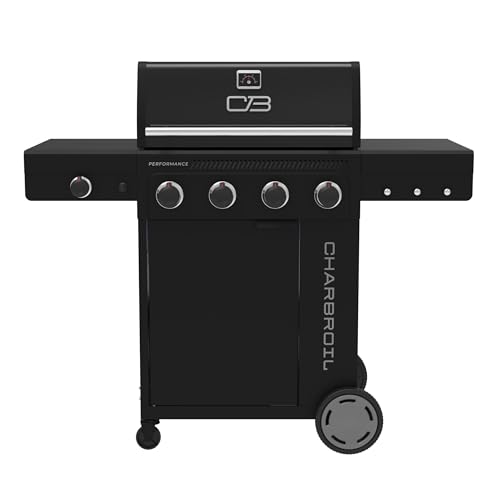
Charbroil Performance Series 4-Burner Gas Grill Cabinet
Badge: Best for Entertaining
Judge it the way owners actually live with a grill: setup on day one, weeknight dinners in month two, and the big cookout that tests every square inch. The Charbroil Performance Series 4-Burner Gas Grill Cabinet is a propane gas design built around 4 burners plus a side burner and four-burner output, with full-size four-burner cooking area to work on. For a household shopping at this tier, the fit question comes first. This is a full-size cart grill, so it asks for a proper home: a level patch of ground, room to open the lid and work both sides, and a storage plan for the off-season. Propane keeps the routine simple: connect, ignite, preheat, cook, and shut down without ash or ember management.
Where owners tend to praise this class of grill is mid-cook control. With four-burner output on tap and a full-size four-burner cooking area, you are not fighting for heat recovery after every lid lift. Burgers go down in a full batch, the lid closes, and the temperature climbs back instead of sagging. That recovery is the difference between steaming meat in its own juices and actually grilling it, and it is the quality to weigh heaviest if you cook for more than two people regularly.
Strengths
- Enclosed cabinet hides the propane tank and stores tools out of sight
- Four burners plus a side burner cover the classic backyard workload in one station
- Performance Series parts and accessories are widely stocked
Trade-offs
- Cabinet doors and panels add assembly time compared with open-cart designs
- Black finish shows dust and pollen between cooks
- No headline sear feature, so crust work relies on preheat discipline
| Fuel | Propane gas |
| Burners | 4 plus side burner |
| Style | Cabinet with double doors |
| Color | Black |
| Model | 463253925 |
One honest limitation deserves plain language: assembly is a genuine afternoon project with many panels, so budget time or a second pair of hands. That does not disqualify it — every grill in this guide carries a compromise of the same weight — but it should shape who buys it. If that limitation collides with how you cook most often, a different pick in this list will serve you better, and the comparison table below is built to make that swap easy to spot.
Best for: backyard owners who want tidy cabinet storage and a mainstream parts network / Not suited for: shoppers with very limited assembly time or patience
Check on Amazon to confirm the current configuration and check the latest price on Amazon before you decide.

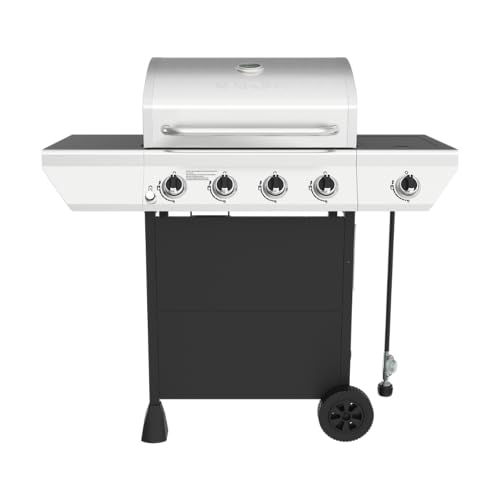
Nexgrill 4-Burner Propane Gas Grill with Side Burner
Badge: Most Powerful
Judge it the way owners actually live with a grill: setup on day one, weeknight dinners in month two, and the big cookout that tests every square inch. The Nexgrill 4-Burner Propane Gas Grill with Side Burner is a propane gas design built around 4 burners plus a side burner and 60,000 BTU, with 626 sq. in. cooking space to work on. For a household shopping at this tier, the fit question comes first. Be in no doubt about scale — this is one of the largest designs in the guide, built for open ground and big gatherings rather than tight quarters. Propane keeps the routine simple: connect, ignite, preheat, cook, and shut down without ash or ember management.
Where owners tend to praise this class of grill is mid-cook control. With 60,000 BTU on tap and a 626 sq. in. cooking space, you are not fighting for heat recovery after every lid lift. Burgers go down in a full batch, the lid closes, and the temperature climbs back instead of sagging. That recovery is the difference between steaming meat in its own juices and actually grilling it, and it is the quality to weigh heaviest if you cook for more than two people regularly.
Strengths
- 626 sq. in. is the largest cooking space in several of these lineups, enough for big mixed grills
- 60,000 BTU across the box means fast preheats and strong recovery after you load cold food
- Electronic ignition and a lid thermometer cover the everyday convenience basics
Trade-offs
- Big output and big space mean a big footprint and a heavier cart to move
- Higher BTU burners go through propane faster when run wide open
- Stainless body needs regular wiping to keep its finish
| Fuel | Propane gas |
| Burners | 4 plus side burner |
| Output | 60,000 BTU |
| Cooking space | 626 sq. in. |
| Ignition | Electronic |
| Extras | Built-in thermometer, double-door cabinet |
One honest limitation deserves plain language: it is simply a lot of grill; on a small patio it becomes the furniture, not an appliance in the corner. That does not disqualify it — every grill in this guide carries a compromise of the same weight — but it should shape who buys it. If that limitation collides with how you cook most often, a different pick in this list will serve you better, and the comparison table below is built to make that swap easy to spot.
Best for: large households and frequent entertainers who need maximum area and output / Not suited for: anyone with a small patio, balcony, or tight storage space
Check on Amazon to confirm the current configuration and check the latest price on Amazon before you decide.

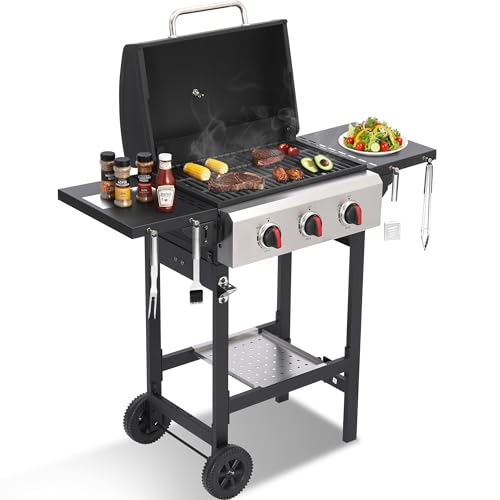
IdeaMaxx 3-Burner Propane Gas Grill
Badge: Best Compact
Look past the headline numbers and ask how the burners, grates, and layout behave when the lid opens and cold food hits the heat. The IdeaMaxx 3-Burner Propane Gas Grill is a propane gas design built around 3 burners and 38,200 BTU, with three-burner cooking area to work on. For a household shopping at this tier, the fit question comes first. Its footprint is on the manageable side of this lineup, which makes placement, covering, and storage noticeably easier than the big cabinet carts. Propane keeps the routine simple: connect, ignite, preheat, cook, and shut down without ash or ember management.
Cleaning and ownership are the unglamorous half of the story. Grease management, grate brushing while the metal is still warm, and a cover that actually gets used decide whether a grill still cooks evenly in year three. This model asks for the standard routine and nothing exotic, which counts in its favor: no proprietary cartridges, no unusual parts in the weekly clean, just a drip tray to empty, grates to brush, and burners to keep clear of debris.
Strengths
- Foldable side shelves shrink the stored footprint, a rare trick in this class
- Cast iron grates hold heat and lay down proper sear marks
- 38,200 BTU is strong output for a three-burner box
Trade-offs
- IdeaMaxx is a small brand, so expect less aftermarket support than the big names
- No side burner or cabinet storage
- Cast iron grates need seasoning and dry storage habits to stay rust-free
| Fuel | Propane gas |
| Burners | 3 |
| Output | 38,200 BTU |
| Grates | Cast iron |
| Extras | Foldable side shelves |
One honest limitation deserves plain language: cast iron rewards owners who oil the grates after cooking and punishes anyone who leaves them wet. That does not disqualify it — every grill in this guide carries a compromise of the same weight — but it should shape who buys it. If that limitation collides with how you cook most often, a different pick in this list will serve you better, and the comparison table below is built to make that swap easy to spot.
Best for: space-conscious owners who need shelves that fold away after cooking / Not suited for: cooks who refuse the upkeep cast iron grates require
Check on Amazon to confirm the current configuration and check the latest price on Amazon before you decide.

Weber Spirit E-425 Gas Grill
Badge: Best Premium
Think about how this grill earns its place across a full season, not just on the first sunny weekend. The Weber Spirit E-425 Gas Grill is a propane gas design built around 4 burners with a Sear Zone and four-burner output with Boost Burners, with full-size four-burner cooking area to work on. For a household shopping at this tier, the fit question comes first. This is a full-size cart grill, so it asks for a proper home: a level patch of ground, room to open the lid and work both sides, and a storage plan for the off-season. Propane keeps the routine simple: connect, ignite, preheat, cook, and shut down without ash or ember management.
In daily use, the pattern that emerges is consistency. Preheat habits matter more than peak output: give the grates ten to fifteen minutes with the lid down, oil the food rather than flooding the grate with spray, and this design rewards you with predictable browning. The 4 burners with a Sear Zone layout means you can hold a working zone and a resting zone at the same time, which is how experienced grillers avoid the panic shuffle when chicken flares or vegetables finish early.
Strengths
- Sear Zone with Boost Burners gives a true high-heat steak station inside a mainstream grill
- Porcelain-enameled cast-iron grates combine sear performance with easier care than bare cast iron
- Weber dealer and parts network is the deepest in the category
Trade-offs
- Premium positioning in this lineup, so you pay for the badge and the burner system
- Weber Works accessories that use the rails are extra purchases
- Full four-burner footprint, not a space-saving design
| Fuel | Propane gas |
| Burners | 4, with Sear Zone and Boost Burners |
| Grates | Porcelain-enameled cast iron |
| Extras | Weber Works rails |
| Brand | Weber |
One honest limitation deserves plain language: the Sear Zone tempts you to cook everything hot and fast, but the grill rewards learning its cooler zones too. That does not disqualify it — every grill in this guide carries a compromise of the same weight — but it should shape who buys it. If that limitation collides with how you cook most often, a different pick in this list will serve you better, and the comparison table below is built to make that swap easy to spot.
Best for: steak lovers who will use a dedicated sear zone and want Weber support depth / Not suited for: budget-first shoppers and anyone short on patio space
Check on Amazon to confirm the current configuration and check the latest price on Amazon before you decide.
Comparison Table
All six picks side by side on the attributes that decide daily satisfaction. Prices and ratings are deliberately not printed here because both change constantly; use the listing link in each row to check the latest price on Amazon.
| Pick | Fuel | Output | Cooking area | Listing |
|---|---|---|---|---|
| Charbroil Classic 3-Burner Propane Gas Grill | propane gas | 30,000 BTU | 360 sq. in. cooking area | Check on Amazon |
| Electactic Stainless Steel 4-Burner Gas Grill with Side Burner | propane gas | 42,000 BTU | full-size four-burner cooking area | Check on Amazon |
| Charbroil Performance Series 4-Burner Gas Grill Cabinet | propane gas | four-burner output | full-size four-burner cooking area | Check on Amazon |
| Nexgrill 4-Burner Propane Gas Grill with Side Burner | propane gas | 60,000 BTU | 626 sq. in. cooking space | Check on Amazon |
| IdeaMaxx 3-Burner Propane Gas Grill | propane gas | 38,200 BTU | three-burner cooking area | Check on Amazon |
| Weber Spirit E-425 Gas Grill | propane gas | four-burner output with Boost Burners | full-size four-burner cooking area | Check on Amazon |
How to Choose the Right Grill for Your Space and Cooking Style
Start with the space, not the spec sheet. Measure the exact patch of ground the grill will live on, including room to stand in front of it, open the lid fully, and walk past with a tray. Then measure the storage spot — a garage corner, a shed, a closet — because a grill that cannot be stored well ages twice as fast. Width with shelves up and shelves down are two different numbers on folding designs, and both matter.
Match capacity to your real headcount. As a working rule, a main cooking area around 350 to 450 sq. in. handles burgers or chicken pieces for four to six people in one batch. Between 450 and 550 sq. in. stretches to eight with sensible batching. Above 600 sq. in. you are cooking for a crowd or running several dishes at once. Buying far beyond your headcount costs you preheat time, fuel, and cleaning effort at every single cook.
Read output relative to box size. Total BTU is meaningless alone. What matters is heat per square inch and how well the lid and firebox hold it. A compact grill with moderate output and a snug lid often sears better than a cavernous box with bigger numbers and thin steel. For charcoal, the equivalent question is vent control: dampers that adjust smoothly and seal reasonably are your thermostat.
Grate material shapes your habits. Porcelain-enameled cast iron is the forgiving middle path — strong searing with moderate care. Bare cast iron sears beautifully and demands seasoning discipline. Porcelain-coated steel is easy to clean and less durable under aggressive scraping. Chrome-plated grates keep portable grills light and affordable, and they are the first component to show age. Choose the material whose care routine you will actually keep.
Burners and zones beat raw burner count. What you are really buying is temperature zones. Three burners let you run hot, medium, and off — enough for direct searing plus indirect finishing. Four or more burners widen the indirect zone and make big mixed loads easier. A side burner is worth it if you cook sauces, corn, or breakfast outdoors; it is dead weight if your kitchen door is three steps away.
Budget the whole purchase, not the grill alone. A cover, a probe thermometer, a spare propane tank or a charcoal chimney, and basic tools are part of the real cost of ownership at any tier. At higher tiers you are paying for thicker steel, better burners, stronger warranties, and parts that remain available years later — the things that decide whether the grill is a three-year appliance or a decade-long fixture. Readers comparing neighbouring setups will also find our guide to Best Grills For A New York Balcony useful, since the sizing logic transfers directly.
How to Set Up, Cook On, and Care for Your Grill
Setup and first burn. Assemble on a flat surface, keep every fastener finger-tight until the frame is square, then tighten in sequence. Before any food touches the grates, run a first burn: gas grills at high heat with the lid down for twenty to thirty minutes to burn off manufacturing oils; charcoal grills with a full chimney of coals spread and burned down. Season cast iron grates with a thin coat of high-heat oil during this first heat, and repeat lightly after the first few cooks.
The standard cook, step by step. One: preheat with the lid down — ten to fifteen minutes for gas, until coals are ash-covered for charcoal. Two: brush the grates hot and clean. Three: set your zones before food goes on, hot side and holding side. Four: cook with the lid down as much as the recipe allows, because lid-down cooking is faster, evener, and less flare-prone. Five: rest everything. Ten minutes of resting does more for a steak or a chicken breast than any gadget in this guide.
Cleaning rhythm. After every cook, brush the grates while warm and empty the drip tray or ash catcher once cool. Monthly in season, scrape the firebox walls, check burner ports or vent movement, and wipe exterior steel. Once a season, deep-clean: grates soaked and scrubbed, burners lifted and brushed, grease pathways cleared. Most uneven-heating complaints trace back to a clogged burner port or a grease-choked firebox, not to a failed grill.
Troubleshooting. Problem: one side cooks much hotter than the other → check for clogged burner ports on the cool side and clear them with a thin wire, and confirm the propane tank is not nearly empty. Problem: constant flare-ups → trim excess fat, move food to the holding zone until flames settle, and clean the grease tray, because old grease is flare fuel. Problem: charcoal temperature keeps crashing → open the intake damper, confirm ash is not choking the vents, and add lit coals rather than raw ones. If your setup changes — a move, a bigger space, a different household — the checks in Best Grills For A Patio Or Balcony cover the adjacent case.
What This Tier Buys That Cheaper Grills Skip
Step down a tier and the cuts are predictable: thinner fireboxes that flex and rust early, burners that clog and flare, grates that warp, and igniters treated as consumables. At the level of this guide, the money goes into heavier steel, cast iron or porcelain-enameled cast iron grates, enclosed storage, and burner systems designed to be cleaned and serviced rather than replaced wholesale.
You also buy temperature honesty. Cheaper grills can hit a high number on the lid thermometer while the grate tells a different story. The picks here pair their output with boxes sized to use it, which is why several mid-output models in this list will out-cook louder spec sheets in real dinners. Judge this tier by recovery after the lid opens, not by the number printed on the carton.
For a closely related scenario, see Best Grills For An Apartment Patio — the constraints overlap more than the names suggest.
Gas Systems at This Level: Zones, Sear Stations, and Side Burners
Four of these six picks run four main burners, and that is the configuration this tier does best: wide enough for a true indirect zone, divisible enough for a weeknight cook for two. The Weber adds a sear station with boost burners for steak work; the Nexgrill answers with the largest area and the joint-highest output; the Charbroil Performance trades headline heat for a tidy cabinet. None of these choices is wrong — they are answers to different questions about how you cook.
Side burners divide owners. If your kitchen is far from the patio or you cook full meals outside, a side burner earns its keep weekly. If the grill stands beside the back door, it may light twice a year. Be honest about your geography before paying for plumbing you will not use, and remember that every extra burner is also an extra burner to clean, cover, and eventually service.
Ownership, Storage, and Seasonal Care
A grill’s second year is the honest one. By then the cover has either become a habit or a decoration, the grates either get brushed hot or slowly crust over, and the ignition either fires first time or has joined the long list of small annoyances owners tolerate until they stop grilling altogether. The designs in this guide are all capable of several good years, and the difference between the ones that deliver them and the ones that disappoint is almost never the purchase — it is the routine.
Store the grill dry whenever you can. If it must live outdoors, a fitted cover that is actually put back on after the grill cools is the single highest-value habit in grilling. Propane tanks should be stored upright, outdoors, and disconnected during long off-seasons. Charcoal belongs in a sealed bin; damp charcoal lights badly, burns cool, and frustrates exactly the cooks who can least afford a struggling fire. Ash should leave the grill within a day or two, because ash plus moisture makes a corrosive paste that eats fireboxes from the inside.
Once a season, do the unglamorous circuit: lift the grates, scrape the firebox, clear every burner port or vent slot, empty the grease path end to end, and check hoses and connections with soapy water if anything smells faintly of gas. Light rust on grates is a cleaning job, not a replacement job; flaking rust and paper-thin firebox metal are the real end-of-life signals. Replacement grates, igniters, and burner tubes are the parts worth pricing before you buy, because a grill whose wear parts are stocked is a grill you can keep for a decade.
Finally, cook on it often. Grills that run weekly stay seasoned, dry, and familiar. Grills that sit for months collect moisture, spiders in the burner tubes, and owners who have forgotten their quirks. The best accessory schedule is a cooking schedule, and the best maintenance plan is the next meal.
Common Buying Mistakes
- Buying for the biggest party instead of the average week. The grill that fits your ordinary Tuesday gets used happily for years; the party-sized one mostly gets cleaned.
- Ignoring the rules of the space. Leases, building management, HOA covenants, and local fire codes can all restrict fuel type or grill placement. Check before purchase, not after delivery.
- Chasing headline BTU. Output divorced from box size tells you almost nothing. Heat retention, grate material, and zone control decide results.
- Skipping the storage plan. A grill stored wet and uncovered loses its grates and ignition to rust. Price a fitted cover into the purchase from the start.
- Forgetting the fuel routine. Gas owners need a spare tank plan; charcoal owners need dry charcoal storage and an ash disposal routine that respects fire safety.
- Judging by the first cook. Every grill has hot spots and habits. Map them with a simple bread-toast test across the grates before deciding the grill disappoints you.
Final Recommendation
If the budget is firm and the patio is ordinary, start with the Best Overall pick and only move when a specific feature — a sear zone, a bigger box, a folding footprint — matches a habit you already have. This tier punishes feature collecting and rewards buying the grill your cooking already describes.
Whichever direction you go, protect the purchase with the boring accessories: a fitted cover, a probe thermometer, and a spare fuel plan. At this level the grill itself is rarely the weak link in anyone’s summer; neglect is.
Start with the Charbroil Classic 3-Burner Propane Gas Grill if you want the safest all-round choice, step to the Electactic Stainless Steel 4-Burner Gas Grill with Side Burner if its badge matches your cooking more closely, and consider the Charbroil Performance Series 4-Burner Gas Grill Cabinet as the strong third option. Whichever you choose, use the listing to check the latest price on Amazon and confirm the configuration before ordering. Readers whose situation sits between categories should also compare Best Grills For An Rv before deciding.
Accessories and Setup Extras That Are Actually Worth Owning
Grill marketing will try to sell you a drawer of gadgets, but ownership experience narrows the list fast. The essentials are few and unglamorous. An instant-read probe thermometer comes first, because it converts guessing into knowing for every protein you cook. A fitted cover comes second, because weather is the leading cause of early grill death. A stiff brush matched to your grate material — brass or nylon on porcelain coatings, steel only where the manufacturer allows it — comes third, because a clean grate is a cooking feature, not a cosmetic one.
Fuel logistics are the next tier. Gas owners should keep a spare tank or a reliable exchange routine, because tanks empty on Saturdays in front of guests with a reliability that feels personal. Charcoal owners should own a chimney starter, which lights coals evenly without lighter fluid flavor, and a metal ash container with a lid, because ash stays hot far longer than it looks. Both camps benefit from long-handled tongs, a wide spatula, and a pair of heat-resistant gloves for moving grates and pans.
After that, buy for your habits rather than the catalog. A griddle plate earns its space if you cook breakfast, smash burgers, or vegetables that fall through grates. A rotisserie kit earns its price only if whole birds and roasts are a monthly ritual. Pizza stones, rib racks, and smoker boxes are all legitimate tools with narrow jobs; the mistake is buying the narrow tool before the wide habits exist. Spend on the essentials first, cook for a season, and let your own menu tell you which specialty tool is missing.
Finally, keep a small maintenance kit with the grill: a spare igniter battery where the design uses one, a thin wire or port cleaner for burner tubes, food-safe oil for grates, and the manual’s clearance and parts pages saved on your phone. Ten minutes of prevention in spring is worth a weekend of troubleshooting in July, and the owners who enjoy their grills longest are, without exception, the ones who treat these small rituals as part of the hobby rather than as chores imposed by it.
Frequently Asked Questions
How many burners do I actually need?
For most households, three or four burners is the sweet spot. Two burners can sear and hold a side zone, but three gives you a true hot, medium, and off arrangement, and four adds room for a crowd. Count the people you feed on an ordinary Tuesday, not the biggest party of the year, then add one burner of headroom.
Is a bigger cooking area always better?
No. Area you do not use still has to preheat, clean, and store. A 360 to 526 sq. in. surface feeds most families in one batch. Step up to 600 sq. in. and beyond only if you regularly cook for eight or more, or you cook mixed loads — proteins, vegetables, and bread — at the same time.
How do I stop food sticking to the grates?
Preheat longer than feels necessary, brush the grates clean while hot, and oil the food lightly instead of the grate. Then leave the food alone until it releases on its own; most sticking is just impatience in the first two minutes. Porcelain-coated grates also need a brass or nylon brush rather than aggressive steel scraping.
Gas or charcoal — which should I choose?
Gas wins on speed, repeatability, and weeknight convenience: light it, wait ten minutes, cook. Charcoal wins on flavor depth and high-heat character, and asks for startup time, ash handling, and vent skill in return. Many households end up happiest with gas as the daily driver and charcoal as the weekend ritual.
How long should a grill at this level last?
With a cover, seasonal deep cleans, and burner tubes kept clear, a mainstream gas grill should give years of even cooking. Charcoal kettles are simpler and often outlast gas models because there are fewer parts to fail. The fastest killers are stored-wet grates, clogged burner ports, and grease left to accumulate under the firebox.
What is the first accessory worth buying?
An instant-read probe thermometer, before any tool set. Grill lid thermometers read the air near the lid, not the food, and guessing doneness is how good meat gets ruined. After that, a fitted cover and a quality brush cover most of what ownership actually requires.