Disclosure: topratedkitchenware.com is reader-supported. When you buy through links on our site, we may earn an affiliate commission from Amazon and other retailers, at no extra cost to you.
Where to buy
Every model below was cross-checked against the verified pick pool for this guide to best indoor commercial restaurant smokers. Each name links to its Amazon listing, where you can check the latest price on Amazon, confirm the current configuration, and read current owner feedback before you decide. Read this before anything else in this guide: every verified pick below is a residential OUTDOOR smoker. None is a certified indoor commercial restaurant smoker, and this guide will not label any of them as one. They are listed because they are the verified pool for this search, assessed honestly for what a small food business could and could not use them for.
- EAST OAK 30-Inch Electric Smoker with Mobility Stand, Polar Night – Best Overall (Outdoor Use)
- Royal Gourmet SE2805 28-Inch Electric Smoker – Best for Bigger Batches
- Traeger Pro 22 Wood Pellet Grill and Smoker – Best Dual-Purpose Pellet
- Pit Boss 700 Carbon Series Wood Pellet Grill and Smoker – Best Mid-Size Pellet
- Pit Boss 500 Carbon Series Wood Pellet Grill and Smoker – Best Compact Pellet
- Pit Boss 850 Navigator Series Wood Pellet Grill and Smoker – Best Connected Pellet
Read the full guide below for the reasoning behind each badge, the honest limitations of every pick, and the checks that matter more than any headline claim.
Anyone searching for the best indoor commercial restaurant smokers deserves a straight answer before a shopping list, so here it is: the verified product pool available for this guide contains no indoor commercial restaurant smokers at all. Every pick below — the best indoor commercial restaurant smokers alternatives we can honestly assess from the pool — is a residential outdoor electric or pellet smoker, built and rated for home outdoor use. A true indoor commercial smoker is a different class of equipment: listed for commercial kitchens, engineered with ventilation and fire-suppression integration, and bought through commercial channels at commercial prices. This guide will not pretend a patio cabinet is that machine.
What this guide can legitimately do is three things. First, explain what a genuine indoor commercial installation requires, so you can brief a commercial equipment supplier properly. Second, assess the six verified residential models honestly for the roles they could play around a small food business — outdoor cooking where codes and leases permit, menu development, trials, events and overflow — with their limits stated plainly. Third, flag the compliance questions that matter more than any product choice: local fire and health codes, ventilation, insurance and lease terms. If you are comparing neighbouring questions while you shop, our notes on Best Indoor Plants For Marijuana Smokers cover the closest overlapping search, and the two guides are designed to be read together rather than as duplicates.
If your requirement is a smoker that cooks inside a restaurant kitchen, day after day, under inspection — stop here and go to a commercial equipment dealer with this guide’s requirements section in hand. If your situation is the common small-business one — a café, food truck, caterer or pub with outdoor space and a smoked special in mind — the assessments below will help you judge what residential equipment can and cannot responsibly do for you.
Key Takeaways
- HONESTY FIRST: no pick in this guide is an indoor commercial restaurant smoker. All six are residential outdoor electric or pellet smokers.
- True indoor commercial smoking requires listed commercial equipment, engineered ventilation, and compliance with local fire and health codes — budget and plan for that separately.
- Residential models can legitimately serve a small business outdoors where codes, lease and insurance permit: trials, specials, catering and events.
- Pellet models in this pool add grilling breadth; electric cabinets add simplicity — neither fact changes their residential, outdoor status.
- Never run any of these units inside a commercial kitchen or dining space. Smoke, carbon monoxide and fire risk make the question non-negotiable.
- Use this guide to write your requirements brief, then take that brief to a commercial supplier for the indoor role.
In this guide
Quick Picks
Short on time? This is the whole guide to best indoor commercial restaurant smokers in one table. Badges here are used again, word for word, in the detailed reviews below, so you can jump straight to the model that matches your situation.
| Badge | Pick | Fuel and control style |
|---|---|---|
| Best Overall (Outdoor Use) | EAST OAK 30-Inch Electric Smoker with Mobility Stand, Polar Night | electric, using wood chips for smoke |
| Best for Bigger Batches | Royal Gourmet SE2805 28-Inch Electric Smoker | electric, using wood chips for smoke |
| Best Dual-Purpose Pellet | Traeger Pro 22 Wood Pellet Grill and Smoker | wood pellets |
| Best Mid-Size Pellet | Pit Boss 700 Carbon Series Wood Pellet Grill and Smoker | wood pellets |
| Best Compact Pellet | Pit Boss 500 Carbon Series Wood Pellet Grill and Smoker | wood pellets |
| Best Connected Pellet | Pit Boss 850 Navigator Series Wood Pellet Grill and Smoker | wood pellets, with WiFi and Bluetooth control |
The badges below rank these models as outdoor residential smokers for business-adjacent uses — capacity, versatility and supervision. They do not certify any model for indoor or commercial-kitchen use, and no badge should be read that way.
How These Picks Were Chosen
The selection method for this guide needs stating plainly, because it differs from a normal roundup. The verified pool supplied for this keyword contained only residential outdoor smokers. Rather than invent commercial products, fabricate certifications, or quietly relabel patio equipment as restaurant equipment, this guide assesses the pool as what it is, and surrounds it with the commercial context a restaurant buyer actually needs. Every specification printed comes from the verified listing data, and every listing describes outdoor home use.
This is a research-led guide, not a hands-on laboratory test, and it does not pretend otherwise. The pool was built by matching real, currently listed products of the right type against the search intent behind best indoor commercial restaurant smokers, then confirming each product identity through the retailer data available at the time of checking. Only products with a confirmed identity received a link and an image. Specs quoted in this article come only from the verified listing data for each pick – cooking area, control type, included racks, probes, loaders, hoppers and stated temperature ranges. Where a listing does not state a figure, this guide leaves it out instead of filling the gap with a plausible guess.
That honesty is the value of the page. A buyer who understands why these models fall short of the indoor commercial brief — listing status, ventilation, duty cycle, capacity per service — is equipped to brief a commercial supplier precisely and to spot the same relabelling trick when other sellers try it. Readers comparing adjacent budgets often start with Best Indoor Plants For Smokers, which is why the tier reasoning in this guide is written to transfer: the same checks – cooking area per cook, reload access, control style and cleaning burden – apply at every tier, even when the specific models change.
The 6 Best Options for best indoor commercial restaurant smokers
Each review states the model’s real identity first, then what it could do around a small food business operating outdoors within the rules, then the limits that disqualify it from the indoor commercial role. The verdict lines keep that framing in every case.
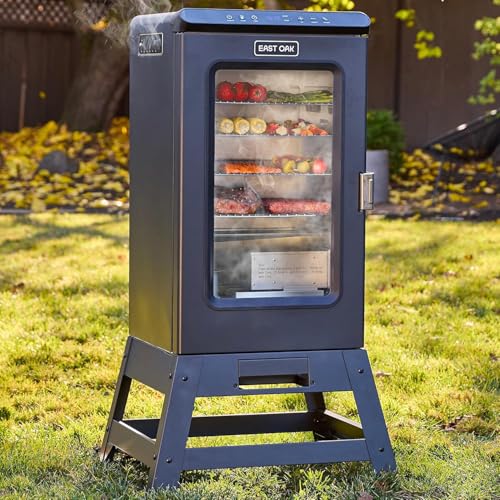
EAST OAK 30-Inch Electric Smoker with Mobility Stand, Polar Night
Badge: Best Overall (Outdoor Use)
Strengths
- Mobility stand makes a 725-square-inch cabinet practical to reposition and store
- Built-in meat probe gives real doneness feedback on thick cuts
- Side chip loader described by the maker as giving up to 6x longer uninterrupted smoke suits the longest cooks in this guide
Trade-offs
- Stand and cabinet together take more storage room than a cabinet alone
- No viewing window appears in the verified listing data for this version
- Outdoor-rated electric cabinet — it is not an indoor or commercial unit, whatever the setting (see the honesty note in this guide)
At a glance
- Form: 30-inch outdoor electric smoker with mobility stand
- Cooking area: 725 square inches
- Extras: built-in meat probe
- Loading: side chip loader, described by the maker as giving up to 6x longer uninterrupted smoke
- Finish: Polar Night
The EAST OAK 30-inch outdoor electric smoker in Polar Night combines the largest electric-cabinet package in this pool — 725 square inches, a built-in meat probe and a side chip loader described by the maker as giving up to six times longer uninterrupted smoke — with a mobility stand. The stand changes the ergonomics the way the Masterbuilt leg kit does: working height plus repositioning, so the cabinet can live against a wall and cook in the open. The probe closes the feedback loop for thick cuts, where surface colour lies and only internal temperature tells the truth. Everything in the verified data describes a residential outdoor smoker, and this guide treats it as exactly that — a very capable one, within its proper setting.
Judged against a restaurant brief, honesty comes first: the EAST OAK 30-Inch Electric Smoker with Mobility Stand, Polar Night is a residential outdoor smoker, not a certified indoor commercial unit, and this guide will not pretend otherwise. What it can legitimately offer a small food business is outdoor or properly vented back-of-house capacity for trials, specials and overflow — used where local codes, the lease and the fire rules allow outdoor cooking equipment. It cannot substitute for a listed commercial indoor smoker with engineered ventilation in a professional kitchen. If your need is genuinely indoor and commercial, treat this guide as a map of the consumer end of the market and budget for commercial equipment and professional advice on codes before you buy anything.
Best for: cooks who want the big EAST OAK cabinet on a stand, with probe feedback built in / Not suited for: anyone shopping for a certified indoor or commercial kitchen smoker — this is a residential outdoor unit
Check on Amazon to confirm the current configuration and check the latest price on Amazon before ordering.

Royal Gourmet SE2805 28-Inch Electric Smoker
Badge: Best for Bigger Batches
Strengths
- Compact 28-inch footprint with 454 square inches fits smaller patios and balconies where a 30-inch cabinet feels oversized
- 1350W element and three grates give a straightforward, honestly specified entry into electric smoking
- Analog adjustable heat keeps the control scheme simple and repairable in spirit — a dial, not a board
Trade-offs
- Smallest cooking area in this pool — large or multiple big cuts will not fit comfortably
- Analog control means no digital set point and no timer in the verified data
- No window, probe or side loader appears in the verified listing data
At a glance
- Form: 28-inch vertical electric smoker
- Cooking area: 454 square inches
- Power: 1350W
- Grates: 3 cooking grates
- Controls: analog temperature control with adjustable heat
- Model: SE2805
The Royal Gourmet SE2805 is the compact option: a 28-inch vertical electric smoker with 454 square inches across three cooking grates, a 1350W element and analog temperature control with adjustable heat. Compact is not a euphemism here — it is a genuine fit argument. Plenty of patios, balconies and small gardens cannot host a 30-inch cabinet gracefully, and plenty of households smoke a chicken, a salmon side or a single rack far more often than they smoke a feast. A smaller cabinet also means a smaller air volume to heat and hold, which suits shorter cooks. What you give up is headroom for growth: if your cooks regularly expand to briskets and multiple shoulders, the bigger cabinets in this guide will suit you better.
Judged against a restaurant brief, honesty comes first: the Royal Gourmet SE2805 28-Inch Electric Smoker is a residential outdoor smoker, not a certified indoor commercial unit, and this guide will not pretend otherwise. What it can legitimately offer a small food business is outdoor or properly vented back-of-house capacity for trials, specials and overflow — used where local codes, the lease and the fire rules allow outdoor cooking equipment. It cannot substitute for a listed commercial indoor smoker with engineered ventilation in a professional kitchen. If your need is genuinely indoor and commercial, treat this guide as a map of the consumer end of the market and budget for commercial equipment and professional advice on codes before you buy anything.
Best for: smaller households and smaller outdoor spaces taking a first step into electric smoking / Not suited for: cooks planning big batch cooks or wanting digital feedback features
Check on Amazon to confirm the current configuration and check the latest price on Amazon before ordering.

Traeger Pro 22 Wood Pellet Grill and Smoker
Badge: Best Dual-Purpose Pellet
Strengths
- True 6-in-1 pellet versatility — grill, smoke, bake, roast, braise and barbecue — covers far more than smoking alone
- Meat probe included, and the 18 lb hopper feeds long cooks without constant attention
- 572 square inches is a sensible family size for a dual-purpose pellet unit
Trade-offs
- Pellet fuel is a running cost and a storage item in a way electric chips are not
- Maker-stated maximum of 450 degrees Fahrenheit is lower than some pellet rivals in this pool
- Strictly an outdoor unit — pellet smoke and combustion rule out any indoor use
At a glance
- Form: wood pellet grill and smoker
- Cooking area: 572 square inches
- Functions: 6-in-1 versatility – grill, smoke, bake, roast, braise and barbecue
- Extras: meat probe
- Maker-stated maximum temperature: 450 degrees Fahrenheit
- Hopper: 18 lb pellet hopper
The Traeger Pro 22 is the pellet all-rounder in this pool: 572 square inches, a meat probe, an 18 lb hopper and 6-in-1 versatility spanning grilling, smoking, baking, roasting, braising and barbecuing, with a maker-stated maximum temperature of 450 degrees Fahrenheit. Pellet cooking changes the indirect equation. The fire is real — burning wood pellets — but it is metered by an auger and supervised by a controller, so the food cooks in wood-fired hot air with a steadiness older offset designs cannot match. For smoking specifically, that means genuine wood smoke flavour with something close to electric convenience. The honest costs are pellets themselves, which you buy and store by the bag, and the fact that a dual-purpose machine is a compromise by definition: it grills and smokes well, where a dedicated cabinet only smokes.
Judged against a restaurant brief, honesty comes first: the Traeger Pro 22 Wood Pellet Grill and Smoker is a residential outdoor smoker, not a certified indoor commercial unit, and this guide will not pretend otherwise. What it can legitimately offer a small food business is outdoor or properly vented back-of-house capacity for trials, specials and overflow — used where local codes, the lease and the fire rules allow outdoor cooking equipment. It cannot substitute for a listed commercial indoor smoker with engineered ventilation in a professional kitchen. If your need is genuinely indoor and commercial, treat this guide as a map of the consumer end of the market and budget for commercial equipment and professional advice on codes before you buy anything.
Best for: households that want one outdoor cooker for weeknight grilling and weekend smoking / Not suited for: electric-cabinet shoppers who want the simplest possible fuel and control routine
Check on Amazon to confirm the current configuration and check the latest price on Amazon before ordering.

Pit Boss 700 Carbon Series Wood Pellet Grill and Smoker
Badge: Best Mid-Size Pellet
Strengths
- 718 square inches with a stated 180 to 500 degree range covers low smoking and hotter roasting in one unit
- LCD digital controller and meat probe give clear, immediate feedback
- 13.5 lb hopper is proportionate to the cooking area for typical long cooks
Trade-offs
- Pellet storage and running costs apply, as with every pellet model
- The wide temperature range invites grilling use, but searing specialists will still prefer a dedicated grill
- Outdoor use only — combustion and pellet smoke are not indoor-compatible
At a glance
- Form: wood pellet grill and smoker
- Cooking area: 718 square inches
- Temperature range: 180 to 500 degrees Fahrenheit
- Controls: LCD digital controller
- Extras: meat probe
- Hopper: 13.5 lb pellet hopper
- Finish: Black
The Pit Boss 700 Carbon Series pellet grill and smoker brings 718 square inches, an LCD digital controller, a meat probe and a 13.5 lb hopper, with a stated temperature range of 180 to 500 degrees Fahrenheit. That range is the story: the bottom end is proper low-and-slow smoking territory, and the top end reaches roasting and grilling heat that no electric cabinet in this guide attempts. As an indirect cooker it works the pellet way — an auger-fed fire, a controller holding the set point, and food cooking in circulating wood-fired air rather than over the flame itself. For households that smoke on weekends and grill on weeknights, that breadth is the entire argument, and it is a strong one.
Judged against a restaurant brief, honesty comes first: the Pit Boss 700 Carbon Series Wood Pellet Grill and Smoker is a residential outdoor smoker, not a certified indoor commercial unit, and this guide will not pretend otherwise. What it can legitimately offer a small food business is outdoor or properly vented back-of-house capacity for trials, specials and overflow — used where local codes, the lease and the fire rules allow outdoor cooking equipment. It cannot substitute for a listed commercial indoor smoker with engineered ventilation in a professional kitchen. If your need is genuinely indoor and commercial, treat this guide as a map of the consumer end of the market and budget for commercial equipment and professional advice on codes before you buy anything.
Best for: cooks who want pellet smoke flavour plus the option to roast and grill hotter in the same unit / Not suited for: anyone who wants the near-zero-effort fuel routine of an electric cabinet
Check on Amazon to confirm the current configuration and check the latest price on Amazon before ordering.

Pit Boss 500 Carbon Series Wood Pellet Grill and Smoker
Badge: Best Compact Pellet
Strengths
- 543 square inches in the Carbon Series format is the most compact pellet option in this pool
- Stated 180 to 500 degree range gives the same low-smoke to hot-roast span as its bigger sibling
- LCD controller and meat probe included — the feedback essentials are not stripped out
Trade-offs
- Smaller cooking area limits the biggest batch cooks
- 13.5 lb hopper will need checking on the very longest cooks
- Pellet fuel costs and outdoor-only use apply as with all pellet models
At a glance
- Form: wood pellet grill and smoker
- Cooking area: 543 square inches
- Temperature range: 180 to 500 degrees Fahrenheit
- Controls: LCD digital controller
- Extras: meat probe
- Hopper: 13.5 lb pellet hopper
- Finish: Black
The Pit Boss 500 Carbon Series pellet grill and smoker is the compact pellet entry: 543 square inches, an LCD digital controller, a meat probe and a 13.5 lb hopper, with a stated range of 180 to 500 degrees Fahrenheit. Think of it as the same pellet argument in a smaller frame — auger-fed wood fire, controller-held temperatures, food cooking indirectly in wood-fired air — sized for households whose typical cook is a couple of racks, a chicken or a small brisket rather than a party load. The inclusion of the probe and the digital controller at this size matters, because small households deserve the same feedback as big ones; doneness does not scale down with the grill. What scales down is only the batch size, and the honest limit that follows from it.
Judged against a restaurant brief, honesty comes first: the Pit Boss 500 Carbon Series Wood Pellet Grill and Smoker is a residential outdoor smoker, not a certified indoor commercial unit, and this guide will not pretend otherwise. What it can legitimately offer a small food business is outdoor or properly vented back-of-house capacity for trials, specials and overflow — used where local codes, the lease and the fire rules allow outdoor cooking equipment. It cannot substitute for a listed commercial indoor smoker with engineered ventilation in a professional kitchen. If your need is genuinely indoor and commercial, treat this guide as a map of the consumer end of the market and budget for commercial equipment and professional advice on codes before you buy anything.
Best for: smaller households that want pellet versatility without a full-size footprint / Not suited for: cooks who regularly fill a big cabinet — the 850 Navigator or 700 Carbon offer more room
Check on Amazon to confirm the current configuration and check the latest price on Amazon before ordering.

Pit Boss 850 Navigator Series Wood Pellet Grill and Smoker
Badge: Best Connected Pellet
Strengths
- 932 square inches is the largest cooking area in this entire pool, by a wide margin
- WiFi and Bluetooth control plus a 30 lb hopper are built for genuinely long, large cooks
- Flame broiler adds a direct-heat option the pure smokers here cannot offer
Trade-offs
- Biggest footprint and hopper to fill — pellets, storage space and patio space all scale up
- Connectivity features need a decent outdoor signal to earn their keep
- Outdoor use only, and overkill for small weekly cooks
At a glance
- Form: wood pellet grill and smoker
- Cooking area: 932 square inches
- Controls: LCD digital controller with WiFi and Bluetooth
- Extras: flame broiler and meat probe
- Temperature range: 180 to 500 degrees Fahrenheit
- Hopper: 30 lb pellet hopper
The Pit Boss 850 Navigator Series is the capacity flagship of this pool: 932 square inches of cooking space, WiFi and Bluetooth control with an LCD digital controller, a flame broiler, a meat probe and a 30 lb pellet hopper, across a stated range of 180 to 500 degrees Fahrenheit. Every figure points the same way — this is a pellet machine built for volume and duration. The large hopper feeds long cooks without mid-cook refills, the connected controls let you supervise a brisket from indoors, and the flame broiler adds a direct-heat finishing option that pure indirect cabinets cannot match. The trade-offs are equally clear: footprint, pellet consumption and sheer presence. Buy it for the cooks you actually do at scale, and it is superb; buy it for two racks of ribs, and it is a lot of machine standing idle.
Judged against a restaurant brief, honesty comes first: the Pit Boss 850 Navigator Series Wood Pellet Grill and Smoker is a residential outdoor smoker, not a certified indoor commercial unit, and this guide will not pretend otherwise. What it can legitimately offer a small food business is outdoor or properly vented back-of-house capacity for trials, specials and overflow — used where local codes, the lease and the fire rules allow outdoor cooking equipment. It cannot substitute for a listed commercial indoor smoker with engineered ventilation in a professional kitchen. If your need is genuinely indoor and commercial, treat this guide as a map of the consumer end of the market and budget for commercial equipment and professional advice on codes before you buy anything.
Best for: cooks who regularly smoke for a crowd and want connected control over long cooks / Not suited for: small households — the capacity, footprint and hopper all exceed the need
Check on Amazon to confirm the current configuration and check the latest price on Amazon before ordering.
Comparison Table
| Pick | Headline specification | Fuel and control style | Listing |
|---|---|---|---|
| EAST OAK 30-Inch Electric Smoker with Mobility Stand, Polar Night | Cooking area: 725 square inches | electric, using wood chips for smoke | Check on Amazon |
| Royal Gourmet SE2805 28-Inch Electric Smoker | Cooking area: 454 square inches | electric, using wood chips for smoke | Check on Amazon |
| Traeger Pro 22 Wood Pellet Grill and Smoker | Cooking area: 572 square inches | wood pellets | Check on Amazon |
| Pit Boss 700 Carbon Series Wood Pellet Grill and Smoker | Cooking area: 718 square inches | wood pellets | Check on Amazon |
| Pit Boss 500 Carbon Series Wood Pellet Grill and Smoker | Cooking area: 543 square inches | wood pellets | Check on Amazon |
| Pit Boss 850 Navigator Series Wood Pellet Grill and Smoker | Cooking area: 932 square inches | wood pellets, with WiFi and Bluetooth control | Check on Amazon |
Compare these models as residential outdoor units: capacity for batch size, pellet versus electric for fuel logistics, connected control for supervision during service. The comparison that matters for the indoor role is not in this table, because no model here qualifies for it. Shoppers who started at Best Indoor Smokers Reddit will notice the same discipline here: no prices and no fixed scores in the table, because both change too often to print honestly. The table compares what does not change – format, capacity and control style.
How to Choose the Right Smoker for best indoor commercial restaurant smokers
A genuine indoor commercial smoker purchase starts with compliance, not products. Commercial kitchens operate under fire codes, health codes, ventilation standards and insurance conditions that together decide what may be installed. A listed commercial smoker is designed to integrate with engineered extraction, to contain fire, to be cleaned to a commercial schedule, and to survive a duty cycle of daily, all-day service. Before comparing any equipment, establish with your local authority and your insurer what listings and ventilation your premises require. That conversation is free, and it invalidates more glossy product claims than any review can.
Capacity planning for a restaurant is arithmetic, not appetite. Work out covers per service, portion size, and how much of the menu the smoker must supply, then translate that into pounds of product per cook and cooks per day. Residential cabinets in this pool top out at 725 square inches and the largest pellet model at 932 — respectable for a special or a food truck, modest against a dining room that expects smoked brisket at every table on a Friday. If your arithmetic needs multiple residential units running in parallel outdoors, that is usually the signal that commercial equipment, with its capacity and duty rating, is the honest purchase.
Duty cycle is the hidden specification. A residential smoker is built for weekly cooks with rest days between. Restaurant service is daily, back-to-back, under time pressure, cleaned by rota and expected to simply work. Elements, controllers, seals and augers all age differently under those two lives. This does not make residential units useless to a business — trials, development, events and seasonal specials are genuinely weekly-pattern work — but it means the business plan should not rest a daily menu promise on equipment warranted and built for a patio.
Fuel and supervision logistics close the brief. Electric cabinets need suitable outdoor power and cheap, storable chips. Pellet models need dry pellet storage and a supply routine. Connected control helps a small team supervise a long cook while serving, which is a real operational benefit for outdoor business use. None of these logistics, however well solved, converts a residential unit into an indoor one. Ventilation is not a feature you can add with optimism: indoor commercial smoking is an engineered system, and it is bought as one.
How to Plan Smoked Menu Items Responsibly in a Small Food Business
Start with development, which is where residential equipment honestly shines for a business. Use an outdoor cabinet or pellet unit — at premises where outdoor cooking is permitted — to develop the smoked items: wood choice, rub, timing, holding behaviour and yield. Cost each dish from real cooks, including fuel, labour and waste, because smoked items live or died on yield long before they meet a customer. Photograph, taste and refine across several cooks, not one lucky afternoon, and write the production sheet from the average, not the best.
Before any item reaches a menu, clear the compliance ground in writing: local rules for outdoor cooking equipment at your premises, your lease, your insurer, and your food-safety plan for cooling, holding and reheating smoked product. Smoked food is often cooked hours before service, which makes temperature control through storage a safety system, not a preference. If any answer is no or unclear, the item waits. A special that cannot survive an inspection question is not a special; it is a liability with good bark.
In service, run the outdoor unit like the satellite station it is: scheduled cooks, supervised loads, logged temperatures, and a cleaning rota that treats the smoker like commercial kit even though it is not — racks and pans washed after every cook, ash and grease managed before they become a fire load, seals and vents checked weekly. Keep the paperwork. If the smoked line grows into a daily promise, let that success trigger the commercial conversation: listed equipment, engineered ventilation, and a kitchen designed for the job, bought with the revenue the trial proved.
Troubleshooting. Problem: smoke fades after the first hour – the chip load or pellet feed has run down; reload through the side loader where fitted, or check the hopper level on a pellet model, without opening the main door longer than necessary. Problem: temperature swings after you open the door – you let the heat out; resist checking, use the window or probe where fitted, and give the cabinet time to recover before adjusting anything. Problem: food tastes bitter or harsh – the smoke was too dense for too long, usually from overloading chips early; use a smaller load, let it settle to a steady thin smoke, and keep the vent path clear.
What a Real Indoor Commercial Smoker Installation Involves
A listed commercial smoker for indoor restaurant use is sold as part of a system. The unit itself is built and tested for commercial duty and indoor installation, with fire containment, controlled smoke output and cleanable, food-safe construction. Around it sits engineered ventilation — extraction sized to the unit, ducting, and where required, suppression — designed and signed off for the premises. Electrical or gas services are installed to commercial standards. The health inspector, the fire officer and the insurer each see documentation, not assurances.
That system is why commercial indoor smokers are bought from commercial dealers, quoted with installation, and priced in a different world from this guide’s pool. It is also why the honest answer to this keyword cannot be a residential product list with commercial adjectives. If a seller offers you a patio smoker as a restaurant indoor solution, the correct response is to ask for its commercial listing and ventilation specification in writing — and to walk away when the paperwork does not exist.
Legitimate Business Roles for Residential Outdoor Smokers
Within the rules, the models in this guide can earn money for a small business. Menu development and staff training are the cleanest roles: the product is real, the costs are low, and no customer promise depends on the equipment’s listing. Events and outside catering follow, where outdoor cooking is the expected format and a pellet unit’s grilling breadth or a cabinet’s batch capacity serves a crowd in the open air. Seasonal specials cooked outdoors at premises that permit it — a summer smoked menu at a pub garden, a food truck’s brisket day — are the third role, provided the compliance checks in this guide are done first and in writing.
The line is equally clear. These units do not cook inside the kitchen, the dining room or any enclosed commercial space. They do not anchor a daily menu that the business cannot fulfil without them. And they do not appear in insurance or inspection paperwork as anything other than what they are. Businesses that respect that line get real value from residential equipment. Businesses that blur it are one inspection or one incident away from learning why the line exists.
One more comparison worth making before you order: readers working through Best Inexpensive Electric Smokers and Best Inexpensive Smokers are usually asking the same underlying question from a different angle – how much smoker, of which type, for the cooks they actually do. Answer that question first and the model choice usually becomes obvious.
Common Buying Mistakes
The most serious mistake available on this keyword is the obvious one: installing a residential outdoor smoker inside a commercial kitchen because a listing used the word restaurant in its marketing. Smoke, carbon monoxide, grease and fire load make indoor use of outdoor equipment dangerous and, in most jurisdictions, a code violation that can void insurance. No menu item is worth it.
The second mistake is skipping the paperwork because the trial went well. A successful summer of outdoor specials proves demand; it does not amend your lease, your policy or the fire code. Convert success into compliance — written permissions, and commercial equipment when the role becomes daily — before the operation grows past what the paperwork covers.
The third mistake is under-costing smoked items by ignoring yield and labour. Long cooks shrink product, consume staff attention across hours, and demand holding discipline. Restaurants that cost from raw weight and best-case cooks discover the truth in the margin. A final mistake is ignoring the unglamorous logistics: where the smoker will stand, where it will be stored, how far it is from a power outlet for electric models, and who has to clean it. The smoker that fits your space and your routine gets used weekly; the one that fights both becomes garden furniture by the second season.
Final Recommendation
Start with the EAST OAK 30-Inch Electric Smoker with Mobility Stand, Polar Night, the Best Overall (Outdoor Use) pick in this guide. As an outdoor residential unit for business-adjacent work — development, trials and permitted outdoor cooking — it offers the pool’s most coherent mix of capacity, feedback and supervision. It remains, like every pick here, disqualified from the indoor commercial role itself.
If its trade-offs are the ones that bother you, the honest alternatives are the Royal Gourmet SE2805 28-Inch Electric Smoker (Best for Bigger Batches) and the Traeger Pro 22 Wood Pellet Grill and Smoker (Best Dual-Purpose Pellet). For breadth, the pellet alternatives grill as well as smoke, which suits events and pub-garden service; for batch smoking, the largest pellet model carries the volume. Choose by the outdoor job you actually have, and brief a commercial supplier for the indoor one. Readers still weighing the neighbouring search at Best Inhaler For Pot Smokers should decide the format question first – vertical electric cabinet versus pellet grill-smoker – because that single choice eliminates half of most shortlists.
Frequently Asked Questions
Can I use any of these smokers inside my restaurant kitchen?
No. Every pick in this guide is a residential outdoor smoker. Using one inside a commercial kitchen would create smoke, carbon monoxide, grease and fire risks and would typically breach fire and health codes and insurance terms. Indoor commercial smoking requires listed commercial equipment with engineered ventilation.
What should I actually buy for indoor commercial smoking?
A listed commercial smoker from a commercial catering equipment dealer, specified with the ventilation your premises require and installed to local code. Take your covers, menu and capacity arithmetic to that dealer — the requirements section of this guide is written to help you brief them.
Can a small café or food truck use a residential smoker at all?
Potentially, for outdoor cooking where local rules, the lease and the insurer permit it — development, trials, events and seasonal specials are the natural roles. Clear those permissions in writing first, and do not build a daily menu promise on residential duty cycles.
Why did this guide not simply recommend commercial models?
Because this programme only links products from a verified pool, and the pool for this keyword contained only residential outdoor smokers. Rather than invent products or certifications, the guide assesses the pool honestly and explains the commercial route properly.
Which pool model suits events and outside catering best?
The pellet models, for their grilling breadth and larger capacities — the largest offers 932 square inches and a 30 lb hopper for long event days. The electric cabinets suit pure batch smoking where outdoor power is available.
What paperwork should I complete before cooking commercially outdoors?
Local permission for outdoor cooking equipment at your premises, lease confirmation, insurer notification, and a food-safety plan covering cooking, cooling, holding and reheating temperatures for smoked items. Keep temperature logs in service.


