Disclosure: topratedkitchenware.com is reader-supported. When you buy through links on our site, we may earn an affiliate commission from Amazon and other retailers, at no extra cost to you.
Where to buy
Shopping for best kitchen faucets repairable? Every faucet below was checked against its verified Amazon listing data before this guide was written, so the specifications quoted here come from the manufacturer’s own listing rather than from roundup sites copying each other. If you already know which style you want, you can jump straight to the product pages from this box. If you are still deciding, the full guide below explains how the contenders differ, how to measure your sink before ordering, and how to install and maintain whichever model you choose. Read the full guide ↓
- OWOFAN Kitchen Faucet with Pull Down Sprayer — Best Budget Pick. Check on Amazon
- WEWE Pull-Down Kitchen Faucet (Tool-Free Install) — Easiest to Service.
- LUFG Brushed Nickel Kitchen Faucet with Pull Down Sprayer — Best Certified Build.
- Moen Adler Pulldown Kitchen Faucet (87233SRS) — Best for Long-Term Parts.
- Lufeidra Kitchen Faucet with Pull-Down Sprayer — Best Traditional Profile.
- FEELSO Kitchen Faucet with Pull Down Sprayer — Best for Utility Sinks.
The best kitchen faucets repairable enough to be worth owning share an unglamorous trait: when something wears out — and something always does — you can fix that thing, with a part you can actually buy, without replacing the whole faucet. A kitchen faucet is cycled thousands of times a year, in water that may be quietly depositing minerals on every internal surface. Cartridges wear, hoses age, nozzles clog, O-rings perish. The difference between a ten-year faucet and a three-year faucet is rarely the showroom spec; it is whether those wear items are standard, accessible, and supported.
This guide scores six pull-down faucets on exactly that basis, using specifications verified from their Amazon listing data. Ceramic cartridges, stainless bodies, cleanable nozzles, standard supply connections, and — the heavyweight factor — the manufacturer’s parts ecosystem all earn their weight in the rankings below. A faucet with a famous name and a sealed, unserviceable valve body would score worse here than a humble model with a standard cartridge, and the reviews say so where relevant. For a broader performance survey of the same category, see our Best Kitchen Faucets Reviewed roundup.
Honesty about method, as always: this is a research-led assessment. We verified the specifications printed below from listing data and reasoned about serviceability from design architecture — cartridge type, materials, mounting format — rather than disassembling units on a bench. Where a listing does not name a component, we do not invent one; we note the gap, because a manufacturer who will not name the cartridge is telling you something about the repair future as well.
Key Takeaways
- Repairability is decided by wear parts: cartridge, hose, spray head, and seals — in that order of failure frequency.
- Ceramic cartridges, named on several picks here, are the single best predictor of a drip-free, fixable middle age.
- The Moen Adler wins on ecosystem: no faucet in this guide has deeper parts availability or wider plumber familiarity.
- Tool-free designs like the WEWE are repairable by architecture — what installs without tools also removes without a fight.
- Cleanable silicone nozzles convert the most common ‘failure’ — a clogged spray face — into a five-second, zero-parts fix.
- Stainless SUS 304 bodies resist the corrosion that turns a simple repair into a full replacement.
In this guide
Quick Picks
Six faucets made the cut for this guide. The table-style list below is the short version: badge, the one-line reason it earned its place, and a link to check it on Amazon. The detailed reviews that follow the selection notes give each model a full work-up — strengths, trade-offs, verified specifications, and an honest verdict about who should and should not buy it.
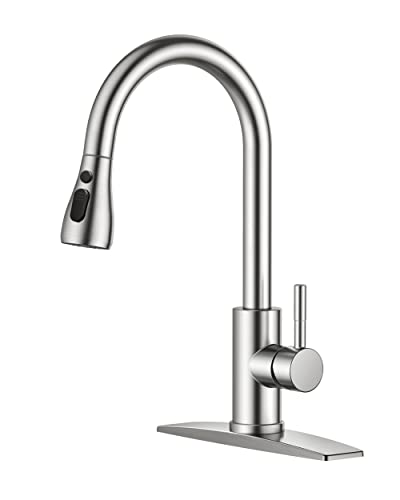
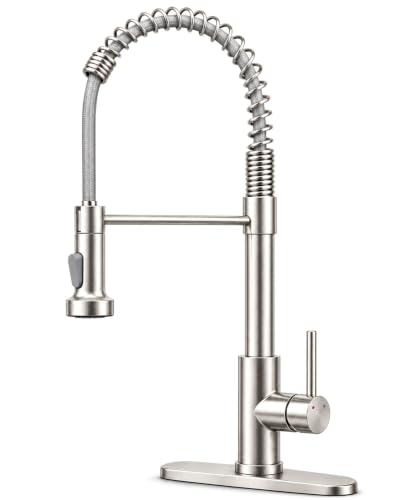
OWOFAN Kitchen Faucet with Pull Down Sprayer — Best Budget Pick. A spring-style faucet in lead-free NSF-certified stainless steel whose standard deck-plate format and simple single-handle layout keep future repairs uncomplicated.
WEWE Pull-Down Kitchen Faucet (Tool-Free Install) — Easiest to Service. Tool-free installation is also tool-free removal — the first repair is the swap itself. Ceramic cartridge and standard braided hoses keep the rest serviceable.
LUFG Brushed Nickel Kitchen Faucet with Pull Down Sprayer — Best Certified Build. SUS 304 body with NSF 61/372 and cUPC credentials and a ceramic-cartridge-class layout; certified materials are the foundation of a long, repairable life.
Moen Adler Pulldown Kitchen Faucet (87233SRS) — Best for Long-Term Parts. The repairability champion by ecosystem: Moen’s Adler platform has the deepest parts availability and plumber familiarity in this guide.
Lufeidra Kitchen Faucet with Pull-Down Sprayer — Best Traditional Profile. SUS 304 construction and a named ceramic cartridge in a classic profile — the two specs that most predict a faucet you fix rather than replace.
FEELSO Kitchen Faucet with Pull Down Sprayer — Best for Utility Sinks. Lead-free NSF-certified stainless with a high arc and broad fit; a simple, serviceable design for kitchens and utility sinks that work hard.
How These Picks Were Chosen
Our rubric weighted the parts that actually fail. First, the valve: a named ceramic cartridge scores highest, because cartridges are the most-replaced internal and ceramic designs resist both wear and mineral damage. Second, the water path: stainless bodies and braided supply hoses over plated bodies and proprietary connections. Third, the spray head: cleanable nozzles and standard hose threads. Fourth, the ecosystem: whether the manufacturer demonstrably supports its installed base with parts, documentation, and a dealer network.
Applying that rubric to faucets with verifiable listing data produced this six. Moen’s Adler represents the ecosystem extreme — a platform so widely installed that its parts are effectively a public utility. The WEWE, LUFG, Lufeidra, and FEELSO models represent the architecture extreme: standard, named internals in stainless bodies at value tiers. The OWOFAN shows that even a stylized spring format can keep a simple, serviceable layout. Material questions are explored further in our Best Kitchen Faucets Stainless Steel guide.
We excluded from consideration any model whose listing hid its construction entirely. A repairable faucet should be legible: you should be able to learn its cartridge type, body material, and mounting format before purchase, because those three facts predict your Saturday mornings in year five better than any feature list.
The 6 Best Options, Reviewed in Detail
Badges here match the Quick Picks section exactly, so you can cross-reference the short list and the long reviews without confusion. Each review follows the same honest format: what the faucet does well, where it compromises, the specifications we could verify from its listing data, how it behaves in the situations this guide is about, and a plain verdict. Where a specification was not present in the verified listing data, we left it out rather than guessing — a faucet guide that invents numbers is worse than one that admits a gap.

OWOFAN Kitchen Faucet with Pull Down Sprayer
Badge: Best Budget Pick
Strengths
- The exposed spring design gives the spray head a commercial-style range of motion and a distinctive semi-professional look.
- Lead-free, NSF-certified stainless steel construction covers the health and durability bases in one line of the spec sheet.
- Deck-plate flexibility for 1- or 3-hole sinks makes it an easy retrofit in older kitchens.
Trade-offs
- Spring faucets have a taller, busier silhouette that can overwhelm a small sink or low cabinets.
- The spring and hose assembly has more moving visual parts to keep clean than a smooth high-arc spout.
- Value-brand support networks are thinner than legacy brands if you need parts years later.
Verified specifications
- Type: single-handle spring kitchen faucet with pull-down sprayer
- Finish: brushed nickel
- Material: lead-free, NSF-certified stainless steel
- Mounting: 1- or 3-hole with deck plate
- Suggested settings in listing title: farmhouse, RV, bar, laundry room
Pick the OWOFAN if you like the semi-professional spring look but want it at a value tier, or if you are outfitting a hard-working laundry or farmhouse sink where the flexible spring arm genuinely helps with buckets, trays, and awkward loads.
The spring arm is not just styling: it lets the spray head sweep across a wide sink and angle into corners that a fixed arc cannot reach, which is why this format migrated from commercial kitchens. The single handle keeps temperature adjustment one-handed while your other hand holds the sprayer, and the stainless body wipes down easily after messy jobs.
For repairability, the OWOFAN’s virtues are simplicity and access: a single handle governing a conventional valve layout, a deck-plate format shared with millions of sinks, and a spring arm that leaves the spray head and hose path easy to reach. Exotic it is not — and when you are the one under the sink with a flashlight, exotic is the last thing you want.
The limitation is proportion: in a compact kitchen the spring tower can look oversized and may crowd upper cabinets, so it suits standard or generous sink runs better than tight galley layouts.
Best for: value-minded owners who want a serviceable spring design / Not suited for: buyers who need a named cartridge specification before purchase

WEWE Pull-Down Kitchen Faucet (Tool-Free Install)
Badge: Easiest to Service
Strengths
- Tool-free installation plus pre-fitted braided supply hoses make this one of the least intimidating DIY swaps in the pool.
- SUS 304 body, ceramic cartridge, and easy-clean nozzles are exactly the trio of specs that predict a trouble-free middle age for a faucet.
- The 360-degree swivel suits island and double-bowl layouts where the faucet must serve two directions.
Trade-offs
- It is a 1-hole fit, so 3-hole sinks will need a deck plate solution that is not the headline feature here.
- Brushed nickel shows spots more than spot-resistant finishes.
- Value-brand long-term parts support is less certain than Moen’s network.
Verified specifications
- Type: high-arc pull-down kitchen faucet
- Finish: brushed nickel
- Body material: SUS 304 stainless steel
- Spray modes: 3, with easy-clean nozzles
- Swivel: 360-degree spout swivel
- Mounting: 1-hole fit
- Valve: ceramic cartridge
- Installation: tool-free install design
- Supply lines: 304 braided supply hoses
This WEWE variant is aimed squarely at the confident DIYer with a modern single-hole sink: unbox, mount, connect the braided hoses, and be done before lunch. It also suits island sinks, where the full swivel earns its keep daily.
In use it mirrors its sibling WEWE’s strengths — three spray modes for the standard jobs, nozzles that clear mineral buildup with a rub, and a ceramic cartridge for smooth, drip-resistant handle action — while the braided 304 supply hoses remove the stiffest, most leak-prone part of an amateur install, the rigid supply connection.
This WEWE makes the most underrated repairability argument in the guide: installation and removal are the same job in opposite directions, and a tool-free faucet is one you can pull, service, and refit without a basin wrench or a prayer. Add a named ceramic cartridge and standard braided hoses, and every likely intervention stays in DIY territory.
The limitation is fit specificity: the 1-hole design is perfect for the sinks it targets and an extra project for everyone else, so confirm your deck configuration before choosing it over the 1-or-3-hole models.
Best for: DIYers who intend to install, service, and eventually remove it themselves / Not suited for: 3-hole decks needing an included plate
LUFG Brushed Nickel Kitchen Faucet with Pull Down Sprayer
Badge: Best Certified Build
Strengths
- SUS 304 construction paired with NSF 61, NSF 372, and cUPC credentials is a strong paperwork package for a value-tier faucet.
- Three spray modes and a full 360-degree swivel cover the complete everyday task list without exotic extras to maintain.
- The included deck plate widens its retrofit compatibility.
Trade-offs
- A lesser-known brand name, so resale-kitchen bragging rights and long-term parts depth are limited.
- Brushed nickel requires routine wiping to look its best.
- The verified title does not state hose reach, so deep double-bowl coverage should be confirmed on the listing.
Verified specifications
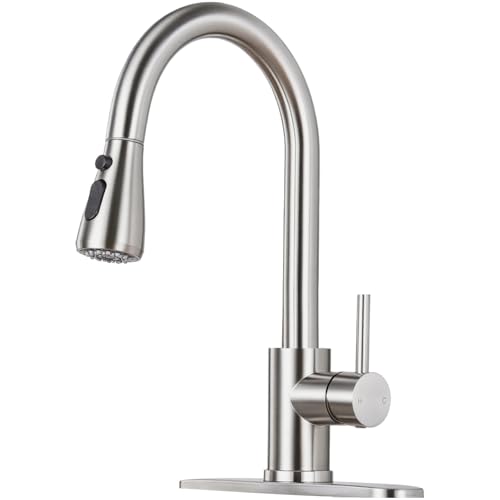
- Type: single-handle pull-down kitchen faucet with deck plate
- Finish: brushed nickel
- Body material: SUS 304 stainless steel
- Spray modes: 3
- Swivel: 360-degree swivel spout
- Certifications: NSF 372, NSF 61, and cUPC listed in the verified listing title
- Suggested settings in listing title: RV, laundry, and bar sinks
The LUFG suits a buyer who reads spec sheets: you want certified materials and full functionality, you are comfortable with a newer brand, and you would rather pay for construction and certifications than for a famous logo.
Its working life is unremarkable in the best sense: a swivel spout that serves both bowls, three spray patterns for filling, rinsing, and scrubbing duty, and a single handle that finds temperature quickly. In the RV, laundry, and bar settings its maker suggests, the compact single-handle format and deck-plate fit simplify tight installs.
The LUFG’s contribution to a repairable life is what does not go wrong: certified SUS 304 construction resists the internal corrosion that seizes lesser faucets solid, so when a wear part eventually needs changing, the faucet still comes apart. Corrosion, not wear, is what turns most repairs into replacements — this is the pick engineered against that ending.
The limitation is the unknown long game: certifications describe the product as sold, but only time in the market tells you how a newer brand supports owners in year six.
Best for: hard-water homes where corrosion resistance decides lifespan / Not suited for: brand-loyal buyers who want a legacy support network

Moen Adler Pulldown Kitchen Faucet (87233SRS)
Badge: Best for Long-Term Parts
Strengths
- The Adler line is one of Moen’s most widely installed pulldown platforms, which translates into deep parts availability and plumber familiarity.
- Spot Resist Stainless finish resists fingerprints and water spots for a cleaner-looking sink between deep cleans.
- A safe, broadly compatible design language that will not date a kitchen quickly.
Trade-offs
- Sits in a higher tier than the value brands here, in exchange for brand support rather than extra listed features.
- The verified title is minimal, so confirm spray functions and dimensions on the product page.
- Styling is deliberately mainstream; design-led renovators may find it plain.
Verified specifications
- Type: pulldown kitchen faucet
- Brand/model: Moen Adler, model 87233SRS
- Finish: Spot Resist Stainless
Choose the Adler when the faucet is part of a long-hold renovation, a rental property you maintain yourself, or any kitchen where future repairability matters more than novelty. Landlords and property managers in particular benefit from a platform any plumber can service blindfolded.
Owners get the mature pulldown experience: dependable docking, predictable spray behavior, and a finish that hides the daily evidence of cooking. Because the platform is so common, replacement cartridges and hoses are the easiest in this guide to source years down the road, which quietly lowers the lifetime cost of ownership.
Here is the ecosystem argument at full strength. The Adler’s platform ubiquity means cartridges and hoses are stocked widely, instructions are documented everywhere, and any plumber you call has serviced this faucet before. Repairability is partly a property of the object and partly a property of the world around it; no pick here is better surrounded.
The limitation mirrors the Essie’s: you are paying a brand premium for support and longevity while value rivals list more features, so feature-maximizers may feel short-changed on paper.
Best for: long-hold homes, rentals, and anyone who wants parts forever / Not suited for: strict budget builds


Lufeidra Kitchen Faucet with Pull-Down Sprayer
Badge: Best Traditional Profile
Strengths
- SUS 304 stainless construction with a ceramic cartridge covers the two most important longevity specs.
- Flexible 1- or 3-hole fit makes it a painless replacement across most standard decks.
- A classic profile that blends into traditional kitchens where ultra-modern faucets look out of place.
Trade-offs
- A newer, lesser-known brand with a thinner long-term support record.
- The listing title’s pot-filler phrasing is marketing language; this is a standard sink faucet with a pull-down sprayer, not a wall-mounted stove pot filler.
- Brushed nickel needs regular wiping to stay spot-free.
Verified specifications
- Type: kitchen faucet with pull-down sprayer
- Finish: brushed nickel
- Body material: SUS 304 stainless steel
- Mounting: fits 1- or 3-hole sinks
- Valve: ceramic cartridge
- Suggested settings in listing title: kitchen sink, laundry, RV, or bar
The Lufeidra is a sensible middle path for a traditional kitchen refresh: classic looks, modern internals, and fit flexibility, at a value tier. It also works well for laundry and bar sinks where its maker suggests it.
Expect the standard modern routine done competently: one-handed temperature control, a pull-down head for rinsing and filling beyond the spout’s fixed reach, and a ceramic cartridge that should keep the handle drip-free through years of daily cycles. The stainless body shrugs off the splashes and mild cleaners of a working kitchen.
The Lufeidra names the two specs a repair-minded buyer asks for first — SUS 304 body, ceramic cartridge — inside a classic, mechanically straightforward profile. Its newer-brand ecosystem is the honest caveat: the architecture is serviceable, but keep your purchase records and the model’s documentation, because sourcing an exact part in year eight leans more on you than with the legacy brands.
The limitation is clarity and pedigree: the title’s pot-filler wording overpromises, and the brand lacks the multi-decade installed base that makes the Moen picks such safe long-term bets.
Best for: traditional kitchens wanting modern, named internals / Not suited for: buyers unwilling to keep their own parts documentation

FEELSO Kitchen Faucet with Pull Down Sprayer
Badge: Best for Utility Sinks
Strengths
- Lead-free, NSF-certified stainless steel construction addresses the material-safety question directly.
- The high arc clears tall stockpots, buckets, and watering cans that defeat low-profile faucets.
- Broad suggested fit — farmhouse, laundry, RV, bar — reflects a genuinely adaptable mounting footprint.
Trade-offs
- Newer value brand, so long-term parts and support are less proven.
- The verified title does not enumerate spray modes, so check the listing if a specific spray pattern matters to you.
- Brushed nickel shows water spots without regular wiping.
Verified specifications
- Type: single-handle high-arc pull-down kitchen faucet
- Finish: brushed nickel
- Material: lead-free, NSF-certified stainless steel
- Mounting: 1- or 3-hole fit
- Suggested settings in listing title: farmhouse, laundry, RV, and bar sinks
FEELSO’s faucet fits the buyer upgrading a farmhouse or hard-working utility kitchen who wants certified materials and a tall arc without entering legacy-brand pricing territory. It is equally at home over a deep laundry tub.
The high arc is the working feature: it turns the sink into a filling station for the biggest vessels in the house, while the pull-down head handles rinsing and basin cleanup. Single-handle control keeps things simple when your other hand is steadying a full pot, and the stainless body tolerates the knocks of a busy sink.
FEELSO’s faucet earns its utility-sink badge on serviceability grounds: a simple single-handle layout, certified lead-free stainless construction, and a high arc that keeps the working parts accessible rather than shrouded. In a laundry or hard-used kitchen, that combination — fixable, tolerant, uncomplicated — outlasts fancier engineering that cannot be serviced in place.
The limitation is information depth: with fewer verified feature details than some rivals, you are buying sound fundamentals — materials, arc, fit — rather than a long feature list.
Best for: laundry, farmhouse, and hard-working utility sinks / Not suited for: feature hunters needing an enumerated spray-mode list
Comparison Table
The table below compresses the six reviews into the attributes that actually separate these faucets: sprayer style, verified standout feature, mounting fit, and the badge each model earned. Prices and ratings are deliberately absent — both change too often to print honestly — so use the Amazon links to check the current position of any model you are serious about.
| Faucet | Style | Standout verified feature | Mounting | Badge | Check |
|---|---|---|---|---|---|
| OWOFAN Kitchen Faucet with Pull Down Sprayer | Spring pull-down | Lead-free NSF-certified stainless; simple single-handle layout | 1- or 3-hole with plate | Best Budget Pick | Check on Amazon |
| WEWE Pull-Down Kitchen Faucet (Tool-Free Install) | High-arc pull-down | Ceramic cartridge; tool-free mount; braided hoses | 1-hole | Easiest to Service | Check on Amazon |
| LUFG Brushed Nickel Kitchen Faucet with Pull Down Sprayer | Pull-down | SUS 304; NSF 61/372 and cUPC in listing | With deck plate | Best Certified Build | Check on Amazon |
| Moen Adler Pulldown Kitchen Faucet (87233SRS) | Pulldown | Moen Adler platform; model 87233SRS | See listing | Best for Long-Term Parts | Check on Amazon |
| Lufeidra Kitchen Faucet with Pull-Down Sprayer | Pull-down | SUS 304 body; ceramic cartridge | 1- or 3-hole | Best Traditional Profile | Check on Amazon |
| FEELSO Kitchen Faucet with Pull Down Sprayer | High-arc pull-down | Lead-free NSF-certified stainless steel | 1- or 3-hole | Best for Utility Sinks | Check on Amazon |
How to Choose the Right Kitchen Faucet
Read a faucet listing like a mechanic, not a decorator. The first question is the valve: does the listing name a ceramic cartridge? Ceramic discs are the industry’s durable standard — they resist the grit and mineral wear that make washer valves drip — and a named cartridge implies a replaceable cartridge, which is the entire game. The WEWE, Lufeidra, and their peers here state it plainly; treat silence on this point as information.
Second, the body. Stainless steel — ideally specified as SUS 304 — does not corrode internally, so threads stay clean and parts stay removable. Plated alloys can freeze solid with scale and corrosion products until the only repair is a saw. Lead-free certification with NSF credentials, present across this pool, tells you the water path was engineered to a standard rather than to a price alone.
Third, the consumables around the valve: the pull-down hose, the spray head, and the supply lines. Braided supply hoses in standard sizes are replaceable anywhere; cleanable nozzles postpone spray-head replacement indefinitely; a hose that routes in a clear under-sink loop ages slower than one kinked against a disposal. When you compare two finalists, choose the one whose wear parts look most ordinary — ordinary is what the parts shelf stocks. Shoppers comparing spray formats may also want our Best Kitchen Faucets Sweep Spray analysis of wide-pattern rinsing.
Fourth, the paperwork. Before buying, search for the model’s cartridge by name and confirm a human can purchase it. Check that the manufacturer publishes installation documents and a parts diagram. Two minutes of this research, done before purchase, is the highest-value step in this entire guide — it converts repairability from a hope into a verified fact for your specific model.
Finally, price the repair future, not just the faucet. A slightly dearer faucet with a standard cartridge and stocked parts will almost always undercut a bargain whose first failure is terminal. If you are hunting value, time the purchase with the patterns in our Best Kitchen Faucets Sale guide rather than downgrading the internals to hit a number.
Repairability also has a geography: your future parts shelf. Before finalizing any pick, imagine its three likeliest repairs — cartridge, hose, spray head — and ask where each part comes from in your town, on a Sunday, with the water off. Platform models answer ‘anywhere’; standard-architecture value models answer ‘the generic shelf’; proprietary designs answer with a website and a wait. The faucet itself does not change across those answers, but your life with it does. Buyers who run this thought experiment rarely choose wrong, because they are no longer buying a faucet — they are buying the repair days they will actually experience.
It is also worth distinguishing repairable from immortal, because confusing them produces bad purchases in both directions. A repairable faucet will still need its cartridge renewed and its nozzles cleaned; it simply makes those events cheap, documented, and possible. An owner who expects immortality neglects maintenance and then blames the product; an owner who expects repairability performs the small rituals and is rewarded with the long service the design promised. The picks in this guide are firmly the second kind — plan the rituals, and the faucet will meet you more than halfway.
One underused resource deserves mention: the manufacturer’s own parts diagram, usually published with the installation documents. Download it before you need it, note the cartridge and hose part designations in your home records, and you have converted a future emergency into a shopping list. Paired with a photograph of your under-sink arrangement, that diagram is the difference between describing a part over the phone and simply ordering it. Repairability, in the end, is information plus standard hardware — and the information half is free.
One more ownership practice separates faucets that get repaired from faucets that get replaced: the pre-emptive parts photograph. On install day, photograph the cartridge, the hose connections, and the model label, and store the images with your home records. Years later, those three photographs answer every question a parts counter or a support line will ask, in seconds, without disassembling anything on speculation. Repairability is often described as a property of metal and standards; in practice it is just as much a property of information kept. The faucet you can identify is the faucet you can fix, and identification is cheapest on the day everything is new, clean, and already in your hands.
How to Maintain a Faucet So Repairs Stay Small
Repairable is a property you maintain, not just one you buy. The highest-value habit is mineral control: rub silicone nozzles clear weekly in hard-water homes, and descale the spray face with a vinegar soak whenever the pattern weakens. Scale left alone migrates inward, loading the cartridge with grit it was never meant to grind — most ‘worn-out’ cartridges were murdered by minerals, not by use.
Once a year, do the ten-minute service. Close the shut-off valves, open the faucet to drain, and inspect every under-sink joint and the hose for damp, swelling, or green corrosion. Exercise the shut-off valves themselves — a valve that is never turned seizes, and a seized valve turns a small future repair into an emergency. Wipe the cartridge area dry, and note the cartridge model in your phone while you are there; future-you at the hardware store will be grateful.
When a drip does start at the spout, act while it is small. On ceramic-cartridge models the fix is a cartridge swap: water off, handle and trim removed per the model’s diagram, old cartridge out (note its orientation), new cartridge in, and a slow, leak-checked restart. Keep the old cartridge until the new one proves itself, and photograph each step — faucet internals are simple, but they are also easy to reassemble one O-ring wrong.
Know the boundary of DIY. A leaking supply valve, corroded deck hardware that will not release, or a leak inside a wall belongs to a plumber. The repairable mindset is not about doing everything yourself; it is about owning a faucet where the professional’s visit, when needed, is a one-hour cartridge job rather than a full replacement with drywall for dessert.
Keep a minimal faucet kit with the faucet, not in a distant toolbox: a soft cloth for finishes, a small container of vinegar for nozzle soaks, the model’s documentation, and a note of the cartridge designation. When a drip or a frayed pattern appears, the kit turns response into routine — you will descale a spray face the week it weakens rather than the season it fails, and you will order the right cartridge the first time. Every long-lived faucet in every owner’s story sits above a cabinet containing some version of this kit. It costs almost nothing, and it is the physical form of the repairable mindset.
Troubleshooting: three problems you can fix yourself
Problem: the handle gets stiff or gritty to move → mineral grit is working into the cartridge. Remove and rinse the cartridge per the model’s instructions; if the action stays rough, replace it — stiffness ignored becomes a cracked disc and a drip.
Problem: flow weakens at the spray head but pressure is fine elsewhere → the spray face or the hose’s inline screen is scaled. Rub or vinegar-soak the nozzles, and check the screen where the hose meets the head; both are five-minute, zero-part fixes.
Problem: a damp smell develops in the sink cabinet → find it now, not later: dry every joint, then run the faucet through all modes and re-check with a paper towel to isolate the weeping connection. Most culprits are a supply nut needing a quarter-turn or a hose past its prime — both cheap, both urgent at this stage.
What makes best kitchen faucets repairable in practice, not just in marketing
Marketing repairability is a mood; practical repairability is a checklist. The faucet must come apart with common tools, in an order a diagram can teach. Its wear parts must be standard enough to buy without the manufacturer’s permission. Its materials must resist the corrosion that welds neglected faucets into single-use sculptures. And its maker must still be answering for it in a decade. Score any faucet on those four axes and the category sorts itself quickly.
Notice what is absent from that list: features. Touchless sensors, electronic controls, and proprietary spray engines all add failure modes that are rarely user-serviceable, which is why this guide’s picks are overwhelmingly mechanical pull-downs. There is a place for electronic faucets — our sale and touch-focused coverage treats them fairly — but a buyer whose first word is ‘repairable’ is voting for the mechanical stack, and the market’s most serviceable designs reflect that vote.
The deepest point is temporal. A faucet is one of the few household objects expected to serve for fifteen years while being touched a hundred times a week. Repairability is simply respect for that arithmetic: every design choice either honors the future owner with a wrench or bills them for a replacement.
The parts ecosystem: why the world around the faucet matters
Ask a plumber what makes a faucet repairable and you will hear about warehouses, not wrenches. A model installed in a million kitchens creates its own gravity: cartridges on every shelf, videos for every procedure, counter staff who know the part numbers by heart. The Moen Adler in this guide is the clearest beneficiary — its ubiquity is a repairability feature as real as its cartridge.
Value brands are building the other half of that equation: standard architectures. When a WEWE or LUFG uses a conventional ceramic cartridge and standard hose fittings, it borrows the ecosystem of the whole industry rather than depending on its own. That is why this guide reads listings for named, standard components: they are evidence the faucet can be fed by the generic parts shelf if its maker ever stops answering email.
Your move as a buyer is simple: before purchase, perform one search for your finalist’s cartridge and one for its hose. If both return purchasable parts from multiple sellers, you are looking at a faucet with a future. If either returns silence, you are looking at a disposable with good styling — price it accordingly or walk away.
Common Buying Mistakes
Mistake one: assuming ‘lifetime warranty’ language equals repairability. A warranty you must claim by shipping a faucet to a service center is a replacement program, not a repair path. What keeps a faucet alive is standard parts on open shelves, not promises in a PDF.
Mistake two: overtightening during install and service. Crushed O-rings and cracked plastic nuts are self-inflicted wounds that later masquerade as product failures. Hand-tight plus a careful quarter-turn is the correct torque for most of what lives under a sink.
Mistake three: ignoring a slow drip. A dripping cartridge erodes its seat and stains the sink; the same repair done a month later can cost a faucet. Small leaks are messages, and they never deliver good news twice.
Mistake four: replacing the faucet when only the hose or spray head has failed. On the standard architectures in this guide, both are discrete, purchasable parts. Diagnose to the component before you sentence the whole fixture.
Mistake five: stocking the wrong spare. Owners who do keep a spare part often keep the glamorous one — a spare spray head — while the part that actually ends service weekends is the cartridge. If you stock anything, stock the cartridge, bought while your model is current and the part is cheap and certain. Label it with the model and the purchase date, store it with the documentation, and your future self inherits a repair instead of a research project.
Mistake six: using thread sealant and tape as a substitute for sound connections. Sealants have their narrow places in plumbing, but on the compression and threaded connections typical of these faucets, they mostly mask a seating problem that will return as a leak with interest. Clean threads, sound washers, and correct quarter-turn discipline are the repair; anything smeared on to persuade a bad joint is a postponement, and postponements under a sink collect cabinet damage as their fee.
Final Recommendation
If repairability is truly the brief, the Moen Adler is the answer with the fewest asterisks: the deepest parts ecosystem in the category, a finish that resists the evidence of daily use, and a platform any plumber can service from memory. It is the faucet you buy when the plan is to fix it, forever, rather than to shop for its successor. Check it on Amazon and confirm your deck fit.
The value-tier counterargument is the tool-free WEWE, whose standard ceramic-cartridge architecture and wrench-free mounting keep every likely intervention in your own hands. Choose the LUFG if corrosion is your local enemy, the FEELSO for a utility sink that works as hard as the kitchen. In every case, you are buying the same thing: a faucet whose future is a parts list, not a landfill date.
Frequently Asked Questions
What is the first part to fail on a kitchen faucet?
Statistically, the cartridge and the spray head’s nozzles cause most service calls: cartridges wear or accumulate mineral grit until they drip or stiffen, and nozzles clog with scale until the spray pattern distorts. Both are exactly the failures this guide’s picks are built to survive — ceramic cartridges that can be swapped, and nozzles designed to be rubbed or soaked clean instead of replaced.
Are ceramic cartridges really more repairable than other valves?
They are more durable, which is better than repairable: a ceramic disc cartridge resists the wear and mineral damage that kill washer and ball valves, so the repair simply comes later and less often. When it does come, standard ceramic cartridges are among the most widely stocked parts in plumbing. Several picks here name their ceramic cartridge in the listing, which is the transparency a repair-minded buyer should demand.
Can I replace a faucet cartridge myself?
On the standard single-handle architectures in this guide, yes — it is a water-off, trim-off, swap, restart job that most owners complete in under an hour with the model’s diagram in hand. Photograph each stage, note the cartridge’s orientation, and keep the old part until the new one proves itself. If your shut-off valves are seized or corroded, that preliminary problem is the plumber’s part of the job.
Do value brands sell replacement parts?
Increasingly, the honest answer is ‘through standard channels.’ Models built on conventional ceramic cartridges and standard hose fittings can be fed from the generic parts shelf even if the brand’s own store is thin — which is why this guide favors named, standard internals. Before buying any value faucet, run one search for its cartridge type and confirm purchasable results; that two-minute check is in the buying guide above.
How long should a repairable faucet last?
With mineral management and one or two cartridge renewals across its life, a stainless-bodied faucet of the kind listed here should serve well past a decade, and the Moen platforms are routinely kept far longer. The killers are corrosion that prevents disassembly and unavailable parts — the two failure modes this guide’s rubric was built to screen out.
Is a touchless faucet a bad idea for repairability?
It is a trade, not a mistake. Sensors add a power source, an electronic valve path, and components that are seldom user-serviceable, so the long-term repair picture is weaker than a mechanical faucet’s. If touchless operation solves a real problem in your kitchen — mobility, hygiene during messy prep — buy it with open eyes and a preference for major brands; if repairability is your first criterion, stay mechanical, as this guide’s picks do.