Disclosure: topratedkitchenware.com is reader-supported. When you buy through links on our site, we may earn an affiliate commission from Amazon and other retailers, at no extra cost to you.
Where to buy
This guide to the best kitchen faucets with ceramic disk valves starts with the two faucets whose verified listings explicitly confirm a ceramic cartridge, then compares the four additional designs we review in prose because their listings do not state the valve type. Every linked pick below goes to its Amazon product page, where you can check the latest price on Amazon and confirm the finish and configuration before ordering.
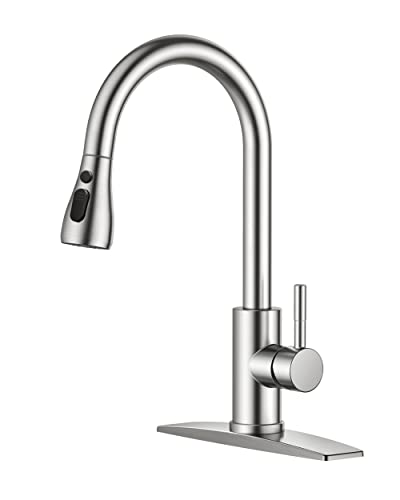
- WEWE Pull-Down Kitchen Faucet, 3-Mode Sprayer, Brushed Nickel — Best Overall. Ceramic cartridge confirmed; check the latest price on Amazon from its product page.
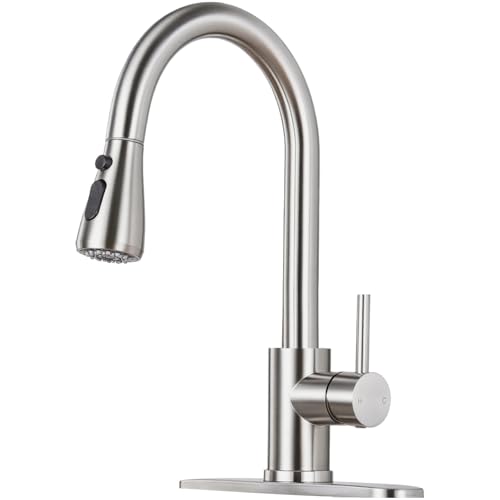
- Lufeidra Kitchen Faucet With Pull-Down Sprayer, Classic Pot Filler Style — Best Classic Design. Ceramic cartridge confirmed, in a traditional silhouette.
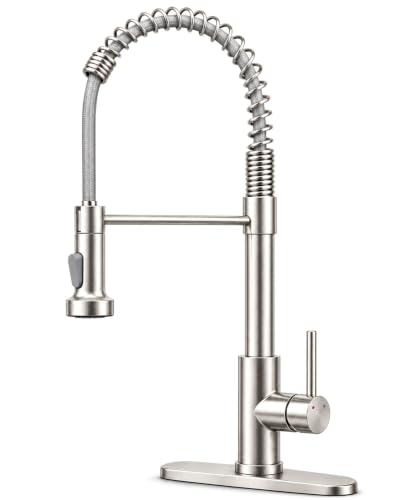
- OWOFAN Kitchen Faucet with Pull Down Sprayer, Brushed Nickel Spring Design (reviewed in prose below — valve type not stated in its verified listing)
- Moen Adler Pulldown Kitchen Faucet, Spot Resist Stainless, 87233SRS (reviewed in prose below — valve type not stated in its verified listing)
- LUFG Brushed Nickel Kitchen Faucet with Pull Down Sprayer and Deck Plate (reviewed in prose below — valve type not stated in its verified listing)
- FEELSO Kitchen Faucet with Pull Down Sprayer, Brushed Nickel (reviewed in prose below — valve type not stated in its verified listing)
Read the full guide ↓ for the valve science, the per-faucet reviews, and the maintenance routine that keeps ceramic disks sealing for years.
Why the Valve Inside Matters More Than the Finish Outside
If you are shopping specifically for the best kitchen faucets with ceramic disk valves, you already understand something many buyers learn the hard way: a faucet almost never fails at the spout. It fails at the valve — the small internal mechanism that starts, stops, and mixes the water every time you lift the handle. The finish can stay beautiful for a decade while the cartridge underneath starts to drip at year three, and a drip that begins as an annoyance becomes a stained sink, a swollen cabinet floor, and a repair bill. That is why this guide is organized around the valve first and everything else second.
A ceramic disk valve works with two polished ceramic disks, each with openings that align or misalign as you move the handle. When the openings line up, water flows. When they slide apart, the flow stops — and because the disks are extraordinarily hard and ground almost perfectly flat, they seal against each other with a precision that rubber washers and plastic cartridges struggle to match over time. Ceramic is also largely indifferent to the grit, sand, and mineral sediment that chew through softer sealing materials, which is why this valve type has become the default expectation in quality single-handle faucets.
There is an honesty point we want to make up front, because it shapes this entire list. Not every faucet sold today advertises its valve type, and a listing that says nothing about a cartridge has told you nothing — in either direction. For this guide we verified each pick against its Amazon listing data. Two of the six faucets below explicitly confirm a ceramic cartridge in their verified titles, and those two carry Amazon links and product images. The other four are strong faucets from the same verified pool whose listings do not state the valve type, so we review them in prose only, tell you plainly that the valve is unconfirmed, and explain how to verify it with the manufacturer before buying if the ceramic disk is a hard requirement for you. Readers comparing this shortlist with the broader Best Kitchen Faucets With Ceramic Valves guide will find the same verification standard applied there.
Beyond the valve, the six faucets here share the modern kitchen baseline: single-handle control, pull-down sprayers, high-arc or spring silhouettes, and brushed nickel or stainless finishes that hide water spots. They differ in spray modes, swivel range, certifications, installation style, and intended setting — some are aimed at full-size family kitchens, others at RV, bar, and laundry sinks where space is tight. The reviews below sort out which is which, and the buying-guide sections explain how ceramic disks behave with hard water, what actually wears them out, and the simple habits that keep them drip-free.
Key Takeaways
- Ceramic disk valves seal with two hardened, polished disks instead of compressible washers, which is why they resist drips and grit damage better than older valve designs.
- Only buy a faucet as a “ceramic disk” purchase when the valve type is actually confirmed — in this list, the WEWE pull-down and the Lufeidra state a ceramic cartridge in their verified listings; the other four picks are reviewed prose-only because their listings do not say.
- Sediment is the one real enemy of ceramic disks: a working aerator and a supply-line flush at install protect the sealing surfaces.
- All six picks are single-handle pull-down designs in brushed nickel or stainless, but they split between full-kitchen models and compact RV, bar, and laundry models — match the faucet to the sink, not just the valve.
- Certifications such as NSF and cUPC listings, where stated, speak to materials and lead safety, which matters as much as the valve in a drinking-water fixture.
In this guide
Quick Picks
| Pick | Badge | Valve status | Standout trait | Link |
|---|---|---|---|---|
| WEWE Pull-Down Kitchen Faucet, Brushed Nickel | Best Overall | Ceramic cartridge confirmed | 3-mode sprayer, 360° swivel, tool-free install | Check on Amazon |
| Lufeidra Kitchen Faucet With Pull-Down Sprayer | Best Classic Design | Ceramic cartridge confirmed | Pot-filler-inspired silhouette, SUS304 stainless | Check on Amazon |
| OWOFAN Kitchen Faucet, Spring Design | Best Spring Design | Not stated in listing | Exposed-spring semi-pro look, lead-free NSF certified | Prose-only |
| Moen Adler Pulldown, 87233SRS | Best Brand-Name Pick | Not stated in listing | Spot Resist Stainless finish, established brand support | Prose-only |
| LUFG Brushed Nickel Kitchen Faucet | Best for RV and Bar Sinks | Not stated in listing | NSF372, NSF61 and cUPC listings, deck plate included | Prose-only |
| FEELSO Kitchen Faucet, Brushed Nickel | Best Farmhouse Style | Not stated in listing | Lead-free NSF certified, high arc, 1 or 3 hole | Prose-only |
Badges reflect the role each faucet plays on this list, and the same badges appear in the detailed reviews so you can cross-reference quickly. Readers whose priority is sprayer reach rather than valve type may also want the companion shortlist of Best Kitchen Faucets With Pull Down Sprayer models, where hose behavior gets the deepest treatment.
How These Picks Were Chosen
This is a research-led guide, not a lab test. We did not install these six faucets side by side, and we will not pretend otherwise. What we did is narrower and, for this particular keyword, more useful: we verified every pick against its Amazon listing data through the Creators API, recorded the exact product title, brand, and image for each, and then read those verified specifications closely for the one attribute this guide exists for — the valve.
That verification pass produced the split you see above. Two listings state “Ceramic Cartridge” in plain language. Four do not mention the cartridge at all. Rather than assume — and many faucets in this class do quietly use ceramic cartridges — we applied the rule that a buying guide about ceramic disk valves may only link a product as a ceramic pick when the claim is confirmed. Unconfirmed faucets stayed in the guide because they are legitimate, verified products from the same pool that a reader might reasonably cross-shop, but they are labeled prose-only with the valve caveat repeated in their reviews.
Within that constraint, we compared the six on the attributes the verified data supports: sprayer type and spray modes, swivel range, body material, hole configuration, certifications, and intended setting. We weighted drip resistance and sealing design first, then everyday usability — sprayer docking, handle feel, and how the faucet suits a main kitchen versus a secondary sink. Price was deliberately excluded as a ranking input; finishes and bundles change too often, and the standing rule for this guide is qualitative tier positioning with a prompt to check the latest price on Amazon.
Finally, we sanity-checked the shortlist against the failure modes readers actually report with kitchen faucets: drips at the spout, leaks at the handle base, sprayer hoses that stop retracting, and finishes that spot. A faucet earned its badge by having a design answer to at least one of those problems, not by having the longest feature list.
The 6 Best Kitchen Faucets With Ceramic Disk Valves, Reviewed

WEWE Pull-Down Kitchen Faucet, 3-Mode Sprayer, Brushed Nickel
Badge: Best Overall
Strengths
- Ceramic cartridge confirmed in the verified listing — the core requirement of this guide, stated rather than assumed.
- Three spray modes on the pull-down head cover the realistic range: aerated stream for filling, spray for rinsing, and a stronger sweep for stuck-on food.
- Full 360° swivel plus easy-clean nozzles and a tool-free install design make it unusually ownership-friendly.
Trade-offs
- Single-hole fit as listed, so three-hole sinks may need a deck plate solution confirmed before ordering.
- Brushed nickel only in this configuration — no matte black or chrome variant in the verified listing.
- The value-brand support network is thinner than a legacy brand’s if you need a replacement cartridge years from now.
Spec box (from verified listing data)
- Material: SUS 304 stainless steel
- Cartridge: ceramic
- Sprayer: pull-down, 3 modes
- Swivel: 360°
- Configuration: 1-hole fit, high arc
- Supply lines: 304 braided hoses
- Install: tool-free design, easy-clean nozzles
This is the faucet we would hand to a reader who wants the ceramic-disk brief answered directly. The verified listing does the one thing this guide cares most about — it names the ceramic cartridge — and then backs it up with a sensible modern package: a high-arc SUS 304 body, a three-mode pull-down head, full swivel, and braided supply hoses. In daily use, the ceramic cartridge is the part you will feel rather than see: handle movement on a good disk valve is smooth with a clean, definite shut-off, and that shut-off quality is what keeps the spout dry between uses.
The three spray modes are well chosen. Most pull-down heads offer stream and spray; the third, higher-pressure mode earns its place on sheet pans and stockpots. Easy-clean nozzles matter more than they sound, because mineral crust on the spray face is the most common cosmetic complaint with any faucet in hard-water homes, and silicone-style nozzles you can clear with a fingertip beat soaking a fixed aerator. The tool-free install positioning and braided hoses also lower the barrier for a confident DIY swap, which is how most faucets in this class are actually installed.
The honest limitation is ecosystem, not function. WEWE is a value-oriented brand; if the cartridge ever does need replacement far down the road, sourcing the exact part takes more effort than walking into a hardware store for a legacy-brand cartridge. Keeping the model details and your order record solves most of that. For shoppers weighing hands-free operation instead, the Best Kitchen Faucets With Sensor category is the neighboring upgrade path, though sensor models add electronics this purely mechanical design avoids.
Best for: buyers who want a confirmed ceramic cartridge in a modern pull-down at a value tier / Not suited for: three-hole sinks without confirming a deck plate, or buyers who prioritize a legacy parts network

Lufeidra Kitchen Faucet With Pull-Down Sprayer, Classic Pot Filler Style
Badge: Best Classic Design
Strengths
- Ceramic cartridge confirmed in the verified listing, in a SUS304 stainless body.
- The classic pot-filler-inspired silhouette suits traditional and transitional kitchens that look wrong with ultra-modern faucets.
- Fits 1- or 3-hole installations, and the listing positions it for kitchen, laundry, RV, and bar sinks alike.
Trade-offs
- The listing does not state a spray-mode count, so assume a simpler sprayer than the three-mode heads here.
- Classic styling reads busy in a minimalist kitchen.
- Like the WEWE, it is a value brand — keep your documentation for future parts.
Spec box (from verified listing data)
- Material: SUS304 stainless steel
- Cartridge: ceramic
- Sprayer: pull-down
- Configuration: fits 1- or 3-hole
- Finish: brushed nickel
- Settings named: kitchen, laundry, RV, bar
The Lufeidra is the second confirmed ceramic-cartridge faucet on this list, and it wins its badge on looks as much as mechanics. Its design borrows the visual language of a classic pot filler — a more traditional, slightly formal profile — which fills a real gap: most ceramic-cartridge pull-downs are styled for contemporary kitchens, and owners of traditional cabinetry often have to choose between the valve they want and a faucet that matches the room. Here they do not have to choose.
Functionally, the package is straightforward and sensible. SUS304 stainless is the right body material at this tier, the pull-down sprayer covers rinsing and filling, and the 1- or 3-hole flexibility means it drops into the majority of existing sink decks without drilling or a separate plate purchase. The listing’s explicit mention of laundry, RV, and bar use is also honest positioning: this is a faucet sized and priced for second sinks as happily as for a main kitchen, and a ceramic cartridge is arguably even more valuable in an RV or laundry setting, where a slow drip can go unnoticed longer and do more damage.
The limitation to accept is sprayer simplicity. Where the WEWE above advertises three modes, the Lufeidra’s verified data does not enumerate modes, so buy it expecting a competent stream-and-spray head rather than a feature showcase. If your cooking involves a lot of high-pressure rinsing, the WEWE is the better tool; if your priority is a confirmed ceramic valve in a classic-looking faucet that fits almost any deck, this is the pick.
Best for: traditional kitchens and second sinks that still deserve a confirmed ceramic cartridge / Not suited for: buyers who want multiple spray modes or an ultra-modern silhouette
OWOFAN Kitchen Faucet with Pull Down Sprayer, Brushed Nickel Spring Design
Badge: Best Spring Design
Strengths
- Exposed-spring, semi-professional silhouette gives the sprayer excellent freedom of movement around a deep sink.
- Lead-free and NSF certified per the verified listing, in stainless steel.
- Single handle with a 1 or 3-hole deck plate included, aimed at farmhouse, RV, bar, and laundry settings.
Trade-offs
- The verified listing does not state the cartridge type — the ceramic disk requirement is unconfirmed for this model.
- The tall spring profile needs overhead clearance and visually dominates small sinks.
- Spring-style heads can feel less precise when docking than magnetic-dock pull-downs.
Spec box (from verified listing data)
- Material: stainless steel, lead-free
- Certification: NSF certified
- Sprayer: pull-down, spring design
- Configuration: 1 handle, 1 or 3-hole with deck plate
- Finish: brushed nickel
- Settings named: farmhouse, RV, bar, laundry
We include the OWOFAN because spring faucets are the style many readers picture when they upgrade, and because its materials story — lead-free, NSF certified stainless — is genuinely good. The exposed coil gives the spray head a range of motion that fixed-arc faucets cannot match, which is why this format migrated from commercial kitchens: you can chase debris around a roasting pan or fill a pot sitting on the counter beside the sink.
But this guide has one job, and honesty requires repeating the caveat in the review itself, not just the quick picks: the verified listing for this faucet does not state its cartridge type. It may well contain a ceramic cartridge — many faucets in this class do — but “may well” is not verification. If the ceramic disk is a hard requirement, contact the seller or manufacturer and get the cartridge specification in writing before ordering, or choose one of the two confirmed picks above. If you love the spring format and the valve turns out to be confirmed by the maker, this becomes a very strong buy; if it is not confirmed, treat it as a style purchase, not a ceramic-disk purchase.
Best for: style-led buyers who want a spring faucet and will verify the cartridge with the maker / Not suited for: buyers who need the ceramic disk confirmed at the point of purchase
Prose-only pick: no Amazon link or image, because the verified listing does not confirm a ceramic cartridge.
Moen Adler Pulldown Kitchen Faucet, Spot Resist Stainless, 87233SRS
Badge: Best Brand-Name Pick
Strengths
- Moen is one of the most established faucet brands in North America, with the retail parts presence that implies.
- Spot Resist Stainless finish is designed to resist fingerprints and water spots — a daily cosmetic advantage.
- The Adler line is a mainstream pulldown format with broad installer familiarity.
Trade-offs
- The verified listing data for this model does not state the cartridge type, so its ceramic status is unconfirmed here.
- Brand-name pricing tiers sit above the value brands on this list in qualitative terms.
- Pulldown only — no spring or touchless variant within this pick.
Spec box (from verified listing data)
- Brand line: Moen Adler, model 87233SRS
- Type: pulldown kitchen faucet
- Finish: Spot Resist Stainless
The Adler is the establishment choice on this list. Moen’s distribution means cartridges, spray heads, and finish-matching accessories are comparatively easy to source years later, and any plumber in North America has installed this faucet or its close relatives. The Spot Resist finish is not marketing fluff in daily life either: on a standard stainless faucet, every wet hand leaves a mark; a spot-resistant finish meaningfully reduces how often the faucet looks dirty.
The same verification caveat applies, and it is worth pausing on why. Legacy brands often document valve specifications in their own spec sheets rather than in marketplace titles, so the absence of “ceramic” in the verified listing title tells you about the listing, not necessarily about the faucet. Moen’s own product documentation for the exact model number, 87233SRS, is the authoritative place to confirm the cartridge before buying. We flag it rather than assume it, because this guide’s promise is that linked picks are confirmed picks. Readers who rank long-term parts availability above point-of-sale valve confirmation may reasonably start with the Adler and verify through the manufacturer’s documentation.
Best for: buyers who value brand support and a spot-resistant finish, and will confirm the cartridge in the maker’s spec sheet / Not suited for: buyers who want the ceramic specification confirmed in the listing itself
Prose-only pick: no Amazon link or image, because the verified listing does not confirm a ceramic cartridge.
LUFG Brushed Nickel Kitchen Faucet with Pull Down Sprayer and Deck Plate
Badge: Best for RV and Bar Sinks
Strengths
- The certification stack is the strongest on this list: NSF372, NSF61, and cUPC all appear in the verified listing.
- SUS 304 stainless body, single handle, three spray modes, and a full 360° swivel spout.
- Deck plate included, and the listing explicitly targets RV, laundry, and bar sinks as well as kitchens.
Trade-offs
- The verified listing does not state the cartridge type — ceramic status unconfirmed.
- Compact multi-setting positioning means it is not the tallest or heaviest-duty option for a large chef’s sink.
- Value-brand parts sourcing requires keeping model documentation.
Spec box (from verified listing data)
- Material: SUS 304 stainless steel
- Certifications: NSF372, NSF61, cUPC
- Sprayer: pull-down, 3 spray modes
- Swivel: 360°
- Configuration: single handle, deck plate included
- Finish: brushed nickel
On paper, the LUFG is one of the most completely specified faucets here: the materials are right, the sprayer has three modes, the spout swivels fully, and its certifications address lead content and material safety directly, which matters in an RV or bar sink used for drinking water. If we were ranking faucets generally, it would sit near the top.
This ranking, however, is about a valve. The LUFG’s verified listing does not name its cartridge, so it sits in the prose-only group with the same advice as the OWOFAN: verify with the seller if ceramic is non-negotiable. What we can say without qualification is that its certification profile and format make it the most interesting secondary-sink option on the list, and secondary sinks are exactly where a confirmed-ceramic upgrade pays off quietly — a drip in an RV or a little-used bar sink can run for weeks before anyone notices. Readers outfitting a second sink may also cross-shop the Best Kitchen Faucets With Pull Out Wand shortlist, where compact reach is the deciding factor.
Best for: RV, bar, and laundry sinks where certifications matter and the cartridge will be verified with the seller / Not suited for: buyers who need ceramic confirmed in the listing, or a maximum-size main-kitchen faucet
Prose-only pick: no Amazon link or image, because the verified listing does not confirm a ceramic cartridge.
FEELSO Kitchen Faucet with Pull Down Sprayer, Brushed Nickel
Badge: Best Farmhouse Style
Strengths
- Lead-free and NSF certified per the verified listing, in stainless steel.
- High-arc silhouette suits farmhouse and apron-front sinks, with clearance for tall pots.
- Single handle, 1 or 3 hole flexibility, positioned for kitchen, farmhouse, laundry, RV, and bar use.
Trade-offs
- Cartridge type is not stated in the verified listing — ceramic status unconfirmed.
- The listing does not enumerate spray modes or swivel range, so expect a standard pull-down feature set.
- High-arc designs splash more in shallow sinks.
Spec box (from verified listing data)
- Material: stainless steel, lead-free
- Certification: NSF certified
- Sprayer: pull-down
- Arc: high arc
- Configuration: single handle, 1 or 3 hole
- Finish: brushed nickel
The FEELSO closes the list as the farmhouse-leaning option: a high arc for pot clearance, a brushed nickel finish that sits comfortably with apron-front sinks and shaker cabinetry, and lead-free NSF-certified construction. As a general faucet proposition for a farmhouse kitchen or a hard-working laundry sink, it is coherent and sensibly specified.
Its position here follows the same rule as the other prose-only picks. The verified data does not name a cartridge, so we do not sell it to you as a ceramic disk faucet. The pattern across this list is actually the most useful shopping lesson in the guide: at the value tier, valve transparency is the exception, not the norm, and the two listings that state their ceramic cartridge plainly — the WEWE and the Lufeidra — earned their links by doing so. If your heart is set on the FEELSO’s look, a two-minute message to the seller asking for the cartridge specification converts a guess into a decision.
Best for: farmhouse kitchens and laundry sinks that want certified lead-free construction and will verify the valve / Not suited for: shallow sinks, or buyers who need ceramic confirmed without a seller inquiry
Prose-only pick: no Amazon link or image, because the verified listing does not confirm a ceramic cartridge.
Comparison Table
| Faucet | Badge | Ceramic cartridge | Sprayer | Material / Finish | Best setting | Link |
|---|---|---|---|---|---|---|
| WEWE Pull-Down | Best Overall | Confirmed | Pull-down, 3 modes | SUS 304 / brushed nickel | Main kitchen | Check on Amazon |
| Lufeidra Pull-Down | Best Classic Design | Confirmed | Pull-down | SUS304 / brushed nickel | Traditional kitchen, second sinks | Check on Amazon |
| OWOFAN Spring | Best Spring Design | Not stated | Pull-down, spring | Stainless, lead-free / brushed nickel | Farmhouse, deep sinks | Prose-only |
| Moen Adler 87233SRS | Best Brand-Name Pick | Not stated | Pulldown | Spot Resist Stainless | Main kitchen | Prose-only |
| LUFG | Best for RV and Bar Sinks | Not stated | Pull-down, 3 modes | SUS 304 / brushed nickel | RV, bar, laundry | Prose-only |
| FEELSO | Best Farmhouse Style | Not stated | Pull-down | Stainless, lead-free / brushed nickel | Farmhouse, laundry | Prose-only |
How to Choose a Kitchen Faucet With a Ceramic Disk Valve
Start by treating “ceramic disk” as a claim to be verified, not a category to be browsed. As this list demonstrates, most listings at the value tier never mention the cartridge. Your verification ladder, from strongest to weakest, is: the manufacturer’s own specification sheet for the exact model number; a listing that states the cartridge type in its title or specifications; a written answer from the seller; and, weakest of all, assumptions based on price or appearance. Only the first two should fully satisfy a buyer for whom the valve is the point of the purchase.
Next, understand what the ceramic disk actually buys you, so you can weigh it against other features. The disks’ hardness resists the abrasive wear that makes washer-based valves drip, and the flat lapped surfaces seal without anything that compresses, dries out, or takes a set. In practical terms: a handle that still shuts off crisply years later, and tolerance for the fine grit that municipal and well water both carry. What ceramic does not buy you is immunity to installation debris — a chunk of solder or pipe scale trapped between the disks at first use can score them — which is why the install flush in the how-to section matters.
Then match the faucet around the valve to your sink. Count your deck holes before anything else: single-hole faucets on a three-hole sink need a deck plate, and not every model includes one. Measure the arc height against your tallest pot and against any shelf or window sill behind the sink — high arcs and spring designs need the room they promise. For double-bowl sinks, a full 360° swivel earns its keep daily; for a single large bowl, sprayer reach matters more. In RVs and bar sinks, scale everything down: a full-size spring faucet on a small sink splashes more than it helps.
Materials and certifications form the third layer. SUS 304 stainless bodies and lead-free construction with recognized listings — NSF/ANSI 61 and 372, cUPC where applicable — address what the water touches, which is a health question, not a cosmetic one. Finishes are the fourth layer: brushed nickel and spot-resistant stainless hide the daily evidence of wet hands, while polished finishes show every drop. Finally, think about the parts horizon. A faucet is a ten-year fixture. Brands differ enormously in how findable their cartridges and spray heads are in year eight, and keeping your model number and purchase record is the cheapest insurance you can buy. Shoppers who find, mid-research, that drip-resistance in general matters more than the specific valve may also want the reliability-focused Best Kitchen Faucets With No Problems shortlist.
How to Install and Protect a Ceramic Disk Faucet
Installation follows the same outline for every pick on this list, with the valve-protection steps bolded by emphasis because they are the ones installers skip. First, shut off the hot and cold supplies under the sink and open the old faucet to drain pressure. Remove the old faucet, clean the deck thoroughly — old putty and grit under a new base plate cause rocking and leaks — and set the new faucet with its deck plate if your sink needs one.
Before connecting the new faucet’s supply lines to the stops, flush the lines: aim each stop into a bucket and open it briefly. This clears the solder beads, pipe scale, and sediment that a plumbing disturbance shakes loose — precisely the debris that can score ceramic disks on first use. Connect the supplies, mount the sprayer weight on the hose at the marked position, and only then open the stops slowly and check every joint with a dry paper towel, which shows moisture far better than a fingertip.
With the faucet running, remove the aerator or spray face and flush the faucet itself for a minute to clear anything that entered during connection, then refit it. Operate the handle through its full range: a ceramic disk valve should feel smooth with no gritty notch, and shut-off should be complete with no delayed drip. Cycle the sprayer through its modes and confirm the hose retracts and docks cleanly.
Troubleshooting, in the pattern of problem and response. Problem: a new faucet drips from the spout within the first weeks → debris is likely trapped at the disks; shut off the supplies, and flush the cartridge per the manufacturer’s instructions before assuming the valve is faulty. Problem: flow weakens gradually over months → the aerator or spray face is liming up; soak it in vinegar, clear the nozzles, and refit. Problem: the sprayer stops retracting fully → the hose weight has slipped or something under the sink is snagging the hose loop; clear the cabinet and reposition the weight. Problem: a leak appears at the handle base → a cartridge or O-ring issue; shut off the water and address it promptly rather than letting it reach the cabinet floor.
Ceramic Disks and Hard Water: What Actually Happens
Hard water is the condition ceramic valves are most often bought for, so it deserves a precise account. The disks themselves are essentially indifferent to dissolved minerals: calcium in solution does not abrade ceramic, and the sealing faces are too hard and too flat for scale to wedge between them the way it distorts rubber seals. This is the genuine, mechanical reason ceramic cartridges outlast washer designs in hard-water regions.
The rest of the faucet is not so lucky. Scale accumulates where water evaporates and aerates — the aerator screen, the spray face, and the nozzle openings — and those deposits, not the valve, cause most hard-water complaints: weak flow, spray that fans sideways, and white crust at the spout. The maintenance answer is boring and effective: wipe the spray face, clear easy-clean nozzles by hand, and soak the aerator in vinegar when flow drops. Do that on a seasonal rhythm and a ceramic-disk faucet in a hard-water home should keep its crisp shut-off for many years, while a washer valve in the same home would be on its second or third set of seals.
Disk, Cartridge, and Washer: A Short Valve Glossary
Terminology confusion causes real mis-purchases, so here is the short version. A ceramic disk valve is a mechanism: two ceramic disks with ports that slide across each other. A cartridge is a format: a self-contained, replaceable unit that houses the valve mechanism — and most modern single-handle faucets, ceramic or not, deliver their valve as a cartridge. So “ceramic cartridge” in a listing means a cartridge whose valve is ceramic-disk, which is exactly what this guide looks for. Compression valves are the older design, screwing a rubber washer down onto a seat; they are the ones that drip as washers harden. Ball and sleeve designs exist in specific brand ecosystems. When a listing says nothing, the faucet could contain any of these — which is why this guide links only confirmed ceramic cartridges and tells you how to verify the rest.
What a Healthy Ceramic Shut-Off Feels Like
Because the valve is hidden, the best diagnostic you own is your hand. A healthy ceramic disk valve has a recognizable feel: the handle moves with even, slightly damped resistance through its arc, with no gritty catch, no spongy give at the end of travel, and no need to lean on it to stop a drip. Shut-off is an event, not a negotiation — the flow stops as the disks slide out of alignment, and the spout stays dry afterward. Temperature blending should also be predictable, with hot and cold mixing progressively rather than jumping.
Changes in that feel are early warnings worth acting on. Grittiness usually means sediment has reached the cartridge, often after plumbing work elsewhere in the house; a flush is the first response. A handle that grows stiff may be accumulating mineral film around the cartridge in a hard-water home. A drip that appears only hours after shut-off points to a slow seal failure rather than debris. None of these require panic, and all of them are cheaper to address in the month they appear than in the year they are ignored — a cartridge swap on a documented model is a modest job, while a long-running drip quietly damages the cabinet and subfloor beneath the sink. Buying a faucet with a confirmed ceramic cartridge, and keeping its paperwork, is what makes that future repair simple.
A Note on Matching the Faucet to Your Water
One variable quietly shapes every pick on this page: the water itself. Homes on municipal supplies with moderate mineral content will get the textbook experience from any of these faucets. Well-water homes, and homes with visibly hard water, should weight two specifications more heavily than this list’s order implies — nozzle cleanability, because scale will visit the spray face first, and the sediment question, because well systems carry grit that a city main filters out. In those homes the confirmed ceramic picks gain a second advantage beyond drip resistance: ceramic disks tolerate the fine sediment that reaches them better than softer sealing materials, provided the aerator stays fitted as the final screen and any house sediment filter is maintained. None of this requires laboratory water testing; if your kettle furs and your showerhead spots, you already know which version of this advice is yours.
Common Buying Mistakes
- Assuming every modern faucet is ceramic. Many are; many are not; and listings often do not say. Verify the exact model, as this list does, before treating the valve as a feature you have bought.
- Skipping the supply-line flush at install. The debris from disturbing old plumbing is the leading cause of early ceramic disk damage, and it is entirely preventable with a bucket and two minutes.
- Buying the silhouette before the sink. Spring and high-arc designs on shallow or small sinks splash constantly. Measure the sink and the clearance first.
- Ignoring hole count. A single-hole faucet on a three-hole deck without a plate looks unfinished and can rock. Confirm the configuration and whether a deck plate is included.
- Overlooking certifications for drinking-water fixtures. Lead-free construction and recognized NSF or cUPC listings are not fine print; they describe what your water touches.
- Throwing away the documentation. Cartridge replacement in year eight is easy with a model number and miserable without one. Photograph the box and keep the manual.
Final Recommendation
For most readers, the first choice is the WEWE Pull-Down Kitchen Faucet: it is the most complete package here whose ceramic cartridge is confirmed in its verified listing, with three spray modes, full swivel, and a tool-free install design. If your kitchen is traditional, choose the Lufeidra instead — the other confirmed ceramic pick, in a classic pot-filler style that suits older cabinetry. The four prose-only faucets are good faucets with an unconfirmed valve: buy the OWOFAN for its spring format, the Moen Adler for its brand support and spot-resistant finish, the LUFG for a certified secondary sink, or the FEELSO for a farmhouse look — but verify the cartridge with the seller or manufacturer first if the ceramic disk is why you came.
Frequently Asked Questions
What is a ceramic disk valve in a kitchen faucet?
It is the water-control mechanism inside the faucet: two hard, polished ceramic disks with openings that align to let water through and slide apart to stop it. Because the disks seal face-to-face without any compressible material, they resist the wear and grit damage that make older washer-style valves drip.
Do ceramic disk faucets last longer than other types?
The valve itself generally does, because ceramic is far harder than the rubber and plastic sealing materials in compression and many cartridge designs, and it tolerates sediment well. Whole-faucet lifespan still depends on hoses, spray heads, finishes, and installation quality — a great valve cannot compensate for debris left in the lines at install.
How can I tell if a faucet really has a ceramic cartridge?
Look for the cartridge type stated in the manufacturer’s specification sheet for the exact model, or in the listing’s specifications. If neither states it, ask the seller in writing. This guide links only faucets whose verified listings state a ceramic cartridge, and reviews the rest in prose with the caveat shown.
Are ceramic disk valves good for hard water?
Yes — the disks themselves are essentially unaffected by dissolved minerals, unlike rubber seals that scale distorts. The parts of the faucet that do suffer in hard water are the aerator and spray nozzles, which need periodic vinegar soaks and wiping to keep flow strong.
Can a ceramic cartridge be replaced if it ever fails?
Yes. The cartridge format exists precisely so the valve can be swapped as a unit without replacing the faucet. The practical requirement is knowing your exact model number, which is why we advise keeping the documentation and purchase record for any faucet you install.
What damages a ceramic disk valve?
Hard debris — solder beads, pipe scale, sand — trapped between the disks is the main threat, and it usually arrives during installation or after plumbing work stirs up the lines. Flushing supply lines before connecting a new faucet, and keeping the aerator in place as a final screen, prevents most of it.
Is a pull-down sprayer or a spring faucet better with a ceramic valve?
The valve and the sprayer are independent choices — either format can house a ceramic cartridge. Choose the sprayer for your sink and cooking style: pull-downs dock neatly and suit most kitchens, while spring designs offer freer movement around deep sinks at the cost of height and visual weight.