Disclosure: topratedkitchenware.com is reader-supported. When you buy through links on our site, we may earn an affiliate commission from Amazon and other retailers, at no extra cost to you.
Where to buy
This guide to the best kitchen faucets with ceramic valves begins with the two faucets that confirm a ceramic cartridge in their verified listings; those two carry Amazon links so you can check the latest price on Amazon on the product page. The other four are reviewed in prose only, because their verified listings do not state the valve type — a distinction this guide maintains carefully, and one explained in full below.
- WEWE Touchless Kitchen Faucet with Soap Dispenser Set, Brushed Nickel — Best Overall. Ceramic cartridge confirmed, plus touchless operation and a soap dispenser in the set.
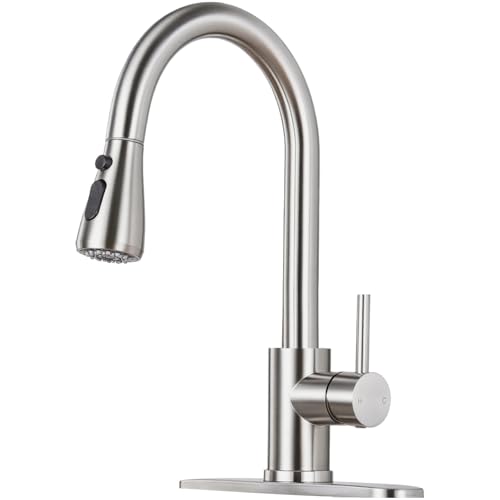
- Lufeidra Kitchen Faucet With Pull-Down Sprayer, Classic Pot Filler Style — Best Classic Design. Ceramic cartridge confirmed in a traditional silhouette.
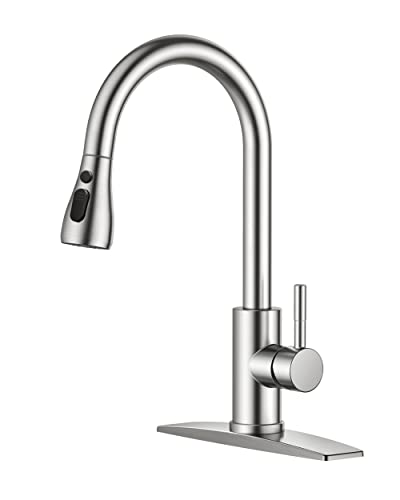
- LUFG Brushed Nickel Kitchen Faucet with Pull Down Sprayer and Deck Plate (prose-only — valve type not stated in its verified listing)
- Moen Adler Pulldown Kitchen Faucet, Spot Resist Stainless, 87233SRS (prose-only — valve type not stated in its verified listing)
- FEELSO Kitchen Faucet with Pull Down Sprayer, Brushed Nickel (prose-only — valve type not stated in its verified listing)
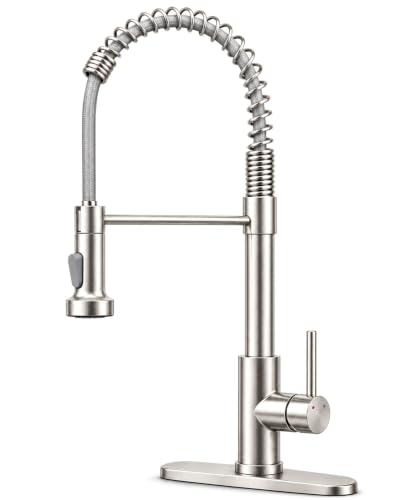
- GIMILI Matte Black Touchless Kitchen Faucet with Spring Pull Down Sprayer (prose-only — valve type not stated in its verified listing)
Read the full guide ↓ for what a ceramic valve does for temperature control and drip resistance, the detailed reviews, and how to care for a cartridge so it outlasts the finish around it.
The Quiet Upgrade Hiding Inside the Best Kitchen Faucets With Ceramic Valves
Ask a plumber what separates a faucet that behaves for a decade from one that starts dripping in year three, and the answer is rarely the brand or the finish. It is the valve. Shoppers searching for the best kitchen faucets with ceramic valves are chasing exactly that insight: inside a ceramic-valve faucet, two polished ceramic disks do the work that rubber washers used to do, and they do it without wearing, swelling, or hardening. The result is a handle that still shuts off cleanly and mixes temperature predictably long after a washer-based faucet would have started its slow drip.
Ceramic valves earned their reputation in single-handle faucets, where one cartridge controls both flow and temperature. Move the handle and the disks’ ports align in different proportions of hot and cold; the mixing is smooth because the disks slide rather than compress. That smoothness is not a luxury detail — it is the daily experience of the faucet, felt every time you wash hands, fill a pot, or nudge the temperature for a child’s cup. A valve that mixes progressively makes the whole kitchen calmer.
This guide verifies before it recommends. Every pick was checked against its Amazon listing data, and only two of the six state a ceramic cartridge outright. Those two are linked and pictured. The remaining four — including a touchless model and a legacy-brand pulldown — are legitimate faucets whose listings stay silent on the valve, so they are reviewed in prose with the caveat stated openly. If you are also reading the deeper technical companion on Best Kitchen Faucets With Ceramic Disk Valves, you will find the same standard there: confirmed means linked, unconfirmed means labeled.
The six designs span the modern range: a touchless set with a soap dispenser, a classic pot-filler style, a certified compact model for smaller sinks, a spot-resistant brand-name pulldown, a farmhouse high-arc, and a matte black touchless spring faucet. Between them they cover most kitchens and most second sinks. What they do not do is all promise the same valve — and learning to shop with that distinction in mind is worth as much as any single pick below.
Key Takeaways
- A ceramic valve controls water with two sliding ceramic disks, giving single-handle faucets smooth temperature mixing and a shut-off that resists dripping as the years pass.
- On this list, the WEWE touchless set and the Lufeidra confirm a ceramic cartridge in their verified listings; the other four picks are prose-only because their listings do not state the valve type.
- Temperature feel is the everyday dividend of a ceramic valve — progressive mixing instead of sudden jumps between hot and cold.
- Cartridges are replaceable units: a ceramic-valve faucet can be renewed inexpensively if you keep the model documentation.
- Sediment protection at install — flushing lines before connection — is the single most valuable habit for any cartridge faucet.
In this guide
Quick Picks
| Pick | Badge | Valve status | Standout trait | Link |
|---|---|---|---|---|
| WEWE Touchless Kitchen Faucet with Soap Dispenser Set | Best Overall | Ceramic cartridge confirmed | Touchless operation, 3-mode sprayer, soap dispenser included | Check on Amazon |
| Lufeidra Kitchen Faucet With Pull-Down Sprayer | Best Classic Design | Ceramic cartridge confirmed | Pot-filler-inspired style, SUS304, fits 1 or 3 hole | Check on Amazon |
| LUFG Brushed Nickel Kitchen Faucet | Best for Compact Sinks | Not stated in listing | NSF372, NSF61, cUPC; 3 spray modes; deck plate included | Prose-only |
| Moen Adler Pulldown, 87233SRS | Best Brand-Name Pick | Not stated in listing | Spot Resist Stainless, deep parts network | Prose-only |
| FEELSO Kitchen Faucet, Brushed Nickel | Best Farmhouse Style | Not stated in listing | Lead-free NSF certified, high arc | Prose-only |
| GIMILI Matte Black Touchless Kitchen Faucet | Best Touchless Design | Not stated in listing | Motion sensor, spring pull-down, matte black | Prose-only |
Note the interesting tension in this table: two faucets here are touchless, but only one of them — the WEWE set — also confirms the ceramic cartridge. Features and fundamentals are separate axes, and this guide ranks the fundamental first. Readers who decide the sensor matters more than the confirmed valve can browse the dedicated Best Kitchen Faucets With Sensors shortlist with eyes open about the trade.
How These Picks Were Chosen
Our method was verification first, comparison second. Each of the six faucets was checked against its Amazon listing data through the Creators API, and we recorded the exact title, brand, and product image for every one. We then read those verified records for the attribute this guide exists to evaluate — an explicit statement of a ceramic cartridge or valve — and sorted the pool accordingly: two confirmed, four unstated.
We want to be transparent that this is a research-led guide. We have not installed these faucets in a test kitchen, and no claim below depends on pretending otherwise. What research can do rigorously is exactly what this keyword demands: distinguish faucets whose ceramic valve is a documented fact from faucets whose valve is a guess. A hands-on review that never opened the faucet up could not tell you more about the valve than the specification does.
After the valve sort, we compared the six on verified attributes: sprayer format and modes, swivel, body material, certifications, hole configuration, bundled extras such as the soap dispenser, and intended setting. Badges were assigned by role — the faucet we would recommend first, the classic-styled option, the compact certified option, the brand-name option, the farmhouse option, and the touchless design option. Price played no ranking role; the guide uses qualitative tiers and sends you to Amazon to check the current figure. We also weighed each faucet against the complaints that dominate faucet ownership — drips, handle stiffness, sprayer problems, spotting — and favored designs with a credible answer to at least one.
The 6 Best Kitchen Faucets With Ceramic Valves, Reviewed
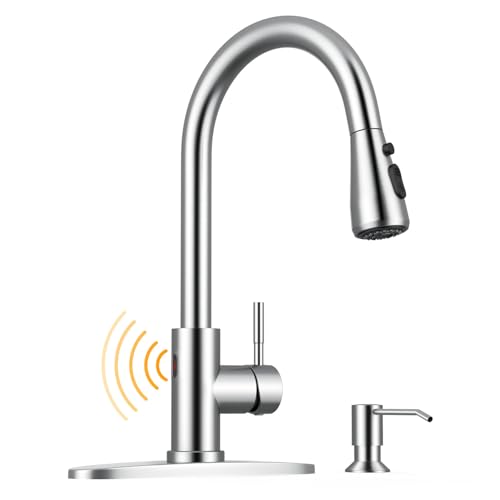
WEWE Touchless Kitchen Faucet with Soap Dispenser Set, Brushed Nickel
Badge: Best Overall
Strengths
- Ceramic cartridge confirmed in the verified listing — and paired, unusually, with touchless sensor operation in the same faucet.
- Three-mode pull-down sprayer, 360° swivel, SUS 304 body, and easy-clean nozzles cover the modern checklist completely.
- The bundled soap dispenser clears the counter and completes a 1- or 3-hole deck in one purchase.
Trade-offs
- Touchless operation adds electronics and a power source to maintain — the price of hands-free convenience.
- A set with a dispenser needs the deck holes to match; confirm your sink’s layout before ordering.
- Sensor faucets reward correct placement; a sensor that faces a busy walkway can trigger when you do not want water.
Spec box (from verified listing data)
- Material: SUS 304 stainless steel
- Cartridge: ceramic
- Operation: touchless sensor, single handle
- Sprayer: pull-down, 3 modes
- Swivel: 360°
- Configuration: 1- or 3-hole fit, soap dispenser included
- Nozzles: easy-clean
This set tops the list because it answers two briefs at once. The ceramic cartridge — confirmed in the verified listing — delivers the smooth mixing and drip-resistant shut-off this guide is about, while the touchless sensor handles the messiest moments in a kitchen: raw chicken on your hands, dough on your fingers, a pot that needs both hands. Sensor operation and a quality mechanical valve are not rivals; the sensor simply decides when the valve opens, and the cartridge still does the mixing and sealing work. That is why a confirmed ceramic cartridge matters even more, not less, in a touchless faucet.
The supporting specifications are complete. A three-mode sprayer handles filling, rinsing, and scouring; the full swivel suits double bowls; easy-clean nozzles answer hard water; and the SUS 304 body is the right material at this tier. The included soap dispenser is a genuine quality-of-life extra — deck-mounted dispensers end the plastic bottle by the sink and refill from above on most designs, and getting one matched to the faucet’s brushed nickel in the same box avoids a finish-matching errand later.
The trade-offs are the honest costs of the category. Electronics need power, whether batteries or an adapter, and a sensor faucet installed carelessly can false-trigger. Neither is a reason to avoid the format; both are reasons to install thoughtfully and keep the manual. If you want the ceramic valve without any electronics, the Lufeidra below is your faucet. If you want both modern layers in one confirmed package, this is the strongest pick on the list, and the natural first stop for readers cross-shopping the Best Kitchen Faucets With Pull Down Sprayer category as well.
Best for: busy cooks who want a confirmed ceramic valve plus hands-free operation and a matched dispenser / Not suited for: buyers who want zero electronics, or decks without a spare hole for the dispenser

Lufeidra Kitchen Faucet With Pull-Down Sprayer, Classic Pot Filler Style
Badge: Best Classic Design
Strengths
- Ceramic cartridge confirmed in the verified listing, in a SUS304 stainless body.
- Classic pot-filler-inspired styling serves traditional kitchens that modern designs clash with.
- Fits 1- or 3-hole decks and is positioned for kitchen, laundry, RV, and bar sinks.
Trade-offs
- No spray-mode count is stated in the verified data — expect a standard pull-down head.
- Purely manual operation; no sensor option in this design.
- Value-brand documentation should be kept for any future cartridge order.
Spec box (from verified listing data)
- Material: SUS304 stainless steel
- Cartridge: ceramic
- Sprayer: pull-down
- Configuration: fits 1- or 3-hole
- Finish: brushed nickel
- Settings named: kitchen, laundry, RV, bar
The Lufeidra is proof that a ceramic valve does not require a futuristic faucet around it. Its verified listing confirms the ceramic cartridge, and wraps it in a design borrowed from classic pot fillers — a look that belongs with inset cabinetry, marble, and traditional hardware. For owners of older kitchens, this combination is rarer than it should be: the market’s ceramic-cartridge models skew contemporary, and this is one of the few confirmed options that will not fight the room.
Practically, it is a versatile fixture. The pull-down sprayer covers the daily work, the 1- or 3-hole compatibility fits most decks, and the listing’s own positioning for laundry, RV, and bar sinks reflects a size and tier that make sense beyond the main kitchen. In a second sink, the ceramic cartridge is a quiet asset: shut-off stays clean even when the faucet sits unused for stretches, and there is no washer quietly taking a set or drying out between uses — a real failure mode for infrequently used fixtures.
Accept its limits and it is easy to recommend. The sprayer is a standard head rather than a multi-mode showcase, and there is no touchless variant. Buyers who want the confirmed valve with maximum sprayer features should look at the WEWE set above; buyers who want the confirmed valve in a faucet that looks at home in a traditional kitchen — or in the RV — should start here.
Best for: traditional kitchens and second sinks needing a confirmed ceramic cartridge without modern styling / Not suited for: buyers wanting multiple spray modes or sensor operation
LUFG Brushed Nickel Kitchen Faucet with Pull Down Sprayer and Deck Plate
Badge: Best for Compact Sinks
Strengths
- Certification depth is excellent for the tier: NSF372, NSF61, and cUPC all appear in the verified listing.
- Three spray modes and a 360° swivel in a SUS 304 body, with the deck plate included in the box.
- Explicitly positioned for RV, laundry, and bar sinks as well as kitchens — honest compact positioning.
Trade-offs
- The verified listing does not state the cartridge type, so the ceramic valve is unconfirmed for this model.
- Compact multi-setting designs are not the tallest option over a deep farmhouse sink.
- Value-brand parts require documentation retention.
Spec box (from verified listing data)
- Material: SUS 304 stainless steel
- Certifications: NSF372, NSF61, cUPC
- Sprayer: pull-down, 3 spray modes
- Swivel: 360°
- Configuration: single handle, deck plate included
- Finish: brushed nickel
Judged purely as a faucet, the LUFG has one of the most complete verified specifications on this list: the right stainless grade, three spray modes, full swivel, a deck plate in the box, and a certification stack that addresses lead content and material safety head-on. For an RV galley or a bar sink — where drinking-water safety and compact competence matter in equal measure — it is a genuinely appealing package.
It is prose-only for one reason, stated plainly: its verified listing does not name the cartridge. In a guide about ceramic valves, that silence is disqualifying for a link, however good the rest of the faucet looks. The remedy is in your hands — a written question to the seller about the cartridge specification — and if the answer confirms ceramic, this faucet’s ranking in your own shortlist should rise sharply. Until then, treat it as an excellent compact faucet with an unverified valve. Readers fitting out small sinks may also find the reach-focused Best Kitchen Faucets With Pull Out Wand guide useful, since compact decks often pair with pull-out formats.
Best for: RV, bar, and laundry sinks where certifications lead and the buyer will verify the cartridge with the seller / Not suited for: buyers who need the ceramic valve confirmed in the listing itself
Prose-only pick: no Amazon link or image, because the verified listing does not confirm a ceramic cartridge.
Moen Adler Pulldown Kitchen Faucet, Spot Resist Stainless, 87233SRS
Badge: Best Brand-Name Pick
Strengths
- Moen’s North American parts and support network is the deepest on this list.
- Spot Resist Stainless finish actively resists fingerprints and water spots.
- A mainstream pulldown format that any plumber knows and any hardware store supports.
Trade-offs
- The verified listing data does not state the cartridge type — ceramic status unconfirmed here.
- Sits at a higher qualitative tier than the value brands on this list.
- No bundled extras such as a dispenser in this pick.
Spec box (from verified listing data)
- Brand line: Moen Adler, model 87233SRS
- Type: pulldown kitchen faucet
- Finish: Spot Resist Stainless
The Adler represents the establishment path: buy the brand whose cartridges sit in bins at the hardware store, whose finish is engineered to look clean between wipe-downs, and whose model numbers any plumber recognizes. For a household that values serviceability above specification hunting, that is a rational first principle, and the Spot Resist finish delivers a daily cosmetic benefit that owners genuinely notice.
Within this guide’s rules, though, the Adler’s verified listing does not state its cartridge, so it is reviewed in prose. The most likely place to settle the question is Moen’s own documentation for model 87233SRS, which is more detailed than any marketplace title. We would encourage exactly that check: if the manufacturer’s sheet confirms a ceramic cartridge, the Adler becomes arguably the safest long-term buy on this page; if it does not, you have learned something worth knowing before money moved. Either way, the verification habit is the point of this guide.
Best for: buyers who prioritize brand support and finish technology, and will confirm the valve in the manufacturer’s documentation / Not suited for: buyers who want ceramic confirmed at the point of sale without further checking
Prose-only pick: no Amazon link or image, because the verified listing does not confirm a ceramic cartridge.
FEELSO Kitchen Faucet with Pull Down Sprayer, Brushed Nickel
Badge: Best Farmhouse Style
Strengths
- Lead-free, NSF certified stainless construction per the verified listing.
- High-arc profile gives farmhouse and apron-front sinks the pot clearance they need.
- Single handle with 1 or 3 hole flexibility across kitchen, laundry, RV, and bar settings.
Trade-offs
- Cartridge type not stated in the verified listing — ceramic unconfirmed.
- Spray modes and swivel range are not enumerated in the verified data.
- High arcs splash in shallow sinks.
Spec box (from verified listing data)
- Material: stainless steel, lead-free
- Certification: NSF certified
- Sprayer: pull-down
- Arc: high arc
- Configuration: single handle, 1 or 3 hole
- Finish: brushed nickel
The FEELSO is the farmhouse entry: a tall arc over the sink, brushed nickel against an apron front, and certified lead-free construction. As a style-and-materials proposition for a country-style kitchen or a working laundry room, it is coherent, and its 1-or-3-hole flexibility means it fits the decks those rooms usually have.
Its prose-only status follows the list-wide rule — no cartridge statement in the verified data, no link. We note, though, that the FEELSO illustrates why sellers should state their valves: a faucet with this one’s certified construction may well contain a ceramic cartridge, and the listing simply never claims the credit. A short seller inquiry is the bridge. If the answer is yes, farmhouse buyers gain a third confirmed option; if the answer never comes, the two confirmed picks above remain the safe route.
Best for: farmhouse kitchens wanting certified lead-free construction and a tall arc, with a seller check on the valve / Not suited for: shallow sinks, or buyers unwilling to verify the cartridge themselves
Prose-only pick: no Amazon link or image, because the verified listing does not confirm a ceramic cartridge.
GIMILI Matte Black Touchless Kitchen Faucet with Spring Pull Down Sprayer
Badge: Best Touchless Design
Strengths
- Motion-sensor, hands-free operation in a dramatic matte black spring design — the visual standout of the six.
- Single-hole installation and a modern farmhouse profile suit statement kitchens.
- Spring format gives the sprayer exceptional freedom around the sink.
Trade-offs
- The verified listing does not state the cartridge type — ceramic unconfirmed, despite the modern specification elsewhere.
- Sensor electronics add power and placement considerations.
- Matte black shows mineral deposits more visibly in hard-water homes and needs wiping.
Spec box (from verified listing data)
- Operation: motion sensor activated, hands-free, single handle
- Sprayer: spring pull-down
- Configuration: single hole installation
- Finish: matte black
- Style: modern farmhouse
The GIMILI is the faucet visitors will ask about. Matte black, an exposed spring, and wave-on sensor operation make it the design statement of this list, and for cooks who handle raw meat and dough daily, the hands-free case is real. It earns its badge honestly — as the best touchless design here.
But this is a ceramic-valve guide, and the GIMILI’s verified listing — for all its detail about sensors and springs — never mentions the cartridge. It therefore closes the list as a prose-only pick, and as the clearest illustration of the guide’s central lesson: a faucet can be advanced in every visible way and still leave its most important internal specification unstated. If you love this design, ask the seller the cartridge question in writing. If the answer confirms ceramic, you may have found your faucet; if not, the WEWE set above delivers touchless operation with the valve already confirmed. Buyers leaning toward touchless generally can compare the wider Best Kitchen Faucets With Sensor field before deciding which axis — sensor or valve — leads their purchase.
Best for: design-led buyers who want sensor operation and a spring silhouette, and will verify the valve / Not suited for: buyers who need ceramic confirmed in the listing, or hard-water homes that dislike wiping matte finishes
Prose-only pick: no Amazon link or image, because the verified listing does not confirm a ceramic cartridge.
Comparison Table
| Faucet | Badge | Ceramic cartridge | Operation | Sprayer | Link |
|---|---|---|---|---|---|
| WEWE Touchless Set | Best Overall | Confirmed | Touchless + handle | Pull-down, 3 modes | Check on Amazon |
| Lufeidra | Best Classic Design | Confirmed | Single handle | Pull-down | Check on Amazon |
| LUFG | Best for Compact Sinks | Not stated | Single handle | Pull-down, 3 modes | Prose-only |
| Moen Adler 87233SRS | Best Brand-Name Pick | Not stated | Single handle | Pulldown | Prose-only |
| FEELSO | Best Farmhouse Style | Not stated | Single handle | Pull-down | Prose-only |
| GIMILI Touchless | Best Touchless Design | Not stated | Motion sensor | Spring pull-down | Prose-only |
How to Choose a Kitchen Faucet With a Ceramic Valve
Begin with the verification ladder. A ceramic valve should be a documented fact, not a vibe: strongest is the manufacturer’s specification for the exact model; next, a listing that states the ceramic cartridge in its own text; next, a written seller answer. Anything below that is a hope. This list was built by that ladder, which is why two faucets carry links and four carry labels. Adopt the same ladder for any faucet you consider beyond this page, including models in adjacent categories such as Best Kitchen Faucets With Separate Sprayer designs, where traditional two-handle and side-sprayer formats have their own valve questions.
Second, decide how you feel about electronics, because it splits this list cleanly. A ceramic cartridge is a purely mechanical device with no power needs and nothing to reboot. Touchless faucets add a sensor and a solenoid on top of a cartridge — the cartridge still does the sealing — in exchange for hands-free convenience. Neither choice is wrong; they are different maintenance profiles. Households that keep faucets for fifteen years often prefer the mechanical purity; households that cook messily every day often prefer the sensor and accept battery changes.
Third, fit the faucet to the deck and the sink. Count holes, including the one a soap dispenser would take. Check arc height against shelves and sills, and sprayer style against sink depth — spring and high-arc designs want deep bowls. For double sinks, prioritize swivel; for single deep sinks, prioritize sprayer reach and modes. In RVs, confirm the faucet’s scale and the cabinet space beneath for hoses and, on sensor models, the power pack.
Fourth, read materials and certifications as health specifications. SUS 304 stainless, lead-free construction, and recognized listings — NSF/ANSI 61 and 372, cUPC — describe what touches drinking water. Finally, think in decades: keep the model number, the manual, and the order record. A ceramic cartridge is replaceable as a unit, and the difference between an easy replacement and an archaeological dig is whether past-you saved the paperwork.
How to Install a Ceramic-Valve Faucet and Care for Its Cartridge
Installation mirrors any single-handle faucet, with cartridge care woven in. Shut off both supplies, drain the old faucet, remove it, and clean the deck. Before connecting anything new, flush each supply stop into a bucket — the sediment and solder debris shaken loose by plumbing work is the leading cause of early cartridge damage, and ceramic disks, for all their hardness, can be scored by a trapped fragment. Connect the new supplies, hang the sprayer hose weight where the instructions mark it, and open the stops slowly.
Run the faucet and flush it with the aerator removed for the first minute, then refit the aerator. Check the handle’s feel: ceramic valves move smoothly and shut off completely, with temperature blending progressively through the arc. Cycle the sprayer modes and confirm docking. On a touchless model, position the sensor and power source per the manual, then test that normal movement around the sink does not false-trigger it.
Cartridge care afterward is mostly prevention. Keep the aerator in place — it is the final sediment screen. If your home has well water or visible sediment, a whole-house or point-of-use sediment filter upstream is the kindest thing you can do for every valve in the building. Wipe spray faces and clear easy-clean nozzles as flow changes, rather than on a fixed schedule.
Troubleshooting, problem first. Problem: the handle feels gritty after plumbing work elsewhere in the house → sediment reached the cartridge; flush the lines and the cartridge per the manufacturer’s guidance before concluding anything is damaged. Problem: a slow drip develops at the spout → shut off the supplies and inspect or replace the cartridge; on a documented model this is a modest, well-defined job. Problem: the sensor stops responding → check the power source first, then the sensor window for film or obstruction, before suspecting the valve. Problem: temperature mixing feels abrupt → the cartridge may be scaled in a hard-water home; a manufacturer-approved descale or a cartridge swap restores progressive mixing.
How Ceramic Valves Change Temperature Control
The least discussed benefit of a ceramic valve is not longevity — it is the quality of temperature control. In a single-handle faucet, one mechanism proportions hot and cold. Washer and compression designs proportion by squeezing, which makes the middle of the handle’s travel vague: small movements produce sudden swings, and the warm zone you want for handwashing or a baby’s bottle is a narrow, touchy target. Ceramic disks proportion by sliding ports across each other, so the blend changes progressively and repeatably — the handle position that gave you warm yesterday gives you warm today.
This matters in more kitchens than admit it. Anyone who has scalded a wrist testing water, or run a sink for a minute hunting for the temperature a child can use, has felt a poor valve. It also matters for consistency tasks — proofing, rinsing delicate produce, filling a water bath. When you read that a faucet has a ceramic cartridge, translate it as: the mixing will feel deliberate. That is a large part of what the confirmed picks on this list are selling, underneath the sprayers and finishes.
Reading a Faucet Listing Like an Inspector
This guide’s split between linked and prose-only picks came from reading listings the way an inspector reads them, and the skill transfers to every faucet you will ever shop for. Read for what is stated, in this order: body material and grade; certifications with their numbers; cartridge or valve type; sprayer modes and hose details; hole configuration and what is in the box. Then read for what is missing. A listing that specifies its stainless grade and certifications but never mentions the valve has told you where its maker’s confidence ends — or at least where its copywriter stopped. Neither proves the valve is poor; both prove it is unverified.
Apply the same discipline to photography and bundles. A soap dispenser in the set, a deck plate in the box, braided supply hoses — these are concrete, checkable inclusions. Vague adjectives are not. And keep the exact model number from any listing you buy; it is the key that unlocks spec sheets, parts diagrams, and cartridge replacements for the life of the faucet.
Ceramic Valves in Second Sinks, Rentals, and Rarely Used Faucets
One underappreciated strength of the ceramic valve shows up away from the main sink. Faucets that sit unused — in a bar sink, an RV, a guest suite, a rental between tenants — are hard on washer-based valves, because rubber components dry, take a set against their seats, and then tear or leak when service resumes. Ceramic disks have nothing to dry out. They sit in whatever position they were left in, inert, and seal on the first use months later exactly as they did on the last. For second sinks, that idle tolerance is a genuine functional advantage, and it is one reason two of this list’s confirmed and certified picks are explicitly positioned for RV, laundry, and bar duty.
Landlords read the same physics from the other side: a faucet whose valve tolerates vacancy and hard use, and whose cartridge can be swapped as a unit when it finally needs attention, is a faucet that generates fewer emergency calls. The documentation habit matters doubly in a rental — the model number recorded in the property file turns a future drip into a scheduled, inexpensive cartridge swap instead of a full faucet replacement chosen in a hurry. None of this requires the most expensive faucet on the list; it requires a confirmed valve and a saved piece of paper.
When a Cartridge Swap Beats a New Faucet
Because ceramic-valve faucets deliver their valve as a replaceable cartridge, they change the economics of a drip. With an older compression faucet, a persistent drip often starts a conversation about replacing the whole fixture, because seats corrode and parts assortments confuse. With a cartridge faucet, the first conversation is narrower: shut off the water, pull the cartridge, and either clean it — debris is the usual culprit — or replace it as a unit. The body, finish, sprayer, and hoses all stay in place.
Knowing this should shape the original purchase. A faucet with a confirmed, identifiable cartridge is a faucet with a future repair path; a faucet with an unstated valve is a question mark you will meet again at the worst moment. This is the practical, non-romantic reason this guide is strict about verification. The two linked picks are not merely faucets we believe have ceramic cartridges — they are faucets whose cartridge identity is documented from the day you buy them, which is what makes the swap easy in year nine. Keep the model number, keep the manual, and a ceramic-valve faucet becomes one of the few kitchen fixtures that can be renewed rather than replaced.
Ceramic Valves and Household Water Pressure
Water pressure is the silent variable in faucet satisfaction, and ceramic valves interact with it in ways worth knowing before you buy. At typical residential pressures, a ceramic disk cartridge delivers its rated flow with the handle well short of full travel, which is why these faucets feel effortless: you are rarely asking the valve for everything it has. In high-pressure homes, that same efficiency means the first part of the handle’s arc does most of the work, and the progressive sliding of the disks becomes a real control advantage — small movements meter the flow finely instead of unleashing it.
At the other extreme, low-pressure homes — upper floors, long runs, some well systems — should pay attention to the faucet around the valve. A restrictive aerator or a spray head with many fine nozzles will cost more perceived flow than the cartridge will. The practical moves are to keep the aerator clean, since a scaled aerator on a low-pressure line is a double penalty, and to favor spray heads whose modes include a simple, open stream for filling. Pressure also explains a classic misdiagnosis: a faucet blamed for weak flow after a municipal repair is usually a faucet whose aerator caught the sediment the repair shook loose. Clean the screen before you judge the valve — the ceramic disks, sealed face-to-face, are the component least likely to be involved.
Ceramic Valves in High-Use Kitchens
Volume is the other stress test, distinct from hard water and idleness alike. A faucet in a busy family kitchen, a shared house, or a small café-style setup may cycle hundreds of times a day, and cycling is what wears valves: every open and close is a pass of the sealing surfaces across each other. This is the duty cycle ceramic disks were born for. Their hardness means the surfaces do not measurably wear against each other, and their flatness means sealing does not depend on any material being squeezed into compliance — the mechanism that fatigues first in washer and many cartridge designs under heavy use.
High use also rearranges the rest of the buying decision. The sprayer hose and dock, cycled as often as the valve, become co-equal wear items, so a high-use buyer should weight hose quality, dock design, and head replaceability alongside the cartridge. Handles take constant handling, which argues for finishes that hide contact — brushed and spot-resistant surfaces — and for keeping a soft cloth at the sink as a household habit rather than a cleaning event. None of this changes the shortlist’s order, but it changes the emphasis within each review: in a high-use home, the confirmed-ceramic WEWE set’s combination of a documented valve, easy-clean nozzles, and full swivel is not a luxury stack; it is the specification of a faucet that expects to be used hard and to keep its manners.
Common Buying Mistakes
- Treating “modern” as a synonym for “ceramic.” Touchless, spring, and matte black designs can hide any valve type. This list contains a sensor faucet with a confirmed ceramic cartridge and one without a stated valve at all.
- Skipping the line flush. Install debris is the top preventable cause of cartridge damage. Two minutes with a bucket protects a decade of service.
- Forgetting the dispenser’s hole. A faucet-plus-dispenser set needs deck holes to match. Count before you fall in love with the bundle.
- Judging by finish alone. Finishes are replaceable impressions; the valve is the faucet’s working life. Rank specifications above shine.
- Discarding documentation. Cartridge replacement is easy with a model number and miserable without one.
- Ignoring sensor placement. On touchless models, a badly aimed sensor turns a convenience into a nuisance. Plan the install, not just the purchase.
Final Recommendation
Start with the WEWE Touchless Kitchen Faucet with Soap Dispenser Set if you want the most complete answer on this page: a confirmed ceramic cartridge, touchless operation, three spray modes, and the dispenser included. Choose the Lufeidra if you want the same confirmed valve with no electronics and a classic look. The prose-only four each have a real case — the LUFG’s certifications, the Moen Adler’s support network, the FEELSO’s farmhouse fit, the GIMILI’s design — but make the seller or the manufacturer’s spec sheet confirm the cartridge before you count any of them as a ceramic-valve purchase.
Frequently Asked Questions
What does a ceramic valve do in a kitchen faucet?
It controls the flow and the hot-cold mix. Two ceramic disks with ports slide across each other inside a cartridge; aligning the ports admits water in the proportion the handle position sets, and sliding them apart seals the flow. The hardness and flatness of the disks are what make the seal durable and the mixing smooth.
Is a ceramic cartridge the same as a ceramic disk valve?
Effectively yes, in modern single-handle faucets. “Cartridge” describes the replaceable unit; “ceramic disk” describes the valve mechanism inside it. A listing that says “ceramic cartridge” is telling you the cartridge’s valve is a ceramic disk design.
Why do some listings not mention the valve at all?
Because marketplace listings emphasize what photographs well — finish, sprayer, silhouette. Valve specifications often live only in the manufacturer’s documentation. Silence in a listing does not prove a poor valve, but it does mean the valve is unverified, which is why this guide reviews such faucets in prose without links.
How long should a ceramic valve last?
A ceramic cartridge is generally the longest-lived part of the faucet, and it is designed to be replaced as a unit if it ever does wear or suffer debris damage. Lifespan in practice depends on water quality, sediment protection, and installation care far more than on the calendar.
Do ceramic valves work with touchless faucets?
Yes. In a touchless faucet, the sensor and solenoid decide when water flows, but a cartridge still mixes and seals. The WEWE set on this list pairs a sensor with a confirmed ceramic cartridge; the GIMILI pairs a sensor with an unstated valve, which is why one is linked and the other is not.
What maintenance does a ceramic valve need?
Very little directly: keep the aerator fitted as a sediment screen, flush lines after plumbing work, and address gritty handle feel promptly with a flush. Most other maintenance — nozzle cleaning, aerator soaking — serves the sprayer and flow, not the valve itself.