Disclosure: topratedkitchenware.com is reader-supported. When you buy through links on our site, we may earn an affiliate commission from Amazon and other retailers, at no extra cost to you.
Where to buy
Every faucet in this guide to the best kitchen faucets with no problems was verified against its Amazon listing data, and each name links to its product page so you can check the latest price on Amazon for the exact model. The six were chosen for one quality above all — a design that answers the problems faucet owners actually report — and the badges tell you which problem each one answers best.
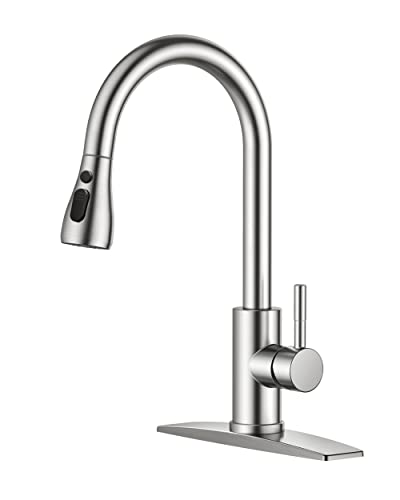
- Lufeidra Kitchen Faucet With Pull-Down Sprayer, Classic Pot Filler Style — Best Overall. Ceramic cartridge, SUS304 body, fits almost any deck.
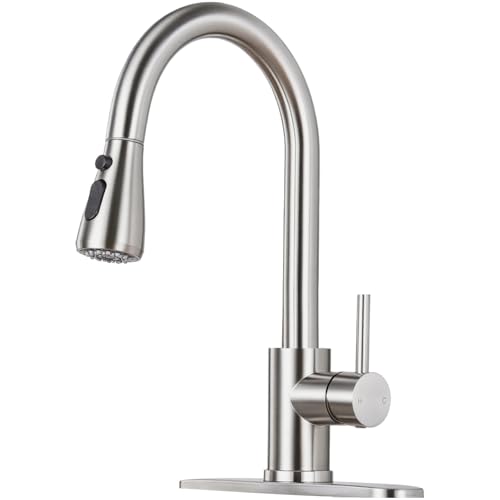
- VFAUOSIT Kitchen Faucet with Pull Down Sprayer — Best Fast Install. Certified lead-free, tool-free install design, cold-start safety.
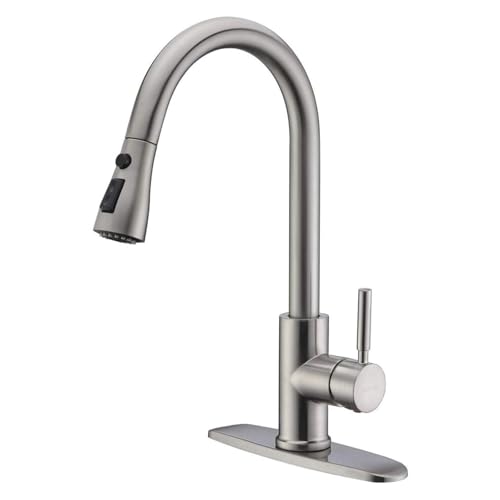
- WEWE High-Arc Pull-Down Kitchen Faucet, Brushed Nickel — Best Easy-Clean. Rub-clean silicone nozzles, 20-inch pull-down reach, ceramic cartridge.
- FEELSO Kitchen Faucet with Pull Down Sprayer, Brushed Nickel — Best Farmhouse Workhorse. Lead-free NSF certified, high arc, simple single-handle design.
- WEWE Touchless Kitchen Faucet with Soap Dispenser Set — Best Touchless. Sensor operation over a ceramic cartridge, dispenser included.
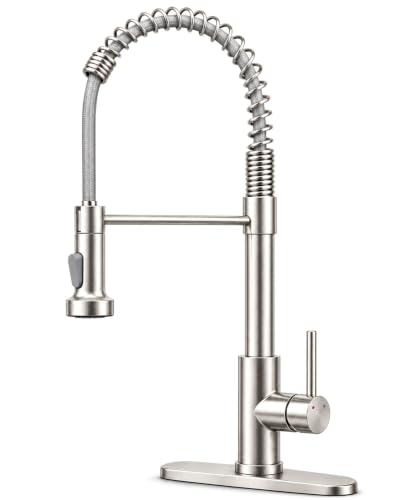
- GIMILI Matte Black Touchless Kitchen Faucet with Spring Pull Down Sprayer — Best Modern Design. Motion sensor, spring format, single-hole install.
Read the full guide ↓ for the failure-mode analysis behind each pick, the maintenance habits that prevent the classic problems, and a troubleshooting map for the ones that appear anyway.
Best Kitchen Faucets With No Problems: What “No Problems” Actually Means
Nobody searches for the best kitchen faucets with no problems because their current faucet is fine. The search comes from experience — a drip that kept a household awake, a handle that loosened, a sprayer hose that stopped retracting, a finish that spotted within a month, a leak discovered only when the cabinet floor warped. “No problems” is shorthand for a specific hope: a faucet whose design has already answered the failures you have personally met. This guide takes that hope literally and organizes every pick by the problem it is built to avoid.
It helps to name the actual problem list, because it is shorter than marketing suggests. Faucet trouble concentrates in five places: the valve (drips, stiff handles, temperature that will not hold), the sprayer system (hoses that kink or stop retracting, heads that stop docking, nozzles that clog), the connections (slow leaks at supply lines and deck seals), the finish (spots, corrosion, flaking), and the installation itself (faucets that rock, loosen, or were never sealed properly). A faucet earns a place here by having a credible design answer to several of those — a ceramic cartridge where drips begin, rub-clean nozzles where flow dies, certified materials where water sits, a tool-free mounting system where looseness starts.
Honesty requires one qualification up front: no faucet is literally problem-proof, and any guide that promises zero trouble forever is selling something. What good design does is move the odds and change the failure style — from sudden and damaging to slow and obvious, from a plumber’s emergency visit to a cartridge you swap yourself. The six faucets below were verified against their Amazon listings and compared on exactly those terms. Several carry ceramic cartridges, the single most effective anti-drip technology in the category; all are single-handle pull-down designs from the modern mainstream; and each has at least one specification that reads like a direct reply to a common complaint. Readers who want to dig into the valve question specifically will find the dedicated Best Kitchen Faucets With Ceramic Valves guide useful alongside this one.
The reviews that follow are organized as problem-and-answer. For each faucet we state its strengths, its trade-offs — because every design trades something — and the household it suits. Then the guide widens: how to choose for reliability, the installation and maintenance habits that prevent most problems outright, and a troubleshooting section for the day something still goes wrong.
Key Takeaways
- Faucet problems cluster in five places — valve, sprayer system, connections, finish, and installation — and reliable faucets are the ones designed against those specific failures.
- A ceramic cartridge is the strongest single anti-drip feature; three picks here state one in their verified listings (Lufeidra, both WEWE models).
- Certified lead-free construction (NSF 61/372, cUPC where stated) and SUS 304 stainless bodies address the slow, invisible problems rather than the cosmetic ones.
- Most “faucet problems” are actually installation problems: line flushing, correct hose-weight placement, and dry-towel leak checks at install prevent the majority.
- Touchless models remove handle wear and messy-hand contact, but add power and sensor care to the ownership list — a trade, not a pure win.
In this guide
Quick Picks
| Pick | Badge | Problem it best answers | Standout trait | Link |
|---|---|---|---|---|
| Lufeidra Kitchen Faucet With Pull-Down Sprayer | Best Overall | Drips and idle-sink seal failure | Ceramic cartridge, SUS304, 1 or 3 hole | Check on Amazon |
| VFAUOSIT Kitchen Faucet with Pull Down Sprayer | Best Fast Install | Bad installs and scald risk | Tool-free install design, cold-start safety, 23in hose | Check on Amazon |
| WEWE High-Arc Pull-Down Kitchen Faucet | Best Easy-Clean | Clogged, liming spray faces | Rub-clean silicone nozzles, 20-inch reach, ceramic cartridge | Check on Amazon |
| FEELSO Kitchen Faucet, Brushed Nickel | Best Farmhouse Workhorse | Complexity itself | Lead-free NSF certified, high arc, simple format | Check on Amazon |
| WEWE Touchless Faucet with Soap Dispenser Set | Best Touchless | Handle wear and messy-hand contact | Sensor over ceramic cartridge, dispenser included | Check on Amazon |
| GIMILI Matte Black Touchless Faucet | Best Modern Design | Contact and reach | Motion sensor, spring pull-down, single hole | Check on Amazon |
The pattern to notice: reliability here is not one feature but a stack — valve, materials, nozzles, mounting — and each pick leads on a different layer of the stack. If your last faucet failed at the sprayer, weight the easy-clean and hose specifications; if it failed at the valve, start with the ceramic picks. Shoppers whose failure was a sprayer that never reached far enough may also want the reach-focused Best Kitchen Faucets With Pull Down Sprayer comparison.
How These Picks Were Chosen
This is a research-led guide built on verified listing data, not a hands-on lab test, and we say so plainly because the keyword invites overclaiming. We verified all six faucets against their Amazon listings through the Creators API — exact titles, brands, and images — and then evaluated each design against a failure-mode checklist drawn from the problems faucet owners actually report: spout drips, handle-base leaks, cartridge stiffness, sprayer retraction and docking failures, nozzle clogging, finish spotting and corrosion, loose mounting, and supply-line leaks.
A pick had to show, in its verified specifications, a design answer to at least two checklist items. Ceramic cartridges counted as an answer to drips and stiffness. Rub-clean silicone nozzles counted against clogging. NSF and cUPC certifications counted toward material safety and corrosion behavior. Tool-free mounting systems counted against looseness and install error. Sensor operation counted against handle wear and contact mess, with its own new maintenance items noted as trade-offs rather than ignored.
We deliberately did not rank by feature count or by price. Feature-stuffed faucets can be problem-prone faucets, and price is a weak proxy for reliability in this category; the guide uses qualitative tiers and asks you to check the current figure on Amazon. We also weighted intended setting: several of these faucets are explicitly positioned for RV, bar, and laundry sinks as well as kitchens, and a faucet that behaves in a occasionally-used RV sink — where a drip can run unnoticed — has passed a different reliability test than one babied in a main kitchen. The badges reflect those roles.
The 6 Best Kitchen Faucets With No Problems, Reviewed

Lufeidra Kitchen Faucet With Pull-Down Sprayer, Classic Pot Filler Style
Badge: Best Overall
Strengths
- Ceramic cartridge confirmed in the verified listing — the strongest anti-drip specification a faucet can carry.
- SUS304 stainless body resists the corrosion that becomes pinhole leaks in lesser materials.
- Fits 1- or 3-hole decks and suits kitchen, laundry, RV, and bar sinks, so it behaves in idle second sinks too.
Trade-offs
- The verified data does not enumerate spray modes — expect a standard pull-down head, not a multi-mode showcase.
- Classic styling will not suit a minimalist kitchen.
- Value-brand parts mean keeping documentation for future cartridge orders.
Spec box (from verified listing data)
- Material: SUS304 stainless steel
- Cartridge: ceramic
- Sprayer: pull-down
- Configuration: fits 1- or 3-hole
- Finish: brushed nickel
- Settings named: kitchen, laundry, RV, bar
The Lufeidra leads this list because it answers the most common faucet problem at its source. Drips begin at the valve, and a ceramic cartridge — two hardened disks sealing face-to-face, with nothing rubber to harden or take a set — is the design least likely to start one. Add a SUS304 body, which shrugs off the internal corrosion that eventually pits lesser metals, and you have a faucet whose two most failure-prone layers are both specified correctly.
Its second reliability virtue is behavioral: ceramic disks tolerate idleness. In an RV, laundry, or bar sink — settings the listing names outright — a faucet may sit for weeks between uses. Washer seals dry and stick in those gaps; ceramic does nothing of the kind, and the faucet seals on its first use after a month away exactly as it did before. For second sinks, where a slow drip can also run longest before anyone notices, that combination of drip resistance and idle tolerance is precisely the “no problems” profile.
The honest limitation is sprayer modesty and brand ecosystem. The verified listing does not promise multiple spray modes, and Lufeidra’s parts network is a keep-your-paperwork affair rather than a hardware-store bin. Neither undermines the core case: if your last faucet died by dripping, this is the pick engineered against your exact history.
Best for: drip-plagued households and second sinks that sit idle between uses / Not suited for: buyers who want multiple spray modes or a legacy-brand parts bin

VFAUOSIT Kitchen Faucet with Pull Down Sprayer, Modern Bar Sink Faucet
Badge: Best Fast Install
Strengths
- Tool-free install design (the listing cites a 10-minute install) attacks the root of most faucet problems: installation error.
- Lead-free with NSF 61/372 and cUPC listings — material safety documented, not implied.
- Cold-start safety defaults the handle to cold, preventing accidental hot-water surprises; the 23-inch retractable hose is the longest reach here.
Trade-offs
- Positioned as a bar sink faucet — check its scale against a large main-kitchen sink before choosing it as your primary.
- The verified title does not state the cartridge type.
- Three spray modes add a mode-selector that simpler heads do not have to maintain.
Spec box (from verified listing data)
- Certifications: lead-free NSF 61/372, cUPC
- Sprayer: pull-down, 3 spray modes
- Hose: 23in retractable
- Safety: cold-start handle design
- Install: tool-free design
- Setting named: bar sink, modern kitchens
Ask plumbers what causes faucet callbacks and a surprising share of answers are not about the faucet at all — they are about the install: mounting nuts never fully tightened in an awkward cabinet, supply lines cross-threaded, debris left in the lines, hose weights hung in the wrong place. The VFAUOSIT is designed directly at that failure class. A tool-free mounting system removes the worst under-sink wrench work, which is where looseness and slow leaks are born, and its quick-install positioning makes a careful DIY job realistic for a first-timer.
Its other specifications continue the theme. Cold-start safety — the handle’s default position delivers cold water — prevents the scald-and-surprise problem that standard handles create, a thoughtful touch in homes with children or elderly users. The 23-inch retractable hose is the longest stated on this list, reducing the yank-and-strain that wears hoses out. And its lead-free certifications are stated with their standard numbers, which is how material claims should look.
Size is the caveat. The listing positions it as a bar sink faucet, and while plenty of owners use such models happily at compact main sinks, a large double-bowl farmhouse setup may want a physically bigger fixture. Match it to a small or medium sink and its install-first design makes it one of the lowest-risk buys here.
Best for: DIY installers, bar and compact sinks, and homes that value scald prevention / Not suited for: very large main sinks, or buyers who need the cartridge type stated
WEWE High-Arc Pull-Down Kitchen Faucet, Brushed Nickel, 3-Mode Sprayer
Badge: Best Easy-Clean
Strengths
- Soft silicone nozzles you rub clean with a fingertip — the direct answer to the most common faucet complaint of all, a clogging spray face.
- Ceramic cartridge confirmed in the verified listing, covering the drip problem at the same time.
- 20-inch pull-down reach, 360° swivel, SUS 304 body, and 1- or 3-hole fit make the whole package low-maintenance.
Trade-offs
- High-arc profile needs vertical clearance and can splash in shallow sinks.
- Brushed nickel is the finish in this configuration.
- Three modes mean a selector to keep clear of mineral film in hard-water homes.
Spec box (from verified listing data)
- Material: SUS 304 stainless steel
- Cartridge: ceramic
- Sprayer: pull-down, 3 modes, 20-inch reach
- Nozzles: soft silicone, rub-clean
- Swivel: 360°
- Configuration: 1- or 3-hole fit
Flow problems outnumber drip problems in real kitchens. The spray that starts fanning sideways, the stream that weakens month by month — that is mineral scale strangling the spray face, and on a conventional head the fix is a vinegar soak and a pin. The WEWE’s answer is disarmingly simple: soft silicone nozzles that shed scale when you rub them with a thumb. Maintenance measured in seconds, done while the kettle boils, is maintenance that actually happens — and a faucet whose upkeep happens is a faucet that stays problem-free in practice, not just in specification.
Underneath that convenience sits the same serious foundation as our top pick: a confirmed ceramic cartridge in a SUS 304 body. The 20-inch pull-down reach and full swivel make it a genuine main-kitchen tool, able to rinse a sheet pan’s far corner or swing between double bowls, and the three spray modes cover filling, rinsing, and scouring without drama. It is the most completely low-maintenance specification on this list, aimed at the two problems — clogging and dripping — that generate the most owner frustration between them. Readers comparing sprayer-first options will find it again in the Best Kitchen Faucets With Pull Out Wand guide, where reach is the ranking axis.
Best for: hard-water homes and busy main kitchens that want upkeep measured in seconds / Not suited for: shallow sinks under low cabinets, where the high arc splashes or will not fit
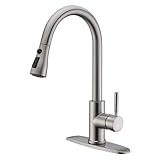

FEELSO Kitchen Faucet with Pull Down Sprayer, Brushed Nickel
Badge: Best Farmhouse Workhorse
Strengths
- Lead-free and NSF certified stainless construction per the verified listing.
- A deliberately simple format — single handle, pull-down sprayer, high arc — with fewer features to fail.
- 1 or 3 hole flexibility across kitchen, farmhouse, laundry, RV, and bar settings.
Trade-offs
- The verified listing does not state the cartridge type or enumerate spray modes.
- No sensor, no dispenser, no extras — simplicity is the whole proposition.
- High arc splashes in shallow basins.
Spec box (from verified listing data)
- Material: stainless steel, lead-free
- Certification: NSF certified
- Sprayer: pull-down
- Arc: high arc
- Configuration: single handle, 1 or 3 hole
- Finish: brushed nickel
There is a reliability philosophy that says the most dependable machine is the one with the fewest things in it, and the FEELSO is that philosophy in faucet form. One handle, one pull-down sprayer, a tall arc, certified lead-free stainless — and a feature list that stops there. Nothing on it needs power, nothing on it needs an app, and the list of things that can go wrong is correspondingly short. For a farmhouse kitchen or a laundry sink that gets used hard and maintained lightly, that restraint is a feature.
The trade is transparency as much as features: the verified listing does not state the cartridge type or the spray modes, so a buyer whose specific trauma was a dripping valve should either ask the seller or choose one of the confirmed-ceramic picks above. What the listing does certify — lead-free, NSF — addresses the invisible problem class, the water itself, which is a sensible priority for a fixture that will also serve RV and bar duty where water systems vary.
Best for: farmhouse and utility sinks that reward simplicity and certified materials / Not suited for: buyers who want the valve type and spray modes spelled out before purchase
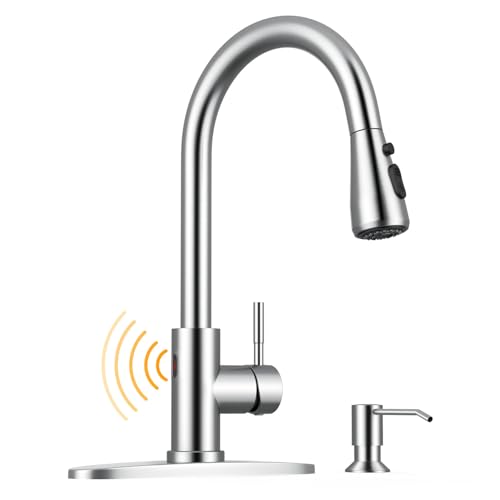
WEWE Touchless Kitchen Faucet with Soap Dispenser Set, Brushed Nickel
Badge: Best Touchless
Strengths
- Touchless operation removes the handle-grabbing that grinds grit into finishes and wears mechanisms — and keeps raw-food hands off the fixture entirely.
- Ceramic cartridge confirmed underneath the sensor, so the anti-drip foundation is documented.
- Three-mode sprayer, 360° swivel, easy-clean nozzles, and a soap dispenser in the set complete a low-fuss package.
Trade-offs
- The sensor system needs power and correct placement; electronics are a new maintenance category.
- The dispenser needs a deck hole and periodic refilling.
- More capable means more components — the opposite philosophy from the FEELSO above.
Spec box (from verified listing data)
- Material: SUS 304 stainless steel
- Cartridge: ceramic
- Operation: touchless sensor, single handle
- Sprayer: pull-down, 3 modes
- Swivel: 360°
- Configuration: 1- or 3-hole fit, soap dispenser included
- Nozzles: easy-clean
Touchless faucets solve a problem so familiar it is rarely named: the handle is the dirtiest, most-abused control in the kitchen. It gets grabbed with chicken hands, flour hands, greasy hands; it gets yanked by children and leaned on by everyone. Removing most of that contact — a wave starts and stops the water — reduces both the hygiene problem and a real share of mechanical wear. That the WEWE pairs its sensor with a confirmed ceramic cartridge matters: the sealing is done by the longest-lived valve type, and the sensor merely tells it when to work.
The rest of the specification supports the low-problem brief — easy-clean nozzles for the clogging class, full swivel and three modes for daily flexibility, and a matched soap dispenser that ends counter clutter. The costs are the known ones of the category: a power source to maintain, a sensor to place thoughtfully so passing traffic does not trigger it, and more components overall. Households that cook messily and often will find the trade heavily in their favor; households that prize mechanical purity should take the Lufeidra or the high-arc WEWE instead. The wider hands-free field is compared in the Best Kitchen Faucets With Sensors guide.
Best for: messy, frequent cooking and households that want handle wear designed out / Not suited for: buyers who want zero electronics or have no spare deck hole for the dispenser
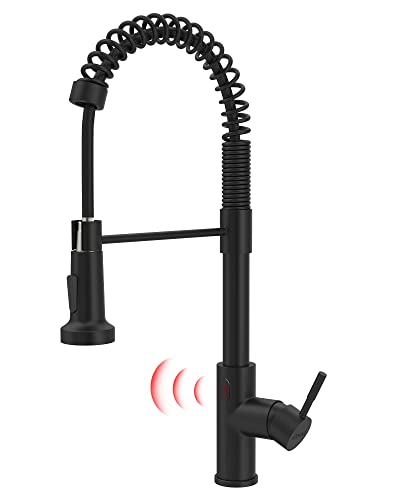
GIMILI Matte Black Touchless Kitchen Faucet with Spring Pull Down Sprayer
Badge: Best Modern Design
Strengths
- Motion-sensor, hands-free control in a matte black spring design — the statement look of the list.
- Spring format frees the sprayer to reach anywhere in and around the sink, reducing the hose-straining that wears pull-downs.
- Single-hole installation keeps the deck simple and the mounting footprint small.
Trade-offs
- The verified listing does not state the cartridge type, so the anti-drip foundation is undocumented here.
- Sensor electronics bring power and placement duties.
- Matte black shows hard-water deposits plainly and asks for regular wiping.
Spec box (from verified listing data)
- Operation: motion sensor activated, hands-free, single handle
- Sprayer: spring pull-down
- Configuration: single hole installation
- Finish: matte black
- Style: modern farmhouse
The GIMILI closes the list as the design-forward touchless option. Its spring sprayer addresses a subtle wear pattern: fixed-arc pull-downs get their hoses strained at the same angle thousands of times, while a spring head moves freely and returns without fighting you. Combined with hands-free activation, the daily interaction is genuinely effortless, and the matte black finish gives a modern farmhouse kitchen its focal point.
Its placement last is about documentation, not drama. Unlike the WEWE touchless above, its verified listing does not state a ceramic cartridge, so the anti-drip core of this guide’s brief is unconfirmed; and matte black, for all its beauty, is the finish that shows mineral deposits most honestly in hard-water homes. Buy it for the design and the sensor, maintain the finish with a wipe, and ask the seller about the cartridge if drips are your personal red line.
Best for: design-led kitchens wanting hands-free operation and free sprayer movement / Not suited for: hard-water homes that dislike wiping, or buyers who need the cartridge documented
Comparison Table
| Faucet | Badge | Cartridge (as listed) | Sprayer | Signature anti-problem trait | Link |
|---|---|---|---|---|---|
| Lufeidra | Best Overall | Ceramic | Pull-down | Ceramic seal + SUS304 body | Check on Amazon |
| VFAUOSIT | Best Fast Install | Not stated | Pull-down, 3 modes, 23in hose | Tool-free install + cold-start safety | Check on Amazon |
| WEWE High-Arc | Best Easy-Clean | Ceramic | Pull-down, 3 modes, 20-inch reach | Rub-clean silicone nozzles | Check on Amazon |
| FEELSO | Best Farmhouse Workhorse | Not stated | Pull-down | Simplicity + NSF lead-free | Check on Amazon |
| WEWE Touchless Set | Best Touchless | Ceramic | Pull-down, 3 modes | Sensor over ceramic cartridge | Check on Amazon |
| GIMILI Touchless | Best Modern Design | Not stated | Spring pull-down | Hands-free + free-moving spring head | Check on Amazon |
How to Choose a Kitchen Faucet That Stays Trouble-Free
Choose by failure mode, not by feature list. Start by writing down how your last faucet actually failed — drip, clog, leak, looseness, finish, or a sprayer that gave up — and let that history lead. A household burned by drips should filter first for a stated ceramic cartridge, as three picks here carry. A household burned by clogging should filter for nozzle design. A household burned by a wobbly, leaking install should filter for mounting systems and deck-plate inclusion. Reliability is personal because failure is personal.
Next, read materials as longevity specifications. SUS 304 stainless bodies resist the internal corrosion that becomes tomorrow’s pinhole leak. Lead-free construction with named certifications — NSF/ANSI 61 and 372, cUPC — tells you the water path was engineered and audited, which correlates with overall manufacturing seriousness. Braided stainless supply hoses, where included, outlast and out-seal basic lines. None of these photograph as well as a finish, and all of them matter more by year five.
Then count the moving systems honestly. Every mechanism is a future maintenance item: sprayers have hoses, weights, and dock seals; sensors have power and electronics; mode selectors have buttons that meet mineral film. This is not an argument for the plainest faucet — the touchless picks here earn their complexity for the right households — but it is an argument for choosing complexity that answers your actual problems rather than complexity that merely demos well. A traditional side-sprayer layout, compared in the Best Kitchen Faucets With Side Sprayer guide, trades the in-spout hose for a deck hose and a separate set of wear points; there is no free lunch, only informed choices.
Fit remains non-negotiable: holes counted, arc clearance measured, sink depth respected, cabinet space below confirmed for hose loops and any sensor power pack. Finally, plan the parts horizon at purchase time. Save the model number, the manual, and the order record. The difference between a problem and a non-event, five years from now, is usually whether anyone can identify the cartridge.
How to Install and Maintain a Faucet So Problems Never Start
Most faucet problems are installed, not manufactured, so this section is the highest-value part of the guide. At install: shut off the supplies, remove the old faucet, and clean the deck completely. Flush each supply stop into a bucket before connecting the new faucet — debris shaken loose by the work is the leading cause of early cartridge trouble. Connect supplies hand-tight plus a careful fraction, hang the sprayer hose weight exactly where the manual marks it, and leave a clear loop of hose under the sink with nothing stored against it.
Open the stops slowly and perform a dry-towel check: wipe every joint dry, wait, and run a fresh dry paper towel over each connection. Paper shows moisture a fingertip misses, and a leak found today is a drip-pan curiosity; the same leak found in six months is a cabinet floor. Flush the faucet with the aerator removed for the first minute, refit it, cycle every spray mode, and confirm the head docks and retracts cleanly.
Maintenance thereafter is a short list done occasionally. Rub silicone nozzles clean when the spray pattern changes; soak a conventional aerator in vinegar when flow drops. Wipe finishes with a soft cloth — abrasives and harsh chemicals create the finish problems owners then blame on the faucet. Glance under the sink monthly when you fetch supplies: a dry cabinet is the whole goal, and early moisture is cheap to fix. Exercise second-sink faucets briefly every few weeks; moving water keeps seals and cartridges in their happy state.
Troubleshooting, problem first. Problem: a drip at the spout → debris or wear at the cartridge; flush first, replace the cartridge as a unit if it persists. Problem: the sprayer will not retract → the weight has slipped or the hose loop is snagged on stored items; clear the cabinet and reposition the weight. Problem: flow weakens slowly → scale at the aerator or spray face; clean or soak before suspecting the valve. Problem: the handle loosens or the faucet rocks → the mounting hardware needs re-tightening; do it now, because rocking works seals loose and turns a one-minute fix into a leak. Problem: a sensor faucet stops responding → power first, sensor window second, valve last.
The Five Failure Modes, Explained
It is worth understanding the five problem families as mechanisms, because mechanism knowledge converts panic into diagnosis. Valve failure is wear or debris at the sealing surfaces, announcing itself as drips or stiffness; ceramic designs resist the wear half of that equation better than any alternative. Sprayer failure is usually hose and dock mechanics — weights, loops, and seals — not the head itself. Connection leaks are installation physics: joints that were never quite tight, or were stressed by a rocking faucet, weep slowly and hide. Finish failure is chemistry: hard water, abrasive pads, and aggressive cleaners against a coating that asked for a soft cloth. Installation failure is the upstream cause of half the others — debris in lines, plates unsealed, hoses kinked at birth.
Notice what this taxonomy does to shopping. It moves attention from the showroom questions — how does it look, how many modes — to the ownership questions: what seals the water, what cleans the spray face, what tightens the mount, what is the cartridge called. The six picks above were chosen because their verified specifications give good answers to ownership questions. A faucet bought on those answers is what “no problems” realistically means.
When to Repair and When to Replace
A problem-free ownership life includes knowing the exit rules. Repair when the fault is a defined, replaceable unit: a cartridge, an aerator, a spray head, a hose, a sensor power source. These are modest parts on a documented model, and the faucet body typically outlasts several of them. Replace when the body itself is compromised — corrosion at the base, a cracked casting, finish failure over large areas — or when the model is so undocumented that no part can be identified with confidence. That last condition is worth dwelling on: it is a purchasing outcome, decided the day you chose an unidentifiable faucet and discarded its paperwork. Every recommendation in this guide quietly assumes you will not do that this time.
The First-Year Reliability Routine
Reliability is mostly a first-year story. The habits that keep a faucet trouble-free for a decade are set — or not — in its first twelve months, and they are light enough to fit on an index card. In the first week, do the dry-towel check twice: once at install, and once after several days of thermal cycles, because joints that weep often do so only after hot and cold have expanded and contracted them a few times. In the first month, confirm the sprayer still docks with its original snap and the hose weight has not migrated; weights settle, and a thirty-second correction now prevents a year of lazy retraction.
Across the first year, tie faucet care to events you already notice. When the spray pattern changes, clean the nozzles or soak the aerator that day, not at some future deep-clean. When plumbing work happens anywhere in the house — a water heater swap, a municipal repair on your street — run the kitchen faucet briefly and check the aerator for caught sediment within the week. When you retrieve something from under the sink, glance at the connections and the cabinet floor. None of this is a chore list; it is a set of reflexes, and faucets owned by people with these reflexes are the ones that earn the phrase “never had a problem with it.”
Reliability in RVs, Rentals, and Second Sinks
The picks on this list repeatedly name RV, bar, and laundry duty, and those settings stress faucets differently enough to deserve their own note. The defining feature of a second sink is neglect punctuated by use: weeks of idleness, then a burst of activity. Idle time punishes rubber seals, which dry and stick, and rewards ceramic cartridges, which simply wait. It also hides leaks — a main-kitchen drip announces itself to daily witnesses, while an RV or laundry drip can run through a whole trip or a whole tenancy. That asymmetry argues for the most drip-resistant valve you can confirm in second sinks, and for a shut-off habit: closing the supply to an RV or a vacant rental’s sink between uses converts any surprise into a non-event.
Rentals add a second consideration — the operator is not the owner. Handles get forced, sprayers get yanked, and nobody reports a slow drip with a main-kitchen urgency. Simple, robust designs with documented cartridges serve landlords best, because the eventual repair is a defined part swapped on a scheduled visit. If you are outfitting a property or a second home from this list, weight the confirmed-ceramic, simply specified picks — the Lufeidra and the FEELSO pattern — above the feature-rich ones, and record the model numbers in the property file before the first tenant or guest ever turns the handle.
Reading Parts and Support Signals Before You Buy
Reliability is partly a prediction about a company’s future behavior, and listings carry signals about it if you know how to read them. The strongest signal is identifiability: a faucet sold under a precise model number, with specifications stated in checkable language — named standards, named materials, a named cartridge type — belongs to a maker who expects to support it. Vague listings that traffic only in adjectives belong to products whose makers expect to move on. This is why this guide repeats model numbers and standard numbers so insistently: they are not pedantry, they are the difference between a faucet that can be repaired in year eight and one that can only be replaced.
The second signal is ecosystem. Legacy brands maintain parts channels because their installed base demands it; value brands increasingly maintain them through the marketplace listing itself, where the same seller page that sold the faucet becomes the route to its cartridge. Either can work — what fails is the undocumented middle. The practical habit that protects you under any brand is the same: save the model number, the manual, and the order record, and photograph the cartridge if you ever have it out. Do that, and nearly every faucet on this list has a credible ten-year story; skip it, and even the best-documented faucet becomes anonymous the day its box is recycled.
A Word About Guarantees
Readers sometimes ask why this guide, organized around having no problems, never uses the word “guaranteed.” Because in plumbing, guarantees attach to parts and labor terms, not to outcomes — and the honest version of reliability is probabilistic. A ceramic cartridge does not promise your faucet will never drip; it removes the most common mechanism by which faucets come to drip. A rub-clean nozzle does not promise perfect spray forever; it makes the restoration of perfect spray a two-second act instead of a service call. Stack enough of those shifted odds — valve, materials, nozzles, mounting, installation care — and the lived experience converges on what owners mean by a problem-free faucet: years in which the fixture simply does its work, and in which the rare maintenance moment is small, obvious, and yours to perform. That convergence, not a promise, is what the six picks above were chosen to deliver.
Common Buying Mistakes
- Believing “problem-free” is a product property. It is a match between a design and your failure history, plus an installation done carefully. Shop your own history first.
- Skipping the supply-line flush. The debris from disturbing old plumbing damages more new cartridges than manufacturing defects ever will.
- Storing cleaning bottles against the sprayer hose. A snagged, weighted-down hose loop is the top cause of “the sprayer stopped retracting” — a cabinet-organization problem wearing a faucet costume.
- Cleaning finishes with abrasives. Scrub pads and harsh chemicals manufacture the finish failure owners later blame on quality.
- Ignoring the under-sink glance. A monthly look for moisture catches leaks while they are still free to fix.
- Throwing away the model documentation. Unidentifiable faucets cannot be repaired cheaply; they can only be replaced.
Final Recommendation
For most households, start with the Lufeidra: its confirmed ceramic cartridge and SUS304 body answer the drip problem at the source, in a faucet that fits nearly any deck. If installation itself is your worry, the VFAUOSIT and its tool-free design are the safer hands to be in. If clogging is your history, take the WEWE High-Arc and its rub-clean nozzles. The FEELSO serves simplicity-first farmhouse and utility sinks, the WEWE Touchless set serves messy daily cooking with a documented ceramic core, and the GIMILI serves design-led kitchens that accept a wiping routine. Choose by the failure you never want to repeat, install carefully, and keep the paperwork — that combination is as close to no problems as faucets honestly get.
Frequently Asked Questions
What makes a kitchen faucet reliable?
A short list of unglamorous things: a quality valve — ideally a stated ceramic cartridge — a corrosion-resistant body such as SUS 304 stainless, certified lead-free water paths, a sprayer system with cleanable nozzles and a sensibly weighted hose, and mounting hardware that can be tightened properly. Installation care then decides whether those advantages survive contact with your plumbing.
Which faucet problem is most common?
By owner reports, flow problems from mineral-clogged aerators and spray faces, and drips from worn or debris-damaged cartridges, lead the list. Both are addressed directly in this guide — rub-clean nozzles and vinegar soaks for the first; ceramic cartridges and line flushing for the second.
Are touchless faucets more problem-prone?
They add a category — power and sensor care — while removing another: handle wear and messy-hand contact. Whether the trade nets positive depends on the household. Heavy, messy daily cooking favors touchless; a rarely used sink favors mechanical simplicity.
How do I stop a new faucet from dripping early?
Flush the supply lines into a bucket before connecting the faucet, flush the faucet itself with the aerator removed for the first minute, and refit the aerator as a sediment screen. Early drips are overwhelmingly debris events, and debris is preventable at install.
Why did my sprayer stop retracting?
Almost always the counterweight: it has slipped along the hose, or the hose loop under the sink is snagged on stored items. Clear the cabinet, reposition the weight where the manual marks it, and retraction usually returns immediately.
Does a ceramic cartridge guarantee no drips?
No guarantee exists in plumbing. A ceramic cartridge removes the most common wear mechanism behind drips — degrading rubber seals — and tolerates grit and idleness better than alternatives. Debris protection and correct installation are still required, which is why this guide pairs every pick with install guidance.
When should I replace a faucet instead of repairing it?
Replace when the body is corroded or cracked, the finish has failed broadly, or the model cannot be identified well enough to source parts. Repair — cartridge, aerator, hose, spray head — when the fault lives in a replaceable unit on a documented faucet.