Disclosure: topratedkitchenware.com is reader-supported. When you buy through links on our site, we may earn an affiliate commission from Amazon and other retailers, at no extra cost to you.
Where to buy
All six picks in this guide to the best french presses coffee makers are listed on Amazon, where you can check the latest price on Amazon, confirm the exact capacity and finish, and read the current listing details before ordering. Every pick below is a stainless steel press verified from the listing data — no glass beakers, no invented specifications, and no prices printed here, because listing prices change too often to quote honestly.
- Best Overall: Secura French Press Coffee Maker 34 oz — Check on Amazon
- Utopia Kitchen Stainless Steel French Press 34 Oz — Check on Amazon
- MuellerLiving French Press Coffee Maker 34 oz — Check on Amazon
- AgcKuzt French Press 34 oz — Check on Amazon
- Ziruma Non-Toxic Stainless Steel French Press 34 oz — Check on Amazon
- Secura French Press Coffee Maker 50 oz — Check on Amazon
Read the full guide ↓
The best french presses coffee makers share a simple promise: coffee with full body and deep flavour, made with nothing more than grounds, hot water and patience. A French press is an immersion brewer — the coffee steeps directly in the water instead of dripping through it — and that contact produces the heavy, rounded cup that drip machines and pod brewers cannot imitate. This guide compares six stainless steel presses, because steel answers the classic press complaints: no fragile glass, better heat retention, and filters that can be refreshed with spare screens.
Choosing between these six is less about whether a press works — the method has barely changed in a century — and more about filtration, capacity and materials. Two picks build their identity around multi-layer filtration for a cleaner cup. Two are the same trusted Secura design in 34 oz and 50 oz sizes. One is specified for camping, and one is built around a no-plastic, surgical-grade steel design brief. The right choice depends on how many people drink, how much sediment you tolerate, and where the press will live.
A note on how to use this guide: the Quick Picks table gives the short answer, the detailed reviews explain who each press suits and where each one honestly falls short, and the buying-guide and how-to sections that follow the reviews will make you better at using whichever press you buy. If you are also comparing electric everyday machines, our companion guides to Best Fresh Coffee Makers and Best Fresh Made Coffee Makers cover the single-serve side of the counter.
Key Takeaways
- All six picks are stainless steel presses — no glass to break, and double-wall or insulated bodies on most picks hold heat far better than a beaker.
- Filtration is the biggest real difference: the Utopia Kitchen, MuellerLiving and Ziruma picks use 4-level or 4-layer filters for a cleaner cup, while the Secura picks use classic mesh screens with spares included.
- Capacity splits the field: five picks are 34 oz (about four cups), and the large Secura brews 50 oz for households and gatherings.
- The Ziruma is the pick for material-conscious buyers, with surgical-grade steel and a stated no-plastic, no-heavy-metals design.
- The AgcKuzt is the camping-ready pick: full steel construction that can travel without protection.
- Every pick is an immersion brewer, so grind coarse, steep by the clock, and decant fully — the how-to section below explains why each step matters.
In this guide
Quick Picks
Six steel presses, six distinct jobs. The badges below are used consistently through the detailed reviews, so the press that wins a category here is the same one carrying that badge in its review.
| Badge | Pick | Why it earns its place | Link |
|---|---|---|---|
| Best Overall | Secura French Press Coffee Maker 34 oz | The benchmark: 304 steel, insulation and spare screens in a 34 oz everyday size | Check on Amazon |
| Best for a Cleaner Cup | Utopia Kitchen Stainless Steel French Press 34 Oz | Four-level filtration for drinkers who love press body but not press sludge | Check on Amazon |
| Best Everyday Pick | MuellerLiving French Press Coffee Maker 34 oz | Double-insulated, food-grade steel built for daily use and dishwasher cleaning | Check on Amazon |
| Best for Camping | AgcKuzt French Press 34 oz | Full steel, double-walled and camping-listed, with spare filters in the box | Check on Amazon |
| Best Plastic-Free Design | Ziruma Non-Toxic Stainless Steel French Press 34 oz | Surgical-grade steel, no-plastic design brief, 4-layer filter and measure marks | Check on Amazon |
| Best for Larger Households | Secura French Press Coffee Maker 50 oz | The 50 oz family-size version of the Best Overall design | Check on Amazon |
How These Picks Were Chosen
These picks were chosen by comparing verified listing data across the stainless French press category: body material and grade, insulation construction, filtration design, stated capacity, included spare screens or filters, and care requirements. Only attributes stated in the verified listings were used — where a listing does not state a specification, this guide leaves it out rather than guessing, and the Ziruma review says plainly which of its claims come from the listing itself.
Filtration received the closest attention, because it is where modern presses genuinely differ. A classic press uses a single mesh screen; the multi-layer designs here stack additional screening to catch more fine particles. Neither approach is automatically better — heavy sediment is part of the traditional press cup, and some drinkers prefer it — so the reviews describe the cup each design produces and let your preference decide.
This is a research-led guide, not a laboratory test. No hands-on testing is claimed: the assessments combine verified specifications with the well-documented behaviour of the French press method itself — immersion extraction, the effect of grind size on sediment, and the heat-retention advantage of double-wall steel over single-wall glass, which follows directly from the construction. Prices and ratings are deliberately excluded, because both change constantly; check the current listing for those.
One further filter was applied before publication: every pick had to be a genuine press. Electric machines that borrow the word ‘press’, and glass models that duplicate a steel pick’s job with none of its durability, were set aside. What remains is a steel-only field on purpose — the guide’s position, argued in the buying section below, is that for a first or only press bought today, stainless steel is the material that will still be serving in a decade.
The 6 Best French Presses Coffee Makers
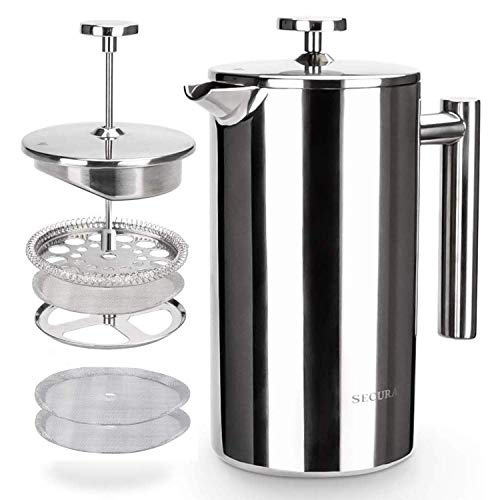
Secura French Press Coffee Maker 34 oz
Badge: Best Overall
Strengths
- Full 304 stainless build shrugs off the drops and knocks that end glass presses
- Insulated body holds serving temperature noticeably longer than a single-wall beaker
- Two spare screens in the box extend the working life of the filter assembly
Trade-offs
- Steel walls hide the brew, so you judge steep progress by time rather than by colour
- Heavier than a glass press of the same capacity when full
- The 34 oz size is a ceiling: larger groups need a second steep or the bigger sibling below
Key specs (from the verified listing)
- Capacity: 34 oz (1 litre)
- Material: 304 grade stainless steel
- Insulation: insulated press design
- Filtration: mesh screens, with 2 extra screens included
- Finish: Silver
The Secura 34 oz is the reference point for this entire category: a one-litre press built entirely from 304 grade stainless steel, insulated, and shipped with two extra filter screens. That combination answers the three complaints that follow glass French presses around — fragility, fast cooling, and screens that fray long before the beaker wears out. In daily use it behaves exactly as a press should: coarse grounds and hot water go in, the lid rests on top during the steep, and the plunger travels down in one slow, steady push.
Because the body is steel rather than glass, the cup character leans a fraction rounder and less brightly defined than the very best glass beakers, a trade most drinkers happily accept for a press that can survive a crowded counter, a camping box, or a clumsy morning. The spare screens matter more than they first appear to: a bent or frayed screen is the usual reason an old press starts pouring gritty coffee, and here the fix is already in the drawer. Rinsing is straightforward, and the all-steel path means no plastic touches the coffee at any point in the brew.
For press brewing specifically, the Secura’s included spare screens are worth more than they look: screen condition is the difference between a clean plunge and a gritty one, and this is the press most likely to still be pouring cleanly years from now.
Best for: most households wanting one durable everyday press / Not suited for: households that need more than four cups per steep
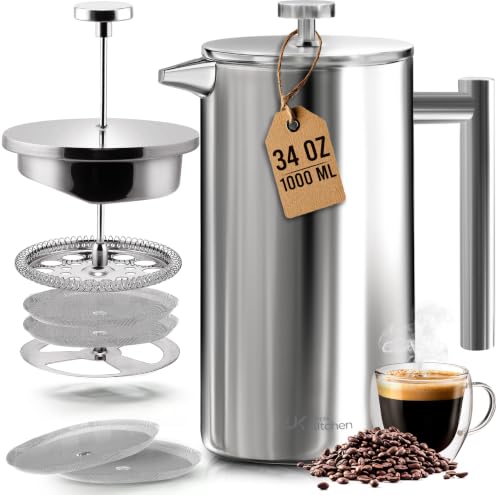
Utopia Kitchen Stainless Steel French Press 34 Oz
Badge: Best for a Cleaner Cup
Strengths
- Four-level filtration is the most layered filtering in this line-up, aimed squarely at a cleaner cup
- Double-wall insulation keeps a second cup worth drinking while you finish the first
- Dishwasher-safe, rust-free build keeps ownership simple
Trade-offs
- More filter layers mean more parts to rinse apart after each brew
- Layered filtration still cannot remove the fine silt that defines press coffee entirely
- Same 34 oz ceiling as most of this group
Key specs (from the verified listing)
- Capacity: 34 oz
- Material: 304 grade stainless steel
- Insulation: double wall insulated
- Filtration: 4-level filtration system, with 2 extra filters included
- Care: rust-free, dishwasher safe
- Finish: Silver
Utopia Kitchen builds its 34 oz press around one headline idea: filtration. The 4-level filtration system stacks more screening stages between the grounds and your cup than a standard single-screen press, and it includes two extra filters so the stack can be refreshed as the originals age. The body is 304 grade stainless steel with double-wall insulation, finished in silver, and rated rust-free and dishwasher safe.
In the cup, the extra filtration shows up as a slightly cleaner finish — less of the dusty sediment that settles at the bottom of a typical press mug, while keeping the heavy body that makes people choose a press in the first place. The honest cost of that cleanliness is thirty extra seconds at the sink, because a multi-layer filter stack wants to be separated and rinsed rather than shaken out in one piece. For drinkers who love press flavour but dislike press sludge, that is exactly the right trade to offer.
If your one hesitation about press coffee has always been the silt in the last mouthful, this is the pick designed around that hesitation — the four-level stack is the closest a press gets to a filtered cup while keeping immersion body.
Best for: press lovers who want maximum filtration and a cleaner finish / Not suited for: drinkers who enjoy the traditional heavy sediment of a classic press
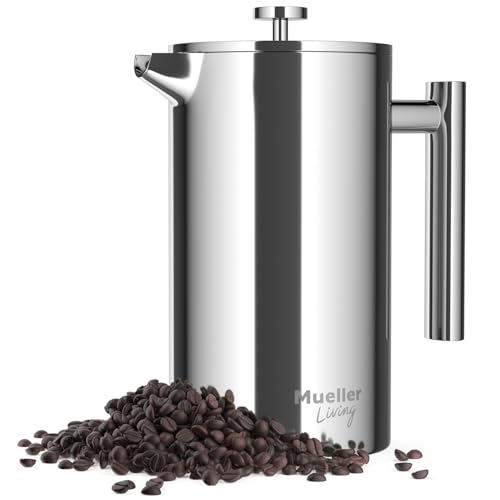
MuellerLiving French Press Coffee Maker 34 oz
Badge: Best Everyday Pick
Strengths
- Double insulation with a heat-resistant build keeps coffee hot and the outside manageable
- Four-filter arrangement targets a smoother pour than a basic single screen
- Food-grade, rust-free steel and dishwasher-safe care keep it low-maintenance
Trade-offs
- Filter stack needs separating for a thorough clean, like the other multi-filter presses here
- No spare filters are listed in the verified listing details, unlike the Secura and Utopia Kitchen picks
- Steel body hides brew colour during the steep
Key specs (from the verified listing)
- Capacity: 34 oz
- Material: stainless steel, food grade
- Insulation: heat resistant, double insulated
- Filtration: 4 filter system
- Care: rust-free, dishwasher safe
The MuellerLiving press is a 34 oz stainless steel pot built around a 4 filter system and a heat resistant, double insulated body. The listing emphasises the practical ownership details — food grade steel, a rust-free finish, and dishwasher-safe cleaning — which makes this the pick aimed at households that will use a press every single day rather than on occasional slow weekends.
Day to day, it delivers the classic press profile: full body, low acidity in the cup, and a forgiving nature with grind size compared with pour-over methods. The double insulation earns its keep on the second cup, which stays properly hot instead of drifting lukewarm. Its limitation is the familiar one for multi-filter presses: the filter assembly rewards a proper rinse, and because no spare filters are listed among the verified details, owners should treat the included set with a little care rather than bending screens back into shape by force.
As a daily press, the MuellerLiving’s pitch is ownership rather than novelty: food-grade steel, rust-free care and a dishwasher-safe routine for a pot that will be used twice a day, every day.
Best for: daily users who want double insulation and the simplest care routine / Not suited for: buyers who want spare filters included in the box

AgcKuzt French Press 34 oz
Badge: Best for Camping
Strengths
- Full stainless construction with no glass to protect suits camping and travel kits
- Double-walled insulation keeps coffee hot away from the kitchen, where refills are not an option
- Two extra filters included, and dishwasher-safe cleaning back home
Trade-offs
- A less established brand name than Secura or Utopia Kitchen in this category
- Four-cup capacity is snug for larger camping groups
- Steel body gives no visual check on steep colour or remaining coffee
Key specs (from the verified listing)
- Capacity: 34 oz, 4 cups
- Material: full stainless steel, food grade
- Insulation: double-walled insulated (upgraded design)
- Filtration: 2 more filters included
- Care: dishwasher safe
- Listed uses: kitchen and camping
The AgcKuzt press takes the same formula — 34 oz, full stainless steel, double-walled insulation — and points it at the kitchen door and beyond: the verified listing explicitly lists camping among its uses, and a steel pot is simply the right material for that job. It is food grade, dishwasher safe, and ships with two more filters, covering the four-cup morning for a small group without a glass beaker anywhere in the bag.
At home it performs as a competent everyday press, with the insulation doing the same second-cup work as its rivals. On a campsite it pulls ahead of glass rivals on the only metric that matters outdoors: surviving the trip. The honest limitation is brand depth — AgcKuzt does not carry the long category history of a Secura, so buyers are trusting the specification sheet rather than a track record. On specification alone — steel throughout, double walls, spare filters — the sheet is convincing.
For camping, judge a press by what happens when it is dropped on gravel at dawn — the AgcKuzt’s full steel body is the only answer in this guide that does not involve a replacement beaker.
Best for: campers, travellers and anyone hard on kitchen gear / Not suited for: buyers who prefer a long-established brand name
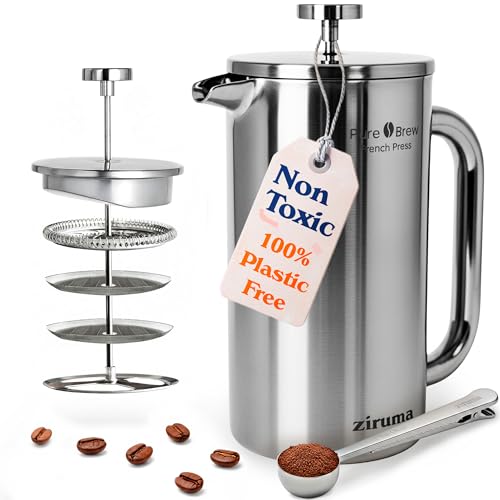
Ziruma Non-Toxic Stainless Steel French Press 34 oz
Badge: Best Plastic-Free Design
Strengths
- Surgical-grade steel and an explicit no-plastic, no-heavy-metals design brief suit ingredient-conscious buyers
- Measure marks on the body make repeatable water-to-coffee ratios easy without a scale
- Four-layer filter plus double-wall insulation cover both cup cleanliness and heat retention
Trade-offs
- The non-toxic positioning is a listing claim to weigh, not an independent certification stated in the title
- Measure marks help, but serious ratio control still benefits from weighing grounds
- Portable sizing is the standard 34 oz, not a smaller travel-specific format
Key specs (from the verified listing)
- Capacity: 34 oz
- Material: surgical-grade stainless steel
- Design note: no plastic or heavy metals (per listing title)
- Filtration: 4-layer filter
- Insulation: double-wall insulated
- Details: measure marks, dishwasher safe, portable
Ziruma’s press is built for the buyer who reads material lists before feature lists. The verified title leads with its construction claims — surgical-grade stainless steel, no plastic or heavy metals — then backs them with the working hardware: a 4-layer filter, double-wall insulation, measure marks pressed into the body, dishwasher-safe care, and a portable 34 oz format.
The measure marks are the quietly useful detail. Press brewing is forgiving, but it rewards a repeatable ratio, and marks let a household land on the same strength every morning without dragging out a scale. The four-layer filter keeps the cup comparatively clean, and the insulation holds heat through a long breakfast. The limitation to state plainly is that the material claims come from the listing itself; buyers who need third-party certification language will not find it in the verified title, and should judge this pick on its steel construction and design, which are concrete.
The Ziruma’s measure marks deserve emphasis for press users: immersion brewing rewards a consistent ratio more than any other variable, and the marks make consistency the default rather than a project.
Best for: material-conscious buyers avoiding plastic in the brew path / Not suited for: buyers who need third-party certification documents before purchasing
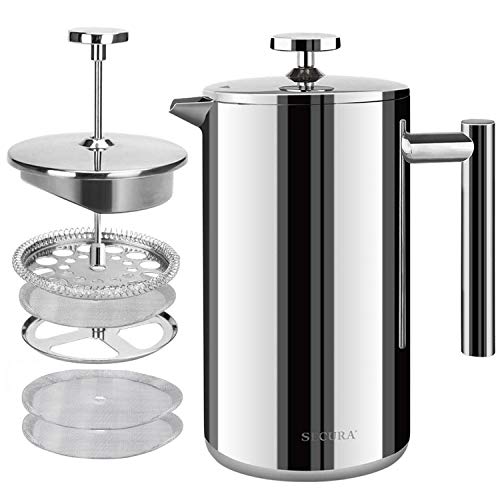
Secura French Press Coffee Maker 50 oz
Badge: Best for Larger Households
Strengths
- The 50 oz capacity serves a full table in one steep, where 34 oz presses need a second round
- Same 304 stainless, insulated Secura build as the smaller Best Overall pick
- Two extra screens included, as with the 34 oz model
Trade-offs
- A full 50 oz steel press is genuinely heavy to pour one-handed
- More coffee per steep means more grounds per brew, so running costs per pot rise
- Oversized for one or two drinkers, who will waste coffee or reheat it
Key specs (from the verified listing)
- Capacity: 50 oz (1.5 litre)
- Material: 304 grade stainless steel
- Insulation: insulated press design
- Filtration: mesh screens, with 2 extra screens included
- Finish: Silver
Everything said about the 34 oz Secura applies here at a larger scale: 304 grade stainless steel, an insulated body, two extra screens in the box, and a silver finish — but with a 50 oz, 1.5 litre capacity that changes who the press is for. This is the brunch, holiday-morning, and full-house press, the one that fills four generous mugs or six smaller cups from a single steep.
Scale cuts both ways, and the review should say so. A full 50 oz press is heavy, and pouring the last cup one-handed while holding the lid steady is a two-hand job for most people. It also commits you to a full pot: households of one or two will either waste coffee or drink it stale. But for the household that regularly brews for a table, one large steep beats two small ones for consistency — every cup comes from the same extraction, at the same strength, served at the same time.
For a crowd, the 50 oz Secura keeps the press ritual intact at table scale — one steep, one plunge, and everyone drinks the same coffee at the same time, which two small presses never quite achieve.
Best for: families and hosts brewing for four to six people at once / Not suited for: solo drinkers and couples, who will waste coffee at this scale
Comparison Table
The table below lines the six presses up on the traits that actually separate them — capacity, filtration design, insulation and the job each one is built for. Notice how much of the field shares the same 34 oz steel format: the differences are in the filter stack and the details.
| Pick | Defining traits | Link |
|---|---|---|
| Secura French Press Coffee Maker 34 oz | 34 oz · 304 stainless · insulated · classic mesh screens with 2 spares included | Check on Amazon |
| Utopia Kitchen Stainless Steel French Press 34 Oz | 34 oz · 304 stainless · double wall · 4-level filtration with 2 extra filters | Check on Amazon |
| MuellerLiving French Press Coffee Maker 34 oz | 34 oz · stainless, food grade · double insulated · 4 filter system | Check on Amazon |
| AgcKuzt French Press 34 oz | 34 oz / 4 cups · full stainless · double-walled · 2 extra filters, camping-listed | Check on Amazon |
| Ziruma Non-Toxic Stainless Steel French Press 34 oz | 34 oz · surgical-grade stainless · 4-layer filter · measure marks, no-plastic design | Check on Amazon |
| Secura French Press Coffee Maker 50 oz | 50 oz · 304 stainless · insulated · classic mesh screens with 2 spares included | Check on Amazon |
How to Choose a French Press
Start with capacity, because it is the one choice you cannot adjust later. A 34 oz press — five of the six picks here — fills about four standard mugs or two very generous ones, and it suits one to three drinkers perfectly. The 50 oz Secura exists for households that regularly pour for four or more. Bigger is not better by default: coffee left sitting in a press keeps extracting and turns bitter, and a half-used large press wastes grounds on every brew. Match the pot to the number of cups you actually pour on a normal morning, not the largest gathering you host twice a year.
Material is the second decision, and this guide has already made it for you in one direction: every pick is stainless steel. Glass beakers show the brew beautifully and can taste marginally brighter, but they break, they lose heat quickly, and replacement beakers are a recurring cost. Steel — particularly the 304 grade used by the Secura and Utopia Kitchen picks, and the surgical-grade steel of the Ziruma — survives drops, travels safely, and, in double-wall form, insulates. The trade is visibility: with steel you brew by ratio and timer rather than by watching the colour develop.
Filtration decides the texture of your cup. A classic mesh screen, as on both Secura picks, produces the traditional press cup: heavy, rich, with a little fine sediment settling in the last sips. Multi-layer systems — the Utopia Kitchen’s 4-level filtration, the MuellerLiving’s 4 filter design and the Ziruma’s 4-layer filter — catch more of those fines and pour a cleaner cup, at the cost of a filter stack that takes longer to rinse. Neither is a defect. Decide whether you are a drinker who savours press body as it is, or one who has always wished it were a little cleaner, and choose the stack that matches.
Insulation matters in proportion to how slowly you drink. A single-wall press begins cooling the moment the water goes in; a double-wall insulated body, fitted to most picks here, holds serving temperature through a long breakfast and keeps a second cup worth drinking. If your household drinks the pot within ten minutes, insulation is a minor virtue. If the pot sits on the table for half an hour — or travels to a desk, a porch or a campsite — it is the difference between coffee and warm regret.
Finally, weigh the ownership details: spare screens or filters in the box (Secura, Utopia Kitchen and AgcKuzt include them), dishwasher-safe care (Utopia Kitchen, MuellerLiving, AgcKuzt and Ziruma state it), and small design helps like the Ziruma’s measure marks. A press has no electronics to fail, so the product you are really buying is a decade of mornings — the details that make the daily routine easier are the ones that compound. Readers comparing manual brewing with push-button convenience may also want our guides to Best Fresh Coffee Makers and Best Fresh Made Coffee Makers, which cover the electric side of the same morning.
Consider also where the press will work, because the room shapes the right pick more than the specification sheet admits. A press that lives beside a kettle on a calm counter can be any of the six. A press that will be carried to a desk, a porch, a boat or a campsite should be one of the double-walled steel picks, and a press that will serve a dining table benefits from the insulation that keeps the second round at temperature while the first is drunk. The same logic — matching the brewer to the room and the routine — governs the electric side of the counter, as our guide to Best Fresh Made Coffee Makers argues for single-serve machines.
How to Brew With a French Press, Step by Step
French press brewing is a method, not a machine setting, and the same six steps produce a good cup from any pick in this guide. The variables that matter are grind size, water temperature, ratio and time — in that order of forgiveness. Get the grind right and the method tolerates small errors everywhere else.
Use coarse, even grounds — the texture of coarse sea salt. Fine grounds slip through every filter design, multiply sediment, and make the plunge hard work. Just-boiled water works, but water a short moment off the boil is kinder and less likely to scorch the grounds. A reliable starting ratio is roughly one part coffee to fifteen parts water by weight; the Ziruma’s measure marks help you repeat a ratio you like, and every other pick rewards a kitchen scale or a consistent scoop-and-level routine.
- Add coarse grounds to the empty press — for a full 34 oz pot, about eight level tablespoons is a sensible starting point.
- Pour in hot water just off the boil, saturating all the grounds, and start a timer.
- Rest the lid on top with the plunger pulled fully up, and steep for about four minutes.
- Optional but worthwhile: break the crust of grounds floating on top with a spoon and skim off the foam for a cleaner cup.
- Press the plunger down slowly and steadily, stopping just above the bed of grounds — never squeeze the grounds hard against the bottom.
- Decant all of the coffee into cups or a separate vessel immediately, even if you are not drinking it yet.
That final step is the one most often skipped and the one that matters most after the grind: coffee left sitting on its grounds continues to extract, and a pot that tasted perfect at four minutes turns harsh at twenty. Decanting is also where double-wall insulation earns its place — in a serving vessel or an insulated press body, the coffee holds its temperature without continuing to cook.
Cleaning decides the next cup as much as brewing decides this one. Knock the grounds out (never down a sink drain in quantity — they belong in the bin or compost), rinse the screen assembly, and separate multi-layer stacks periodically for a thorough wash so old coffee oils do not stale the next brew. Dishwasher-safe picks make this a non-event; the classic screens on the Secura picks rinse clean by hand in seconds.
Troubleshooting
- Problem: the cup is muddy and gritty → what to do: grind coarser, let the poured cup rest a minute so fines settle, and pour gently without draining the last sediment-heavy ounce.
- Problem: the plunger is very hard to push → what to do: the grind is too fine or the dose is too high; press more slowly, and if resistance is extreme, lift the plunger slightly and continue rather than forcing it, which can spray hot coffee.
- Problem: the coffee tastes bitter or harsh → what to do: shorten the steep, decant immediately after pressing, and check that you are not leaving coffee sitting in the press between cups.
French Press vs Other Brew Methods: Where the Press Wins
Against drip machines, the press trades a paper filter’s clarity for body: paper absorbs the coffee oils that carry much of the flavour weight, while the press’s mesh lets them through. Against pod machines, the press offers fresh grounds of your choosing, no per-cup pod cost and no plastic pod waste — at the price of a kettle, a timer and four minutes of patience. Readers weighing that trade directly will find the pod side argued fairly in our guide to Best Fresh Coffee Makers.
Against pour-over, the press is the more forgiving method: immersion forgives an uneven pour and a basic kettle, while pour-over rewards technique with clarity. Many households end up keeping both — pour-over for the single careful cup, the press for the shared pot. The press also travels in a way no electric method can: the steel picks here need only hot water, which is why one of them is specified for camping outright.
Using a French Press for Tea, Cold Brew and More
A press is a general immersion tool, and two other uses are genuinely worthwhile. Loose-leaf tea steeps beautifully in a press — the plunger separates leaves from liquor at the end of the steep, exactly as it does with coffee — though a press used for both should be washed thoroughly between roles, because coffee oils will haunt a delicate tea. The Elite Gourmet machine in our companion coverage makes the same dual-use argument from the electric side; among the picks here, any press can do it.
Cold brew is the second use: coarse grounds and cool water, steeped in the press for twelve hours or more, then plunged and decanted, produce a smooth concentrate you can dilute to taste. The 34 oz picks make a household batch; the 50 oz Secura makes a party batch. One caution for both extra uses — the filter screens are designed for coffee-sized particles, so very fine teas and powders will pass through any press, however many layers its filter carries.
Caring for a Stainless Steel Press: Screens, Scale and Storage
A French press has exactly one wear part that matters: the screen assembly. Everything else is a steel vessel that time barely touches. Screen care is therefore the whole maintenance game, and it is a short one — rinse the assembly after every brew so coffee fines do not dry into the mesh, separate the stack weekly if you brew daily, and inspect the screen edges monthly for the fraying and bending that let grounds escape into the cup. When a screen does tire, the picks that ship with spares (both Secura models, the Utopia Kitchen and the AgcKuzt) turn a replacement into a two-minute drawer job instead of a parts hunt.
Scale is the second quiet enemy, and it attacks flavour rather than function. In hard-water areas a pale film builds on steel and filter mesh, and coffee brewed through it picks up a dull, chalky edge that owners often blame on their beans. A monthly soak of the pot and screen assembly in a descaling solution or a vinegar-water bath, followed by a thorough rinse, removes it completely. The dishwasher-safe picks in this guide tolerate the machine’s hottest wash for the same purpose, though the screen stack still benefits from being separated first so water reaches every layer.
Storage sounds trivial until a press is stored assembled, damp and closed — the one arrangement that guarantees stale smells at the next brew. Store the pot dry, with the plunger resting loosely rather than pressed down and sealed, and keep spare screens flat so their edges stay true. Treated this way, a stainless press is close to a lifetime purchase: no electronics to obsolesce, no proprietary parts beyond a standard screen, and a brew method that has already outlived a century of kitchen fashion. That permanence is the press’s final argument against every electric rival on the counter.
Common Buying Mistakes
The most common mistake is grinding too fine. Espresso-fine or drip-fine grounds flood through the screen, turn the cup muddy, make the plunge a wrestling match, and extract bitter flavours. A press wants the coarsest grind in your kitchen; if your grinder struggles to go coarse and even, that grinder — not the press — is the limiting factor in your coffee.
The second mistake is leaving brewed coffee in the press. Extraction does not stop because the plunger is down; the coffee keeps steeping in contact with the grounds and turns harsh while it sits. Decant everything at serving time. The third mistake is buying on capacity for the wrong day: a 50 oz press for a two-person household wastes grounds daily, while a 34 oz press for a six-person brunch means a second steep and a delayed table. Buy for your ordinary morning.
Finally, do not neglect the screen. A bent, frayed or clogged screen is behind most ‘my press suddenly pours gritty coffee’ complaints, and it is a wear part, not a life sentence. Picks that include spare screens or filters — both Secura models, the Utopia Kitchen and the AgcKuzt — let you fix the problem from the drawer in two minutes. Whichever pick you choose, rinse the filter assembly after every use and deep-clean it weekly if the press works daily.
Final Recommendation
For most households, the Secura French Press Coffee Maker 34 oz is the right first answer: 304 stainless steel, insulation, spare screens and a decade-proof simplicity that the category is built on. It is the press this guide would hand to a first-time press buyer and the one least likely to be replaced.
Choose by your difference instead. If sediment is your objection to press coffee, the Utopia Kitchen’s four-level filtration answers it. If the press will travel, take the AgcKuzt. If materials come first, take the Ziruma. And if your table seats six, the 50 oz Secura keeps the ritual to a single steep. Start with Secura French Press Coffee Maker 34 oz if the first pick fits you, or Secura French Press Coffee Maker 50 oz if the alternative profile sounds closer to your kitchen.
One closing observation for buyers hesitating between this guide and an electric machine: the two are not really rivals. A press asks for a kettle, coarse grounds and four attentive minutes, and repays them with a cup no pod has matched for body; an electric single-serve asks for nothing and repays with speed. Many households in this programme’s readership end up owning both — the press for the weekend table, the machine for the weekday door — and if that is your household’s shape, buy the press first. It is the cheaper instrument, it will outlive the machine beside it, and the mornings it governs will be the ones you remember.
Related guides
Frequently Asked Questions
Are stainless steel French presses better than glass ones?
They are better at surviving and at holding heat, and this guide’s picks are all steel for those reasons. Glass can produce a marginally brighter cup and lets you watch the brew, but it breaks, cools quickly and needs careful handling. For daily use, camping or a busy household, steel is the practical winner; for a careful solo ritual, glass remains a legitimate preference.
How fine should the grind be for a French press?
Coarse — about the texture of coarse sea salt. Fine grounds pass through the screen, create heavy sediment, make plunging difficult and taste bitter. If you buy pre-ground coffee, choose the coarsest option available, and expect a noticeably cleaner cup than drip-grind coffee gives in a press.
How long should coffee steep in a French press?
About four minutes is the standard starting point with water just off the boil. Shorter steeps taste thin and sour; much longer steeps turn harsh. Adjust in thirty-second steps to your taste, change one variable at a time, and decant immediately once the steep ends.
Can a French press make espresso?
No. A press is an immersion brewer with no pressure mechanism, so it cannot produce espresso or crema. What it produces is a full-bodied filter-style coffee — closer in spirit to a rich cafetière cup. If espresso drinks are the goal, a dedicated espresso machine is the right tool.
How do I keep French press coffee hot?
Start with an insulated or double-wall press, as most picks in this guide are, pre-warm the pot with hot water before brewing on cold mornings, and decant into warmed cups or a thermal vessel. Never leave the press on a heat source to keep warm — continued heat and continued contact with grounds both damage the flavour.
Are French presses dishwasher safe?
Several picks here — the Utopia Kitchen, MuellerLiving, AgcKuzt and Ziruma — are listed as dishwasher safe. The classic Secura screens rinse clean by hand quickly. Whichever model you choose, separate the filter assembly periodically for a thorough clean, because trapped oils and fines are the main cause of stale-tasting brews.


