Disclosure: topratedkitchenware.com is reader-supported. When you buy through links on our site, we may earn an affiliate commission from Amazon and other retailers, at no extra cost to you.
Where to buy
Every pick in this guide to the best home brew coffee makers comparison is sold through Amazon, where you can check the latest price on Amazon, confirm the finish in stock and read the current product page for the exact feature list. The short list below is the whole guide in miniature — follow the detailed reviews further down before deciding, or go straight to a pick you already recognise.
- Keurig K-Express Single Serve Coffee Maker, Mint — Best All-Rounder.
- Hamilton Beach FlexBrew Advanced 4-in-1 Single Serve Coffee Maker — Best Reservoir Value.
- Ninja Single Serve Coffee Maker (PB051) — Best Simple Grounds Pick.
- Keurig K-Elite Single Serve K-Cup Pod Coffee Maker, Brushed Silver — Best Compact Pick.
- Keurig K-Express Single Serve Coffee Maker, Black — Best for Iced Coffee.
- Keurig K-Express Single Serve Coffee Maker, Warm Stone — Best Statement Finish.
Read the full guide ↓ for the strengths, trade-offs and honest limitations behind each name on that list.
Introduction: Finding the best home brew coffee makers comparison
A useful guide to the best home brew coffee makers comparison has to do more than list machines — it has to compare them on the axes that change what lands in your cup and how your morning feels. That is the approach here. The six picks are all home single serve brewers, but they differ in ways a specification sheet flattens: what they accept (pods only, or pods and grounds), how much water they hold, how large a cup they can fill, whether they think about iced coffee at all, and how much control they hand you over strength and style. Compared properly, those differences — not brand, not colour — are what should decide your purchase.
The shortlist is deliberately drawn from one format family so the comparison stays honest. Every machine here brews one serving at a time for home use, which means the comparison is about variations inside a shared idea rather than a contest between unrelated categories. Readers who want the wider market view will find it in Best Home Coffee Makers, and readers who want this same shortlist reduced to a single grid can jump to Best Home Brew Coffee Makers Comparison Chart. This page is the middle layer: the reasoning that a chart cannot hold.
One comparison trap is flagged now because it shapes several reviews below: colour variants. The K-Express appears in this guide in Mint, Black and Warm Stone finishes across the shortlist. In a comparison they are one machine with three faces, and any table that scores them differently on performance is inventing differences. We compare the platform once, honestly, and treat finish as a separate, legitimate, purely personal axis. Everything else in this comparison — reservoir, inputs, cup size, modes — is a real engineering difference with real consequences for real mornings.
Key Takeaways
- Compare home brewers on inputs first: pods-only, grounds-only and dual-format machines lead to different costs, choice and effort for years.
- Reservoir size is the comfort axis: 42 oz, 45 oz and 56 oz reservoirs remove very different amounts of refilling from your week.
- Cup-size ceiling matters more than cup-size count — a machine that fills a 24 oz travel mug in one cycle solves a problem a smaller machine cannot.
- Iced modes and brew styles are real differences; colour finishes are not. Compare engineering, choose colour last.
- The K-Express colours are one platform — any comparison scoring them differently on taste is inventing a difference.
In this guide
Quick Picks
The table below condenses the best home brew coffee makers comparison shortlist. Badges are used consistently here and in the detailed reviews, so you can jump between the summary and the full review of any pick without losing track of why it earned its place.
| Pick | Badge | Format | Best for | Check |
|---|---|---|---|---|
| Keurig K-Express (Mint) | Best All-Rounder | Single serve, K-Cup pods | Best All-Rounder | Check on Amazon |
| Hamilton Beach FlexBrew Advanced 4-in-1 | Best Reservoir Value | Single serve, pod packs and grounds | Best Reservoir Value | Check on Amazon |
| Ninja Single Serve Coffee Maker PB051 | Best Simple Grounds Pick | Single serve combo machine, K-Cup pods and grounds | Best Simple Grounds Pick | Check on Amazon |
| Keurig K-Elite (Brushed Silver) | Best Compact Pick | Single serve, K-Cup pods | Best Compact Pick | Check on Amazon |
| Keurig K-Express (Black) | Best for Iced Coffee | Single serve, K-Cup pods | Best for Iced Coffee | Check on Amazon |
| Keurig K-Express (Warm Stone) | Best Statement Finish | Single serve, K-Cup pods | Best Statement Finish | Check on Amazon |
How These Picks Were Chosen
The comparison method behind this guide is simple to state and strict to apply. Each pick’s verified listing information was placed side by side — format, accepted inputs, brew sizes, reservoir capacity, named features and finish — and every claim in the reviews below traces to that verified information. Nothing is scored on taste we have not tasted, and no specification is borrowed from a sibling model: where a listing is brief, most notably the K-Elite, the review states the limit and directs you to the product page rather than completing the picture from the brand’s other machines.
From that verified base, picks were ordered by how much genuine difference they bring to a comparison. Dual-format machines earn prominent places because input flexibility is the largest real-world divide in home brewing. Reservoir and cup-size differences come next, because they decide how a machine behaves in a multi-cup household. Finish variants are retained — buyers genuinely choose between them — but are labelled as variants wherever they appear. This is a research-led comparison, not a lab ranking: there are no invented scores here, only attributed features, stated trade-offs and reasoning you can check. If your household’s needs run to batch brewing, the guide to Best Home Brewing Coffee Makers covers the routine those machines serve.
The 6 Best Options for Best home brew coffee makers comparison
Each review below is written as a comparison entry, not an advertisement: what the machine is, what it does differently from the picks around it, where it loses as plainly as where it wins, and the household for which its particular balance of compromises is the right one.

Keurig K-Express (Mint)
Badge: Best All-Rounder
Strengths
- Complete K-Express specification — reservoir, three sizes, Strong Brew — in a fresh Mint finish
- Light colour brightens small or windowless kitchens where black appliances crowd the eye
- Same broad K-Cup compatibility as every other K-Express
Trade-offs
- A pale finish will show coffee splashes and drip marks more readily than black
- Mechanically identical to the other K-Express colours, so compare finishes on looks and availability only
- Pod-only format, one cup at a time
At a glance
- Format: Single serve, K-Cup pods
- Brew sizes: 3 brew sizes
- Reservoir: 42 oz, removable
- Feature: Strong Brew button
- Travel mug friendly
- Finish: Mint
The Mint K-Express is the same sensible machine as its Black, Warm Stone and Evergreen siblings — 42 oz removable reservoir, three brew sizes, Strong Brew button, travel mug clearance — wearing the lightest finish in the family. Mint suits the kitchens the other colours do not: small, bright, white-tiled or pastel-leaning spaces where a black appliance reads as a hole in the room. One honest caution belongs with any pale appliance, and it is practical rather than discouraging: light finishes show the evidence. Coffee drips, splash marks around the drip tray and dust on the lid will all be more visible on Mint than on Black, so this is the finish for someone who wipes the counter as they go. In return you get a machine that looks fresh rather than industrial, on a platform with the deepest pod catalogue in single serve coffee. Treat the colour decision as a housekeeping decision as much as a style one, and Mint makes complete sense.
Mint’s ownership story is the story of a finish that keeps its owner honest. Coffee drips announce themselves on the pale surface immediately, the drip tray gets emptied before it overflows because the evidence would show, and the machine consequently tends to be the cleanest-kept appliance in kitchens that own it. The K-Express routine underneath is the familiar one — sink-filled reservoir, three sizes, strength button as the household default — and the light finish suits the morning light of small kitchens in a way owners mention disproportionately. If your temperament wipes as it goes, Mint rewards you daily; if it does not, choose a darker sibling and be at peace.
In comparison terms, Keurig K-Express (Mint) is the reference platform in a fresh finish — the machine the others are measured against on reservoir, sizes and simplicity.
Best for: bright, light kitchens that want the full K-Express specification in a pale finish / Not suited for: messy counters and anyone who will not wipe up drips promptly

Hamilton Beach FlexBrew Advanced 4-in-1
Badge: Best Reservoir Value
Strengths
- Accepts both pod packs and grounds, so you are never locked into one format
- 45 oz removable reservoir is the largest among the pod-focused picks here alongside the Ninja
- Hot and iced modes in one machine cover the two main single serve jobs
Trade-offs
- A 4-in-1 design has more modes to learn than a one-button machine
- Still a single serve format — no carafe for a table of drinkers
- Using grounds well takes a little measuring discipline that pure pod machines never ask for
At a glance
- Format: Single serve, pod packs and grounds
- Modes: 4-in-1, hot and iced coffee
- Reservoir: 45 oz, removable
- Brewing: Fast brewing (per listing title)
- Finish: Black
The Hamilton Beach FlexBrew Advanced 4-in-1 is built around a refusal to make you choose a side. Pod packs on the mornings you are half awake, ground coffee on the mornings you care, hot coffee in winter and iced coffee in summer — one machine, a 45 oz removable reservoir, and no second appliance. That flexibility has a practical value beyond variety. Pod prices and availability fluctuate, blends come and go, and a machine that also brews grounds is insurance: whatever happens to your pod supply, the machine still makes coffee. The reservoir deserves its own mention, because at 45 oz it removes the most common single serve annoyance for multi-cup households — the constant refill — while staying removable for sink filling and proper washing. Hamilton Beach also has a long history in American kitchens, which counts for something in a category full of unfamiliar names. The cost of the flexibility is a slightly busier control experience than a one-button mini, and that is a fair trade for most households.
The FlexBrew’s ownership pattern is consolidation: households report the familiar arc of the second machine — the grounds brewer, the iced-tea-era gadget — quietly leaving the counter once one box covers pods, grounds, hot and iced. The 45 oz reservoir sets a refill rhythm of every few days for most homes, and the dual input trays mean the weekly shop no longer has a single point of failure: if the pods run out, the grounds carry the morning, and vice versa. Its ownership cost is a slightly richer set of parts to keep track of and wash, the fair price of a machine that replaced two.
Where Hamilton Beach FlexBrew Advanced 4-in-1 wins a comparison is versatility per machine: every additional format or mode is one less appliance, one less compromise, for a mixed household.
Best for: households split between pods and grounds who also drink iced coffee / Not suited for: buyers who want the absolute simplest one-button experience

Ninja Single Serve Coffee Maker PB051
Badge: Best Simple Grounds Pick
Strengths
- The largest reservoir here at 56 oz, plus the largest cup size at up to 24 oz
- Four brew styles give more control over the cup than a standard pod machine
- Pods and grounds in one machine, so format freedom matches the FlexBrew
Trade-offs
- The biggest capability here comes with the biggest presence on the counter
- Four styles are only useful if you actually experiment — creatures of habit may use one
- Grounds brewing adds a small measuring and cleaning routine to pod convenience
At a glance
- Format: Single serve combo machine, K-Cup pods and grounds
- Brew styles: 4 styles of brewing
- Cup sizes: Up to 24 oz
- Reservoir: 56 oz, removable
- Finish: Black
- Model: PB051
The Ninja PB051 is the maximalist answer in this line-up: pods and grounds, four brew styles, cup sizes up to 24 oz and a 56 oz removable reservoir — the largest water capacity and the largest single serving of any pick in this guide. Those numbers solve real problems. The reservoir ends refill fatigue in a multi-person home. The 24 oz ceiling covers the oversized travel mug that smaller machines simply cannot fill in one cycle. And four brew styles acknowledge something most pod machines ignore, which is that the same household often wants a normal cup on Tuesday and something stronger or richer at the weekend. Ninja’s wider reputation is for over-delivering on specification at a given tier, and the PB051 follows that pattern on paper: it is the pick for the buyer who reads a comparison chart and wants the row with the fewest gaps. The honest cost is size and complexity. This is not the machine for a cramped dorm desk, and its talents are wasted on anyone who presses one button the same way forever.
The Ninja PB051 is owned the way a range cooker is owned: as the kitchen’s designated heavy lifter. The 56 oz reservoir stretches refills across the busiest multi-cup stretches, the 24 oz ceiling ends the two-cycle travel mug ritual, and the four styles give the household experimenter a sanctioned playground that keeps the experimenting inside one machine. Its footprint means the counter is arranged around it rather than it fitting around the counter, a commitment owners should make consciously. In return, it is the pick in this guide least likely to be outgrown: households change, mugs get bigger, tastes diversify, and the PB051’s headroom absorbs all three.
Compared on capacity alone, Ninja Single Serve Coffee Maker PB051 sits at the top of this scale — and whether that point is right depends entirely on how many cups your household stacks into one morning.
Best for: multi-cup homes wanting the biggest reservoir, biggest cup size and most brew styles / Not suited for: tiny counters, dorm desks and one-button minimalists

Keurig K-Elite (Brushed Silver)
Badge: Best Compact Pick
Strengths
- The K-Elite name sits above the K-Express in Keurig’s own line-up, aimed at buyers wanting the step-up model
- Brushed Silver is the most conventional premium-look finish among these picks
- Full K-Cup compatibility, with the ecosystem depth that comes with the Keurig name
Trade-offs
- The verified listing title for this pick is brief, so buyers should confirm the exact feature set on the product page before ordering
- Premium positioning within a pod range still means pod running costs
- Single serve format — one cup at a time, however upmarket the finish
At a glance
- Format: Single serve, K-Cup pods
- Brand line: Keurig K-Elite
- Finish: Brushed Silver
The K-Elite in Brushed Silver is the step-up Keurig in this selection: the model line Keurig positions above the K-Express family, in the finish most buyers associate with a premium countertop appliance. A note on method matters here, because the verified title for this pick is unusually short — it confirms the K-Elite name, the single serve K-Cup format and the Brushed Silver finish, and this guide deliberately builds no specification claims beyond that. The product page is the place to confirm the current feature list before buying, and that two-minute check is worth doing on any step-up model. What can be said confidently is about positioning and ecosystem. A K-Elite buyer is paying for Keurig’s higher tier rather than its entry point, and for the deepest pod catalogue in the business — every roast, brand collaboration and seasonal blend in the K-Cup world is made for machines like this. Brushed Silver also ages gracefully in a kitchen full of stainless appliances, where coloured finishes can clash.
Ownership of the K-Elite begins with a homework step this guide repeats deliberately: read the live product page, confirm the current feature set for the Brushed Silver model, and set the machine up against that list rather than against assumptions borrowed from other Keurigs. From there, ownership is the Keurig pattern at its most established — the deepest pod catalogue in the category, controls in the family idiom, and a finish that sits comfortably among stainless appliances without demanding to be a centrepiece. The step-up buyer’s real dividend is ecosystem depth: seasonal blends, brand collaborations and replacement availability all favour the platform with the largest installed base, and the K-Elite sits squarely on it.
The comparative note on Keurig K-Elite (Brushed Silver) is that it is the step-up entry: judged on positioning and ecosystem here, with its live feature list to be confirmed on the product page.
Best for: buyers stepping up within the Keurig range who want a stainless-look finish / Not suited for: buyers who need a fully confirmed feature list before spending on a step-up model

Keurig K-Express (Black)
Badge: Best for Iced Coffee
Strengths
- A 42 oz removable reservoir means several cups between refills, unlike fill-every-time mini machines
- The Strong Brew button gives a simple way to push a pod toward a bolder cup
- Three brew sizes cover a small mug through to a travel mug without guesswork
Trade-offs
- Pod-only brewing, so there is no built-in option for loose grounds in the box as described
- It brews one cup at a time, which is slow when several people want coffee at once
- The different K-Express colours are the same machine, so the finish is a style choice, not a performance upgrade
At a glance
- Format: Single serve, K-Cup pods
- Brew sizes: 3 brew sizes
- Reservoir: 42 oz, removable
- Feature: Strong Brew button
- Travel mug friendly
- Finish: Black
The K-Express in Black is the straightforward centre of the Keurig single serve range: a removable 42 oz reservoir, three brew sizes and a Strong Brew button, in the finish that disappears into almost any kitchen. The reservoir is the detail that matters most day to day. Machines that ask you to add water for every cup are fine for occasional use, but a reservoir you fill once and draw from several times changes the morning from a small chore into a single button press. Removing the reservoir to fill it at the sink, rather than carrying a jug to the machine, also keeps water off the counter. The Strong Brew button is the other genuinely useful feature. Pod coffee can taste thin when a larger brew size simply runs more water through the same pod, and a strength option is the manufacturer’s answer to that problem. It will not turn a pod into a slow bar extraction, and it should not be judged that way. Judged as what it is — a fast, repeatable cup with one lever for strength — it is a well-judged design.
Ownership of the Black K-Express settles into a pattern within a week: reservoir filled at the sink every few days rather than every morning, drip tray emptied when the mug starts sitting crooked, and a wipe of the splash zone folded into the normal counter wipe. The black finish hides coffee drips well and shows pale dust and limescale flecks instead, so its cleaning prompt is visual rather than urgent. Pod storage is the only real estate negotiation — a drawer or a counter caddy — and households that solve it once stop thinking about the machine entirely, which is the definition of a successful appliance.
Set against its neighbours, Keurig K-Express (Black) is the standard platform in its most neutral dress: the baseline routine against which finishes and features elsewhere are priced.
Best for: households wanting the standard reservoir pod routine in a neutral finish / Not suited for: anyone who needs a full pot for a table, or who wants to brew loose grounds
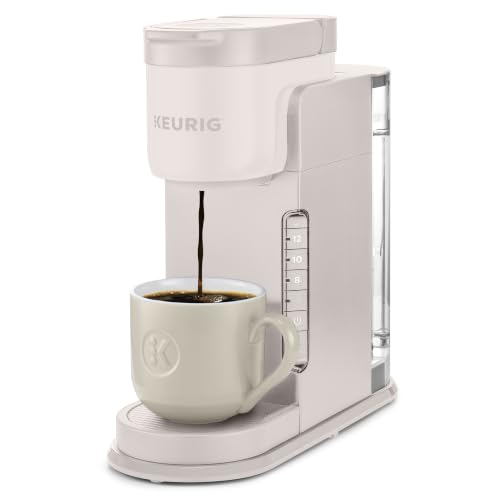
Keurig K-Express (Warm Stone)
Badge: Best Statement Finish
Strengths
- Identical proven K-Express layout to the Black version, in a softer Warm Stone finish
- 42 oz removable reservoir suits a household making several cups a morning
- Strong Brew button and three sizes give simple control without menus
Trade-offs
- You are paying for a colour, not for extra brewing ability, versus other K-Express finishes
- Pod-only format keeps running costs and waste tied to capsules
- One cup at a time is a real limit for a busy shared kitchen at peak time
At a glance
- Format: Single serve, K-Cup pods
- Brew sizes: 3 brew sizes
- Reservoir: 42 oz, removable
- Feature: Strong Brew button
- Travel mug friendly
- Finish: Warm Stone
Choose the Warm Stone K-Express when you like everything about the standard K-Express — the 42 oz removable reservoir, the three brew sizes, the Strong Brew button and travel mug clearance — but do not want another matte black appliance on the counter. Finish sounds like a trivial reason to pick one machine over another until you remember that a coffee maker is one of the few appliances that never gets put away. It sits in your eyeline every morning, and a warmer, lighter tone genuinely suits pale worktops, wood cabinetry and rental kitchens where a black block can look heavy. Mechanically there is nothing to separate this machine from its Black and Evergreen siblings, and this guide will not pretend otherwise. That honesty is actually a point in its favour: you are buying into a widely sold layout with a deep pod ecosystem and controls a guest can work out without instructions. What you are choosing here is purely how the same reliable routine looks in your kitchen.
Living with the Warm Stone finish is a small lesson in how colour changes housekeeping. The pale, warm tone shows coffee splashes honestly, which sounds like a flaw and behaves like a feature: the machine gets wiped little and often, and never reaches the state of grime that dark machines can hide until it is advanced. Mechanically the ownership rhythm is the shared K-Express one — reservoir at the sink, pods in a drawer, a strength button that becomes the household default within days. Owners who choose this finish tend to place the machine prominently, and prominent machines get maintained; the two facts are connected.
The honest comparative note on Keurig K-Express (Warm Stone) is that finish is its variable, not its engineering — which makes it the easiest pick here to choose with your eyes once the platform suits you.
Best for: buyers who want the K-Express routine in a softer, lighter kitchen scheme / Not suited for: buyers choosing on features alone, since the finish is the only difference here
Comparison Table
This table is the comparison in its purest form: inputs, water capacity and the single point that distinguishes each machine. Read it across for the machine, and down for the factor you care about — the two readings give different winners, which is exactly what a good comparison should reveal.
| Pick | Inputs | Reservoir / capacity | Standout point | Check |
|---|---|---|---|---|
| Keurig K-Express (Mint) | K-Cup pods | 42 oz removable | Mint finish | Check on Amazon |
| Hamilton Beach FlexBrew Advanced 4-in-1 | Pod packs and grounds | 45 oz removable | 4-in-1 hot and iced | Check on Amazon |
| Ninja Single Serve Coffee Maker PB051 | K-Cup pods and grounds | 56 oz removable | 4 brew styles, up to 24 oz cups | Check on Amazon |
| Keurig K-Elite (Brushed Silver) | K-Cup pods | See product page | Step-up Keurig line, Brushed Silver | Check on Amazon |
| Keurig K-Express (Black) | K-Cup pods | 42 oz removable | Strong Brew button | Check on Amazon |
| Keurig K-Express (Warm Stone) | K-Cup pods | 42 oz removable | Warm Stone finish | Check on Amazon |
If the table leaves you between two machines, the deciding question is almost always inputs: the machine that accepts the coffee you actually buy wins ties, because you will feed it thousands of times. For the chart on its own page, with the same discipline applied, see Best Home Brew Coffee Makers Comparison Chart.
How to Choose the Right Pick Among the Best home brew coffee makers comparison
Compare inputs before anything else. Pods offer the widest ready-made catalogue and zero measuring; grounds offer any coffee from any roaster and the lowest cost per cup; dual-format machines refuse the choice. In a comparison this axis dominates because it is the only one you cannot change later — a pods-only machine will never brew your bag of grounds, whatever its other virtues. Households divided on the question should weight dual-format picks heavily: the FlexBrew and Ninja in this shortlist exist precisely for them.
Compare water handling next. Three numbers matter and they are often confused. Reservoir capacity (42 oz on the K-Express platform, 45 oz on the FlexBrew, 56 oz on the Ninja) decides refilling frequency. Brew size range decides the smallest and largest single servings. Travel mug clearance decides whether your actual mug fits. A comparison that lists only one of the three misleads; a household with a tall travel mug and two drinkers needs all three answers to be yes.
Compare control honestly. A Strong Brew button, multiple brew styles and an iced mode are different kinds of control. Strength control changes the cup you already make; brew styles change which cups you can make; an iced mode adds a category. Rank them by your own drinking: the daily black-coffee drinker gains most from strength control, the varied household from styles, the summer drinker from iced. Control you will never touch is not a comparison win, it is decoration — a point worth remembering when a longer feature list tempts you, and one the testers behind Best Home Coffee Makers Consumer Reports style evaluations make in their own way.
Finally, compare the cost of the habit in tiers. Qualitatively, minis and simple grounds machines occupy the lower tier, reservoir pod machines the middle, and large-capacity or step-up models the upper tier of single serve. Running costs run the other way for pods versus grounds. A fair comparison holds both truths at once and lets your cups-per-day arithmetic, which only you know, pick the winner.
How to Run Your Own Side-by-Side Comparison at Home
A fair home comparison, step by step. 1) Use the same mug and the same target size on every machine. 2) Use the same coffee — the same pod type, or the same grounds measured the same way — so the machine is the only variable. 3) Time each brew from button press to finished cup, and note the noise; both matter at 6 a.m. 4) Taste blind if you can: have someone else pour, and rank the cups before knowing which is which. 5) Live with the winner’s routine for a day — refilling, emptying, wiping — because the comparison that matters includes the chores, not just the coffee.
Keeping any of these machines at its best. Fresh water in the reservoir, a drip tray emptied before it overflows, a splash zone wiped while fresh, and descaling on the maker’s schedule rather than the machine’s distress signals. Grounds machines add one rule: empty the reusable filter promptly and wash it properly, because yesterday’s grounds are tomorrow’s off flavour.
Troubleshooting. Problem: one machine’s cup tastes thinner than another’s at the same size → check for a strength setting before concluding anything; extraction options differ by design. Problem: a travel mug overflows or will not fit → the comparison failed at clearance and cup ceiling, so re-check those two numbers on the product page. Problem: brews slow down over months on any machine → descale; mineral build-up is the common cause across every brand in this guide.
The Differences That Actually Change the Cup
Of everything compared in this guide, three differences reach the cup itself. Brew size is the first: the same pod brewed small is concentrated, brewed large is diluted, so a machine’s size range is really a strength range in disguise. Strength settings are the second: a dedicated strong option exists to break that size-strength link, and in a side-by-side tasting it is the feature most likely to make one machine’s large cup beat another’s. Water freshness is the third, and it is unglamorous: a reservoir machine whose water sits for a week makes worse coffee than a mini filled fresh each time, which is why reservoir discipline appears in the how-to section.
Everything else compared here — reservoir size, clearance, modes, finish — changes the experience around the cup rather than the cup. That is not a dismissal. Experience is most of ownership. But a comparison that keeps the two categories separate, as this one tries to, stops buyers paying for experience features while expecting cup differences, or the reverse. The broader context in Best Home Brewing Coffee Makers makes the same distinction for the home-brewing routine as a whole.
When the Comparison Says Buy the Simpler Machine
Comparisons have a bias toward more: more modes, more sizes, more capacity. Ownership often rewards less. A one-button grounds machine has almost nothing to misunderstand, descale-neglect aside, and its cup depends on your coffee rather than its electronics. A mini has almost no footprint to resent. Several picks in this guide win their place precisely by declining to compete on breadth.
The practical test is the weekday test: imagine the machine at your most rushed, least patient moment. The pick whose routine still feels easy then is the comparison’s real winner for your household, whatever the table says. Charts inform; mornings decide.
Comparing Running Costs and Waste: the Columns Nobody Prints
Two honest comparisons rarely appear in buying guides because they cannot be reduced to a specification: what each format costs to run, and what it throws away. On cost, the tiers are structural rather than numerical. Ground coffee bought by the bag is the cheapest way to fill any of these machines per cup, by a wide and durable margin. Pods trade that economy for consistency and speed, and their per-cup premium is the price of never measuring, never dialling in and never drinking a badly made cup of your own making. Dual-format machines let a household arbitrage the two — grounds when time allows, pods when it does not — which is why, in a long comparison, they so often win households that a pure format would lose.
On waste the comparison runs in the same direction with one complication. Grounds brewing produces compostable waste and a reusable filter; pod brewing produces a small used capsule per cup. The complication is behaviour: a grounds household that brews a pot-sized habit into single cups wastes little, while a pod household that would otherwise throw away half-pots of stale batch coffee may waste less coffee itself even as it generates capsule waste. Honest comparison holds both ledgers — packaging and coffee — rather than declaring a winner from one column.
The practical conclusion for a comparing buyer is to estimate your household’s cups per day and multiply mentally across a year. At one cup a day, format economics are a rounding error and convenience should decide. At four or five cups a day across a household, the running-cost column quietly becomes the largest number in the whole comparison — larger, over the machine’s life, than any difference between the machines themselves. That is why this guide compares inputs first and finishes last: the chart’s least photogenic column is its most expensive one.
Common Buying Mistakes
Comparing colour variants as if they were rivals. K-Express finishes share one platform; ranking them against each other on performance manufactures a difference that does not exist. Counting brew sizes instead of checking the ceiling. Three sizes that top out below your travel mug lose to two sizes that fill it. Letting one feature stand for the machine. An iced mode is valuable only to iced drinkers; a strength button only matters if you brew large cups. Ignoring inputs. The prettiest comparison win is worthless if the machine will not accept the coffee already in your cupboard. Forgetting the chores. Reservoirs, filters and drip trays are part of every pick; compare the cleaning routine with the same care as the brewing one.
Final Recommendation
If this comparison must produce one name, it is Keurig K-Express (Mint) — not because it wins every row, but because its balance of reservoir, sizes and strength control is the one the fewest households will outgrow. Households split between pods and grounds should step sideways to Hamilton Beach FlexBrew Advanced 4-in-1, whose dual-format design settles the inputs argument permanently. And buyers drawn to a step-up badge should examine Keurig K-Elite (Brushed Silver) closely, confirming its current feature list on the product page before paying for the tier. Compare on inputs, water and control — then let colour be the reward for deciding well.
A Last Word on Comparing Well
Comparison is a skill with a characteristic failure mode: it rewards the measurable and quietly taxes everything else. The machines in this guide can be lined up by reservoir, by cup ceiling, by inputs and by modes, and the lining-up is genuinely useful — it is most of what the reviews and tables here are for. But the cup you drink on a wet Wednesday is not in any table. It depends on the coffee you chose, the size you brewed it at, the freshness of the water and whether the machine’s routine made you want to use it properly or cut corners. Hold the comparison firmly for what it decides — format, capacity, fit — and loosely for what it cannot. The buyer who does both ends up with the right machine and the right expectations, which together are what satisfaction is actually made of.
Frequently Asked Questions
What is the fairest way to compare two coffee makers?
Hold everything else constant: same mug, same size, same coffee, and judge the cup, the time, the noise and the cleaning routine together. Most unfair comparisons — and most disappointing purchases — come from changing the coffee and the machine at the same time.
Does a bigger reservoir make better coffee?
No — it makes coffee more convenient, which is different. A reservoir changes how often you refill, not how the machine brews. Its only flavour risk is stale water, avoided by refreshing the reservoir regularly.
Are pods or grounds better in a comparison?
Pods win on speed, consistency and catalogue; grounds win on choice of coffee and cost per cup. Dual-format machines exist because neither answer suits every household, and they are the honest compromise.
Why do the K-Express colours appear as separate picks?
Because that is how they are sold and chosen — but they are one platform. Treat them as one machine in three finishes: identical brewing, different looks and different visibility of drips and dust.
What does a brew style setting do that a size setting does not?
Size changes how much water goes through the coffee. Style settings aim to change how the brew itself behaves — strength and character rather than volume — which is why the Ninja’s four styles are a different kind of control from a size dial.
Is iced coffee from a single serve machine any good?
It can be, provided the brew is strong and small enough to survive dilution over ice. Machines with a dedicated iced mode are designed around that maths; with other machines, brew the smallest strong cup over a full glass of ice.
Which compared machine suits a two-person household best?
A reservoir machine — the 42 oz class and above — because back-to-back cups are where fill-each-time minis lose their charm. Between reservoir models, decide on inputs and cup-size ceiling.


