Disclosure: topratedkitchenware.com is reader-supported. When you buy through links on our site, we may earn an affiliate commission from Amazon and other retailers, at no extra cost to you.
Where to buy
Every pick in this guide to the best home coffee makers consumer reports is sold through Amazon, where you can check the latest price on Amazon, confirm the finish in stock and read the current product page for the exact feature list. The short list below is the whole guide in miniature — follow the detailed reviews further down before deciding, or go straight to a pick you already recognise.
- Tastyle Mini Single Serve Hot and Iced Coffee Maker (K310IC) — Best First Buy.
- Keurig K-Express Single Serve Coffee Maker, Evergreen — Best for Bright Kitchens.
- Keurig K-Express Single Serve Coffee Maker, Mint — Best No-Pod Pick.
- Hamilton Beach FlexBrew Advanced 4-in-1 Single Serve Coffee Maker — Best Dorm Pick.
- Ninja Single Serve Coffee Maker (PB051) — Best Hot and Iced.
- Keurig K-Elite Single Serve K-Cup Pod Coffee Maker, Brushed Silver — Best Classic Look.
Read the full guide ↓ for the strengths, trade-offs and honest limitations behind each name on that list.
Introduction: Finding the best home coffee makers consumer reports
Searching for the best home coffee makers consumer reports usually means you want the lab-coat view: machines judged by repeatable tests, consistent criteria and reliability thinking, rather than by marketing or by whoever shouts loudest online. This guide honours that intent without impersonating any testing organisation. No scores from any consumer testing body are quoted here, no test results are invented, and no pick is described as recommended by anyone but this guide. What you get instead is the consumer-reports style of thinking applied openly: standardised criteria, verified specifications, trade-offs stated in plain language, and a clear account of what would need hands-on laboratory work to truly settle.
The six machines assessed are the mainstream home single serve field: a dual-format Tastyle Mini, the K-Express platform in Evergreen and Mint, the Hamilton Beach FlexBrew, the large-capacity Ninja PB051 and Keurig’s step-up K-Elite. They are assessed on the criteria a test programme would use for this category — brewing consistency potential, capacity and convenience, format flexibility, ease of use, ease of cleaning and the ownership picture — using verified listing information as the evidence base. Readers who want the general market guide can find it at Best Home Kcup Coffee Makers; readers who want a neighbouring category assessed the same way can use Best Home K Pod Coffee Makers.
Two cautions belong at the front of any test-style guide. First, specification is not performance: a chart can verify that a machine offers a strength setting, but only repeated measured brewing can verify how consistent its cups are across a month — which is why this guide grades evidence as carefully as machines. Second, reliability is a years-long question that no new-product guide can answer from listings; the honest proxies available are brand track record, simplicity of design and the availability of parts and support, and those proxies are labelled as proxies wherever they are used.
Key Takeaways
- This guide applies test-style criteria — consistency, capacity, flexibility, usability, cleaning, ownership — but invents no scores and quotes no external test results.
- Verified specifications are the evidence base; where a listing is brief (the K-Elite), the assessment says so and withholds judgement accordingly.
- Dual-format machines (Tastyle, FlexBrew, Ninja) score their advantage on flexibility criteria, not on claimed taste superiority.
- Reliability cannot be read from a listing — brand history, design simplicity and support are used as labelled proxies, not as data.
- The most test-worthy difference in this field is measurable and mundane: reservoir size, cup-size ceiling and the presence of strength control.
In this guide
Quick Picks
The table below condenses the best home coffee makers consumer reports shortlist. Badges are used consistently here and in the detailed reviews, so you can jump between the summary and the full review of any pick without losing track of why it earned its place.
| Pick | Badge | Format | Best for | Check |
|---|---|---|---|---|
| Tastyle Mini Single Serve Hot and Iced Coffee Maker | Best First Buy | Single serve, K-Cup pods and ground coffee | Best First Buy | Check on Amazon |
| Keurig K-Express (Evergreen) | Best for Bright Kitchens | Single serve, K-Cup pods | Best for Bright Kitchens | Check on Amazon |
| Keurig K-Express (Mint) | Best No-Pod Pick | Single serve, K-Cup pods | Best No-Pod Pick | Check on Amazon |
| Hamilton Beach FlexBrew Advanced 4-in-1 | Best Dorm Pick | Single serve, pod packs and grounds | Best Dorm Pick | Check on Amazon |
| Ninja Single Serve Coffee Maker PB051 | Best Hot and Iced | Single serve combo machine, K-Cup pods and grounds | Best Hot and Iced | Check on Amazon |
| Keurig K-Elite (Brushed Silver) | Best Classic Look | Single serve, K-Cup pods | Best Classic Look | Check on Amazon |
How These Picks Were Chosen
The assessment method mirrors what a careful test programme does before any machine is switched on: define the criteria in advance, gather the same evidence for every candidate, and refuse to fill gaps with reputation. Evidence here means verified listing information — format, inputs, brew sizes, reservoir capacity, named features and finish — collected identically for all six picks. Every factual claim in the reviews traces to that evidence. Where the evidence is thin, most clearly the K-Elite’s brief verified title, the review narrows its claims to what the evidence supports and directs readers to the product page for the current full feature list.
Criteria were weighted for home use rather than novelty. Consistency potential (strength control, sensible size ranges) and daily convenience (reservoir, format) lead, because test programmes consistently find ownership satisfaction tracks those more than exotic modes. Flexibility follows, cleaning and usability are assessed from design evidence — removable reservoirs, dishwasher-safe parts, auto shut-off — and the ownership picture (pod commitment versus grounds freedom) is treated as a criterion in its own right. This is a desk assessment in the test style, not laboratory testing, and it never claims otherwise. Households cross-checking categories will find adjacent assessments in Best Home Coffee Makers With Grinder and the wider guides linked throughout.
The 6 Best Options for Best home coffee makers consumer reports
Each assessment below follows the same order a test report would: what the machine verifiably is, its strengths against the criteria, its trade-offs against the same criteria, and a verdict separating the household the evidence supports buying it from the household it does not. Badges summarise the assessment and are used identically in the Quick Picks.
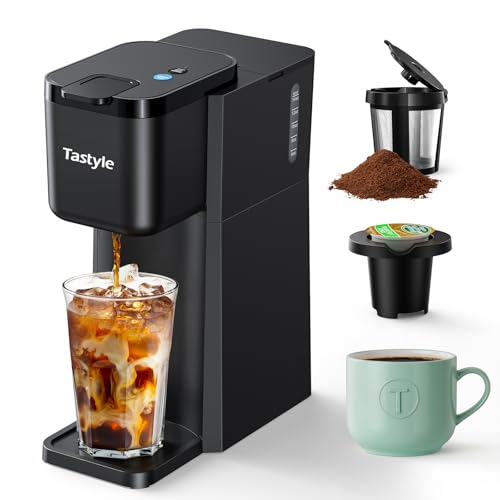
Tastyle Mini Single Serve Hot and Iced Coffee Maker
Badge: Best First Buy
Strengths
- Takes both K-Cup pods and ground coffee, the widest input choice among the mini machines here
- A dedicated iced coffee mode answers a use case most single serve machines ignore
- A 6 to 14 oz size range is unusually flexible for a mini machine
Trade-offs
- Mini format still means one serving at a time and frequent refilling
- Iced results depend heavily on using enough ice and a suitable pod or grounds dose
- A less established brand than Keurig, so long-term parts and support are a bigger unknown
At a glance
- Format: Single serve, K-Cup pods and ground coffee
- Brew sizes: 6 to 14 oz
- Modes: Hot and iced coffee
- Includes: Recipe book
- Power: 120V
- Model: K310IC, version 2.0
- Finish: Classic Black
The Tastyle Mini K310IC is the overachiever of this group. Where most mini machines narrow your options, this one widens them: K-Cup pods when you want speed, ground coffee when you want your own beans, hot coffee in the morning and a dedicated iced mode when the weather turns. The 6 to 14 oz range is well judged — small enough for a concentrated short cup, large enough for a proper mug over ice without overflowing it. The included recipe book sounds like a throwaway extra, but for iced drinks in particular it has a real job: iced coffee fails when it is brewed weak and then diluted, and a recipe that starts from the right strength fixes the most common disappointment. The listing’s own positioning — home, travel, RV, office and dorm — is honest about the format. This is a personal machine, not a family one, and its 120V rating marks it for North American outlets. Within that brief, few machines at this size offer this much choice.
Owning the Tastyle Mini is owning options, and the ownership skill is curation rather than maintenance. Households tend to settle, after a month of experimentation, into a pattern — pods on workdays, grounds at weekends, iced mode whenever the weather argues for it — and the recipe book earns its keep during exactly that settling period. The machine’s small water handling means the freshness discipline of minis applies: fill for the cup you are making, enjoy water that was never stored. Its one ownership question mark, stated plainly, is the support horizon of a younger brand; the counterweight is that the machine asks for so little — no proprietary ecosystem beyond the pods it also accepts — that its usefulness does not depend on any single company’s roadmap.
Assessed against the criteria, Tastyle Mini Single Serve Hot and Iced Coffee Maker is the flexibility outlier among the minis: it is the only small machine here whose evidence covers pods, grounds, hot and iced — breadth a test programme would credit, provided the buyer uses it.
Best for: single-cup drinkers who want pods, grounds, hot and iced from one mini machine / Not suited for: households brewing for a crowd, or buyers who prioritise a long-established brand name

Keurig K-Express (Evergreen)
Badge: Best for Bright Kitchens
Strengths
- Full K-Express reservoir and Strong Brew specification in a distinctive Evergreen finish
- Three brew sizes and travel mug clearance cover most single-cup routines
- A colour that works as a deliberate kitchen accent rather than an appliance apology
Trade-offs
- Same machine as the other K-Express finishes — no extra features for the colour
- Pod-only brewing, with no grounds option described
- Single-cup throughput is the standing limit of the format
At a glance
- Format: Single serve, K-Cup pods
- Brew sizes: 3 brew sizes
- Reservoir: 42 oz, removable
- Feature: Strong Brew button
- Travel mug friendly
- Finish: Evergreen
Evergreen is the K-Express for people who decorate on purpose. The specification is the familiar, sensible one — 42 oz removable reservoir, three brew sizes, Strong Brew button, travel mug friendly — but the deep green finish turns the machine from background equipment into a chosen object, the way a coloured stand mixer does. That matters more than specification sheets admit. Appliances in colours people actually like get kept on the counter, used daily and looked after; appliances people tolerate get shoved in cupboards and replaced. If your kitchen has plants, brass, wood or a retro streak, Evergreen will look intentional in a way black rarely does. Performance expectations should be set by the shared K-Express platform rather than the paint: a consistent, fast pod coffee, a strength button for larger cups, and a reservoir that removes the fill-every-time friction of mini machines. Buy it because the colour makes you happy every morning, and let the proven layout underneath handle the coffee.
The Evergreen K-Express tends to become a fixture in the decorative sense: owners place it where the colour works, guests comment on it, and it acquires the status of the coloured stand mixer — an appliance that is also a choice. Ownership mechanics are the family standard, reservoir and pods and a weekly wipe, with one finish-specific note: deep green shows dust and pale water marks more than it shows coffee, so its prompt is a dry cloth rather than a damp one. Because it is bought on purpose rather than by default, it is also, anecdotally among colourful-appliance owners generally, the machine least likely to be replaced on a whim — affection is a form of longevity.
On the evidence available, Keurig K-Express (Evergreen) presents the standard reservoir case cleanly: known capacity, known sizes, a named strength feature — an assessment with few unknowns, which is itself a consumer virtue.
Best for: style-led kitchens that want full K-Express ability in a deep green finish / Not suited for: minimalist monochrome kitchens, or buyers indifferent to finish

Keurig K-Express (Mint)
Badge: Best No-Pod Pick
Strengths
- Complete K-Express specification — reservoir, three sizes, Strong Brew — in a fresh Mint finish
- Light colour brightens small or windowless kitchens where black appliances crowd the eye
- Same broad K-Cup compatibility as every other K-Express
Trade-offs
- A pale finish will show coffee splashes and drip marks more readily than black
- Mechanically identical to the other K-Express colours, so compare finishes on looks and availability only
- Pod-only format, one cup at a time
At a glance
- Format: Single serve, K-Cup pods
- Brew sizes: 3 brew sizes
- Reservoir: 42 oz, removable
- Feature: Strong Brew button
- Travel mug friendly
- Finish: Mint
The Mint K-Express is the same sensible machine as its Black, Warm Stone and Evergreen siblings — 42 oz removable reservoir, three brew sizes, Strong Brew button, travel mug clearance — wearing the lightest finish in the family. Mint suits the kitchens the other colours do not: small, bright, white-tiled or pastel-leaning spaces where a black appliance reads as a hole in the room. One honest caution belongs with any pale appliance, and it is practical rather than discouraging: light finishes show the evidence. Coffee drips, splash marks around the drip tray and dust on the lid will all be more visible on Mint than on Black, so this is the finish for someone who wipes the counter as they go. In return you get a machine that looks fresh rather than industrial, on a platform with the deepest pod catalogue in single serve coffee. Treat the colour decision as a housekeeping decision as much as a style one, and Mint makes complete sense.
Mint’s ownership story is the story of a finish that keeps its owner honest. Coffee drips announce themselves on the pale surface immediately, the drip tray gets emptied before it overflows because the evidence would show, and the machine consequently tends to be the cleanest-kept appliance in kitchens that own it. The K-Express routine underneath is the familiar one — sink-filled reservoir, three sizes, strength button as the household default — and the light finish suits the morning light of small kitchens in a way owners mention disproportionately. If your temperament wipes as it goes, Mint rewards you daily; if it does not, choose a darker sibling and be at peace.
Keurig K-Express (Mint) repeats that same clean evidence picture in a second finish; a test-style guide records the platform once and treats the finish as a preference variable, exactly as it does here.
Best for: bright, light kitchens that want the full K-Express specification in a pale finish / Not suited for: messy counters and anyone who will not wipe up drips promptly

Hamilton Beach FlexBrew Advanced 4-in-1
Badge: Best Dorm Pick
Strengths
- Accepts both pod packs and grounds, so you are never locked into one format
- 45 oz removable reservoir is the largest among the pod-focused picks here alongside the Ninja
- Hot and iced modes in one machine cover the two main single serve jobs
Trade-offs
- A 4-in-1 design has more modes to learn than a one-button machine
- Still a single serve format — no carafe for a table of drinkers
- Using grounds well takes a little measuring discipline that pure pod machines never ask for
At a glance
- Format: Single serve, pod packs and grounds
- Modes: 4-in-1, hot and iced coffee
- Reservoir: 45 oz, removable
- Brewing: Fast brewing (per listing title)
- Finish: Black
The Hamilton Beach FlexBrew Advanced 4-in-1 is built around a refusal to make you choose a side. Pod packs on the mornings you are half awake, ground coffee on the mornings you care, hot coffee in winter and iced coffee in summer — one machine, a 45 oz removable reservoir, and no second appliance. That flexibility has a practical value beyond variety. Pod prices and availability fluctuate, blends come and go, and a machine that also brews grounds is insurance: whatever happens to your pod supply, the machine still makes coffee. The reservoir deserves its own mention, because at 45 oz it removes the most common single serve annoyance for multi-cup households — the constant refill — while staying removable for sink filling and proper washing. Hamilton Beach also has a long history in American kitchens, which counts for something in a category full of unfamiliar names. The cost of the flexibility is a slightly busier control experience than a one-button mini, and that is a fair trade for most households.
The FlexBrew’s ownership pattern is consolidation: households report the familiar arc of the second machine — the grounds brewer, the iced-tea-era gadget — quietly leaving the counter once one box covers pods, grounds, hot and iced. The 45 oz reservoir sets a refill rhythm of every few days for most homes, and the dual input trays mean the weekly shop no longer has a single point of failure: if the pods run out, the grounds carry the morning, and vice versa. Its ownership cost is a slightly richer set of parts to keep track of and wash, the fair price of a machine that replaced two.
The evidence for Hamilton Beach FlexBrew Advanced 4-in-1 supports a strong flexibility and capacity assessment — dual inputs, the joint-largest pod-class reservoir in this set, hot and iced — balanced against a busier control picture than one-button rivals.
Best for: households split between pods and grounds who also drink iced coffee / Not suited for: buyers who want the absolute simplest one-button experience

Ninja Single Serve Coffee Maker PB051
Badge: Best Hot and Iced
Strengths
- The largest reservoir here at 56 oz, plus the largest cup size at up to 24 oz
- Four brew styles give more control over the cup than a standard pod machine
- Pods and grounds in one machine, so format freedom matches the FlexBrew
Trade-offs
- The biggest capability here comes with the biggest presence on the counter
- Four styles are only useful if you actually experiment — creatures of habit may use one
- Grounds brewing adds a small measuring and cleaning routine to pod convenience
At a glance
- Format: Single serve combo machine, K-Cup pods and grounds
- Brew styles: 4 styles of brewing
- Cup sizes: Up to 24 oz
- Reservoir: 56 oz, removable
- Finish: Black
- Model: PB051
The Ninja PB051 is the maximalist answer in this line-up: pods and grounds, four brew styles, cup sizes up to 24 oz and a 56 oz removable reservoir — the largest water capacity and the largest single serving of any pick in this guide. Those numbers solve real problems. The reservoir ends refill fatigue in a multi-person home. The 24 oz ceiling covers the oversized travel mug that smaller machines simply cannot fill in one cycle. And four brew styles acknowledge something most pod machines ignore, which is that the same household often wants a normal cup on Tuesday and something stronger or richer at the weekend. Ninja’s wider reputation is for over-delivering on specification at a given tier, and the PB051 follows that pattern on paper: it is the pick for the buyer who reads a comparison chart and wants the row with the fewest gaps. The honest cost is size and complexity. This is not the machine for a cramped dorm desk, and its talents are wasted on anyone who presses one button the same way forever.
The Ninja PB051 is owned the way a range cooker is owned: as the kitchen’s designated heavy lifter. The 56 oz reservoir stretches refills across the busiest multi-cup stretches, the 24 oz ceiling ends the two-cycle travel mug ritual, and the four styles give the household experimenter a sanctioned playground that keeps the experimenting inside one machine. Its footprint means the counter is arranged around it rather than it fitting around the counter, a commitment owners should make consciously. In return, it is the pick in this guide least likely to be outgrown: households change, mugs get bigger, tastes diversify, and the PB051’s headroom absorbs all three.
Ninja Single Serve Coffee Maker PB051 tops the measurable columns of this assessment — reservoir, cup ceiling, brew styles — and a test-style reading adds the obvious corollary: capability unused is capability wasted, so its verdict turns on household size.
Best for: multi-cup homes wanting the biggest reservoir, biggest cup size and most brew styles / Not suited for: tiny counters, dorm desks and one-button minimalists

Keurig K-Elite (Brushed Silver)
Badge: Best Classic Look
Strengths
- The K-Elite name sits above the K-Express in Keurig’s own line-up, aimed at buyers wanting the step-up model
- Brushed Silver is the most conventional premium-look finish among these picks
- Full K-Cup compatibility, with the ecosystem depth that comes with the Keurig name
Trade-offs
- The verified listing title for this pick is brief, so buyers should confirm the exact feature set on the product page before ordering
- Premium positioning within a pod range still means pod running costs
- Single serve format — one cup at a time, however upmarket the finish
At a glance
- Format: Single serve, K-Cup pods
- Brand line: Keurig K-Elite
- Finish: Brushed Silver
The K-Elite in Brushed Silver is the step-up Keurig in this selection: the model line Keurig positions above the K-Express family, in the finish most buyers associate with a premium countertop appliance. A note on method matters here, because the verified title for this pick is unusually short — it confirms the K-Elite name, the single serve K-Cup format and the Brushed Silver finish, and this guide deliberately builds no specification claims beyond that. The product page is the place to confirm the current feature list before buying, and that two-minute check is worth doing on any step-up model. What can be said confidently is about positioning and ecosystem. A K-Elite buyer is paying for Keurig’s higher tier rather than its entry point, and for the deepest pod catalogue in the business — every roast, brand collaboration and seasonal blend in the K-Cup world is made for machines like this. Brushed Silver also ages gracefully in a kitchen full of stainless appliances, where coloured finishes can clash.
Ownership of the K-Elite begins with a homework step this guide repeats deliberately: read the live product page, confirm the current feature set for the Brushed Silver model, and set the machine up against that list rather than against assumptions borrowed from other Keurigs. From there, ownership is the Keurig pattern at its most established — the deepest pod catalogue in the category, controls in the family idiom, and a finish that sits comfortably among stainless appliances without demanding to be a centrepiece. The step-up buyer’s real dividend is ecosystem depth: seasonal blends, brand collaborations and replacement availability all favour the platform with the largest installed base, and the K-Elite sits squarely on it.
Keurig K-Elite (Brushed Silver) is where this guide’s evidence discipline bites hardest: the verified listing confirms line, format and finish only, so the assessment credits its step-up positioning and ecosystem, and explicitly leaves feature-level judgement to the product page.
Best for: buyers stepping up within the Keurig range who want a stainless-look finish / Not suited for: buyers who need a fully confirmed feature list before spending on a step-up model
Comparison Table
The table is the assessment at a glance: inputs, water capacity and the distinguishing verified point for each machine. It contains no scores, because the evidence gathered here supports comparison of specifications, not laboratory ranking — and printing numbers the evidence cannot carry would fail the standard this guide is written to.
| Pick | Inputs | Reservoir / capacity | Standout point | Check |
|---|---|---|---|---|
| Tastyle Mini Single Serve Hot and Iced Coffee Maker | K-Cup pods and grounds | 6 to 14 oz brew sizes | Hot and iced modes | Check on Amazon |
| Keurig K-Express (Evergreen) | K-Cup pods | 42 oz removable | Evergreen finish | Check on Amazon |
| Keurig K-Express (Mint) | K-Cup pods | 42 oz removable | Mint finish | Check on Amazon |
| Hamilton Beach FlexBrew Advanced 4-in-1 | Pod packs and grounds | 45 oz removable | 4-in-1 hot and iced | Check on Amazon |
| Ninja Single Serve Coffee Maker PB051 | K-Cup pods and grounds | 56 oz removable | 4 brew styles, up to 24 oz cups | Check on Amazon |
| Keurig K-Elite (Brushed Silver) | K-Cup pods | See product page | Step-up Keurig line, Brushed Silver | Check on Amazon |
Read the table as a test engineer would: the columns are the criteria, and the winner changes with the weighting. Weight capacity and the Ninja leads; weight flexibility per footprint and the Tastyle leads; weight simplicity and the grounds and mini machines rise. Your weighting is your household’s, and the reviews exist to help you set it. The narrative comparison behind this grid is at Best Home Grind And Brew Coffee Makers.
How to Choose the Right Pick Among the Best home coffee makers consumer reports
Buy on criteria, in a fixed order. Test-style buying works because the order is decided before the shopping starts. For home coffee makers the defensible order is: format and inputs (the years-long commitment), capacity (reservoir and cup ceiling against your household’s busiest morning), control (strength and styles you will genuinely use), cleaning design (removable, washable, auto shut-off), and only then brand tier and finish. Buyers who reverse that order — finish first, format discovered later — generate most of this category’s returns.
Demand evidence for claims, including ours. Every specification in this guide is attributed to a verified listing, and you should hold any guide to the same standard. Claims that cannot be sourced — exact temperatures, pump pressures, durability figures — should be treated as decoration wherever you meet them. For the K-Elite in this shortlist, the verified listing is brief; the correct consumer response is not suspicion but homework: open the product page, read the current feature list, and let the assessment proceed on facts.
Price reliability thinking into the decision. No listing can prove a machine will last, but consumers can still reason: established brands with deep installed bases tend to support parts and answer questions longer; simpler machines have fewer systems to fail; formats with multiple manufacturers’ ecosystems strand owners less often. These are heuristics, labelled as such, and they are the honest maximum available at purchase time. The same long-view thinking applies to running costs — pods versus grounds is a multi-year ledger that dwarfs small differences in machine tier, a point Best Home K Pod Coffee Makers cost discussions develop for the general buyer.
Use ratings the way a tester would: as questions, not answers. Owner reviews are evidence about failure modes and frustrations, best read for patterns — repeated mentions of the same leak, the same lid, the same frustration — rather than for averages. Averages blend model years and misuse; patterns survive both. Read for the pattern, check whether the pattern touches your use case, and let specifications and criteria make the final call.
How to Assess a Coffee Maker Like a Tester
A home assessment protocol, step by step. 1) Define your criteria before shopping and write them down — format, capacity, control, cleaning — so a persuasive listing cannot quietly redefine them. 2) Gather the same evidence for every candidate: format, sizes, reservoir, named features, from the maker’s own listing. 3) In the first week of ownership, run the consistency check a tester would: same coffee, same size, five consecutive cups across different days, tasted for sameness rather than excellence. 4) Time the full routine — fill, brew, empty, wipe — because ownership cost is measured in minutes as much as money. 5) Record the chores honestly for a fortnight before judging; most dissatisfaction is chore dissatisfaction wearing a taste disguise.
Care, on the evidence. The maintenance that protects measured performance is unglamorous: fresh reservoir water, emptied drip trays, washed removable parts, prompt emptying of grounds filters, and descaling on the maker’s schedule — scale being the variable most likely to make a good machine test badly in your own kitchen.
Troubleshooting. Problem: cups vary in strength day to day → standardise size and coffee first; variation usually enters through the user, not the machine. Problem: brew times lengthen over months → descale and re-time before concluding decline. Problem: a feature in a review seems absent on your unit → check the current product page for your exact model and finish; listings and variants change, and the page outranks any guide, including this one.
What Laboratory Testing Can and Cannot Tell You About Coffee
A test laboratory brings real gifts to coffee: repeatability, measurement and independence. It can tell you whether a machine’s cups are consistent, how long it takes, how hot it serves and how its parts survive standardised wear — questions a reviewer with one machine and one morning cannot answer. For a category bought on autopilot, that discipline is valuable, and this guide borrows its criteria gratefully.
What the laboratory cannot tell you is whether you will like the coffee, whether the machine’s chores fit your kitchen, or whether its finish will please you in February. Those are household questions, and they decide ownership happiness at least as much as measured consistency. The mature consumer uses both instruments: test-style evidence to eliminate the unsound, and household judgement to choose among the sound. Any guide that offers only one of the two — including a guide that hides behind scores — is giving you half a decision.
Reading Any Coffee Maker Guide Critically, Including This One
Four questions expose most weak buying guides. Are specifications sourced, or merely asserted? Are trade-offs printed as prominently as strengths? Are prices and ratings presented as live links to check, or as fixed numbers that will rot? And does the guide admit the limits of its own method? This guide’s answers are on the page: verified listings as the evidence base, three trade-offs per pick, check-price links instead of printed prices, and an explicit statement that the assessment is desk-based rather than laboratory work.
Apply the same four questions wherever you research — retailer pages, video reviews, forums discussing machines like those in Best Home Singe Serve Coffee Makers — and the information market becomes much easier to navigate. Scepticism is not the enemy of a good purchase; it is the method of one.
Evidence Quality in This Guide: What Is Verified, What Is Judgement, What Is Unknown
A test-style guide owes its readers an evidence map, so here is this one’s, in three parts. Verified: every specification printed in this guide — formats, brew sizes, reservoir capacities, named features such as the Strong Brew button, the FlexBrew’s 45 oz reservoir, the Ninja’s 56 oz reservoir and 24 oz cup ceiling, the Tastyle’s 6 to 14 oz range and iced mode, the Elite Gourmet’s 600W rating and reusable filter — comes from the picks’ verified listing information, gathered on the same basis for all six machines. If a claim in these pages has a number in it, that is where the number lives.
Judgement: the badges, the ordering, the weighting of criteria and the verdicts are editorial judgement, and they are labelled as such by being visibly different in kind from the specifications. Judgement can be argued with — a household that weights footprint above capacity will reorder these picks, correctly for itself — and a guide that hides its judgements inside pseudo-measurements denies readers that argument. Where this guide’s judgement does real work, in the final recommendation, the weighting is stated so you can re-weight it.
Unknown: three things no desk assessment can know, stated plainly. Long-term reliability of each model, which only years and service data reveal. Measured brew performance — temperatures, times, consistency across hundreds of cycles — which only laboratory work establishes. And the current feature list of any model whose verified listing is brief, the K-Elite here, which only its live product page can settle. A guide that admits its unknowns is not weaker for it; it is the only kind whose knowns deserve trust. Buy with the verified, decide with the judgement, and check the unknowns that matter to you before the box is opened.
Common Buying Mistakes
Treating a score as a substitute for criteria. A single number cannot know your household’s size, format preference or counter. Believing unsourced specifications. If a temperature or pressure figure has no maker source, it is decoration. Judging reliability from newness. New models have no track record by definition; reason from brand support and design simplicity instead. Reading review averages instead of patterns. Repeated specific complaints are data; blended averages are weather. Skipping the product page on briefly-listed models. Where evidence is thin — the K-Elite here — the live listing is part of the purchase process, not an optional extra.
Final Recommendation
On the criteria as weighted for a typical home — format flexibility, capacity, control and cleaning — the evidence supports Tastyle Mini Single Serve Hot and Iced Coffee Maker as this shortlist’s most complete small machine, with the explicit condition that its breadth suits households who will use pods, grounds and iced modes rather than admire them. Reservoir households should take the K-Express platform, represented here by Keurig K-Express (Evergreen), whose evidence picture is the cleanest in the set. And households whose mornings stack cups should step up to Hamilton Beach FlexBrew Advanced 4-in-1, the dual-format reservoir machine whose capacity the criteria reward. Decide your weighting first; the table and the assessments will do the rest honestly.
A Last Word on Standards of Evidence
The habit this guide most hopes to leave behind is not a machine choice but a reading habit: ask of every claim who verified it, of every number where it was measured, and of every verdict what it is weighted on. Coffee makers are a gentle place to practise — the stakes are breakfast, not surgery — but the habit transfers to every purchase where marketing speaks louder than evidence. Here, the evidence was verified listings, the judgements were labelled, and the unknowns were named. If those three disciplines seemed demanding, consider that they are simply what a good test report does quietly on every page. Demand them everywhere, and the guides that survive your demand — this one included, on its merits — will be the ones worth following.
Frequently Asked Questions
Does this guide quote Consumer Reports test results?
No. No external testing organisation’s scores or results are quoted or implied. This guide applies test-style criteria — consistency, capacity, flexibility, usability, cleaning, ownership — to verified specification evidence, and labels its conclusions as its own.
Why are there no numerical scores for the picks?
Because the evidence gathered — verified listings — supports comparing specifications, not ranking performance to decimal precision. Invented scores would look rigorous while being unfounded, which is the opposite of the standard this guide is written to.
How can I judge reliability before buying?
You cannot measure it from a listing. Reason from proxies, labelled as proxies: the brand’s installed base and support history, the simplicity of the design, and whether the format’s ecosystem is deep enough to outlast any single model.
What is the most useful specification to compare?
For daily life, reservoir capacity and cup-size ceiling — they decide refilling and whether your mug fills in one cycle. For long-term satisfaction, inputs: pods, grounds or both, because that commitment outlives every other feature.
A pick’s listing seems to list fewer features than expected. What should I do?
Treat the live product page as the authority and check it before buying — this guide flags the K-Elite’s verified listing as brief and deliberately claims no features beyond it. Listings are revised; pages are current in a way no guide can be.
Are owner star ratings worth reading at all?
Yes, but for patterns rather than averages. Repeated, specific complaints about the same part or behaviour are genuine evidence; a blended average across model years and use cases is not.
Which pick best fits a test-minded buyer on a small counter?
The Tastyle Mini: it is the only mini here whose verified evidence covers pods, grounds and hot-and-iced modes, so its flexibility-per-footprint leads the assessment — provided you will actually use that breadth.


