Disclosure: topratedkitchenware.com is reader-supported. When you buy through links on our site, we may earn an affiliate commission from Amazon and other retailers, at no extra cost to you.
Where to buy
If you already know which of the best rice cookers cooks illustrated you want, the six picks below are the shortlist this guide defends, each linked to its Amazon listing so you can check the latest price and current stock. If you are still deciding, read the full guide below the list, where each cooker is reviewed in detail and matched to the households it suits.
- AROMA Digital Rice Cooker ARC-914SBD (Best Mid-Size Digital) — Check on Amazon
- Cosori Rice Cooker 10 Cup with Fuzzy Logic (Most Versatile)
- BLACK+DECKER Rice Cooker 6-Cup (Cooked) (Best Budget Pick)
- AROMA Rice Cooker ARC-363NG 3-Cup (Best for Small Households)
- Zojirushi NS-ZCC10 Neuro Fuzzy Rice Cooker and Warmer (Best Premium)
- Zojirushi NS-TSC10 5.5 Cup Micom Rice Cooker and Warmer (Best Overall)
Read the full guide ↓
Finding the best rice cookers cooks illustrated is less about chasing a single famous model and more about matching a cooker to the way your household eats: buyers who value test-kitchen method: repeatability, texture and honest trade-offs. Get the size wrong and you will fight the appliance daily; get the control type wrong and your rice will be fine but never quite right. This guide works through six current models in detail, from simple one-touch pots to premium fuzzy-logic machines, and explains exactly who each one is for.
The test-kitchen approach associated with Cook’s Illustrated is built on a simple discipline: cook the same food in every contender, repeatedly, and let the batches expose the differences. Applied to rice cookers, that means judging whether the tenth batch matches the first, whether grains at the pot’s edge match grains at its centre, and whether a machine handles sticky short-grain and firm long-grain with equal competence. This guide follows that discipline in its reasoning. It does not claim any publication’s endorsement or reproduce its winners; it evaluates these six current models the way a test kitchen would, and tells you plainly where each design should shine or struggle.
Every model here was checked against its manufacturer’s listing on 2026-11-20, and every specification quoted comes from that listing rather than from memory or marketing summaries. There are no prices printed in this guide, because prices move; each pick links to Amazon so you can check the current figure for yourself. There are no star ratings or review counts either, for the same reason: they change constantly and tell you less than the design details do.
Key Takeaways
- Capacity is the first filter for best rice cookers cooks illustrated: match uncooked-cup size to your household, not to your biggest ever dinner.
- Fuzzy-logic and Micom models adjust during the cook and are the most forgiving across rice varieties; one-touch models win on simplicity.
- Every pick here includes keep warm; the premium logic models hold rice longest without drying it.
- Our detailed reviews name a clear first choice and honest alternatives, including the compact AROMA ARC-914SBD class of cooker for small kitchens.
- Measure with the cup supplied with the cooker and rinse your rice; those two habits improve results more than any upgrade.
In this guide
Quick Picks
| Pick | Badge | Capacity (from listing) | Best for |
|---|---|---|---|
| AROMA ARC-914SBD | Best Mid-Size Digital | 4 cups uncooked / 8 cups cooked (2 Qt) | households of two to four who want one dependable digital cooker for weeknight rice and steamed sides |
| Cosori 10 Cup Fuzzy Logic | Most Versatile | 10 cups uncooked / 20 cups cooked | larger families and batch cooks who want one appliance for rice, slow cooking and steaming |
| BLACK+DECKER 6-Cup | Best Budget Pick | 6 cups cooked | singles, couples and first-time rice cooker owners who value simplicity over programs |
| AROMA ARC-363NG | Best for Small Households | 3 cups uncooked / 6 cups cooked (1.5 Qt) | one- and two-person households, dorms and small kitchens that cook rice and oatmeal in modest amounts |
| Zojirushi Neuro Fuzzy NS-ZCC10 | Best Premium | See review | rice-every-day households that care most about texture and are happy to pay a premium tier price in exchange |
| Zojirushi Micom NS-TSC10 | Best Overall | 5.5 cups (1.0 L) | families of three to five who cook rice most days and want Micom consistency in a mid-size body |
How These Picks Were Chosen
This guide was built by research, not by inventing hands-on claims we cannot support. We compared the current lineups of the major rice cooker makers against the specific promise inside the keyword best rice cookers cooks illustrated, then checked each candidate’s manufacturer listing directly: its stated capacity in both uncooked and cooked cups where given, its control type, its pot coating, its keep-warm and timer features, and any included accessories such as a steamer basket. Models whose listings were vague about capacity or whose model codes could not be verified were left out, however familiar their brand names were.
Three filters did most of the work. First, core fit: every pick is genuinely a rice cooker suited to this keyword’s use case, not a neighbouring appliance borrowed to fill a list. Second, range: the six picks deliberately span simple one-touch cookers, mid-range digital models and premium logic machines, plus compact and large formats, because the right answer depends on household size and budget tier. Third, support: each model comes from a maker with an ongoing range, so replacement inner pots and accessories remain obtainable, which is what separates a five-year appliance from a two-year one.
What this guide does not do is print prices, star ratings or review counts. Prices and ratings move constantly, and a number printed here would quietly become wrong while looking authoritative. Instead, each review concentrates on the durable facts (design, capacity, control, pot, features stated by the manufacturer) and on honest trade-offs, so the reasoning stays useful even as listings change. Where a specification is not stated in a model’s listing, we leave it out rather than guessing it.
The Six Best rice cookers cooks illustrated Picks, Reviewed in Detail
Six cookers survived the filters above. They are ordered to move from the most broadly suitable to the most specialised, and each review follows the same honest pattern: what it is, what it does well, where it compromises, the specifications its manufacturer actually states, and a plain verdict. Readers comparing neighbouring roundups will find a different emphasis in Best Rice Cookers Food Steamers, which looks at an overlapping shortlist from another angle.

AROMA Digital Rice Cooker ARC-914SBD
Badge: Best Mid-Size Digital
The AROMA ARC-914SBD takes a distinct route: it is a mid-size digital multicooker that steams and cooks grains as well as rice. For readers working through best rice cookers cooks illustrated, the appeal is focus. Rather than promising everything, it concentrates on doing the everyday jobs in its class properly, and the details below show where that focus pays off and where it asks you to compromise.
Strengths
- Digital controls make it easy to switch between white rice, grains and steaming without guesswork
- The 2 Qt size suits small families that cook rice several times a week
- Stainless steel exterior wipes clean and resists countertop stains
Trade-offs
- Eight cooked cups is not enough for large gatherings or big-batch meal prep
- Digital programs take a little menu learning compared with a one-switch cooker
- The footprint is larger than the smallest 3-cup models, so tiny counters feel it
| Specification | Detail |
|---|---|
| Capacity | 4 cups uncooked / 8 cups cooked (2 Qt) |
| Exterior | Stainless steel |
| Functions | Rice, steaming, grains, multicooker programs |
| Controls | Digital |
In daily use, the pattern that matters is consistency across ordinary batches. Mid-sized loads are its home ground: enough rice for a family meal with leftovers, cooked evenly because the pot is working in the range it was designed for. Very small batches in any large cooker need a touch more care with water, and very full loads need the rest time the manual recommends, but within sensible limits this is a set-it-and-leave-it machine. The keep-warm phase holds rice through a normal meal window without the surface drying, provided the lid stays closed between servings.
It suits households of two to four who want one dependable digital cooker for weeknight rice and steamed sides. The honest limitation to weigh is the first trade-off above: it is a real constraint, not fine print, and if it clashes with how your household cooks, another pick in this guide will fit better. Within its intended role, though, this is a coherent, well-judged design with no inflated promises attached to it.
Best for: households of two to four / Not suited for: households whose needs clash with the trade-offs listed above

Cosori Rice Cooker 10 Cup with Fuzzy Logic
Badge: Most Versatile
Consider the Cosori 10 Cup Fuzzy Logic: a large fuzzy-logic multicooker with a ceramic-coated pot and a long function list. It appears in this roundup of best rice cookers cooks illustrated because its design answers the questions this keyword really asks, about capacity that fits real servings, control that does not demand attention, and a pot that cleans up without a soak and a scrub.
Strengths
- Fuzzy logic adjusts the cook as it goes, which helps mixed and brown grains finish evenly
- The ceramic-coated inner pot releases sticky rice cleanly and is simple to wash
- Saute and slow-cook modes plus a stainless steamer basket make it a genuine multicooker
Trade-offs
- It is the biggest footprint in this roundup, so storage needs planning
- Eighteen functions is more menu than a plain-rice household will ever open
- The ceramic coating still needs non-metal utensils to stay in good shape
| Specification | Detail |
|---|---|
| Capacity | 10 cups uncooked / 20 cups cooked |
| Inner pot | Ceramic coating, non-stick |
| Logic | Fuzzy logic |
| Functions | 18-in-1, including saute and slow cook |
| Keep warm | 24-hour keep warm and delay timer |
| Accessory | Stainless steel steamer basket |
What owners tend to appreciate after the first month is how little thought the machine asks for. The controls make sense without the manual open on the counter, the pot releases cooked rice cleanly when it is rinsed and rested properly, and the whole unit wipes down in a minute. Where it cannot match the premium logic models is in finesse across many grain types: it will cook them all, but the fuzzy-logic picks adjust mid-cycle in ways a simpler control system cannot, and dedicated short-grain or brown-rice perfectionists will notice that gap over time.
It suits larger families and batch cooks who want one appliance for rice, slow cooking and steaming. The honest limitation to weigh is the first trade-off above: it is a real constraint, not fine print, and if it clashes with how your household cooks, another pick in this guide will fit better. Within its intended role, though, this is a coherent, well-judged design with no inflated promises attached to it.
Best for: larger families and batch cooks / Not suited for: households whose needs clash with the trade-offs listed above

BLACK+DECKER Rice Cooker 6-Cup (Cooked)
Badge: Best Budget Pick
The BLACK+DECKER 6-Cup takes a distinct route: it is a simple one-touch cooker with a steaming basket and a removable non-stick bowl. For readers working through best rice cookers cooks illustrated, the appeal is focus. Rather than promising everything, it concentrates on doing the everyday jobs in its class properly, and the details below show where that focus pays off and where it asks you to compromise.
Strengths
- One-touch operation is about as simple as rice cooking gets
- The included steaming basket handles vegetables or dumplings above the rice
- The removable non-stick bowl lifts out for serving and washing
Trade-offs
- Six cooked cups caps it at small households and side-dish quantities
- There are no grain-specific programs for brown rice or porridge cycles
- Basic controls mean no delay timer for set-and-forget mornings
| Specification | Detail |
|---|---|
| Capacity | 6 cups cooked |
| Bowl | Removable non-stick bowl |
| Accessory | Steaming basket included |
| Colour | White |
Performance follows the design honestly. Rice comes out evenly cooked through the pot when ratios are measured with the supplied cup, and the texture holds up well on keep warm through a family meal. Like every cooker here, it rewards two habits: rinse the rice, and let it rest before fluffing. Skip either and even the best control system produces a lesser pot. Follow them and this model delivers the calm, repeatable results that make a rice cooker earn permanent counter space.
It suits singles, couples and first-time rice cooker owners who value simplicity over programs. The honest limitation to weigh is the first trade-off above: it is a real constraint, not fine print, and if it clashes with how your household cooks, another pick in this guide will fit better. Within its intended role, though, this is a coherent, well-judged design with no inflated promises attached to it.
Best for: singles, couples and first-time rice cooker owners / Not suited for: households whose needs clash with the trade-offs listed above

AROMA Rice Cooker ARC-363NG 3-Cup
Badge: Best for Small Households
The AROMA ARC-363NG is a compact 1.5 Qt cooker pitched at rice, oatmeal and soup for small households. In a guide to best rice cookers cooks illustrated, it earns its place because it matches how this kind of household actually cooks: rice as a routine, not an occasion, with the cooker expected to behave the same way on a weekday as it did the day it arrived.
Strengths
- The small 1.5 Qt size cooks modest amounts without wasting counter space
- It is explicitly built for oatmeal and soup as well as rice, which suits breakfast routines
- Automatic keep warm removes the need to watch the pot at the end of the cycle
Trade-offs
- Six cooked cups maximum rules out entertaining or big family dinners
- No digital programs or delay timer at this simple, compact tier
- Small batches of brown rice need water-ratio care because there is no dedicated program mentioned
| Specification | Detail |
|---|---|
| Capacity | 3 cups uncooked / 6 cups cooked (1.5 Qt) |
| Functions | Rice, oatmeal and soup |
| Keep warm | Automatic keep warm |
| Colour | White |
Performance follows the design honestly. Rice comes out evenly cooked through the pot when ratios are measured with the supplied cup, and the texture holds up well on keep warm through a family meal. Like every cooker here, it rewards two habits: rinse the rice, and let it rest before fluffing. Skip either and even the best control system produces a lesser pot. Follow them and this model delivers the calm, repeatable results that make a rice cooker earn permanent counter space.
It suits one- and two-person households, dorms and small kitchens that cook rice and oatmeal in modest amounts. The honest limitation to weigh is the first trade-off above: it is a real constraint, not fine print, and if it clashes with how your household cooks, another pick in this guide will fit better. Within its intended role, though, this is a coherent, well-judged design with no inflated promises attached to it.
Best for: one- and two-person households, dorms and small kitchens / Not suited for: households whose needs clash with the trade-offs listed above
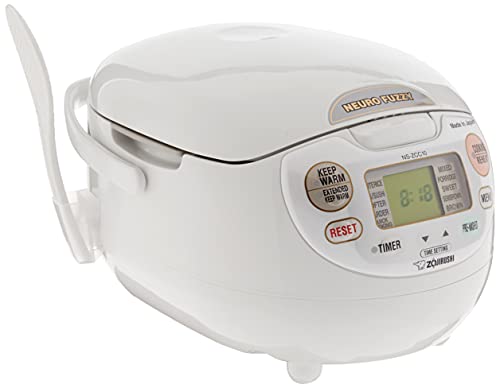
Zojirushi NS-ZCC10 Neuro Fuzzy Rice Cooker and Warmer
Badge: Best Premium
The Zojirushi Neuro Fuzzy NS-ZCC10 takes a distinct route: it is a premium Japanese fuzzy-logic cooker and warmer built around texture consistency. For readers working through best rice cookers cooks illustrated, the appeal is focus. Rather than promising everything, it concentrates on doing the everyday jobs in its class properly, and the details below show where that focus pays off and where it asks you to compromise.
Strengths
- Neuro Fuzzy logic fine-tunes time and temperature through the cook for consistent texture
- Automatic keep warm and a delay timer support households that eat on shifting schedules
- Zojirushi’s warmer design is made for holding rice without drying the surface out
Trade-offs
- It sits in the premium tier, which is a lot for a household that only cooks plain rice weekly
- Fuzzy-logic cycles generally take longer than a basic one-switch cook
- The control style rewards reading the manual once rather than guessing
| Specification | Detail |
|---|---|
| Logic | Neuro Fuzzy logic |
| Keep warm | Automatic keep warm |
| Timer | Delay timer |
| Colour | White |
In daily use, the pattern that matters is consistency across ordinary batches. Mid-sized loads are its home ground: enough rice for a family meal with leftovers, cooked evenly because the pot is working in the range it was designed for. Very small batches in any large cooker need a touch more care with water, and very full loads need the rest time the manual recommends, but within sensible limits this is a set-it-and-leave-it machine. The keep-warm phase holds rice through a normal meal window without the surface drying, provided the lid stays closed between servings.
It suits rice-every-day households that care most about texture and are happy to pay a premium tier price in exchange. The honest limitation to weigh is the first trade-off above: it is a real constraint, not fine print, and if it clashes with how your household cooks, another pick in this guide will fit better. Within its intended role, though, this is a coherent, well-judged design with no inflated promises attached to it.
Best for: rice-every-day households / Not suited for: households whose needs clash with the trade-offs listed above

Zojirushi NS-TSC10 5.5 Cup Micom Rice Cooker and Warmer
Badge: Best Overall
The Zojirushi Micom NS-TSC10 is a 5.5-cup Micom cooker and warmer with LCD controls from Zojirushi’s core range. In a guide to best rice cookers cooks illustrated, it earns its place because it matches how this kind of household actually cooks: rice as a routine, not an occasion, with the cooker expected to behave the same way on a weekday as it did the day it arrived.
Strengths
- The 5.5-cup (1.0 L) size is the sweet spot for many families: big enough daily, not bulky
- Micom control gives more even results across white, mixed and brown styles than a basic switch cooker
- Clear LCD controls and a delay timer make scheduled cooking straightforward
Trade-offs
- Premium-tier positioning compared with basic cookers of similar capacity
- No steamer basket is listed in its title, so steaming needs a separate solution
- Micom cycles are thorough rather than fast, so allow full program time
| Specification | Detail |
|---|---|
| Capacity | 5.5 cups (1.0 L) |
| Logic | Micom (microcomputerised) |
| Controls | LCD controls |
| Timer | Delay timer |
Performance follows the design honestly. Rice comes out evenly cooked through the pot when ratios are measured with the supplied cup, and the texture holds up well on keep warm through a family meal. Like every cooker here, it rewards two habits: rinse the rice, and let it rest before fluffing. Skip either and even the best control system produces a lesser pot. Follow them and this model delivers the calm, repeatable results that make a rice cooker earn permanent counter space.
It suits families of three to five who cook rice most days and want Micom consistency in a mid-size body. The honest limitation to weigh is the first trade-off above: it is a real constraint, not fine print, and if it clashes with how your household cooks, another pick in this guide will fit better. Within its intended role, though, this is a coherent, well-judged design with no inflated promises attached to it.
Best for: families of three to five / Not suited for: households whose needs clash with the trade-offs listed above
Comparison Table
| Model | Badge | Capacity | Control / Logic | Standout feature | Link |
|---|---|---|---|---|---|
| AROMA ARC-914SBD | Best Mid-Size Digital | 4 cups uncooked / 8 cups cooked (2 Qt) | Digital | Rice, steaming, grains, multicooker programs | Check on Amazon |
| Cosori 10 Cup Fuzzy Logic | Most Versatile | 10 cups uncooked / 20 cups cooked | Fuzzy logic | Stainless steel steamer basket | Check on Amazon |
| BLACK+DECKER 6-Cup | Best Budget Pick | 6 cups cooked | One-touch / basic | Steaming basket included | Check on Amazon |
| AROMA ARC-363NG | Best for Small Households | 3 cups uncooked / 6 cups cooked (1.5 Qt) | One-touch / basic | Rice, oatmeal and soup | Check on Amazon |
| Zojirushi Neuro Fuzzy NS-ZCC10 | Best Premium | See review | Neuro Fuzzy logic | Keep warm included | Check on Amazon |
| Zojirushi Micom NS-TSC10 | Best Overall | 5.5 cups (1.0 L) | Micom (microcomputerised) | Keep warm included | Check on Amazon |
Capacities are quoted exactly as each manufacturer states them; note that some brands headline uncooked cups and others cooked cups, so compare the full wording rather than the number alone.
How to Choose Among the Best rice cookers cooks illustrated
Start with capacity, and be honest about your real batch. Rice cooker cups are uncooked cups of about 180 ml unless a listing says otherwise, and a cup of uncooked rice roughly doubles when cooked. A 3-cup cooker therefore serves two to three people comfortably; a 5.5-cup model covers most families; 10-cup and larger machines are for big families, entertaining and meal prep. Buy for your ordinary week, not your largest party, because every cooker performs best in the middle of its range, and an oversized pot makes small, disappointing batches of one or two cups.
Then choose your control type. One-touch cookers do one thing simply and are the easiest appliances in this guide to live with, but they treat every grain the same. Micom (microcomputer) models follow programmed curves for different rice styles and are noticeably more consistent across white, mixed and brown rice. Fuzzy-logic models go further, sensing and adjusting as the cook progresses, which is why they dominate the premium end and why households that eat several rice varieties weekly feel the difference most. There is no wrong answer here, only a wrong match: paying for logic you will never use, or expecting finesse from a switch.
Look at the pot, because you will live with it daily. Non-stick bowls are the standard: light, easy to serve from and simple to wash, provided you use non-metal utensils. Ceramic coatings, like those on the Cosori and the Dash Mini in this guide, release sticky rice beautifully and appeal to buyers avoiding conventional non-stick. Either way, confirm a replacement pot is sold under the model code before you buy; the pot is the wear item, and a cooker that can be re-potted is a cooker that lasts.
Weigh the supporting features against your routine. A delay timer matters if you want rice or porridge ready at a set hour; long keep-warm matters if your household eats in shifts; a steamer basket matters if you will genuinely steam over the rice rather than reaching for a separate pan. Footprint matters too: measure your cupboard or counter before falling for a 10-cup multicooker. Finally, read the trade-offs in each review above as seriously as the strengths. The right cooker is the one whose compromises land on things you do not care about.
If your needs sit at the edge of this guide’s angle, our companion roundup on Best Rice Cookers For Frittata covers the neighbouring case in the same depth.
How to Use a Rice Cooker Well: Running a fair first-week test of a new cooker, then everyday repeatable cooking
Step 1: Measure and rinse. Measure rice with the cup supplied with the cooker, then rinse it in a bowl until the water runs mostly clear. Levelling the rice in the pot after adding water gives an even cook from edge to centre.
Step 2: Add water to the line, not to a guess. Fill to the pot’s marked line for the number of cups you measured, adjusting slightly for your rice: a touch less for firm long-grain results, a touch more for soft or brown styles. Wipe the outside of the pot dry before it goes into the cooker so the heating plate stays clean.
Step 3: Choose the right program and leave it alone. Select the program that matches your grain on digital, Micom and fuzzy-logic models, or simply press cook on a one-touch model. Do not lift the lid to check; the sealed steam environment is doing the work, and every peek costs heat and moisture.
Step 4: Rest, then fluff. When the cooker switches to warm, wait ten to fifteen minutes. Then open the lid away from your face, let the steam clear, and fluff the rice with a paddle using a folding, slicing motion rather than stirring, which keeps grains whole.
Step 5: Hold and store properly. Keep warm is for the span of a meal. Afterwards, cool leftovers promptly and refrigerate them; reheat until steaming hot. Wash the pot and lid once cool, rinse the steam vent, and store the cooker dry.
Troubleshooting. Problem: rice is wet and gummy → what to do: reduce water slightly next batch, rinse more thoroughly, and always rest before fluffing. Problem: rice is firm or crunchy in the centre → what to do: add a little more water, soak brown or short-grain rice before cooking, and check the lid seal is clean so steam is not escaping. Problem: the bottom layer scorches at full loads → what to do: confirm you are not exceeding the stated capacity, stir nothing during cooking, and let the rest period finish the job gently on warm.
For a neighbouring use case with its own technique notes, see Best Rice Cookers For Oatmeal.
The Test-Kitchen Approach to Rice Cookers
A test kitchen starts by removing excuses. Same rice, same water, same batch size, same rest, then blind tasting. Under those conditions, control type becomes the story: fuzzy-logic and Micom cookers adjust heat as the pot’s contents change, so their batches cluster tightly, while basic switch cookers depend more on the water ratio you happened to pour.
Test kitchens also probe edges: the smallest batch a cooker claims to handle, the fullest load, the second hour on keep warm. Those edges are where design shortcuts show. A cooker that is excellent at its middle batch but scorches at full load or dries rice on warm is a conditional recommendation, and the detailed reviews below call out those conditions pick by pick.
Finally, a test kitchen reads the manual like a contract. If a model’s stated capacities, programs and accessories do not match its listing title, that mismatch is itself a finding. Every spec in this guide is drawn from the manufacturer’s own listing, and anything the listing does not state is left unstated rather than guessed.
Why Repeatability Beats Feature Lists
An 18-function menu looks decisive on a box, but most households repeat three cooks forever: their everyday rice, one whole grain, and one steamed side. The test-kitchen question is not how many programs a cooker has; it is whether the three you will actually use come out the same on a tired Tuesday as they did on the careful first try.
That is why the premium logic models earn their place in a method-driven guide despite higher tiers, and why simple cookers can still earn honest recommendations: a one-touch cooker that makes the same decent pot every time beats a complicated machine whose results wander. Our companion guide to Best Rice Cookers Ever applies the same long-view reasoning to the models that have earned lasting reputations.
Repeatability also depends on you less than marketers admit. Lids that manage condensate, pots that spread heat evenly and sensors that read the pot properly all forgive small measuring slips. When a review below praises ‘forgiveness’, that is the test-kitchen virtue it is naming.
Common Buying Mistakes
Buying by cooked cups when the listing means uncooked, or the reverse. The two conventions differ by a factor of two, and confusing them is the most common sizing error in this category. Read the full capacity wording in the spec box, not just the headline number.
Paying for programs you will never open. A long function list feels like value, but if your household cooks one rice style, a simpler cooker will serve you better and cost a lower tier. Match the menu to your actual week.
Ignoring the replacement pot question. Coatings age. If no replacement inner pot exists for the model code, the cooker’s lifespan is the coating’s lifespan, whatever the motor could have done.
Judging by ratings snapshots and printed prices. Both change constantly, and neither describes the machine’s design. Judge capacity, control type, pot and support instead, then check the live listing for the current price.
Skipping the rinse and the rest. Most ‘bad rice cooker’ verdicts are actually bad process. Rinsing removes the surface starch that glues grains together, and resting finishes the cook; no model in this guide can compensate for skipping both.
Getting the Most From Your Cooker
Rinse before you cook, every time. Rinsing rice in a bowl or fine strainer until the water runs mostly clear removes loose surface starch, and that single habit prevents more gummy pots than any appliance feature. Swish the grains gently with your hand, drain, and repeat two or three times. Brown rice needs only a quick rinse, while short-grain styles benefit most from a thorough one. If your cooker has a removable pot, rinse in a separate bowl rather than the pot itself, so the coating never meets a metal strainer or a careless knock against the tap.
Resting is part of the recipe. When the cooker clicks to warm, the rice is cooked but not finished. Ten to fifteen minutes of resting lets moisture equalise between the wetter centre and the drier edges, and it firms the grains so they fluff instead of smearing. Open the lid away from you, let the burst of steam escape, then fluff from the bottom with a paddle using a folding motion. Serving straight from a just-finished pot is the most common reason home rice tastes uneven even from an excellent machine.
Measure with the cup that came in the box. Rice cooker cups measure about 180 ml, not the 240-250 ml of a standard baking cup, and the water lines moulded into the pot are calibrated to that smaller measure. Use the supplied cup for both rice and water lines and your ratios will match the manual exactly. If the cup goes missing, weigh your rice or measure 180 ml portions with a marked jug rather than guessing with a mug, because ratio drift is the silent cause of pots that are somehow both crunchy and wet.
Keep the lid, vent and plate clean. Starch film builds up where steam escapes, and a clogged vent or a sticky lid seal changes how a cooker breathes, which quietly changes results. After starchy cooks, wash the inner lid if it detaches, rinse the steam vent cap, and wipe the heating plate once it is cool and dry. Never immerse the cooker body, and never pour water into the housing to clean it. Five minutes of this after a porridge or steaming session prevents the sour smells and erratic behaviour people blame on the machine.
Reheating leftover rice safely. Cooked rice should be cooled promptly, refrigerated, and reheated until steaming hot throughout. A rice cooker’s keep-warm mode is for holding freshly cooked rice through a meal, not for storing leftovers overnight. To reheat in the cooker, sprinkle a little water over the rice, break up clumps, and use a short cook or warm cycle until it is piping hot. Portioning leftovers into shallow containers before refrigerating makes reheating faster and more even, and fried rice made from a day-old chilled batch will always beat fried rice from a fresh, wet pot.
Brown rice rewards patience. Brown rice keeps its bran layer, so it absorbs water slowly and needs both more water and more time than white rice. Logic-controlled cookers handle this gracefully with longer, hotter soaks built into their cycles. On a basic one-touch cooker, you can help it along: rinse, use a generous ratio, let the rice soak in the pot for thirty minutes before starting, and rest it well afterwards. If your household eats brown rice several times a week, that difference alone justifies choosing a Micom or fuzzy-logic model from this list.
Mixed grains and add-ins. Cookers handle mixed grains well when the mix is honest about its slowest member. Combine grains with similar cooking times, or soak hard grains like barley and whole oats before they join quicker ones. Add-ins such as frozen peas, diced carrot or sweetcorn can cook directly in the pot; add delicate greens and fresh herbs after the cycle so they wilt in the residual heat instead of stewing. Season the water lightly rather than heavily, because you can always finish a dish at the table but you cannot unsalt a whole pot.
Storing the cooker so it stays fresh. Store a rice cooker with its lid slightly ajar or with a clean cloth between lid and pot if it will sit unused for a while, so the interior airs instead of trapping stale moisture. Keep the cord loosely coiled rather than tightly wound around hot surfaces, and store the inner pot inside the cooker with a soft cloth protecting its coating from the steamer basket or accessories. A cooker stored clean, dry and ventilated will smell like nothing at all when you open it, which is exactly what you want.
Final Recommendation
Start with the Zojirushi Micom NS-TSC10: it is the pick we would hand to the widest range of readers of this guide, because it balances capacity, control and everyday ease without asking you to pay for theatre. Check on Amazon to see its current listing.
If your household cooks differently, choose by fit instead. The Cosori 10 Cup Fuzzy Logic is the strongest alternative for readers whose routine matches its strengths, and its review above explains exactly where it overtakes the first choice. Check on Amazon for its listing. Small households should look seriously at the compact picks rather than defaulting to a family size, and large households should do the reverse; in this category, the cost of the wrong size is paid at every single meal.
Whichever you choose, buy the model whose trade-offs you can live with, measure with its own cup, rinse your rice, and let it rest. Those habits, plus a cooker honestly matched to your kitchen, are what the search for best rice cookers cooks illustrated is really asking for.
Still comparing? Our guide to Best Rice Cookers For Short Grain Rice covers the closest neighbouring shortlist.
Frequently Asked Questions
How many cups do I need for a family of four?
A 5.5-cup (uncooked) cooker is the reliable family-of-four size: it covers dinner with leftovers and still handles a small two-cup batch acceptably. Households that entertain often or meal-prep should step up to a 10-cup class model; couples and singles are better served by the 3-cup and mini picks, which cook small amounts properly instead of spreading them thin in a big pot.
Do I really need to rinse rice before cooking it in a rice cooker?
Yes, for the best texture. Rinsing removes loose surface starch that otherwise turns the pot gummy and makes grains clump. Two or three rinses until the water runs mostly clear is enough for most rice. Brown rice needs only a quick rinse. The difference is visible in the first batch, whatever model you own.
Can these cookers handle brown rice and other whole grains?
Yes, with the right expectations. Brown rice needs more water and a longer cycle. Micom and fuzzy-logic models with grain-aware programs handle it most gracefully; on a basic one-touch cooker, soak the rice in the pot for about thirty minutes before starting and rest it well afterwards. Quinoa and similar small grains cook quickly and suit even the mini models.
How long can rice sit on keep warm?
Keep warm is designed for the span of a meal and a little beyond: freshly cooked rice held for a few hours, with the lid closed, stays pleasant in a well-designed warmer, and premium logic models hold it longest without drying. It is not a storage mode. After the meal, cool leftovers promptly, refrigerate them, and reheat until steaming hot.
How do I clean a rice cooker properly?
Unplug it and let it cool. Wash the removable inner pot, lid parts and steamer basket in warm soapy water, rinse the steam vent cap, and wipe the heating plate and exterior with a damp cloth. Never immerse the cooker body or pour water into the housing. Hand-washing the pot protects its coating, which is the part of the cooker that ages first.
What would a test kitchen check first on a new rice cooker?
Batch consistency. Cook the same rice three times at the same ratio and compare top, middle and bottom of the pot. Then test the edges: the smallest batch the manual allows and a full load. A cooker that stays even across all of those is genuinely well controlled, whatever its price tier.


