Disclosure: topratedkitchenware.com is reader-supported. When you buy through links on our site, we may earn an affiliate commission from Amazon and other retailers, at no extra cost to you.
Where to buy
Every linked pick in this guide to best rice cookers for sticky rice is listed on Amazon, where you can check the latest price on Amazon, confirm the exact variant and read the current listing details before ordering. Listings and bundles change, so match the full model name on the listing to the pick reviewed below. Orders are placed on Amazon under its normal delivery and returns terms.
- Best Overall for Sticky Rice: Zojirushi NS-ZCC10 Neuro Fuzzy Rice Cooker — Check on Amazon
- Zojirushi NS-TSC10 Micom Rice Cooker 5.5 Cup — Check on Amazon
- Dash Mini Rice Cooker 2-Cup — Check on Amazon
- BLACK+DECKER 16-Cup Rice Cooker RC516 — Check on Amazon
- Aroma Housewares ARC-363-1NGB Rice Cooker — Check on Amazon
- Aroma Housewares 20 Cup Digital Rice Cooker ARC-150SB — Check on Amazon
Read the full guide ↓
Sticky rice asks more of a cooker than almost any other style, so the best rice cookers for sticky rice are the ones that respect its ritual: a thorough soak, a controlled cook that does not blast the grains apart, and a rest that lets them set into that glossy, clinging, scoopable texture. Glutinous rice — which contains no gluten, despite the name — behaves differently from table rice. Its grains absorb water slowly, turn translucent as they cook, and punish both impatience and excess water.
This guide ranks six verified cookers for that job across every household scale, from a personal mini for a single portion of mango sticky rice to two large machines for festival and family batches. The premium Micom and Neuro Fuzzy models lead on control, but honest basic cookers earn places too, because sticky rice cooked by the traditional soak-and-steam logic can succeed in simple equipment when the cook does the preparation properly.
You will find the method, the maths of soaking and water, a step-by-step for both everyday sticky rice and dessert batches, and the failure fixes that matter. Readers whose stickiness comes from short grain table rice rather than glutinous rice should start from the grain-first discussion at Best Rice Cookers Japanese Rice, and those interested in the Japanese specialist machines behind that tradition will find a companion angle at Best Rice Cookers Japanese.
Key Takeaways
- Soaking is non-negotiable for glutinous rice: the grains must hydrate before the cook, or the centres stay hard.
- Sticky rice needs restraint with water — excess water makes glue, not stickiness.
- Managed-control cookers protect texture best, but a soaked batch in a basic cooker beats an unsoaked batch in a premium one.
- Rest the cooked rice covered so the grains set glossy and clinging instead of wet and smeared.
- Size the batch to the bowl: sticky rice for one and sticky rice for a crowd are different machines in this list.
- Check the latest price on Amazon and the exact capacity basis — cooked or uncooked cups — before choosing a large model.
In this guide
Quick Picks
Six picks, one shortlist. The table below is the whole guide to best rice cookers for sticky rice on one screen; the detailed reviews that follow explain the reasoning, the trade-offs and the kitchens each machine actually suits.
| Pick | Badge | Format (from listing title) | Best for | Amazon |
|---|---|---|---|---|
| Zojirushi NS-ZCC10 Neuro Fuzzy Rice Cooker | Best Overall for Sticky Rice | Controls (per listing title): Neuro Fuzzy logic | daily rice cooks who value texture refinement and a Japanese specialist design | Check on Amazon |
| Zojirushi NS-TSC10 Micom Rice Cooker 5.5 Cup | Best for Family Batches | Controls (per listing title): Micom (microcomputer) controls with LCD | households wanting Japanese Micom control in the classic 5.5-cup size | Check on Amazon |
| Dash Mini Rice Cooker 2-Cup | Best for Single Servings | Pot: removable ceramic nonstick pot | solo cooks, dorm rooms and anyone cooking one serving at a time | Check on Amazon |
| BLACK+DECKER 16-Cup Rice Cooker RC516 | Best for Crowds | Controls (per listing title): one touch | large families, gatherings and weekly batch cooking | Check on Amazon |
| Aroma Housewares ARC-363-1NGB Rice Cooker | Best Compact Pick | Format: rice cooker, steamer and multicooker | couples and small families wanting a compact steamer-cooker in black | Check on Amazon |
| Aroma Housewares 20 Cup Digital Rice Cooker ARC-150SB | Best for Big Events | Format: digital rice cooker, slow cooker and food steamer | big gatherings, extended families and high-volume meal prep | Check on Amazon |
How These Picks Were Chosen
Picks were chosen for sticky rice on three criteria: control over a gentle, managed cook; a bowl size matched to a realistic sticky rice batch; and a pot surface that releases a famously clingy grain without a fight. The two Zojirushi models lead because their managed cooking suits a grain that punishes aggressive boiling. The large BLACK+DECKER and AROMA models are included deliberately for crowd batches, where sticky rice is often cooked for gatherings, and the Dash Mini covers the single-serving dessert case that big machines handle badly.
The research basis is the verified listing information for each model — capacity, control type and functions as the manufacturers state them — combined with established glutinous rice practice: soak the grains, drain, cook with restrained water or steam, and rest before serving. No hands-on laboratory testing is claimed, and no setting is credited to a machine unless its listing title states it. Where a cooker has no dedicated sticky setting, the review says so and explains the manual method instead of pretending otherwise.
Badges follow the batch, not the brand. Best Overall is the cooker a sticky-rice household should buy first; the crowd and event badges mark the volume machines; the compact and personal badges mark the small-batch specialists. If your interest in sticky texture is really about Japanese table rice, compare this ranking with Best Rice Cookers Japanese before spending on a premium model.
The 6 Picks for best rice cookers for sticky rice, Reviewed
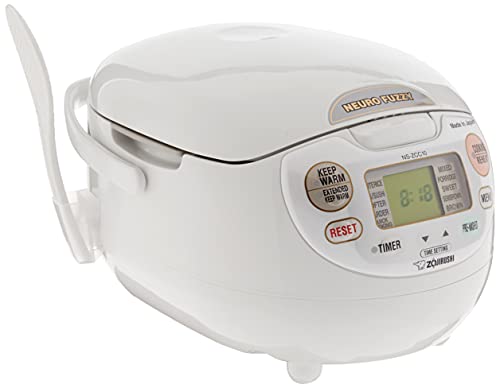
Zojirushi NS-ZCC10 Neuro Fuzzy Rice Cooker
Badge: Best Overall for Sticky Rice
Strengths
- Neuro Fuzzy logic is designed to fine-tune the cook rather than run one fixed cycle
- Japanese specialist brand with a long rice-cooker focus behind the design
- Delay timer and automatic keep-warm suit set-and-forget weekday routines
Trade-offs
- Premium-tier positioning compared with the basic cookers in this pool
- The listing title does not state capacity, so size must be checked carefully before buying
- Buyers who only cook plain long-grain rice may never use its refinement
Key specs (from the verified listing)
- Brand / origin: Zojirushi, the Japanese rice-cooker specialist brand in this pool
- Controls (per listing title): Neuro Fuzzy logic
- Features (per listing title): automatic keep-warm, delay timer
- Format: rice cooker and warmer, white
- Note: the listing title does not state a cup capacity — confirm the exact size variant on the listing before ordering
The NS-ZCC10 is the connoisseur pick in this pool: Zojirushi’s Neuro Fuzzy cooker and warmer in white, with automatic keep-warm and a delay timer. Zojirushi is the Japanese specialist brand here, and the Neuro Fuzzy name describes a control system built to make small, continuous adjustments during the cook instead of following one rigid curve. That refinement shows up most with demanding grains, where a few minutes of soak behaviour and a gentler finish separate separate, glossy grains from a sticky slab. The delay timer supports the way these cookers are actually used in Japanese-style routines: rice measured in the morning, ready at dinner, then held on automatic keep-warm without constant attention. Two honest cautions belong in any recommendation. First, this is premium-tier equipment, and a household that cooks plain rice twice a month will not feel the difference it pays for. Second, the listing title does not state the cup capacity, so confirm the exact size variant on the listing itself before ordering. For daily rice cooks who notice texture, it is the benchmark the rest of this list is measured against.
For sticky rice, the Neuro Fuzzy Zojirushi is the control benchmark in this pool. Glutinous grains need a cook that brings them through absorption without violent boiling, and a system that adjusts as it goes protects the moment where soaked grains turn translucent and tender. Use the delay timer as a soaking tool — load rinsed, drained grains with their measured water, and let the timer hold the soak before the cook begins — then rest the batch covered so it sets glossy. Daily sticky rice households will feel this refinement at every meal, which is the only honest justification for a premium pick.
Best for: daily rice cooks who value texture refinement and a Japanese specialist design / Not suited for: occasional rice cooks who will not feel the premium difference

Zojirushi NS-TSC10 Micom Rice Cooker 5.5 Cup
Badge: Best for Family Batches
Strengths
- 5.5-cup size is the classic household capacity in Japanese-style cooker design
- Micom control with an LCD makes settings and timing easy to confirm at a glance
- Delay timer supports morning-setup, evening-ready rice routines
Trade-offs
- Premium-tier positioning next to the basic lever cookers in this pool
- 5.5 cups will be small for very large families cooking in one batch
- Refined controls are wasted on buyers who want a single lever and nothing else
Key specs (from the verified listing)
- Capacity (per listing title): 5.5 cup, 1.0 L
- Controls (per listing title): Micom (microcomputer) controls with LCD
- Feature (per listing title): delay timer
- Format: rice cooker and warmer
The NS-TSC10 pairs Zojirushi’s Micom — microcomputer — control with LCD controls and a delay timer in a 5.5-cup, 1.0-litre cooker and warmer. That capacity is worth pausing on: 5.5 cups uncooked is the long-standing standard household size in Japanese cooker design, large enough for a family dinner and small enough that a half batch still cooks at a sensible depth. The LCD matters in daily use more than spec sheets suggest, because you can confirm the setting and the timer at a glance instead of guessing from a lever position. Micom control gives the cook a managed curve rather than a simple on-off boil, which is the difference buyers are paying for with this brand. As with its Neuro Fuzzy sibling, the honest framing is value through repetition: cooked daily, the consistency compounds; cooked rarely, a basic cooker in this guide does the job for less commitment. Check the listing for the current variant details, measure your usual batch against the 5.5-cup ceiling, and this becomes an easy cooker to recommend to texture-focused households.
The NS-TSC10 gives family-size sticky rice the same Micom-managed treatment in a stated 5.5-cup, 1.0-litre size with an LCD you can verify. That capacity suits the way sticky rice is actually served at home — as the centre of a meal for several people — and the delay timer again doubles as a soak scheduler for grains loaded in advance. Confirm the setting on the display, resist adding extra water ‘for luck’, and rest the full batch before portioning. For households that cook sticky rice weekly in family quantities, this is the balanced premium answer.
Best for: households wanting Japanese Micom control in the classic 5.5-cup size / Not suited for: very large families or lever-only simplicity seekers

Dash Mini Rice Cooker 2-Cup
Badge: Best for Single Servings
Strengths
- True personal size: 1 cup uncooked is the smallest honest batch in this pool
- Removable ceramic nonstick pot is easy to serve from and wash
- Also handles oatmeal, quinoa and grains, so it earns its place in a tiny kitchen
Trade-offs
- 2 cups cooked is a hard ceiling — it cannot scale up for guests
- Simple mini format has no fuzzy logic or grain programs
- Keep warm on a tiny batch dries the edges faster than on a large batch
Key specs (from the verified listing)
- Capacity (per listing title): personal 1 cup uncooked, makes 2 cups cooked
- Pot: removable ceramic nonstick pot
- Feature (per listing title): keep warm function
- Also cooks (per listing title): oatmeal, quinoa and grains
- Colour: black
The Dash Mini is exactly what its listing title promises: a personal rice cooker that takes 1 cup uncooked and makes 2 cups cooked, with a removable ceramic nonstick pot and a keep warm function, in black. In a pool of family machines, it is the only design whose minimum batch is genuinely one serving, and that changes the cooking physics in its favour — a single portion fills its small pot properly instead of spreading thinly across the base of a big bowl. The ceramic nonstick pot lifts out for serving and washing, and the listing’s oatmeal, quinoa and grains roles make it a small-space all-rounder for dorm rooms, studio flats, office kitchens and solo cooks. The ceiling is absolute, though: 2 cups cooked is dinner for one, not a side dish for four, and there are no smart programs to lean on. Buy it as a personal appliance and it is excellent at its job; buy it hoping it will stretch to family meals and it will disappoint from the first Sunday lunch.
A single portion of sticky rice is a real use case — mango sticky rice for one, a small bowl alongside a Thai-style meal — and it is the case big cookers ruin by spreading the grains thin. The Dash Mini’s one-cup uncooked scale keeps a small soaked batch at proper depth, and its removable ceramic nonstick pot matters because sticky rice lives up to its name at serving time. Soak the grains before they go in, use restrained water, and serve straight from the pot. It will never cater a party, and it is not trying to; it is the right-sized tool for a personal sticky rice ritual.
Best for: solo cooks, dorm rooms and anyone cooking one serving at a time / Not suited for: families or anyone who hosts

BLACK+DECKER 16-Cup Rice Cooker RC516
Badge: Best for Crowds
Strengths
- Largest capacity in this pool for big families, gatherings and batch cooking
- One-touch operation keeps a big machine simple to run
- Steaming basket lets a large batch of vegetables cook above the rice
Trade-offs
- Far too large for small batches, which spread thin and cook unevenly in the big bowl
- Takes significant counter and storage space even when idle
- Basic one-touch control has no grain-specific programs
Key specs (from the verified listing)
- Capacity (per listing title): 16-cup cooked, 8-cup uncooked
- Controls (per listing title): one touch
- Extras: steaming basket, removable non-stick bowl
- Model: RC516
The RC516 is the volume pick: a 16-cup cooked, 8-cup uncooked BLACK+DECKER cooker with one-touch operation, a steaming basket and a removable non-stick bowl. Everything about it is scaled for feeding a crowd in one cycle — large families, meal-prep Sundays, potlucks and households where rice is a base for many plates. One-touch control is the right interface at this size, because the cook’s attention belongs on the rest of the meal, and the removable bowl keeps serving and cleanup manageable despite the volume. Its strength is also its boundary. A cooker built for 8 cups uncooked cannot give a 1-cup batch the depth it needs; small amounts spread across a wide bowl, lose moisture unevenly and finish dry at the edges. That is not a defect, it is geometry. So this model earns its place in guides about feeding many people, and it should be judged there — while small households should honestly pass it by for the compact picks in this same pool, however attractive a big capacity looks on paper.
Sticky rice for a crowd — a family gathering, a community meal, a big batch for wrapping and sharing — is where the RC516 earns its badge. Sixteen cups cooked from eight uncooked gives the volume, one-touch operation keeps the cook’s attention on the rest of the food, and the steaming basket offers a practical route for cooking soaked grains above water, closer to the traditional method, in generous quantities. The trade-off is control: a basic one-touch machine will not finesse the finish, so the soak and the draining must be done properly. At crowd scale, preparation beats electronics.
Best for: large families, gatherings and weekly batch cooking / Not suited for: small batches or one- and two-person households

Aroma Housewares ARC-363-1NGB Rice Cooker
Badge: Best Compact Pick
Strengths
- Compact 3-cup uncooked size matched to small and medium batches
- Steamer and multicooker roles widen what a small machine can do
- Black finish suits kitchens where a white appliance looks out of place
Trade-offs
- 6-cup cooked ceiling limits entertaining and large batch prep
- Basic format offers no fuzzy-logic correction for measuring mistakes
- Small pot means grains must be measured carefully to avoid boil-over with starchy rice
Key specs (from the verified listing)
- Capacity (per listing title): 3 cups uncooked / 6 cups cooked, described as 2-6 cups
- Format: rice cooker, steamer and multicooker
- Colour: black
- Model: ARC-363-1NGB
The ARC-363-1NGB is AROMA’s black-finished compact cooker: 3 cups uncooked, 6 cups cooked, described in its listing as covering 2-6 cups, with steamer and multicooker roles alongside the main rice job. It is effectively the right-sized answer for couples and small families, with a bowl proportioned so that everyday batches sit at a depth that cooks through evenly. The steamer role is more than a badge at this size — a tray of vegetables or dumplings above a small rice batch turns the cooker into a complete one-pot dinner for two, which is how compact appliances justify themselves. The multicooker framing in the title should be read sensibly: this is a simple machine that handles simple secondary jobs, not a program-driven digital cooker. Its limits mirror its sibling AROMA compacts — no fuzzy logic, a firm ceiling on batch size, and results that follow your measuring. Within those lines it is a dependable, space-honest pick, and the black finish gives small kitchens an option that does not have to look like a dorm appliance.
This compact AROMA is the everyday sticky rice pick for couples and small families: a 3-cup uncooked batch is a realistic household quantity of glutinous rice, the bowl proportions keep the grain bed deep enough to cook evenly, and the steamer role gives a second method for soaked grains. It has no smart correction layer, so treat the soak as part of the recipe rather than an optional extra, drain well, and keep the water restrained. Served promptly and rested properly, its results satisfy the household case completely — the premium models add consistency, not a different category of rice.
Best for: couples and small families wanting a compact steamer-cooker in black / Not suited for: large batches or program-driven cooking

Aroma Housewares 20 Cup Digital Rice Cooker ARC-150SB
Badge: Best for Big Events
Strengths
- Joint-largest capacity in this pool for events and extended-family meals
- Digital controls plus slow cooker and steamer roles make it a multi-job appliance
- Stainless exterior suits a main-counter, always-out placement
Trade-offs
- 10-cup uncooked bowl is the wrong tool for a small everyday batch
- Big footprint demands dedicated counter or cupboard space
- More functions than a rice-only household will ever open
Key specs (from the verified listing)
- Capacity (per listing title): 20 cup cooked, 10 cup uncooked
- Format: digital rice cooker, slow cooker and food steamer
- Exterior: stainless steel (SS), black
- Model: ARC-150SB
The ARC-150SB is AROMA’s big digital: 20 cups cooked from 10 cups uncooked, with digital controls and slow cooker and food steamer roles, in a stainless steel exterior with black finish. It belongs to the feed-everyone category — extended-family dinners, community events, holiday sides and serious meal prep — where cooking rice in two rounds would hold up the whole meal. The digital control set earns its keep at this scale, because timing a large batch by a simple lever is less forgiving, and the slow cooker role means the same counter slot can handle a stew on the days rice is not the plan. The steamer function scales too, moving from a token tray to a genuinely useful quantity. The trade-off is the mirror image of the mini cookers in this pool: a 10-cup uncooked bowl is poor geometry for a small batch, and the machine needs real estate whether it is cooking or not. Buy it for volume and versatility at volume, and it is the right tool; buy it for two-person weeknights and the compact AROMA and Dash picks will serve you better.
The ARC-150SB is the event-scale option: 20 cups cooked, digital controls, and steamer and slow cooker roles in one large stainless-exterior machine. For sticky rice, its digital timing helps manage a very large soaked batch more evenly than a lever would, and the steamer function supports the traditional approach at volume. The cautions are scale cautions — a small test batch will not cook properly in a 10-cup uncooked bowl, and the machine needs a permanent home on the counter. Buy it when sticky rice is cooked for many people, often, and let smaller households choose the compact picks.
Best for: big gatherings, extended families and high-volume meal prep / Not suited for: small daily batches or tight counters
Comparison Table
| Pick | Brand | Capacity (per listing title) | Standout point | Amazon |
|---|---|---|---|---|
| Zojirushi NS-ZCC10 Neuro Fuzzy Rice Cooker | Zojirushi | Zojirushi, the Japanese rice-cooker specialist brand in this pool | Neuro Fuzzy logic is designed to fine-tune the cook rather than run one fixed cycle | Check on Amazon |
| Zojirushi NS-TSC10 Micom Rice Cooker 5.5 Cup | Zojirushi | 5.5 cup, 1.0 L | 5.5-cup size is the classic household capacity in Japanese-style cooker design | Check on Amazon |
| Dash Mini Rice Cooker 2-Cup | DASH | personal 1 cup uncooked, makes 2 cups cooked | True personal size: 1 cup uncooked is the smallest honest batch in this pool | Check on Amazon |
| BLACK+DECKER 16-Cup Rice Cooker RC516 | BLACK+DECKER | 16-cup cooked, 8-cup uncooked | Largest capacity in this pool for big families, gatherings and batch cooking | Check on Amazon |
| Aroma Housewares ARC-363-1NGB Rice Cooker | AROMA | 3 cups uncooked / 6 cups cooked, described as 2-6 cups | Compact 3-cup uncooked size matched to small and medium batches | Check on Amazon |
| Aroma Housewares 20 Cup Digital Rice Cooker ARC-150SB | AROMA | 20 cup cooked, 10 cup uncooked | Joint-largest capacity in this pool for events and extended-family meals | Check on Amazon |
Read the table by role, not by row order: the right machine for best rice cookers for sticky rice is the one whose capacity, controls and standout point match the work described in the reviews above.
How to Choose Among the best rice cookers for sticky rice
Decide which sticky rice you mean, because the word covers two related but different cooks. Glutinous rice — the sticky rice of Thai and Lao meals and mango sticky rice — must be soaked and is traditionally steamed, and it is the stricter test used in this guide. Short grain table rice cooked to a clinging texture is the second meaning, and it is more forgiving. A cooker that handles the first well handles the second easily, so buy for the stricter case if both are on your menu.
Prioritise the soak in your routine, then the cooker’s control. No machine in this pool can rescue unsoaked glutinous rice, because the grains’ centres simply have not hydrated. Build the soak into your schedule — overnight in water, or loaded into a timer model so the delay does the waiting — and the cook itself becomes the easy part. Managed-control cookers then earn their premium by protecting the finish; basic cookers earn their place by being simple enough that you will actually use them on a weeknight.
Match the batch to the bowl with unusual care, because sticky rice is often cooked in two extreme quantities: a small dessert portion or a gathering-sized batch. The middle of this list — the 3-cup compact and the 5.5-cup Micom — covers household meals. The personal mini and the two large machines cover the extremes. A household that cooks both extremes regularly is honestly a two-machine household, or a one-machine household that steams the small portion by a stovetop method on dessert night.
Consider the pot surface as a serving issue, not a spec. Sticky rice clings to the pot as enthusiastically as it clings to itself, so a sound non-stick or ceramic surface and a removable bowl change the experience from scraping to scooping. Serve with a wet paddle or wet hands for shaped portions, rinse the pot promptly, and never use metal tools on the coating to free a stuck batch — soak the pot in warm water and let the rice release itself.
Finally, let the rest of the meal vote. Sticky rice is rarely cooked alone: it accompanies grilled meats, curries, and desserts that may themselves want the steamer basket or the counter space. The steamer-equipped picks here can cook a side above the rice, and the timer models can finish as the rest of the meal lands. Readers building a Japanese-style sticky texture rather than a glutinous one should also weigh the specialist discussion at Best Rice Cookers From Japan.
How to Cook Sticky Rice in a Rice Cooker: Soak, Drain, Cook, Rest
The method below works with every cooker in this guide. The soak and the draining do the real work; the machine finishes the job.
- Rinse the glutinous rice until the water runs mostly clear, handling the grains gently.
- Soak the rinsed rice in plenty of cool water for several hours or overnight. The grains should look opaque white and feel hydrated, not chalky, before they meet heat.
- Drain the soaked rice thoroughly. Water clinging to the grains is part of your cooking water now, which is why the next step uses restraint.
- Add the drained rice to the cooker with a restrained amount of fresh water — noticeably less than for table rice — or set the soaked grains in the steamer basket above water if your cooker and batch suit the steaming method.
- Cook on the standard cycle, or the setting your cooker’s listing provides, and keep the lid closed throughout.
- Rest the finished rice, covered, for ten to fifteen minutes. This is when the grains set into their glossy, clinging finish.
- Fluff and portion with a wet paddle to reduce sticking, and serve promptly; sticky rice is at its best warm and freshly set.
- Refrigerate leftovers promptly. Chilled sticky rice reheats best with a sprinkle of water and a covered steam, not a dry blast of heat.
Troubleshooting
Problem: the centres of the grains are still hard and chalky: The soak was too short. No cooking adjustment fully repairs it; rest the batch covered so steam softens what it can, and soak longer — overnight for preference — next time.
Problem: the rice is a wet, gluey mass instead of clinging grains: Too much water, usually from undrained soaked rice plus a full measure of fresh water. Drain thoroughly and cut the added water on the next batch; spread this batch briefly on a tray to release surface steam before serving.
Problem: a layer has welded itself to the pot: The batch sat too long after cooking, or the pot coating is tired. Soak the pot in warm water until the rice releases on its own, serve future batches promptly, and check the bowl surface before the next cook.
Dessert Sticky Rice Versus Table Sticky Rice: Two Batches, Two Temperaments
Mango sticky rice and its dessert relatives want grains that are tender, distinct and glossy, sweetened after cooking with coconut milk that should coat rather than drown them. Small, careful batches suit dessert work, which is why the personal mini and the compact AROMA have genuine roles in a sticky rice guide despite their size. Cook the rice plain, rest it, then fold the warm sweetened coconut milk through and let it absorb — the cooker’s job ends at perfectly set grains.
Table sticky rice, eaten by hand or alongside grilled and curried dishes, wants a firmer set and is usually cooked in larger quantities. That is the natural territory of the 5.5-cup Micom and the two big machines. The technique is identical — soak, drain, restrained water, rest — but the tolerance changes: a gathering batch forgives a little unevenness that a small dessert batch would show immediately. Choose your primary case and let it rank the list for you; the other case will still work, just with more attention.
Why Steaming Tradition Still Matters in an Electric Cooker
Traditional sticky rice is steamed, not boiled, and understanding why improves every electric-cooker batch. Steaming hydrates soaked grains with vapour rather than submerging them, so they cook through without bursting into paste. A rice cooker boils by default, which is why the electric method compensates with a thorough soak and restrained water: the grains arrive mostly hydrated, and the cooker finishes them gently instead of asking boiling water to do the whole job.
The steamer baskets included with several picks in this pool offer a middle path for modest batches — soaked, drained grains steamed above water inside the cooker. It takes a little more setup than the standard cycle and repays it with the most traditional texture these machines can produce. Whichever route you choose, the principle is the same one this whole guide repeats: preparation is the recipe, and the cooker is the finisher. For a deliberately softer, wetter finish rather than a set, clinging one, see Best Rice Cookers For Wetter Rice.
Storing Glutinous Rice and Planning the Soak Around Real Life
Glutinous rice keeps like other rice in a cool, dry store, but the soak is where real schedules break down: a cook who decides on sticky rice at six o’clock cannot serve it at seven. Build the decision earlier in the day. A morning soak in a bowl, drained at cooking time, is the simplest system; a timer model loaded with rinsed grains and measured water turns the soak into part of the program for households that cook sticky rice on weekdays. Either way, write the soak into the plan the way you would a marinade — as an ingredient, not an afterthought.
Batch planning helps too. Sticky rice reheats acceptably with added moisture and a covered steam, so cooking a household batch and reheating a portion for lunch is a reasonable routine, while cooking a fresh mini batch for each dessert is the connoisseur routine. Neither is wrong. What fails is improvising the quantity at the cooker: decide the batch, size it to the bowl from the picks above, and let the method carry it.
Sticky Rice at the Table: Serving, Shaping and Sharing
How sticky rice is served changes what you should cook. Eaten by hand in the traditional style, it wants a firm, glossy set that holds a pinched ball shape — the texture the soaked, drained, rested method in this guide produces, and the texture the managed-control picks protect most reliably. Served as a base under saucy dishes, it can afford to be a touch softer, because the sauce completes it. Cooked for wrapping or for desserts, it wants to be fresh and warm, portioned with wet hands or a wet paddle so the grains release cleanly instead of taking half the batch with them.
That serving logic feeds back into the machine choice one final time. Hand-eaten sticky rice for a family is a weekly ritual that justifies the premium Micom and Neuro Fuzzy picks, because their consistency is the difference between a set that shapes and a set that smears. Occasional dessert batches ask far less, and the compact and personal picks serve them completely. Crowd batches ask for volume and preparation discipline above all, which is why the big basic machines hold their badges here without apology. Match the machine to the serving you actually make, and sticky rice stops being a special occasion and becomes a routine your kitchen can repeat.
A Note on Grain Buying for Sticky Rice Households
Buy glutinous rice from a source with steady turnover, store it sealed and dry, and expect older grain to want a longer soak and a touch more patience at the rest. The variety is sometimes labelled sweet rice or sticky rice rather than glutinous, and all three names describe the same grain for the purposes of this guide. What matters is that the bag in your cupboard is that grain and no other: a household that perfects the soak with the wrong variety is rehearsing a play it will never perform. Check the bag once, cook confidently thereafter, and let the routine — not the shopping — occupy your attention at the cooker.
Common Buying Mistakes
- Skipping or shortening the soak, then blaming the cooker for hard-centred grains.
- Adding table-rice quantities of water to drained, soaked grains and producing glue instead of stickiness.
- Stirring the finished rice aggressively instead of resting it and portioning with a wet paddle.
- Cooking a single dessert portion in a 20-cup machine and expecting an even set.
- Using metal tools on a coated pot to free a stuck batch, and ruining the surface for every future cook.
- Assuming ‘sticky’ on a menu means short grain table rice, and buying for the wrong grain entirely.
Final Recommendation
The Zojirushi NS-ZCC10 Neuro Fuzzy is the first recommendation for a committed sticky rice household: its managed cook protects soaked grains through the finish, and its timer turns the soak into part of the routine. Compare it with the NS-TSC10 before deciding — between them they cover the premium pattern in two sizes, and the 5.5-cup Micom model suits family batches whose size is already known.
Start your shortlist with the Zojirushi NS-ZCC10 Neuro Fuzzy Rice Cooker, and compare it against the Zojirushi NS-TSC10 Micom Rice Cooker 5.5 Cup before deciding — between them they cover the two most common use patterns in this guide.
Choose the Dash Mini for single dessert portions, the compact AROMA for couples, and the BLACK+DECKER RC516 or the big AROMA ARC-150SB when sticky rice means feeding a gathering. Whichever you choose, honour the soak — it, not the badge on the lid, is what makes sticky rice sticky in the right way.
Related guides
Frequently Asked Questions
Does sticky rice really have to be soaked?
Yes. Glutinous rice grains hydrate slowly, and an unsoaked batch cooks unevenly with hard, chalky centres no setting can fully repair. Several hours is the working minimum and overnight is the reliable habit. The soak is not a refinement; it is the main preparation step, and every cooker in this guide assumes it.
Is glutinous rice the same as short grain rice?
No. Glutinous rice is its own variety, named for its glue-like texture — it contains no gluten. Short grain table rice cooks up clinging and tender but is a different grain with a shorter preparation. This guide is written for the glutinous case, which is the stricter test; the Japanese short grain table-rice case is covered at Best Rice Cookers Japanese Rice.
Can I cook sticky rice in a basic one-touch cooker?
Yes, with preparation doing the work the electronics do not. Soak thoroughly, drain well, use restrained water, and rest the batch covered. The compact and large basic picks in this guide cook satisfying sticky rice on exactly that basis. What a basic cooker cannot do is correct a skipped soak or an over-watered batch mid-cycle.
Why did my sticky rice turn out like glue?
Almost always water. Soaked grains carry surface water into the pot, so adding a full table-rice measure on top floods them. Drain thoroughly, reduce the added water, and rest the finished batch so the grains set instead of smearing. Spread a gluey batch on a tray briefly to let surface steam escape before serving.
What size cooker do I need for sticky rice for a party?
Work backwards from cooked volume. The 16-cup cooked BLACK+DECKER and the 20-cup cooked AROMA in this guide exist for exactly that case, and their steamer baskets help with generous batches. For a family dinner rather than a party, the 5.5-cup Micom model is the proportionate choice — party machines cook small batches badly, so do not buy party size for weekly use.
How should I reheat leftover sticky rice?
With moisture and steam. Sprinkle the rice with a little water, cover it, and heat it gently until the grains soften and turn glossy again. A dry, uncovered reheat hardens the surface. Refrigerate leftovers promptly, and treat next-day sticky rice as a reheating job rather than a keep-warm job.


