Disclosure: topratedkitchenware.com is reader-supported. When you buy through links on our site, we may earn an affiliate commission from Amazon and other retailers, at no extra cost to you.
Where to buy
Every linked pick in this guide to best rice cookers japanese is listed on Amazon, where you can check the latest price on Amazon, confirm the exact variant and read the current listing details before ordering. Listings and bundles change, so match the full model name on the listing to the pick reviewed below. Orders are placed on Amazon under its normal delivery and returns terms.
- Best Japanese Pick — Neuro Fuzzy: Zojirushi NS-ZCC10 Neuro Fuzzy Rice Cooker — Check on Amazon
- Zojirushi NS-TSC10 Micom Rice Cooker 5.5 Cup — Check on Amazon
- Dash Mini Rice Cooker 2-Cup — reviewed below as a prose-only reference pick (no purchase link; see the review for why)
- BLACK+DECKER 16-Cup Rice Cooker RC516 — reviewed below as a prose-only reference pick (no purchase link; see the review for why)
- Aroma Housewares ARC-363-1NGB Rice Cooker — reviewed below as a prose-only reference pick (no purchase link; see the review for why)
- Aroma Housewares 20 Cup Digital Rice Cooker ARC-150SB — reviewed below as a prose-only reference pick (no purchase link; see the review for why)
Read the full guide ↓
The word ‘Japanese’ in best rice cookers japanese is a promise, and this guide keeps it literally: the only linked recommendations are the two Zojirushi models, from the Japanese specialist brand, whose Micom and Neuro Fuzzy control systems were developed inside Japanese rice culture. The other four verified pool models — a personal mini, two large machines and a compact, all from American brands — are reviewed in full as prose-only comparisons, with no links and no images, so the market context is visible without pretending those machines are something they are not.
Why insist on the distinction? Because Japanese rice cooking is a discipline with a definable content: rice washed until the water runs clear, soaked as a matter of routine, cooked on a managed curve, rested, and held properly for a meal in which rice is the centre rather than a side. A Japanese cooker is a machine designed around that discipline by a maker who answers to the households that practise it. Buyers who search this keyword generally want that design philosophy, and they deserve a shortlist that does not dilute it with lookalikes.
The article therefore spends its recommendation weight on the two specialists — how they differ, which households each suits, and what their refinement is worth — while the comparison reviews map the alternatives a buyer will meet on the same shelf. If your question is really about the grain, start instead with Best Rice Cookers Japanese Rice; if it is about the flagship control tier, Best Rice Cookers Neuro Fuzzy is the companion read.
Key Takeaways
- Two linked picks only: both Zojirushi, the Japanese specialist brand in the pool.
- Four American-brand models are reviewed prose-only as comparisons — described honestly, never sold as Japanese.
- Japanese design means managed control, serious keep warm, and proportions tuned to daily family batches.
- The NS-TSC10 states the classic 5.5-cup size; the Neuro Fuzzy title omits capacity, so verify its variant on the listing.
- The premium is a daily-use argument. Occasional rice does not repay specialist refinement.
- Check the latest price on Amazon and the exact model code before ordering either specialist.
In this guide
Quick Picks
Six picks, one shortlist. The table below is the whole guide to best rice cookers japanese on one screen; the detailed reviews that follow explain the reasoning, the trade-offs and the kitchens each machine actually suits.
| Pick | Badge | Format (from listing title) | Best for | Amazon |
|---|---|---|---|---|
| Zojirushi NS-ZCC10 Neuro Fuzzy Rice Cooker | Best Japanese Pick — Neuro Fuzzy | Controls (per listing title): Neuro Fuzzy logic | daily rice cooks who value texture refinement and a Japanese specialist design | Check on Amazon |
| Zojirushi NS-TSC10 Micom Rice Cooker 5.5 Cup | Best Japanese Pick — Classic 5.5 Cup | Controls (per listing title): Micom (microcomputer) controls with LCD | households wanting Japanese Micom control in the classic 5.5-cup size | Check on Amazon |
| Dash Mini Rice Cooker 2-Cup | Comparison Pick — Not Japanese (Prose-Only) | Pot: removable ceramic nonstick pot | solo cooks, dorm rooms and anyone cooking one serving at a time | Prose-only reference |
| BLACK+DECKER 16-Cup Rice Cooker RC516 | Comparison Pick — Not Japanese (Prose-Only) | Controls (per listing title): one touch | large families, gatherings and weekly batch cooking | Prose-only reference |
| Aroma Housewares ARC-363-1NGB Rice Cooker | Comparison Pick — Not Japanese (Prose-Only) | Format: rice cooker, steamer and multicooker | couples and small families wanting a compact steamer-cooker in black | Prose-only reference |
| Aroma Housewares 20 Cup Digital Rice Cooker ARC-150SB | Comparison Pick — Not Japanese (Prose-Only) | Format: digital rice cooker, slow cooker and food steamer | big gatherings, extended families and high-volume meal prep | Prose-only reference |
How These Picks Were Chosen
The pool was screened on the keyword’s core attribute first: Japanese origin and design tradition. Zojirushi passes that screen; AROMA, BLACK+DECKER and DASH, all American brands, do not — regardless of how capable their machines are at other jobs. Rather than silently dropping the four, this guide reviews them as labelled prose-only comparisons, because a buyer deciding whether the Japanese premium is worth it needs to see what the non-Japanese market actually offers at each size. That transparency is the selection method, and it is the same rule applied across this site to any core-attribute mismatch.
The two specialists were then ranked against each other on definition and refinement. The NS-TSC10 is the defined article: stated 5.5-cup capacity, Micom control, LCD, delay timer. The NS-ZCC10 is the refined article: Neuro Fuzzy control, automatic keep warm, delay timer, with capacity to be confirmed from its listing variants. Neither ranking demotes the other; they answer slightly different buyers, and the reviews are written so each buyer can recognise themselves.
Evidence throughout is the verified listing information quoted exactly, with brand origin treated as the public fact it is. No hands-on testing is claimed, and no feature is credited beyond the listing titles. Readers who want the flagship control question treated in depth will find it at Best Rice Cookers Neuro Fuzzy; readers who want the retailer comparison can continue to Best Rice Cookers Kohls.
The Honest Shortlist for best rice cookers japanese: Two Specialists, Four Comparisons
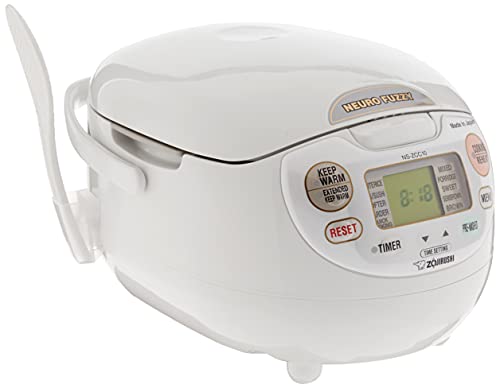
Zojirushi NS-ZCC10 Neuro Fuzzy Rice Cooker
Badge: Best Japanese Pick — Neuro Fuzzy
Strengths
- Neuro Fuzzy logic is designed to fine-tune the cook rather than run one fixed cycle
- Japanese specialist brand with a long rice-cooker focus behind the design
- Delay timer and automatic keep-warm suit set-and-forget weekday routines
Trade-offs
- Premium-tier positioning compared with the basic cookers in this pool
- The listing title does not state capacity, so size must be checked carefully before buying
- Buyers who only cook plain long-grain rice may never use its refinement
Key specs (from the verified listing)
- Brand / origin: Zojirushi, the Japanese rice-cooker specialist brand in this pool
- Controls (per listing title): Neuro Fuzzy logic
- Features (per listing title): automatic keep-warm, delay timer
- Format: rice cooker and warmer, white
- Note: the listing title does not state a cup capacity — confirm the exact size variant on the listing before ordering
The NS-ZCC10 is the connoisseur pick in this pool: Zojirushi’s Neuro Fuzzy cooker and warmer in white, with automatic keep-warm and a delay timer. Zojirushi is the Japanese specialist brand here, and the Neuro Fuzzy name describes a control system built to make small, continuous adjustments during the cook instead of following one rigid curve. That refinement shows up most with demanding grains, where a few minutes of soak behaviour and a gentler finish separate separate, glossy grains from a sticky slab. The delay timer supports the way these cookers are actually used in Japanese-style routines: rice measured in the morning, ready at dinner, then held on automatic keep-warm without constant attention. Two honest cautions belong in any recommendation. First, this is premium-tier equipment, and a household that cooks plain rice twice a month will not feel the difference it pays for. Second, the listing title does not state the cup capacity, so confirm the exact size variant on the listing itself before ordering. For daily rice cooks who notice texture, it is the benchmark the rest of this list is measured against.
Lead recommendation for the committed Japanese-style cook. The Neuro Fuzzy NS-ZCC10 represents the top of Zojirushi’s control ladder in this pool: a system that adjusts through the cook, serving the washed, soaked, rested routine with a finish that is even from the base of the bowl to the top. Automatic keep warm and the delay timer are not garnish here; they are how the machine fits a household where rice is prepared ahead and expected to be right at serving time. Confirm the capacity variant on the listing, since the title omits it, and buy it for daily use — its case collapses honestly if rice is a weekly event.
Best for: daily rice cooks who value texture refinement and a Japanese specialist design / Not suited for: occasional rice cooks who will not feel the premium difference

Zojirushi NS-TSC10 Micom Rice Cooker 5.5 Cup
Badge: Best Japanese Pick — Classic 5.5 Cup
Strengths
- 5.5-cup size is the classic household capacity in Japanese-style cooker design
- Micom control with an LCD makes settings and timing easy to confirm at a glance
- Delay timer supports morning-setup, evening-ready rice routines
Trade-offs
- Premium-tier positioning next to the basic lever cookers in this pool
- 5.5 cups will be small for very large families cooking in one batch
- Refined controls are wasted on buyers who want a single lever and nothing else
Key specs (from the verified listing)
- Capacity (per listing title): 5.5 cup, 1.0 L
- Controls (per listing title): Micom (microcomputer) controls with LCD
- Feature (per listing title): delay timer
- Format: rice cooker and warmer
The NS-TSC10 pairs Zojirushi’s Micom — microcomputer — control with LCD controls and a delay timer in a 5.5-cup, 1.0-litre cooker and warmer. That capacity is worth pausing on: 5.5 cups uncooked is the long-standing standard household size in Japanese cooker design, large enough for a family dinner and small enough that a half batch still cooks at a sensible depth. The LCD matters in daily use more than spec sheets suggest, because you can confirm the setting and the timer at a glance instead of guessing from a lever position. Micom control gives the cook a managed curve rather than a simple on-off boil, which is the difference buyers are paying for with this brand. As with its Neuro Fuzzy sibling, the honest framing is value through repetition: cooked daily, the consistency compounds; cooked rarely, a basic cooker in this guide does the job for less commitment. Check the listing for the current variant details, measure your usual batch against the 5.5-cup ceiling, and this becomes an easy cooker to recommend to texture-focused households.
The NS-TSC10 is the specialist most households should actually buy: Zojirushi Micom control, an LCD that makes settings verifiable, a delay timer for the load-ahead routine, and a stated 5.5-cup, 1.0-litre capacity that matches the classic Japanese family batch. Its argument against its Neuro Fuzzy sibling is completeness — everything a buyer needs to know is on the page, including the size. Its argument against the comparison machines is the tradition itself: managed cooking and keep-warm design from the brand that treats rice as the main event. For a first Japanese cooker, this is the defined, defensible choice.
Best for: households wanting Japanese Micom control in the classic 5.5-cup size / Not suited for: very large families or lever-only simplicity seekers
Dash Mini Rice Cooker 2-Cup
Badge: Comparison Pick — Not Japanese (Prose-Only)
Strengths
- True personal size: 1 cup uncooked is the smallest honest batch in this pool
- Removable ceramic nonstick pot is easy to serve from and wash
- Also handles oatmeal, quinoa and grains, so it earns its place in a tiny kitchen
Trade-offs
- 2 cups cooked is a hard ceiling — it cannot scale up for guests
- Simple mini format has no fuzzy logic or grain programs
- Keep warm on a tiny batch dries the edges faster than on a large batch
Key specs (from the verified listing)
- Capacity (per listing title): personal 1 cup uncooked, makes 2 cups cooked
- Pot: removable ceramic nonstick pot
- Feature (per listing title): keep warm function
- Also cooks (per listing title): oatmeal, quinoa and grains
- Colour: black
The Dash Mini is exactly what its listing title promises: a personal rice cooker that takes 1 cup uncooked and makes 2 cups cooked, with a removable ceramic nonstick pot and a keep warm function, in black. In a pool of family machines, it is the only design whose minimum batch is genuinely one serving, and that changes the cooking physics in its favour — a single portion fills its small pot properly instead of spreading thinly across the base of a big bowl. The ceramic nonstick pot lifts out for serving and washing, and the listing’s oatmeal, quinoa and grains roles make it a small-space all-rounder for dorm rooms, studio flats, office kitchens and solo cooks. The ceiling is absolute, though: 2 cups cooked is dinner for one, not a side dish for four, and there are no smart programs to lean on. Buy it as a personal appliance and it is excellent at its job; buy it hoping it will stretch to family meals and it will disappoint from the first Sunday lunch.
The Dash Mini is the small comparison in this set: an American personal cooker for one cup uncooked, with a removable ceramic pot. In a Japanese guide its role is to pose the solo question — can one person’s Japanese-style rice be served by routine rather than by origin? A washed, soaked single portion in this mini can be genuinely good, and the specialist refinement is at its least visible at single scale. It remains prose-only because it is not a Japanese cooker, and it is reviewed fully because solo cooks deserve the comparison before deciding whether the Zojirushi premium makes sense for a portion of one.
Prose-only pick: this machine is reviewed in full for reference, but it carries no purchase link and no product image in this guide, because it does not honestly fit the brief of this keyword. The reasoning is recorded in the article’s sources file.
Best for: solo cooks, dorm rooms and anyone cooking one serving at a time / Not suited for: families or anyone who hosts
BLACK+DECKER 16-Cup Rice Cooker RC516
Badge: Comparison Pick — Not Japanese (Prose-Only)
Strengths
- Largest capacity in this pool for big families, gatherings and batch cooking
- One-touch operation keeps a big machine simple to run
- Steaming basket lets a large batch of vegetables cook above the rice
Trade-offs
- Far too large for small batches, which spread thin and cook unevenly in the big bowl
- Takes significant counter and storage space even when idle
- Basic one-touch control has no grain-specific programs
Key specs (from the verified listing)
- Capacity (per listing title): 16-cup cooked, 8-cup uncooked
- Controls (per listing title): one touch
- Extras: steaming basket, removable non-stick bowl
- Model: RC516
The RC516 is the volume pick: a 16-cup cooked, 8-cup uncooked BLACK+DECKER cooker with one-touch operation, a steaming basket and a removable non-stick bowl. Everything about it is scaled for feeding a crowd in one cycle — large families, meal-prep Sundays, potlucks and households where rice is a base for many plates. One-touch control is the right interface at this size, because the cook’s attention belongs on the rest of the meal, and the removable bowl keeps serving and cleanup manageable despite the volume. Its strength is also its boundary. A cooker built for 8 cups uncooked cannot give a 1-cup batch the depth it needs; small amounts spread across a wide bowl, lose moisture unevenly and finish dry at the edges. That is not a defect, it is geometry. So this model earns its place in guides about feeding many people, and it should be judged there — while small households should honestly pass it by for the compact picks in this same pool, however attractive a big capacity looks on paper.
At 16 cups cooked, the RC516 is the anti-Japanese-tradition comparison: maximum volume, one-touch simplicity, American brand. Japanese home cooking optimises the daily batch, cooked fresh at family scale; this machine optimises the occasional crowd. Both are legitimate engineering answers to different questions, and including this one prose-only lets a reader feel the fork in the road clearly. If your household’s rice life is gatherings, buy in this direction knowingly. If it is daily family meals where rice is the centre, the comparison itself explains why the 5.5-cup specialist, not the 16-cup generalist, is the tradition’s answer.
Prose-only pick: this machine is reviewed in full for reference, but it carries no purchase link and no product image in this guide, because it does not honestly fit the brief of this keyword. The reasoning is recorded in the article’s sources file.
Best for: large families, gatherings and weekly batch cooking / Not suited for: small batches or one- and two-person households
Aroma Housewares ARC-363-1NGB Rice Cooker
Badge: Comparison Pick — Not Japanese (Prose-Only)
Strengths
- Compact 3-cup uncooked size matched to small and medium batches
- Steamer and multicooker roles widen what a small machine can do
- Black finish suits kitchens where a white appliance looks out of place
Trade-offs
- 6-cup cooked ceiling limits entertaining and large batch prep
- Basic format offers no fuzzy-logic correction for measuring mistakes
- Small pot means grains must be measured carefully to avoid boil-over with starchy rice
Key specs (from the verified listing)
- Capacity (per listing title): 3 cups uncooked / 6 cups cooked, described as 2-6 cups
- Format: rice cooker, steamer and multicooker
- Colour: black
- Model: ARC-363-1NGB
The ARC-363-1NGB is AROMA’s black-finished compact cooker: 3 cups uncooked, 6 cups cooked, described in its listing as covering 2-6 cups, with steamer and multicooker roles alongside the main rice job. It is effectively the right-sized answer for couples and small families, with a bowl proportioned so that everyday batches sit at a depth that cooks through evenly. The steamer role is more than a badge at this size — a tray of vegetables or dumplings above a small rice batch turns the cooker into a complete one-pot dinner for two, which is how compact appliances justify themselves. The multicooker framing in the title should be read sensibly: this is a simple machine that handles simple secondary jobs, not a program-driven digital cooker. Its limits mirror its sibling AROMA compacts — no fuzzy logic, a firm ceiling on batch size, and results that follow your measuring. Within those lines it is a dependable, space-honest pick, and the black finish gives small kitchens an option that does not have to look like a dorm appliance.
This compact AROMA is the comparison most easily mistaken for the real thing: a modest 3-cup size, a steamer role, a tidy black finish — the silhouette of a small Japanese cooker without the origin or the Micom management behind it. Reviewed prose-only, it makes a fair case for itself as a simple small-household machine whose results follow the cook’s routine. That is precisely its lesson for this guide’s reader: Japanese-style results can be approached with technique in a simple cooker, but the cooker itself does not become Japanese, and the consistency a specialist sells is the difference between approaching the result daily and achieving it on your careful days.
Prose-only pick: this machine is reviewed in full for reference, but it carries no purchase link and no product image in this guide, because it does not honestly fit the brief of this keyword. The reasoning is recorded in the article’s sources file.
Best for: couples and small families wanting a compact steamer-cooker in black / Not suited for: large batches or program-driven cooking
Aroma Housewares 20 Cup Digital Rice Cooker ARC-150SB
Badge: Comparison Pick — Not Japanese (Prose-Only)
Strengths
- Joint-largest capacity in this pool for events and extended-family meals
- Digital controls plus slow cooker and steamer roles make it a multi-job appliance
- Stainless exterior suits a main-counter, always-out placement
Trade-offs
- 10-cup uncooked bowl is the wrong tool for a small everyday batch
- Big footprint demands dedicated counter or cupboard space
- More functions than a rice-only household will ever open
Key specs (from the verified listing)
- Capacity (per listing title): 20 cup cooked, 10 cup uncooked
- Format: digital rice cooker, slow cooker and food steamer
- Exterior: stainless steel (SS), black
- Model: ARC-150SB
The ARC-150SB is AROMA’s big digital: 20 cups cooked from 10 cups uncooked, with digital controls and slow cooker and food steamer roles, in a stainless steel exterior with black finish. It belongs to the feed-everyone category — extended-family dinners, community events, holiday sides and serious meal prep — where cooking rice in two rounds would hold up the whole meal. The digital control set earns its keep at this scale, because timing a large batch by a simple lever is less forgiving, and the slow cooker role means the same counter slot can handle a stew on the days rice is not the plan. The steamer function scales too, moving from a token tray to a genuinely useful quantity. The trade-off is the mirror image of the mini cookers in this pool: a 10-cup uncooked bowl is poor geometry for a small batch, and the machine needs real estate whether it is cooking or not. Buy it for volume and versatility at volume, and it is the right tool; buy it for two-person weeknights and the compact AROMA and Dash picks will serve you better.
The big digital AROMA closes the comparisons at event scale: 20 cups cooked, digital control, slow cooker and steamer roles, stainless exterior. It is a capable American multicooker, and its presence here, unlinked, underlines the guide’s rule from the other direction — even a feature-rich, digital machine is not a Japanese pick, because the keyword’s core attribute is a design tradition, not a feature count. Households feeding crowds will find its class useful; households seeking the Japanese discipline should let its review confirm that versatility and specialism are different purchases, and choose the one their kitchen actually needs.
Prose-only pick: this machine is reviewed in full for reference, but it carries no purchase link and no product image in this guide, because it does not honestly fit the brief of this keyword. The reasoning is recorded in the article’s sources file.
Best for: big gatherings, extended families and high-volume meal prep / Not suited for: small daily batches or tight counters
Comparison Table
| Pick | Brand | Capacity (per listing title) | Standout point | Amazon |
|---|---|---|---|---|
| Zojirushi NS-ZCC10 Neuro Fuzzy Rice Cooker | Zojirushi | Zojirushi, the Japanese rice-cooker specialist brand in this pool | Neuro Fuzzy logic is designed to fine-tune the cook rather than run one fixed cycle | Check on Amazon |
| Zojirushi NS-TSC10 Micom Rice Cooker 5.5 Cup | Zojirushi | 5.5 cup, 1.0 L | 5.5-cup size is the classic household capacity in Japanese-style cooker design | Check on Amazon |
| Dash Mini Rice Cooker 2-Cup | DASH | personal 1 cup uncooked, makes 2 cups cooked | True personal size: 1 cup uncooked is the smallest honest batch in this pool | Prose-only reference |
| BLACK+DECKER 16-Cup Rice Cooker RC516 | BLACK+DECKER | 16-cup cooked, 8-cup uncooked | Largest capacity in this pool for big families, gatherings and batch cooking | Prose-only reference |
| Aroma Housewares ARC-363-1NGB Rice Cooker | AROMA | 3 cups uncooked / 6 cups cooked, described as 2-6 cups | Compact 3-cup uncooked size matched to small and medium batches | Prose-only reference |
| Aroma Housewares 20 Cup Digital Rice Cooker ARC-150SB | AROMA | 20 cup cooked, 10 cup uncooked | Joint-largest capacity in this pool for events and extended-family meals | Prose-only reference |
Read the table by role, not by row order: the right machine for best rice cookers japanese is the one whose capacity, controls and standout point match the work described in the reviews above.
How to Choose Among the best rice cookers japanese Tradition Offers
Start by deciding whether you are buying origin, method or grain, because the three searches look alike and buy differently. This article serves the origin buyer: a Japanese specialist machine. The method buyer — who wants Japanese-style results from any machine — should weight the routine in the how-to below as heavily as the hardware, and the grain buyer should begin with the rice itself, at Best Rice Cookers Japanese Rice. Naming your actual question prevents the classic error of paying an origin premium to solve a technique problem.
Between the specialists, let paperwork and refinement trade places honestly. The NS-TSC10 gives you a stated size, a display and Micom management — the complete, checkable package. The NS-ZCC10 gives you the higher Neuro Fuzzy tier and asks you to confirm its size variant on the listing. A household that knows its batch is 5.5 cups and cooks daily may still prefer the flagship’s control; a household buying its first specialist usually prefers the model whose facts are all on the page. Both instincts are sound.
Price the premium against frequency, in batches. A specialist cooker used daily repays its refinement hundreds of times a year, in finishes that are even, keep-warm holds that respect the rice, and timers that absorb the soak into the schedule. Used weekly, the same refinement is a rounding error next to grain quality and routine. There is no universal verdict, which is why this guide’s Final Recommendation splits by household instead of crowning one machine for every reader who typed the keyword.
Respect the tradition’s sizing logic. Japanese home cookers cluster around family formats like the stated 5.5-cup size because the routine is fresh rice, cooked daily, at a depth that steams evenly. The comparison machines show the alternatives — personal and crowd formats — and both extremes sit outside the tradition’s centre for a reason. If your household genuinely lives at an extreme, buy the extreme knowingly from the comparison set’s class; if it lives at the family centre, the specialists are sized exactly for you.
Verify before you buy, as with any specialist purchase: exact model code, capacity variant where the title omits it, and the latest price on Amazon. Zojirushi names its models in families with similar codes, and a one-letter difference can be a different size or control tier. The two minutes spent matching the code to this guide’s reviews is the cheapest insurance in the whole purchase.
How to Cook Japanese-Style Rice: Wash, Soak, Cook, Rest, Hold
The Japanese routine is the software these machines run. Practised faithfully, it also lifts the results of every comparison cooker in this guide.
- Measure level cups with the supplied measure. Repeatability is the foundation the whole routine stands on.
- Wash the rice in water, swirling gently and draining, repeating until the water runs mostly clear. Polished surface starch is the enemy of the distinct, glossy finish.
- Add fresh water to the cooker’s line for your cups, or to the level you have established for your grain.
- Soak before cooking — build it into the schedule, or let a delay timer hold the soak while the cooker waits.
- Cook on the confirmed setting, lid closed, without lifting to check; the top layer is steaming in the vapour you would release.
- Rest the rice, covered, for about ten minutes after the cycle, so moisture equalises through the batch.
- Fluff with a paddle in slicing, lifting strokes, folding the base up through the top without crushing grains.
- Serve what the meal needs and hold the rest on keep warm for the meal’s duration — not as storage. Tomorrow’s rice is tomorrow’s fresh cook.
Troubleshooting
Problem: the finish is sticky and dull rather than glossy and distinct: The wash was rushed or the fluffing stirred instead of sliced. Wash until the water runs mostly clear, rest fully, and fluff with cutting strokes that separate rather than smear.
Problem: grains are firm in the centre despite correct water: Extend the soak. Older or drier grain needs longer hydration before the cook, and the timer models in this guide make that extension effortless to schedule.
Problem: rice held for the meal dried at the edges: Keep-warm holding has limits even in specialist machines. Hold only the meal’s quantity, keep the lid closed between servings, and cook a fresh small batch rather than holding a large one across two meals.
Micom, Fuzzy and Neuro Fuzzy: What the Control Ladder Actually Means
The control vocabulary of Japanese cookers is a ladder, not a word salad. Micom — microcomputer — control, as in the NS-TSC10, means the cooker follows a managed program rather than a simple thermostat cycle, with stages the maker has tuned for rice. Fuzzy logic adds adaptation: the cooker reads the cook’s progress and adjusts within the cycle. Neuro Fuzzy, the NS-ZCC10’s tier, is Zojirushi’s name for its most developed version of that adaptive approach in this pool. Each rung forgives more variation in grain, water and batch, and charges more for the forgiveness.
The buying consequence is refreshingly concrete. If your routine is disciplined — washed, soaked, measured — Micom already delivers the tradition’s results, and the higher rungs buy consistency insurance. If your household cooks in real-world haste, with measuring that varies by cook and by evening, the adaptive tiers earn their premium by narrowing the spread between your best and worst batches. Choose the rung that matches the routine you actually run, which is the same advice this programme gives for every control claim in every category.
Keep Warm as a Design Philosophy, Not a Feature Bullet
In most cooker marketing, keep warm is a line in a list. In Japanese design it is closer to a philosophy: rice is cooked ahead of the meal as a matter of household rhythm, so the hours between cooking and serving are part of the product’s job. That is why the specialists in this guide pair their timers with automatic keep warm as an integrated routine — load, soak on delay, cook, hold — rather than as unrelated features. Judged that way, the question for a buyer is not ‘does it have keep warm’ but ‘does my household eat on a rhythm this system was designed around’.
Households that eat together, shortly after cooking, will barely use the philosophy and should weight it lightly. Households with staggered evenings — rice ready when the first person is home, still right when the last person sits down — are the ones the Japanese system was built for, and for them the timer-plus-hold combination is not a bullet point but the reason to buy. The comparison machines hold rice too, after their fashion; the specialists were designed around the holding. Frequency and rhythm, again, decide what that is worth.
Reading Zojirushi Model Names Without a Decoder Ring
Specialist model codes look forbidding and are actually informative once you accept one rule: never guess from the code alone. This guide’s two picks illustrate the safe method. The NS-TSC10’s verified title states its type, its 5.5-cup capacity, its 1.0-litre measure, its LCD controls and its timer — everything material, on the page. The NS-ZCC10’s verified title states its Neuro Fuzzy control, keep warm and timer — and omits capacity, which this guide flags instead of filling in. The rule for any model, in any family: buy only the facts the listing states, and treat an omitted fact as a question to answer on the listing, not as a detail to assume.
That discipline protects against the most common specialist-buying error, which is ordering a sibling variant — a different size under a near-identical name — and discovering the mismatch at the first batch. Match the full model code from the review to the listing, confirm the variant selector shows the size you intend, and the decoder ring becomes unnecessary.
Living With a Specialist: The First Month With a Japanese Cooker
New specialist owners usually go through two phases. In the first week, the machine feels like an event: the wash is performed ceremonially, the timer is set with ceremony to match, and every batch is inspected like evidence. By the end of the first month, the ceremony has become a rhythm — rice washed while the kettle boils, the soak absorbed into the morning, dinner’s rice simply ready — and that rhythm, not any single batch, is what the premium actually purchased. Judge a Japanese cooker at the month, not at the first bowl, because its product is a routine that runs itself.
The same month teaches the machine’s limits honestly. Keep warm will be over-trusted once and corrected. A hasty, unwashed batch will be cooked once and regretted informatively. A variant or size misjudgement, if it was made, will announce itself in batch geometry and can usually still be put right. None of that is failure; it is calibration, and it is why this guide keeps repeating that the routine is the technology. The cooker hosts the routine. The household, over the first month, becomes the specialist.
Common Buying Mistakes
- Treating ‘Japanese-style’ marketing language as evidence of Japanese origin.
- Paying for the flagship control tier while running a routine that skips washing and soaking.
- Ordering by model family name without matching the full code and size variant.
- Expecting keep warm to store rice across meals rather than hold it for one meal.
- Buying crowd capacity for a tradition built on fresh daily family batches.
- Judging the specialist difference on plain long grain, where it is smallest, instead of on the grains you actually eat.
Final Recommendation
For most households seeking a Japanese cooker, the recommendation is the Zojirushi NS-TSC10: Micom control, LCD clarity, a delay timer and the classic stated 5.5-cup size — the specialist tradition in its most completely defined form. Compare it with the Neuro Fuzzy NS-ZCC10 before deciding; between them they cover the two specialist patterns, the defined family standard and the higher-tier adaptive flagship.
Start your shortlist with the Zojirushi NS-ZCC10 Neuro Fuzzy Rice Cooker, and compare it against the Zojirushi NS-TSC10 Micom Rice Cooker 5.5 Cup before deciding — between them they cover the two most common use patterns in this guide.
Choose the flagship when daily, demanding grains justify its refinement and you have confirmed its size variant. And if the comparison reviews persuaded you that origin matters less than size or simplicity in your kitchen, buy the American alternative that fits — knowingly, for its own merits, and with the routine in this guide to bring its results as close to the Japanese standard as technique can.
Frequently Asked Questions
What makes a rice cooker ‘Japanese’ in this guide?
Origin and design tradition: a cooker from a Japanese specialist brand, designed within Japanese rice culture. Here, that means the two Zojirushi models, which are the only linked picks. American-brand models from AROMA, BLACK+DECKER and DASH are reviewed as prose-only comparisons and are never described as Japanese, however Japanese their size or styling may appear.
What is the difference between the two Zojirushi picks?
Definition versus refinement. The NS-TSC10 states its 5.5-cup, 1.0-litre capacity and pairs Micom control with an LCD and a delay timer. The NS-ZCC10 offers the higher Neuro Fuzzy control tier with automatic keep warm and a delay timer, but its listing title does not state capacity, so its variant must be confirmed on the listing. Both serve the same routine; they suit different buyers.
Can I get Japanese-style results from a non-Japanese cooker?
You can approach them with technique: wash until the water runs clear, soak, measure carefully, rest, and fluff with slicing strokes. The comparison compacts here can produce good Japanese-style batches on careful days. What the specialists add is consistency — the same result on hasty days — which is why the premium is fundamentally a frequency purchase.
Why are the non-Japanese picks not linked?
Because linking them in a guide to Japanese cookers would recommend them under a description they do not meet. They are reviewed in full, with strengths and trade-offs, so readers can judge them as alternatives — and the sources file for this article records the origin reason for each prose-only decision. The same rule applies across this site to size and function mismatches.
Is the 5.5-cup size right for my family?
It is the classic Japanese household format: roughly, a full batch serves a family meal generously, and a half batch still cooks at a depth that steams evenly. Very large families cooking in one cycle, and solo cooks, sit outside its centre — the comparison reviews cover those extremes honestly, including the personal mini and the 16-cup machine.
Do Japanese cookers need special rice or voltage considerations?
They cook the rice you buy locally; the tradition is in the routine, not in imported grain. Buy good short or medium grain rice, wash and soak it as the how-to describes, and let the cooker do its part. As with any appliance, confirm the listing’s stated electrical specification matches your home supply before ordering — a check that applies to every pick in this programme, Japanese or not.


