Disclosure: topratedkitchenware.com is reader-supported. When you buy through links on our site, we may earn an affiliate commission from Amazon and other retailers, at no extra cost to you.
Where to buy
The six verified picks for this guide to the best rice cookers korea are listed below. Each name links to its Amazon listing, where you can check the latest price on Amazon, confirm the current configuration, and read the newest owner feedback before you decide. Read the full guide ↓ for the ranking logic, the honest limits of every pick, and the Korean-style cooking checks that matter more than any headline claim.
- Zojirushi NS-ZCC10 Neuro Fuzzy Rice Cooker and Warmer — Best Overall
- Cosori Rice Cooker 10 Cup with Fuzzy Logic — Best for Mixed Grains
- Zojirushi NS-TSC10 5.5-Cup Micom Rice Cooker and Warmer — Best Everyday Short-Grain
- AROMA Digital Rice Cooker ARC-914SBD — Best Value Digital
- AROMA Rice Cooker ARC-363NG — Best for Porridge and Small Batches
- BLACK+DECKER Rice Cooker 6-Cup (Cooked) — Best Budget Pick
Searching for the best rice cookers korea usually means one of two things: you want the sticky, glossy, slightly chewy short-grain rice that anchors a Korean table, or you are curious about the pressure-cooker tradition that Korean home cooks treat as the gold standard. Both searches run into the same honest complication, and this guide states it up front: the verified pick pool for this article contains no Korean-brand pressure cooker. What it does contain are six widely available cookers — two computerized Zojirushi models, a fuzzy-logic Cosori, two Aroma machines and a simple BLACK+DECKER — judged here on how close each one gets to Korean-style results with short-grain rice, mixed grains and porridge, and on what each gives up along the way.
That framing matters because Korean rice cooking is not generic rice cooking with a different label. The default grain is short or medium-short, cooked to a texture that holds together on chopsticks without turning gummy. Mixed-grain rice blends that base with barley, brown rice, beans and millet, and those additions punish cookers with weak soaking and uneven heat. Porridge needs a gentle, long, unattended simmer. A cooker that shines with fluffy long-grain rice can fail all three of those tests, so the reviews below weight texture control, grain programs and keep-warm behaviour far above raw capacity or menu counts.
One final framing before the reviews: judge every pick below by the bowl of plain rice it produces on an ordinary weeknight, not by its menu count on the box. Korean-style cooking rewards the cooker that is boring in the best way — predictable, even, gentle with grains — and the ranking that follows is built on exactly that standard.
You will find a quick-picks table, a transparent explanation of how the ranking was built, a detailed review of every pick with strengths, trade-offs and a plain verdict, a comparison table, a buying guide, a practical how-to section covering Korean-style rice from rinsing to reheating, and answers to the questions buyers ask most. Readers who want the technology explained in depth will also want our companion guide to Best Rice Cookers Neuro Fuzzy, because the fuzzy-logic question sits underneath almost every serious Korean-style rice decision.
Key Takeaways
- No Korean-brand pressure cooker appears in the verified pool; the two Zojirushi computerized models come closest to Korean-style short-grain texture, and this guide says so openly rather than dressing any pick up as something it is not.
- For mixed-grain rice in the japgokbap style, the Cosori’s fuzzy logic and large capacity make it the most forgiving pick, because mixed grains need soaking time and even heat more than they need pressure.
- Short-grain texture is decided by water ratio and resting, not by the badge on the lid: every pick below can produce good Korean-style rice if you rinse properly, measure by weight or knuckle consistently, and let the rice stand before fluffing.
- Simple one-touch cookers like the BLACK+DECKER and the small Aroma are honest budget answers for plain white rice, but they ask you to manage mixed grains and porridge manually.
- If you are buying from Korea or importing a Korean-market cooker, check voltage, plug shape and control language before anything else; a cooker built for the Korean grid will not run safely on a North American outlet without conversion.
- Keep-warm quality separates the picks more than cooking quality: the computerized models hold rice pleasantly for hours, while the basic models are best emptied within a short window.
In this guide
Quick Picks
| Pick | Badge | Capacity from listing | Why it earns its place | Link |
|---|---|---|---|---|
| Zojirushi NS-ZCC10 Neuro Fuzzy | Best Overall | Family-size warmer format | Adaptive fuzzy-logic cooking that adjusts to short-grain batches better than any other pick here | Check on Amazon |
| Cosori Rice Cooker 10 Cup | Best for Mixed Grains | 10-cup uncooked / 20-cup cooked | Fuzzy logic, ceramic-coated pot and 18-in-1 range for japgokbap-style blends and big households | Check on Amazon |
| Zojirushi NS-TSC10 Micom | Best Everyday Short-Grain | 5.5-cup / 1.0 litre | Microcomputerized control with LCD and delay timer in a right-sized everyday format | Check on Amazon |
| AROMA ARC-914SBD Digital | Best Value Digital | 4-cup uncooked / 8-cup cooked, 2 Qt | Digital controls, steamer and grain-cooker roles at an accessible tier | Check on Amazon |
| AROMA ARC-363NG | Best for Porridge and Small Batches | 3-cup uncooked / 6-cup cooked, 1.5 Qt | Small, simple cooker whose oatmeal and soup roles translate well to Korean-style porridge | Check on Amazon |
| BLACK+DECKER 6-Cup (Cooked) | Best Budget Pick | 6-cup cooked | One-touch simplicity with a steaming basket for plain rice on the tightest budget | Check on Amazon |
How These Picks Were Chosen
Every product in this guide comes from a verified pick pool checked against the Amazon Creators API on 2026-11-20. Names, capacities and functions in the reviews are taken from those verified listings, and nothing has been added from memory or from other retailers. Where a listing is silent about a detail, the review leaves that detail out instead of filling the gap with a plausible guess.
The ranking was then built for this keyword specifically. Because the search is about Korean-style results, the criteria were weighted in this order: control over short-grain texture, ability with mixed grains and brown rice, porridge-friendliness, keep-warm behaviour over a family meal’s timescale, and only then capacity and convenience features. That weighting is why two mid-priced computerized cookers sit at the top while the largest machine in the list, the Cosori, is recommended for a narrower job — feeding many people mixed grains — rather than as the default answer.
This is a research-led guide, not a hands-on laboratory test, and it does not pretend otherwise. The judgements combine verified listing data, the documented behaviour of each cooking technology — one-touch, microcomputerized and fuzzy logic — and the recurring themes in owner feedback for each model class. Readers who enjoy seeing how community experience compares with guides like this one often cross-check with Best Rice Cookers Reddit, where long-term owners describe exactly the keep-warm and texture behaviours this guide weighs most heavily.
The 6 Best Rice Cookers Korea Lovers Can Buy Outside Korea
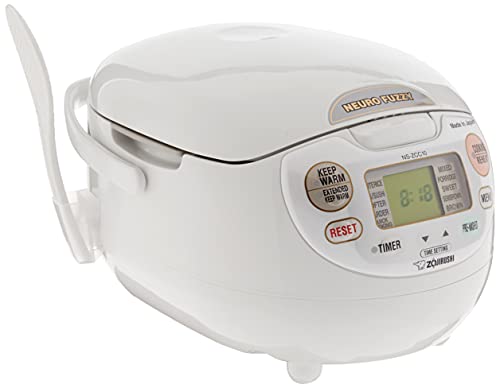
Zojirushi NS-ZCC10 Neuro Fuzzy Rice Cooker and Warmer
Badge: Best Overall
Strengths
- Neuro Fuzzy logic senses and adjusts during the cook, which is exactly the behaviour short-grain rice rewards.
- Automatic keep-warm holds cooked rice in serving condition across a long family meal.
- Delay timer lets you load the pot in the morning and eat on schedule in the evening.
Trade-offs
- It is a conventional fuzzy-logic cooker, not a pressure cooker, so it cannot reproduce the deep gloss of a Korean pressure pot exactly.
- Premium tier positioning: it costs more than the simple cookers here by a wide margin.
- Cooking cycles on computerized machines run longer than one-touch cycles.
Mini spec box
- Type: Neuro Fuzzy rice cooker and warmer
- Controls: computerized fuzzy logic with delay timer
- Keep-warm: automatic
- Finish: white
Korean home cooks judge a cooker by the bowl of plain short-grain rice it produces with nothing else in it, and that is the test the NS-ZCC10 passes best in this line-up. Its Neuro Fuzzy system does not run a fixed timer; it monitors the cooking process and adjusts heat and time as the batch develops, which compensates for the small variations — a slightly wet measure, a new bag of rice, a cold kitchen — that push one-touch cookers toward either chalky centres or a gummy surface. The result, batch after batch, is the evenly hydrated, distinct-yet-clinging grain structure that Korean meals assume.
For mixed grains it behaves well too, because the same adaptive logic tolerates the uneven absorption of barley and brown rice better than a fixed cycle does, especially if you give the blend a soak before starting. The honest limitation is pressure: Korean pressure cookers force moisture into the grain under load and produce a particular sheen and chew that no atmospheric cooker fully copies. If that exact texture is your non-negotiable, no pick in this guide is a true substitute, and the buying guide below explains the import route and its electrical caveats. For everyone else, this is the closest and most consistent approximation available in the pool.
Best for: households that eat short-grain rice daily and want the most Korean-style texture this pool can offer / Not suited for: buyers who insist on true pressure-cooked rice or who cook rice only occasionally.

Cosori Rice Cooker 10 Cup with Fuzzy Logic
Badge: Best for Mixed Grains
Strengths
- Fuzzy logic cooking with an 18-in-1 program range that covers grains well beyond plain white rice.
- Large 10-cup uncooked capacity suits extended families and batch cooking.
- Ceramic-coated inner pot and stainless steel steamer basket broaden what one appliance can do.
Trade-offs
- Its size is wasted on one or two people, and small batches in a big pot are less consistent.
- 24-hour keep-warm is a convenience that should still be used with food-safety judgement.
- Menu breadth means a learning curve before the machine feels simple.
Mini spec box
- Capacity: 10-cup uncooked / 20-cup cooked
- Technology: fuzzy logic, 18-in-1 programs including sauté and slow cook
- Inner pot: ceramic non-stick coating
- Timers: 24-hour keep-warm and delay timer
- Accessory: stainless steel steamer basket
- Finish: black
Japgokbap — rice cooked with a mixture of grains, beans and seeds — is where this Cosori earns its badge. Mixed grains are the hardest everyday job in Korean rice cooking because each component drinks water at a different rate: brown rice and barley lag behind short-grain white rice, beans lag further still. A cooker with fuzzy logic and generous capacity handles that spread gracefully, and the sauté and slow-cook functions let you pre-cook or bloom harder additions in the same pot. For a household that cooks mixed grains several times a week, or that regularly feeds a table of six or more, this is the most practical machine in the guide.
For plain short-grain white rice it is very good rather than class-leading; the Zojirushi models edge it on single-grain finesse. Its honest limitation is proportion: the pot is built for volume, and a one-cup batch rattles around in it with less even results. Buy it for the mixed-grain, big-table job and it will not disappoint; buy it as a solo cook’s daily driver and you are paying for capacity you will never use. Shoppers comparing it against pressure-based approaches should also read Best Rice Cookers Pressure to understand what pressure changes — and what it does not.
Best for: large households and committed mixed-grain cooks / Not suited for: single cooks, small kitchens, or buyers who want one-button simplicity.

Zojirushi NS-TSC10 5.5-Cup Micom Rice Cooker and Warmer
Badge: Best Everyday Short-Grain
Strengths
- Microcomputerized (Micom) control gives consistent, repeatable short-grain results in a right-sized 5.5-cup format.
- LCD controls and a delay timer make daily scheduling straightforward.
- Compact 1.0-litre class footprint suits ordinary family kitchens better than the big multi-cookers.
Trade-offs
- Micom control is a step below the Neuro Fuzzy model in how finely it adapts mid-cook.
- Capacity tops out quickly for parties or large extended-family meals.
- Like its sibling, it is an atmospheric cooker, not a pressure cooker.
Mini spec box
- Capacity: 5.5-cup / 1.0 litre
- Type: Micom (microcomputerized) rice cooker and warmer
- Controls: LCD with delay timer
If the NS-ZCC10 is the connoisseur’s pick, the NS-TSC10 is the sensible daily driver, and for many Korean-style kitchens it is the better buy. Its 5.5-cup size matches the rhythm of a typical household: enough rice for dinner plus tomorrow’s lunchbox, without the waste and texture drift of cooking small amounts in an oversized pot. The Micom system runs programmed cooking curves informed by sensors, which in practice means the rice comes out the same on a humid Tuesday as on a dry Sunday — the quiet consistency that matters more over a year of dinners than any single spectacular batch.
Mixed grains work here too, in family-sized rather than banquet-sized quantities, and the delay timer pairs naturally with an overnight soak for brown-rice blends. The honest limitation is headroom: invite eight people and you will be cooking in relays. Within its size class, though, it gives up very little to the flagship, and its simpler control set is arguably easier for older family members to use confidently — a real consideration in multi-generational Korean households.
Best for: families of two to five who cook short-grain rice most days / Not suited for: large gatherings or buyers chasing the finest adaptive control.

AROMA Digital Rice Cooker ARC-914SBD
Badge: Best Value Digital
Strengths
- Digital controls with dedicated grain-cooker and multicooker roles at an accessible tier.
- Steamer function lets vegetables or dumplings cook above the rice for a one-pot meal.
- Stainless steel exterior wipes clean and suits a modern kitchen.
Trade-offs
- No fuzzy logic: programs are fixed, so short-grain texture depends more on your water measurement.
- 8-cup cooked capacity is a ceiling for bigger families.
- Digital convenience still cannot match computerized models on keep-warm finesse.
Mini spec box
- Capacity: 4-cup uncooked / 8-cup cooked, 2 Qt
- Roles: rice cooker, steamer, grain cooker, multicooker
- Exterior: stainless steel
- Model: ARC-914SBD
The ARC-914SBD is the pick for cooks who want digital convenience — set a program, walk away, come back to rice — without paying computerized-cooker money. Its grain-cooker role matters for this keyword: Korean-style eating rarely means plain rice alone, and a machine that also handles other grains and steams a tray of vegetables or mandu above the rice fits the way a Korean weeknight meal actually comes together. Short-grain results are good when you measure carefully; the fixed programs are less forgiving of a sloppy water ratio than the fuzzy-logic models, so treat the first few batches as calibration and note the ratio that works with your rice.
Its honest limitation is refinement. The gap between this and the Zojirushi pair shows up in the details: slightly less even hydration at the pot’s edges, keep-warm that is fine for an evening rather than a day. For a first rice cooker, a student kitchen, or a household that eats rice a few times a week rather than at every meal, those are reasonable trades for the tier it sits in — a genuinely accessible price band compared with the premium picks above.
Best for: value-focused households wanting digital programs and a steamer / Not suited for: daily short-grain perfectionists or large families.

AROMA Rice Cooker ARC-363NG
Badge: Best for Porridge and Small Batches
Strengths
- Small 3-cup uncooked format cooks modest batches evenly, where big pots struggle.
- Oatmeal-cooker and soup-maker roles translate naturally to Korean-style porridge (juk).
- Automatic keep-warm and a simple control keep it approachable for any age of cook.
Trade-offs
- 6-cup cooked ceiling rules it out as a family’s only cooker.
- One-touch class cooking: no programs to rescue a wrong water ratio.
- Mixed grains need a pre-soak and realistic expectations at this size and tier.
Mini spec box
- Capacity: 3-cup uncooked / 6-cup cooked, 1.5 Qt
- Roles: small rice cooker, oatmeal cooker, soup maker
- Keep-warm: automatic
- Finish: white
- Model: ARC-363NG
Every Korean kitchen culture has a convalescent dish, and juk — slow rice porridge — is it: the food of sick days, exam mornings and gentle breakfasts. The ARC-363NG is the pick this guide would hand to someone who cooks porridge and small rice batches often. Its listing names oatmeal and soup roles, which are the same gentle, wet, long-simmer jobs as juk, and its small pot means a single serving of porridge or a two-person rice batch cooks in the volume the machine was designed around, instead of spread thin across the floor of a family pot.
As a main family cooker it is simply too small, and its one-touch mechanism leaves texture entirely in your hands — which experienced cooks may actually enjoy, since a simple cooker responds predictably once you learn its habits. Think of it as the second cooker many Korean households effectively keep: the small one for porridge, for a child’s rice, for the experimental batch. At its modest tier, that is a respectable role.
Best for: porridge lovers, couples, dorms and second-cooker duty / Not suited for: families needing one cooker to do everything.

BLACK+DECKER Rice Cooker 6-Cup (Cooked)
Badge: Best Budget Pick
Strengths
- The lowest-cost route in this guide to hands-off rice, in a simple one-touch format anyone can operate.
- Included steaming basket adds a vegetable or protein tray above the rice.
- Removable non-stick bowl keeps washing up quick.
Trade-offs
- No programs, no logic: short-grain texture is entirely down to your rinsing and water ratio.
- 6-cup cooked output is modest even for a small family.
- Keep-warm on basic cookers dries rice faster than on computerized models; serve promptly.
Mini spec box
- Capacity: 6-cup cooked
- Pot: removable non-stick bowl
- Accessory: steaming basket
- Finish: white
There is an honesty to the cheapest cooker in a guide: it promises rice, cooked, with no decisions attached, and the BLACK+DECKER keeps that promise. For a reader whose Korean-style cooking is mostly plain rice beside dishes bought or cooked separately — rice for kimchi fried rice tomorrow, rice under a stew tonight — a one-touch machine with a steaming basket covers the job at the lowest tier in this line-up. Generations of cooks made excellent rice in machines exactly this simple; the technique sections below matter more than the badge on the lid at this level.
Its limits are the class’s limits. Mixed grains will need soaking and a watchful eye, porridge is a stovetop job, and rice left warming while a long dinner unfolds will dry at the edges. Buy it knowing those boundaries — as a first cooker, a spare, or a budget answer — and it earns its place. Buyers watching for the seasonal moments when even premium models drop a tier can track Best Rice Cookers On Sale alongside this guide.
Best for: tight budgets, first cookers, plain-rice duty / Not suited for: mixed-grain enthusiasts or long keep-warm needs.
Comparison Table
| Pick | Badge | Control type | Capacity (listing) | Standout role | Link |
|---|---|---|---|---|---|
| Zojirushi NS-ZCC10 | Best Overall | Neuro Fuzzy logic | Warmer format | Short-grain texture | Check on Amazon |
| Cosori 10 Cup | Best for Mixed Grains | Fuzzy logic, 18-in-1 | 10-cup uncooked / 20-cup cooked | Japgokbap and big batches | Check on Amazon |
| Zojirushi NS-TSC10 | Best Everyday Short-Grain | Micom, LCD | 5.5-cup / 1.0 L | Daily family rice | Check on Amazon |
| AROMA ARC-914SBD | Best Value Digital | Digital programs | 4-cup uncooked / 8-cup cooked | Steaming over rice | Check on Amazon |
| AROMA ARC-363NG | Best for Porridge | One-touch, auto warm | 3-cup uncooked / 6-cup cooked | Juk and small batches | Check on Amazon |
| BLACK+DECKER 6-Cup | Best Budget Pick | One-touch | 6-cup cooked | Plain rice, lowest tier | Check on Amazon |
How to Choose a Rice Cooker for Korean-Style Cooking
Start with the grain, not the machine. Korean-style cooking centres on short-grain rice eaten fresh and slightly sticky, with mixed grains and porridge in supporting roles. A cooker should be judged on those three jobs in that order. If your household eats plain short-grain rice daily and mixed grains rarely, a computerized single-purpose cooker like either Zojirushi serves you better than a vast multi-cooker. If japgokbap is a weekly habit, capacity and fuzzy logic for uneven grains matter more, which is the Cosori’s argument.
Understand the three control tiers. One-touch cookers (the BLACK+DECKER and the small Aroma) heat until the pot’s temperature behaviour tells them the water is absorbed, then switch to warm: simple, fast, and entirely dependent on your measuring. Digital program cookers (the Aroma ARC-914SBD) run fixed timed programs for different foods, adding convenience without adaptation. Computerized cookers (Micom, fuzzy logic and Neuro Fuzzy) monitor the cook and adjust, which buys consistency across rice ages, batch sizes and grain mixtures. Each step up costs more and forgives more; none of the steps is a scam, and none is mandatory.
Do the capacity maths in cooked cups. Listings mix uncooked and cooked figures freely, so convert everything: a cup of uncooked rice yields roughly two to three cups cooked, and a Korean-style serving is generous. A 5.5-cup uncooked cooker covers a family of four with leftovers; the 3-cup Aroma suits one or two people; the 10-cup Cosori is for crowds, meal prep and big mixed-grain batches. Buying one size up from your daily need is wise; buying three sizes up makes small batches worse.
Weigh keep-warm as a feature, not a footnote. Korean meals are rarely served the minute rice finishes, and rice is often held for second helpings. Computerized models manage holding temperature and moisture noticeably better. With basic models, plan to serve within a shorter window or transfer rice to a thermal container. Whichever you choose, treat very long holding with food-safety common sense: rice held warm for many hours should be refrigerated and reheated properly instead.
Consider the inner pot as a long-term relationship. The pot is the part you will handle, wash and eventually judge the whole machine by. Ceramic-coated and non-stick pots both release rice cleanly when young; both dislike metal utensils, abrasive pads and thermal shock. The Cosori’s ceramic coating and the removable non-stick bowls in the simpler picks all reward a soft sponge and a silicone or wooden paddle. Ask, before buying, whether a replacement pot for your chosen model is easy to find — a cooker whose pot is replaceable has a second life built into it, while a cooker without one is disposable on the coating’s schedule, whatever the motor’s lifespan.
Price the tiers qualitatively. This guide publishes no static prices, because listings move; check the latest price on Amazon for each pick. What can be said durably is the shape of the market: one-touch cookers occupy the lowest tier, digital program models the next, Micom and fuzzy-logic machines the upper tiers, with capacity and brand pushing individual models around within that shape. Spend where your eating habits actually live.
How to Cook Korean-Style Rice, Step by Step
Step 1 — Rinse properly. Put the measured short-grain rice in the pot, cover with water, swish gently with your hand, and pour off the cloudy water. Repeat until the water runs mostly clear, usually several changes. Rinsing removes surface starch that would otherwise glue the grains into porridge; for Korean-style texture this step is not optional.
Step 2 — Measure water with one consistent method. Use the same method every batch so you can adjust intelligently: either the pot’s marked lines for your rice type, a fixed ratio by volume, or the traditional knuckle method. New-crop rice needs slightly less water; older rice slightly more. Change one variable at a time and write your winning ratio on a note inside a cupboard door.
Step 3 — Soak when grains get complicated. Plain white short-grain benefits from even a short rest in its cooking water before you start the cycle. Mixed grains need more: give japgokbap blends a proper soak — an hour at minimum, longer for beans and brown rice — or use the delay timer on the computerized picks to soak and cook in one planned motion.
Step 4 — Cook, then rest. When the cycle ends, do not open the lid immediately. Let the rice stand in the closed pot for about ten minutes so moisture equalises from the wet bottom to the drier top. Then fluff with a paddle using a cutting-and-folding motion, working from the edges to the centre, which keeps grains intact and glossy rather than mashed.
Step 5 — For porridge, change the ratio, not the machine. Juk uses far more water than table rice and a gentle programme: the small Aroma’s oatmeal and soup roles, or a slow programme on the Cosori, suit it. Stir once midway if your cooker allows a peek without losing much heat, season near the end, and serve it fresh rather than held.
Cleaning and care. Wash the inner pot with a soft sponge — ceramic and non-stick coatings both reward gentleness and punish metal utensils. Wipe the lid’s underside and any condensation collector after each use; yesterday’s rice water is the main source of off smells. Dry the pot fully before storing it inside the closed cooker.
Troubleshooting. Problem: rice is gummy and clumped → too much water or too little rinsing; cut water slightly next batch and rinse more thoroughly. Problem: chalky, hard centres → too little water or no rest; add a splash more water and always let the rice stand before fluffing. Problem: mixed grains uneven, beans still firm → the blend needed a longer soak; extend soaking or pre-soak beans separately overnight.
Shopping From Korea, or Importing a Korean Cooker
Some readers arrive at this keyword from the other direction: they are in Korea, or they want the genuine Korean-market article. Three practical checks decide whether that route ends happily. First, electricity: Korea’s grid and North America’s differ in both voltage and plug shape, and a cooker is a high-draw heating appliance, so a cheap travel adapter is not a safe answer; a properly rated converter is bulky and costly, and many imported cookers are simply happiest staying on their home grid. Second, language: Korean-market models often carry Korean-only controls, labels and voice prompts, which range from charming to genuinely obstructive depending on your reading comfort. Third, warranty and parts: an imported unit usually has no local service path, and the part most likely to age — the inner pot’s coating — becomes a cross-border hunt.
None of that makes importing wrong; it makes it a deliberate purchase for enthusiasts who want pressure-cooked texture and accept the friction. Everyone else is better served by a locally sold computerized cooker and good technique, which is the combination this guide ranks. Readers shopping from other regions with their own grid quirks face a mirror-image version of the same checks — the notes in Best Rice Cookers Nz walk through the equivalent questions for New Zealand buyers.
What About Nurungji and Stone-Pot Effects?
Two beloved Korean textures sit outside any electric cooker’s standard repertoire, and honesty requires naming them. Nurungji, the golden scorched crust from the bottom of the pot, forms in heavy traditional pots over direct heat; some modern Korean pressure cookers court it deliberately, but none of the six picks here promises it, and the closest home approximation remains a well-seasoned heavy pot on the stove. Stone-pot bibimbap’s sizzling rice crust likewise belongs to the dolsot itself. A rice cooker supplies the well-cooked rice; the crust is a separate, pleasurable project. Buyers browsing the wider shelf sometimes start from general retail searches such as Best Rice Cookers On Ama and land here for the Korean specifics — the crust question is usually what they were really asking.
Rice Varieties and Water Ratios, the Korean Way
The cooker is only half the system; the other half is knowing what is in the pot. Korean-style cooking uses several rice preparations that look similar in a shopping list and behave very differently in a cooker, and matching your water and program choices to each one is the fastest route to better results from any pick in this guide.
Plain short-grain white rice (ssalbap) is the reference dish. Rinsed until the water runs mostly clear, cooked with a moderate water ratio, rested, and fluffed, it should emerge glossy, tender and gently cohesive. New-crop rice, sold in the months after harvest, carries more internal moisture and wants slightly less added water; rice that has sat in a warehouse through summer wants slightly more. This is the adjustment computerized cookers quietly help with and one-touch cookers leave entirely to you.
Mixed-grain rice (japgokbap) blends the white base with some combination of brown rice, barley, black rice, sorghum, millet and beans. Two rules govern it. First, soak: the blend’s hardest members set the schedule, and an unsoaked bean will still be firm when everything else is soft. Second, water: mixed grains generally take a little more water than white rice alone, but the increase should be modest and earned by experiment, because a drowned blend loses the pleasant chew that makes the dish worth cooking. Black rice deserves a specific warning — a small amount tints the whole pot a dramatic purple, which is traditional and delicious, but surprises anyone expecting white rice with speckles.
Brown rice (hyeonmi) keeps its bran layer, which is precisely why it needs more water, more time and ideally a soak; it is also the preparation where the gap between control tiers shows most clearly. Fuzzy-logic and Micom programs are built to manage that long, uneven absorption. In a one-touch cooker, soak brown rice well, accept a firmer result, and consider cooking it as part of a blend rather than alone while you learn your machine’s habits.
Porridge (juk) inverts the usual ratio: several times more water than rice, cooked gently until the grains dissolve into a soothing whole. Because it starts so wet, porridge forgives cheap cookers and punishes inattention differently — the risks are scorching at the base in a fierce machine and blandness if seasoned too early. The small Aroma’s soup and oatmeal roles exist in exactly this territory.
Across all four preparations, one habit pays for itself: keep a small notebook or phone note of grain, ratio, soak and result for your first dozen batches in a new cooker. Korean home cooks develop fierce loyalty to particular machines largely because they have calibrated themselves to one; the calibration, more than the hardware, is the expertise.
Keep-Warm Culture, Leftovers and Next-Day Rice
Rice in a Korean household is rarely a one-meal event. It is cooked in the morning for lunchboxes, held for a staggered family dinner, and reborn the next day as fried rice, porridge or rice cakes’ companion. A cooker’s keep-warm and your leftover habits therefore matter almost as much as the initial cook, and the picks divide clearly on this ground.
The computerized Zojirushi models and the Cosori are built for holding: they manage temperature steadily and limit the drying and yellowing that long holding can cause. Even so, held rice slowly loses the gloss that makes fresh short-grain rice special, and the practical rhythm is to cook close to the meal when you can, hold through the meal when you must, and refrigerate what remains rather than warming it indefinitely. The basic Aroma and BLACK+DECKER hold rice acceptably for a short window; plan smaller batches in them rather than relying on hours of warming.
Leftovers deserve technique too. Refrigerate cooked rice promptly in a shallow, covered container so it cools quickly and evenly. For fried rice, day-old refrigerated rice is not a compromise but the correct ingredient: its dried surface fries into separate, chewy grains instead of steaming into clumps. For plain reheated rice, sprinkle a little water over the portion and reheat it covered, in the microwave or back in the cooker, so the steam restores softness. Frozen portions, packed flat in bags, reheat from frozen the same way and keep a busy household in near-instant rice without a fresh cook — a system that makes even the smallest pick in this guide punch above its capacity.
Common Buying Mistakes
- Assuming a Korean-style result requires a Korean brand. Technique and control tier matter more than the badge; conversely, do not let any listing talk you into believing a basic one-touch cooker is a pressure cooker in disguise.
- Buying banquet capacity for a two-person kitchen. Oversized pots cook small batches unevenly and eat counter space every single day.
- Ignoring the water, blaming the machine. Most disappointing Korean-style rice traces back to unrinsed grain or an uncalibrated ratio, not to the cooker.
- Importing without checking voltage and plug. A heating appliance is the worst category to discover electrical incompatibility with.
- Holding rice warm indefinitely. Even excellent keep-warm has a sensible window; refrigerate leftovers and reheat them properly.
Final Recommendation
For most readers, the Zojirushi NS-ZCC10 Neuro Fuzzy is the first choice: it produces the most convincing Korean-style short-grain rice in this pool, holds it well, and forgives the small measuring errors of real kitchens. Families who want the same computerized consistency in a slightly simpler, right-sized package should take the Zojirushi NS-TSC10 Micom, while mixed-grain devotees and big households belong with the Cosori 10 Cup. The Aroma pair and the BLACK+DECKER remain honourable answers at their tiers — for digital value, for porridge and small batches, and for the tightest budgets respectively. Choose by the rice you actually cook, and every pick here will serve you honestly.
Frequently Asked Questions
Can a non-Korean rice cooker really make Korean-style rice?
Yes, within one honest limit. Short-grain texture comes from the grain itself, thorough rinsing, a calibrated water ratio, a resting period and even heat — all achievable in the computerized and even the simpler cookers above. The limit is pressure: the specific gloss and chew of Korean pressure-cooked rice cannot be fully replicated at atmospheric pressure, which is why this guide recommends the adaptive fuzzy-logic models as the closest approximation rather than claiming equivalence.
What rice should I buy for Korean-style cooking?
Look for short-grain or medium-grain rice labelled for sushi or Korean-style use; the grains are plumper and higher in the starch that gives the characteristic gentle cling. Avoid long-grain varieties for this purpose — no cooker can make jasmine or basmati behave like short-grain, because the difference is in the grain’s starch composition, not the cooking.
How do I cook mixed grains (japgokbap) in these machines?
Rinse the blend, soak it — an hour at minimum, longer when beans or brown rice are included — then cook on the most capable program your machine offers. Fuzzy-logic and Micom models handle the uneven absorption best; in one-touch cookers, extend the soak and check doneness, adding a short extra rest if the hardest grains lag. The delay timers on the Zojirushi and Cosori models make soak-plus-cook a single planned step.
Is it safe to leave rice on keep-warm for a long time?
Keep-warm is designed for the span of a meal and a little beyond, and the computerized models manage it best. As a habit, avoid holding cooked rice warm for many hours; refrigerate leftovers promptly in shallow containers and reheat them until steaming. This is ordinary food-safety practice for cooked rice in any appliance, Korean-style or otherwise.
Can these cookers make rice porridge (juk)?
Yes. Porridge is rice cooked in far more water at a gentle pace. The small Aroma’s oatmeal and soup roles suit it directly, larger multi-program machines handle it on their slower settings, and even simple cookers manage a basic version if you watch the consistency. Season near the end of cooking, and serve porridge fresh rather than holding it warm, since it thickens as it stands.
Should I import a Korean pressure rice cooker instead?
Only with open eyes. You would gain genuine pressure texture and, on many models, deliberate nurungji-friendly design. You would also take on voltage and plug incompatibility with the North American grid, Korean-language controls on many units, and no local warranty or parts path. For most households, a locally sold fuzzy-logic cooker plus disciplined technique delivers ninety percent of the experience with none of the friction; the import route is for enthusiasts who specifically want that final increment.


