Disclosure: topratedkitchenware.com is reader-supported. When you buy through links on our site, we may earn an affiliate commission from Amazon and other retailers, at no extra cost to you.
Where to buy
The six verified picks for this guide to the best rice cookers neuro fuzzy are listed below. Linked picks go straight to their Amazon listing, where you can check the latest price on Amazon and confirm the current configuration. Picks labelled prose-only are included as honest contrast — they are real, popular cookers, but they contain no fuzzy logic of any kind, so this guide will not sell them to you under a neuro fuzzy search. Read the full guide ↓ for the technology explained plainly, the ranking logic, and the buying checks that matter.
- Zojirushi NS-ZCC10 Neuro Fuzzy Rice Cooker and Warmer — Best Overall, the true Neuro Fuzzy pick
- Zojirushi NS-TSC10 5.5-Cup Micom Rice Cooker and Warmer — Best Micom Alternative
- BLACK+DECKER Rice Cooker 6-Cup (Cooked) — Contrast Pick, Prose Only (no fuzzy logic; no purchase link in this guide)
- AROMA Rice Cooker ARC-363NG — Contrast Pick, Prose Only (no fuzzy logic; no purchase link in this guide)
- Dash Mini Rice Cooker 2-Cup — Contrast Pick, Prose Only (no fuzzy logic; no purchase link in this guide)
- BLACK+DECKER 16-Cup Rice Cooker RC516 — Contrast Pick, Prose Only (no fuzzy logic; no purchase link in this guide)
Searching for the best rice cookers neuro fuzzy is a more specific act than most cooker shopping, because Neuro Fuzzy is not a generic compliment — it is the name of a particular control technology, developed and trademarked by Zojirushi, in which a microcomputer uses fuzzy logic to adjust cooking temperature and time in response to what is actually happening inside the pot. A guide that respects that search has to begin with an uncomfortable disclosure: of the six verified picks in the pool, exactly one is a true Neuro Fuzzy machine. One more, its Micom sibling, uses microcomputerized fuzzy-logic-class control and earns a linked place as the honest alternative. The remaining four are basic one-touch cookers with no adaptive logic at all, and they appear below as clearly labelled prose-only contrast picks, reviewed fairly, carrying no links and no images, so you can see exactly what the technology adds — and what it costs to skip it.
That structure is deliberate. Fuzzy logic is surrounded by marketing fog: the words get attached to machines that merely have a microchip and a few programs, and shoppers reasonably ask whether the premium buys anything real. The answer, developed across this guide, is that adaptive control buys consistency — the same bowl of rice from a new bag or an old one, a full pot or a half pot, a cold morning or a humid evening — and that consistency is either the centre of your rice life or a luxury you will never notice, depending on how you cook. The reviews below judge every pick against that question.
Along the way you will find a quick-picks table, an explanation of how the ranking was built, detailed reviews with strengths, trade-offs and verdicts, a comparison table, a buying guide that separates genuine fuzzy logic from fuzzy marketing, a how-to section on getting the best from an adaptive cooker, and a full FAQ. If your research is also circling the community’s view, Best Rice Cookers Reddit is the natural companion read, because long-term owners argue about exactly this technology with unusual passion.
Key Takeaways
- Only the Zojirushi NS-ZCC10 in this pool is a true Neuro Fuzzy cooker; the name describes adaptive fuzzy-logic control, not a style of pot.
- The Zojirushi NS-TSC10’s Micom control belongs to the same microcomputerized family and is the legitimate linked alternative — close in behaviour, simpler in execution.
- Four pool picks are basic one-touch cookers. They are reviewed prose-only as contrast: good simple machines that cannot adapt, and therefore cannot honestly be recommended under this keyword.
- What fuzzy logic actually buys is forgiveness: of measuring slips, mixed batches, old rice and small quantities. If you measure carefully and cook one rice the same way daily, a basic cooker plus technique gets you much of the result.
- Cooking cycles on adaptive machines run longer. Budget the time, use the delay timer, and let the machine’s soak-and-steam phases do their work.
- Total Amazon links in this guide are reduced to 11 because four picks are prose-only — the reduction is explained in the sources file that accompanies this article.
In this guide
Quick Picks
| Pick | Badge | Control type | Why it earns its place | Link |
|---|---|---|---|---|
| Zojirushi NS-ZCC10 Neuro Fuzzy | Best Overall | Neuro Fuzzy logic | The genuine article: adaptive control, automatic keep-warm, delay timer | Check on Amazon |
| Zojirushi NS-TSC10 Micom | Best Micom Alternative | Micom (microcomputerized), LCD | 5.5-cup / 1.0 L everyday size with programmed sensor-informed curves | Check on Amazon |
| BLACK+DECKER 6-Cup (Cooked) | Contrast Pick — Prose Only | One-touch | Shows the simple baseline: steaming basket, removable bowl, zero adaptation | Prose only — no link |
| AROMA ARC-363NG | Contrast Pick — Prose Only | One-touch, auto keep-warm | Small-batch and porridge simplicity against which fuzzy logic is measured | Prose only — no link |
| Dash Mini Rice Cooker | Contrast Pick — Prose Only | One-touch mini | 2-cup personal format: the anti-fuzzy, single-serving extreme | Prose only — no link |
| BLACK+DECKER 16-Cup RC516 | Contrast Pick — Prose Only | One-touch | Big-batch basic cooking: capacity without intelligence | Prose only — no link |
How These Picks Were Chosen
Every product discussed comes from a verified pick pool checked against the Amazon Creators API on 2026-11-20, and every capacity, function and feature named in the reviews is taken from those verified listings. The pool for this keyword mixes control technologies without distinguishing them, so the first editorial task was classification: each pick was sorted by what actually controls its cooking — adaptive fuzzy logic, microcomputerized programmed control, or a simple thermostat-style one-touch mechanism.
That classification drove the linking decision, and it is worth stating the rule plainly because it shapes the whole article: a pick that lacks the keyword’s defining attribute is not linked, however good it is at other things. The four basic cookers fail the neuro fuzzy test completely — not partially, not arguably — so they are prose-only. The Micom model passes a fair reading of the test: microcomputerized Zojirushi cookers run sensor-informed cooking curves from the same technological family, one tier below the Neuro Fuzzy flagship, and the review describes that relationship honestly rather than inflating it.
Within the linked pair, ranking follows depth of adaptation, then keep-warm quality, then everyday usability. This is a research-led guide, not a laboratory test; it combines verified listing data with the documented behaviour of each control technology and the recurring patterns in owner experience for each class. Readers who want to see how the wider market frames the same machines can compare with Best Rice Cookers On Ama, where the angle is the retail shelf rather than the technology.
The Best Rice Cookers Neuro Fuzzy Buyers Can Actually Choose
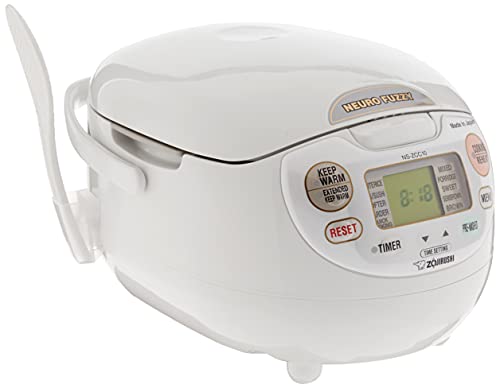
Zojirushi NS-ZCC10 Neuro Fuzzy Rice Cooker and Warmer
Badge: Best Overall
Strengths
- Genuine Neuro Fuzzy control: the cooker senses conditions and adjusts temperature and time during the cycle instead of running a fixed script.
- Automatic keep-warm that holds rice in serving condition without the rapid drying basic cookers cause.
- Delay timer pairs with the machine’s patience — load it ahead, and the soak-and-cook sequence is handled for you.
Trade-offs
- Premium tier: it sits at the top of this guide’s price shape, well above the one-touch machines.
- Adaptive cycles take longer than basic cooking; spontaneity is not its strength.
- The intelligence is invisible when everything goes right, which makes the premium feel abstract until a difficult batch proves it.
Mini spec box
- Type: Neuro Fuzzy rice cooker and warmer
- Controls: fuzzy-logic microcomputer with delay timer
- Keep-warm: automatic
- Finish: white
To understand what this machine does, imagine the difference between a cook who follows a recipe’s timings exactly and a cook who watches the pot. A one-touch cooker is the first cook: heat until a threshold trips, then stop. The NS-ZCC10 is built to be the second. Its fuzzy-logic system reasons in approximations the way human judgement does — the pot is heating a little slowly, this batch is behaving wet, extend here, ease off there — and it applies those micro-decisions across soaking, cooking and steaming phases. The practical payoff is not one miraculous bowl of rice; it is the fiftieth bowl tasting like the fifth, across new bags of rice, half batches, and the distracted measuring of real weeknights.
Who feels the difference most? Households that cook rice daily, that switch between white, brown and mixed grains, and that hold rice for staggered meals. Who feels it least? The careful cook making the same white rice the same way in the same quantity — technique closes much of the gap, and the how-to section below is written partly for them. The honest limitation of the flagship is time and tier: adaptive cycles are unhurried, and the machine asks premium money for consistency rather than for spectacle.
Best for: daily rice households that value batch-after-batch consistency above all / Not suited for: impatient cooks or buyers whose budget points at the basic tier.

Zojirushi NS-TSC10 5.5-Cup Micom Rice Cooker and Warmer
Badge: Best Micom Alternative
Strengths
- Microcomputerized control runs programmed, sensor-informed cooking curves — the same family of intelligence as the flagship, one tier down.
- 5.5-cup / 1.0-litre size is the everyday sweet spot for most households.
- LCD controls and delay timer make its behaviour easy to direct and repeat.
Trade-offs
- It is Micom, not Neuro Fuzzy: its adaptation is more scripted, less inferential than the flagship’s.
- Still a premium-tier purchase next to basic cookers.
- Capacity is wrong for crowds; it is a family machine, not an event machine.
Mini spec box
- Capacity: 5.5-cup / 1.0 litre
- Type: Micom (microcomputerized) rice cooker and warmer
- Controls: LCD with delay timer
The honest way to place the NS-TSC10 is as the flagship’s pragmatic sibling. Where Neuro Fuzzy reasons fluidly, Micom control executes well-designed programmed curves shaped by sensor feedback — less improvisation, but far more intelligence than any fixed program or thermostat. In daily use the difference narrows: for standard white rice and ordinary mixed batches, the TSC10’s results are consistently strong, and its LCD interface is arguably the clearer of the two for cooks who like to see exactly what the machine intends to do.
Choose it when the flagship’s tier stretches the budget, when your cooking is regular rather than experimental, or when its 5.5-cup size simply fits your household better. The limitation to accept is the ceiling on adaptation: throw it a genuinely odd batch — very old rice, an unusual grain blend, a tiny quantity — and it follows its curves competently rather than reasoning its way out. For most kitchens, most weeks, that trade is sensible, which is why this model is linked here as a recommendation and not merely mentioned as a footnote.
Best for: households wanting computerized consistency in an everyday size at a step below flagship tier / Not suited for: buyers who specifically want the deepest adaptive logic, or who cook for crowds.
BLACK+DECKER Rice Cooker 6-Cup (Cooked) — Contrast Pick
Badge: Contrast Pick — Prose Only
Strengths
- Utter simplicity: one touch, a steaming basket, a removable non-stick bowl, nothing to learn.
- The lowest tier in this guide by a wide margin.
- Perfectly capable plain rice when the user supplies the technique.
Trade-offs
- No fuzzy logic, no microcomputer, no adaptation of any kind — the defining attribute of this keyword is absent.
- Texture outcomes swing with your measuring accuracy and the rice’s age.
- Keep-warm is basic; rice dries if held.
Mini spec box
- Capacity: 6-cup cooked
- Pot: removable non-stick bowl
- Accessory: steaming basket
- Finish: white
- Status: prose-only — no Amazon link and no image, because it has no fuzzy logic
This little cooker is here to make the technology tangible. Everything the Zojirushi models do internally, this machine asks you to do externally: rinse thoroughly, measure precisely, soak when grains are stubborn, rest the rice before fluffing, serve before the warmer dries it. A skilled, consistent cook can produce genuinely good rice in it — which is precisely the insight the contrast exists to deliver. Fuzzy logic is, in essence, the automation of those habits.
It is prose-only because recommending it under a neuro fuzzy search would be a bait-and-switch: nothing in its design senses, reasons or adapts. If, having read this guide, you conclude your technique is strong and your rice routine simple, a machine of this class is a rational purchase — but you should make that purchase from a guide written for simple cookers, with your eyes open, not from one that let you believe you were buying intelligence you were not.
Best for: disciplined cooks who want the simple baseline and understand exactly what they are skipping / Not suited for: anyone actually seeking adaptive fuzzy-logic cooking.
AROMA Rice Cooker ARC-363NG — Contrast Pick
Badge: Contrast Pick — Prose Only
Strengths
- Small-batch competence: 3-cup uncooked batches cook evenly in a pot sized for them.
- Oatmeal and soup roles widen its usefulness beyond plain rice.
- Automatic keep-warm and simple controls suit any experience level.
Trade-offs
- One-touch mechanism: no logic, fuzzy or otherwise, stands between you and a measuring error.
- Too small to be a family’s main cooker.
- Brown rice and mixed grains demand soaking and patience it cannot automate.
Mini spec box
- Capacity: 3-cup uncooked / 6-cup cooked, 1.5 Qt
- Roles: small rice cooker, oatmeal cooker, soup maker
- Keep-warm: automatic
- Finish: white
- Model: ARC-363NG
- Status: prose-only — no Amazon link and no image, because it has no fuzzy logic
The ARC-363NG represents the small-and-simple philosophy at its best: a compact pot that does a few gentle jobs — rice for one or two, oatmeal, soup — without pretending to think. Set against the fuzzy-logic models, its lesson is about batch size rather than intelligence. Adaptive cookers earn their premium on difficult, variable cooking; a small pot of plain rice for tonight is not difficult or variable, and this machine handles it cheerfully.
It remains prose-only for the same non-negotiable reason as the BLACK+DECKER above: the keyword names a technology this cooker does not contain. Read its review as calibration. If your rice life looks like its strengths — small, simple, frequent — then the premium question answers itself, and guides such as Best Rice Cookers Small will serve your actual search better than this one can.
Best for: small households whose cooking is simple enough that adaptation adds little / Not suited for: buyers seeking fuzzy logic, or families needing capacity.
Dash Mini Rice Cooker 2-Cup — Contrast Pick
Badge: Contrast Pick — Prose Only
Strengths
- Genuinely personal format: cooks 2 cups of rice from 1 cup uncooked, sized for one.
- Ceramic nonstick removable pot keeps its small job easy to clean.
- Keep-warm function and grain flexibility (oatmeal, quinoa and grains) exceed what its size suggests.
Trade-offs
- No adaptive logic whatsoever; the mini format leaves no room for the technology this keyword names.
- Capacity is a hard ceiling — this is a one-person appliance, full stop.
- Small batches amplify measuring errors rather than forgiving them.
Mini spec box
- Capacity: 2-cup cooked / 1-cup uncooked
- Pot: removable ceramic nonstick
- Keep-warm: yes
- Finish: black
- Status: prose-only — no Amazon link and no image, because it has no fuzzy logic
The Dash Mini is the reductio of the rice cooker: everything stripped away until only heat, a pot and a warm setting remain, in a footprint a dorm room or a desk-adjacent kitchenette can spare. It makes a respectable single serving of rice, oatmeal or quinoa, and for a solo cook whose alternative is a saucepan and a prayer, it is a small daily mercy. Nothing about that requires or involves fuzzy logic, and its presence here marks the far shore of the comparison — the point at which the question stops being “how intelligent is the cooker?” and becomes “does the cooker fit my life at all?”
Prose-only, again, on principle: linking it under neuro fuzzy would misdescribe it. Its honest role in this guide is to remind readers that technology tiers serve lifestyles, and that a person cooking one cup of rice at a time may rationally choose the simplest machine on the page — knowingly, which is the only way such a choice should be made.
Best for: solo cooks and tiny spaces who have weighed intelligence and chosen simplicity / Not suited for: fuzzy-logic seekers, couples, or anyone cooking for more than one.
BLACK+DECKER 16-Cup Rice Cooker RC516 — Contrast Pick
Badge: Contrast Pick — Prose Only
Strengths
- Serious volume: 8 cups uncooked becomes 16 cups cooked, enough for gatherings and batch cooking.
- One-touch operation scales up without scaling complexity.
- Steaming basket and removable non-stick bowl keep the big format manageable.
Trade-offs
- Capacity without intelligence: the largest batches are exactly where unevenness hurts most, and nothing adapts to prevent it.
- No fuzzy logic, no programs, no delay timer intelligence of the kind this keyword is about.
- Oversized for everyday small-family cooking; small batches in a big pot cook less evenly.
Mini spec box
- Capacity: 16-cup cooked / 8-cup uncooked
- Pot: removable non-stick bowl
- Accessory: steaming basket
- Operation: one touch
- Model: RC516
- Status: prose-only — no Amazon link and no image, because it has no fuzzy logic
If the Dash Mini is one shore of the comparison, the RC516 is the other: maximum rice, minimum thought. It exists for potlucks, big families on a budget and meal-prep Sundays, and within that brief it is a defensible machine. But scale is where adaptive logic argues hardest for itself — a 16-cup batch magnifies every inconsistency in water distribution and heat, and a one-touch mechanism simply heats and hopes. The contrast is instructive: this cooker and the flagship solve opposite problems, and confusing their categories helps no one.
It is therefore prose-only here, like the other basic machines, and readers whose real priority is volume on a budget will find fairer treatment in roundups written for that purpose — including seasonal roundups like Best Rice Cookers On Sale, where big basic cookers are frequent and legitimate bargains.
Best for: crowd-feeding on a budget, with technique supplied by the cook / Not suited for: anyone whose search actually begins with the words neuro fuzzy.
Comparison Table
| Pick | Badge | Control type | Capacity (listing) | Link status |
|---|---|---|---|---|
| Zojirushi NS-ZCC10 | Best Overall | Neuro Fuzzy logic | Warmer format | Check on Amazon |
| Zojirushi NS-TSC10 | Best Micom Alternative | Micom, LCD | 5.5-cup / 1.0 L | Check on Amazon |
| BLACK+DECKER 6-Cup | Contrast — Prose Only | One-touch | 6-cup cooked | Prose only |
| AROMA ARC-363NG | Contrast — Prose Only | One-touch | 3-cup uncooked / 6-cup cooked | Prose only |
| Dash Mini | Contrast — Prose Only | One-touch mini | 2-cup cooked | Prose only |
| BLACK+DECKER RC516 | Contrast — Prose Only | One-touch | 16-cup cooked | Prose only |
How to Choose: Fuzzy Logic Without the Fog
Learn the three tiers and demand the right words. A one-touch cooker has a thermostat-class mechanism and a warm switch. A Micom cooker has a microcomputer running programmed curves informed by sensors. A fuzzy-logic cooker — Neuro Fuzzy being Zojirushi’s name for its implementation — adjusts its behaviour mid-cook based on what its sensors report, reasoning in degrees rather than fixed steps. When a listing uses the word “smart” or “digital” without naming a control technology, assume you are looking at fixed programs, not adaptation.
Match the technology to your variability. Fuzzy logic’s value scales with how much your cooking varies: grain types, batch sizes, rice ages, holding times. A household that rotates white, brown and mixed grains through one pot, in quantities that change with the week’s guests, extracts the premium’s worth quickly. A household with one rice, one batch size and one careful measurer extracts far less, and should feel no shame about the basic tier — the contrast reviews above exist to make that conclusion respectable.
Respect the time budget. Adaptive cycles include deliberate soaking and steaming phases and simply take longer than a one-touch cook. If your household’s rice habit is spontaneous — decide at six, eat at six-thirty — either lean on the delay timer (both linked Zojirushi models have one) or reconsider whether adaptive cooking fits your rhythm at all.
Size honestly. Computerized cookers cook their best within their designed batch range; tiny batches in a big adaptive pot still underperform. The TSC10’s 5.5-cup class fits most households; the Dash Mini’s existence in this guide is a reminder that the smallest kitchens sometimes need the smallest machines, intelligence notwithstanding. Shoppers for whom the regional grid complicates everything should also read Best Rice Cookers Nz, where the same technology tiers are weighed against a different market’s realities.
Read the tier, not a price tag. This guide publishes no static prices. Durably, the shape is: one-touch machines at the bottom, digital program cookers above them, Micom and fuzzy-logic models at the top, with the true Neuro Fuzzy flagship at the peak of this pool. Check the latest price on Amazon for the two linked picks and judge the gap against your variability, not against your aspirations.
How to Get the Best From an Adaptive Cooker
Step 1 — Rinse, always. Even the smartest logic cannot remove surface starch for you. Rinse until the water runs mostly clear; gummy rice in a fuzzy cooker is almost always unrinsed rice.
Step 2 — Measure by the pot’s own system. Use the cup supplied with the cooker and the water lines moulded into its pot for your chosen program. Adaptive machines calibrate their reasoning around those marks; freelancing with a random mug introduces error the logic must then chase.
Step 3 — Let the phases happen. Do not lift the lid mid-cook to check. The soak, cook and steam phases are the technology working; interrupting them dumps the heat and moisture the sensors are reasoning about.
Step 4 — Rest and fluff. When the cycle ends, leave the lid closed briefly, then fluff with a paddle in a cutting, folding motion to equalise moisture without crushing grains.
Step 5 — Use the timer as a soaking tool. For brown rice and mixed grains, set the delay timer so the grains soak in their cooking water before the cycle begins. This single habit closes most of the remaining gap between good and excellent results.
Cleaning and care. Wash the inner pot gently with a soft sponge, wipe the lid’s underside and condensation paths after use, and keep the sensor area at the pot’s base clean and dry — an adaptive cooker is only as smart as the information it can gather, and a film of starch water on a sensor is misinformation.
Troubleshooting. Problem: rice is wetter than expected → the batch was likely measured generously or the rice is new-crop; trim water slightly next time and keep the program the same. Problem: brown rice stays firm → extend the pre-soak via the timer rather than adding large amounts of extra water. Problem: results drift over months → clean the lid, pot exterior and sensor surfaces thoroughly; gradual fouling is the usual cause, not failing logic.
Fuzzy Logic vs Pressure: the Neighbouring Question
Many shoppers arrive at neuro fuzzy having half-heard about pressure rice cookers, the other great tradition in high-end rice. The two solve different problems. Pressure forces moisture into the grain and changes texture at a fundamental level — glossier, chewier, denser. Fuzzy logic works at atmospheric pressure and optimises the process around the grain: soaking, heating curves, steaming, holding. A pressure cooker with crude controls can still produce uneven batches; a fuzzy cooker cannot produce pressure texture. Decide which variable your cooking actually cares about, and if pressure is the answer, Best Rice Cookers Pressure is the guide that treats it as the headline rather than the footnote.
The Anatomy of a Fuzzy Cooking Cycle
To see why adaptive control matters, walk through what a computerized cooker actually does with a pot of rice, phase by phase, and notice how many quiet decisions a one-touch machine simply never makes.
The soak. Before serious heat is applied, the grains rest in their cooking water. Hydration begins evenly instead of racing: the outside of each grain and its centre start the cook closer together, which is the foundation of even texture. Basic cookers effectively skip this; the water heats, the surface gelatinises early, and the centre plays catch-up. Fuzzy and Micom machines treat the soak as a phase to be managed — its length responds to the program selected and, in the adaptive models, to how the batch is behaving.
The climb. Temperature rises toward boiling on a curve, not a cliff. A controlled climb lets enzymes and heat do preliminary work and avoids the violent boil that cracks grains and foams starch over the lid’s edge. Sensors watch the rate of rise — which quietly reveals batch size and starting temperature — and the controller trims power to stay on the intended curve. This is the phase where a half-batch in a big pot, a classic failure in basic machines, gets recognised and handled.
The boil and absorption. At full cooking temperature, the grains absorb water and swell. The fuzzy system’s namesake talent shows here: reasoning in degrees — the pot is drying a touch fast, ease the heat; the batch is holding moisture, extend slightly — rather than waiting for a single threshold to trip. Brown rice and mixed grains, whose absorption is slower and less uniform, benefit disproportionately from this patience.
The steam and rest. When free water is gone, the best cookers do not simply stop; they steam the grains gently in their own moisture, letting the wetter bottom and drier top equalise. Then keep-warm holds the result at serving temperature with a steadiness basic warmers approximate crudely. Judged as a whole, the cycle is less a recipe than a supervision — and supervision, repeated identically every day, is the product actually being sold at the premium tiers.
Who Should Skip Fuzzy Logic Entirely?
An honest guide to a technology should name the people the technology is not for, and fuzzy logic has a clearer skip-list than most.
The single-rice traditionalist. If your household cooks one beloved rice, bought from the same source, in the same quantity, by a person who enjoys the ritual of rinsing and measuring, a basic cooker plus that person’s hands is a complete system. The contrast picks in this guide — the small Aroma especially — exist in kitchens like yours all over the world, producing rice their owners would defend against any machine.
The saucepan cook. Some cooks simply prefer the stove: the heavy pot, the lid lifted at the practised moment, the crust at the bottom that no electric cooker courts. For them a rice cooker of any intelligence is a counter-space negotiation, not an upgrade, and the money is better spent on the pot itself.
The impatient. Adaptive cycles are unhurried by design. If your household’s pattern is last-minute rice, every night, the delay timer only partly rescues the mismatch — it requires the decision to happen earlier instead. A fast basic cooker, or pressure cooking (a different guide’s subject), fits that rhythm more honestly.
The very occasional rice eater. Premium consistency amortises over hundreds of batches. At a few batches a month, the difference between good technique in a simple machine and adaptive logic narrows to nearly nothing, and the basic tier’s money stays in your pocket for better rice itself — an upgrade whose effect on the bowl is larger than any control system.
Notice what unites the skip-list: none of these cooks is making a mistake. They are matching a tool to a life, which is the entire discipline this guide is trying to teach — and the reason its prose-only picks are reviewed with respect rather than as cautionary tales.
A Short History of Fuzzy Logic in the Kitchen
Fuzzy logic began as mathematics, not marketing. Developed in the 1960s as a way for systems to reason with partial truths — warm rather than hot, nearly done rather than done — it found one of its first mass consumer homes in Japanese rice cookers of the late twentieth century, where engineers recognised that rice cooking is precisely a partial-truth problem. No single temperature or minute count describes a perfect batch; the right answer depends on the grain, the water, the quantity and the room, in combinations too numerous for a fixed table of rules.
Zojirushi’s Neuro Fuzzy branding pushed the idea further, layering learning-flavoured adaptation onto the fuzzy foundation: a cooker that does not merely execute fuzzy rules but tunes its responses with experience of its own cooking environment. Whether one calls that learning or very good engineering, the consumer-facing result is the same and testable in your own kitchen — reduced variance. It is also why the technology’s reputation was built by word of mouth among daily rice eaters rather than by advertising: the benefit is invisible in a showroom and obvious in a month of dinners.
That history carries a shopping lesson. Because the concept proved itself, the vocabulary escaped into the wild, and “fuzzy” now appears in listings where it describes little more than a microchip’s presence. The defence is the one this guide applies throughout: ask what the machine senses, ask what it adjusts, and if the answers are vague, price the cooker as a basic one — because functionally, that is what it is.
What Fuzzy Logic Cannot Fix
Balance requires the other ledger. Adaptive control is powerful within its domain — time and temperature decisions during the cook — and powerless outside it, and several classic rice disappointments live outside it.
It cannot fix the wrong rice. Long-grain rice will never cling like short-grain, and stale, poorly stored rice will never taste fresh, whatever supervises its cooking. It cannot fix storage sins either: rice kept beside strong spices absorbs their odours, and rice held warm for many hours declines in any machine ever built. It cannot rinse for you, cannot notice that the pot was put in wet or the lid seal is fouled with last week’s starch — indeed, fouled sensors quietly undermine the very feedback the system depends on, which is why the cleaning guidance in this guide is maintenance of intelligence, not mere hygiene. And it cannot fix a mismatch of expectations: a cook chasing pressure-cooked gloss or stovetop crust is asking for a different physics, and no control system, however subtle, changes the pressure inside an unpressurised pot.
None of this diminishes the technology; it locates it. Fuzzy logic is the best available answer to one question — how do I get the same excellent result from variable inputs without standing over the pot? Buyers whose real question is different will find their answer in a different feature, a different appliance, or, as the skip-list above suggests, in no appliance at all.
Reading a Listing Like an Engineer
One transferable skill closes this guide: how to interrogate any cooker listing, here or anywhere, for the technology actually inside. Find the control description and translate it. “One touch” means a thermostat-class mechanism — honest, basic, technique-dependent. “Digital” with named programs means fixed timed routines — convenient, not adaptive. “Micom” or “microcomputer” means programmed curves with sensor input. “Fuzzy logic” and “Neuro Fuzzy” mean mid-cook adaptation, the subject of this article. If a listing cannot tell you what the machine senses or what it adjusts, the safest assumption is that it does neither, whatever adjectives surround the claim. Apply that translation habit ruthlessly and the entire category becomes legible: you will know which tier a price belongs to before you ever look at the price itself.
Common Buying Mistakes
- Buying the words instead of the technology. “Digital”, “smart” and “advanced” are not fuzzy logic. Look for the control technology named explicitly.
- Assuming every Zojirushi is Neuro Fuzzy. The brand makes Micom and simpler models too; the TSC10 in this guide is excellent and is not the flagship technology.
- Paying the premium for a routine that does not vary. One rice, one batch, careful measuring: technique substitutes for logic more often than marketing admits.
- Lifting the lid to supervise. You bought a cook that watches the pot; let it.
- Judging by the first batch. Adaptive cookers and their owners calibrate to each other over several cooks. Give any new machine a fair half-dozen batches before verdicts.
Final Recommendation
The recommendation of this guide is singular because the keyword is singular: the Zojirushi NS-ZCC10 Neuro Fuzzy is the true neuro fuzzy pick, and for a household that cooks varied rice often, its consistency repays its premium tier quietly, batch after batch — start with the NS-ZCC10 unless your circumstances argue otherwise. The circumstance that argues otherwise most honourably is regularity: if your cooking is steady and your size is everyday, the Zojirushi NS-TSC10 Micom delivers most of the intelligence in the right-sized format. And if the contrast reviews persuaded you that your technique, not a microcomputer, is your kitchen’s real strength, buy a basic cooker proudly — from a guide that calls it what it is.
Frequently Asked Questions
What does Neuro Fuzzy actually mean?
It is Zojirushi’s name for rice-cooker control that uses fuzzy logic: a microcomputer reasons about the cooking process in approximate, human-like terms — a little hotter, a little longer — based on sensor feedback, instead of following one fixed program. The result is a cooker that adjusts to the batch in front of it: its size, its moisture, its grain type, within the program you selected.
Is Micom the same as fuzzy logic?
They are close relatives, not twins. Micom means microcomputerized: the cooker runs programmed cooking curves informed by sensors. Fuzzy-logic models, including the Neuro Fuzzy line, adapt those curves more fluidly during the cook. In this guide the Micom TSC10 is linked as the legitimate alternative tier, described as exactly what it is; the Neuro Fuzzy ZCC10 remains the full expression of the technology.
Does fuzzy logic make rice taste better, or just more consistent?
Primarily more consistent — and for most households consistency is the taste improvement that matters. A careful cook with a basic cooker can match a fuzzy cooker’s best batch. What the careful cook cannot easily match is producing that batch on a tired evening, with a new bag of rice, in a half-size quantity, while doing three other things. The premium buys the floor, not just the ceiling.
Why are four picks in this guide not linked?
Because they contain no fuzzy logic, and this keyword names a technology, not a category. The BLACK+DECKER pair, the small Aroma and the Dash Mini are honest basic cookers; they are reviewed in full as contrast picks so readers can judge what adaptation adds. Linking them here would misdescribe them, so they carry no Amazon link and no image, and the guide’s total link count drops from 27 to 11 accordingly.
How long does a neuro fuzzy cooker take to cook rice?
Longer than a one-touch cooker, because the cycle includes deliberate soaking and steaming phases rather than a single blast of heat. Plan around it with the delay timer: load the pot when convenient, set the finish time, and let the machine sequence the work. Most owners find the rhythm natural within a week; cooks who need rice in the shortest possible time should weigh that honestly before paying for adaptation.
Can a fuzzy-logic cooker handle brown rice and mixed grains?
Yes — that is one of its strongest use cases. Uneven absorption is exactly the kind of variability adaptive control exists to manage, especially combined with a timer-set soak. Basic cookers can also cook these grains, but they transfer the management to you: longer manual soaks, closer water judgement, and more variable results while you learn the batch.


