Disclosure: topratedkitchenware.com is reader-supported. When you buy through links on our site, we may earn an affiliate commission from Amazon and other retailers, at no extra cost to you.
Where to buy
The six verified picks for this guide to the best rice cookers nz are listed below. Each name links to its Amazon listing, where you can check the latest price on Amazon, confirm the current configuration, and — critically for New Zealand buyers — verify the voltage and plug details on the listing before you commit. Read the full guide ↓ for the ranking, the import checks that decide whether a cooker is a bargain or a paperweight, and the buying advice written specifically for Kiwi kitchens.
- Zojirushi NS-ZCC10 Neuro Fuzzy Rice Cooker and Warmer — Best Overall
- Zojirushi NS-TSC10 5.5-Cup Micom Rice Cooker and Warmer — Best Everyday Family Pick
- Aroma Housewares 20-Cup Cooked Digital Rice Cooker ARC-150SB — Best for Crowds
- BLACK+DECKER 16-Cup Rice Cooker RC516 — Best Big-Batch Budget
- Aroma Housewares ARC-363-1NGB Rice Cooker — Best Small-Batch Value
- Dash Mini Rice Cooker 2-Cup — Best for One Person
Shopping for the best rice cookers nz is a different exercise from shopping in the market most reviews are written for, and the difference is electrical before it is culinary. New Zealand runs on a 230-volt, 50-hertz supply with Type I plugs; North America runs on roughly half that voltage with different plugs and a different frequency. The six verified picks in this guide are models listed on US Amazon, which makes them easy to research and compare — and makes one check absolutely non-negotiable before any of them crosses the Pacific: the individual listing’s voltage specification. This guide ranks the six on their cooking merits for Kiwi households, explains exactly what to verify and what your options are when a model is built for the wrong grid, and refuses to pretend the issue away, because a rice cooker is a heating appliance and heating appliances forgive electrical mistakes least of all.
Why bother with imported models at all? Because the local shelf, while perfectly serviceable at the basic end, is thin at the top: the computerized Japanese machines that serious rice cooks covet are far easier to find through international listings than through domestic retailers, and the price gaps can be startling in both directions once shipping is counted. The cooks who go down this road happily are the ones who do the arithmetic and the voltage check first. The ones who skip those steps write the cautionary tales.
Inside you will find a quick-picks table, the reasoning behind the ranking, a full review of every pick with strengths, trade-offs and verdicts, a comparison table, a buying guide covering capacity in both cup and metric thinking, a practical how-to for cooking and care, a dedicated section on importing safely into New Zealand, and a full FAQ. If your household’s rice ambitions run toward the adaptive end of the market, the wider shelf surveyed in Best Rice Cookers On Ama pairs naturally with the NZ-specific checks here.
Key Takeaways
- Voltage is the first filter, not the last: confirm on the listing that any cooker you import suits New Zealand’s 230 V supply, or budget honestly for the conversion route and its limits with heating appliances.
- On cooking merit, the two Zojirushi computerized models lead this pool for texture and consistency; the Aroma and BLACK+DECKER machines compete on capacity and tier.
- Cup measures in listings are cooker cups, not metric cups; a “cup” of uncooked rice in this category is a smaller unit than the 250 ml metric cup in your drawer.
- Freight and potential duties change the value equation: compare the landed total, not the headline listing figure, against locally available alternatives.
- Small households are well served here — the Dash Mini and the compact Aroma cover one- and two-person cooking without forcing an oversized pot.
- Whatever you buy, rinsing, resting and water discipline matter more than the badge; the how-to section is written to make any of these six perform at its best.
In this guide
Quick Picks
| Pick | Badge | Capacity from listing | Why it earns its place | Link |
|---|---|---|---|---|
| Zojirushi NS-ZCC10 Neuro Fuzzy | Best Overall | Warmer format | Adaptive fuzzy-logic cooking and automatic keep-warm for the most consistent rice in the pool | Check on Amazon |
| Zojirushi NS-TSC10 Micom | Best Everyday Family Pick | 5.5-cup / 1.0 litre | Micom control with LCD and delay timer in the size most Kiwi families actually need | Check on Amazon |
| Aroma ARC-150SB Digital | Best for Crowds | 20-cup cooked / 10-cup uncooked | Digital rice, slow-cook and steam roles for big gatherings and batch cooking | Check on Amazon |
| BLACK+DECKER RC516 | Best Big-Batch Budget | 16-cup cooked / 8-cup uncooked | One-touch volume with steaming basket at the pool’s big-format budget tier | Check on Amazon |
| Aroma ARC-363-1NGB | Best Small-Batch Value | 3-cup uncooked / 6-cup cooked | Compact multicooker format for couples and small households | Check on Amazon |
| Dash Mini Rice Cooker | Best for One Person | 2-cup cooked / 1-cup uncooked | Personal ceramic-pot cooker for flats, dorms and solo dinners | Check on Amazon |
How These Picks Were Chosen
Every pick comes from a verified pool checked against the Amazon Creators API on 2026-11-20; names, capacities and functions in the reviews come from those listings and nowhere else. The ranking for this keyword was built in two passes. The first pass is universal: cooking consistency, control technology, keep-warm behaviour, size honesty and tier. The second pass is the NZ lens: how well each model’s format suits New Zealand households — smaller average household sizes than the US market these listings assume, a strong flat- and apartment-living culture among younger buyers, and the reality that any of these machines may be an import purchase requiring the checks detailed later in this guide.
One thing this guide will not do is assert a voltage for a specific model that its verified listing data does not state. Voltage and frequency information lives on individual product pages and rating labels, and it can vary by production run and seller. The reviews therefore tell you what each cooker is and does, and the import section tells you exactly what to confirm, where to look for it, and what your fallback options are. That division — verified facts here, verification instructions there — is the only honest way to write a cross-border buying guide.
This is research-led guidance, not a hands-on test programme, and it says so. Judgements combine the verified data, the documented behaviour of each control class, and recurring owner-experience themes for each model family. Community discussions are a useful cross-check on long-term behaviour in particular, and readers who enjoy that angle will find Best Rice Cookers Reddit a good companion once the shortlist here is set.
The 6 Best Rice Cookers NZ Buyers Can Order With Confidence
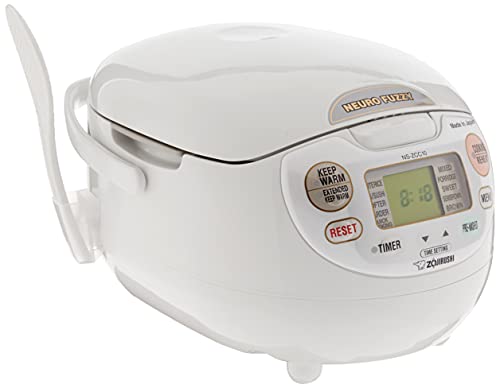
Zojirushi NS-ZCC10 Neuro Fuzzy Rice Cooker and Warmer
Badge: Best Overall
Strengths
- Neuro Fuzzy adaptive control delivers the most consistent texture in this pool across batch sizes and grain types.
- Automatic keep-warm holds rice properly through long, staggered family meals.
- Delay timer supports the load-it-in-the-morning routine that busy households rely on.
Trade-offs
- Premium tier, and as an import the landed cost in New Zealand needs the full freight-and-fees calculation.
- Adaptive cycles are longer than one-touch cooking.
- Like every pick here, its listing must be voltage-checked before it is a rational NZ purchase.
Mini spec box
- Type: Neuro Fuzzy rice cooker and warmer
- Controls: fuzzy-logic microcomputer with delay timer
- Keep-warm: automatic
- Finish: white
The NS-ZCC10 tops this ranking for the same reason it tops rankings everywhere: it removes variance. Its fuzzy-logic system monitors the cook and adjusts, so the rice that emerges on a humid Auckland evening in a half-size batch matches the rice from a full pot on a crisp Dunedin morning. For New Zealand households that eat rice several times a week — a large and growing share of the country, across every cuisine the country cooks — that reliability is the difference between an appliance that earns its bench space and one that gets quietly replaced by a saucepan.
The NZ caveat is real but manageable, and it is the subject of this guide’s import section: verify the electrical specification on the listing, do the landed-cost maths, and buy with your eyes open. Cooks for whom that process feels like too much friction should look honestly at the simpler picks below or at locally stocked equivalents — but on cooking merit alone, nothing else in this pool displaces the flagship.
Best for: frequent rice households wanting the best texture consistency in the pool / Not suited for: buyers unwilling to do import checks, or very occasional rice cooks.

Zojirushi NS-TSC10 5.5-Cup Micom Rice Cooker and Warmer
Badge: Best Everyday Family Pick
Strengths
- Micom microcomputerized control gives repeatable results for the daily white-rice routine.
- 5.5-cup / 1.0-litre capacity matches typical NZ household size without waste.
- LCD controls and delay timer make scheduling transparent and easy.
Trade-offs
- One tier of adaptation below the Neuro Fuzzy flagship.
- Too small for big gatherings without cooking in relays.
- Same import-verification homework as every US-listed pick in this guide.
Mini spec box
- Capacity: 5.5-cup / 1.0 litre
- Type: Micom (microcomputerized) rice cooker and warmer
- Controls: LCD with delay timer
If the flagship is the enthusiast’s answer, the TSC10 is the family’s. Its capacity is the quiet star: enough uncooked rice for a household dinner with leftovers for tomorrow’s lunches, in a pot compact enough for the average Kiwi bench and cupboard. The Micom system runs sensor-informed programmed curves, which in practice means the weekday rice comes out the same every time — the quality family cooking actually runs on — and the delay timer absorbs the chaos of sports practice, late trains and homework overruns.
Its honest limits are headroom and hierarchy: it will not stretch to a twenty-person gathering, and it concedes the finest edge of adaptability to its Neuro Fuzzy sibling. For the large middle of New Zealand households, neither limit bites often, and the tier saving against the flagship is real money once freight is counted.
Best for: families of two to five cooking rice most days / Not suited for: event-scale cooking or buyers chasing maximum adaptation.

Aroma Housewares 20-Cup Cooked Digital Rice Cooker ARC-150SB
Badge: Best for Crowds
Strengths
- Largest capacity in the pool: 10 cups uncooked becomes 20 cups cooked for gatherings, clubs and batch cooking.
- Digital programs span rice, slow cooking and steaming in one appliance.
- Stainless steel exterior presents well and wipes clean after big cooks.
Trade-offs
- Everyday small batches cook less evenly in a pot this size.
- Bench and cupboard footprint is substantial for smaller NZ kitchens.
- Digital programs are fixed, not adaptive; texture still depends on your measuring.
Mini spec box
- Capacity: 20-cup cooked / 10-cup uncooked
- Roles: digital rice cooker, slow cooker, food steamer
- Exterior: stainless steel
- Finish: black
- Model: ARC-150SB
New Zealand social life runs on gatherings — the barbecue that becomes twenty people, the sports-club feed, the extended-family Sunday — and this is the pick built for that life. Twenty cooked cups is a genuinely large amount of rice, and the ARC-150SB’s additional slow-cook and steam roles mean the same machine that produces the rice mountain can hold a curry’s companion or steam vegetables above the next batch. For marae-scale and hall-kitchen cooking, or for households that batch-cook Sunday rice for a week of meals, its format is the point.
Just be clear-eyed about the flip side: this is a specialist wearing a generalist’s clothes. A couple cooking a cup of rice on a Tuesday will get better texture from the small picks below, and this machine will occupy real estate in the cupboard while it waits for its moment. Buy it for the crowds and it is excellent value in its tier; buy it as an only cooker for a small household and it will quietly disappoint.
Best for: big gatherings, batch cooking and multi-role duty / Not suited for: small households or texture perfectionists.

BLACK+DECKER 16-Cup Rice Cooker RC516
Badge: Best Big-Batch Budget
Strengths
- 16-cup cooked output at the big format’s budget tier.
- One-touch operation anyone can run, including borrowed helpers at a busy event.
- Steaming basket and removable non-stick bowl keep the big job simple to serve and wash.
Trade-offs
- No programs or adaptation: big batches magnify any measuring inconsistency.
- Basic keep-warm; plan to serve rather than hold.
- Too large for daily cooking in small households.
Mini spec box
- Capacity: 16-cup cooked / 8-cup uncooked
- Pot: removable non-stick bowl
- Accessory: steaming basket
- Operation: one touch
- Model: RC516
The RC516 is the ARC-150SB’s simpler rival for the same job: feeding a crowd without ceremony. It gives up the digital program range and keeps the essentials — a big removable bowl, a steaming basket, one touch to start. For a school gala, a work shout or a big flat’s curry night, that simplicity is a feature: nobody needs a manual to help you cook. Its budget tier also softens the import equation; even with freight counted, it lands in a different cost conversation from the computerized models.
The trade is consistency at scale. Sixteen cups is a lot of rice to hydrate evenly with a fixed mechanism, and the results reward a cook who rinses well, measures carefully and fluffs promptly. Treat it as event equipment with everyday backup potential, and it earns its badge.
Best for: budget-conscious crowd cooking and big flats / Not suited for: daily small-batch cooking or hands-off perfection.

Aroma Housewares ARC-363-1NGB Rice Cooker
Badge: Best Small-Batch Value
Strengths
- Compact 3-cup uncooked format sized for couples and small households.
- Rice cooker, steamer and multicooker roles cover a small kitchen’s weeknight range.
- Accessible tier — the value pick of the pool for modest needs.
Trade-offs
- 6-cup cooked ceiling; guests mean a second batch or a different plan.
- Simple mechanism: no adaptation to rescue a careless water measure.
- Small pots reward small-batch technique; overfilling defeats the design.
Mini spec box
- Capacity: 3-cup uncooked / 6-cup cooked
- Roles: rice cooker, steamer, multicooker
- Range: 2–6 cups
- Finish: black
- Model: ARC-363-1NGB
Most rice-cooker disappointment is a sizing error, and this Aroma is the pool’s standing correction for small households. Two people do not need a ten-cup pot; they need a cooker whose smallest sensible batch is also its best batch, and the ARC-363-1NGB’s 2-to-6-cup working range is built exactly there. Its steamer and multicooker roles stretch it across a couple’s week — rice tonight, steamed vegetables and protein tomorrow — without demanding the bench space of the big machines.
It asks for ordinary care in return: measure properly, respect the fill line, fluff on time. In exchange it offers the pool’s friendliest combination of size honesty and tier. For first-home buyers and couples upgrading from a saucepan, this is where this guide would start the conversation. Buyers who regularly time purchases around promotions can also keep an eye on Best Rice Cookers On Sale, where compact models like this are perennial features.
Best for: couples, small households and first rice cookers / Not suited for: families or entertainers.

Dash Mini Rice Cooker 2-Cup
Badge: Best for One Person
Strengths
- True personal size: 1 cup uncooked becomes 2 cups cooked, the solo dinner format.
- Removable ceramic nonstick pot makes its small job nearly effortless to clean.
- Keep-warm function plus oatmeal, quinoa and grain cooking give it range beyond rice.
Trade-offs
- One person, one meal: capacity is a hard limit, not a suggestion.
- No adaptation; small batches punish sloppy measuring proportionally more.
- As an import for a single small appliance, freight can outweigh the machine’s tier advantage — do the landed maths.
Mini spec box
- Capacity: 2-cup cooked / 1-cup uncooked
- Pot: removable ceramic nonstick
- Keep-warm: yes
- Finish: black
Flatting, dorms, studio apartments, the bach with one power point to spare: New Zealand has a large population of one-person kitchens, and the Dash Mini is the only pick here designed for them without compromise. It cooks a single serving of rice — or oatmeal for breakfast, or quinoa for a grain bowl — in a ceramic pot that rinses clean in seconds, and its keep-warm holds your dinner while you finish a call. Everything about it is proportionate to solo life, including its footprint.
The caution is economic rather than culinary: small appliances suffer most from international freight, so a Kiwi buyer should compare its landed total against small cookers available domestically before importing on impulse. Where the numbers work — or where its exact format is simply unavailable locally — it is the pool’s most honest answer to cooking for one. Space-starved readers will find its philosophy extended in Best Rice Cookers Small.
Best for: solo cooks, flats, dorms and small benches / Not suited for: anyone who ever cooks for two or more.
Comparison Table
| Pick | Badge | Control type | Capacity (listing) | Link |
|---|---|---|---|---|
| Zojirushi NS-ZCC10 | Best Overall | Neuro Fuzzy logic | Warmer format | Check on Amazon |
| Zojirushi NS-TSC10 | Best Everyday Family Pick | Micom, LCD | 5.5-cup / 1.0 L | Check on Amazon |
| Aroma ARC-150SB | Best for Crowds | Digital programs | 20-cup cooked / 10-cup uncooked | Check on Amazon |
| BLACK+DECKER RC516 | Best Big-Batch Budget | One-touch | 16-cup cooked / 8-cup uncooked | Check on Amazon |
| Aroma ARC-363-1NGB | Best Small-Batch Value | Simple multicooker | 3-cup uncooked / 6-cup cooked | Check on Amazon |
| Dash Mini | Best for One Person | One-touch mini | 2-cup cooked | Check on Amazon |
Importing a Rice Cooker Into New Zealand: the Checks That Matter
Voltage and frequency first. New Zealand’s supply is 230 V at 50 Hz. Appliances built for the North American market are designed around a much lower voltage, and plugging a low-voltage heating appliance into a 230 V outlet without proper conversion is not a calculated risk — it is how appliances die and, occasionally, how fires start. Before buying any pick in this guide, open its listing and find the electrical specification. If the listing states dual or wide-range voltage covering 230 V, you are in luck and need only a plug solution. If it states a single low voltage, your options are a properly rated step-down transformer sized generously for a heating appliance’s draw — bulky, costly, and a permanent bench companion — or walking away and buying a locally supplied model. For most households, walking away is the right answer; for a coveted computerized model unavailable locally, the transformer route exists but should be priced into the decision honestly.
Plugs are the easy part. New Zealand uses Type I plugs with an earth pin. A simple travel adapter changes a plug’s shape; it does nothing to voltage. Never let an adapter’s existence blur that distinction — the adapter is only appropriate once the voltage question is already answered in the appliance’s favour.
Do the landed maths. The listing figure is the beginning of the cost, not the end. Add international shipping, consider whether the total crosses thresholds that attract GST or duty on import, and compare the final number against the closest locally available equivalent, including the value of a local warranty and easy returns. New Zealand’s consumer protections are strong for goods bought from NZ businesses; purchases from overseas sellers sit in a greyer area, which is worth a discount, not a premium. Readers comparing retail channels more broadly may also find Best Rice Cookers Target useful for how big-box pricing compares with marketplace pricing, even though the retailer itself is a US one.
Cups, grams and honest capacity. Listings speak in cooker cups — the measure supplied with the machine, smaller than a 250 ml metric cup. When a recipe or your habits think in grams, weigh your rice for a week and calibrate: consistency of measurement matters more than the unit chosen. Capacities in this guide are quoted exactly as the verified listings state them, in uncooked and cooked cups, so convert before comparing across picks.
How to Choose the Right Size and Tier
Count eaters, then add one. A useful rule: choose uncooked capacity roughly equal to your regular number of rice eaters, plus a little headroom. One person: the Dash Mini or the small Aroma. Two to five: the TSC10’s class or the compact Aroma at its top end. Regular crowds: the two big machines, bought deliberately as event equipment.
Let your grains set the tier. Plain white rice a few times a week forgives basic mechanisms. Brown rice, mixed grains and variable batch sizes repay computerized control — the two Zojirushi picks — because those are the jobs where fixed programs guess worst. Shoppers whose interest is specifically in machines that straddle categories can compare with Best Rice Cookers Pressure, where multi-cookers make a different trade.
Bench space is a specification too. Measure the cupboard or bench the cooker will live in, including lid-opening height. The big Aroma and BLACK+DECKER are honest appliances that become irritating furniture in a small kitchen; the mini and compact picks disappear into a drawer-adjacent life.
How to Cook Great Rice in Any of These Machines
Step 1 — Rinse. Swish the rice in water and drain, repeating until the water runs mostly clear. This removes the surface starch that turns separate grains into glue, in every cooker at every tier.
Step 2 — Measure one way, every time. Use the supplied cup and the pot’s water lines, or weigh both rice and water. Pick a system and keep it for a month before judging the machine; most “bad cooker” stories are inconsistent measuring wearing a disguise.
Step 3 — Soak stubborn grains. Brown rice and mixed grains improve markedly with a soak in their cooking water before the cycle starts; the delay timers on the computerized picks automate this elegantly.
Step 4 — Rest, then fluff. Leave the lid shut for about ten minutes after the cycle, then fluff with a paddle using a cutting, folding motion. The rest equalises moisture; the fluff keeps grains distinct.
Step 5 — Hold briefly, store smartly. Serve from keep-warm within a sensible window, refrigerate leftovers promptly in shallow containers, and reheat with a sprinkle of water under a cover. Yesterday’s rice, chilled, is tomorrow’s superior fried rice.
Cleaning and care. Wash inner pots with a soft sponge to protect ceramic and non-stick coatings, wipe lid undersides and condensation collectors after each use, and let everything dry before closing the machine for storage. In humid coastal NZ homes, that drying step is the difference between a fresh-smelling cooker and a musty one.
Troubleshooting. Problem: mushy rice → too much water or unrinsed grains; trim water slightly and rinse longer. Problem: hard centres → too little water or no rest; add a little water and always rest before fluffing. Problem: rice scorches at the base in a basic cooker → the batch was likely too small for the pot or held too long on warm; match batch to pot size and serve sooner.
Rice in New Zealand Kitchens: What We Actually Cook
A buying guide lands better when it respects the local table, and the New Zealand table has become a genuinely rice-centred one. The weeknight rotation in most Kiwi homes now runs through curries from every tradition, stir-fries built on whatever the garden or the market offered, sushi and poke bowls, fried rice as the designated leftover-rescue, and the humble rice-and-something that feeds shift workers and students. That variety has a direct consequence for cooker choice: a machine bought for plain white rice alone will spend its life being asked to do more.
Three local patterns deserve weight in the decision. First, grain variety: brown rice and mixed grains have moved from health-food niche to supermarket staple, and they are exactly the preparations where computerized control earns its keep and basic cookers demand soaking discipline. Second, batch rhythm: NZ households are, on average, smaller than the households US listings imagine, which is why this guide keeps steering readers toward the 5.5-cup class and below for daily cooking, and treats the two big machines as event equipment. Third, the holding pattern: between sport, shifts and long summer evenings, Kiwi dinners are frequently staggered, so keep-warm quality — a footnote in many overseas reviews — is a headline feature here, and one of the clearest dividers between the Zojirushi pair and the rest of the pool.
There is also a seasonal rhythm worth naming. Winter is curry and slow-cooked territory, where the Aroma ARC-150SB’s extra roles flirt with replacing a second appliance. Summer is salads, rice bowls and barbecue support, where a cooker that produces clean, separate grains for cooling into salads matters more. A cooker bought in one season will be judged in the other; the picks that survive both judgements are the ones with honest capacity for your household and control suited to your grains, which is the whole argument of the buying guide above, restated in local dress.
Bench Space, Storage and the Small-Kitchen Reality
New Zealand kitchens, especially in the apartments and units where many younger buyers live, do not offer unlimited bench. A rice cooker is a permanent resident in a way a kettle is not — it is used at dinner time, in the dinner rush, and it needs lid-opening clearance under wall cupboards that surprises many first-time owners. Before ordering any pick, measure three things: the footprint where it will sit, the height with the lid fully open, and the cupboard it must fit when guests need the bench back. The Dash Mini and compact Aroma pass almost any version of this audit. The TSC10 passes most. The two big machines should be bought only by households that have already pictured where they will live, because a cooker that must be fetched from a garage shelf is a cooker that stops being used.
Storage inside the machine matters too. Cords, paddles and measuring cups wander; models and habits that keep the accessories inside the pot between uses stay tidy. And in much of coastal New Zealand, humidity is a storage condition, not a detail: dry the pot and lid fully before closing the cooker away, and a wipe of the lid’s underside after cooking prevents the stale-water smell that otherwise greets the next batch. These are unglamorous considerations, but they decide whether a cooker is still in service in year three — which, for an imported appliance with a thinner local support path, matters more than any single cooking feature.
The Import Question, Pick by Pick
Because every pick in this guide is a US listing, the import decision deserves one more pass at the level of individual machines, since the right answer genuinely differs by model.
The Zojirushi pair make the strongest import case. Computerized Japanese cookers are the category’s acknowledged top tier, domestic availability is limited and often priced at a steep premium, and the machines are durable goods bought for a decade of service. If any appliances justify freight, a transformer where genuinely needed, and a thinner warranty path, it is these two — provided the electrical specification of the specific listing resolves in your favour, which must be confirmed, never assumed.
The big Aroma and BLACK+DECKER make a conditional case. Their formats are less exotic, and big basic cookers exist in local retail; importing wins only when the landed total is decisively lower or the exact configuration is unavailable domestically. Run the full comparison before ordering, because freight on a large appliance is itself a large number.
The compact Aroma and the Dash Mini make the weakest freight case and the strongest format case. Small cookers are cheap to buy and relatively costly to ship, so the maths often favours a local equivalent; but if the specific format — a true one-person ceramic-pot mini, say — is simply not stocked locally, importing a small machine is a modest, contained decision. In all six cases the discipline is identical: specification first, landed total second, local alternative third, sentiment last.
Buying the Rice Itself in New Zealand
The cooker is half the system; the grain is the other half, and New Zealand’s supermarket shelves reward a little literacy. For everyday eating, medium-grain rice is the versatile local default, cooking up tender with a gentle cling that suits curries and bowls alike. Short-grain styles serve sushi and stickier preparations. Long-grain jasmine and basmati bring fragrance and separation for their own cuisines, and they will never behave like short-grain no matter what machine cooks them — a fact worth remembering before blaming a cooker for a grain’s nature. Brown rice needs the soak-and-patience routine described in the how-to section, and rewards it with a nuttier, chewier result that many households now prefer as their staple.
Storage matters in a humid climate: keep rice in a sealed container away from heat and strong odours, buy in quantities your household turns over in a reasonable span, and let older rice — which cooks drier and wants a touch more water — be an argument for the computerized picks, whose whole purpose is absorbing exactly that kind of variation without your intervention.
Dedicated Cooker or Multi-Cooker? A Note for Kiwi Benches
Many New Zealand shoppers arrive at this search owning, or eyeing, a multi-cooker that also makes rice, and the honest comparison deserves space. A multi-cooker’s rice is a sideline: competent, sometimes genuinely good, produced by a machine whose design centre is pressure and whose pot, programs and keep-warm are compromises shared across many jobs. A dedicated rice cooker inverts the priorities: one job, optimised — the pot shape, the heating curve, the holding behaviour all serve rice alone.
The practical dividing line is frequency and standards. If rice appears twice a month as a supporting player, a multi-cooker’s version is entirely respectable and a dedicated machine is bench clutter. If rice appears four nights a week, or if your household includes anyone who judges a meal by its rice, the dedicated cooker’s consistency — especially in the computerized tier — is a daily, cumulative pleasure that a sideline function does not match. There is also a workflow argument: the household that owns both often finds the multi-cooker busy pressure-cooking the curry at the exact moment the rice needs to start, and a modest dedicated cooker resolves the collision permanently. Several picks in this guide, the compact Aroma especially, are priced and sized precisely to be that second machine. Readers whose curiosity runs the other way — toward pressure as the main event — will find the dedicated treatment in the pressure guide linked earlier in this article.
Common Buying Mistakes
- Treating a plug adapter as a voltage solution. Adapters change shape, not electricity. This is the single most expensive mistake in cross-border appliance shopping.
- Comparing headline prices instead of landed totals. Freight and possible import charges can erase an apparent bargain or crown a local purchase the smarter buy.
- Buying American capacity for a Kiwi household. The big machines serve events, not Tuesday dinners for two.
- Confusing cooker cups with metric cups. Calibrate once, with the supplied measure or a scale, and the confusion ends.
- Skipping the warranty question. An imported premium cooker with no local service path should be bought at a price that reflects that risk.
Final Recommendation
For the New Zealand household that cooks rice often and is willing to do the import homework, the Zojirushi NS-ZCC10 Neuro Fuzzy is the pool’s best machine and this guide’s first choice, with the Zojirushi NS-TSC10 Micom as the right-sized, slightly gentler-tier alternative most families should actually buy. Crowd-feeders should choose between the Aroma ARC-150SB for programs and the BLACK+DECKER RC516 for simplicity, while couples and solo cooks are best served by the compact Aroma and the Dash Mini respectively. Whichever you choose, run the voltage check before the card comes out — that order of operations is the whole NZ game.
One last NZ-specific note on timing: imported appliances arrive on freight schedules, not retail ones, so a cooker bought for a specific event — a wedding feed, a holiday household — should be ordered with generous margin, and a household replacing a dead cooker mid-winter should weigh a locally available stopgap against a fortnight of saucepan rice. Planning the purchase is part of the purchase.
Frequently Asked Questions
Can I plug a US rice cooker straight into a New Zealand socket?
Only if that specific model is rated for New Zealand’s 230 V supply — check the listing and the appliance’s rating label, not the product category. Many US-market appliances are built for roughly half that voltage, and connecting one directly risks destroying the appliance and creating a fire hazard. A plug adapter alone never makes a low-voltage appliance safe; it only changes the plug’s shape.
Is a step-down transformer a good solution?
It is a workable solution for a specific, coveted model, and a poor one as a default. A transformer suitable for a heating appliance must be rated generously above the cooker’s draw, which makes it heavy, bulky and a permanent fixture beside the cooker. Price it into the purchase, keep it ventilated, and never run it near its limit. For basic cookers, buying locally almost always wins.
Why do listings measure rice in such small “cups”?
The cooker cup is a traditional Japanese measure that became the category standard; it is smaller than the 250 ml metric cup. Cookers are calibrated around their own cup and the water lines in their pots, so the system is self-consistent — confusion only arrives when recipes, habits and machines mix units. Weighing your rice for the first week with a new machine settles your personal conversion permanently.
Which pick suits a typical NZ family best?
The Zojirushi NS-TSC10: its 5.5-cup capacity matches a household of two to five, its Micom control delivers consistent daily results, and its size respects an ordinary bench and cupboard. Families that cook a wide rotation of grains, or hold rice for staggered dinners, are the ones who should step up to the Neuro Fuzzy flagship instead.
Are the big Aroma and BLACK+DECKER models worth importing?
They can be, for the jobs they are built for — events, clubs, batch cooking — provided the landed total still beats local big-format options and the voltage question resolves cleanly. For everyday family cooking they are oversized regardless of price, and the smaller picks in this guide will produce better daily rice with less fuss.
What should I check in the listing before ordering?
Four things, in order: the electrical specification (voltage and frequency range), the exact capacity in uncooked cups against your household, the included accessories the review mentions (steaming basket, measuring cup, paddle), and the seller’s shipping and returns terms for New Zealand. That five-minute audit prevents nearly every cross-border disappointment this category produces.
Will I pay GST or duty on an imported rice cooker?
Possibly, depending on the purchase channel and the total value: overseas sellers selling into New Zealand commonly collect GST at checkout for lower-value goods, while higher-value consignments can attract assessment on arrival. The rules and thresholds are set by New Zealand Customs and Inland Revenue and do change, so check the current position on their official sites before a large purchase, and fold any expected charges into the landed-total comparison this guide keeps insisting on. A cooker that looks cheaper at the listing can become the expensive option at the border, and the time to discover that is before ordering, not at the courier’s door.
How long should a good rice cooker last?
The motor and electronics of a well-made cooker should serve for many years of regular use; the component with a genuine lifespan is the inner pot’s coating, which ages with use, utensils and washing habits. Gentle handling — soft sponges, non-metal utensils, no thermal shock — stretches that lifespan considerably, and models with readily available replacement pots can be renewed rather than replaced. For an imported premium model, confirming that a replacement pot can be sourced is a five-minute check that protects a decade-long purchase, and it belongs on the pre-order list beside voltage and freight.


