Disclosure: topratedkitchenware.com is reader-supported. When you buy through links on our site, we may earn an affiliate commission from Amazon and other retailers, at no extra cost to you.
Where to buy
The verified picks for this guide to the best rice cookers small are listed below. Linked picks go straight to their Amazon listing, where you can check the latest price on Amazon and confirm the configuration. Two picks are labelled prose-only, honestly and prominently: they are large-capacity machines that appear in the verified pool for this keyword but fail its defining test — they are not small — so this guide reviews them as contrast, with no links and no images, rather than selling them to you under a search they do not answer. Read the full guide ↓ for the ranking, the sizing maths, and the small-batch technique that makes little cookers sing.
- Dash Mini Rice Cooker 2-Cup — Best Overall, the Truly Small Pick
- Aroma Housewares ARC-363-1NGB Rice Cooker — Best Small Cooker for Couples
- Zojirushi NS-TSC10 5.5-Cup Micom Rice Cooker and Warmer — Best Small Family Cooker
- Zojirushi NS-ZCC10 Neuro Fuzzy Rice Cooker and Warmer — Best Premium Quality
- Aroma Housewares 20-Cup Cooked Digital Rice Cooker ARC-150SB — Contrast Pick, Prose Only (20-cup capacity is not small; no purchase link in this guide)
- BLACK+DECKER 16-Cup Rice Cooker RC516 — Contrast Pick, Prose Only (16-cup capacity is not small; no purchase link in this guide)
Searching for the best rice cookers small sounds simple until you notice that “small” is doing three different jobs in the catalogue. For one shopper it means a cooker for one person, in a kitchen measured in centimetres. For another it means the smallest machine that still feeds a family without a second batch. For a third it means a modest footprint on a crowded counter, whatever the pot holds. This guide serves all three honestly: it ranks four genuinely small machines — a true one-person mini, a compact couples’ multicooker, a 5.5-cup computerized family cooker at the upper edge of small, and a premium fuzzy-logic machine whose quality is its argument — and it quarantines the pool’s two large machines as prose-only contrast, because a 16-cup or 20-cup cooker recommended under the word “small” would be a lie with a link attached.
The deeper theme of the guide is that small is not a compromise category. A right-sized pot cooks its intended batch better than an oversized pot cooks the same amount — heat and moisture distribute through a full small pot more evenly than through a thin layer spread across a big one’s floor — and small machines wash faster, store easier and invite the daily use that makes a cooker worth owning. The reviews below judge each pick by that standard: not “good for its size”, but good because its size matches a real life described in the review.
Inside: a quick-picks table, the method behind the ranking, six reviews (four linked recommendations, two labelled contrast picks), a comparison table, a sizing-first buying guide, a small-batch how-to, common mistakes, a final recommendation and a full FAQ. Total Amazon links in this guide are 19 rather than the usual 27, because the two prose-only picks carry none — the reduction is documented in the sources file published with this article. Readers whose small-kitchen question is really about a retail channel can cross-check Best Rice Cookers Target afterwards.
Hold that definition of success — a machine absorbed into routine — against every pick and every channel claim you meet, and the rest of this guide becomes a formality: the ranking is simply that standard, applied six times.
Key Takeaways
- The Dash Mini is the pool’s only true one-person cooker: 1 cup uncooked becomes 2 cups cooked, in a ceramic pot that rinses in seconds.
- The Aroma ARC-363-1NGB is the couples’ sweet spot — 3 cups uncooked, 6 cooked, with steamer and multicooker roles.
- The Zojirushi NS-TSC10’s 5.5 cups mark the upper boundary of “small”: a family cooker for households that cook modest batches with computerized consistency.
- The Zojirushi NS-ZCC10 argues quality over dimensions: adaptive fuzzy logic for small households that eat rice daily and care how it tastes.
- Two pool picks — the 20-cup Aroma and the 16-cup BLACK+DECKER — are not small by any definition and are reviewed prose-only as contrast, with no links.
- Small-batch success is technique: measure precisely, respect minimum batches, and never cook one cup of rice in a pot built for ten.
In this guide
Quick Picks
| Pick | Badge | Capacity from listing | Why it earns its place | Link |
|---|---|---|---|---|
| Dash Mini Rice Cooker | Best Overall | 2-cup cooked / 1-cup uncooked | The genuine article: personal size, ceramic pot, keep-warm | Check on Amazon |
| Aroma ARC-363-1NGB | Best Small Cooker for Couples | 3-cup uncooked / 6-cup cooked | Compact rice, steam and multicooker range for two | Check on Amazon |
| Zojirushi NS-TSC10 Micom | Best Small Family Cooker | 5.5-cup / 1.0 litre | Micom consistency at the top of the small class | Check on Amazon |
| Zojirushi NS-ZCC10 Neuro Fuzzy | Best Premium Quality | Warmer format | Adaptive fuzzy logic for small households that prioritise texture | Check on Amazon |
| Aroma ARC-150SB | Contrast Pick — Prose Only | 20-cup cooked / 10-cup uncooked | Event-scale machine included to mark the boundary of “small” | Prose only — no link |
| BLACK+DECKER RC516 | Contrast Pick — Prose Only | 16-cup cooked / 8-cup uncooked | Big-batch budget machine, likewise outside this keyword | Prose only — no link |
How These Picks Were Chosen
Every pick comes from a verified pool checked against the Amazon Creators API on 2026-11-20, with capacities and functions taken from those listings. For this keyword the first editorial act was a size audit, because the pool — like the wider catalogue — mixes genuinely small machines with large ones under a small keyword. The audit’s rule is the one this site applies to every defining attribute: a pick that fails the keyword’s core test is not linked, however worthy it is elsewhere. A 20-cup event cooker and a 16-cup batch cooker fail “small” completely, so they are prose-only contrast picks; the four remaining machines were then ranked by fit to the small lives they describe — solo, couple, small family, and quality-first small household.
Within the linked four, the criteria are the small-cooker virtues: batch honesty (does the machine cook its smallest sensible batch well?), footprint and storage, cleanup speed, and then control quality. That ordering is why a one-touch mini can top a list containing two computerized machines — in the small category, proportion is a feature and sophistication is secondary — while the Zojirushi pair still anchor the guide’s quality end for households whose small batches are daily and discerning. This is research-led guidance from verified data, not a hands-on test, and the prose-only decision is documented in the accompanying sources file so the reasoning can be checked.
A word on the boundary case: the NS-ZCC10’s listing does not trumpet a tiny capacity, and this guide does not invent one. It is included as a linked pick because its format is a modest countertop warmer-class machine rather than a large-capacity one, and because its honest role in a small-cooker guide is the quality benchmark for small households that cook premium rice in family-modest quantities. Its review states that positioning plainly rather than dressing it as a mini.
The Best Rice Cookers Small Kitchens Deserve — Plus Two That Are Not Small at All

Dash Mini Rice Cooker 2-Cup
Badge: Best Overall
Strengths
- True personal proportion: 1 cup uncooked to 2 cups cooked — one generous serving, no leftovers unless you plan them.
- Removable ceramic nonstick pot: the fastest cleanup in this guide, which is the feature solo cooking actually runs on.
- Keep-warm function plus oatmeal, quinoa and grain cooking give one person a full repertoire.
Trade-offs
- The ceiling is absolute: a second person means a second batch or a different machine.
- Tiny batches magnify measuring errors; a sloppy quarter-cup of water is a large percentage of the whole.
- No adaptation or programs: your consistency is the control system.
Mini spec box
- Capacity: 2-cup cooked / 1-cup uncooked
- Pot: removable ceramic nonstick
- Keep-warm: yes
- Finish: black
The Dash Mini wins this guide because it is the only pick that takes the keyword completely seriously. Everything about it is scaled to one life: the pot, the portion, the footprint, the washing-up. It cooks its single serving of rice properly — a full small pot hydrates evenly in a way a token cup rattling in a family machine never does — and then it rinses clean while the rice rests, so the entire ritual of a solo dinner fits inside twenty unhurried minutes. Its grain range is a quiet marvel at this size: oatmeal at breakfast, quinoa at lunch, rice at night, one small pot washing between each.
Its honesty is its charm. It does not pretend to stretch, scale or entertain, and buyers who respect its brief describe it with an affection rarely earned by appliances. Buy it for one person’s life — a dorm, a studio, an office corner, a caravan — and it will be used daily. Buy it hoping a couple can share it and you will be cooking in relays by Friday, which is not the machine’s failure but the brief’s.
Best for: solo cooks in small spaces / Not suited for: couples, families, or anyone who entertains.

Aroma Housewares ARC-363-1NGB Rice Cooker
Badge: Best Small Cooker for Couples
Strengths
- The couples’ format: 3 cups uncooked becomes 6 cooked — dinner for two with a lunchbox margin.
- Steamer and multicooker roles stretch one compact machine across the weeknight repertoire.
- Accessible tier and a footprint that respects small kitchens.
Trade-offs
- Guests expose the ceiling quickly; this is a household machine, not an occasion machine.
- Simple mechanism: no adaptation, so measuring discipline is yours.
- Its working range (2–6 cups) should be respected at both ends.
Mini spec box
- Capacity: 3-cup uncooked / 6-cup cooked
- Roles: rice cooker, steamer, multicooker
- Range: 2–6 cups
- Finish: black
- Model: ARC-363-1NGB
If the Dash is the soloist, the ARC-363-1NGB is the duet — and for the enormous population of two-person households it is the most rational cooker in this guide. Its pot is sized so that the everyday batch is also the best batch: two people’s rice fills it into its efficient zone, the steamer tray turns the same cycle into a two-course dinner, and the multicooker roles cover the soups and grains a small kitchen rotates through. Nothing about it is theatrical, and everything about it is proportionate.
The limitation is social, not mechanical: the household that regularly feeds five will outgrow it, and should buy its successor (the TSC10 below) first rather than second. Within its brief, its combination of size honesty, versatility and tier makes it the guide’s default recommendation for couples — and a natural companion to the grain-variety discussion in Best Rice Cookers That Cook Other Grains, since small households often cook the widest grain rotations of all.
Best for: couples and small households / Not suited for: families or frequent entertainers.

Zojirushi NS-TSC10 5.5-Cup Micom Rice Cooker and Warmer
Badge: Best Small Family Cooker
Strengths
- Micom computerized consistency in a 5.5-cup / 1.0-litre format — the top of the small class, done properly.
- LCD controls and a delay timer bring scheduling to small-batch cooking.
- The quality answer for small families who cook rice most days.
Trade-offs
- Premium tier next to the simple small machines.
- 5.5 cups is small for a family, not for a person: solo cooks should buy below it.
- Its footprint, while modest, is a real appliance’s, not a mini’s.
Mini spec box
- Capacity: 5.5-cup / 1.0 litre
- Type: Micom (microcomputerized) rice cooker and warmer
- Controls: LCD with delay timer
The TSC10 defines where “small” ends and “family” begins, and it is included because most households shopping this keyword actually live at that boundary: two to five people, modest batches, daily rice. Its Micom control delivers what the simple small machines cannot — the same result on a tired evening as on a careful one, across white, brown and mixed grains — in a pot sized for a small family’s dinner plus tomorrow’s lunches. For the household whose constraint is appetite rather than counter space, this is the small cooker to buy.
Its trade-offs are proportion and price, plainly: it is too much machine for one person and a premium purchase beside one-touch rivals. But it is also the pick in this guide most likely to end a household’s cooker search for a decade, and the delay timer’s soak-and-cook routine quietly solves the small family’s hardest problem — dinner timing — every single school night.
Best for: small families wanting computerized consistency / Not suited for: solo cooks or the tightest budgets.
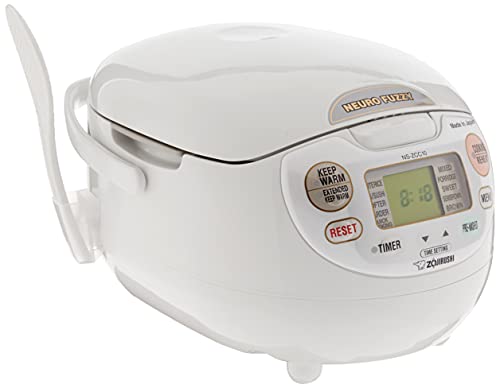
Zojirushi NS-ZCC10 Neuro Fuzzy Rice Cooker and Warmer
Badge: Best Premium Quality
Strengths
- Neuro Fuzzy adaptive control: the finest texture consistency available to a small household.
- Automatic keep-warm of a quality the simple machines cannot approach — decisive for staggered small-household dinners.
- Delay timer completes the premium small-kitchen system.
Trade-offs
- It is the quality pick, not the size pick: households needing a true mini should choose the Dash.
- Premium tier, unapologetically.
- Adaptive cycles are unhurried.
Mini spec box
- Type: Neuro Fuzzy rice cooker and warmer
- Controls: fuzzy-logic microcomputer with delay timer
- Keep-warm: automatic
- Finish: white
Some small households are small by circumstance; others are small by choice and discerning by nature, cooking premium rice in modest quantities and caring intensely about the result. The NS-ZCC10 is in this guide for them. Its fuzzy-logic system brings the category’s best variance reduction to family-modest batches, and its keep-warm holds a two-person dinner through the unpredictable evening better than anything else here. It is not a mini and does not pose as one; it is the answer to “we are few, and we want the rice to be excellent”.
The honest boundary is the one its own review must state: if your constraint is genuinely physical — centimetres of counter, a single cupboard — the Dash and the Aroma serve you better, and this machine’s virtues will not shrink it. Buy it when quality, not dimension, is your binding constraint, and it will justify itself at every meal. Shoppers weighing material questions alongside size will find the compliance-focused discussion in Best Rice Cookers That Pass California Proposition 65 a useful parallel read.
Best for: small, discerning households prioritising texture / Not suited for: true micro-kitchens or budget-first buyers.
Aroma Housewares 20-Cup Cooked Digital Rice Cooker ARC-150SB — Contrast Pick
Badge: Contrast Pick — Prose Only
Strengths
- Event scale with digital convenience: 20 cups cooked plus slow-cook and steam roles.
- A genuinely good machine — for the opposite keyword.
- Its presence here marks the exact boundary of “small” by counterexample.
Trade-offs
- Twenty cups cooked is not small, in capacity, footprint or batch behaviour.
- Small daily batches cook poorly in a pot this size — the precise failure this guide exists to prevent.
- Prose-only here: no link, no image, because recommending it under “small” would misdescribe it.
Mini spec box
- Capacity: 20-cup cooked / 10-cup uncooked
- Roles: digital rice cooker, slow cooker, food steamer
- Exterior: stainless steel
- Finish: black
- Model: ARC-150SB
- Status: prose-only — no Amazon link and no image, because its capacity contradicts the keyword’s core attribute
There is nothing wrong with the ARC-150SB except its presence in this search. As an event machine it is capable and versatile, and households that feed crowds will find it reviewed approvingly in guides written for them. But a small-cooker guide that linked it would be teaching its readers that capacity is a detail — and capacity is the entire subject here. A couple’s nightly cup of rice, spread across this pot’s floor, would cook unevenly and dry quickly, and the machine’s footprint would tax a small kitchen every day in exchange for a capacity used twice a year.
It therefore stands as this guide’s clearly labelled contrast: the proof that “small” is a real specification with a real boundary, and that the boundary runs far below twenty cups. Readers who recognise their own cooking in this machine’s strengths do not need a different review of it — they need a different keyword, and the crowd-oriented guides on this site will serve them honestly.
Best for: crowd cooks who arrived here by accident / Not suited for: anyone whose search actually contains the word small.
BLACK+DECKER 16-Cup Rice Cooker RC516 — Contrast Pick
Badge: Contrast Pick — Prose Only
Strengths
- Sixteen cups cooked at a budget tier, with a steaming basket and removable bowl.
- One-touch simplicity at scale.
- A fine potluck machine — in a guide about potlucks.
Trade-offs
- Sixteen cups is a crowd format; nothing about it is small.
- Its minimum sensible batch exceeds a small household’s entire dinner.
- Prose-only here: no link, no image, for the same core-attribute reason as the pick above.
Mini spec box
- Capacity: 16-cup cooked / 8-cup uncooked
- Pot: removable non-stick bowl
- Accessory: steaming basket
- Operation: one touch
- Model: RC516
- Status: prose-only — no Amazon link and no image, because its capacity contradicts the keyword’s core attribute
The RC516 completes the contrast pair with the budget version of the same lesson. It is a likeable machine in its own category — cheap volume, honest simplicity — and a small household that bought it on a “small rice cooker” search would own a pot whose smallest reasonable batch is a party’s worth of rice. The mismatch is not subtle, and this guide’s refusal to link it is the review: specifications mean things, and a guide’s first loyalty is to the word the reader typed.
If your household’s reality is the RC516’s reality — regular crowds, batch cooking, a big kitchen — then the correct action is to shop the big-cooker guides, where this machine competes fairly and often wins. If your reality is the small end of this page, let its presence here simply confirm that you are reading a guide willing to say no, which is the kind worth trusting for the yeses above. Brand-curious readers who came looking for a specific maker’s small models can continue to Best Rice Cookers Tiger for that brand-focused view.
Best for: budget crowd cooking, elsewhere / Not suited for: any definition of a small rice cooker.
Comparison Table
| Pick | Badge | Control type | Capacity (listing) | Link status |
|---|---|---|---|---|
| Dash Mini | Best Overall | One-touch mini | 2-cup cooked | Check on Amazon |
| Aroma ARC-363-1NGB | Best for Couples | Simple multicooker | 3-cup uncooked / 6-cup cooked | Check on Amazon |
| Zojirushi NS-TSC10 | Best Small Family | Micom, LCD | 5.5-cup / 1.0 L | Check on Amazon |
| Zojirushi NS-ZCC10 | Best Premium Quality | Neuro Fuzzy logic | Warmer format | Check on Amazon |
| Aroma ARC-150SB | Contrast — Prose Only | Digital programs | 20-cup cooked | Prose only |
| BLACK+DECKER RC516 | Contrast — Prose Only | One-touch | 16-cup cooked | Prose only |
How to Choose a Small Rice Cooker: Size Is the Specification
Count eaters, honestly, on an ordinary week. One: the Dash Mini, without apology. Two: the Aroma ARC-363-1NGB. Three to five with modest appetites for rice: the TSC10. Few eaters with exacting standards: the NS-ZCC10. The most common small-cooker regret is buying for the household you host twice a year instead of the one you feed two hundred times.
Respect the minimum batch. Every cooker has a smallest batch it cooks well; below it, water ratios skew and texture suffers. Small machines exist precisely to lower that floor. If your typical cook is one cup of rice, a mini’s floor is your friend and a family pot’s floor is your enemy — the physics behind this guide’s prose-only decisions about the big machines.
Measure the home, not just the pot. Footprint, lid-opening height, and the cupboard or bench where the machine will live: small kitchens punish optimistic purchases. A cooker that lives out gets used; a cooker that must be fetched becomes a rumour. The Dash and the compact Aroma pass almost any space audit; the Zojirushi pair need a real, if modest, home.
Let control tier follow frequency. Daily small-batch rice repays computerized consistency (the Zojirushi pair) because small batches are where variance is most noticeable per spoonful. Occasional small batches are served honestly by the simple machines, whose tier leaves money for better grains — a trade this guide endorses openly. Compliance-minded shoppers can add the material checks surveyed in Best Rice Cookers That Don T Have Hazardous Ingregients For California to their shortlist routine.
How to Cook Small Batches Well
Step 1 — Rinse, even for one cup. Small batches are not exempt from starch; if anything, surface starch dominates a tiny pot faster. Rinse until the water runs mostly clear.
Step 2 — Measure with unusual care. In a 1-cup batch, a casual splash is a large percentage error. Use the supplied cup and the pot’s lines, or weigh — small cooking rewards precision disproportionately.
Step 3 — Stay inside the working range. Do not underfill a family pot or overfill a mini. Each pick in this guide lists its range; the range is the recipe’s first ingredient.
Step 4 — Rest and fluff, unchanged. Ten closed minutes and a gentle fluff matter as much at two cups as at twenty — more, because a small batch’s moisture has nowhere to hide.
Step 5 — Serve small batches promptly. A little rice in a warm pot dries faster than a lot; small cooking’s rhythm is cook-and-eat, with leftovers chilled quickly for tomorrow’s fried rice.
Cleaning and care. Small pots are a gift here: a soft sponge, a rinse, done. Wipe lids and condensation paths, dry before storing, and protect ceramic and non-stick surfaces from metal utensils — in a mini, the pot is nearly the whole machine, and its coating is its lifespan.
Troubleshooting. Problem: one-cup batch comes out wet → the ratio error is proportionally large; trim water by a spoonful, not a guess. Problem: rice dries before serving → the batch sat in a big pot or a long warm; cook closer to the meal or step down a size. Problem: mini overflows → the batch exceeded its range or the rice was unrinsed; respect the line and rinse.
Small Kitchens, Real Lives: Where Each Pick Lives
Picture the Dash in a studio where the kitchen is a countertop’s end: it cooks dinner for one while a laptop charges beside it, and it stores in the space a toaster would envy. Picture the Aroma in a first flat shared by two people learning to cook together, steaming fish over rice on Fridays. Picture the TSC10 in a small family home where rice is daily and the delay timer is set at breakfast. Picture the ZCC10 in the kitchen of a couple who downsized everything except their standards. The two contrast machines belong to other pictures entirely — a hall kitchen, a team dinner — and this guide’s respect for its readers consists of keeping the pictures separate. A cooker is a decade-long roommate; choose the one whose life resembles yours.
The Physics of Small: Why Pot Proportion Changes the Rice
It is worth understanding why this guide insists that batch-to-pot proportion is a cooking variable rather than a preference, because the physics is simple and it explains most small-cooker disappointment. A rice cooker heats from below and judges doneness by the pot’s temperature behaviour as water is absorbed. In a properly filled pot, the grain bed is deep enough for heat and steam to circulate through it in a stable pattern: the bottom layer’s moisture migrates up, the top layer finishes in steam, and the temperature signal the mechanism reads describes the whole batch truthfully. Spread the same rice thinly across an oversized pot and every part of that system degrades — the layer dries at the edges while the centre is still wet, the temperature signal describes a thin film rather than a bed, and the result is the familiar large-pot small-batch syndrome: scorched edges, uneven centres, and a cook blaming a machine that was simply asked the wrong question.
The converse holds at the top of the range: an overfilled small pot traps foam, crowds the grains and cooks its centre by luck. This symmetry is why every review in this guide repeats its pick’s working range like a refrain, and why the two contrast machines are not merely “bigger options” but category errors for this keyword. Small is not a smaller version of the same decision; it is a different decision, with its own physics, its own technique and — as the linked four demonstrate — its own excellences. Shoppers cross-checking material safety at this scale will find the misspelling-tolerant route into that topic at Best Rice Cookers That Pass California Propasition 65, which covers the same compliance ground.
Second Cookers: the Small Machine’s Secret Career
A large share of small cookers are not bought as main cookers at all, and a guide to the category should honour the second-cooker career openly. The household with a big family machine buys a mini or a compact for the jobs the big pot does badly: one person’s early breakfast porridge, a child’s separate portion, a experimental batch of a new grain, rice for one when the rest of the house is eating out. Offices keep them for lunch grains; caravans and holiday houses keep them because a small machine is the one that fits the shelf and the power budget; grandparents keep them because a household of two that once cooked for six does not need the old capacity and does not want the old footprint. In every case the logic is the physics above, wearing domestic clothes: the right pot for the batch, bought without replacing anything. If that is your situation, the Dash and the compact Aroma are not compromises in this guide — they are the headline recommendations, and the family machines are the ones that would be the mistake.
Storing, Travelling and Living With a Small Cooker
Small machines earn a section on logistics because their owners actually move them. A mini that lives in a cupboard between uses should be stored fully dry with its cord and paddle inside the pot — the habit that prevents both musty smells and lost accessories. A compact that travels to a holiday house or a caravan benefits from its box or a padded bag, because the component that resents travel is the lid’s fit, and a cooker whose lid sits true cooks true. In student and shared housing, the small cooker’s portability is also its risk: label it, keep its cup with it, and remember that a borrowed mini returns happiest when it returns clean. None of this is burdensome; it is the ordinary stewardship of a small, likeable object, and it is precisely the scale at which stewardship stays pleasant rather than becoming a maintenance regime.
There is a final, underappreciated virtue to record: small cookers are cheap to replace and easy to gift onward, which makes them the lowest-regret entry into the entire category. A household unsure whether a rice cooker fits its life at all can learn the answer with a mini or a compact, at a tier where a wrong answer becomes a welcome gift to a student rather than a costly mistake in a cupboard. Few appliance categories offer so gentle an experiment, and this guide recommends it without hesitation to the genuinely undecided.
A Day in a Small Pot: Breakfast, Lunch and Dinner
The strongest argument for the small category is a timetable. Morning: the mini or the compact Aroma cooks oatmeal or a small pot of rice porridge while its owner dresses, in a pot that rinses before the kettle has boiled twice. Midday: yesterday’s rice, chilled overnight as it should be, becomes fried rice in a pan while the small cooker rests — or a fresh cup of quinoa cooks for a grain bowl in the Dash’s listed repertoire. Evening: the main event, sized to the household — one serving in the mini, two in the Aroma, a small family’s dinner in the TSC10, each batch filling its pot into the zone where the physics works. Across the day the pattern is the point: three small, fresh, correctly proportioned cooks instead of one large cook and two reheats, with washing-up measured in seconds each time. Households that eat this way do not experience small cookers as a limitation category; they experience large cookers as the blunt instrument. If the timetable above resembles your life more than the banquet does, this guide’s ranking needs no further defence — buy the size of your day.
When Small Is the Wrong Answer
Symmetry demands the counter-case, briefly and fairly. Small is wrong when the household’s rice life is genuinely social — weekly gatherings, team feeds, festival cooking — because no technique turns two cups into twenty, and the household will end up owning the big machine anyway, later and at a worse moment. Small is wrong when the cook’s pleasure is batch cooking: a Sunday session that stocks the week’s grains wants volume, and the big pots serve it well within their own guides. And small is a false economy when it is bought as a timid first step by a household that already knows it cooks family rice daily — the TSC10’s tier, spent once, is cheaper than a mini outgrown by spring and replaced. This guide’s prose-only pair are not villains; they are answers to those other questions, standing in this article as a reminder that every size is somebody’s right size. The discipline is not “buy small”. The discipline is “buy yours”.
Energy, Waste and the Small Virtues
Two practical virtues of the category deserve a closing word, because they compound quietly over years. The first is waste: a right-sized batch is a batch that gets eaten, and households that cook to their actual appetites throw away a fraction of the rice that oversized cooking produces — yesterday’s surplus is only a virtue when somebody actually wants fried rice. The second is energy and time: a small pot heats a small mass, reaches its cycle quickly, and washes in a sink rather than a strategy, which across hundreds of cooks is a real, if unglamorous, saving of electricity, water and evenings. Neither virtue will ever headline a listing, and neither requires virtue from the buyer — they are simply what proportion does when nobody is watching. In a category addicted to more — more cups, more programs, more functions — this guide is content to end its case for small on the oldest ground in cooking: enough, exactly enough, is a feast.
Common Buying Mistakes
- Buying capacity for guests. Twice-a-year crowds should borrow a pot, not dictate a decade of daily batches.
- Assuming small means worse. A full small pot outperforms a nearly empty large one; proportion is a cooking feature.
- Ignoring the minimum batch. The floor matters more than the ceiling for small households.
- Skipping the space audit. Lid height and storage decide whether a cooker lives out or lives away.
- Trusting a guide that calls 20 cups small. Specifications mean things; hold every source — including this one — to them.
Final Recommendation
For the solo cook, the Dash Mini Rice Cooker is this guide’s first choice and the purest expression of the keyword. Couples should take the Aroma ARC-363-1NGB, small families the Zojirushi NS-TSC10, and quality-first small households the NS-ZCC10 — each sized to a life, each honest about its ceiling. And let the two prose-only giants stand as the guide’s signature: a small-cooker list that refuses to sell you a 20-cup machine is a list whose recommendations you can build a kitchen on.
One last small-cooker truth, offered as the guide’s benediction: the best rice cooker is the one that disappears into your routine, and small machines disappear fastest — into the cupboard, into the morning, into the background of a well-fed life. Choose the size of your days, and let the giants keep the banquet hall.
Frequently Asked Questions
What capacity counts as a small rice cooker?
As a working definition: up to about 5 or 6 cups cooked for the compact class, with true minis at 2 cups cooked. The picks in this guide span that range — Dash Mini at 2 cups cooked, the Aroma at 6, the TSC10 at the boundary with 5.5 cups uncooked. Machines at 16 and 20 cups cooked are large by any honest measure, which is why they appear here only as prose-only contrast. One refinement is worth adding: judge size by your batch, not by the label — a household of six that cooks two cups at a time lives in the small category whatever its headcount, and a household of two that batch-cooks for a freezer lives partly outside it. The label serves the batch, never the reverse.
Does a small cooker cook rice as well as a big one?
For its intended batch, often better. A small pot filled to its working range distributes heat and moisture evenly through the grains; the same small amount spread across a large pot’s floor cooks in a thin, uneven layer that dries at the edges. Quality in rice cooking is a property of the match between batch and pot, not of the pot’s size or price alone.
Can a small rice cooker handle brown rice and other grains?
Yes, with the usual adjustments: a soak for brown rice, careful ratios for small grains, and respect for the working range. The computerized TSC10 manages these jobs most forgivingly; the simple machines ask the cook to supply the patience. The Dash Mini’s listing explicitly includes oatmeal, quinoa and grains in its solo repertoire, which at its size is a genuinely useful breadth. Small pots have one quiet advantage here: a test batch of an unfamiliar grain costs a cup, not a potful, so small-cooker households tend to become the most adventurous grain cooks of all — the experiment is cheap, the feedback is fast, and the notebook fills with winning ratios while a big-pot household is still rationing its courage.
Which small cooker is best for a dorm room?
The Dash Mini, provided your residence permits small appliances: it is sized for one, cooks a full solo repertoire of rice and grains, keeps a meal warm, and cleans in seconds — the four properties dorm life actually tests. Check your housing rules first; where cookers are barred, no recommendation in this guide outranks the rulebook. Where they are permitted, pair the mini with a small sealed container for rice storage and a mug that doubles as your measure, and you have a complete one-person rice kitchen that fits in a single cupboard — which is, in the end, the entire promise of the small category kept.
Why are two picks in this guide not linked?
Because they are not small. The 20-cup Aroma ARC-150SB and the 16-cup BLACK+DECKER RC516 are capable machines for crowds and batch cooking, but linking them under a “small” search would misdescribe them and mislead the exact readers this guide serves. They are reviewed in full as labelled contrast picks, with the link count reduced from 27 to 19 and the reasoning documented in the article’s sources file.
Should a couple buy the mini or the compact?
The compact — the Aroma ARC-363-1NGB — in almost every case. The Dash Mini’s one-serving ceiling turns every shared meal into two batches, while the Aroma’s 6-cup cooked output covers a couple’s dinner and tomorrow’s lunch in one cycle. The mini is the right answer only where one person truly cooks alone nearly all of the time. Couples who eat at different hours sometimes imagine the mini as a personal second cooker beside a family machine, and that is a legitimate pattern — but as the household’s only cooker, the compact’s headroom will be thanked at the first shared meal, and its pot will still be small enough to honour every principle in this guide.


