Disclosure: topratedkitchenware.com is reader-supported. When you buy through links on our site, we may earn an affiliate commission from Amazon and other retailers, at no extra cost to you.
Where to buy
The six models below are the verified picks for this guide to best rice cookers wirecutter, chosen and checked the way a test-driven review site would want them checked: against the manufacturer’s own listing details, with capacities, materials, and functions taken only from verified product data. Each name links to its Amazon listing, where you can check the latest price on Amazon and confirm the current configuration before you buy.
- AROMA Digital Rice Cooker ARC-914SBD
- Cosori Rice Cooker 10 Cup with Fuzzy Logic
- BLACK+DECKER Rice Cooker 6-Cup (Cooked)
- AROMA Rice Cooker ARC-363NG
- Zojirushi NS-ZCC10 Neuro Fuzzy Rice Cooker
- Zojirushi NS-TSC10 Micom Rice Cooker 5.5 Cup
Read the full guide ↓ for the detailed reviews, the buying checks, and the how-to sections.
Shoppers who search for best rice cookers wirecutter are usually not looking for another list. They are looking for a method: the test-driven, pick-a-winner style of reviewing that measures a small set of strong models properly instead of skimming dozens. This guide is written in that spirit. It takes six verified rice cookers, states the criteria before the verdicts, separates a top pick from an upgrade pick and a simple pick, and is honest about what a research-led guide can and cannot claim — we work from verified listing data and category knowledge, not from a test kitchen, and we say so wherever that distinction matters.
What follows is structured the way a testing-led review is structured. First the picks, with badges that reflect roles rather than a single ladder. Then the criteria and how they were applied. Then a detailed review of each cooker covering strengths, trade-offs, and the specs the manufacturer actually states. After that comes the practical layer most listicles skip: how to choose for your household size and grain habits, how to cook, clean, and troubleshoot, how to read any site’s rice cooker picks critically — including ours — and the mistakes that send the most buyers to the returns window. If you are comparing neighbouring questions as well, readers weighing lid styles often also read about Best Rice Cookers With Pop Lid, which approaches the same machines from the hardware side.
Key Takeaways
- Best Overall here is the Cosori 10 Cup: fuzzy logic, a ceramic coating inner pot stated in the listing, and 20-cup cooked capacity.
- Best Premium is the Zojirushi NS-ZCC10 Neuro Fuzzy — the pick for households that cook rice most days and value consistency.
- Simple one-lever cookers are not bad picks; for plain white rice cooked daily, the gap to premium models is narrower than marketing implies.
- Judge any review site’s picks by whether the criteria are stated before the verdicts, and whether capacities and materials are quoted from the listing, not invented.
- Buy the size you will actually fill: most returns in this category are capacity mistakes, not quality failures.
In this guide
Quick Picks: Best Rice Cookers Wirecutter
Six verified cookers, six distinct roles. The badges below are used identically in the detailed reviews, so you can jump straight to the role that matches your kitchen.
| Pick | Badge | Best for | Where to check |
|---|---|---|---|
| AROMA Digital Rice Cooker ARC-914SBD | Best Value Digital | Digital control and a steamer in a compact 2 Qt body | Check on Amazon |
| Cosori Rice Cooker 10 Cup with Fuzzy Logic | Best Overall | Fuzzy logic, ceramic pot, and 20-cup cooked capacity | Check on Amazon |
| BLACK+DECKER Rice Cooker 6-Cup (Cooked) | Best Simple Pick | One-job simplicity with a steaming basket included | Check on Amazon |
| AROMA Rice Cooker ARC-363NG | Best for Small Households | 1.5 Qt compact that also handles oatmeal and soup | Check on Amazon |
| Zojirushi NS-ZCC10 Neuro Fuzzy Rice Cooker | Best Premium | Neuro Fuzzy logic with keep-warm and a delay timer | Check on Amazon |
| Zojirushi NS-TSC10 Micom Rice Cooker 5.5 Cup | Best for Serious Rice Cooks | 5.5-cup Micom control with clear LCD and delay timer | Check on Amazon |
How These Picks Were Chosen
The pool for this guide was fixed before any verdicts: six rice cookers whose listings could be verified in detail, spanning simple one-touch models, digital mid-size machines, a fuzzy-logic multicooker, and two Zojirushi specialists. Each listing was read for what it actually states — capacity in both directions where given, pot and basket materials where named, timers, functions, and sizes — and anything a listing does not state is treated in this guide as unstated, never filled in from assumption. That discipline matters in this category, where a stainless steel exterior is easily misread as a stainless steel pot and a cup figure can mean cooked or uncooked output with a two-to-one difference between them.
The criteria applied, in order, were: cooking consistency technology (fixed cycle, Micom, or fuzzy logic), capacity honesty and fit for real households, materials transparency, scheduling features such as delay timers and keep-warm behaviour, and versatility beyond plain rice. Badges were then assigned by role — Best Overall, Best Premium, Best Value Digital, Best Simple Pick, Best for Small Households, Best for Serious Rice Cooks — because a test-led guide’s job is to match machines to cooks, not to pretend the sixth-ranked cooker is a worse version of the first. Readers who arrived via typo’d searches will find the same pool discussed under Best Rick Cookers, and community-flavoured takes under Best Ricr Cookers Refdit; the verdicts here stand on the criteria above.
One more methodological note, because the search that leads here often carries an expectation worth correcting: a test-led guide’s winner is a winner for a stated household, not for all households. The badges in this guide therefore travel with their briefs — Best Overall means the widest fit, not the highest quality in some absolute sense, and Best Premium means the consistency ceiling, at a premium tier, for people who cook rice constantly. When you compare this guide against any other site’s picks, compare the briefs before the badges. Two guides can rank the same six machines differently and both be honest, if their briefs differ and both say so. The disagreements worth distrusting are the ones where no brief is stated at all.
The 6 Best Options for Best Rice Cookers Wirecutter

AROMA Digital Rice Cooker ARC-914SBD
Badge: Best Value Digital
Strengths
- Mid-size capacity suits couples and small families without hogging counter space
- Digital controls give more repeatable results than a one-lever basic cooker
- Steamer and grain functions stretch it beyond plain white rice
Trade-offs
- The stainless steel is the exterior; the listing does not describe the inner pot material
- Too small for large batch cooking or big gatherings
- Digital panel is more to learn than a single switch
Key specs from the verified listing
- Capacity: 4-cup uncooked / 8-cup cooked
- Size: 2 Qt
- Exterior: stainless steel
- Functions named in the listing: rice cooker, steamer, grain cooker, multicooker
- Model: ARC-914SBD
The ARC-914SBD sits in the middle of the rice cooker market: bigger than a personal mini, smaller than a family-size multicooker, and digital without being complicated. The 4-cup uncooked capacity translates to 8 cups cooked, which covers dinner for two to four people with leftovers, and the 2 Qt footprint keeps it easy to store in a standard cabinet. Because the listing names steamer and grain-cooker functions alongside plain rice cooking, it handles the realistic weeknight pattern of rice plus something steamed above it, and grains like oatmeal or quinoa-style bowls on other mornings. The stainless steel exterior wipes clean and looks at home next to other steel appliances, though you should note the listing describes the exterior material only and says nothing about the inner pot, so check the product page if pot material is a deciding factor for you. In daily use the appeal is repeatability: set the program, and the machine manages the cook and the switch to warm, which removes the stovetop guesswork of absorption cooking.
Judged by test-driven criteria — repeatability, capacity honesty, and cleanup — the ARC-914SBD scores well because its claims are modest and checkable: the capacity is stated both ways, the functions are named plainly, and the one material claim is clearly about the exterior. A testing-led reviewer would still flag that exterior-versus-pot distinction in the first paragraph of notes, and so do we: it is the single most misread line in this listing.
Best for: Couples and small families who want digital control and a steamer function in a compact 2 Qt body / Not suited for: Large households cooking rice for a crowd, or buyers who need the inner pot material confirmed before purchase

Cosori Rice Cooker 10 Cup with Fuzzy Logic
Badge: Best Overall
Strengths
- Fuzzy logic adjusts the cook instead of running one fixed cycle
- Ceramic coating inner pot is clearly stated in the listing
- Huge 20-cup cooked capacity plus sauté and slow cook functions
Trade-offs
- Large capacity is wasted on one- or two-person households
- 18 functions mean a learning curve before the extras earn their keep
- Big batches take counter and storage space smaller kitchens may not have
Key specs from the verified listing
- Capacity: 10 cup uncooked / 20 cup cooked
- Inner pot: ceramic coating, described as non-stick ceramic coating
- Logic: fuzzy logic
- Functions: 18-in-1, including sauté and slow cook
- Keep warm and delay timer: 24H
- Steamer basket: stainless steel
- Colour: black
Cosori’s 10-cup cooker is the capacity and technology pick in this pool. Fuzzy logic is the headline: rather than boiling on a single fixed program, the cooker senses and adjusts during the cook, which is the feature cooks reach for when they switch between white rice, brown rice, and mixed grains and want each batch to land properly without manual tweaking. The listing is unusually explicit about materials: a ceramic coating inner pot, described as non-stick ceramic coating, and a stainless steel steamer basket. Capacity is the other headline — 10 cups uncooked, 20 cups cooked — which is party, meal-prep, and big-family territory. The 18-in-1 function list includes sauté and slow cook, and the 24-hour keep warm and delay timer support the set-it-in-the-morning pattern. The honest cost of all this is size and complexity: it is a lot of machine for a household that cooks one cup of rice twice a week.
In a Wirecutter-style test plan, this is the model you would run the widest test matrix on: white rice, brown rice, mixed grains, a steamed load above, a delayed start, and a long keep-warm hold, because its fuzzy logic and 18-in-1 brief claim competence at all of them. Its listing supports that ambition better than most — pot material, basket material, timer range, and capacities are all stated — which is why it takes the Best Overall badge here rather than winning on any single headline number.
Best for: Large families, meal preppers, and mixed-grain cooks who want fuzzy logic and a clearly stated ceramic pot / Not suited for: Singles and small kitchens that only need a couple of cups at a time

BLACK+DECKER Rice Cooker 6-Cup (Cooked)
Badge: Best Simple Pick
Strengths
- Dead-simple operation suits first-time rice cooker owners
- Removable bowl is easy to wash and to carry to the table
- Steaming basket adds a second job without a second appliance
Trade-offs
- 6-cup cooked capacity is small for families
- Non-stick bowl coating type is not named in the listing
- No digital programs or delay timer are mentioned
Key specs from the verified listing
- Capacity: 6-cup (cooked)
- Steaming basket included
- Bowl: removable, non-stick
- Colour: white
This BLACK+DECKER is the straightforward end of the rice cooker spectrum: a 6-cup cooked capacity, a removable non-stick bowl, and a steaming basket in the box. There are no programs to scroll through and no logic chips to configure, which is exactly the point — load rice and water, start it, and let the machine handle the absorption cook while you make everything else. The steaming basket matters more than it looks on paper, because it turns a single-purpose purchase into a small two-part meal station: rice below, vegetables, dumplings, or fish above. The removable bowl lifts out for serving and washing. Buyers should go in with clear expectations: the listing does not name the bowl’s coating material beyond non-stick, and it lists no timer or specialty grain programs, so this is a cooker for households whose rice routine is simple and frequent rather than varied and technical.
Every serious test programme needs a control sample, and this BLACK+DECKER is it: no logic, no programs, just a bowl, a basket, and a cook cycle. Testers value models like this because they reveal how much of the premium machines’ advantage is real. For plain white rice cooked the same way every day, the gap is smaller than marketing suggests; where this model falls behind in a test matrix is variety — different grains and held rice are where adaptive cookers pull away.
Best for: Beginners, dorms, and small households that want simple rice plus basic steaming / Not suited for: Grain enthusiasts who want dedicated brown-rice or porridge programs

AROMA Rice Cooker ARC-363NG
Badge: Best for Small Households
Strengths
- Compact 1.5 Qt size fits small counters and cabinets
- Auto keep warm removes the need to watch the pot
- Oatmeal and soup roles make it useful beyond dinner rice
Trade-offs
- 6-cup cooked ceiling is too small for family batch cooking
- Basic feature set with no digital programs named
- Inner pot material is not stated in the listing
Key specs from the verified listing
- Capacity: 3-cup uncooked / 6-cup cooked
- Size: 1.5 Qt
- Auto keep warm
- Also positioned as an oatmeal cooker and soup maker
- Model: ARC-363NG
- Colour: white
The ARC-363NG is AROMA’s small, simple answer: 3 cups uncooked, 6 cups cooked, in a 1.5 Qt body that fits where bigger multicookers cannot. The listing positions it as three small appliances in one — rice cooker, oatmeal cooker, and soup maker — which matches how small households actually cook: porridge in the morning, a small pot of soup or rice in the evening. Auto keep warm is the one convenience feature named, and it is the right one for this size, because small batches are the ones most likely to sit while the rest of a meal catches up. There are no digital programs to manage and the listing does not state the inner pot material, so treat this as an honest basic: it cooks small amounts of rice and similar foods reliably and then gets out of the way. For one or two people, that restraint is a feature, not a gap.
A test-driven guide always asks who a product is for before asking how it scores, and the ARC-363NG is the clearest who in this pool: one or two people, small batches, small kitchen. Its test criteria would be portion accuracy and hold quality rather than peak capacity, and its auto keep warm is the feature that matters most at this size, because small cooks are the ones who eat in shifts. It would not win a variety test, and it is not trying to.
Best for: Singles, couples, and small kitchens that cook modest amounts of rice, oatmeal, and soup / Not suited for: Families, batch cookers, or anyone who wants programmable grain settings
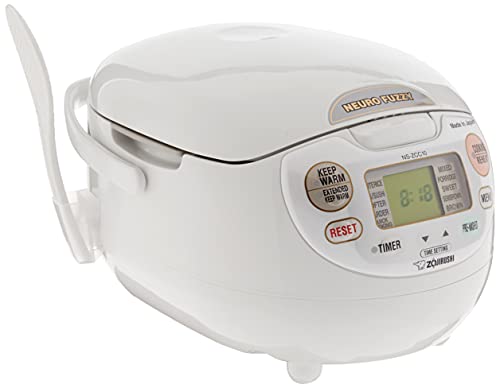
Zojirushi NS-ZCC10 Neuro Fuzzy Rice Cooker
Badge: Best Premium
Strengths
- Neuro Fuzzy logic is the reference standard for adaptive rice cooking
- Automatic keep-warm and a delay timer support flexible meal timing
- A focused, rice-first design from a specialist maker
Trade-offs
- The listing states no capacity figure, so verify size on the product page
- Premium-tier positioning compared with basic cookers
- Feature set centres on rice rather than multi-cooking
Key specs from the verified listing
- Technology: Neuro Fuzzy logic
- Automatic keep-warm
- Delay timer
- Colour: white
- Model: NS-ZCC10
Zojirushi’s Neuro Fuzzy line is the name that comes up whenever rice texture is treated as a serious subject, and the NS-ZCC10 is its representative in this pool. Neuro Fuzzy logic means the cooker monitors and adjusts the cooking cycle rather than following one rigid program, which is the technology associated with consistent results across different rice types and batch sizes. The listing confirms automatic keep-warm and a delay timer, the two scheduling features that matter in daily life: rice ready when you get home, and rice held properly until the rest of dinner is done. One caution: the verified listing title does not state a capacity, so confirm the size on the product page before ordering — Zojirushi sells this family in more than one size and the wrong one is an annoying mistake. Expect a premium-tier machine whose value shows up in texture consistency over years of use, not in a long function list.
Upgrade picks in test-led guides exist for the reader who cooks the food daily and can taste the difference consistency makes, and the NS-ZCC10 is that pick here. A testing programme would focus on batch-to-batch variance — the same rice, the same ratio, five cooks in a row — because that is what Neuro Fuzzy logic is for. The one thing a careful tester would circle in red is the missing capacity in the listing title: verify the size on the product page, because premium money spent on the wrong size is the most avoidable mistake in this category.
Best for: Rice-focused households that cook rice several times a week and care about texture consistency / Not suited for: Bargain hunters, or buyers who want one appliance to replace several others

Zojirushi NS-TSC10 Micom Rice Cooker 5.5 Cup
Badge: Best for Serious Rice Cooks
Strengths
- 5.5-cup size is the sweet spot for many households
- LCD controls make settings and timing easy to read
- Delay timer supports morning prep for evening rice
Trade-offs
- Smaller than the big family cookers in this pool
- Premium-tier positioning
- The listing names fewer multi-cook functions than rival multicookers
Key specs from the verified listing
- Capacity: 5.5 cup
- Volume: 1.0 L
- Controls: LCD
- Delay timer
- Technology: Micom (microcomputerised)
- Model: NS-TSC10
The NS-TSC10 is Zojirushi’s Micom cooker in the popular 5.5-cup, 1.0-litre size — large enough for a family’s dinner rice, small enough to live on the counter. Micom control means a microcomputer runs the cook, adjusting heat through the cycle instead of simply switching off at a set point, and the LCD controls make the selected setting and the delay timer easy to set and confirm at a glance. That delay timer is the everyday hero: measure rice and water in the morning, and the machine times the cook so the rice finishes when dinner does. Compared with its Neuro Fuzzy sibling in this pool, the TSC10’s listing leans on clarity — stated capacity, stated volume, stated controls — which makes it the easier Zojirushi to buy with confidence. It remains a rice specialist rather than a do-everything multicooker, and it sits in the premium tier, so its case rests on how often you cook rice and how much you value getting it right every time.
If the Neuro Fuzzy model is the upgrade pick, the TSC10 is the one a test editor would call the sensible enthusiast choice: the capacity is stated, the controls are legible, and the delay timer covers the real-world scheduling test — rice set in the morning, eaten at night. In a side-by-side test log, this is the model whose settings a tester could record and reproduce exactly, and reproducibility is the quiet virtue that separates a good buying guide from a pile of opinions.
Best for: Households of three to five who cook rice often and want clear LCD control with a delay timer / Not suited for: Very large families, or shoppers who mainly want slow-cook and sauté functions
Comparison Table
Capacities below are quoted exactly as the verified listings state them; note which models state uncooked and cooked figures and which state only one.
| Pick | Badge | Capacity / size | Standout point | Check |
|---|---|---|---|---|
| AROMA Digital Rice Cooker ARC-914SBD | Best Value Digital | 4-cup uncooked / 8-cup cooked | Digital programs at a mid-size capacity most small families can use daily | Check on Amazon |
| Cosori Rice Cooker 10 Cup with Fuzzy Logic | Best Overall | 10 cup uncooked / 20 cup cooked | Fuzzy logic plus a clearly stated ceramic coating inner pot | Check on Amazon |
| BLACK+DECKER Rice Cooker 6-Cup (Cooked) | Best Simple Pick | 6-cup (cooked) | The simplest operation in the pool, with a basket for a second food | Check on Amazon |
| AROMA Rice Cooker ARC-363NG | Best for Small Households | 3-cup uncooked / 6-cup cooked | Small footprint with auto keep warm for one- and two-person homes | Check on Amazon |
| Zojirushi NS-ZCC10 Neuro Fuzzy Rice Cooker | Best Premium | Neuro Fuzzy logic | Neuro Fuzzy adaptive cooking from the category’s specialist maker | Check on Amazon |
| Zojirushi NS-TSC10 Micom Rice Cooker 5.5 Cup | Best for Serious Rice Cooks | 5.5 cup | Stated capacity and LCD clarity from a rice specialist | Check on Amazon |
How to Choose a Rice Cooker the Way a Tester Would
Start with capacity, and start by translating it. Rice cooker cups are uncooked unless a listing says cooked, and rice roughly doubles, so a 5.5-cup cooker makes about eleven cups of cooked rice — far more than most households eat at a sitting. The commonest sizing error is buying for the biggest gathering of the year and then cooking two cups in a cavernous pot every weeknight, which both wastes energy and can cook unevenly at the bottom of the machine’s range. Testers size for the Tuesday dinner, not the holiday: one to two people usually land at 3 cups uncooked or below, families of three to five at 5.5 to 10 cups, and only regular hosts or batch cookers genuinely need 20-cup cooked output like the Cosori or the big Aroma class.
Next, decide how much cooking intelligence you are paying for. A fixed-cycle cooker heats until the water is absorbed and then switches to warm; it is honest, durable technology for one kind of rice cooked one way. Micom and fuzzy-logic cookers monitor the cycle and adjust it, which shows its value when you rotate grains — brown rice, mixed grains, porridge — or cook partial batches that confuse a fixed program. If your household cooks one white rice the same way daily, a tester’s honest advice is that the simple machine is not a compromise. If your grain shelf looks like a health-food store, adaptive logic is the feature that earns its premium, and materials — a stated ceramic pot, a stated stainless basket — should be your next filter.
Finally, weigh scheduling and cleanup, the two factors that decide whether a cooker is still used in year two. A delay timer converts a rice cooker from an appliance you operate into one that works to your timetable; keep-warm quality decides whether rice cooked at five is still pleasant at seven. Removable bowls and baskets that wash easily matter more than a sixth cooking program. Shoppers comparing material claims across models should also read the dedicated material-focused guide to Best Rice Stainless Steel Ceramic Cookers, which separates exterior finishes from inner pot facts. Run any candidate through these three filters — size, intelligence, daily-life fit — and the right badge usually picks itself.
A word about price tiers, since a test-driven framework has to place them somewhere: this guide prints no prices, because they move, but the tier structure of the category is stable enough to plan around. Simple fixed-cycle cookers occupy the entry tier, digital mid-size machines the middle, and Micom and fuzzy-logic specialists the premium tier. The useful question is never the tier itself but what the step up buys — scheduling, grain range, consistency — and whether your cooking uses it weekly. A premium machine used for one white rice a week is not an upgrade; it is an expensive way to do a simple job. Conversely, a basic machine asked to handle five grains is not a saving; it is a slow purchase of the second machine you actually needed.
How to Cook Rice Properly in Any of These Cookers
Technique matters as much as hardware. The same cooker produces mediocre or excellent rice depending on rinsing, ratios, and resting, so this is the method testers use as their baseline before judging any machine.
- Rinse the rice in the removable bowl under cold water, swirling gently, until the water runs mostly clear. This removes surface starch that makes cooked rice gummy, whatever cooker you own.
- Add water to the bowl’s marked line for the amount of rice, or use the ratio your rice variety needs; when in doubt, the bowl markings beat internet ratios because they are calibrated to the machine.
- Wipe the outside of the bowl dry, seat it in the cooker, and close the lid fully so steam pressure and temperature sensing work as designed.
- Select the program that matches the grain — white, brown, or grain settings where fitted — or simply start a basic cooker. Set a delay timer now if dinner is hours away.
- When the cooker switches to keep warm, leave the lid closed for about ten minutes. This resting step finishes the texture; opening early releases the steam that completes the cook.
- Fluff with a paddle using a cutting-and-folding motion, then serve. Move leftovers to the fridge within a sensible window rather than holding them on warm indefinitely.
- Wash the bowl and any steamer basket after use, dry the lid area and condensation collector where fitted, and leave the machine open briefly so no stale moisture lingers.
Brown rice and mixed grains need more water and more time than white rice; if your cooker has a dedicated setting, use it rather than forcing the white-rice cycle, and expect the first batch of any new grain to be a calibration cook — note the result and adjust the water slightly next time. That small habit, borrowed from test kitchens, is worth more than any single feature on a spec sheet.
Storage and reheating deserve a tester’s footnote, because a cooker is often blamed for what happens after the cook. Cooked rice keeps best when it is cooled promptly, refrigerated in a shallow covered container, and reheated with a sprinkle of water until steaming hot throughout. Freezing works surprisingly well for plain rice: portion it flat, freeze it solid, and reheat from frozen with a little water for a result close to fresh. What does not work is the keep-warm setting as a storage strategy — it is a serving tool measured in hours, and treating it as refrigeration is the one habit most likely to produce both bad texture and a genuine food-safety problem.
Troubleshooting
Problem: Rice is mushy and clumped → what to do: reduce water slightly next batch, rinse more thoroughly before cooking, and always rest the rice ten minutes with the lid closed before fluffing.
Problem: Rice is hard or undercooked in the centre → what to do: add a little more water, confirm the lid was fully closed during the cook, and check you used the right program for the grain; brown rice on a white setting is the usual culprit.
Problem: Rice scorches or sticks badly to the bowl → what to do: verify the bowl exterior was dry and seated flat, avoid cooking far below the machine’s minimum quantity, and let the bowl soak before scrubbing so the surface is not damaged.
How to Read Any Site’s Rice Cooker Picks Critically
The Wirecutter effect on this category is real: one prominent pick can sell out a model and push shoppers to whatever is in stock, which is why understanding a pick’s structure matters more than memorising its name. A test-led pick normally comes in tiers — a top pick for most people, an upgrade pick for enthusiasts, and a budget or simple pick — and each tier answers a different question. If a guide cannot tell you what its top pick gives up compared with its upgrade pick, the ranking is decoration. Look for the sentence that names the trade-off; in this guide, the Cosori’s trade-off is size and complexity, and the Zojirushi NS-ZCC10’s is premium positioning and an unstated capacity in its listing.
Also check what evidence a guide offers. Verified specs quoted from listings, honest statements about research method, and clearly flagged unknowns are good signs. Invented precision — capacities, materials, or performance figures that the manufacturer never stated — is the tell of a guide written to fill a page. Apply the same scepticism to this article: every spec box above quotes its listing, and every unknown is labelled unknown. That is the standard the search that brought you here was asking for, and it is the standard to hold every result to, including the ones ranked above and below this page. Shoppers who started from the oddly-phrased Best Rolling Cookers query will find that the honest answer there is a short one, which is itself a useful lesson in reading results critically.
Why Consistency Beats Features in Rice Cooking
Rice is a daily food in the households that buy these machines, and daily foods are judged by variance, not by peak performance. A cooker that produces one spectacular batch and three ordinary ones is a worse tool than a cooker that produces the same good batch every time, because dinner planning depends on the predictable version. This is the real argument for Micom and fuzzy-logic machines: not that they unlock a higher level of rice, but that they narrow the spread between your best and worst batch across different grains, batch sizes, and starting water temperatures.
It is also why simple cookers keep their place in honest guides. A fixed-cycle machine cooking the same white rice at the same quantity has very little variance to narrow — the cook is already repeatable. The premium question is therefore not ‘which cooker is best’ but ‘how much variety does my cooking contain’. Answer that honestly and the choice between the simple BLACK+DECKER, the adaptive Cosori, and the specialist Zojirushi models makes itself.
The Upgrade Question: When the Premium Pick Earns Its Tier
Every test-led guide eventually faces the reader who asks whether the upgrade pick is ‘worth it’, and the honest answer is a formula rather than a verdict: divide the premium by the number of cooks it will serve. A household cooking rice five times a week runs a cooker perhaps a thousand times across its life; at that frequency, even a small per-cook improvement in consistency, and the scheduling freedom of a good delay timer, compounds into something real. A household cooking rice twice a month runs the same machine two dozen times a year, and the premium buys almost nothing the middle tier would not have delivered.
There is also a second, quieter upgrade path that rankings underplay: upgrading your inputs and technique before your hardware. Better rice, rinsed properly, rested properly, in a mid-tier digital cooker, beats mediocre rice in a premium machine every time. That is why this guide’s how-to layer is not filler — it is the cheapest performance available in the whole category. Buy the premium pick when your technique is already consistent and your grain variety is genuinely taxing your current machine; until then, the Best Overall and Best Value badges exist precisely for you.
A closing observation about this category’s review culture, offered because the search behind this page proves it: rice cookers attract stronger brand loyalty than almost any other small appliance, and loyalty distorts rankings in both directions — the beloved specialist brand gets forgiven its gaps, the value brand gets denied its genuine strengths. The discipline this guide has tried to model is to let each machine’s verified record speak in its own section: the Zojirushi pair’s consistency technology, the Cosori’s stated materials and capacity, the AROMA pair’s honest mid-market briefs, the BLACK+DECKER’s simplicity. Read that way, the pool stops being a league table and becomes what a good test programme actually produces — a set of well-understood tools, each with a named job.
If you take one habit from this page into every other appliance search, take the spec-box habit: before believing any verdict, find the sentence in the listing that supports it. Capacity in both directions, materials attached to their nouns, functions named rather than implied. A guide that survives that check — including this one, which invites it — is a guide whose winner you can trust enough to argue with. And arguing with a ranking, on evidence, is the most Wirecutter-spirited thing a reader can do.
Common Buying Mistakes
These are the errors that most often turn a good cooker into a returned cooker.
- Buying capacity for the biggest day of the year instead of the average week — oversized pots cook small batches poorly and live in cupboards.
- Reading ‘stainless steel exterior’ as ‘stainless steel pot’. They are different claims; check which one a listing actually makes.
- Comparing cup figures without checking cooked versus uncooked. The same machine can be sold as a 10-cup or a 20-cup cooker depending on which number is quoted.
- Skipping the rest. Opening the lid the second the cycle ends vents the steam that finishes the texture, then the machine gets blamed.
- Judging a guide by its winner instead of its criteria. If the criteria are not stated, the ranking cannot be checked — including against your own needs.
Final Recommendation
If you buy one cooker from this guide, make it the Cosori Rice Cooker 10 Cup with Fuzzy Logic: it is the most complete package here, with fuzzy logic for varied grains, a ceramic coating inner pot stated in plain language, and capacity that covers everything from family dinners to meal prep. Readers who cook rice almost daily and taste the difference consistency makes should step up to the Zojirushi NS-ZCC10 Neuro Fuzzy Rice Cooker, the premium Neuro Fuzzy pick, after confirming its size on the product page.
On a tighter brief, the AROMA Digital Rice Cooker ARC-914SBD delivers digital control and a steamer at a mid-size most small families will use well, and nobody should feel they settled if they choose the simple BLACK+DECKER for plain daily rice. Match the badge to your cooking pattern and any of the six will serve you honestly.
Frequently Asked Questions
What does Wirecutter-style testing look for in a rice cooker?
Consistency across repeated cooks, honest capacity, materials that are stated rather than implied, controls a tired cook can operate at 6 p.m., and cleanup that does not punish daily use. This guide applies the same criteria to verified listing data and states its method openly, rather than claiming a test kitchen it does not have.
Is fuzzy logic worth paying for in a rice cooker?
If you rotate grains — brown rice, mixed grains, porridge — or cook varied batch sizes, yes: adaptive control narrows the gap between batches. If you cook one white rice the same way every day, a simple fixed-cycle cooker is a rational choice and testers would tell you so.
How do I know which size of rice cooker to buy?
Count uncooked cups for your typical meal, not your biggest one. One to two people: around 3 cups uncooked or less. Three to five: 5.5 to 10 cups. Regular hosts and meal preppers: the 20-cup cooked class. Remember cooked output is roughly double the uncooked figure.
Why does this guide flag the AROMA’s stainless steel claim?
Because the listing says stainless steel exterior. The inner pot material is not stated, and honest reviewing means repeating the claim the manufacturer actually made. If pot material decides your purchase, verify it on the product page.
Can these cookers handle brown rice and other grains?
The Cosori’s fuzzy logic and 18-in-1 brief and the Zojirushi Micom and Neuro Fuzzy models are designed for varied grains. Basic cookers can cook brown rice with more water and time, but results vary more; a dedicated setting is the reliable route.
How long can rice sit on keep warm?
Keep warm is for holding cooked rice through a meal window, not for storage. Serve within a few hours, refrigerate leftovers promptly, and reheat thoroughly. Small batches held for one eater arriving late are exactly what the small AROMA and Dash-class machines handle well.


