Disclosure: topratedkitchenware.com is reader-supported. When you buy through links on our site, we may earn an affiliate commission from Amazon and other retailers, at no extra cost to you.
Where to buy
The quickest route to each pick among the best slow cookers ever covered in this guide is below. Linked picks go straight to their Amazon listing, where you can check on Amazon for the current details before you buy. Read the full guide ↓ for the reasoning, because calling anything the best ever obliges a guide to explain what “ever” is allowed to mean.
- Hamilton Beach 6 Quart Slow Cooker (33665G) — Best Timeless Simple
- Crock-Pot Programmable Slow Cooker 8-Quart, Black Stainless — Best for Crowds
- Cosori Rice Cooker 10 Cup with Slow Cook — Most Versatile
- Aroma Housewares 20 Cup Digital Rice Cooker and Slow Cooker (ARC-150SB) — Best for Large Families
- Crock-Pot Oval Manual Slow Cooker 7-Quart — Best Classic Stoneware
- Crock-Pot Programmable Slow Cooker 7-Quart with MyTime — Best Modern Classic
Every category has a version of this search — the best slow cookers ever made — and it deserves a more careful answer than a fresh ranking with the word “ever” pasted on. “Ever” is a claim about time. It asks which designs have proven themselves across years of dinners, which ideas turned out to be permanent and which were decoration, and what a buyer today should learn from the machines that lasted. This guide answers in those terms. The six verified picks below are current models, checked through the Amazon Creators API, but they are judged by the standards the category’s long history has established: stoneware and thermal mass, honest capacity, controls a household can operate for a decade without a manual, and features that solved real problems rather than chasing novelty.
The slow cooker is one of the few appliances whose essential design was settled early and has been refined rather than replaced. A heavy ceramic vessel, a gentle heating element, a lid: the formula emerged because it works, and the half-century since has mostly been an argument about the details around that core — dial or digital, round or oval, plain crock or multicooker. The picks here map that whole argument. There are two manual stoneware classics, two programmable crocks including one that schedules backwards from your mealtime, the largest batch machine in the class, and two rice-led multicookers whose verified listings include a slow-cook function, representing the category’s modern expansion into one-pot versatility.
What “ever” rules out is as useful as what it rules in. It rules out features that date a machine, formats that fight the food, and complexity that shortens service life. It rules in the six-quart family crock that never needed reinventing, the oval shape that roasts have always wanted, and — more surprisingly — a couple of modern ideas, mealtime scheduling and in-pot browning, that solve problems as old as the appliance itself. Readers who want the feature inventory in neutral terms can set this retrospective beside our Best Slow Cookers Features breakdown and watch which features have earned their permanence.
Key Takeaways
- The slow cooker’s core design — heavy vessel, gentle heat, tight lid — was right early and has been refined, not replaced.
- Longevity is the real “ever” criterion: simple controls, replaceable crocks and mature designs outlast feature cycles.
- Six and seven quarts are the enduring family sizes; eight quarts is the permanent batch-and-events size.
- Two modern ideas have earned classic status: scheduling that protects the finish, and browning in the same pot.
- The Cosori and Aroma picks are rice-led multicookers with a verified slow-cook function — the category’s versatility branch, judged by the same timeless standards.
- Buy the design your household will still be using in ten years, not the one with the longest mode list this season.
In this guide
Quick Picks
Six machines, six claims on permanence. The badges below are used consistently through the detailed reviews, so you can move between this summary and the full sections without translating between two sets of labels.
| Pick | Badge | Best for | Link |
|---|---|---|---|
| Hamilton Beach 6 Quart Slow Cooker (33665G) | Best Timeless Simple | The enduring family size with three settings and dishwasher-safe parts | Check on Amazon |
| Crock-Pot Programmable Slow Cooker 8-Quart, Black Stainless | Best for Crowds | The permanent batch size, with a 20-hour timer and automatic warm | Check on Amazon |
| Cosori Rice Cooker 10 Cup with Slow Cook | Most Versatile | The modern versatility branch: sauté, slow cook and rice in one pot | Check on Amazon |
| Aroma Housewares 20 Cup Digital Rice Cooker and Slow Cooker (ARC-150SB) | Best for Large Families | Volume across rice, slow cooking and steaming for big households | Check on Amazon |
| Crock-Pot Oval Manual Slow Cooker 7-Quart | Best Classic Stoneware | The original idea in its purest current form: oval crock, dial, time | Check on Amazon |
| Crock-Pot Programmable Slow Cooker 7-Quart with MyTime | Best Modern Classic | Mealtime scheduling and a locking lid — the new ideas that solve old problems | Check on Amazon |
How These Picks Were Chosen
This is a research-led guide, and it does not claim hands-on testing that did not happen. Picks were drawn from a verified product pool checked through the Amazon Creators API, which confirmed each product’s identity, brand, capacity, listed functions and image. For an “ever” guide, the comparison criteria were deliberately historical: Is the design mature rather than novel? Does it embody one of the category’s proven formats — the family crock, the oval roast crock, the batch cooker, the multicooker — at its best? Are its controls and parts the kind that survive a decade? And does any modern feature it carries solve a problem as old as the appliance itself, which is the only way a new idea earns a place in a retrospective?
Specifications in the mini spec boxes come only from the verified listings, and no historical sales figures, awards or ratings are invented for any pick; the argument here is made from design evidence a reader can check. Where the guide discusses the category’s past, it stays at the level of well-established design history — the early triumph of the stoneware crock, the later arrival of programmability, the recent multicooker expansion — rather than attaching unverifiable claims to individual models. That discipline is what separates a retrospective from a nostalgia advertisement. The working cook’s version of the same judgement, from the professional side, appears in our Best Slow Cookers For Chefs guide.
Two of the six picks are multicookers rather than dedicated slow cookers, included because their verified titles list a slow-cook function or a slow cooker role. In an “ever” guide they represent the live question of the category: whether versatility is a permanent branch or a passing fashion. Their reviews argue the case on the evidence of the problems they solve.
What “Ever” Has Taught This Category
The crock was the invention
The slow cooker’s founding insight was not electrical; it was ceramic. A heavy stoneware vessel stores heat and returns it gently and evenly, forgiving the crude thermostats of early models and the inattention of busy cooks alike. Everything the category has done since — oval shapes for roasts, programmable timers, locking lids — is commentary on that original vessel. This is why the manual stoneware models in this guide are not the budget leftovers of a modern line-up; they are the invention itself, still in production because nothing has superseded it. When a design survives essentially intact for decades in a competitive appliance market, the market is telling you the physics is right.
Capacity settled, then stayed settled
History also settled the size question early. Households converged on the five-to-seven-quart band for family cooking, with larger machines serving the batch-and-events niche, and that settlement has barely moved since. The picks here honour it exactly: six quarts for the standard family, seven for the family that roasts and hosts, eight for the household that cooks in bulk. A buyer choosing inside that settlement is choosing with fifty years of dinners as evidence; a buyer choosing a novelty size is volunteering as the experiment.
Features that earned permanence — and those that did not
The features that lasted are the ones attached to recurring pain. The warm setting lasted because dinners run late. The countdown timer and automatic warm lasted because workdays do not end when recipes do. The locking transport lid lasted because slow-cooked food travels to gatherings. Removable, dishwasher-safe crocks lasted because cleaning decides whether an appliance gets used. By contrast, the category’s history is littered with decorative complexity that dated quickly and shortened service life. Judge every modern feature by that historical test — does it answer a pain that will still exist in ten years? — and the two contemporary ideas in this guide, mealtime scheduling and in-pot browning, pass it cleanly, because late dinners and unbrowned stews are as old as the appliance.
The 6 Best Slow Cookers Ever, Judged by Time
Each review follows the same pattern: the design’s claim on permanence, its strengths and trade-offs, the verified specifications, and who should buy it for the long term.

Hamilton Beach 6 Quart Slow Cooker (33665G)
Badge: Best Timeless Simple
Strengths
- Six quarts is the size history settled on, matched to the largest body of recipes ever written for the category.
- Three settings are the complete grammar of slow cooking; nothing to learn, nothing to become obsolete.
- Dishwasher-safe stoneware and lid answer the cleaning reality that decides long-term use.
Trade-offs
- No timer or automatic warm — the one scheduling gap the modern era legitimately added.
- Capacity stops short of crowd and batch work.
- Browning still needs a skillet, as it has for fifty years.
At a glance
- Capacity: 6 quart
- Controls: 3 cooking settings
- Crock and lid: dishwasher-safe stoneware crock and glass lid
- Finish: Silver
- Model: 33665G
If the question is which current machine a household could buy today and still be using, unthinkingly, a decade from now, this is the safest answer in the guide. The Hamilton Beach 33665G is the settled design in its settled size: a six-quart stoneware crock, a glass lid, three cooking settings. Nothing in it can be made obsolete, because nothing in it depends on fashion, software or a proprietary ecosystem. It is the slow cooker as the category’s history distilled it — the appliance equivalent of a cast-iron pan, bought once and absorbed into the kitchen’s permanent furniture.
Its virtues compound quietly. The six-quart capacity sits at the centre of the recipe universe, so every cookbook, every family notebook and every tested collection assumes roughly this vessel. The glass lid teaches the no-lift discipline by letting the cook look instead. The dishwasher-safe crock and lid protect the habit itself, because the historical record of this category is unambiguous: cookers that are easy to clean get used for decades, and cookers that are not get used for a season. Hamilton Beach’s long presence in the category also means the model is plainly identified — 33665G — and the ownership tail, parts and information, is as secure as this market offers.
The honest asterisk is scheduling. The modern era’s one unambiguous improvement on the classic design is the managed finish, and this machine does not have it: a person ends the cook. Households whose days are home-centred will never feel the lack. Households buying for unattended weekday cooking should take the classic’s modern descendant instead — but they should notice that even then, they are buying this same crock with a clock added, which is the strongest evidence of the design’s permanence.
Best for: buy-it-for-a-decade households wanting the settled design at the settled size / Not suited for: unattended timed cooking or crowd-scale batches.
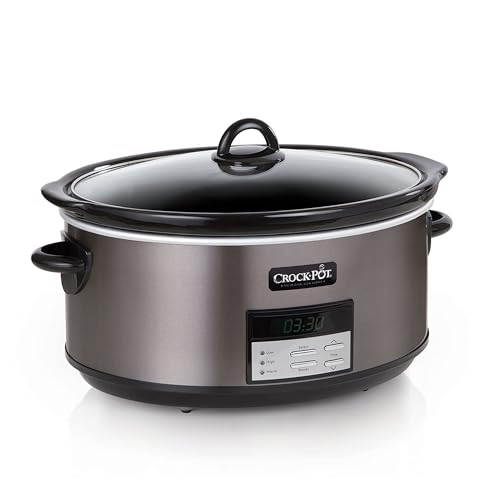
Crock-Pot Programmable Slow Cooker 8-Quart, Black Stainless
Badge: Best for Crowds
Strengths
- Eight quarts for more than ten people is the permanent answer to a permanent occasion: feeding a crowd from one pot.
- A digital timer up to 20 hours plus automatic warm modernises the batch cook without changing its nature.
- Dishwasher-safe crock and lid keep a big machine usable at big scale, year after year.
Trade-offs
- The largest storage and lifting commitment in the guide — permanence needs a cupboard to match.
- Small households will under-fill it and miss the performance its design promises.
- Electronics add the modern failure modes to an otherwise ancient idea.
At a glance
- Capacity: 8-quart, for 10+ people
- Controls: digital timer up to 20 hours, auto warm setting
- Crock and lid: dishwasher-safe lid and stoneware pot
- Finish: Black stainless steel
Some cooking occasions are as old as the appliance: the harvest supper, the team dinner, the freezer-filling day that stocks a household against winter. This eight-quart Crock-Pot is the current form of the machine those occasions have always required, and its claim on “ever” is that it changes nothing about the idea except to protect it. The stoneware still does the cooking; the digital timer, running up to 20 hours, and the automatic warm setting simply stand guard over the largest, most ingredient-expensive cooks a home kitchen attempts.
That guardianship is the historically literate kind of feature. Batch cooking concentrates risk — a ruined eight-quart cook wastes more food, time and goodwill than any other failure in this category — and the timer-plus-warm combination is aimed exactly at the two ways big cooks die: finishing unwatched past their peak, or cooling while the event runs long. The black stainless finish suits the machine’s realistic life in view on a bench, and the dishwasher-safe crock and lid keep the aftermath proportionate, which at this scale is the difference between a tradition and a one-off.
The permanence bargain is storage and fill. This cooker must be fed crowds regularly to justify the cupboard it occupies and the fill levels its cooking assumes, and the household that cannot honestly promise it that life should buy smaller and borrow big on the rare occasions. For the household that can — the hosts, the batch cooks, the freezer strategists whose system is mapped in our Best Slow Cookers For Meal Prep guide — this is the design that will still be anchoring gatherings when today’s novelty features are footnotes.
Best for: households whose crowd and batch cooking is a permanent feature of life / Not suited for: small households or small kitchens.

Cosori Rice Cooker 10 Cup with Slow Cook
Badge: Most Versatile
Strengths
- In-pot sauté solves the oldest flavour problem in slow cooking, inside the vessel itself.
- Fuzzy logic control is the modern route to the same gentle stability stoneware achieves by mass.
- An 18-in-1 repertoire gives the machine daily relevance beyond slow-cooker days, which is its own kind of longevity.
Trade-offs
- Electronics age faster than stoneware and dials; its “ever” claim rests on usefulness, not indestructibility.
- Round bowl geometry excludes the roast repertoire that defines the classic category.
- Capacity in rice cups keeps it a translation away from crock-written recipes.
At a glance
- Capacity: 10 cup uncooked, 20 cup cooked (rice measure)
- Functions: 18-in-1, including sauté and slow cook
- Control: fuzzy logic, 24-hour keep warm and delay timer
- Inner pot: ceramic coating, non-stick
- Included: stainless steel steamer basket
- Colour: Black
Every retrospective should include the design that asks whether the category itself is changing, and the Cosori is that design. Its verified listing describes an 18-in-1 machine on fuzzy logic control, with slow cook as a designed function and sauté beside it. The historical argument for it is stronger than novelty: the two oldest frustrations in slow cooking are that the pot cannot brown and that one more appliance must justify its cupboard space, and this machine answers both at once. Browning in the pot is not a gadget; it is the repair of the category’s founding compromise.
The control philosophy deserves its place in the history too. Stoneware achieved gentle, stable heat through mass; fuzzy logic pursues the same stability through sensing and adjustment. A test of time will judge which ages better — the early evidence of the category is that simple things outlast clever ones — but the goal is identical and honourable, and for the saucy, grain-centred repertoire the results are what matter. Add the delay timer and long keep-warm, and the machine also absorbs the scheduling lesson the category learned over decades.
Its “ever” claim is therefore conditional in a way the stoneware picks’ claims are not. It will not be handed down like a crock, and its round bowl will never host the roast tradition. But for the modern household whose cooking is plural — rice, steaming, curries, congee, slow braises in rotation — it may be the most-used appliance of its decade, and usefulness sustained over years is a legitimate form of greatness. History will file it as the versatility branch’s strongest current argument.
Best for: modern, rice-centred households that want one hard-working machine for many techniques / Not suited for: roast traditionalists or buyers optimising for multi-decade service.

Aroma Housewares 20 Cup Digital Rice Cooker and Slow Cooker (ARC-150SB)
Badge: Best for Large Families
Strengths
- Twenty-cup cooked capacity serves the household scale that never goes out of date: the big family.
- Three enduring roles — rice cooker, slow cooker, steamer — rather than a carousel of novelties.
- Digital repeatability suits the standard family recipes that get cooked for years.
Trade-offs
- Round-pot format sits outside the roast tradition.
- The verified listing does not detail timer and warm behaviour; confirm scheduling specifics at the listing.
- Its scale is a burden the moment a household downsizes.
At a glance
- Capacity: 20 cup cooked (10 cup uncooked)
- Functions: digital rice cooker, slow cooker, food steamer
- Exterior: stainless steel
- Model: ARC-150SB
- Colour: Black
The Aroma ARC-150SB makes its historical case through its maker as much as its specification. Aroma built its name on rice cookers across decades, and this machine applies that accumulated thermal discipline to a three-role family appliance: digital rice cooker, slow cooker and food steamer at a 20-cup cooked capacity. In an “ever” guide, that lineage matters. Categories are littered with brands that arrived with a feature and left with the fashion; the makers who endure are the ones whose core competence is heat management itself.
The machine’s virtues are the durable kind. Digital control makes the family’s standard dishes repeatable by anyone in the house, which is how recipes become traditions rather than performances. The capacity serves the multigenerational and big-family households whose cooking volume is a permanent condition, not a phase. And the role selection is conservative in the best sense — rice, steam and slow cooking are three of the oldest techniques in the home kitchen, combined rather than disrupted. Nothing here is chasing this year’s idea of smart.
The caveats are the standing multicooker ones, plus an evidence note: the round pot excludes the roast repertoire, and the verified listing provided for this guide does not detail the timer and warm behaviour, so scheduling-focused buyers should confirm those specifics at the listing. For the large household it targets — the one mapped in our Best Slow Cookers For Large Family guide — it is the versatility branch in its most proven, least gimmicky form.
Best for: large families wanting an established maker’s multitasker for daily volume / Not suited for: small or downsizing households.

Crock-Pot Oval Manual Slow Cooker 7-Quart
Badge: Best Classic Stoneware
Strengths
- The oval stoneware crock is the category’s founding format, still unsurpassed for roasts and whole birds.
- A dial with high, low and warm is the control scheme with the longest proven service record in the category.
- Removable stoneware serves, stores and washes the way households have always wanted it to.
Trade-offs
- No scheduling: the finish belongs to the cook, as it did in the beginning.
- Heavy stoneware demands care against thermal shock and hard floors.
- Seven quarts is more cooker than a small household can fill honestly.
At a glance
- Capacity: 7-quart, serves 8+ people
- Controls: high and low cook settings, warm setting
- Crock: removable oval stoneware
- Finish: Stainless steel
If this guide had to preserve one machine as the category’s type specimen, it would be this one. The seven-quart oval Crock-Pot in manual form is the founding idea with its edges polished: an oval stoneware crock that fits the shape of roasts and birds, a dial offering high, low and warm, and a removable vessel that cooks, serves and stores in one continuous role. The brand name itself became the generic word for the appliance in everyday speech, and while this guide makes no unverifiable claims about individual model history, the format’s dominance across decades is the visible fact.
Cooking with it explains the dominance. Stoneware’s mass holds the gentle line that collagen conversion wants; the oval geometry puts a shoulder or a chicken properly in its liquid; the absence of electronics removes every failure mode except the cook’s own timing. Generations of family recipes — the notebook cards, the annotated margins — were written against exactly this machine’s behaviour, which gives it an installed base of knowledge no new design can buy. Owning one is joining the main line of the tradition rather than a branch of it.
Its limits are the tradition’s limits, stated plainly. The finish is unmanaged; browning is a skillet’s job; the crock is heavy and mortal if dropped or shocked. A buyer who needs scheduling should buy its programmable sibling and know they are trading a little permanence for a lot of practicality. A buyer whose cooking is home-centred and roast-led is looking at the most proven purchase in this entire guide.
Best for: traditionalists and roast cooks who want the founding format, undiluted / Not suited for: unattended weekday cooking.
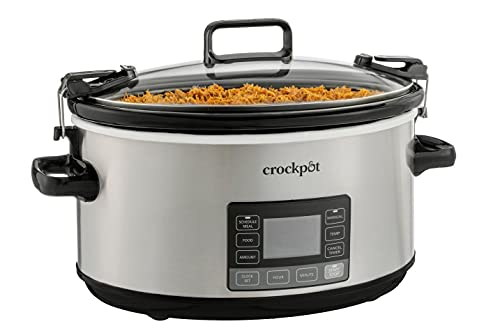
Crock-Pot Programmable Slow Cooker 7-Quart with MyTime
Badge: Best Modern Classic
Strengths
- MyTime scheduling answers the oldest scheduling pain in the category: dinner must be ready when life says, not when a timer started.
- The Cook & Carry locking lid answers the second-oldest pain: getting a full crock to the gathering intact.
- It keeps the classic seven-quart crock format rather than reinventing the vessel.
Trade-offs
- Its classic status is a prediction, not a record; the electronics must still prove their decade.
- Setup per cook is a modern tax the dial never charged.
- Households with fixed routines gain little over the manual original.
At a glance
- Capacity: 7-quart, feeds 9+
- Controls: programmable, MyTime technology adjusts cooking
- Lid: Cook & Carry locking lid
- Finish: Stainless steel
Every retrospective needs one pick that argues the present can still produce a classic, and this Crock-Pot makes the argument the right way: by keeping the vessel and fixing the calendar. The seven-quart format is inherited intact. What MyTime adds is a scheduling logic that works backwards from the mealtime you set, adjusting the cooking cycle to land there — and that addresses the complaint that has shadowed slow cooking since its first decade, that the food is ready on the appliance’s schedule rather than the family’s. Features that answer complaints that old tend to stay.
The Cook & Carry locking lid passes the same historical test. Slow-cooked food has always travelled — to family tables, community suppers, holiday houses — and it has always travelled badly, in foil-wrapped hope. A lid designed to lock the crock shut is the category finally engineering for its own social reality. Together, the two features make this the most life-shaped machine in the guide: it assumes dinners move and food travels, because in real households they do. Households of two should still read the sizing honesty in our Best Slow Cookers For 2 People guide before choosing any seven-quart machine, this one included.
The reservation is written into the badge: modern classic is a forecast. The dial models have already served their decades; this one’s electronics are still earning the claim. Buyers who weight proven permanence above all should take the manual original. Buyers whose lives match its two solutions will find it is not a gadget but a correction — and corrections, historically, are what classics are made of.
Best for: busy, gathering-centred households that want the classic format with its two oldest pains fixed / Not suited for: permanence purists or fixed-routine cooks.
Comparison Table
The table lines the picks up on the attributes a buyer can verify from the listings. Read it through the retrospective lens: format and capacity are the columns history cares about.
| Pick | Capacity | Controls | Claim on permanence | Link |
|---|---|---|---|---|
| Hamilton Beach 6 Quart Slow Cooker (33665G) | 6 quart | 3 settings, manual | The settled design at the settled size | Check on Amazon |
| Crock-Pot Programmable Slow Cooker 8-Quart, Black Stainless | 8-quart, 10+ people | Digital timer to 20 hours, auto warm | The batch tradition, guarded by a timer | Check on Amazon |
| Cosori Rice Cooker 10 Cup with Slow Cook | 10 cup uncooked rice measure | Fuzzy logic, delay timer | Browning repaired, versatility branch | Check on Amazon |
| Aroma Housewares 20 Cup Digital Rice Cooker and Slow Cooker (ARC-150SB) | 20 cup cooked | Digital | An established maker’s three-role staple | Check on Amazon |
| Crock-Pot Oval Manual Slow Cooker 7-Quart | 7-quart, 8+ people | High, low and warm dial | The founding format, undiluted | Check on Amazon |
| Crock-Pot Programmable Slow Cooker 7-Quart with MyTime | 7-quart, 9+ people | Programmable, MyTime | The classic with its calendar fixed | Check on Amazon |
How to Choose a Slow Cooker for the Long Term
Buy the format your food has always wanted
History’s clearest lesson is that format outlives features. Roasts and birds want the oval crock; family stews and soups are happy in the six-quart classic; crowds want eight quarts; saucy, grain-centred repertoires are the multicookers’ home ground. Choose the format first and the specific model second, and you are buying in the direction the evidence points. The household that reverses that order — features first, format as an afterthought — is the household shopping again in three years.
Interrogate every feature with the ten-year question
Ask of each feature: will the problem this solves still exist in my kitchen in ten years, and will this mechanism still be working then? Warm settings, timers, locking lids and dishwasher-safe crocks pass easily. Scheduling to a mealtime passes for households whose lives are genuinely irregular. Long mode lists pass only for cooks who will actually rotate the modes weekly. The question is severe, and it is meant to be: an “ever” purchase should survive severe questions.
Weight the ownership tail
Long-term value lives in the unglamorous tail: a mainstream brand, a clearly identified model, replacement crocks and lids that remain obtainable, and a design mature enough that its behaviour is common knowledge. Every pick in this guide was chosen partly on that tail. A slightly plainer machine from an established line will almost always out-serve a dazzling one from a line that may not exist when you need a lid.
How to Use and Care for Your Slow Cooker
Long service is partly bought and partly behaved. Treat stoneware as the ceramic it is: let it change temperature gradually, never set a hot crock on a cold stone surface or run cold water into it, and lift it with two hands and dry grips. Cook with the lid closed and the fill between half and two-thirds, brown first where flavour matters, and hold finished food on warm for serving rather than storage.
- Wash crocks, pots and lids once cooled; dishwasher-safe parts may go in the machine, but hand washing is the gentlest route to a long life.
- Inspect the cord and the crock glaze occasionally; retire a through-cracked crock rather than cooking in it.
- Store the lid inverted or ajar on a cloth to protect the rim and keep the vessel fresh.
- Keep the manual — or a photo of the model plate — so parts can be matched years later without guesswork.
- Season a new machine with two or three forgiving cooks before trusting it with an occasion.
Troubleshooting
Problem: hairline cracks have appeared in the glaze → what to do: surface crazing is usually cosmetic and common in old soldiers; a crack you can feel through the wall, or any leaking, ends the crock’s service — replace the crock, keep the base if the maker supports it.
Problem: the cooker runs hotter than it did in its early years → what to do: check the lid seal and rim for residue or warping first, since a poor seal changes the whole thermal behaviour; clean, reseat, and retest with a simple stew before concluding the element has drifted.
Problem: a programmable model forgets its settings after outages → what to do: that is electronic behaviour, not a fault to cook around; note the programme on paper during storm-prone seasons and favour manual certainty for the cooks that cannot be risked.
Designs and Ideas That Did Not Last
A retrospective earns its authority by remembering the failures too. This category has seen novelty shapes that fit no recognisable food, control schemes that required a manual at every cook, decorative finishes that could not survive a family kitchen, and complexity whose only achievement was shortening the interval between purchase and landfill. The pattern in every failure is the same: the idea served the product launch rather than the cook’s recurring life. The pattern in every survivor in this guide is the opposite — each answers a weekly reality: weeknight timing, Sunday roasts, batch days, rice on the table, food that travels. When you are next tempted by a feature that cannot name the weekly reality it serves, remember which side of this section it is auditioning for.
The Slow Cooker as Kitchen Inheritance
There is a reason slow cookers appear in family stories more often than blenders do. They are bought young, used through every household era — first flat, young family, the big gathering years — and they accumulate associations the way cast iron does: the stew that meant winter, the pulled pork that meant the team was coming, the soup that meant someone was being looked after. That accumulation is only possible because the machines last, and it is the deepest meaning of “ever” in this category. A cooker that survives long enough stops being equipment and becomes part of how a family feeds itself, which is why the plain, durable designs in this guide command an affection that spec-for-spec superior novelties rarely earn.
The practical inheritance matters too. A stoneware crock passed to a student flat or a first apartment arrives with its whole support system intact: three settings anyone can operate, a size the recipe world is written for, and no account, app or ecosystem standing between the new owner and dinner. When you buy one of the classic formats, you are plausibly buying for two households across its life — yours now, and someone else’s later. Few purchases in a modern kitchen can say that, and it is a legitimate line item in the value calculation, even if it never appears on a comparison chart.
When a Classic Finally Retires
Even the longest-lived cooker eventually meets the dropped crock, the cracked glaze or the cord that should not be trusted, and the historically literate response is replacement in kind rather than reinvention. Check first whether the maker still supplies the crock or lid alone, because the base of a manual model usually has years left in it; a vessel-only replacement is the cheapest and most sustainable route back to service. If the whole machine must go, replace it by format first — the same size and shape your recipes, cupboards and habits are built around — and let features argue for changes only where your life has genuinely changed since the original purchase: a newly irregular schedule may justify the programmable step, a newly smaller household the step down in size. Retire the old unit responsibly, keep the notebook of timings you built on it, and the successor inherits the knowledge even if it cannot inherit the stoneware.
A Short Buyer’s Creed for Timeless Appliances
Distilled from everything above, the creed for buying in this category is short enough to keep on a phone. Buy the format your food wants, at the size your ordinary week fills. Prefer the maker with a history and the model with a number you can match. Let a feature in only if it names the weekly pain it cures. Treat the vessel as the appliance and everything else as staff. And remember that the goal is not to own the most advanced slow cooker of this season; it is to be, ten years from now, a person whose slow cooker is simply there — seasoned, understood and still turning out the dinners your household runs on. Every pick in this guide can be that appliance for the right kitchen. The creed exists to make sure the kitchen and the cooker are matched.
Common Buying Mistakes
- Confusing new with better. In this category the burden of proof sits on novelty; the classics are classics because they already passed it.
- Buying a mode list instead of a format. Shape and capacity decide a decade of cooking; modes decide a season of novelty.
- Ignoring the ownership tail. Replacement crocks, lids and a surviving brand are worth more than any launch feature.
- Oversizing for imagined occasions. The permanent size is the one your ordinary week fills properly.
- Neglecting the stoneware. Thermal shock and hard floors end more classic cookers than any electrical failure.
Final Recommendation
If “ever” means the single most proven purchase, take the Hamilton Beach 6 Quart Slow Cooker for its settled size and indestructible simplicity, or the Crock-Pot Oval Manual 7-Quart if roasts are your tradition — between them they are the category’s main line. If your household’s life is modern in the specific ways that matter, the Crock-Pot Programmable 7-Quart with MyTime is the classic-in-progress that fixes the calendar without touching the crock. Buy the format your food wants, from a maker who will still exist when you need a lid, and your slow cooker will not be a purchase you revisit — it will be furniture, in the best sense, for a decade of dinners.
Frequently Asked Questions
What makes a slow cooker a classic?
A format that fits real food, controls that cannot become obsolete, a vessel that tolerates decades of use, and a maker who keeps supporting it. By those tests the manual stoneware crock is the category’s classic design, and modern machines earn the label only by preserving that core while fixing a genuine, recurring problem.
Are older-style manual slow cookers still worth buying?
Yes, for households that are home at finishing time. The cooking itself has not been improved upon — gentle heat in a heavy vessel is the whole technique — so a manual model’s only real sacrifice is scheduling. Many cooks reasonably conclude that is no sacrifice at all.
Which size has proven best over time?
Six quarts for the standard family and seven for the family that roasts and hosts; those are the sizes the recipe literature and decades of ownership converged on. Eight quarts is the proven batch size. Novelty sizes have repeatedly failed to displace that settlement.
Will a multicooker age as well as a stoneware crock?
Probably not in raw service years, because electronics age faster than ceramics and dials. Its claim is different: daily usefulness across many techniques. Judge it as a hard-working modern appliance rather than an heirloom, and the Cosori and Aroma picks are the strongest current examples of the type.
What feature has proven most valuable historically?
The warm setting and its programmable descendants. Dinners have run late for as long as the appliance has existed, and every durable innovation in the category — timers, automatic warm, mealtime scheduling — is a refinement of the answer to that single recurring fact.
How long should a good slow cooker last?
A dedicated stoneware model, treated with ordinary care against thermal shock and drops, should serve for many years, with the crock and lid as the only realistic wear items. That longevity is precisely why buying the right format and size matters more here than in faster-moving appliance categories.


