Disclosure: topratedkitchenware.com is reader-supported. When you buy through links on our site, we may earn an affiliate commission from Amazon and other retailers, at no extra cost to you.
Where to buy
This page is a buying guide to the best slow cookers for semis: six machines with verified specifications, compared below with a link on every pick so you can check the latest price on Amazon before you decide.
Slow cooking in a semi is a specific discipline: household machines powered through the truck’s electrical system, cooking done while parked at stops, food that must travel safely between cab, fridge and table. This guide is honest about that from the first line — none of these is a purpose-built 12-volt truck cooker — and then does the useful work: which of six verified slow cookers fits cab life best, led by the one model with a locking lid. Every pick links to Amazon so you can check the latest price.
- Crock-Pot Oval Manual Slow Cooker 7-Quart — Best Simple Cab Crock
- Crock-Pot Programmable Slow Cooker with MyTime 7-Quart — Best Overall for Semis — Locking Lid
- Hamilton Beach 6 Quart Slow Cooker — Smallest Crock Here
- Crock-Pot Programmable Slow Cooker 8-Quart Black Stainless — Best for Team Drivers and Big Batches
- Cosori Rice Cooker 10 Cup — Most Versatile for Cab Cooking
- Aroma Housewares 20 Cup Digital Rice Cooker and Slow Cooker — Best for Rice Meals on the Road
Read the full guide ↓ for the reasoning, the comparisons and the buying advice before you decide.
The search for the best slow cookers for semis starts with two honest facts. First, the machines in this guide are household slow cookers, not dedicated 12-volt truck appliances: they run on standard household power, which in a cab means a suitably rated inverter, and the right first step with any of them is checking the appliance’s own power label against your inverter’s rating. Second, slow cooking in a truck should be done while parked, on a stable, level, heat-safe surface — a moving cab is no place for a crock of hot liquid, locking lid or not. Within those facts, a slow cooker is one of the best eating tools a driver can carry: real food, cooked during a stop, ready at the end of a shift.
Judged for cab life, the features reorder themselves. A locking lid — offered by exactly one pick here — becomes the headline, because food in a vehicle gets carried. Capacity is a trade, not a virtue: enough for several days of portions, small enough to store. Simple controls beat clever ones at the end of a long driving day, though a mealtime-adjusting control has a genuine shift-work logic. And easy cleaning matters more, not less, when the sink is small. Home-based family drivers will recognise the same trade-offs, at kitchen scale, in our Best Slow Cookers For Small Families guide.
Method, briefly: research-led comparison of verified specifications against cab constraints — lid security, footprint, control simplicity, timer behaviour and cleanup. No prices or ratings are invented, no machine’s power draw is guessed, and where a pick’s road use has a hard boundary, the review states it rather than selling past it.
Key Takeaways
- These are household machines: in a cab they run through an inverter, so check the appliance’s power label against your inverter’s rating before the first cook.
- Cook while parked, on a stable and level surface. The locking lid on the MyTime pick is for carrying food safely — it is not a licence to cook in motion.
- The locking lid is the single most valuable feature for vehicle life; resting lids mean the crock travels empty or not at all.
- Capacity is a trade in a cab: 6–7 quarts portions into several days of meals; 8 quarts only earns its space for team drivers or deliberate batching.
- Simple controls and a pot that rinses clean in a small sink are road features, not compromises.
In this guide
Quick Picks
| Pick | Badge | Why it stands out | Link |
|---|---|---|---|
| Crock-Pot Oval Manual Slow Cooker 7-Quart | Best Simple Cab Crock | A manual control with nothing electronic to confuse, in the classic stoneware format that cooks a driver’s dinner from a morning set-up | Check on Amazon |
| Crock-Pot Programmable Slow Cooker with MyTime 7-Quart | Best Overall for Semis — Locking Lid | The Cook & Carry locking lid is the one feature that directly answers life in a moving vehicle — a sealed crock, not a resting lid | Check on Amazon |
| Hamilton Beach 6 Quart Slow Cooker | Smallest Crock Here | At 6 quarts the smallest dedicated crock here, with dishwasher-safe parts for home days and simple three-setting control | Check on Amazon |
| Crock-Pot Programmable Slow Cooker 8-Quart Black Stainless | Best for Team Drivers and Big Batches | Eight quarts and a 20-hour timer for team drivers cooking for two, or one driver batching several days at a stop | Check on Amazon |
| Cosori Rice Cooker 10 Cup | Most Versatile for Cab Cooking | Slow cook plus rice, steam and sauté in one machine — a whole cab kitchen in a single footprint | Check on Amazon |
| Aroma Housewares 20 Cup Digital Rice Cooker and Slow Cooker | Best for Rice Meals on the Road | Rice, slow cooking and steaming in one unit for drivers whose road meals are built on grains | Check on Amazon |
How These Picks Were Chosen
The pool is the verified slow-cooker group, re-judged against the constraints of a cab: whether the lid locks, how much space the machine claims, whether the control can be operated correctly by a tired person, whether a timer can finish a cook during a stop or hold it to a shift’s end, and how the vessel cleans with limited water and sink space. Machines were not credited with any truck-specific feature their listings do not verify — none here is a 12-volt appliance, and the guide says so wherever it matters.
We also weighed the two real road patterns: cooking at stops for the same day’s dinner, and batching at a long stop or at home for several days on the road. The badges map to those patterns and to crew size, including the team-driver case. The home end of a driver’s cooking — family meals on reset days — is covered in our Best Slow Cookers For Two People guide, which many drivers will find matches their home kitchen better than their cab.
The 6 Best Slow Cookers for Semis

Crock-Pot Oval Manual Slow Cooker 7-Quart
Badge: Best Simple Cab Crock
Strengths
- The oval stoneware shape is the classic slow-cooker format, and it fits whole roasts and poultry more naturally than a round pot
- High, Low and Warm on a manual control is as simple as slow cooking gets — nothing to program and very little to go wrong
- The removable stoneware lifts out for serving and washing, so the crock doubles as a table dish
Trade-offs
- There is no timer, so the cooker will not switch itself to Warm at a set hour — you manage the schedule
- Manual control means no delay start and no automatic adjustment if a cook runs long
- Stoneware is heavy, especially filled, and it needs a little care against knocks and sudden temperature shocks
At a glance
- Capacity: 7-quart, serves 8+ people
- Settings: High and Low cook settings, Warm setting
- Crock: Removable oval stoneware
- Exterior: Stainless steel
- Control type: Manual
This is the traditional slow cooker in its most recognisable form: a 7-quart oval stoneware crock in a stainless steel housing, run by a manual control with High, Low and Warm. There is a reason this format has endured. The oval shape takes whole chickens, roasts and ribs without forcing them into a round pot, the heavy stoneware holds heat evenly and steadily, and the removable insert moves from base to table to sink as a single serving vessel.
What you give up is automation. A manual cooker does exactly what you set and nothing more: it will not count down, switch itself to Warm when a timer ends, or delay its start until morning. For cooks who are home to keep an eye on things, or who simply prefer a control they can understand at a glance, that simplicity is the appeal. For cooks who need the machine to manage a schedule on its own, one of the programmable picks on this page is the better tool. Judged on the cooking itself — steady heat, generous capacity, honest stoneware — this remains the benchmark shape the others are compared against.
For a driver, the manual Crock-Pot’s appeal is its indifference to complexity: set Low at a stop, eat a proper stew hours later, switch to Warm while you finish paperwork. Stoneware holds heat forgivingly and the oval shape takes a whole chicken for several days of meals. Its limit must be stated plainly: the lid rests rather than locks, so this is a cook-while-parked machine. Set it up stable and level at a stop, and it is a dependable cab companion; do not ask it to travel sealed and full.
Best for: drivers who cook while parked at stops and want a control that cannot be mis-set / Not suited for: drivers who want any cooking to happen in motion — no resting lid allows that
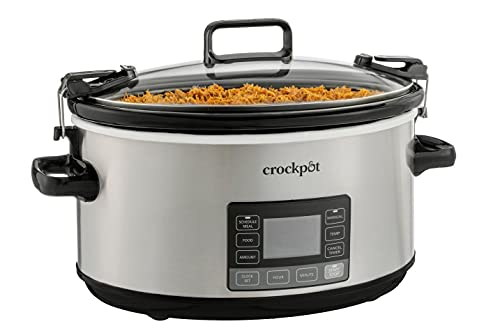
Crock-Pot Programmable Slow Cooker with MyTime 7-Quart
Badge: Best Overall for Semis — Locking Lid
Strengths
- MyTime technology adjusts the cooking to be ready at the mealtime you set, instead of forcing you to work backwards from a fixed duration
- The Cook & Carry locking lid seals the crock for transport, which makes potlucks and family visits far less risky
- You get the classic 7-quart format with programmable convenience layered on top
Trade-offs
- The electronics add a learning step compared with a simple High/Low dial
- A locking lid needs its latches checked and cleaned, because sauce in the mechanism is a nuisance
- Like all 7-quart stoneware-format cookers, it is a substantial appliance to store and to wash
At a glance
- Capacity: 7-quart, feeds 9+
- Technology: MyTime technology adjusts cooking
- Lid: Cook & Carry locking lid
- Exterior: Stainless steel
- Control type: Programmable
The MyTime Crock-Pot keeps the familiar 7-quart programmable format and changes the question the timer asks. Instead of setting only a duration, MyTime technology adjusts the cooking so the food is ready at the mealtime you choose, which is a more natural way to plan around work, school runs and everything else that decides when dinner actually happens. For households whose evenings rarely run to a fixed clock, that adjustment is the headline feature.
The Cook & Carry locking lid is the second practical upgrade. A standard lid rests on top; this one latches down, so a full crock can travel to a potluck, a relative’s house or a holiday table with far less risk of a spill in the car. Back home, the programmable control and the 7-quart capacity that feeds 9 or more make it a full-size family cooker in the classic mould. Its honest limitation is complexity: there is more to set, more to clean around the lid mechanism, and more to learn than on the manual model — worth it if you use the scheduling, wasted if you never do.
The MyTime Crock-Pot is the only pick here designed around a lid that latches shut, and in a vehicle that single fact reorganises everything. A sealed crock can be carried from cab to rest area, home and back without the sloshing risk a resting lid carries, and finished food can travel to where it will be eaten. Add MyTime’s mealtime adjustment — dinner ready at the end of a shift whose end time you know better than a cook duration — and this is the most road-thoughtful machine in the group. The sensible pattern remains cooking while parked on a stable surface; the locking lid is for carrying, and it earns its badge there.
Best for: drivers who want the sealed, locking lid and a mealtime finish after a driving shift / Not suited for: drivers who prefer the simplest possible manual control

Hamilton Beach 6 Quart Slow Cooker
Badge: Smallest Crock Here
Strengths
- Three cooking settings keep the control as simple as it can be while still covering the everyday jobs
- Both the stoneware crock and the glass lid are dishwasher-safe, which makes cleanup genuinely low-effort
- At 6 quarts it is the smallest dedicated crock in this group, so it stores and handles a little more easily
Trade-offs
- No programmable timer, delay start or automatic scheduling — you set a setting and manage the clock yourself
- The glass lid does not lock, so it is not the pick for transporting a full cooker
- Six quarts is generous for most meals but is the first capacity here that a very large gathering can outgrow
At a glance
- Capacity: 6 quart
- Settings: 3 cooking settings
- Crock and lid: Dishwasher-safe stoneware crock and glass lid
- Finish: Silver
- Model: 33665G
Hamilton Beach’s 6-quart cooker is the straightforward dedicated crock in this line-up: three cooking settings, a stoneware insert, a glass lid, and a silver finish. Nothing about it asks for study. You fill the crock, choose a setting, and let steady heat do the work, which is exactly what many slow-cooker owners want from the appliance and nothing more.
Its most underrated feature is in the specification: both the stoneware crock and the glass lid are dishwasher-safe. Slow cooking’s dirty secret is the heavy, sauce-crusted insert waiting in the sink, and a cooker whose parts can go straight into the dishwasher removes the main friction from using it every week. The limitations are equally clear. There is no timer and no locking lid, so scheduling and transport are manual affairs, and at 6 quarts it is the smallest of the dedicated crocks here. For everyday family cooking with the easiest cleanup in the group, those are trades many kitchens will happily make.
Cab space is measured in inches, so the Hamilton Beach’s status as the smallest dedicated crock here — 6 quarts — is a genuine road feature, and its three settings are all a tired driver needs to operate correctly. The dishwasher-safe crock and lid pay off on home days, when the whole kit can be reset properly. Like the manual Crock-Pot, its lid does not lock, so it cooks parked. Within that honest boundary, it is the easiest crock in the group to live with in a small space.
Best for: solo drivers wanting the smallest real crock and easy cleaning / Not suited for: drivers needing a locking lid
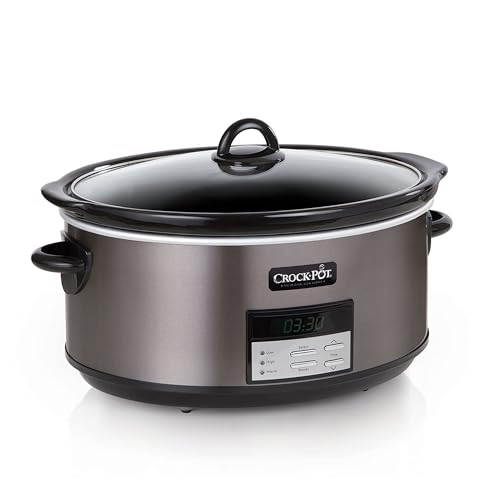
Crock-Pot Programmable Slow Cooker 8-Quart Black Stainless
Badge: Best for Team Drivers and Big Batches
Strengths
- The 8-quart capacity is the largest dedicated crock in this group, rated for 10 or more people
- A digital timer up to 20 hours plus an auto warm setting means the cooker manages long cooks and the finish without supervision
- The lid and stoneware pot are dishwasher-safe, which matters a great deal on a crock of this size
Trade-offs
- It is the biggest appliance here, with a counter and storage footprint to match
- A full 8-quart stoneware pot is heavy to lift, carry and wash, even before food goes in
- For small households cooking small meals, most of this capacity simply goes unused
At a glance
- Capacity: 8-quart, for 10+ people
- Timer: Digital timer up to 20 hours
- Warm: Auto warm setting
- Care: Dishwasher-safe lid and stoneware pot
- Exterior: Black stainless steel
This is the capacity leader among the dedicated crocks: 8 quarts, rated for 10 or more people, in a black stainless steel housing. If your slow cooking regularly means feeding a crowd, doubling a recipe for the freezer, or cooking the largest cuts, the extra quart over the 7-quart models is not a rounding error — it is the difference between a recipe fitting comfortably and a crock filled to the brim, which slow cookers do not reward.
The supporting specification is built for hands-off cooking. The digital timer runs up to 20 hours, the cooker switches to an auto warm setting when the cook finishes, and both the lid and the stoneware pot are dishwasher-safe — a mercy at this size. The honest costs are physical: this is a big, heavy appliance that claims real counter and cupboard space, and a full crock takes two hands and some care to move. Households that will use the capacity will not mind; households that will not should step down a size.
The 8-quart Crock-Pot’s road case is narrow but real: team drivers cooking for two, or a solo driver who batches several days of food during a long stop or a reset, then portions it into the cab fridge. Its 20-hour timer and auto warm suit those long, supervised-at-a-stop cooks, and the capacity turns one session into most of a week. The costs are equally real — the biggest footprint and the heaviest full crock here, in the workspace where both matter most. Buy it for the batching pattern or not at all.
Best for: team drivers and batch-cookers with the cab or stop facilities to house it / Not suited for: solo drivers in a tight cab — the smaller picks fit the life better

Cosori Rice Cooker 10 Cup
Badge: Most Versatile for Cab Cooking
Strengths
- Fuzzy logic control adjusts the cooking as it goes, which takes some of the guesswork out of long, gentle cooks
- The slow cook function sits inside an 18-in-1 machine, so one appliance covers rice, steaming, sautéing and slow cooking
- The ceramic-coated inner pot is non-stick, so sticky, sugary or starchy foods release more easily at cleanup
Trade-offs
- It is a rice cooker first, so the cooking vessel is a round inner pot rather than a deep oval stoneware crock
- The feature list is long, and the control panel takes a little learning before the slow cook routine feels automatic
- Ceramic non-stick coatings need gentle utensils and washing if the surface is to stay slick over years of use
At a glance
- Capacity: 10 cup uncooked / 20 cup cooked
- Functions: 18-in-1, including Sauté and Slow Cook
- Inner pot: Ceramic coating, non-stick
- Timing: 24H keep warm and delay timer
- Included accessory: Stainless steel steamer basket
- Finish: Black
The Cosori is the multi-function entry in this group: a fuzzy-logic rice cooker whose verified specification includes a dedicated slow cook function alongside sautéing, steaming and a long list of other programs. That matters because the cooking style is different from a stoneware crock. Heat is managed electronically and the fuzzy logic makes small adjustments as the cook progresses, which suits foods that benefit from a steady, closely held temperature rather than the slow thermal climb of a heavy ceramic insert.
The ceramic-coated inner pot is the other defining trait. Slow-cooked food that would bake onto raw stoneware — sweet sauces, starchy grains, dairy-based dishes — tends to release more readily from a non-stick surface, and the pot itself is lighter to lift to the sink. The trade-off is shape: a round rice-cooker pot does not cradle a whole roast or a long rack the way an oval crock does, so this machine earns its place through versatility and control rather than through classic crock geometry. The 24-hour keep warm and delay timer in the specification also make it one of the more schedule-friendly designs here.
The Cosori is the cab-kitchen consolidator: rice for the base, steam for vegetables, sauté for a quick start, slow cook for the main — one appliance, one footprint, in a workspace where every stored item competes with the job. Its delay timer and long keep warm suit a driver’s staged day, and the non-stick ceramic pot rinses clean in a small sink, which in a cab is not a small thing. It cooks parked, like everything here; what it adds is range, letting one machine cover a varied week’s eating instead of a single dish style.
Best for: drivers who cook varied meals and want one appliance to do all of it, while parked / Not suited for: drivers wanting classic stoneware roasts

Aroma Housewares 20 Cup Digital Rice Cooker and Slow Cooker
Badge: Best for Rice Meals on the Road
Strengths
- Three roles in one footprint: rice cooker, slow cooker and food steamer, which suits kitchens short on storage
- The cooked capacity is the largest grain capacity in this group, so big batch cooking is squarely in its comfort zone
- Digital controls are simpler to set than a purely manual dial when you want a repeatable routine
Trade-offs
- Like the Cosori, it is a rice-cooker format, so the vessel shape differs from a classic oval stoneware crock
- Slow cooking is one role among several rather than the machine’s single dedicated purpose
- The headline capacity is measured in cooked cups of rice, which needs translating before you compare it with quart-rated crocks
At a glance
- Capacity: 20 cup cooked (10 cup uncooked)
- Roles: Digital rice cooker, slow cooker, food steamer
- Exterior: Stainless steel
- Model: ARC-150SB
- Finish: Black
Aroma’s ARC-150SB approaches slow cooking from the rice-cooker side of the kitchen. Its verified title lists three roles — digital rice cooker, slow cooker and food steamer — in a stainless-steel-exterior machine with a 20-cup cooked capacity. For households that already cook a lot of rice and grains, that combination is genuinely practical: the same appliance that handles the staple can also hold a slow, gentle cook, and the steamer role adds a way to cook vegetables or dumplings without another pot.
Judged purely as a slow cooker, the honest framing is that you are getting a capable slow-cook function inside a multi-purpose machine rather than a dedicated stoneware crock. The vessel is a rice-cooker pot, the capacity is expressed in cooked cups rather than quarts, and the cooking geometry suits grains, soups, stews and saucy dishes better than it suits a large whole roast. Within those boundaries it is a sensible, space-efficient choice, and the digital control keeps the routine repeatable from one batch to the next.
Drivers whose road food is built on rice — and long-haul eating often is, because rice is cheap, filling and keeps — will find the Aroma the most natural fit: a proper grain capacity, a slow cook function for the curry, stew or beans that go over it, and a steamer for the rest, in one unit. It is a parked-cooking, rice-first answer, and within that pattern it may be the most-used appliance on this page. Drivers who rarely eat rice should look to the crocks instead.
Best for: drivers whose meals are rice-based and who value one compact multi-role unit / Not suited for: drivers wanting a locking-lid crock for transport
Comparison Table
| Pick | Key attribute | Main limitation | Link |
|---|---|---|---|
| Crock-Pot Oval Manual Slow Cooker 7-Quart | 7-quart oval stoneware; manual High, Low, Warm | Resting lid does not lock — cook parked, and never rely on it sealed in motion | Check on Amazon |
| Crock-Pot Programmable Slow Cooker with MyTime 7-Quart | Locking lid; MyTime mealtime adjustment; 7-quart capacity | The electronics want a stable power supply and a little learning | Check on Amazon |
| Hamilton Beach 6 Quart Slow Cooker | 6-quart crock; three settings; dishwasher-safe crock and lid | Lid does not lock, so it is a parked-cooking machine | Check on Amazon |
| Crock-Pot Programmable Slow Cooker 8-Quart Black Stainless | 8-quart capacity; timer to 20 hours; auto warm | The largest footprint and heaviest crock here — a squeeze in many cabs | Check on Amazon |
| Cosori Rice Cooker 10 Cup | 18-in-1 functions; delay timer; ceramic non-stick pot | A multicooker’s controls and lid are not built for cooking while rolling | Check on Amazon |
| Aroma Housewares 20 Cup Digital Rice Cooker and Slow Cooker | Three roles in one footprint; 20-cup cooked capacity | Rice-led format; the lid is not a locking travel lid | Check on Amazon |
How to Choose a Slow Cooker for a Semi Truck
Start with power and place, because both are non-negotiable. Read the appliance’s power label and your inverter’s rating and confirm they are compatible, with the inverter able to sustain the cooker’s draw for a long cook — if in doubt, ask the inverter maker, not the internet. Then measure the spot: the cooker needs a stable, level, heat-safe surface with clearance around it, plus a storage home where it cannot slide or fall. Only after those two gates are passed does the model choice begin, and drivers who skip them buy the wrong machine no matter how good it is.
Next, the lid and the size. If food will ever be carried — cab to rest area, truck to home, stop to picnic table — the locking lid on the MyTime pick is the feature to pay for; a resting lid travels only on an empty crock. For size, a solo driver’s week is usually best served by 6 to 7 quarts cooked at a stop and portioned into the fridge; the 8-quart pick is for team drivers feeding two or batchers with room. The multicookers earn consideration where variety matters in one footprint, which is also the logic young households use in our Best Slow Cookers For Young Couple guide — one machine, many jobs, small space.
Finally, controls and cleaning for tired people. A manual dial cannot be mis-set; a mealtime adjustment can land dinner at a shift’s end without arithmetic; a long timer with auto warm can hold a finished cook safely through a delay. Choose the most automation you will actually use, no more. And prefer the vessel you can clean in a cab sink or a dishwasher at home — non-stick ceramic rinses, dishwasher-safe stoneware delegates. Readers comparing the broader market rather than the truck case will find the general buying framework in our sale guide linked from this page’s recommendations.
How to Slow-Cook Safely at Truck Stops, Step by Step
Road slow cooking is a parked routine. Followed in order, it turns a stop into dinner without drama.
- Park, stabilise, then cook. Choose a level stop, set the cooker on a stable, heat-safe surface with clearance, and confirm it cannot slide. Cooking happens parked — always.
- Check the power before the food. Connect through your inverter as its maker directs, confirm the cooker’s draw is within the inverter’s sustained rating, and start the cook before you settle into other stop routines.
- Load to the line. Half to two-thirds full, lid closed. In a vehicle the fill rule is also a spill rule — leave headroom.
- Time it to the stop or the shift. Use Low for a long stop, a timer or mealtime setting where the machine offers one, so the finish lands when you are ready to eat or to portion.
- Portion into the fridge promptly. Eat what is for now; move the rest into sealed containers and into the cab fridge without letting it sit warm.
- Travel with the crock empty or locked. A resting-lid crock travels empty. A locking-lid crock may carry food, set flat and secure, for a short and careful move.
Troubleshooting. Problem: the inverter strains or cuts out → the cooker’s draw exceeds what the setup sustains; stop, and resolve the power question with the inverter’s documentation before trying again — never improvise around electrical limits. Problem: food has sloshed or the lid has shifted → the surface was not level or the crock travelled full with a resting lid; cook parked, travel empty or locked. Problem: dinner is not ready at the end of a stop → the batch was too large or started too late; cook smaller, start earlier in the stop, or use a model whose timer plans the finish for you. Drivers researching the wider slow-cooker market, including the non-Crock-Pot brands, will find the brand-alternative view in our Best Slow Cookers Not Crock Pot guide.
What to carry alongside the cooker
A slow cooker on the road works as part of a small kit, and the kit is worth assembling deliberately. Sealed portion containers are the heart of it — the batch pattern this guide is built on lives or dies by them — sized to the cab fridge and to a single meal. A compact chopping board and one good knife cover preparation at a stop; a can opener, a vegetable peeler and a wooden spoon cover nearly everything a slow cooker recipe asks. Seasoning travels in small, sealed containers: salt, pepper, one spice blend you actually use, and stock cubes, which turn water and vegetables into a meal at any stop in the country.
Add the unglamorous safety items: a stable board or mat to give the cooker its level, heat-safe surface where the cab’s own surfaces are doubtful, a roll of paper towels, and bags for rubbish, because a clean cab is a workable cab. None of this is expensive, and all of it together weighs less than the cooker. The drivers who eat well on the road are rarely the ones with the most equipment; they are the ones whose small kit is complete, so that cooking at a stop is a routine rather than an improvisation.
Home days: the reset-day cook
Most drivers’ slow cooking splits between the road and the reset, and the home cook deserves its own mention because it is where the big patterns happen. A reset day is when the 7- and 8-quart crocks in this guide earn their keep at home: a full batch cooked unhurriedly, eaten as a family dinner, and portioned into the containers that go back into the cab. The locking-lid MyTime model closes the loop neatly, since the same crock that cooked at home can carry food out to the truck sealed. Households that run this rhythm find the cooker working at both ends of the driver’s week — which is the strongest value case any appliance on this page can make.
Reset-day cooking is also where a driver’s family eats the same food the driver eats all week, and that shared table is worth more than the logistics. If you are equipping both a cab and a home kitchen, one versatile machine that travels between them — or two modest machines, one in each place — beats one premium machine stranded in the wrong location. Decide which pattern your weeks actually follow before spending, as with every pick in this guide.
Cooking for two in the cab: partners and passengers
Not every cab carries one. Driving teams, married couples who run together, and drivers who occasionally carry a passenger all cook for two in the space this guide has mostly treated as a solo workplace, and the arithmetic changes in their favour: a 6- or 7-quart crock cooked at a stop produces dinner for two plus a next-day lunch without any change of equipment, which is why the team case appears in this guide’s badges rather than as an afterthought. The locking-lid pick matters even more with two people’s food moving around a shared cab, and the batch rhythm stretches further — one cook, more meals, fewer stops spent on food.
The courtesy rules are the only real addition: strong-smelling dishes are a shared-air decision, the cooking schedule bends around two people’s rest rather than one, and the portion containers double. Couples who drive together often report that the cooker is the appliance that makes the cab feel like a household rather than a workplace — a hot, home-seasoned dinner at the end of a shared shift. For that crew, buy the size this guide recommends for batching and do not apologise for it: two people’s week is exactly what a 7-quart crock was built to hold.
A driver’s week of eating from one cooker
The pattern that works on the road is a rhythm, not a recipe. At a long stop or on a home reset, cook a full crock — a stew, a braise, a whole chicken in the oval crocks — and portion it into sealed containers for the fridge. Across the following days, the same cook becomes different meals with different additions: fresh bread, a bagged salad, rice from the multicooker picks, a sauce from a jar. One cooking session, four or five dinners, no truck-stop food queue. The cookers here were chosen to serve that rhythm: big enough to batch, simple enough to run tired, and — in the MyTime’s case — sealable enough to move.
The rhythm also explains why this guide does not chase the smallest possible cooker. A tiny cooker cooks tonight’s dinner; a 6- or 7-quart crock cooks the week. For a driver, the week’s eating is the problem worth solving, and it is solved at a stop, with a machine that then mostly rests while the fridge does the daily work.
Common Buying Mistakes
- Cooking in motion. Hot liquid, a moving vehicle and a resting lid are a bad combination in any order. Cook parked; carry locked or empty.
- Guessing the power. An inverter mismatch is not a cooking problem, it is an electrical one. Read both labels and respect the lower number.
- Buying capacity a cab cannot store. The 8-quart pick is a batching tool for drivers with room. In a tight cab, an unusable big crock is worse than a smaller one used daily.
- Letting cooked food sit warm. Portion and refrigerate promptly at the stop. A cab fridge is part of the cooking system, not an accessory.
- Choosing features over the lid. For vehicle life, the locking lid outranks every electronic feature. If food will be carried, buy the lid first.
- Skipping the level check. A cooker on a slope cooks unevenly and spills eagerly. Thirty seconds with a level surface is the cheapest safety feature on this page.
Final Recommendation
Start with the Crock-Pot Programmable Slow Cooker with MyTime 7-Quart if you buy one machine from this page: the locking lid is the feature cab life rewards most, and MyTime’s mealtime finish fits shift work in a way a fixed duration never quite does.
The Crock-Pot Oval Manual Slow Cooker 7-Quart is the traditional alternative for drivers who cook at stops and want a control that cannot be mis-set, and the Hamilton Beach 6 Quart Slow Cooker is the space-saver’s crock — the smallest here, with the easiest home-day cleanup. Its three settings are genuinely all a tired driver needs.
Beyond the crocks, the Cosori consolidates a whole cab kitchen into one footprint, the Aroma serves rice-based road eating, and the 8-quart Crock-Pot serves team drivers and batchers with room. Solve power and parking first, buy the lid second, and the eating takes care of itself.
Frequently Asked Questions
Can you use a regular slow cooker in a semi truck?
Yes, with two conditions: power and parking. These are household machines, so in a cab they run through an inverter — check the cooker’s power label against the inverter’s sustained rating first. And the cooking should be done while parked, on a stable, level, heat-safe surface, never while the truck is moving.
What is the best slow cooker feature for a truck driver?
A locking lid. The MyTime Crock-Pot in this guide latches its lid for carrying, which makes moving a finished crock — cab to rest area, truck to home — a sealed, low-risk job. Cookers with resting lids should travel empty. After the lid, simple controls and a timer that fits shift patterns matter most.
What size slow cooker suits a solo driver?
Six to seven quarts is the practical range: cooked at a stop, a full crock portions into several days of fridge meals, which is the pattern that makes road cooking worthwhile. Eight quarts suits team drivers or deliberate batching, provided the cab can store it.
Can a slow cooker cook while the truck is moving?
It should not. Hot liquid in a moving vehicle is a spill and scald risk whatever the lid, and an uneven, shifting cooker cooks badly besides. The road pattern is to cook while parked at a stop — the stop is long enough for a slow cooker’s Low setting to do its work — and to travel with the crock empty or, for a locking-lid model, sealed and secured.
How do drivers handle leftovers from a slow cooker?
Portion promptly into sealed containers and refrigerate them in the cab fridge as soon as the meal is served. Treat the batch as several days of planned meals, varied with fresh additions, rather than leaving food in the crock or holding it warm.
Is a multicooker or a crock better for cab cooking?
A crock is better for the batch-and-portion pattern, especially with a locking lid. A multicooker like the Cosori here is better when variety in one footprint matters — rice, steaming, sautéing and slow cooking from a single stored appliance. Both cook parked; the choice is about your menu, not the machine’s quality.


