Disclosure: topratedkitchenware.com is reader-supported. When you buy through links on our site, we may earn an affiliate commission from Amazon and other retailers, at no extra cost to you.
Where to buy
Short on time? This guide to the best slow cookers ratings compares six verified models side by side, with the research method, the detailed sections and the buying advice laid out below. Start with the shortlist, then read the full guide for the reasoning behind every pick.
- Hamilton Beach 6 Quart Slow Cooker — Best Starting Point for Ratings Readers
- Crock-Pot Programmable Slow Cooker 8-Quart — Best for Checking Long-Term Owner Themes
- Cosori Rice Cooker 10 Cup with Slow Cook — Best for Comparing Feature Satisfaction
- Aroma Housewares ARC-150SB Digital Rice Cooker and Slow Cooker — Best for Niche-Use Ratings
- Crock-Pot Oval Manual Slow Cooker 7-Quart — Best for Longevity Themes
- Crock-Pot Programmable Slow Cooker with MyTime 7-Quart — Best for Schedule-Feature Feedback
Read the full guide ↓
This guide to the best slow cookers ratings takes the word in its title seriously — and therefore prints no ratings at all. That is not a dodge; it is the honest core of the topic. Scores attached to products shift constantly as new owners weigh in, they compress thousands of different kitchens into one number, and a guide that engraved a figure into an article would be misleading you within months. What actually helps is learning to read ratings the way a careful researcher does: what the distribution of opinion reveals, which complaints repeat until they become evidence, and which verified specifications should carry more weight than any score. That method, applied to six verified slow cookers, is this page.
So the picks below are ordered by how instructive they are for a ratings reader — models whose owner feedback tends to cluster around clear, checkable themes, and whose verified listings let you test those themes against fact. A simple stoneware crock teaches you to read longevity comments; a feature-rich multicooker teaches you to separate delight with versatility from frustration with complexity; a schedule-adjusting flagship teaches you to judge whether a headline feature survives contact with real evenings.
You will learn the full method in the lens sections: how to read a rating distribution instead of an average, how to mine critical comments for patterns rather than anecdotes, and how to discount the biases built into who bothers to review a slow cooker at all. Readers who want a straight, structured verdict after mastering the method will find one in Best Slow Cookers Reviewed, and those who prefer raw community discussion to scores can go straight to Best Slow Cookers Reddit.
Two niches reward the same segmented reading: the format specialists gathered in Best Slow Cookers Stovetop Safe Cooking and the feature specialists in Best Slow Cookers That Brown Meat both punish any shopper who reads an average instead of a camp.
Key Takeaways
- This guide prints no fixed scores or counts, deliberately: ratings move constantly, and an engraved number would mislead within months.
- Read distributions and repeated themes, not averages — a score cannot tell you why owners are happy or unhappy, but patterns in their words can.
- Critical comments are the most valuable section of any listing when several strangers independently report the same behavior.
- Match every ratings theme against the verified specification: if owners praise a capacity or a control, confirm the listing actually promises it.
- Slow-cooker ratings carry built-in biases — simple machines attract fewer angry reviews, and gifted appliances attract gentler ones — so adjust before you conclude.
In this guide
Quick Picks
Ordered for the ratings reader: each pick is a case study in a kind of evidence, from longevity themes to feature satisfaction. The badges name what each model teaches you to look for.
| Pick | Badge | Capacity / format | Check |
|---|---|---|---|
| Hamilton Beach 6 Quart Slow Cooker | Best Starting Point for Ratings Readers | 6 quart | Check on Amazon |
| Crock-Pot Programmable Slow Cooker 8-Quart | Best for Checking Long-Term Owner Themes | 8 quart, for 10+ people | Check on Amazon |
| Cosori Rice Cooker 10 Cup with Slow Cook | Best for Comparing Feature Satisfaction | 10 cup uncooked / 20 cup cooked | Check on Amazon |
| Aroma Housewares ARC-150SB Digital Rice Cooker and Slow Cooker | Best for Niche-Use Ratings | 20 cup cooked (10 cup uncooked) | Check on Amazon |
| Crock-Pot Oval Manual Slow Cooker 7-Quart | Best for Longevity Themes | 7 quart, serves 8+ people | Check on Amazon |
| Crock-Pot Programmable Slow Cooker with MyTime 7-Quart | Best for Schedule-Feature Feedback | 7 quart, feeds 9+ | Check on Amazon |
How These Picks Were Chosen
The evidence discipline of this program applied with extra strictness here, because this page’s subject is evidence itself. Every model was verified against supplier data — brand, capacity format, control type, insert and the features in its verified listing title — and the detailed sections assert nothing beyond that data. Where this guide discusses ratings, it discusses how such feedback behaves in general and what themes to look for, without inventing figures for these or any products.
Selection favored instructive variety. The pool naturally spans the category’s evidence types: a minimal manual crock whose feedback concentrates on durability and simplicity, programmable models whose feedback tests whether timing features deliver, multicookers whose feedback splits between versatility delight and interface friction, and a large-format cooker whose feedback turns on size honesty. Together they let this guide demonstrate the reading method on every pattern a shopper will meet elsewhere.
Ordering follows teaching value rather than a claim about scores. The simplest, most broadly owned style of machine leads, because its feedback patterns are the easiest to learn to read; the most feature-dependent model closes the list, because judging its feedback requires the full method. A reader who finishes this page should be able to open any listing, in any category, and extract more truth from its ratings than the average shopper — that, and not a number, is the deliverable.
The 6 Best slow cookers ratings
Each section pairs the verified facts of the model with the ratings themes a reader should expect and interrogate for machines of its type. Treat the themes as questions to carry to the listing, not as verdicts — the method only works if you check the current evidence yourself.

Hamilton Beach 6 Quart Slow Cooker
Badge: Best Starting Point for Ratings Readers
Strengths
- Straightforward three-setting operation that a guest or teenager can run without instructions
- Dishwasher-safe crock and glass lid make cleanup a non-event
- Six quarts is the most flexible single size for everyday family cooking
Trade-offs
- No programmable timer is stated in the verified title
- Fewer features than the digital picks for schedule-driven households
- Glass lid is not a locking transport lid
Mini spec box
- Capacity: 6 quart (per verified listing title)
- Settings: 3 cooking settings
- Insert and lid: dishwasher-safe stoneware crock and glass lid
- Finish: silver
- Model: 33665G
The Hamilton Beach is the ideal first case study because its design leaves owners so little to argue about: three settings, stoneware, dishwasher-safe parts. Feedback for machines of this type concentrates on the themes that matter for simple appliances — whether it cooks evenly, whether the crock survives years of use, whether cleanup stays easy. When you read its current owner comments, sort for repetition: the same observation from many kitchens is evidence; one dramatic story is weather.
Hamilton Beach keeps this cooker deliberately plain: six quarts of stoneware, three cooking settings, a glass lid, and parts that go straight into the dishwasher. That plainness is the product. There is no menu to scroll and no program to mis-set, so the cooker disappears into a routine — fill it in the morning, turn one control, come home to dinner. The six-quart size is the category’s everyday sweet spot, big enough for a family stew or a pork shoulder, small enough that a half batch still cooks evenly.
Cleanup is where this design quietly wins weeks. A dishwasher-safe crock and lid sound like a footnote until you have scrubbed a Sunday braise out of a pot that could not go in the machine; here the whole cooking vessel hands that job over. Households that want timers, apps or schedule adjustment should look at the programmable picks instead — this one’s promise is reliability through simplicity, and it keeps that promise completely.
Best for: ratings learners who want a clear, low-noise evidence base / Not suited for: shoppers who need feature-rich feedback to compare
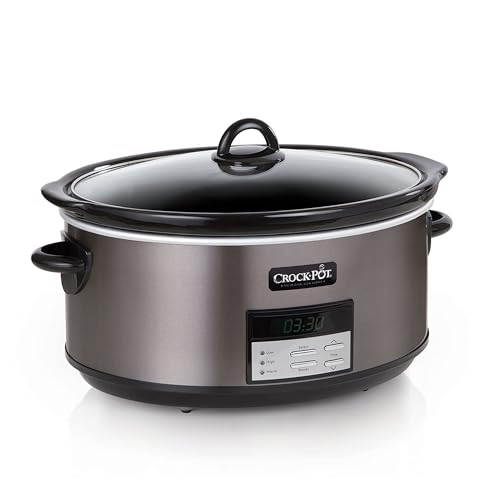
Crock-Pot Programmable Slow Cooker 8-Quart
Badge: Best for Checking Long-Term Owner Themes
Strengths
- The largest capacity in the group, sized for crowds and serious batch cooking
- A digital timer with automatic Warm covers long, unpredictable days
- Dishwasher-safe stoneware and lid keep a big cooker easy to live with
Trade-offs
- Eight quarts is oversized for small nightly meals and can under-fill
- The footprint and stoneware weight demand real counter and storage space
- Black stainless shows its finish best when wiped, like any dark appliance
Mini spec box
- Capacity: 8 quart, for 10+ people (per verified listing title)
- Timer: digital timer up to 20 hours
- Holding: auto warm setting
- Cleanup: dishwasher-safe lid and stoneware pot
- Finish: black stainless steel
A large programmable cooker generates a more divided evidence base, and learning to read the division is the lesson. Owners who bought eight quarts on purpose tend to praise capacity and the timer’s protection on long days; owners who bought it aspirationally complain about storage, weight and under-filled weeknight cooks. The ratings theme to mine is therefore not satisfaction in general but size honesty — check whether unhappy comments describe the machine failing, or the match failing, because only the first kind indicts the product.
When the batch is the point, this is the cooker in the group built for it: eight quarts, a digital timer that runs up to twenty hours, and an automatic switch to Warm when cooking ends. Game-day chili, a double batch of pulled pork, soup for a crowd — the capacity is not a spec-sheet flourish, it changes what you can cook in one pass. The black stainless finish gives the big body a calmer, more modern look than bright steel.
Size discipline matters with a cooker this large. Slow cookers cook best when reasonably full, so a household of two making a small stew will work against the design, while a household that batch cooks, entertains or freezes portions will use every quart. The dishwasher-safe stoneware and lid matter at this scale more than anywhere else in the group, because hand-washing an eight-quart crock is nobody’s favorite end to a party.
Best for: readers learning to separate product failure from size mismatch / Not suited for: small households, whose experience its feedback least predicts

Cosori Rice Cooker 10 Cup with Slow Cook
Badge: Best for Comparing Feature Satisfaction
Strengths
- Slow cook sits inside an 18-in-1 program list, so one appliance covers rice, steaming and long braises
- Ceramic-coated inner pot is the easiest surface in this group to wipe clean after sticky sauces
- A delay timer and long keep-warm window suit set-ahead cooking days
Trade-offs
- Cup-based capacity is harder to compare with quart-sized crocks when you shop by roast size
- The slow-cook mode is one program among many, so the interface asks more of a first-time user
- No locking transport lid is stated in the verified title
Mini spec box
- Capacity: 10 cup uncooked, 20 cup cooked (per verified listing title)
- Programs: 18-in-1, including sauté and slow cook
- Inner pot: ceramic coating, non-stick
- Keep warm and delay timer: 24H keep warm and delay timer stated in the listing title
- Included: stainless steel steamer basket
- Control approach: fuzzy logic
Multicookers produce the most polarized feedback in the category, and the Cosori’s eighteen-program design is the perfect specimen. One camp of owners celebrates consolidation — rice, steam, sauté and slow cooking in one footprint — while another camp reports interface friction and a slow-cook mode that behaves differently from a stoneware crock. Neither camp is wrong; they are reporting different households. The ratings skill here is segmenting: find the comments from kitchens like yours, and let their experience outweigh the aggregate mood.
The Cosori is the multicooker of this group: a fuzzy-logic rice cooker first, with a slow-cook program built into an 18-in-1 menu that also sautés and steams. Its ceramic-coated inner pot behaves differently from stoneware — it heats as part of a sealed rice-cooker body, releases sticky grains and sauces readily, and goes from a morning porridge cycle to an afternoon braise without a second vessel on the counter. The stainless steel steamer basket matters more than it looks: vegetables, dumplings or eggs can ride above a stew instead of turning to mush inside it.
Treat its capacity honestly. Ten cups uncooked, twenty cups cooked, is a rice measure, not a quart measure, so judge it by the batch of grains or stew your household actually eats rather than by the headline number. The delay timer and extended keep-warm are the features slow-cooker traditionalists usually have to buy a programmable crock to get, and here they arrive in a machine that also handles weeknight rice without supervision.
Best for: readers learning to segment polarized multicooker feedback / Not suited for: readers who want a single undivided owner consensus

Aroma Housewares ARC-150SB Digital Rice Cooker and Slow Cooker
Badge: Best for Niche-Use Ratings
Strengths
- Three roles in one footprint: rice cooking, slow cooking and steaming
- Digital controls are simpler to set than a multi-program flagship menu
- Stainless steel exterior wipes down easily in a busy kitchen
Trade-offs
- Cup capacity, like the Cosori, needs translating before you compare it with quart crocks
- No programmable slow-cook timer detail is stated in the verified title
- The rice-cooker format gives a rounder, deeper batch shape than an oval crock
Mini spec box
- Capacity: 20 cup cooked, 10 cup uncooked (per verified listing title)
- Functions: digital rice cooker, slow cooker and food steamer in one unit
- Exterior: stainless steel (SS exterior in the listing title)
- Model: ARC-150SB
The Aroma teaches niche reading. Its happiest owners are rice-centered cooks who use its slow cooking for soups, porridges and curries; its least happy are roast cooks who expected an oval crock’s behavior from a rice-cooker format. When a product serves a niche, the average mood of all reviewers is nearly useless — the only ratings that predict your experience are those from people cooking your menu. Look for comments that name the dishes cooked, and weight those above every score.
Aroma built its name on rice cookers, and the ARC-150SB shows it: a digital countertop unit that cooks rice, steams food and slow cooks, wrapped in a stainless steel exterior that shrugs off splashes. For households whose slow cooking is mostly soups, congee-style porridges, steamed vegetables over grains and saucy one-pot meals, that triple role is a genuine space saver — one lid, one pot, one cord to store.
Where it differs from a classic crock is shape and expectation. The batch sits deeper and rounder, which suits spoonable food better than a wide flat roast, and the digital panel invites timed, set-and-leave cooking rather than dial-twiddling. Shoppers who slow cook mostly large whole cuts should picture that geometry before choosing it; shoppers who steam as often as they braise will feel at home immediately.
Best for: rice-centered cooks reading within their niche / Not suited for: roast-focused cooks, whose menu its happiest owners do not share

Crock-Pot Oval Manual Slow Cooker 7-Quart
Badge: Best for Longevity Themes
Strengths
- The simplest control scheme in the group: one dial, High, Low and Warm
- Oval stoneware fits whole roasts and chickens in a natural orientation
- Removable stoneware moves from base to table to sink without fuss
Trade-offs
- No timer and no automatic switch to Warm, so someone must be home to change settings
- Manual control means cooking ends when you end it, not when a program ends it
- Stoneware is heavier than a coated metal insert
Mini spec box
- Capacity: 7 quart, serves 8+ people (per verified listing title)
- Settings: High, Low and Warm, manual dial control
- Insert: removable oval stoneware
- Exterior: stainless steel
For longevity themes, the manual classic is the pool’s richest text. Machines with one dial and a stoneware crock accumulate owner reports measured in years and in inherited-from-a-parent stories, and the recurring critical themes for the type are equally specific: crocks that crack under thermal shock, dials that loosen, the absence of a timer felt on workdays. Read its feedback asking two questions — how long did it serve, and what finally failed — because for simple appliances, the failure mode is the review that matters.
This is the archetypal slow cooker: an oval stoneware crock in a stainless steel base, a single dial, and three honest settings. There is nothing to program, nothing to update and nothing to learn beyond the oldest rule in slow cooking — Low for the long day, High for the shorter one, Warm for holding dinner until people sit down. The seven-quart oval shape is the quiet advantage: roasts, whole chickens and ribs lie flat instead of being folded into a round pot.
Manual control cuts both ways, and this guide will not pretend otherwise. Without a timer, the cooker will not rescue a meal if your day runs long; it will simply keep cooking. For cooks who are home, who cook on weekends, or who pair the dial with a simple routine of starting Low in the morning and switching to Warm at dinner, that limitation rarely bites — and the absence of electronics removes the most common failure point in the category.
Best for: readers prioritizing longevity and failure-mode evidence / Not suited for: readers who need timer behavior assessed
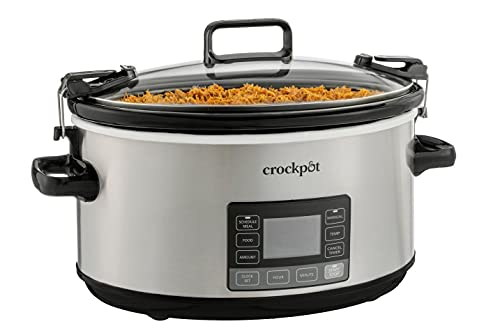
Crock-Pot Programmable Slow Cooker with MyTime 7-Quart
Badge: Best for Schedule-Feature Feedback
Strengths
- MyTime adjusts the cooking cycle to finish when you ask it to, rather than when a fixed timer ends
- Locking Cook & Carry lid makes transport to gatherings far less risky
- Programmable convenience in a full seven-quart family format
Trade-offs
- More electronics means more to learn than a one-dial manual crock
- The schedule-based approach rewards cooks who plan a finish time
- Locking lids should not be clamped during everyday cooking unless the maker directs it
Mini spec box
- Capacity: 7 quart, feeds 9+ (per verified listing title)
- Technology: MyTime, which adjusts cooking to your schedule
- Lid: Cook & Carry locking lid
- Exterior: stainless steel
The MyTime model closes the list because its feedback tests the hardest ratings question: does a headline feature survive real life? Schedule-adjusting cooking is exactly the kind of promise that marketing states cleanly and households experience messily, so its owner comments deserve a feature audit — search the feedback for the feature by name, count how many owners describe it changing their routine versus merely existing, and discount comments from anyone who never used it. That audit technique transfers to every flagship feature in every category you will ever shop.
The MyTime model answers the most common programmable-cooker complaint: food that finishes at the timer’s convenience instead of yours. Its MyTime technology adjusts cooking so the meal is ready at the time you set, which changes the slow cooker from a rough countdown into a dinner appointment. Around that idea sits a seven-quart Cook & Carry design with a locking lid, built for households that both cook at home and carry dishes to other people’s tables.
The locking lid deserves a calm note. It exists for transport — chili that survives a car ride — and it makes this the natural pick in the group for potlucks, tailgates and family gatherings across town. At home on the counter, most cooks leave lids unclamped and let the cooker breathe as designed. Judged as a package — schedule-aware cooking plus genuine portability — nothing else in this pool combines the same two strengths.
Best for: readers auditing whether a flagship feature delivers / Not suited for: readers who distrust all feature claims equally and want simplicity
Comparison Table
For this lens, the useful comparison is not specification against specification but evidence type against evidence type: what kind of owner feedback each machine generates, and which verified facts let you check that feedback. Capacities and controls are stated from the verified listings.
| Pick | Capacity / format | Control style | Check |
|---|---|---|---|
| Hamilton Beach 6 Quart Slow Cooker | 6 quart | Three settings, simple control | Check on Amazon |
| Crock-Pot Programmable Slow Cooker 8-Quart | 8 quart, for 10+ people | Digital timer up to 20 hours, auto warm | Check on Amazon |
| Cosori Rice Cooker 10 Cup with Slow Cook | 10 cup uncooked / 20 cup cooked | Digital, fuzzy logic, 18-in-1 programs | Check on Amazon |
| Aroma Housewares ARC-150SB Digital Rice Cooker and Slow Cooker | 20 cup cooked (10 cup uncooked) | Digital multi-function | Check on Amazon |
| Crock-Pot Oval Manual Slow Cooker 7-Quart | 7 quart, serves 8+ people | Manual dial, High / Low / Warm | Check on Amazon |
| Crock-Pot Programmable Slow Cooker with MyTime 7-Quart | 7 quart, feeds 9+ | Programmable, MyTime schedule adjustment | Check on Amazon |
How to Choose a Slow Cooker by Reading Ratings Properly
Start with the distribution, not the average. Two cookers can share an identical average mood while one is uniformly liked and the other is loved by half its owners and regretted by the rest. The second pattern is not worse — it usually signals a specialist machine — but it demands that you locate yourself in the distribution before buying. Ask which camp’s kitchen resembles yours, and read only that camp’s comments closely; the rest is information about other people’s dinners.
Mine the critical comments for repetition. A single angry review is an anecdote with a keyboard; the same complaint from many independent owners, across months, describing the same behavior — a lid that warps, a Low that runs fierce, a crock that stains — is the closest thing ratings offer to a finding. Keep a tally as you read: themes that recur earn a place in your decision, and one-off disasters earn sympathy and a scroll.
Verify themes against the specification. When owners praise a cooker’s capacity, check the verified listing’s actual capacity and format; when they curse a missing timer, confirm whether the listing ever promised one. A surprising share of negative feedback describes buyers discovering, at home, facts that were printed on the listing all along — which tells you the machine is fine and the shopping was careless. Do not let other people’s carelessness set your shortlist.
Adjust for the known biases. Simple machines collect fewer furious reviews because there is less to misunderstand; complex machines collect more, some earned and some not. Appliances bought as gifts are reviewed more gently than appliances bought with research. Early reviews skew enthusiastic; the comments from owners a year in, describing what wore or endured, are worth several launch-week raves. None of this makes ratings useless — it makes them readable.
End with a decision rule you set in advance: for example, that a repeated, specification-relevant complaint outweighs a favorable average, or that niche products are judged only by their niche’s owners. Deciding the rule before you read keeps the loudest comment on the page from deciding for you.
How to Audit a Slow Cooker Listing in Fifteen Minutes
Method beats mood. The audit below turns any of these six listings — or any competitor’s — into usable evidence in about fifteen minutes, using nothing but the listing itself and the discipline from the section above.
- Minutes one to three: read the verified facts first — capacity and its format, control type, insert material, and the features the title actually states. Write down what the machine promises, in its maker’s own words.
- Minutes four to seven: scan the owner feedback by theme, not by score. Tally recurring words — hot, slow, cracked, easy, heavy, small, perfect — and note which themes repeat across independent comments.
- Minutes eight to ten: read the critical comments in full, hunting for repetition and for specificity. A detailed complaint that names a dish, a setting and a duration is evidence; a vague one-liner is weather.
- Minutes eleven to thirteen: segment by household. Find owners whose batch size, menu and schedule resemble yours, and re-read only their experience with fresh attention.
- Minutes fourteen to fifteen: apply your pre-set decision rule, compare the surviving themes against the promised specification from step one, and write a single sentence verdict of your own before looking at any other guide — including this one.
Keep those one-sentence verdicts when you shop across categories. Within a month you will own something no score can give you: a calibrated sense of how your kitchen’s experience maps onto strangers’ words.
Troubleshooting
Problem: Two listings show nearly identical averages but feel completely different → they almost certainly have different distributions — one uniform, one polarized. Read the critical clusters on both; the polarized machine is a specialist, and the question becomes whether you belong to its happy camp.
Problem: Every critical comment contradicts another one → look for the variable that splits them — batch size, menu, or whether a feature was used at all. Contradictions in ratings usually resolve into segments once you sort owners by household type.
Problem: A model you like has a frightening recent complaint → check whether the complaint repeats and whether it concerns the current verified specification; a single report about a changed or misused product should inform your questions, not veto your shortlist on its own.
Why This Guide Prints No Scores: The Honest Arithmetic of Ratings
A product’s rating is a moving average over a changing population, computed from a sample that was never random. It shifts as seasons change what people cook, as new batches of owners arrive with different expectations, and as the product itself quietly revises. An article that prints a figure borrows the authority of measurement without any of its stability: the number was true, perhaps, on one day, for one marketplace’s slice of owners, and it begins decaying immediately. A guide that respects its readers does not engrave decaying numbers into permanent text.
Counts mislead in the same direction. A large tally of reviews mostly certifies that a product has been sold for a long time in large numbers — information about distribution, not about whether the machine suits your kitchen. A small tally on a newer or more specialized model certifies almost nothing at all, in either direction. Treating either figure as a quality verdict confuses popularity with fit, and fit is the only thing a buyer actually needs.
What does not decay is method. Distributions, repeated themes, specification checking and bias adjustment work on any listing, on any day, in any category — including the six machines in this guide, whose current feedback you can now audit for yourself in fifteen minutes. That is why this page spends its length on how to read rather than on what the reading said on one unrepeatable afternoon. Readers who want this program’s own structured verdicts instead can find them in Best Slow Cookers Test Kitchen, and the testing-evidence counterpart lives in Best Slow Cookers Tested.
The Five Biases Built Into Every Slow Cooker Rating
First, selection bias: owners with strong experiences write; the contented middle mostly cooks in silence, so every average overstates both delight and disappointment. Second, expectation bias: a simple dial machine is judged against a low bar and clears it easily, while a flagship is judged against its marketing and pays for every flourish it inspired. Third, mismatch bias: a large share of negative feedback records a buyer discovering a printed fact — size, format, a missing timer — after purchase, which measures shopping, not engineering.
Fourth, survivorship in time: comments accumulate from the units that stayed in kitchens, while returned units leave fewer traces, and early enthusiastic comments never get revised when a crock cracks in year two — which is why the rare long-term follow-up comment is worth hunting for. Fifth, household invisibility: almost no review states its batch size, menu or schedule up front, yet those three variables explain most disagreements between reviewers, so the reader must excavate them from dish names and passing details.
None of these biases is a reason to ignore ratings; together they are a reading protocol. Discount launch enthusiasm, hunt for the year-two comment, forgive complaints that contradict the printed specification, segment by household, and tally themes instead of absorbing scores. Do that, and the crowd’s experience becomes genuinely useful — a noisy instrument, honestly calibrated, pointed at your own kitchen’s decision.
Ratings Versus Rankings Versus Reviews: Three Different Instruments
Confusing the three instruments wastes more shopping time than any bad product. A rating is an aggregate mood — fast, shallow, unstable. A ranking is an argued order under a stated rubric — slower, transparent, and only as good as its criteria’s match to your household. A review, in the detailed sense used across this program, is a structured examination of one machine’s verified facts, strengths and trade-offs — the slowest instrument and the only one that can tell you why.
Use them in sequence. Let detailed reviews narrow the field to machines whose facts fit your kitchen; let a ranking order those finalists under a rubric you accept; and let ratings, read with the method in this guide, audit the finalists for repeated real-world complaints your research could not see. Reversing the sequence — starting from scores — puts the shallowest instrument in charge of the deepest decision.
A Worked Example: Reading One Model’s Evidence End to End
Theory earns its keep in application, so take the simplest machine in this pool — the three-setting Hamilton Beach — and run the full method on the kind of evidence its type generates. Start with the verified facts, which take one minute: six quarts, three settings, stoneware crock, glass lid, dishwasher-safe parts. Those five facts define the entire space of legitimate praise and complaint; anything an owner says can be sorted against them.
Now imagine the themes a reader typically meets for such a machine, in the abstract: repeated approval of cleanup and of cooking evenness, a recurring minority complaint about the absent timer, and occasional longevity stories measured in years. Sorted by the method, the cleanup and evenness themes are product evidence — they match the specification and repeat independently. The timer complaint is mismatch evidence — the listing never promised one — and it should move only shoppers whose schedules need timing, for whom it is genuinely decisive. The longevity stories are the highest-value items on the page, because they report the one thing no specification can: time.
Finish with the decision rule in action. A commuter reading that evidence should promote the programmable models despite this machine’s calm consensus; a home-centered cook should take the consensus at face value and buy the simple machine with confidence. Same evidence, two correct decisions — which is the whole argument of this guide in miniature. Ratings do not contain answers; they contain material from which households, applying their own rules, manufacture answers.
Keeping Your Own Ratings: The Household Scorebook
The final upgrade to the method is to become a rater yourself — privately, where the biases cannot reach. Keep a simple scorebook for the appliances you own: the dish, the setting, the result, and one line on cleanup, recorded while the memory is fresh. Within a year you will own the only ratings dataset on earth collected entirely in your kitchen, under your conditions, by a reviewer whose incentives are perfectly aligned with yours. It will not help you choose this slow cooker, since it starts the day the cooker arrives — but it will quietly govern every purchase after it, which is the real prize the ratings-reading method was always pointing at.
Common Buying Mistakes
- Treating an average score as a verdict instead of reading the distribution and the repeated themes beneath it.
- Letting one vivid complaint outweigh a pattern, or one glowing story outweigh a recurring critical theme.
- Judging a niche machine by the average mood of all its owners rather than by the owners who cook your menu.
- Punishing a product in your mind for complaints that contradict its own printed specification — that is measuring careless shopping, not the cooker.
- Comparing raw review tallies across models as if volume were quality, when it mostly measures age and distribution.
- Reading only recent comments and missing the long-term owners whose reports carry the durability evidence.
Final Recommendation
If you read ratings the way this guide teaches, the first machine to audit is the Hamilton Beach six-quart model: its simple design generates the clearest, least noisy owner evidence in the pool, and its verified specification is short enough to check completely. It is also, not coincidentally, a cooker that the method tends to vindicate — few promises, plainly kept, washed in the dishwasher.
From there, audit by your question. Wondering whether schedule features deliver? Put the MyTime model through the feature audit. Tempted by consolidation? Segment the Cosori’s polarized feedback by household size. Feeding crowds? Separate the eight-quart model’s product failures from its size mismatches. The ratings will not make the decision — properly read, they will keep you from making it blind, which is all evidence has ever honestly offered.
To act on this guide: start with the Hamilton Beach 6 Quart Slow Cooker — Check on Amazon; consider the Crock-Pot Programmable Slow Cooker with MyTime 7-Quart — Check on Amazon; consider the Cosori Rice Cooker 10 Cup with Slow Cook — Check on Amazon. Each link opens the current listing, where you can confirm the exact configuration, the included parts and the delivery options before you decide.
Frequently Asked Questions
Why does this guide not list the actual ratings of these slow cookers?
Because ratings and review counts change constantly as new owners weigh in, and any figure printed in a permanent article would decay into misinformation. Instead, this guide verifies each model’s specifications and teaches you to read the current ratings on the listing yourself — distribution, repeated themes, and bias adjustment — which stays accurate on any day you shop.
What matters more, a high average rating or a large number of reviews?
Neither, on its own. An average hides the distribution — uniform approval and polarized love-and-regret can average identically — and a large count mostly proves a product has sold widely for a long time. What predicts your experience is the pattern of themes among owners whose households resemble yours, checked against the verified specification.
How do I spot a genuinely recurring problem in reviews?
Read the critical comments and tally them. When several independent owners, across different months, describe the same behavior in specific terms — a dish, a setting, a failure mode — you are looking at evidence. A single dramatic story, however vivid, is an anecdote; let repetition, not intensity, move your decision.
Why do simple slow cookers often seem better rated than feature-rich ones?
Expectation bias. A three-setting crock is judged against a modest promise and clears it easily, while a flagship is judged against its own marketing and pays for every expectation it raised. Simple machines also offer less to misunderstand. Adjust for the height of the bar each machine set for itself before comparing their moods.
Should negative reviews about size put me off a large cooker?
Only if they describe the machine failing at its stated job. Many size complaints record a mismatch — a buyer discovering at home a capacity that was printed on the listing all along. If your batches genuinely fill a large crock, those comments describe someone else’s kitchen, not your future. Match the vessel to your batch and let product-failure themes, not mismatch themes, guide you.
How recent should the reviews I read be?
Read across the whole life of the listing, with special hunger for long-term reports. Recent comments reflect current versions and current expectations; older and follow-up comments carry the durability evidence — what wore, what cracked, what still cooks weekly — that launch-period enthusiasm cannot provide. Weight the year-two voice heavily.


