Disclosure: topratedkitchenware.com is reader-supported. When you buy through links on our site, we may earn an affiliate commission from Amazon and other retailers, at no extra cost to you.
Where to buy
If you are shopping for the best meat smokers 2001 listings can surface, start here: the six machines below are the strongest current examples of the vertical electric cabinet format, cross-checked against verified listing data. Each pick links straight to its Amazon listing so you can check the latest price on Amazon and confirm the current configuration before you buy.
- EAST OAK 30-Inch Electric Smoker (Mist Silver) — Check on Amazon
- RYHOFOUD 30-Inch Vertical Electric Smoker
- Masterbuilt 30-Inch Analog Electric Smoker (MB20070210)
- EAST OAK 30-Inch Electric Smoker (Matte Black)
- EAST OAK 30-Inch Electric Smoker with Mobility Stand (Polar Night)
- Royal Gourmet SE2805 28-Inch Electric Smoker
Read the full guide ↓
Search for the best meat smokers 2001 and you will find a strange mix of old pages and new machines, because the number itself does not correspond to a model year, a size, or a standard that any current maker uses. This guide treats the query honestly: as a search for the best meat smokers available now, in the format that dominates home smoking — the vertical electric cabinet — with the ambiguous number noted rather than dressed up as a specification. If you arrived here from a similar search, you may also want our breakdown of Best Meat Smokers Electric models specifically.
What makes a meat smoker good has not changed with any calendar: steady low temperature, clean and controllable smoke, enough rack space for real loads, and a way to know when the meat is done. The six cabinets in this guide cover the meaningful variations on that theme — analog and digital control, side chip loaders, built-in probes, viewing windows, wheels, stands, and one compact 28-inch option for small patios. Between them they cover 454 to 725 square inches of cooking area, all in the plug-in format that makes weeknight-adjacent smoking realistic.
Read the detailed reviews for the machine-by-machine picture, the buying guide for the capacity and control decisions, and the how-to section if this is your first cabinet. Smokers reward cooks who understand their format, and the vertical electric cabinet is the most forgiving format there is — which is precisely why it is the right place for a general guide like this one to concentrate.
Key Takeaways
- All six picks are vertical electric cabinets — the most forgiving format for home meat smoking.
- Side chip loaders (on three picks) let you add wood without opening the door and losing heat.
- Built-in probes on the EAST OAK models remove the guesswork from doneness; analog models need your own thermometer.
- Capacity runs from 454 sq in (compact) to 725 sq in (large stacked loads) — match it to your real cook, not your biggest fantasy cook.
- The ‘2001’ in the keyword matches no current model designation; buy on format, capacity, and controls, not on the number.
In this guide
Quick Picks
| Pick | Badge | Cooking space | Link |
|---|---|---|---|
| EAST OAK 30-Inch Electric Smoker (Mist Silver) | Best Overall | 725 sq in cooking area | Check on Amazon |
| RYHOFOUD 30-Inch Vertical Electric Smoker | Best for Jerky and Sausage | 30-inch vertical electric smoker | Check on Amazon |
| Masterbuilt 30-Inch Analog Electric Smoker (MB20070210) | Best Analog Simplicity | 535 sq in cooking area | Check on Amazon |
| EAST OAK 30-Inch Electric Smoker (Matte Black) | Best for Set-and-Forget Cooking | 725 sq in large cooking area | Check on Amazon |
| EAST OAK 30-Inch Electric Smoker with Mobility Stand (Polar Night) | Best Ergonomics | 725 sq in cooking area | Check on Amazon |
| Royal Gourmet SE2805 28-Inch Electric Smoker | Best Compact Cabinet | 454 sq in cooking area | Check on Amazon |
How These Picks Were Chosen
Every pick in this guide was cross-checked against the manufacturer’s listing data before it was written up: the model name, fuel type, cooking area, and control style in this article come from that verified listing information, not from memory or from third-party roundups. Where a listing states a figure — a cooking area, a wattage, a hopper size — that is the figure used in the spec boxes, and where a listing does not state something, this guide leaves it out rather than guessing.
The shortlist was built by comparing the attributes that actually change a smoking session: how fuel and smoke are delivered, how temperature is controlled, how much food fits in a realistic load, and how the cook is monitored. Models that duplicated another pick’s exact formula without adding anything were cut. This is a research-led guide: the judgments come from verified specifications, design analysis, and the accumulated pattern of owner experience with each format, not from a single weekend of hands-on testing, and the trade-offs sections say plainly where each machine is weak.
Best Meat Smokers 2001: The 6 Picks in Detail

EAST OAK 30″ Electric Smoker with Meat Probe and Viewing Window
Badge: Best Overall
Strengths
- Side chip loader lets you add wood without opening the door and dumping heat
- Built-in meat probe tracks internal temperature without a separate thermometer
- Viewing window lets you check bark and color without lifting the door
Trade-offs
- Vertical cabinet suits racks of ribs and brisket flats better than very wide cuts
- Window needs regular cleaning or smoke film clouds it over
- Single-zone cabinet, so every rack cooks at the same set temperature
Key specs (from the verified listing):
- 30-inch vertical electric cabinet
- 725 sq in cooking area
- Built-in meat probe
- Clear viewing window
- Side wood chip loader (up to 6x longer smoking per load, per maker)
- Color: Mist Silver
This EAST OAK cabinet is built around three conveniences that matter on long cooks: a side wood chip loader, a built-in meat probe, and a clear viewing window. The loader is the headline. On most vertical electric smokers, adding chips means opening the door, and every door opening costs heat and time while the element works to recover. Loading from the side keeps the chamber sealed, and the maker positions a single load as lasting up to six times longer than a basic chip tray setup, which stretches the unattended stretches between refills on an overnight pork shoulder.
The 725 square inches of cooking area are spread across the cabinet’s racks, so the natural loads are stacked ones: several racks of ribs, a couple of brisket flats, chicken halves, or a mix of sausage and vegetables on the lower racks. The built-in probe handles the part of smoking that beginners most often get wrong, which is judging doneness by time or color instead of internal temperature. The window sounds like a small thing until you have smoked in the dark at 5 a.m.; a quick look at bark color without opening the door is genuinely useful. The honest limitation is the format itself: a 30-inch vertical cabinet is tall rather than wide, so a full packer brisket or a very large whole bird can be a squeeze, and the window only stays clear if you wipe it down between cooks.
As a general-purpose answer to a general search, this is the cabinet that covers the most bases at once: probe, window, side loader, and full-size capacity in a single machine.
Best for: long, low-attention cooks where you want probe feedback and minimal door openings / Not suited for: cooks who regularly smoke very wide cuts that need a wide, single-level grate

RYHOFOUD 30-Inch Vertical Electric Smoker with Wheels
Badge: Best for Jerky and Sausage
Strengths
- Accessory bundle (water pan, S-hooks, drip trays) covers more cooking styles out of the box
- S-hooks suit hanging sausage and jerky, which many cabinets cannot do well
- Clear window plus wheels cover monitoring and moving in one package
Trade-offs
- Chip tray design means door openings to reload on long cooks
- Less established brand support network than the biggest names
- Analog-style simplicity means fewer digital conveniences
Key specs (from the verified listing):
- 30-inch vertical electric smoker
- Wheels for mobility
- Water pan and wood chip tray included
- Clear viewing window
- Steel racks
- Includes S-hooks and drip trays
- Listed for meat, fish, sausage and jerky
The RYHOFOUD 30-inch vertical smoker competes on completeness. Alongside the cabinet itself you get a water pan, a wood chip tray, steel racks, S-hooks, and drip trays, and that accessory list quietly widens what the smoker does. The water pan steadies the cooking environment and helps keep lean cuts moist; the S-hooks are the interesting inclusion, because hanging sausage and jerky is exactly what a tall vertical cabinet is shaped for, and many rival cabinets leave you to improvise hooks of your own.
The clear window lets you check color without opening the door, and wheels make the cabinet easy to reposition. Where it asks more of you is smoke management: chips load into an internal tray rather than a side loader, so topping up mid-cook means a brief door opening and the small heat dip that comes with it. For the shorter and mid-length cooks this smoker is aimed at — fish, sausage, jerky, chicken, ribs — that is a mild inconvenience rather than a flaw. On a twelve-hour brisket it becomes a rhythm you plan around. As a first vertical smoker that can hang, rack, and pan-cook from day one, the bundle is the argument.
For a general guide, its value is range — the hooks and pans stretch one cabinet across jerky, sausage, fish, and ribs without extra purchases.
Best for: jerky, sausage, and fish smokers who want hanging hooks and a full accessory set included / Not suited for: overnight-cook specialists who want a side chip loader
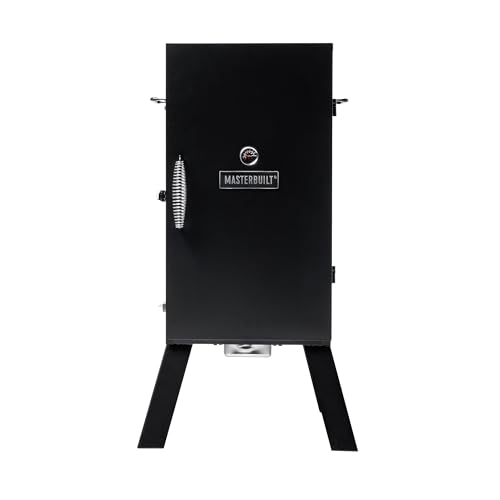
Masterbuilt 30-inch Electric Vertical Smoker with Analog Control
Badge: Best Analog Simplicity
Strengths
- Analog dial control is simple, repairable, and has no screen to fail
- 535 sq in is a right-sized cabinet for most family cooks
- Masterbuilt’s long model history means parts and advice are easy to find
Trade-offs
- No digital timer or built-in probe in this configuration
- Smaller cooking area than the 710–725 sq in cabinets
- Analog dials give coarser temperature precision
Key specs (from the verified listing):
- 30-inch vertical electric cabinet
- Analog temperature control
- Chrome smoking racks
- 535 sq in cooking area
- Model MB20070210
- Color: Black
The MB20070210 is the traditionalist of this group: a 30-inch Masterbuilt electric cabinet with an analog temperature dial instead of a digital panel. There is a real case for analog in a smoker. A dial has no display to wash out in sunlight, no control board to glitch, and a learning curve measured in minutes — set the dial, let the cabinet settle, and cook. Generations of backyard cooks learned low-and-slow on exactly this pattern of machine, and the depth of owner knowledge around Masterbuilt cabinets makes troubleshooting advice easy to find.
The 535 square inches of cooking space on chrome racks is the honest size for most households: a couple of racks of ribs, a pork shoulder, a chicken or two, without heating a half-empty large cabinet for a Tuesday dinner. What you give up is instrumentation. There is no built-in probe and no digital timer here, so internal temperature checks are on you and your own thermometer, and the dial rewards a short settling period after each adjustment rather than constant fiddling. If your smoking style is a handful of weekend cooks a month and you value simplicity over readouts, this is the configuration that fits.
It represents the classic end of the category: the format in its simplest, most proven form, for buyers who distrust extra electronics outdoors.
Best for: traditionalists who want dial-simple controls and a right-sized cabinet / Not suited for: data-driven cooks who want digital control and a built-in probe

EAST OAK 30″ Outdoor Electric Smoker with Digital Timer and Wheels
Badge: Best for Set-and-Forget Cooking
Strengths
- Digital controls with a 12-hour timer suit set-and-forget scheduling
- Side chip loader stretches the time between refills
- Wheels make a 30-inch cabinet easy to move for storage or cleaning
Trade-offs
- No built-in meat probe listed, so a separate thermometer is wise
- Timer manages the session, not the food’s internal temperature
- Vertical layout is tall rather than wide
Key specs (from the verified listing):
- 30-inch vertical electric cabinet
- 725 sq in large cooking area
- Side wood chip loader (up to 6x longer on a single load, per maker)
- Digital control with 12-hour timer
- Easy-rolling wheels
- Color: Matte Black
Where the probe-and-window EAST OAK models chase monitoring, this Matte Black version chases scheduling. Its digital control panel includes a 12-hour timer, which changes how a long cook fits into a day: load the cabinet in the morning, set the session, and let the smoker hold its routine while you do other things. The side wood chip loader supports that hands-off style, because a single load is positioned to run up to six times longer than a basic tray, and fresh chips go in from outside without opening the door.
The 725 square inches of cooking area are arranged as stacked racks inside a 30-inch cabinet, and the easy-rolling wheels matter more than they sound — a loaded electric smoker is awkward to shuffle across a patio, and being able to roll it into a garage corner between cooks keeps it out of the weather. The trade-off to know about is monitoring: this configuration does not list a built-in meat probe, so doneness still depends on you checking internal temperature with a thermometer of your own at the right moments. Treat the timer as a session manager, not a doneness guarantee, and it is a very capable one.
Its digital timer makes it the pick for cooks whose smoking has to fit around a workday rather than the other way round.
Best for: planners who want a digital timer, long chip loads, and easy storage between cooks / Not suited for: cooks who want a built-in probe and will not use a separate thermometer
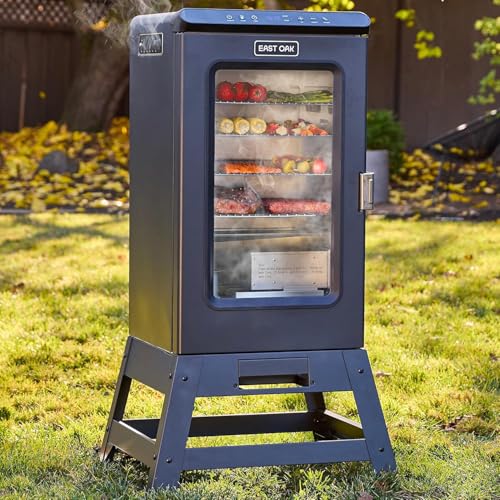
EAST OAK 30″ Outdoor Electric Smoker with Meat Probe and Mobility Stand
Badge: Best Ergonomics
Strengths
- Mobility stand raises the cabinet to a comfortable working height
- Built-in meat probe covers doneness without extra equipment
- Side loader keeps the door shut during long sessions
Trade-offs
- Stand adds footprint compared with a countertop-height setup
- Vertical cabinet still limits the widest cuts
- Probe is a single point of measurement on multi-cut loads
Key specs (from the verified listing):
- 30-inch vertical electric cabinet
- 725 sq in cooking area
- Built-in meat probe
- Mobility stand included
- Side wood chip loader (up to 6x longer uninterrupted smoke, per maker)
- Color: Polar Night
This Polar Night EAST OAK variant adds one ergonomic idea to the familiar formula: a mobility stand. A 30-inch vertical smoker sits low, and loading the bottom racks of a ground-level cabinet means crouching with a hot tray. Raising the cabinet on its stand puts the door, racks, and controls at a friendlier height, and it makes rolling the unit between its cooking spot and its storage spot simpler. For older cooks, or anyone with a bad back, that is not a cosmetic extra.
Underneath the stand, the cooking package is the strong EAST OAK combination: 725 square inches of rack space, a side chip loader that keeps smoke sessions running up to six times longer per load without door openings, and a built-in meat probe so internal temperature — the only doneness signal that matters — is always on the display. The cabinet format still shapes what you cook: stacked racks love ribs, wings, sausage, and chicken pieces, while the widest cuts need trimming or creative placement. A single probe also means one cut gets monitored continuously and the rest get spot-checked, which is normal for the class but worth planning around on mixed loads.
The stand makes this the considerate choice for cooks who load heavy trays often or simply prefer not to crouch to a low door.
Best for: cooks who value working height, mobility, and probe feedback in one cabinet / Not suited for: tight patios where the stand’s extra footprint is a problem

Royal Gourmet SE2805 28-Inch Electric Smoker
Badge: Best Compact Cabinet
Strengths
- Compact 28-inch size fits smaller patios and balconies
- 1350W element is strong for the cabinet size
- Three grates still allow stacked, multi-item cooks
Trade-offs
- 454 sq in is the smallest cooking area in this guide
- Analog control means manual temperature management
- Fewer racks limit very large batch cooking
Key specs (from the verified listing):
- 28-inch vertical electric smoker
- 454 sq in cooking area
- 1350W heating element
- Analog temperature control
- 3 cooking grates
- Adjustable heat
- Color: Black
The Royal Gourmet SE2805 is the compact option in this lineup: a 28-inch vertical electric smoker with 454 square inches across three cooking grates and a 1350W element. That wattage matters in a small cabinet — a strong element in a modest volume recovers temperature quickly after the door opens, which is exactly when small smokers usually struggle. For apartment patios, small decks, and households cooking for two to four people, the size is the point rather than a compromise.
Controls are analog with adjustable heat, so running it is a dial-and-patience exercise: set, let it settle, and check with your own thermometer at the moments that matter. Three grates still allow genuinely stacked cooking — a small shoulder up top, ribs in the middle, vegetables below — you simply plan portions around the cabinet instead of filling it by instinct. The limitation is obvious and honest: this is not the smoker for a twenty-person barbecue or a pile of full packer briskets. It is a right-sized tool for regular small-batch smoking, and in that role the quick recovery and small footprint are real advantages rather than consolations.
It is the proof that a general guide still needs a small option: not everyone has the patio or the household size for a 30-inch cabinet.
Best for: small patios and small households that smoke modest batches often / Not suited for: hosts who regularly cook for large groups
Comparison Table
| Pick | Format | Cooking area | Standout feature | Link |
|---|---|---|---|---|
| EAST OAK 30-Inch Electric Smoker (Mist Silver) | Electric vertical cabinet | 725 sq in cooking area | Built-in meat probe | Check on Amazon |
| RYHOFOUD 30-Inch Vertical Electric Smoker | Electric vertical cabinet | — | Water pan and wood chip tray included | Check on Amazon |
| Masterbuilt 30-Inch Analog Electric Smoker (MB20070210) | Electric vertical cabinet | 535 sq in cooking area | Chrome smoking racks | Check on Amazon |
| EAST OAK 30-Inch Electric Smoker (Matte Black) | Electric vertical cabinet | 725 sq in large cooking area | Side wood chip loader (up to 6x longer on a single load, per maker) | Check on Amazon |
| EAST OAK 30-Inch Electric Smoker with Mobility Stand (Polar Night) | Electric vertical cabinet | 725 sq in cooking area | Built-in meat probe | Check on Amazon |
| Royal Gourmet SE2805 28-Inch Electric Smoker | Electric vertical cabinet | 454 sq in cooking area | 1350W heating element | Check on Amazon |
How to Choose the Right Electric Cabinet Smoker
Start with capacity, and think in loads rather than square inches. A 30-inch vertical cabinet rated around 535 to 725 square inches holds its food on stacked racks, so picture your real cook: two racks of ribs and a shoulder, or four chickens, or a brisket flat plus sides. If your typical load is one or two cuts, a cabinet near the smaller end heats faster and wastes less space. If you cook for gatherings, the 710 to 725 square inch cabinets earn their size every time.
Next, choose your control style honestly. An analog dial is simple and durable but asks you to let the cabinet settle after adjustments and to verify temperature yourself. Digital control holds a set point more precisely and often adds a timer; WiFi control adds remote monitoring on top. None of these make food taste better by themselves — they change how much attention the cook demands, so match the control to your patience, not to a feature list.
Then look at how smoke is loaded. A side wood chip loader lets you add chips without opening the door, which protects temperature on long cooks; an internal tray is simpler but costs a heat dip at every refill. For cooks under four hours the difference is small. For overnight shoulders and briskets it is the difference between a steady session and a sawtooth temperature graph.
Finally, plan the physical life of the smoker: where it sits, where it stores, and how you will load it. Wheels and stands sound minor until you move a cabinet across a patio or crouch to its bottom rack in the dark. Measure your space, check that an outdoor outlet is within safe reach of the cord, and decide whether a leg kit or mobility stand belongs in your setup from the start.
How to Use a Vertical Electric Smoker, Step by Step
- Season a new cabinet. Run it empty at a moderate temperature with a small load of chips for the first session. This burns off manufacturing residues and coats the interior with its first layer of smoke seasoning.
- Load the water pan and chips. Fill the water pan, add dry wood chips to the tray or loader, and do not soak the chips — soaking delays smoke and adds steam, not flavor.
- Preheat with the door closed. Set your target temperature and let the cabinet settle at it for at least 20 to 30 minutes before food goes in, so the metal itself is heat-soaked.
- Load food cold-side first. Place the largest cuts on the middle racks, leave space between items for smoke circulation, and insert the probe into the thickest cut away from bone.
- Cook to temperature, not time. Recipes give time ranges; your probe gives the truth. Expect the stall — a long plateau in internal temperature — and do not chase it with heat spikes.
- Rest before slicing. Tent cooked meat loosely and rest it; brisket and shoulder improve noticeably with a rest of at least 30 minutes.
Cleaning is the maintenance that decides how long a cabinet lasts. Empty the chip tray and drip trays after every cook, wipe the door seal, and wash racks while they are still warm enough for residue to release. Wipe the viewing window, if your model has one, before the next cook rather than after — smoke film bakes on harder with each session. Store the cabinet dry, ideally covered or under shelter, and check the cord before each season.
Troubleshooting
Problem: thin, bitter smoke or acrid flavor → the chips are smoldering too hot or the vent is nearly closed; open the vent, let the smoke settle to a thin, pale stream, and avoid overfilling the chip tray.
Problem: temperature will not recover after loading food → the cabinet is overloaded or the door was open too long; give the element time, keep the door shut, and load large cuts at room-resting pace rather than straight from a cold fridge in one pile.
Problem: meat finishes dry despite low temperature → check the water pan level, verify doneness with the probe instead of the clock, and make sure you rested the meat before slicing.
What the ‘2001’ in This Search Does and Does Not Mean
It is worth saying plainly, because roundup pages rarely do: no current smoker line uses ‘2001’ as a meaningful designation, and the number does not tell you a size, a fuel type, or a quality tier. Searches like this usually come from an old bookmark, a mistyped model number, or a page title copied years ago. The useful response is not to invent a meaning but to answer the intent underneath it — a shopper who wants a good meat smoker and a trustworthy shortlist.
That intent is what this guide serves. Every pick here is a current, verified listing, and the criteria used to choose them — temperature stability, smoke delivery, capacity in realistic loads, monitoring, and ease of living with the machine — are the same criteria you should apply to any smoker shortlist, whatever number was in the search box. If your search was really about a specific fuel type, our focused guide to Best Meat Smokers For Sale across current listings may be a better next step.
Matching a Cabinet to the Meats You Actually Smoke
Most home smoking is a rotation of the same heroes: pork shoulder, ribs, brisket, chicken, and sausage, with fish and jerky as honored guests. Each makes a slightly different demand. Shoulder and brisket are long cooks that reward side chip loaders and probes. Ribs are a rack-space question — how many racks lie flat without overlapping. Chicken cooks faster and benefits from the water pan’s moisture. Sausage and jerky are where a tall cabinet with hooks, like the RYHOFOUD, quietly outclasses wider machines.
Think about your rotation before your biggest occasion. A smoker bought for a once-a-year feast spends fifty weeks being too big for Tuesday, while a right-sized cabinet gets used constantly and makes you better at smoking. Readers planning a holiday bird should look at our dedicated guide to Best Meat Smokers For Turkeys, where single-level space matters more than stacked totals. And whatever you cook, doneness is a temperature question — the guidance in Best Meat Thermometer For Use With Smokers applies to every machine in this guide.
Seasoning and Your First Three Cooks: A Playbook
Every smoker in this guide improves after its first sessions, and the cook who plans those sessions learns the machine fastest. The first run is a seasoning burn: no food, moderate temperature, a load of chips or a modest pellet burn, run long enough to coat the interior and burn off the residues of manufacture and shipping. Watch how the machine behaves while nothing is at stake — how long it takes to settle at temperature, how its display compares with a probe at cooking level, how much smoke it makes on a standard fuel load. Those three observations are the foundation of everything you will cook later.
Cook one should be pork shoulder, the most forgiving teacher in barbecue. It tolerates temperature swings, it is done across a wide window of tenderness, and it teaches the stall — the long plateau where internal temperature refuses to rise — without punishing you for meeting it. Cook two should be ribs, which teach timing, bark, and the bend test. Cook three can be chicken, which teaches moisture management and the value of the water pan in cabinets, or higher finishing heat in pellet grills. By the end of that sequence you will know your machine’s hot spots, its fuel appetite, and its honest preheat time.
Keep notes from the start, even if they are five lines in a phone: date, cut, weight, wood, temperature, and verdict. Smokers are consistent machines, and a short log converts that consistency into prediction. The cooks who plateau in this hobby are usually the ones re-learning the same lessons every season because nothing was written down; the ones who improve treat each session as data. It is not homework — it is how a new appliance becomes your smoker.
A Practical Guide to Smoke Wood
Wood is the ingredient that makes a smoker a smoker, and it divides into families with distinct personalities. Fruitwoods — apple, cherry, peach — burn mild and slightly sweet, and they are the safe hands for poultry, fish, pork, and anything delicate. Hickory is the traditional barbecue backbone: assertive, savory, and right at home on shoulder, ribs, and brisket, though a heavy hand can push chicken toward bitterness. Oak is the steady middle — more presence than fruitwood, less push than hickory — and it blends beautifully with both, which is why so many competition cooks treat it as a base.
Mesquite sits at the strong end: wonderful in small doses on beef, harsh when it dominates a long cook. Maple and alder are the gentle specialists, maple for pork and vegetables, alder for fish. For cabinets, these woods come as chips; for pellet grills, as pellets, often in blends. The practical approach is a small pantry: one fruitwood, hickory, and oak will cover nearly everything you cook while you learn your own preferences, and small bags keep the experiment cheap.
Technique matters as much as species. Dry wood, a settled fire or element, and a thin stream of pale smoke produce clean flavor; thick white clouds produce the acrid taste beginners blame on the wood itself. Meat takes smoke most readily while it is cool and moist, early in the cook, which is why the first hours deserve your best smoke discipline. Later, the cooker is mostly an oven finishing the job — a truth that should relax you about late-session refills.
Common Buying Mistakes
- Buying by headline capacity alone. A summed rack total and a single-level grate area describe different kinds of space. Match the format to your largest realistic load.
- Judging doneness by time or color. The stall makes liars of clocks. Internal temperature, checked with a probe, is the only reliable signal.
- Opening the door to look. Every look costs heat and time. Use windows, probes, and patience instead.
- Overloading the chip tray. More chips make harsher smoke, not better smoke. A thin, steady stream beats a thick cloud.
- Skipping the rest. Slicing immediately spills the juices you spent hours keeping. Rest large cuts at least 30 minutes.
- Ignoring storage. A smoker left wet and dirty between cooks ages years in a season. Ten minutes of cleanup per cook is the cheapest longevity there is.
Final Recommendation
For most readers, the first choice is the EAST OAK 30-inch with probe and window (Mist Silver): it combines the three conveniences that matter most — side chip loading, built-in probe monitoring, and a window — at full 725 sq in capacity. If your cooks run on a schedule, the Matte Black EAST OAK with its digital 12-hour timer is the alternative to pick, and the two are easy to compare side by side.
Choose the Masterbuilt analog cabinet if you want the simplest possible machine, the RYHOFOUD if jerky and sausage are central to your plans, the stand-equipped EAST OAK if loading height matters, and the Royal Gourmet if your patio is small. Shoppers whose searches started with odder phrasings, like Best Meat Smokers L, will find the same shortlist logic applies: format first, then capacity, then controls. And if you are still deciding how you will judge doneness, the roundup at Best Meat Thermometers For Smokers is the companion read.
Quick links: Check the EAST OAK 30-Inch Electric Smoker (Mist Silver) on Amazon | Check the EAST OAK 30-Inch Electric Smoker (Matte Black) on Amazon
More Notes for Best Meat Smokers 2001 Shoppers
A note on smoke wood for cabinet smokers: chips are the fuel of this format, and a small bag each of hickory, apple, and oak will teach you more in a month than any single large bag. Hickory is the assertive classic for pork and beef; apple is gentle enough for chicken and fish; oak sits between them and blends well with both. Keep chips dry and stored indoors — damp chips smolder reluctantly and produce the kind of thick, stale smoke that makes food taste like an ashtray rather than a barbecue.
Placement deserves a paragraph of its own. An electric smoker needs a level spot, a safe distance from walls and overhangs per its manual, and an outdoor outlet it can reach without extension-cord gymnastics. It also produces hours of fragrant smoke, which your household will love and your neighbors will at least notice. A spot with light shelter from wind helps temperature stability noticeably, especially for analog models, and a cover or garage corner for storage will add years to the cabinet’s finish and electronics.
Finally, calibrate your expectations for your first three cooks. Every cabinet has a personality: a rack that runs slightly hot, a door seal that settles after a few sessions, a dial whose marked numbers sit a few degrees off the truth. Cook forgiving cuts first — pork shoulder is the classic teacher — take a note or two each time, and by the fourth cook the machine will feel less like an appliance and more like an instrument you know how to play.
Fuel storage deserves more respect than it usually gets. Wood chips should live in a sealed container indoors, where they stay dry and keep their aroma; a bag left open in a damp garage absorbs moisture and odor alike, and both show up in the food. Pellets are even less forgiving — they are compressed sawdust, and humidity swells them into a crumbly mass that feeds erratically and can jam an auger outright. Buy pellets in quantities you will use within a season, store them off the floor in a lidded bin, and never pour the dusty bottom of a bag into the hopper. Good fuel is invisible in the finished food; bad fuel is all you can taste.
Electrical safety is the unglamorous foundation of every cabinet in this guide. Plug the smoker into a proper outdoor-rated outlet, keep the cord off wet ground, and avoid extension cords where you can — if one is unavoidable, it should be a heavy-duty outdoor cord rated for the load, laid out so nobody trips it mid-cook. Never run an electric smoker in standing water or heavy rain, and give the plug and socket a glance each season for corrosion or damage. These are thirty-second habits that protect both the machine and the cook, and they cost nothing but attention.
The smoke ring deserves a short myth-busting paragraph, because it causes more beginner anxiety than any other topic. The pink ring under the bark is a chemical reaction between smoke gases and the meat’s surface pigments; it is pretty, it is traditional, and it is not a doneness signal, a smoke-penetration meter, or a quality grade. Electric cabinets, which burn chips rather than logs, often produce a fainter ring than offset pits while delivering excellent smoked flavor. Judge your cooks by tenderness, moisture, and taste — the ring will take care of itself, or not, without changing what is on the plate.
A few accessories genuinely earn their place next to any smoker in this guide. Heat-resistant gloves turn rack handling from a juggling act into a non-event. A sturdy sheet pan is the universal transport between kitchen and smoker. A spray bottle of water or apple juice helps bark set on long cooks. Butcher paper or foil for wrapping gives you control over the stall and the bark’s final texture. None of these is expensive, all of them get used weekly, and together they matter more to your results than any single feature upgrade on a spec sheet.
Leftovers are the dividend of smoking, and they reward a little planning. Large cuts almost always cook better in full size than in small portions, so cook the whole shoulder or brisket and treat the surplus as an ingredient: pulled pork for sandwiches and tacos, brisket for chili and hash, smoked chicken for soups and salads. Cool leftovers promptly, refrigerate them in shallow containers, and reheat gently with a splash of moisture to keep the texture you worked hours to create. Many cooks quietly admit the second-day dishes are why they really smoke.
A last word on patience, because it is the ingredient no listing can sell you. Smoking compresses badly: rushing a preheat, crowding a cabinet, opening a door every half hour, and slicing without a rest each tax the final plate in ways no machine can refund. The smokers in this guide were chosen to remove every obstacle except the clock — temperature, fuel, and monitoring are handled. What remains is the discipline to let a shoulder take the hours it takes. Cooks who make peace with that discover the hobby’s real pleasure: the food is almost a by-product of a well-run, unhurried day.
Related guides
Frequently Asked Questions
What wood chips or pellets suit most meats?
Fruitwoods like apple and cherry are mild and forgiving, and suit poultry, pork, and fish. Hickory is the classic all-purpose barbecue wood with a stronger profile that stands up to brisket and shoulder. Oak is a middle path — present but not aggressive. Mesquite is the strongest common option and is best used sparingly or blended. When in doubt, start milder: you can add smoke time, but you cannot take harsh smoke back out of finished meat.
How long does a typical smoke session take?
It depends on the cut far more than the machine. Ribs commonly take several hours, a pork shoulder the better part of a day, and a brisket longer still, while fish and sausage are comparatively quick. Every smoker in this guide is built around holding a low, steady temperature for those durations; the real planning skill is starting early enough that the meat, not the guests, decides when dinner is.
Do I need to soak wood chips before smoking?
No. Soaking mostly delays smoke production while the water steams off, and it does not meaningfully extend useful smoke. Dry chips in the tray or loader, a settled thin stream of smoke, and a closed door produce cleaner flavor. The exception some cooks swear by is a small handful of soaked chips mixed into dry for a slower start — a preference, not a requirement.
Can I use an electric smoker in cold or windy weather?
Yes, with expectations adjusted. Cold and wind increase heat loss, so preheat longer, shelter the cabinet from wind where you safely can, and keep the door shut. Digital models compensate automatically to a point; analog models may need a slightly higher dial setting. Avoid using any outdoor electric appliance in rain, and keep cords and connections dry.
Does the year or number in a smoker listing matter when I buy?
Only when it is a genuine model designation from the maker, with a spec sheet behind it. A bare number in a search phrase — like the one in this guide’s keyword — carries no information about size, fuel, or quality. Judge any smoker by its verified specifications: cooking area, fuel type, control style, and included equipment. Those four facts predict your experience far better than any number in a title.
Is a vertical electric cabinet a good first smoker?
It is the most forgiving first smoker for most people. The element holds low temperatures without fire management, chips are cheap and easy to dose, and the cabinet format handles the classic cuts well. Add a reliable thermometer habit and a little patience, and the learning curve is measured in two or three cooks rather than a season.


