Disclosure: topratedkitchenware.com is reader-supported. When you buy through links on our site, we may earn an affiliate commission from Amazon and other retailers, at no extra cost to you.
Where to buy
The six models below are the picks in this guide to best cookig air fryers. Each name links to its Amazon listing, where you can check the latest price on Amazon, confirm the current configuration, and read the newest owner feedback before you decide.
- Gourmia French Door Toaster Oven Air Fryer
- Ninja Prestige Smart XL Countertop Oven DT501
- Chefman 6-Quart Dual Basket Air Fryer
- Ninja Foodi 10-Qt DualZone XL Air Fryer DZ401
- Ninja Foodi 8-Qt DualZone Air Fryer DZ201
- OLIXIS Dual Basket Air Fryer 9.5-Qt
Read the full guide ↓ for how each machine actually cooks, food by food, and the techniques that turn a good specification into a good dinner.
If you searched for best cookig air fryers, the missing n is welcome here, because the question underneath the typo is the oldest and best one in this category: which air fryers cook best? Not which have the longest feature lists, the largest cavities, or the loudest claims, but which ones, loaded with real food on a real evening, produce the crispest fries, the juiciest chicken, the most evenly roasted vegetables, and the leftovers you would swear were fresh. This guide answers the cooking question directly. Its six picks, drawn from a verified pool, are assessed food by food and technique by technique, with the honest limits of each format stated where a cook will actually meet them.
The shortlist divides by shape, as cooking always does. Two oven-format machines, a family French-door model and a premium flagship, cook flat, wide, and in trays. Four dual basket machines cook heaped, shaken, and in two zones at once. Neither shape is the cooking winner in the abstract; each is the winner at the foods it was shaped for, and the reviews below are organised to make that mapping unmistakable. Readers who want the same machines assessed as purchases rather than as cooking instruments will find the buying-side companion in Best Cooking Air Fryers; this guide keeps its eyes on the food.
Key Takeaways
- Cooking quality in an air fryer is decided by load discipline first and machine second: single layers, air gaps, and a halfway shake or turn beat any specification.
- Oven formats win at flat and tray cooking, pizza, and large single dishes; dual baskets win at two-food dinners and heaped, shaken foods.
- The Ninja DZ401 is this guide’s overall cooking pick for families, the Gourmia its tray-cooking pick, and the Ninja Prestige its premium instrument.
- Every pick comes from a verified pool with its listing identity confirmed; spec boxes contain only what the verified titles state, and no prices are printed.
- Check the latest price on Amazon for each pick before deciding, and confirm the configuration on the listing.
- Calibrate any new machine with three familiar foods in the first week; the settings you write down are worth more than any preset.
In this guide
Quick Picks
| Pick | Badge | Why it earns its place | Listing |
|---|---|---|---|
| Gourmia French Door Toaster Oven | Best Tray-Cooking Pick | Nine-slice trays, twelve presets, and dishwasher-safe trays for family cooking. | Check on Amazon |
| Ninja Prestige Smart XL DT501 | Best Premium Instrument | Ten functions and turkey-scale capacity for cooks who cook everything. | Check on Amazon |
| Chefman 6-Quart Dual Basket | Best for Small Households | Two zones with windows, so small dinners cook watched and together. | Check on Amazon |
| Ninja Foodi DZ401 | Best Overall Cooking Pick | Two five-quart zones with Match Cook, the family dinner machine. | Check on Amazon |
| Ninja Foodi DZ201 | Best Mid-Size Cooking Pick | The DualZone pattern at eight quarts for the centre of the market. | Check on Amazon |
| OLIXIS Dual Basket 9.5-Qt | Best Value Cooking Pick | Wide temperature range and a shake reminder from a value brand. | Check on Amazon |
Cooks comparing the air-fried result with the deep-fried original often detour through Best Deep Fryers Air Fryers to settle the crispness question once, and this guide’s technique sections give them the air-side method to bring back.
How These Picks Were Chosen
This guide is research-led. The six picks come from a verified pool for this product group, each included only where its identity, brand, and listing details could be confirmed. For a cooking brief, the comparison weighted the factors that reach the plate: usable cooking area in the format’s natural unit, trays for ovens and quarts for baskets, the temperature range and power where titles state them, features that change cooking outcomes rather than brochure counts, viewing windows, sync systems, shake reminders, and the cleaning design that decides whether the machine is ready to cook well again tomorrow. We also weighted format coverage, so that the tray cook, the two-zone cook, and the premium all-rounder each find a machine shaped like their cooking.
No hands-on testing is claimed, and no invented performance figures appear. The cooking guidance is built from the verified specifications and from the well-understood behaviour of these formats, the physics of circulated hot air, the geometry of baskets and trays, and the standard techniques that experienced air fryer cooks converge on. Where a machine’s title is silent on a figure, the spec box is silent too. What the guide promises is not laboratory authority but cooking clarity: which machine cooks which food best, and what you, the cook, must do to let it.
The 6 Best Cookig Air Fryers
Gourmia French Door Toaster Oven Air Fryer
Badge: Best Tray-Cooking Pick
Strengths
- Nine-slice tray area that cooks family quantities of flat food in a single layer.
- Twelve presets with adjustable time and temperature to start common foods consistently.
- Dishwasher-safe trays, so the machine returns to duty clean after greasy cooks.
Trade-offs
- Tray cooking browns from above; thick items still need turning.
- A large cavity heats more air for a small snack than a basket does.
- Presets are starting points, not substitutes for watching the first batch.
Spec box
- Capacity: 9-slice
- Display: digital
- Design: French door
- Presets: 12 cooking presets
- Controls: adjustable time and temperature
- Air circulation: FryForce 360°
- Trays: dishwasher-safe
- Finish: stainless steel
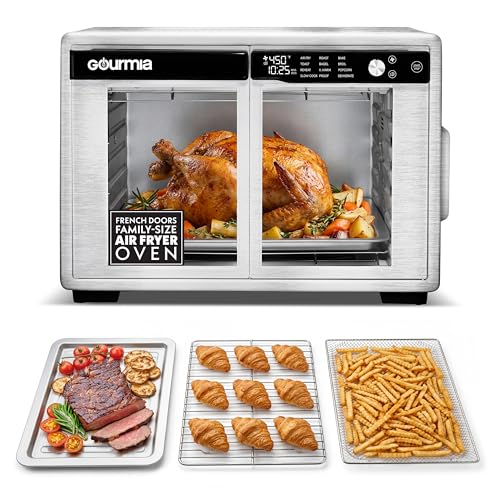
The Gourmia cooks the way family kitchens actually cook: in trays. A full sheet of vegetables, a row of chicken thighs skin-up, a breakfast of toast for the whole table, a tray of wings spread in the single layer that crisping demands, this is its native repertoire, and the nine-slice cavity is sized to hold it without the basket shuffle. The French doors make tray handling graceful at the moment it matters, sliding a hot, loaded tray in and out, and the twelve presets give the household’s less confident cooks a dial position to start from on the standard foods. Its branded circulation system is described in the maker’s own terms in its title, and in the kitchen its job is the familiar one: keep the air moving across the tray so the edges caramelise before the centres dry.
Its cooking limits are the tray format’s own. Heat arrives most strongly from above, so thick or uneven items reward a halfway turn that basket food gets from a shake. Small loads rattle around in a large cavity that a basket would heat faster. And presets, here as everywhere, are averages that the first supervised batch must translate into house settings. None of that dents its standing for its household: if your cooking is measured in trays, this is the machine in the guide that was built in your image, and its dishwasher-safe trays mean it will still be cooking willingly on the tired evenings when lesser-cleaning machines get skipped.
Best for: families whose cooking is tray-shaped and frequent / Not suited for: solo cooks making small, heaped loads

Ninja Prestige Smart XL Countertop Oven DT501
Badge: Best Premium Instrument
Strengths
- Ten functions across a cavity the maker describes in meals: twenty cookies, a twelve-pound turkey.
- Eighteen hundred watts for fast recovery when cold food enters the cavity.
- Prestige build that holds its settings and seals consistently across years of cooking.
Trade-offs
- Premium tier, the guide’s highest, for capability many households use occasionally.
- The largest footprint here, with cabinet clearance to verify.
- Its breadth rewards a cook who will actually range across it.
Spec box
- Model: DT501
- Functions: 10-in-1, including air fry, bake, toast, pizza, and reheat
- Power: 1800W
- Capacity notes: bakes 20 cookies; fits a 12 lb turkey
- Finish: stainless steel
The Prestige is the cooking instrument of this guide, the machine for the cook whose repertoire runs from a weeknight tray of vegetables to a holiday bird without changing appliances. Its capacity statements are a cook’s statements, cookies and turkey rather than abstract volume, and they describe the two ends of its range honestly: batch baking at one end, a centrepiece roast at the other, with air frying, pizza, toast, and reheating filling the week between. Strong stated power matters to cooking more than to brochures, because a cavity that recovers its temperature quickly after a cold load enters is a cavity whose browning does not stall, and stall is the difference between roasted and merely cooked.
The trade is commitment. This oven asks for counter, for budget, and for a cook who will use its breadth; in a household that air fries fries and reheats pizza, it is a grand piano bought for chopsticks. But for the household that cooks, really cooks, across the whole map, it is the one machine in this guide that never sends you to another appliance, and that completeness has a flavour of its own: the confidence to attempt the ambitious dish on a Tuesday. Cooks who shop with one eye on the calendar’s big cooking weekends may also enjoy the event-side reading in Best Crownful Air Fryers, where premium capacity is usually the headline.
Best for: ambitious home cooks wanting one complete countertop instrument / Not suited for: narrow briefs, small counters, or small budgets

Chefman 6-Quart Dual Basket Air Fryer
Badge: Best for Small Households
Strengths
- Two independent baskets that cook a protein and a side as one timed event.
- Viewing windows that let the cook steer browning by eye, the oldest cooking skill.
- Sync Finish and a high-heat finish feature for the last-minute crisp.
Trade-offs
- Three quarts a side caps the size of each food, if not of the dinner.
- Heaped basket food needs the halfway shake to cook evenly.
- No flat cooking: the format refuses trays and pizza.
Spec box
- Capacity: 6 quart total, two independent 3-quart baskets
- Features: Sync Finish, Hi-Fry, auto shutoff
- Windows: easy view
- Baskets: nonstick, dishwasher-safe
- Controls: digital
- Colour: black
The Chefman cooks the small household’s dinner the way that dinner is actually composed: two things, different natures, one arrival time. Salmon in one basket at its gentler setting, asparagus or fries in the other at a fiercer one, with Sync Finish staggering the starts so the cook is free until both are done. The windows elevate the whole exercise, because cooking by eye is not nostalgia but information, and a basket you can see into is a basket you can correct, a minute more for the pale side, a shake now rather than at the timer’s guess. The high-heat finish option answers the basket format’s one recurring wish, for a final blast of crispness on foods that have cooked through before they have browned enough.
Its limits are portion and shape, stated in its own figures. Three quarts per basket is a serving architecture for two or three, and the cook who regularly feeds five will spend the machine’s life running second shifts. The halfway shake is not optional technique in a basket; it is the mechanism by which heaped food meets the air evenly, and cooks who skip it will blame the machine for geometry. Within its household, though, the Chefman is the most companionable cooker in this guide, the one whose design seems to have watched real people cook real small dinners and taken notes.
Best for: couples and small households cooking two foods at once / Not suited for: large portions or flat-food cooking

Ninja Foodi 10-Qt DualZone XL Air Fryer DZ401
Badge: Best Overall Cooking Pick
Strengths
- Two five-quart baskets that cook family portions of two foods simultaneously.
- Match Cook for one large single-food batch across both zones.
- Six functions extending the cooking into roast, bake, and dehydrate territory.
Trade-offs
- Wide footprint, the price of family-scale zones.
- Capacity tempts crowding, and crowding is the one sin its cooking cannot forgive.
- Basket shape still excludes the flat repertoire.
Spec box
- Model: DZ401
- Capacity: 10 qt total, two independent 5 qt baskets
- Functions: 6-in-1 — air fry, roast, broil, bake, reheat, dehydrate
- Features: Match Cook, IQ Boost
- Colour: grey
The DZ401 takes the overall cooking badge because the family dinner is the category’s most-cooked meal and this machine cooks it in its sleep: a family protein in one five-quart zone, a family side in the other, independently set, jointly finished. Scale changes technique in the cook’s favour here, because five-quart baskets hold a single layer of real portions, and single layers are where air frying becomes the crisp, even cooking its reputation promises. Match Cook covers the second family pattern, the single-food feast, wings or fries for everyone, by mirroring both zones into one ten-quart batch, and the roast and dehydrate functions extend the machine’s cooking week beyond the dinner it was bought for.
The discipline it demands is restraint at the loading tray. Ten quarts looks like permission to heap, and heaped food steams in its own moisture no matter how the zones are set; the cook who loads this machine in honest layers will be rewarded with the most consistent family cooking in the guide, and the cook who treats it as a bin will conclude, wrongly, that big baskets cook worse. Its footprint is the other honest cost. For families whose dinners match its shape, the DZ401 is the cooker the rest of the list is compared against, which is the working definition of an overall pick.
Best for: families cooking two foods at family scale, most nights / Not suited for: narrow counters or tray-and-pizza households

Ninja Foodi 8-Qt DualZone Air Fryer DZ201
Badge: Best Mid-Size Cooking Pick
Strengths
- The complete two-zone cooking system at the market’s central size.
- Smart Finish synchronises the zones; Match Cook mirrors them.
- Six functions, including dehydrate, for a varied cooking week.
Trade-offs
- Less headroom than the DZ401 for guests and growing appetites.
- The same basket discipline: layers and shakes, or uneven results.
- Grey finish only.
Spec box
- Model: DZ201
- Capacity: 8 qt total, two independent baskets
- Functions: 6-in-1 — air fry, roast, broil, bake, reheat, dehydrate
- Features: Smart Finish, Match Cook
- Colour: grey
The DZ201 cooks exactly like its larger sibling, in a frame matched to the centre of the market, and for many households that makes it the better cooking purchase of the two. Eight quarts across two zones holds the standard family dinner in single layers, heats two modest cavities rather than two large ones on small nights, and leaves counter for the rest of the cooking to happen on. Its technique is the DualZone technique entire: set each zone for its food, let Smart Finish reconcile the clocks, shake both baskets at the halfway point, and serve two foods that taste as if they were cooked by someone with four hands.
Choosing between the two Ninjas is a portion audit and nothing else, because their cooking systems are the same system. Audit honestly, by the largest dinner you cook most weeks rather than the largest you cook ever, and the DZ201 wins every household whose audit lands at eight quarts, which is most of them. The money and counter it saves can go to ingredients, which is where cooking quality is actually bought after the machine is chosen. Shoppers who time that purchase to the big retail weekends will find the landscape mapped in Best Cyber Prices For Air Fryers; the cooking, whenever you buy it, starts with the calibration week described below.
Best for: families of three to four cooking the two-zone pattern / Not suited for: the largest regular portions

OLIXIS Dual Basket Air Fryer 9.5-Qt
Badge: Best Value Cooking Pick
Strengths
- Independent temperature control from eighty to four hundred fifty degrees Fahrenheit, a cook’s range.
- A shake reminder that enforces the basket’s essential technique automatically.
- A ceramic crisper plate and sync setting in a nine and a half quart value machine.
Trade-offs
- A value brand with a shorter track record than the Ninja names.
- Ten functions is a long list; the cooking core matters more than the count.
- Large footprint, as with all big dual baskets.
Spec box
- Capacity: 9.5 quarts, two baskets
- Functions: 10-in-1, including bake, broil, defrost, and dehydrate
- Temperature range: 80–450°F, independent per basket
- Features: ceramic crisper plate, sync setting, shake reminder
- Colour: grey
The OLIXIS cooks with two ideas that punch above its tier. The first is its temperature range, independently controlled per basket from a gentle eighty degrees to a browning four hundred fifty, which lets a cook defrost in one zone while crisping in the other, or hold a finished food warm without cooking it further while its partner catches up. Range is a cooking virtue, not a specification fetish, because real dinners are full of foods that want different intensities at the same moment. The second idea is the shake reminder, a small prompt that automates the basket’s one essential technique, and any cook who has ever served one-sided fries because the phone rang at the halfway point will recognise it as the most honest feature in this guide.
The reservation is provenance, as it is wherever this machine appears: a newer value brand asks the buyer to trade some certainty about long-term support for capability today. Cooks who accept the trade get a nine and a half quart two-zone machine whose cooking manners, range, reminder, ceramic crisper plate, are those of a maker who has clearly stood in a kitchen. Verify the configuration on the listing, calibrate it in the first week like any machine here, and it will cook the family pattern at a tier the established names make you climb for.
Best for: value-led cooks wanting range and capacity in two zones / Not suited for: buyers who put brand heritage above cooking features
Comparison Table
| Pick | Badge | Format | Cooking standout | Listing |
|---|---|---|---|---|
| Gourmia French Door Toaster Oven | Best Tray-Cooking Pick | French-door oven | Nine-slice single-layer trays | Check on Amazon |
| Ninja Prestige Smart XL DT501 | Best Premium Instrument | XL countertop oven | Turkey-scale roasts to cookie batches | Check on Amazon |
| Chefman 6-Quart Dual Basket | Best for Small Households | Dual basket | Watched, synchronised two-food dinners | Check on Amazon |
| Ninja Foodi DZ401 | Best Overall Cooking Pick | Dual basket | Family portions in two zones | Check on Amazon |
| Ninja Foodi DZ201 | Best Mid-Size Cooking Pick | Dual basket | The same system at eight quarts | Check on Amazon |
| OLIXIS Dual Basket 9.5-Qt | Best Value Cooking Pick | Dual basket | Wide independent temperature range | Check on Amazon |
How to Choose an Air Fryer for Cooking, Not for Brochures
Choose by the food you cook most, in the shape you cook it. List your five most repeated dinners and mark each one tray or basket, single food or two. The format with the most marks is your format, and the argument is over before features are mentioned, because a machine that fits the shape of your cooking will out-cook a superior machine shaped for someone else’s. Then size by the largest of those five dinners, in a single layer, and let the occasional feast fend for itself with the main oven. The Ninja DZ401 wins the basket count for families and the Gourmia wins the tray count, and most households will find their five dinners point at one of those two doors.
Only then should features enter, and they should enter as cooking verbs: to watch, which argues for windows; to synchronise, which argues for sync and finish systems; to cook gently and fiercely at once, which argues for wide independent ranges like the OLIXIS offers; to roast whole, which argues for the Prestige’s cavity. A feature that is not a verb in your kitchen is decoration, and decoration is the first thing a wise cook declines to pay for. Finish with the live checks: check the latest price on Amazon for your finalist, confirm the configuration and included trays or baskets, measure the counter, and then spend your remaining budget where cooking quality actually lives after purchase, on ingredients worth crisping.
How to Cook in an Air Fryer: The Complete Method
Every good air-fried result in this guide’s collective experience follows the same five-beat method. Dry the food’s surface, because surface moisture is browning’s enemy and a pat with a towel is the cheapest upgrade in the category. Oil the food, lightly and on its surface, rather than the basket, so the coating cooks onto the food where it belongs. Load in a single layer with gaps, the non-negotiable beat, because the air is the cooking medium and it cannot cook what it cannot reach. Cook hot and watch the final minutes, since circulated air accelerates at the end and the distance between golden and scorched is short. Rest briefly before serving, as you would from any oven, because juices and crusts both settle.
Adapt the method by format. In baskets, shake or turn at the halfway point and treat the shake as part of the recipe, not an interruption of it; in two zones, start the denser food earlier or let the sync system do it. On trays, rotate the tray once for even colour and keep flat foods flat and separated. For reheating, use a moderate heat and a short time, checking early, because the goal is restoration, not a second cooking. For dehydrating, where a pick offers it, think in hours and thin, uniform slices. Across all of it, write down the settings that work in your machine, because your machine, your loads, and your taste are the final specification.
Troubleshooting is the method read backwards. Problem: food is pale and soft → the surface was wet, the layer was crowded, or the heat was timid; dry, thin, and raise the temperature. Problem: food is dark outside and raw inside → the pieces are thick and the heat is fierce; lower the temperature, lengthen the time, and let the centre arrive. Problem: one side cooks faster → the halfway turn was skipped or the tray was not rotated; build the turn into the recipe. Problem: smoke on fatty foods → drips are meeting a hot surface; cook on the rack or basket arrangement that keeps fat away from the element, and clean before the next round. Master these four, and there is very little left that an air fryer can surprise you with.
The Foods That Decide It: A Cook’s Scorecard
Five foods, honestly cooked, will tell you more about any machine in this guide than its entire specification, and they make a practical first-week scorecard for whichever pick you buy. Fries test evenness and the shake. Wings test rendering and crisp skin under fat. Roast vegetables test caramelisation at the edges before the centres collapse. A reheated slice of pizza tests restoration, crust below and melt above. Chicken thighs, skin-on, test the whole system at once: heat, airflow, fat management, and timing. Cook each food twice, adjust once between attempts, and record the setting that wins. A machine that pleases you on four of the five, at settings you have written down, is a machine that cooks, whatever its badge, and a machine that fights you on three is telling you something no return window should be wasted ignoring.
The scorecard also explains the guide’s badges in plate terms. The DZ401 aces the family version of all five. The Gourmia owns the tray-shaped entries, vegetables and pizza above all. The Chefman makes the small-household versions feel watched and personal. The OLIXIS surprises on range, holding one food gently while crisping another. The Prestige is the only pick that adds a sixth test of its own, the whole roast, and passes it by design. Cooking, in the end, is the only review that cannot be argued with, and this guide’s last advice is to conduct it yourself, promptly, while the evidence can still change the outcome.
Wet Food in Hot Air: Marinades, Batters, and Sauces
The cooking question this guide has not yet faced squarely is moisture, because air fryers are dry-heat machines and half of good cooking arrives wet. Marinades are the easy case: they flavour the surface, and the surface is where air frying happens, provided the excess is allowed to drip off before loading, since pooled marinade steams and sugars scorch. Pat marinated food to merely damp, cook it hot, and expect deeper colour than the same food from a static oven, watching the final minutes where sugars turn. Dry rubs are even more at home, because the moving air sets them into a crust, and a rub with a little sugar and a little patience is the closest this category comes to a bark.
Wet batters are the honest difficulty, and a cooking guide should say so without flinching. A liquid batter drips through baskets and trays before it can set, which is why the category’s successful breaded foods use dry coatings, crumbs pressed onto a tacky surface, a flour-egg-crumb sequence given a few minutes to hydrate before cooking. Frozen breaded products succeed because the factory has already set the coating. The home cook’s version of the same trick is a brief rest after crumbing and a light oil spray over the coating, so the crumb itself fries in place. Sauces belong after the cook, almost without exception: glaze in the final minutes if you must, sauce at the table if you are wise, because a sauce applied early is a sauce steamed off, and its sugars will spend the cook trying to burn. None of this is a limitation unique to these six machines; it is the physics of the category, and the cooks who internalise it stop asking the machine for fried-chicken miracles and start producing the roasted, crusted, glazed cooking at which it genuinely excels, a trade most weeknight kitchens come to prefer.
Cooking for Two, Cooking for a Crowd: Portion Craft
Portion changes technique as surely as format does, and the picks in this guide divide by it cleanly. Cooking for two is an exercise in small cavities and fast recovery: the Chefman’s three-quart zones are not a compromise at this scale but an optimisation, heating little air, browning small portions fiercely, and finishing a composed dinner in the time a large oven takes to come to temperature. The couple’s craft is sequencing, letting the sync system run the dinner while the cooks do anything else, and its characteristic error is buying family capacity for romantic reasons and heating it empty for years.
Cooking for a crowd inverts every term. Capacity becomes the binding constraint, batches replace single runs, and the craft becomes batch management: cook in a planned sequence from the food that reheats best to the food that must be served instantly, hold finished batches loosely covered, and re-crisp the held items for a few minutes as the table is called. The DZ401’s mirrored zones and the Gourmia’s trays are the crowd tools in this guide, and the Prestige is its banquet instrument. The crowd cook’s characteristic error is the opposite of the couple’s: under-buying, then discovering at the first gathering that the machine’s honest single-layer capacity is half its headline volume. Both errors are visible in advance to anyone who runs the portion audit this guide keeps recommending, and both are survivable, which is more than can be said for the third error, shopping by headline during the seasonal events catalogued in Best Dealson Air Fryers, where portion maths goes to be forgotten. A last word belongs to the brand-loyal crowd cook, who will find the single-maker view in Best Deas On Phillps Air Fryers a useful contrast to this guide’s open field: loyalty simplifies the audit, but the audit, portions, layers, timing, still has to be run, in Philips kitchens as in all others.
There is a rhythm to serving from an air fryer that the scorecard week teaches almost by accident, and it is worth naming because it separates relaxed air-fryer households from frantic ones. Serve in the order the machine finishes, not the order the menu was written. The food that holds best, roasted vegetables, anything crusted, cooks first and waits without complaint; the food that peaks instantly, fries and delicate fish, cooks last and goes straight to the table. In two-zone machines the sync system formalises the rhythm, but the rhythm itself is older than the machines, the same one good short-order cooks have always used, and a household that adopts it finds the air fryer stops feeling like a gadget with a timer and starts feeling like a second pair of hands, which is the moment the purchase quietly justifies itself, whatever it cost and whichever badge it wears.
Common Buying Mistakes
The first mistake is buying a format your food does not fit, the tray cook with a basket, the two-zone household with a single oven. The second is judging a machine by its first, uncalibrated cook, before the calibration week has taught you its settings. The third is crowding, the universal error, committed most by owners of the largest machines. The fourth is paying for feature counts instead of cooking verbs. The fifth is skipping the halfway shake or turn and blaming the physics. The sixth is neglecting cleaning until yesterday’s flavours season today’s dinner, at which point even the best cooker in this guide starts tasting like its own history.
Final Recommendation
For the family dinner that defines this category, cook it on the Ninja DZ401, or on the DZ201 if your portions honestly fit eight quarts. Tray cooks should take the Gourmia, small households the Chefman, value-led cooks the OLIXIS, and the cook who wants one instrument for everything should take the Prestige and use it like one. Check the latest price on Amazon, confirm the configuration, and then run the five-food scorecard in your first week. The machine that passes it in your kitchen is, by the only definition that survives dinner, the best cooking air fryer. Pass or fail, write the result down and keep the machine that earned the pass without a backward glance, because the cook who trusts a calibrated machine cooks more, experiments more, and wastes less food on doubt than the cook who is forever wondering whether the other model would have browned the thighs better.
Frequently Asked Questions
How long does it take to learn a new air fryer?
About a week of ordinary cooking, if the week is used deliberately. The first two cooks teach browning speed and capacity, the next two teach fat behaviour and reheating, and by the fifth or sixth cook most owners are adjusting by instinct and checking the food rather than the clock. The cooks who learn fastest keep the small written record this guide recommends, because a setting remembered is a setting approximated, and approximation is where uneven results creep back in. After the calibration week, the machine’s presets become what they should have been all along, rough starting points you confidently overrule, and the cooking becomes the calm, repeatable routine that made the category popular in the first place.
What is the secret to genuinely crisp air-fried food?
There are three, and none of them is a feature. Dry the surface before cooking, load in a single layer with air gaps, and cook hot enough, long enough, watching the final minutes. Oil belongs on the food in a light coating, not pooled in the basket. Every machine in this guide will reward those habits with crisp results, and no machine in any guide can rescue food that is wet, piled, and timidly heated. Technique is the specification the brochures cannot print. It is also the specification that transfers: the habits learned on any one of these six machines, drying, layering, shaking, watching, recording, will serve you on every air fryer you ever own afterwards, which makes the first machine, whichever badge it carries, partly an education and partly an appliance, and a wise buyer budgets for it as both. The education, unlike the appliance, never wears out, never needs a replacement tray, and improves every meal it touches, including the ones cooked years later on machines that have not been designed yet, in kitchens you have not moved into, for people you may not have met.
Is the typo in this guide’s keyword a different topic from cooking air fryers?
No. The keyword is preserved exactly as searched, misspelling included, and the topic is cooking: which machines cook which foods best, and how to cook in them. The guide treats the typo the way a good cook treats a smudged recipe card, by reading the intention and cooking the meal. If you arrived here from the correctly spelled search, you are in the right kitchen; the content is the same, and so is the method.
Should I shake the basket even when a recipe does not say to?
Yes, in almost every case. Heaped basket food cooks where the air reaches it, and the halfway shake is how the bottom pieces take their turn at the top. The exceptions are delicate, set items, breaded foods in their first minutes, anything that would break or shed its coating, which should be turned gently once instead. One pick in this guide, the OLIXIS, even reminds you to shake, which tells you how central the habit is to honest basket cooking.
Can an air fryer replace deep frying for flavour?
It can replace it for most weeknight purposes, with a different and many cooks think cleaner result: crisp surfaces, rendered fat, and food that tastes of itself rather than of the oil bath. It does not replicate the exact shattering crust of a deep fryer on every food, and pretending otherwise helps no one. The comparison guide linked earlier in this article weighs the two methods food by food; the short version is that air frying wins the week, and deep frying keeps a few ceremonial dishes.
How do I stop food drying out in an air fryer?
Dryness is usually time and surface, not the machine. Cook hot and short rather than moderate and long for lean foods, oil the surface lightly, avoid overcooking past the point your calibration week established, and rest the food briefly before serving so moisture redistributes. Thick proteins benefit from the gentler end of a wide temperature range, one reason the OLIXIS’s independent range earns its mention, and from being turned once rather than repeatedly handled.
What should I cook first in a new machine?
Run the scorecard in this guide, in this order: fries, to learn the browning speed; vegetables, to learn the capacity in real food; wings or thighs, to learn fat behaviour; a reheated slice, to learn restoration; and one family dinner in the machine’s native pattern, two zones or a tray. Write down every winning setting. By the fifth cook you will know the machine better than any review can know it, including this one, and that knowledge is the actual product you were shopping for. Keep the record where the cooking happens, on the fridge or in the notes you actually reopen, because a calibration that lives in a drawer is a calibration that will be approximated by Christmas, and the whole point of the week was to replace approximation with knowledge while the machine was new and the lessons were cheap.