Disclosure: topratedkitchenware.com is reader-supported. When you buy through links on our site, we may earn an affiliate commission from Amazon and other retailers, at no extra cost to you.
Where to buy
This guide to the best digital hot air fryers combines two requirements and verifies both literally: the machine must cook with hot air — all six picks do — and its verified listing title must state digital control or a digital display. Only one machine in the current pool passes both tests, and it is the one linked pick below: its name links to its Amazon listing, and its review carries a Check on Amazon link so you can check the latest price on Amazon. The other five are excellent hot air cookers whose titles do not state digital control; they are reviewed in full as prose-only picks, with no link and no image, so the evidence for the shortlist is visible rather than asserted.
- CHEFMAN 6 Quart Dual Basket Air Fryer, Digital — Best Digital Hot Air Fryer. Best for couples and small families wanting stated digital control over two hot-air zones.
- Ninja Foodi 10 Qt DualZone XL (DZ401) — Best Family Hot Air Cooker, covered prose-only below. Its title does not state digital control, so it earns no link on this page.
- Ninja Foodi 8 Qt DualZone (DZ201) — Best Mid-Size Hot Air Cooker, covered prose-only below. The smaller DualZone, likewise not titled as digital.
- OLIXIS Dual Air Fryer, 9.5 Quarts — Widest Temperature Range, covered prose-only below. Its title states independent temperature control without calling it digital.
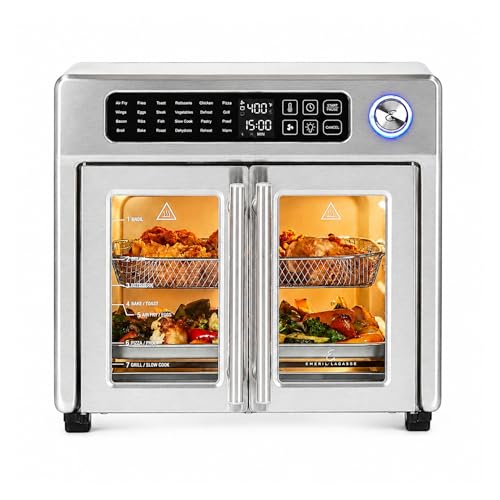
- Emeril Lagasse 26QT French Door Air Fryer Oven — Best Big-Cavity Hot Air Oven, covered prose-only below. Its title states presets and convection, not digital control.
- Nuwave Bravo XL Pro Air Fryer Toaster Oven — Widest Heat Span, covered prose-only below. Its title states a 50–500°F range and a probe, not digital control.
Read the full guide ↓ for badges, honest trade-offs, a comparison table and an explanation of how digital control changes hot air cooking specifically.
“Hot air” is the original name of this entire technology, and it still describes the physics better than the marketing that replaced it. An air fryer is a compact, high-powered convection chamber: an element heats air, a fan drives it fast around food, and that moving air strips moisture from surfaces and browns them in a fraction of an oven’s time. The word “digital” in front of it is therefore not decoration. Moving air is a volatile medium — its effective cooking power swings with load, moisture and starting temperature — and digital control is how you pin it down: exact set temperatures, timers that end the cook, and, on two-zone machines, coordination between baskets. People searching this exact phrase are usually asking for both halves at once: real hot-air crisping, commanded precisely.
The strictness of this guide’s rule produces a result some readers will find surprising — a single linked pick — and we present it without apology, because the alternative is worse. A guide that linked machines on the assumption that their panels must be digital, because the photographs glow, would be guessing with your money. Instead, the one verified digital hot air fryer is linked and reviewed in depth, and the five strongest hot air cookers in the pool are reviewed in full beside it, each labelled with exactly why it carries no link. If you finish the page and decide that hot-air capability matters more to you than the stated digital claim, you will have lost nothing: the comparison is complete, and our Best Electric Air Fryers guide ranks the same field without the digital gate.
What follows is organised around the combination, not just the criterion. The reviews judge each machine as a hot air cooker first — circulation, capacity, temperature behaviour — and the later sections explain the technique that makes hot air cooking succeed or fail, because with this technology the user’s habits move the results as much as the machine does. A precise panel on a badly loaded basket still steams dinner; a well-loaded basket under exact control is where the category’s reputation was earned.
A word about how to use a one-link guide, since this page’s shape is unusual. Treat the linked pick as the verified answer to the exact question asked, and the prose-only five as the market context that makes the answer meaningful: their capacities, ranges and systems define what you gain and give up by insisting on the stated digital claim today. Some readers will conclude the claim is worth it; others will conclude that a prose-only machine’s extra quarts or degrees matter more in their kitchen. Both conclusions are successes for this page, because both were reached with the distinction in plain sight — which is more than can be said for guides that blur it for the sake of a longer link list.
Key Takeaways
- Hot air is the technology itself: fast-moving heated air that crisps by stripping surface moisture. Digital control is how you command it precisely.
- Only one of six picks states digital control in its verified title — the Chefman dual basket — so it is the single linked pick; the other five are reviewed in full, prose-only.
- The prose-only five include the category’s biggest dual baskets and widest temperature spans; choose them if capability outranks the digital claim for you.
- Technique decides hot air results: single layers, dry surfaces, a shake halfway, and exact settings repeated from a notebook.
- “Hot” adds no separate restriction here — every pick is a hot air cooker; the digital statement is the gate, applied literally.
In this guide
Quick Picks
| Pick | Badge | Shape and size | Digital status | Check |
|---|---|---|---|---|
| CHEFMAN 6 Quart Dual Basket | Best Digital Hot Air Fryer | Dual basket, 6 qt | Title states Digital Double Air Fryer — linked | Check on Amazon |
| Ninja Foodi 10 Qt DualZone XL (DZ401) | Best Family Hot Air Cooker — Prose-Only | Dual basket, 10 qt | Title does not state digital — no link | Reviewed in full below |
| Ninja Foodi 8 Qt DualZone (DZ201) | Best Mid-Size Hot Air Cooker — Prose-Only | Dual basket, 8 qt | Title does not state digital — no link | Reviewed in full below |
| OLIXIS Dual Air Fryer 9.5 Qt | Widest Temperature Range — Prose-Only | Dual basket, 9.5 qt | Title states temp control, not digital — no link | Reviewed in full below |
| Emeril Lagasse 26QT Oven | Best Big-Cavity Hot Air Oven — Prose-Only | Oven, 26 qt | Title does not state digital — no link | Reviewed in full below |
| Nuwave Bravo XL Pro | Widest Heat Span — Prose-Only | Oven, 30 qt | Title does not state digital — no link | Reviewed in full below |
Badges are used consistently through this guide: the badge in this table is the badge in each detailed review, so you can track a pick from summary to verdict without translating between two naming systems.
How These Picks Were Chosen
The method is stated on the tin. From the current verified pool, every candidate is by definition a hot air cooker — that is what the category is — so the discriminating question was the second half of the keyword: does the machine’s own verified listing title state digital control or a digital display? One did. We then faced the choice every strict guide faces: publish a one-product page, or build the honest comparison around it. We chose the comparison. The five prose-only reviews are the strongest hot air machines in the same pool rotation, each carried in full — strengths, trade-offs, specifications, verdict — with its link withheld for one stated reason only.
Within that frame, the usual research filters applied: capacity suited to real meals rather than demonstration portions, function lists extending beyond a single fry mode, and a spread of formats — dual baskets in three sizes, two countertop ovens — so the page maps the hot air category instead of repeating one corner of it. We also weighted temperature evidence heavily on a page with “hot” in its title: stated ranges, stated wattage where given, and the presence of finishing or searing features all counted, because a hot air guide that ignores heat would be a poor joke.
Readers who want the same strict digital reading applied to the plainer phrasing of the question will find it in our digital air fryer coverage, while Best Dry Air Fryers takes up the low-oil, dry-heat cooking style that hot air makes possible.
The 6 Best Digital Hot Air Fryers in Detail

CHEFMAN 6 Quart Dual Basket Air Fryer Oven, Digital
Badge: Best Digital Hot Air Fryer
Strengths
- Its title states “Digital Double Air Fryer” — verified digital control over two independent hot-air zones.
- Easy View windows let you watch hot air do its work without opening a basket and dumping the heat.
- Sync Finish lands both zones together; Hi-Fry adds a hot finishing stage; baskets are nonstick and dishwasher safe.
Trade-offs
- Three quarts per basket is a one-to-three-portion zone; family crowds need batches or a bigger machine.
- Hi-Fry’s extra-hot finish needs watching the first few times you use it.
- As the only linked pick, it carries the whole digital case for this page — smaller households only.
Mini spec box
- Capacity: 6 quarts total — two independent 3-quart baskets
- Controls: digital, with Sync Finish and Hi-Fry
- Baskets: nonstick, dishwasher safe, with Easy View windows
- Safety: auto shutoff
- Colour: black
- Link status: linked — title states digital
The Chefman earns the single link on this page by stating its credentials in its name, and then — more importantly — by being the right kind of machine for the combination the keyword describes. Hot air cooking in two zones is a precision exercise: two different foods, two different moisture levels, one shared deadline. Digital control is what makes that exercise routine instead of theatrical. You set each zone’s temperature as a number, the sync system schedules the finishes to coincide, and the windows let you verify browning with your eyes instead of your hands, keeping the hot air inside the baskets where it belongs. Every element of the design serves the same idea — information and heat, both under control.
As a hot air cooker in its own right, it behaves the way a good basket machine should: fast, fierce circulation in a compact chamber, strong crisping on the foods baskets do best — wings, fries, roasted vegetables, reheated anything — and a finishing boost for the last-minute colour that separates good from pale. Its honest limitation is the one printed in its specification: six quarts in total, split in two. For couples and small families that is a dinner-sized machine; for a household of six it is an appetiser station next to a main oven doing the real work. Buy it as the verified digital hot air fryer for a smaller household and it is complete. Ask it to feed a crowd and no control system, digital or otherwise, can save it.
Best for: couples and small families wanting the verified digital claim over two hot-air zones / Not suited for: large families, or anyone who needs a single large cooking chamber
Ninja Foodi Air Fryer, 10 Qt DualZone XL (DZ401)
Badge: Best Family Hot Air Cooker — Prose-Only
Strengths
- Two independent 5-quart baskets — the largest hot-air zones in this guide, family portions per side.
- Six functions span air fry, roast, broil, bake, reheat and dehydrate.
- Match Cook and IQ Boost manage settings and power across the two zones.
Trade-offs
- Its title does not state digital control, so it is prose-only on this page.
- The widest footprint of any basket machine here; measure before anything else.
- Two fully loaded zones temper the fierce single-zone pace hot air is known for.
Mini spec box
- Capacity: 10 quarts total — two independent 5-quart baskets
- Functions: 6-in-1 — air fry, roast, broil, bake, reheat, dehydrate
- Systems: DualZone, Match Cook, IQ Boost
- Colour: grey
- Link status: prose-only — title does not state digital control/display
As a pure hot air cooker, the DZ401 is the family benchmark: two big chambers of fast-moving air, each capable of a family portion, each independently set, with systems to copy a setting across both or finish two different foods together. Its six functions cover the whole hot-air repertoire — the fierce crisping of air fry and broil at one end, the long gentle airflow of dehydrate at the other — and its scale changes what hot air cooking means at home, from side-dish appliance to the machine dinner actually comes out of.
Its prose-only status here is a labelling fact, not a capability judgement, and this guide states it as plainly in this review as in the table above: the title describes the DualZone system and its functions without stating digital control or a digital display, so under the rule printed at the top of this page it carries no link. The reader who decides that ten quarts of two-zone hot air matter more than the stated digital claim has this guide’s full support and a complete review to decide from. Its honest limitation is physical — width, weight and the counter commitment they demand.
Best for: large families prioritising hot-air capacity over the digital criterion / Not suited for: small kitchens, or buyers who want the stated digital claim
Ninja Foodi Air Fryer, 8 Qt DualZone (DZ201)
Badge: Best Mid-Size Hot Air Cooker — Prose-Only
Strengths
- The DualZone system — independent baskets, Smart Finish, Match Cook — in a smaller body.
- Six functions cover the hot-air week, from roast to dehydrate.
- Eight quarts total is the three-to-four-person sweet spot of the category.
Trade-offs
- Its title does not state digital control — prose-only on this page, like its sibling.
- Crowd cooking means batches where the XL cooks once.
- Still a substantial machine; the saving over the XL is in degree, not kind.
Mini spec box
- Capacity: 8 quarts total — two independent baskets
- Functions: 6-in-1 — air fry, roast, broil, bake, reheat, dehydrate
- Systems: DualZone, Smart Finish, Match Cook
- Colour: grey
- Link status: prose-only — title does not state digital control/display
The DZ201 applies the same hot-air logic as its larger sibling at the size most households can house. Two zones of moving air, a finish-syncing system so a main and a side land together, and a match mode for doubling one dish across both baskets: the complete two-zone idea, trimmed to eight quarts. For a household of three or four, this is arguably the most rational hot air cooker in the pool — big enough for dinner, small enough for the counter it will live on.
On this page it stands, like the DZ401, as a prose-only review, for the single stated reason that its title does not claim digital control. The practical comparison for a reader of this guide is against the linked Chefman: the Chefman is smaller per basket but carries the verified digital statement and the viewing windows; the DZ201 offers more hot-air room per zone and the category’s most proven two-zone system, without the statement. Households should choose by which of those two sentences describes their priority — and either choice, made knowingly, is a good one. Its honest limitation is the familiar one: two baskets are a commitment, in counter space and in washing up, that single-chamber cooks may not need.
Best for: households of three to four wanting proven two-zone hot air cooking / Not suited for: buyers insisting on the stated digital claim, or regular crowd cooking
OLIXIS Dual Air Fryers with 2 Baskets, 9.5 Quarts
Badge: Widest Temperature Range — Prose-Only
Strengths
- Independent temperature control from 80–450°F — hot air at every intensity from gentle drying to fierce roasting.
- Ten functions including defrost and dehydrate, with a sync setting and shake reminder.
- A ceramic crisper plate gives food a different cooking surface from standard nonstick.
Trade-offs
- Its title states temperature control without calling it digital — prose-only here.
- A ten-function menu means navigation for simple jobs.
- A newer brand name than the established pairs on this page.
Mini spec box
- Capacity: 9.5 quarts total across two baskets
- Functions: 10-in-1 — including bake, broil, defrost and dehydrate
- Temperature: independent control, 80–450°F
- Features: ceramic crisper plate, Sync Setting, Shake Reminder
- Colour: grey
- Link status: prose-only — title does not state digital control/display
On a page with “hot” in its title, the OLIXIS makes the most literal case of any prose-only pick: a stated temperature span that runs from 80°F — air barely warm, for defrosting and slow drying — to 450°F, which is genuinely fierce roasting heat, independently controlled in each of two baskets. Hot air is a spectrum, and this machine covers more of it than any other basket here. Add defrost, a function experienced cooks prize out of proportion to its glamour, and a shake reminder that serves the single most important hot-air technique, and the package is formidable.
It is prose-only for one narrow reason, repeated here so no reader has to hunt for it: the title states “Independent Temp Control” without stating that the control is digital. This guide’s rule turns on the stated word. Readers whose priority is the range itself — and there is a strong case that range is the most digital-feeling attribute on this page — will find the OLIXIS the most interesting machine in the comparison, and its honest limitations are the ones of youth: a newer brand, a busier interface, and trust still to be earned beside the category’s elders.
Best for: versatile cooks who prize temperature span and functions over the digital label / Not suited for: buyers who want the verified digital claim, or the simplest possible controls
Emeril Lagasse 26QT French Door Multi-Function Air Fryer Toaster Oven
Badge: Best Big-Cavity Hot Air Oven — Prose-Only
Strengths
- A 26-quart extra-large interior moves hot air around trays, pizzas and roasts no basket can hold.
- French doors and six included accessories make it a working second oven.
- Twenty-four one-touch presets give less confident cooks a starting point for common dishes.
Trade-offs
- Its title states presets and convection, not digital control — prose-only on this page.
- Oven-style hot air cooks in layers; deep-basket crisping behaves differently.
- The largest footprint here alongside the Nuwave, with clearance to match.
Mini spec box
- Capacity: 26 quarts, extra-large interior
- Format: French door countertop convection oven
- Presets: 24 one-touch options
- Included: six cooking accessories
- Link status: prose-only — title does not state digital control/display
The Emeril represents the other philosophy of hot air: not a fierce little chamber but a broad, even bath of it, sized for the foods families actually gather around. A 26-quart convection cavity crisps a tray of wings while it roasts vegetables beneath, takes a pizza whole, and turns the air fryer from a side-dish machine into the oven the meal comes from. The French doors are the daily pleasure — one hand, a clear tray path — and the six accessories mean the machine arrives ready to work rather than ready to be supplemented.
Its prose-only status follows the page’s rule exactly: twenty-four one-touch presets describe a programme library without stating digital control or a digital display, so no link is carried. The reader weighing it against the linked Chefman is really weighing formats — a big shared cavity against two small sealed zones — and for tray-shaped cooking the Emeril’s case is strong regardless of labels. Its honest limitation is the oven format’s own: foods that crisp best piled in a basket cook in a shallower layer here, and the counter commitment is permanent and large. Households with the space and the tray habit will not regret either.
Best for: families whose hot air cooking is tray-shaped — pizzas, roasts, sheet dinners / Not suited for: small counters, deep-basket crisping fans, or digital-claim sticklers
Nuwave Bravo XL Pro Air Fryer Toaster Oven with Grill Combo
Badge: Widest Heat Span — Prose-Only
Strengths
- A stated 50–500°F range — the widest heat span in the guide, from proofing warmth to searing heat.
- A temperature probe for roasts and thick cuts, plus 142 presets.
- Thirty quarts in stainless steel, with a grill combo and PFAS-free positioning.
Trade-offs
- Its title states range and presets, not digital control — prose-only on this page.
- The premium tier and the largest footprint of the six.
- Its depth is wasted on narrow cooking repertoires.
Mini spec box
- Capacity: 30 quarts
- Temperature: 50–500°F
- Presets: 142, with a temperature probe
- Format: air fryer toaster oven with grill combo, stainless steel
- Construction note: PFAS free
- Link status: prose-only — title does not state digital control/display
The Nuwave closes the reviews as the heat extremist. Five hundred degrees is a number no other pick here states, and it changes what hot air can do: at that ceiling, the machine sears and chars rather than merely browns, while at its 50°F floor it can proof dough and dry herbs with air so gentle it barely qualifies as cooking. Between those poles sit 142 presets and a probe that measures the food instead of the clock. As a hot air instrument, it is the most complete on the page.
And it is prose-only, because completeness is not the criterion — the stated word is, and its title spends its words on range, presets and the probe rather than on claiming digital control. This guide regards that outcome as the rule working correctly, not as an embarrassment: the reader who wants the widest heat span in the category now knows exactly which machine has it, exactly what it costs in label terms, and can choose it with open eyes from a complete review. Its honest limitations are size and tier — thirty quarts of stainless steel is a commitment — and a preset library whose depth only wide-ranging cooks will ever explore.
Best for: serious cooks who want the widest stated heat span and a probe, label aside / Not suited for: small kitchens, tight tiers, or buyers who require the stated digital claim
Comparison Table
| Pick | Format | Capacity | Digital status (per title) | Check |
|---|---|---|---|---|
| CHEFMAN Dual Basket | Dual basket | 6 qt | Digital stated | Check on Amazon |
| Ninja DZ401 | Dual basket | 10 qt | Not stated — prose-only | Reviewed above |
| Ninja DZ201 | Dual basket | 8 qt | Not stated — prose-only | Reviewed above |
| OLIXIS Dual | Dual basket | 9.5 qt | Control stated, digital not stated — prose-only | Reviewed above |
| Emeril 26QT | Oven, French door | 26 qt | Not stated — prose-only | Reviewed above |
| Nuwave Bravo XL Pro | Oven with grill | 30 qt | Not stated — prose-only | Reviewed above |
How Hot Air Cooking Actually Works
A conventional oven cooks mostly by radiation and slow natural convection: the air near the element warms, drifts, and eventually the food’s surface dries enough to brown. An air fryer compresses that process violently. The element sits close to the food, the fan drives the heated air at speed, and the moving stream does three things at once — it delivers heat faster than still air can, it strips the thin layer of cool, moist air that clings to food surfaces, and it carries evaporated moisture away before it can condense back. Browning, which needs a dry, hot surface, therefore starts sooner and proceeds faster, in a chamber a fraction of an oven’s size. That is the whole technology; everything else is refinement.
The refinements matter, though, and they explain the spread of this guide’s six machines. Chamber shape decides how evenly the stream reaches food — baskets concentrate it fiercely on a small load, ovens spread it across trays. Fan and element placement decide whether the top browns before the bottom cooks. And control decides whether the stated temperature is the delivered temperature across a full cook, as food loads the air with moisture and the element cycles to compensate. Digital control enters here not as a luxury but as the governor of a volatile process: exact set points, timed endings, and — in the linked Chefman’s case — coordination between two chambers whose loads differ. Understanding the physics also hands you the technique section below almost for free: everything in it exists to help the moving air do its three jobs.
How to Get the Crisp: Hot Air Technique, Step by Step
- Dry the surface. Pat proteins and vegetables dry before they go in; hot air browns dry surfaces and steams wet ones, and the first two minutes decide which.
- Oil the food, not the chamber — a light, even coating on the food itself helps heat transfer and browning without pooling.
- Load in a single layer with gaps. The air is the cooking medium; a crowded basket is a steamer with a fan.
- Set the temperature as a number and trust it: hot air cooks faster than still air, so start a few degrees below your oven habit for delicate foods, and at full heat for sturdy ones.
- Shake, flip or rotate once, halfway. The side facing the stream browns first; one intervention equalises the cook.
- Use the finish deliberately — a short hotter stage at the end, the linked pick’s Hi-Fry idea, deepens colour without drying the interior.
- Rest proteins briefly, and write down what worked. Hot air cooking is repeatable; a notebook turns repetition into mastery.
Troubleshooting
Problem: food crisps on top but stays soggy beneath → the layer was too thick or never turned; cook in a single layer and flip or shake halfway through.
Problem: delicate coatings blow off or dry out → the load was too light for the fan’s force or the food went in dry; oil the surface lightly and lower tall, fragile items away from the element.
Problem: smoke during high-heat cooking → fatty residue on the element or tray from earlier cooks is burning off; clean the chamber and empty drip trays before fierce cooks, and give fatty foods a tray beneath them.
Choosing Your Hot Air Format: Baskets, Ovens and Zones
Strip the labels away and this page offers three formats. The dual basket — the linked Chefman and the two prose-only Ninjas and OLIXIS — is the two-dinners-at-once format: fierce air, small chambers, synchronised finishes, ideal for the protein-and-side household. The countertop oven — the Emeril and the Nuwave — is the tray format: broad, even air over flat food, pizzas and roasts whole, ideal for families and bakers. Between them sits the question of scale: zones multiply variety, cavities multiply volume, and no machine does both supremely. Choose by your three most-cooked dinners, as this guide keeps advising, and the format chooses itself.
The digital layer then applies within the format. If the stated claim matters to you — because you bake precisely, repeat settings weekly, or simply want the verified article — the linked Chefman is the current pool’s answer, and its two-zone format makes it a natural fit for the two-dish household. If your format is the oven, the honest position is the one this page prints: the pool’s oven titles do not state digital control, so oven buyers choose between waiting, widening the search, or accepting a prose-only machine on its considerable merits. Readers exploring the format question further will find the oven field compared in Best French Door Air Fryers, and the grill-leaning corner in Best Grill Air Fryers.
Hot Air and Oil: What Frying Means Without the Fryer
The honest physics of this category includes a spoonful of oil. Hot air alone browns food, but a light coating of oil on the food’s surface dramatically improves heat transfer, colour and the fried character people are actually seeking — which is why every experienced air fryer cook keeps a brush or a mister beside the machine. The amount is the revolution: a teaspoon worked over a basket of potatoes does the sensory work that a litre does in a deep fryer, because the oil’s job has changed from cooking medium to surface treatment. Foods that arrive pre-oiled — frozen fries, breaded items — need none added, and adding more only smokes. Foods that arrive dry and lean — fresh vegetables, plain proteins — are transformed by the lightest coat.
This is also where expectations should be set with care. Hot air produces its own texture: crisp, roasted, intensely browned, and for most everyday foods — wings, fries, vegetables, reheated anything — close enough to deep frying that households convert permanently. Delicate wet batters are the honest exception; they drip, blow and set unevenly in fast air, and the cooks who love them keep a small deep fryer for those dishes without any sense of contradiction. A digital hot air fryer is not a claim that oil cooking is obsolete. It is a claim that ninety percent of what a household fries can be cooked in moving air, under precise control, with a teaspoon where a litre used to be — and the remaining ten percent was never this machine’s assignment.
Sizing Hot Air to Your Household
Hot air capacity is measured in two different currencies on this page, and confusing them is the commonest sizing error. Basket quarts describe chamber volume for piled, shaken foods — fries, wings, chopped vegetables — where the load tumbles and the air works between the pieces. Oven quarts describe cavity volume for flat, still foods — trays, pizzas, roasts — where what matters is the rack’s footprint, not the air above it. A 6-quart dual basket and a 26-quart oven are therefore not a small and a large version of one thing; they are two instruments, and the household’s menu, not the numbers, says which currency it spends.
Within each currency, size honestly. Basket zones of about three quarts serve one to three portions of a piled food; five-quart zones serve a family’s side or main in one run. Oven cavities should be judged by the tray and pizza test — your largest weekly tray, your household’s usual pizza — rather than by quart figures at all. And in both currencies, remember the single-layer rule from the technique section: the capacity that counts is the capacity in one layer with air gaps, which is always less than the brim-full figure a box might imply. Buy for the layer, and the machine will perform the way the reviews promise.
Keeping a Hot Air Fryer Cooking Hot and Clean
Hot air machines live or die by their airflow, and airflow is a maintenance item. Grease mist from roasting coats the element, the fan guard and the chamber walls in a film that, left alone, smokes at high heat, flavours delicate foods with last week’s dinner, and insulates the very surfaces meant to radiate heat. The routine that prevents it is short: baskets and trays washed after fatty cooks — the linked pick’s are nonstick and dishwasher safe for exactly this reason — crumb and drip trays emptied before they carbonise, and the chamber wiped while warm after roast-heavy weeks. Monthly, look up at the element and fan area with a torch; what you can see, you can wipe, and what you wipe never becomes the baked lacquer that defeats cleaning entirely.
Placement is the other half of care. These machines move a great deal of hot air and need somewhere for it to go: clearance above and behind, away from cabinet lips and walls, pulled forward for long fierce cooks. A starved machine cooks unevenly and works its fan harder than its designers intended, which shortens the life of the hardest-working component in the box. Give a hot air fryer air, keep its passages clean, and it will deliver the same fierce, even performance in its third year as in its first week — which, for a machine bought on precision, is the whole point of owning it.
Common Buying Mistakes
- Treating “hot air” as a special feature. Every air fryer cooks with hot air; the phrase names the technology, so judge machines on control, capacity and stated ranges instead.
- Assuming a glowing panel means a digital claim. Photography is not specification; if the claim matters, buy the title that states it.
- Crowding the chamber and blaming the machine. Hot air needs room to move; most “weak” air fryers are overloaded ones.
- Ignoring stated temperature spans. On a hot-air page, the range is the résumé: low floors dry and defrost, high ceilings sear.
- Buying zones you will not use. Two baskets are a system, not a bonus; single-dish households are happier with one good cavity.
Final Recommendation
For the buyer who wants exactly what this keyword promises — hot air cooking under stated digital control — the answer is the CHEFMAN 6 Quart Dual Basket: the one verified digital title in the pool, wrapped around two windowed, sync-finishing zones that suit couples and small families beautifully. Everyone else should read the five prose-only reviews as the honest map they are: the Ninja pair for dual-zone scale, the OLIXIS for temperature span, the Emeril for tray capacity and the Nuwave for the widest heat range in the category. A guide that linked all six would be longer on links and shorter on truth. This one gives you the verified pick, the complete comparison, and the technique to make either choice cook well — which is what the search deserved.
Frequently Asked Questions
What is a hot air fryer, exactly?
It is the original name for what is now marketed as an air fryer: a compact convection chamber where a fan drives heated air fast around food, drying and browning surfaces far quicker than a still-air oven. Every machine in this guide is one; the keyword simply names the technology directly.
Why is only one pick linked in this guide?
Because only one pick’s verified listing title states digital control — the Chefman, titled a “Digital Double Air Fryer”. The other five are reviewed in full as prose-only picks, each labelled with that reason, so you can still choose one knowingly if its capacity or range matters more to you than the stated claim.
Does digital control make hot air cooking crispier?
It makes it more consistent. Crisping itself comes from load, dryness and airflow — the technique section covers those — while digital control holds the temperature you chose and ends the cook on time, so the crisp you achieve once is the crisp you can repeat.
Which is better for hot air cooking, a basket or an oven?
Baskets concentrate fast air on small loads and crisp fiercely; ovens spread even air over trays, pizzas and roasts. Two-dish households suit baskets and zones; tray-and-family cooking suits ovens. The format question outranks every other on this page.
What temperature range should I look for?
Enough to cover your cooking: a floor low enough for gentle drying or defrosting if you do those things, and a ceiling at full roasting heat or beyond if you sear. The OLIXIS states 80–450°F among baskets and the Nuwave 50–500°F among ovens — the widest stated spans in this comparison.
Why do my results vary even at the same digital settings?
Because the machine controls its side of the bargain — temperature, time, fan — while you control the load: portion size, starting temperature, surface moisture and layer thickness all change how the same setting performs. Frozen versus thawed, a single layer versus a piled one, wet vegetables versus dried ones can each shift the outcome by minutes. The fix is the notebook habit from the technique section: hold your portions and preparation steady, change one variable at a time, and the digital settings will reward you with the repeatability they were bought for.
Is a window useful on a digital hot air fryer?
Surprisingly, yes — it completes the digital philosophy. Precise settings tell you what the machine intends; a window tells you what the food is doing, without opening the chamber and dumping the heat the settings built. On the linked Chefman, the Easy View windows are the feature owners mention most after the sync system, because browning is a visual event and no timer, however exact, can see it for you.
Can a digital hot air fryer replace deep frying?
For most everyday foods, it replaces the result closely enough that households rarely look back — crisped, browned, far less oil — while differing honestly in texture for delicate batters and a few traditional dishes. Our Best Food Air Fryers coverage looks at the foods themselves in more depth.