Disclosure: topratedkitchenware.com is reader-supported. When you buy through links on our site, we may earn an affiliate commission from Amazon and other retailers, at no extra cost to you.
Where to buy
All six picks in this guide to the best dry air fryers are current, verified listings you can order online today. Each name below links to its Amazon listing, and every detailed review carries its own Check on Amazon link, so you can check the latest price on Amazon for the exact model you are reading about. “Dry” in this guide is read the way the category itself uses it: air frying is dry-heat cooking — no oil bath, no braising liquid, just fast hot air — and every pick here is a dry-heat machine, judged on how well it crisps, roasts, dries and dehydrates.
- Ninja Foodi 8 Qt DualZone Air Fryer (DZ201) — Best Overall Dry Air Fryer. Best for households wanting two-zone dry cooking with a dedicated dehydrate function.
- OLIXIS Dual Air Fryer, 9.5 Quarts — Best for Drying and Defrosting. Best for cooks who will use the 80°F low end and ten functions, defrost included.
- Emeril Lagasse 26QT French Door Air Fryer Oven — Best Dry Oven for Big Batches. Best for families drying, roasting and crisping tray food in quantity.
- Nuwave Bravo XL Pro Air Fryer Toaster Oven — Best Low-and-Slow Dry Range. Best for serious cooks wanting a 50°F floor for proofing and drying, up to searing heat.
- Oster Extra-Large French Door Air Fryer Oven — Best Simple Family Dry Oven. Best for large households wanting a big, plain, six-preset dry-heat oven.
- Emeril Lagasse Everyday 360 Air Fryer Oven — Best Rotisserie Dry Roasting. Best for cooks who want 360° dry convection and a rotisserie in a mid-size oven.
Read the full guide ↓ for badges, honest trade-offs, a comparison table and the dry-cooking technique that separates crisp from merely dried out.
Every cooking method is either wet or dry, and the distinction explains most of what happens in a kitchen. Wet methods — boiling, steaming, braising — cap at the temperature of water and keep surfaces moist. Dry methods — roasting, grilling, frying in oil, and air frying — let surfaces exceed that cap, dry out, and brown. People searching for the best dry air fryers are usually chasing one of three things, and this guide serves all three honestly: crisping with little or no oil, where the dry moving air does the work an oil bath used to do; drying and dehydrating food itself — herbs, fruit, jerky, vegetable crisps — where a low, patient airflow is the entire technique; and dry-heat roasting with rubs and dry brines, where a surface kept dry is what turns seasoning into crust.
That triple reading shapes the shortlist. Machines earn their place here by their dry credentials: dedicated dehydrate functions, low temperature floors that make real drying possible, strong airflow for crisping, and — for the oven picks — the tray space that batch drying and roasting demand. The six below spread from an 8-quart dual basket with a dehydrate mode to a 30-quart oven whose range starts at dough-proofing warmth, so each of the three dry pursuits has a machine that suits it. If your interest is the healthier-eating frame around the same cooking, our Best Healthy Cooking Air Fryers guide takes that angle in full; this page stays on the dry technique itself.
One warning belongs at the top, because it is the whole craft in a sentence: dry cooking’s enemy is not dryness but moisture in the wrong place. A wet surface in hot air steams before it browns; a crowded basket traps the very moisture the fan is trying to remove; a lean protein left too long in dry heat crosses from crisp to desiccated. The reviews and the how-to section below return to this theme from several directions, because the machine you choose matters less than whether its strengths match the dry job you actually have in mind.
One clarification will save some readers a paragraph of confusion: “dry” in this keyword does not describe a separate appliance category, and no manufacturer sells a “dry air fryer” as a distinct product line. It describes the method all air fryers share, read from the cook’s side — the side of crisp surfaces, dry rubs, dried herbs and food that roasts instead of steaming. This guide therefore does what the search intends: it takes the category’s real machines and ranks them by their dry performance, with the specifications that decide dry performance — low temperature floors, dehydrate functions, airflow, tray area — given the weight they deserve and rarely get in general roundups. If your question was really about a different appliance altogether, no harm done; but if it was about cooking dry, you are in the right place, and the six machines below are the current pool’s best answers.
Key Takeaways
- Air frying is dry-heat cooking: fast hot air dries surfaces so they can brown and crisp, with little or no oil.
- For dehydrating, the temperature floor is the specification that matters — the OLIXIS reaches 80°F and the Nuwave 50°F, and both Ninja and OLIXIS list dedicated dehydrate functions.
- The Ninja DZ201 is the best all-round dry cooker here: two zones plus dehydrate, at the size most households need.
- Oven picks (Emeril 26QT, Oster, Nuwave) win for batch drying and tray roasting; baskets win for fierce, fast crisping.
- Dry technique is mostly moisture management: dry surfaces, single layers, airflow gaps, and pulling lean foods early.
In this guide
Quick Picks
| Pick | Badge | Shape and size | Dry-cooking strength | Check |
|---|---|---|---|---|
| Ninja Foodi 8 Qt DualZone (DZ201) | Best Overall Dry Air Fryer | Dual basket, 8 qt | Dehydrate function plus two-zone crisping | Check on Amazon |
| OLIXIS Dual Air Fryer 9.5 Qt | Best for Drying and Defrosting | Dual basket, 9.5 qt | 80–450°F range, dehydrate and defrost among 10 functions | Check on Amazon |
| Emeril Lagasse 26QT Oven | Best Dry Oven for Big Batches | Oven, 26 qt | Extra-large cavity for tray drying and roasting | Check on Amazon |
| Nuwave Bravo XL Pro | Best Low-and-Slow Dry Range | Oven, 30 qt | 50–500°F span for drying, proofing and searing | Check on Amazon |
| Oster Extra-Large French Door Oven | Best Simple Family Dry Oven | Oven, extra-large | Big cavity, six plain presets, family trays | Check on Amazon |
| Emeril Lagasse Everyday 360 | Best Rotisserie Dry Roasting | Oven, 9-in-1 | 360° convection plus rotisserie for dry roasting | Check on Amazon |
Badges are used consistently through this guide: the badge in this table is the badge in each detailed review, so you can track a pick from summary to verdict without translating between two naming systems.
How These Picks Were Chosen
This is a research-led guide, not a hands-on laboratory test. We built the shortlist from the current verified pool for this category and cross-checked every model against its listing details, then ranked for dry cooking specifically — a different exercise from ranking air fryers generally, and one that changes the order. Three dry-specific filters did the work.
First, the low end: genuine drying and dehydrating need sustained low temperatures, so stated temperature floors and dedicated dehydrate functions counted heavily — they are the difference between a machine that can dry herbs and one that can only cook them. Second, airflow authority at the high end: crisping is moisture removal at speed, so strong convection formats, sensible chamber sizes and features like shake reminders all counted. Third, surface and space: trays, racks and basket geometry decide how much food can sit in a single layer with air moving around it, which is the physical precondition of every dry technique.
We also read for the failure modes dry cooking punishes: ovens without low ranges pretending to dehydrate, baskets too small for a single-layer family portion, and function lists that name-check drying while offering no temperature low enough to do it gently. Each review below names its machine’s honest limitation in dry terms. Readers whose dry interest is really the grill-marked, charred end of the spectrum can continue to Best Grill Air Fryers from here.
The 6 Best Dry Air Fryers in Detail

Ninja Foodi Air Fryer, 8 Qt DualZone (DZ201)
Badge: Best Overall Dry Air Fryer
Strengths
- Dehydrate is one of its six stated functions — real drying, not an improvised low bake.
- Two independent baskets let a crisping job and a drying job run their own schedules.
- Smart Finish and Match Cook coordinate the zones for mixed dry cooking.
Trade-offs
- Basket drying capacity is modest; serious dehydrating batches belong in an oven pick.
- Eight quarts total still asks real counter space of a smaller kitchen.
- No stated ultra-low temperature floor in its title — drying follows its dehydrate programme.
Mini spec box
- Capacity: 8 quarts total — two independent baskets
- Functions: 6-in-1 — air fry, roast, broil, bake, reheat, dehydrate
- Systems: DualZone, Smart Finish, Match Cook
- Colour: grey
The DZ201 takes the top badge because it covers the most dry territory for the most households. At the fierce end, two independent baskets of fast air crisp the weeknight rotation — wings, vegetables, potatoes — in single layers with room to breathe, which is the entire physical secret of dry crisping. At the gentle end, a stated dehydrate function means the same machine dries apple slices, herbs and jerky on purpose, at programme settings, instead of by hopeful improvisation. Most households’ dry cooking lives between those poles, and this machine simply owns the middle ground.
The two-zone design earns a specific dry dividend: moisture management can be split. Dense, wet vegetables can start in one zone at fierce heat to drive off their water, while a drier, faster food waits in the other — or a batch of herbs dries low and slow in one basket while dinner crisps in its neighbour. Its honest limitation is batch scale at the drying end: a basket is a basket, and the gardener with a glut of tomatoes should look at the oven picks below, whose trays multiply drying area. For the normal run of family dry cooking, this is the most complete answer in the guide.
Best for: households wanting crisping and dehydrating in one two-zone machine / Not suited for: bulk dehydrating, or the smallest counters

OLIXIS Dual Air Fryers with 2 Baskets, 9.5 Quarts
Badge: Best for Drying and Defrosting
Strengths
- A stated 80–450°F range with independent control — the lowest basket floor here, built for gentle drying.
- Dehydrate and defrost both appear among its ten functions.
- A shake reminder serves crisping; a sync setting coordinates the zones.
Trade-offs
- Ten functions means menu navigation before simple jobs start.
- The ceramic crisper plate is a different care routine from nonstick baskets.
- A newer brand, still earning the trust the Ninja name already holds.
Mini spec box
- Capacity: 9.5 quarts total across two baskets
- Functions: 10-in-1 — including bake, broil, defrost and dehydrate
- Temperature: independent control, 80–450°F
- Features: ceramic crisper plate, Sync Setting, Shake Reminder
If the DZ201 is the all-rounder, the OLIXIS is the dry specialist. The specification that matters is the floor: 80°F, independently set per basket, is a temperature at which drying is a controlled process rather than a race against cooking — herbs keep their colour, fruit dries before it bakes, jerky firms without hardening. Paired with a stated dehydrate function and a defrost mode that begins the dry story even earlier — a properly thawed, surface-dried protein crisps better than a rushed one — the machine reads as if its designers read this guide’s brief.
At the hot end it loses nothing: 450°F across 9.5 quarts with a shake reminder is a serious crisping specification, and the ceramic crisper plate gives sturdy foods a surface that releases well and browns honestly. Its honest limitations are youth and complexity — a newer brand, and a ten-function interface that asks to be learned once. For the cook whose dry ambitions run from jerky and dried fruit to fierce weeknight crisping, it is the most dry-capable basket machine on this page.
Best for: drying enthusiasts and versatile cooks who will use the low range weekly / Not suited for: buyers wanting the simplest controls or the longest-established brand
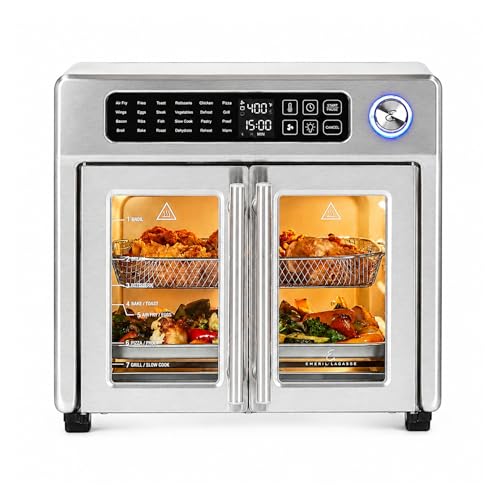
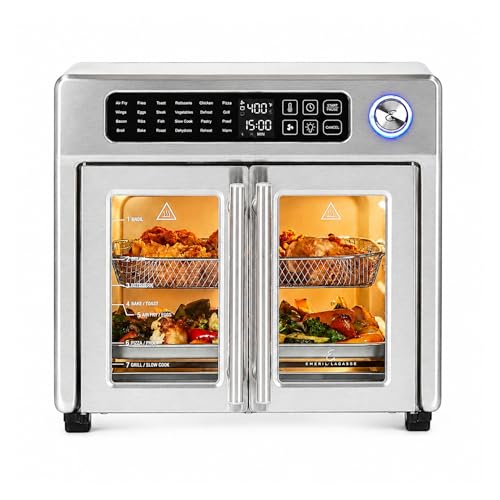
Emeril Lagasse 26QT French Door Multi-Function Air Fryer Toaster Oven
Badge: Best Dry Oven for Big Batches
Strengths
- A 26-quart extra-large interior dries and roasts on trays — batch scale no basket matches.
- French doors make loading and turning tray food easy mid-cook.
- Twenty-four presets and six included accessories cover the dry repertoire from crisps to roasts.
Trade-offs
- No ultra-low drying floor is stated in its title; batch drying follows its programmes and settings.
- The footprint is the joint-largest here, with clearance needs to match.
- Layer-style oven crisping differs from deep-basket crisping; fries behave differently.
Mini spec box
- Capacity: 26 quarts, extra-large interior
- Format: French door countertop convection oven
- Presets: 24 one-touch options
- Included: six cooking accessories
Drying and roasting share a physical requirement that baskets cannot satisfy at scale: area. A tray of tomato slices, a sheet of seasoned vegetable crisps, a family roast with its vegetables spread in one layer — these are area jobs, and the Emeril’s 26-quart cavity is the area pick of this guide. The French doors matter more in dry cooking than in any other style, because tray food needs turning and checking without a hot drop-down door in the way, and the six included accessories mean the racks and trays for the job arrive in the box.
As a dry oven it suits the household whose dry cooking is generous and social: big roasts with properly dried, salted surfaces; party batches of crisps; a weekend tray of drying produce from the garden. Its honest limitation is the low end — its title promises presets and convection rather than a stated ultra-low floor, so the precision dryer should compare the Nuwave below before deciding. For batch dry cooking at family scale, though, area beats decimals, and this is the area champion.
Best for: families and gardeners drying or roasting in tray-sized batches / Not suited for: precision low-temperature drying, or small counters

Nuwave Bravo XL Pro Air Fryer Toaster Oven with Grill Combo
Badge: Best Low-and-Slow Dry Range
Strengths
- A stated 50–500°F range — the widest here — covers proofing, drying, roasting and searing in one cavity.
- Thirty quarts of tray space for batch drying, with 142 presets to run it.
- A temperature probe finishes roasts by measurement, protecting them from dry-heat overshoot.
Trade-offs
- The premium tier and the largest footprint of the six.
- Its preset depth is wasted on narrow repertoires.
- Low-and-slow drying in a big cavity uses the whole oven for small batches.
Mini spec box
- Capacity: 30 quarts
- Temperature: 50–500°F
- Presets: 142, with a temperature probe
- Format: air fryer toaster oven with grill combo, stainless steel
- Construction note: PFAS free
The Nuwave is the dry extremist in both directions, and dry cooking is precisely the discipline that rewards extremes. At 50°F it can proof dough and begin the gentlest drying with air that barely cooks at all; through the low hundreds it dries fruit, herbs and jerky with oven-scale tray area; at the top of its range it sears a dry-brined steak’s crust the way dry heat is supposed to. No other pick spans the full dry spectrum in a single cavity, and the probe is the finishing touch — in dry heat, the line between roasted and desiccated is an internal temperature, and the probe watches that line so you do not have to guess it.
Its honest limitations are commitment and cost of scale: thirty quarts in stainless steel at the premium tier, and a big cavity that is an extravagant way to dry six apple slices. Households that dry, proof, roast and sear across a whole week will find the extravagance justified; households with one dry job should buy the specialist for that job instead — the OLIXIS for basket drying, the Emeril for tray batches. For the cook who wants the entire dry map in one machine, this is it.
Best for: serious cooks spanning drying, proofing, roasting and searing in one oven / Not suited for: small kitchens, tight tiers, or single-purpose drying

Oster Extra-Large French Door Air Fryer Countertop Oven
Badge: Best Simple Family Dry Oven
Strengths
- An extra-large cavity fitting 15 x 12 inch pans — family trays dry and roast in one layer.
- Six plain presets keep dry cooking accessible to the whole household.
- An auto-shutoff timer suits long, low-attention cooks.
Trade-offs
- No stated dehydrate function or ultra-low range — drying here is straightforward roasting territory.
- Extra-large footprint, as with every big oven in this guide.
- No rotisserie, probe or specialty programmes.
Mini spec box
- Capacity: extra-large; fits 15 x 12 inch pans
- Format: French door countertop oven
- Presets: 6 cooking presets
- Safety: auto-shutoff timer
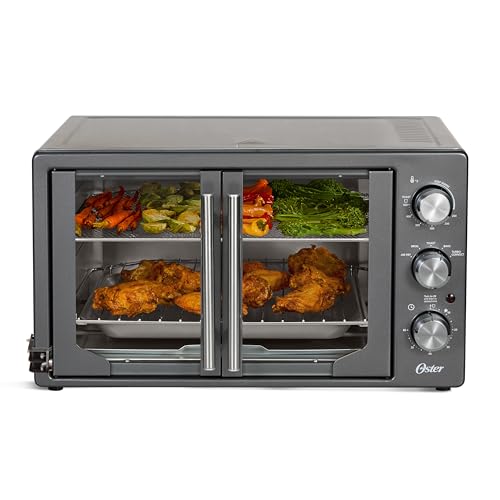
The Oster’s dry case is the case for honest simplicity at family scale. Most household dry cooking is not jerky-making; it is roast potatoes with crisp skins, vegetables that caramelise instead of steaming, reheated pizza that comes back crunchy, and tray dinners where everything needs its own dry space. For that repertoire, a big cavity, moving air and six presets anyone can run are not a compromise — they are the specification. The 15 x 12 inch pan capacity means the family’s own cookware does the drying and roasting, in single layers, which is the technique that matters more than any programme.
Its honest limitation is the specialist end: with no stated dehydrate function or low range in its title, it is not the machine for the herb-dryer or the jerky maker, and this guide will not pretend otherwise. Buy it as the family’s dry-roasting oven and it is superb value in its tier; buy it as a dehydrator and the specialist picks above exist to correct you. Knowing which dry household you are is, as ever, the whole decision.
Best for: large families whose dry cooking is roasting, crisping and reheating at tray scale / Not suited for: dehydrating specialists, or small counters
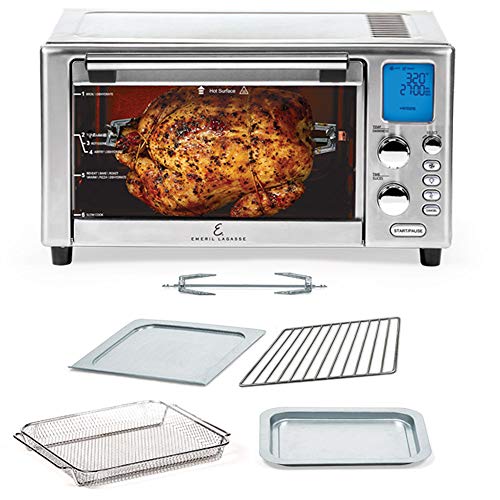
Emeril Lagasse Everyday 360 Air Fryer Oven, 9-in-1
Badge: Best Rotisserie Dry Roasting
Strengths
- 360° convection wraps food in dry moving air from all sides — even browning without tray rotation.
- Rotisserie dry-roasts birds and joints with self-basting, crisping skin.
- A mid-size 9-in-1 oven that fits kitchens the extra-large picks cannot.
Trade-offs
- Mid-size cavity; batch drying and crowd roasts mean rounds.
- No stated ultra-low drying floor in its title.
- Rotisserie loads suit modest birds rather than the largest poultry.
Mini spec box
- Functions: 9-in-1 countertop oven
- Circulation: 360° convection
- Feature: rotisserie among its cooking functions
- Format: countertop air fryer oven for everyday meals
Dry roasting reaches its most theatrical form on a rotisserie, and the Everyday 360 is this guide’s rotisserie pick. A turning bird in 360° moving air bastes itself in its own juices while its skin dries and crisps continuously — the two things dry roasting wants, happening at once, with no turning schedule for the cook to keep. The same all-around circulation serves tray food kindly, evening out the hot-spot problem that makes lesser ovens roast in patches.
As an everyday dry oven it is the mid-size compromise done well: nine functions covering the week, a footprint ordinary kitchens can house, and the one specialty — rotisserie — that genuinely changes the menu. Its honest limitations are scale and the specialist low end: crowd batches take rounds, and precision drying belongs to the low-floor picks above. For the household whose dry signature is a Sunday chicken with properly crisp skin, it is the most enjoyable machine on this page, and Best Electric Fryers Air covers its electric cousins for readers comparing the wider field.
Best for: rotisserie lovers and mid-size kitchens wanting even dry convection / Not suited for: batch drying, crowd cooking, or precision low-temperature work
Comparison Table
| Pick | Format | Capacity | Dry standout | Check |
|---|---|---|---|---|
| Ninja DZ201 | Dual basket | 8 qt | Dehydrate function, two zones | Check on Amazon |
| OLIXIS Dual | Dual basket | 9.5 qt | 80°F floor, dehydrate + defrost | Check on Amazon |
| Emeril 26QT | Oven, French door | 26 qt | Batch tray area | Check on Amazon |
| Nuwave Bravo XL Pro | Oven with grill | 30 qt | 50–500°F span + probe | Check on Amazon |
| Oster French Door | Oven, French door | Extra-large, fits 15 x 12 in pans | Simple family dry roasting | Check on Amazon |
| Emeril Everyday 360 | Oven, 9-in-1 | Mid-size | Rotisserie + 360° convection | Check on Amazon |
How to Choose a Dry Air Fryer
Decide which dry job is yours, because the three dry pursuits rank machines differently. For crisping — the everyday dry job — airflow authority and single-layer capacity rule: baskets for small fierce loads, ovens for trays, and any pick here will serve. For dehydrating, the ranking inverts: the temperature floor and the stated dehydrate function become the whole specification, which is why the OLIXIS and the DZ201, with the Nuwave’s 50°F floor behind them, lead that conversation. For dry roasting with rubs and brines, cavity and evenness rule — the rotisserie Emeril and the big French door ovens earn their keep. Most households do the first daily, the second occasionally and the third weekly, which is exactly the weighting behind the DZ201’s top badge; households that dry seriously should re-weight without hesitation and buy the floor, not the badge.
Then check the physical facts. Drying area is rack and tray area — count it in the pans you own. Low-temperature work needs a machine whose stated range actually reaches it, not a bake setting asked to improvise. And dry cooking is long cooking at the gentle end, so timer length and auto shutoff — the Oster’s quiet virtue — matter more than they do for a twelve-minute fry. Match those facts to your dry repertoire and the shortlist usually narrows itself to one.
How to Dry and Dehydrate in an Air Fryer
- Slice evenly. Uniform thickness is the whole secret of even drying; a mandoline or a patient knife matters more than the machine.
- Prepare the surface: pat produce dry, season or cure jerky properly, and blanch the vegetables that need it before drying.
- Load in a single layer with air gaps on every side. Drying is airflow over time; overlap creates damp pockets that spoil first.
- Set the lowest appropriate temperature — the OLIXIS at its 80°F end, the Nuwave through its low range, or the dehydrate programme on the Ninja — and give it time measured in hours, not minutes.
- Rotate trays or baskets once or twice during long dries, so the pieces nearest the airflow do not finish long before the rest.
- Judge doneness by feel and snap, then condition the batch: rest dried food in a sealed container for a few days, checking for any residual moisture, before long storage.
Troubleshooting
Problem: dried food turns leathery in patches and crisp in others → slices were uneven or the load overlapped; slice uniformly, load in one layer, and rotate during the dry.
Problem: herbs darken and lose aroma → the temperature was too high; drying herbs is the lowest-heat job in this guide, so use the lowest stated setting and patience.
Problem: crisped food goes soggy within minutes of serving → it rested in its own steam; lift it onto a rack, not a plate, and serve promptly — dry food reabsorbs moisture eagerly.
Dry Rubs, Dry Brines and the Crust They Build
Dry heat’s finest trick is what it does to seasoning. A dry rub — salt, spices, perhaps a little sugar — sitting on a surface that the moving air keeps dry will toast, set and become a crust; the same rub on a steaming surface dissolves into sauce. The air fryer is therefore the rub’s natural home, and the technique is simple: apply rubs early enough for salt to work — an hour helps, overnight in the fridge, uncovered, transforms chicken skin and roasts — then cook without adding moisture back. No spritzing, no basting with liquid, no crowded basket raining steam onto the crust you built. The rotisserie pick is the honourable exception that proves the rule: its basting liquid is the bird’s own fat, rendered and redistributed by turning, while the surface still dries between passes of hot air.
Dry brining deserves the same paragraph of respect. Salt alone, applied a day ahead and left uncovered in the refrigerator, seasons deeply, dries the surface, and sets up the crispest skin and crusts this category can produce — and it costs nothing but foresight. Pair it with any pick here and the improvement will be larger than the difference between any two machines on this page, which is the honest perspective every buying guide should end with: buy a good dry machine, then learn the dry craft, in that order but with more effort on the second.
Crisp Outside, Moist Inside: Managing Dry Heat’s One Risk
The paradox of dry cooking is that its virtue and its failure are the same property. Moving dry air that crisps a surface will, given time, desiccate the interior — lean fish, chicken breast and thin vegetables live closest to that line. The management is technique, not machinery: choose the right thickness, use the fierce-short pattern (high heat, brief time) for lean foods rather than the moderate-long one, pull them a fraction early and let carryover finish the job, and rest proteins so their juices redistribute before cutting. Where a machine offers a probe — the Nuwave — use it for exactly this borderland, because internal temperature is the honest measure of the line.
It is also worth saying that some foods should not be dry-cooked at all, and a guide that pretends otherwise sells machines at the cost of dinners. Delicate wet batters, very lean white fish in thin fillets, and anything whose virtue is succulence under gentle steam will all be happier in another appliance. The dry category is enormous — crisping, roasting, drying, dehydrating, reheating — and it does not need to annex the whole kitchen to justify itself. Readers comparing formats for the foods themselves can browse Best Food Air Fryers for the dish-first view.
The Science of the Crisp: Why Dry Air Browns Better
Browning is chemistry with a moisture problem. The reactions that create roasted flavour and golden colour — the Maillard reactions between proteins and sugars, and caramelisation in vegetables — only proceed at pace once a food’s surface is both hot and dry. In a still oven, a vegetable spends its first minutes wrapped in its own escaping steam, effectively poaching its surface at water’s temperature while the clock runs. Moving dry air changes the sequence: the fan strips that steam layer away continuously, the surface dries within minutes, its temperature climbs past the threshold, and browning begins while the interior is still gently cooking. That is why air-fried food tastes roasted in a way boiled-then-baked food never does, and why the same potato crisps in an air fryer at a setting where a still oven merely softens it.
The same science explains this guide’s recurring commandments. Crowding re-creates the steam blanket the fan exists to remove. Wet surfaces spend their heat budget on evaporation instead of browning. Sugar-bearing rubs scorch if the fierce stage runs too long, because a dry surface at high temperature is chemically eager. And dried foods keep so well precisely because the process is moisture removal carried to completion — the microbes that spoil food need water the finished product no longer offers. A cook who understands that dry air is a moisture-management system, not just a heat source, will get better results from the Oster’s six presets than a careless cook gets from the Nuwave’s hundred and forty-two, which is the most useful sentence in this entire guide.
Dry Cooking Across the Week
It helps to see how the three dry pursuits distribute across an ordinary week, because that distribution is what your purchase should match. Crisping is the daily shift: fries, wings, roasted vegetables, reheated leftovers returning to crispness — short, fierce, frequent. Dry roasting is the weekly anchor: the Sunday chicken on the rotisserie, the tray of root vegetables, the dry-brined pork that spent Saturday in the fridge. Dehydrating is the occasional project: a glut of apples, a herb harvest, a batch of jerky for a trip — long, low and infrequent, but impossible to improvise on a machine without the range for it. A household honest about its own distribution will usually find crisping dominates, which is why all-rounders lead this guide; but the household whose garden floods it with produce every autumn should weight the third pursuit far higher and buy the low floor without apology.
There is also a seasonal rhythm worth noticing. Summer belongs to crisping and to drying the garden’s surplus; winter belongs to roasting, to reheating, and to the dried stores coming back out of the cupboard. A machine bought in one season for one pursuit will be asked to do the others by the next, which is the practical argument for the versatile picks — the two-zone Ninja, the wide-range OLIXIS and Nuwave — over a narrow specialist, unless the specialist’s one job is truly your whole story.
Cleaning and Storing: Care for a Dry-Heat Machine
Dry cooking is mercifully clean cooking — no oil bath to filter, no spattering deep fat — but it has its own residue: the fine grease mist that roasting sends around the chamber, and the sugary films that rubs and glazes leave on trays. Both bake harder with every cook if ignored. The routine is the familiar one, done promptly: baskets and trays washed while the residue is young, crumb trays emptied, interiors wiped warm, and a monthly look at the element and fan guard. Dry machines forgive a skipped clean better than most, right up until the day a fierce crisping cook burns off a month of mist as smoke; the two-minute habit is cheaper.
For the drying household, add one storage discipline: dried food is only as good as its container. Cool batches completely before sealing, store them airtight and away from light, and label with the date — dried herbs and fruit keep their quality for months, but “months” is a property of the storage, not just the drying. The machine’s job ends at the rack; the cupboard’s job begins there, and both deserve the same single-layer, dry-air respect.
Dry Air Fryers vs Dedicated Dehydrators
The drying reader may fairly ask why this guide exists at all, when dedicated dehydrators are sold for exactly that job. The honest comparison runs both ways. A dedicated dehydrator offers stacked trays, very low and even heat, and nothing else; for a household drying in serious volume — a harvest, a hunting season — it remains the specialist’s tool, and no air fryer in this guide pretends to out-dry it at scale. What the air fryer offers instead is the rest of the week: the same machine that dries Saturday’s apples crisps Monday’s dinner, roasts Sunday’s chicken and reheats Tuesday’s pizza, in a footprint one appliance deep. Most households’ drying is occasional and modest, and for them the dual-purpose machine is not a compromise but the correct allocation of counter and money. Buy the dedicated dehydrator when drying becomes a harvest-scale habit; until then, a low-floored pick from this page covers the job inside an appliance you will use daily — which is, in the end, the driest and most practical argument in this guide.
Common Buying Mistakes
- Buying a “dehydrator” with no low end. If the stated range or programme list shows no genuinely low temperature or dehydrate function, the machine cooks; it does not dry.
- Crowding in the name of capacity. Dry cooking is single-layer cooking; a brim-full basket is a steamer, whatever the badge says.
- Judging drying by quarts. Drying capacity is tray and rack area in one layer, not chamber volume.
- Skipping the surface prep. Wet food steams before it browns; the pat-dry minute is the cheapest performance upgrade in this guide.
- Leaving lean foods in “a little longer to be safe”. In dry heat, a little longer is the difference between crisp and desiccated; use time and temperature discipline instead.
Final Recommendation
For most households, start with the Ninja DZ201: a stated dehydrate function, two-zone crisping and the category’s sweet-spot size make it the most complete dry cooker here. If drying is your serious pursuit, the OLIXIS and its 80°F floor is the specialist’s pick, while the Emeril 26QT wins when dry batches are tray-sized. The Nuwave is the full-spectrum instrument for the cook who dries, proofs, roasts and sears; the Oster is the family’s simple dry-roasting oven; and the Emeril 360 owns rotisserie dry roasting. Choose by your dry job, keep surfaces dry and layers single, and any of these six will show you why dry heat built this category’s reputation.
Frequently Asked Questions
What does “dry” mean in dry air fryers?
It names the cooking method: dry heat. Air fryers cook with fast-moving hot air and no oil bath or liquid, so surfaces dry, brown and crisp. This guide reads the word that way — as the category’s general lens — and judges machines on crisping, dry roasting and dehydrating, the three jobs dry heat defines.
Can an air fryer really dehydrate food?
Yes, if it can hold genuinely low temperatures for hours. Machines with a stated dehydrate function — the Ninja DZ201 and the OLIXIS here — or a very low stated floor, like the Nuwave’s 50°F, dry herbs, fruit and jerky properly. A machine whose range starts at baking temperatures can only imitate the job.
How do I stop air-fried food from drying out?
Cook lean foods hot and short rather than moderate and long, pull them slightly early, and rest proteins before cutting. Surface dryness is the goal; interior dryness is a timing error. A probe, where fitted, removes the guesswork for thick cuts.
Do I need any oil at all for dry air frying?
Often none, and at most a light coating on the food itself for browning and heat transfer — a teaspoon’s worth across a basket, not a bath. Pre-oiled frozen foods need none added. The dry method’s point is that oil becomes a seasoning-level ingredient, not the cooking medium.
Which is better for drying, a basket or an oven?
An oven, for batches: tray area in a single layer is drying capacity, and the big cavities here multiply it. Baskets dry small batches well and crisp fiercely, and a dual basket can dry in one zone while dinner cooks in the other — the DZ201’s party trick.
Can I dry herbs from the garden in an air fryer?
Yes — it is one of the gentlest and most satisfying dry jobs, provided your machine reaches genuinely low temperatures. Use the lowest stated setting or the dehydrate programme, spread leaves in a single layer off their stems, and check in short cycles near the end: herbs are done when they crumble between fingers, and they go from done to scorched with little warning at higher heats. The OLIXIS at its low end and the Nuwave through its low range are the picks here; a machine that only bakes will cook your herbs instead of drying them, which is the difference this whole guide is about.
Is a dry air fryer good for reheating?
It is the best reheating method most kitchens own. Because the heat is dry and moving, yesterday’s roast potatoes, pizza and fried foods return to crispness instead of the microwave’s steam-softened version of themselves — a few minutes at moderate heat, in a single layer, is the whole technique. For many households this quiet daily job, more than any headline dish, is what justifies the machine’s counter space.
Why does my crisped food go soft after a few minutes?
Steam. Hot food keeps releasing moisture, and if it rests piled on a plate it reabsorbs its own steam and softens. Rest it on a rack in a single layer and serve promptly; dry food is at its best in its first minutes, which is a serving habit, not a machine fault.