Disclosure: topratedkitchenware.com is reader-supported. When you buy through links on our site, we may earn an affiliate commission from Amazon and other retailers, at no extra cost to you.
Where to buy
The six models below are the verified picks for this guide to traditional slot toasters. Each name links to its Amazon listing, where you can check the latest price on Amazon and confirm the current variant before you order.
- Hommater 2 Slice Smart Toaster with LCD Display
- Amazon Basics 2 Slice Toaster
- Elite Gourmet ECT1027B 2-Slice Cool-Touch Toaster
- Hamilton Beach 22634 Extra-Wide Slot 2 Slice Toaster
- bella Fits-Anywhere Slim Toaster, 4 Slice
- BLACK+DECKER 2-Slice Toaster with Extra-Wide Slots
Read the full guide ↓ for how the pop-up mechanism actually works, which carriages and lifts serve it best, and why this format still beats the alternatives for pure toast.
The best pop up toasters are built around the most satisfying mechanism in the kitchen: bread goes down under a lever, disappears into glowing slots, and returns — transformed — on a spring, announced by a pop that has started more breakfasts than any alarm clock. This guide is a defence and an audit of that mechanism. All six verified picks here are true pop-up slot toasters, five in the classic two-slice form and one in a slim long-slot four-slice form, and not one is a toaster oven in disguise: no doors, no racks, no baking pretensions. They are ranked by how well each serves the pop-up idea itself — carriage travel and lift height, slot geometry, shade control, the special cycles that adapt the pop to bagels and frozen bread, and the trays that keep the whole performance clean.
Choosing the pop-up format is itself a decision worth making consciously. A toaster oven bakes, broils and reheats; a pop-up toaster does one thing at a speed and evenness the oven format does not match for sliced bread, in a footprint a fraction of the size. Households whose breakfast is toast, bagels and muffins — which is most households, most mornings — are served better by the specialist. Readers torn between the formats should compare our guide to Best Prices On 4 Slice Toasters for capacity questions and the oven-format field separately; readers who want the pop-up judged purely on build should see Best Quality Toasters. Here, the pop is the point.
Every pick is drawn from verified listing information checked on 2026-11-20, with specifications quoted only as stated. Each review carries a badge, three strengths, three trade-offs and a plain verdict, and no hands-on testing is claimed — only a close reading of how each machine implements the classic mechanism.
Key Takeaways
- Pop-up means slots and a spring carriage: all six picks here are true pop-up toasters, with no oven-format impostors.
- Lift is the pop-up’s signature detail — extra lift levers and Toast Boost decide whether small slices come back to you.
- The Hommater adds a countdown display and nine shade settings to the classic pop.
- The Hamilton Beach pairs its pop with auto shutoff, answering the mechanism’s one historic weakness, the jam.
- The bella stretches the pop-up idea into a slim four-slice long slot for family rounds.
- Wide and extra-wide slots are universal here, so bagels and thick bread pop as happily as sandwich slices.
In this guide
Quick Picks
Six true pop-up machines, ranked by mechanism and fit. Professional-format readers may also want our guide to Best Professional Toasters for heavier-duty interpretations of the same format.
| Pick | Badge | Best for | Listing |
|---|---|---|---|
| Hommater 2 Slice Smart Toaster | Best Overall Pop-Up | Precision households wanting display feedback on the classic pop | Check on Amazon |
| Amazon Basics 2 Slice Toaster | Best Classic Pop-Up Value | The complete pop-up specification with tray and cord wrap | Check on Amazon |
| Elite Gourmet ECT1027B | Best Pop-Up for Families | Cool-touch housing around the classic mechanism | Check on Amazon |
| Hamilton Beach 22634 | Best Pop-Up for Small Slices | Toast Boost lift plus auto shutoff | Check on Amazon |
| bella Fits-Anywhere Slim Toaster | Best Long-Slot Pop-Up | Four slices and long loaves from a slim pop-up body | Check on Amazon |
| BLACK+DECKER 2-Slice Toaster | Best Traditional Pop-Up | Lever, extra lift and tray in the purest form here | Check on Amazon |
How These Picks Were Chosen
The pool is the verified slot-toaster field, checked against Amazon’s listing data through the Creators API on 2026-11-20. The first filter was format purity: only true pop-up slot toasters were admitted, so every pick lowers its bread into slots on a carriage and raises it on a spring — no countertop ovens, no drawer or conveyor designs. The second filter was pop-up execution as stated in the listings: lift help for the return stroke, slot width for the load, shade range for the timing, tray design for the aftermath, and the special cycles — bagel, defrost, cancel, reheat — that adapt the basic pop to modern bread.
That method yields a guide with a clear centre. Two picks perfect the classic return stroke (the BLACK+DECKER’s extra lift lever, the Hamilton Beach’s Toast Boost). Two complete the classic specification around the mechanism (the Amazon Basics’ tray and cord wrap, the Elite Gourmet’s cool-touch housing and dimensioned slots). One modernises the pop’s information layer (the Hommater’s countdown and nine settings). And one stretches the mechanism’s geometry (the bella’s long slot, four slices in a slim body). Each is a different answer to the same question: what should a pop-up toaster be, now that its format has won?
This is a research-led guide with no hands-on claims and no printed prices. Mechanism descriptions are general engineering accounts of how slot toasters work; per-model claims are confined to what each listing states, and gaps are flagged in the reviews rather than filled by assumption. Buyers comparing this format against ranked alternatives will find the same pool ordered by reputation in our guide to Best Ranked Toasters.
The 6 Best Pop Up Toasters, Reviewed
Badges match the Quick Picks table. Each review uses only stated specifications, names one honest limitation, and ends with a plain verdict.
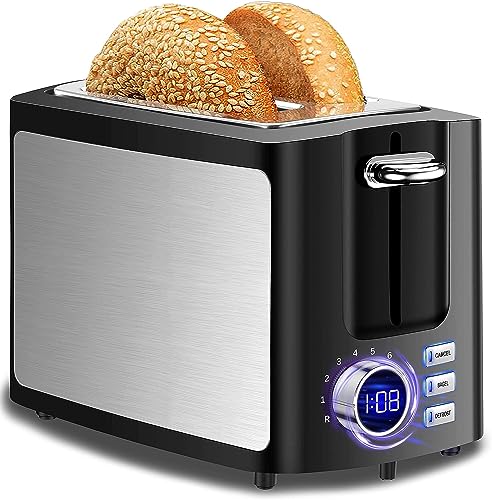
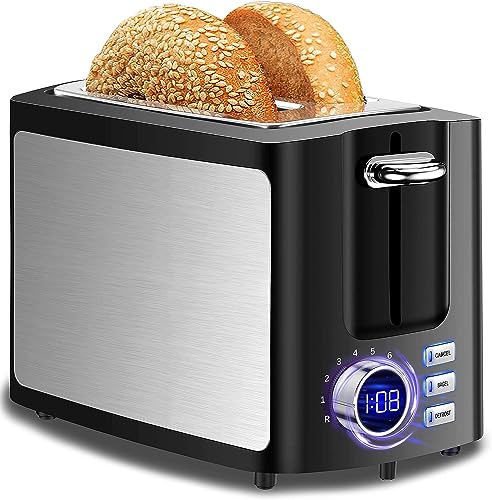
Hommater 2 Slice Smart Toaster with LCD Display
Badge: Best Overall Pop-Up
Strengths
- The classic pop, instrumented: an LCD countdown shows the cycle the carriage is running.
- Nine shade settings give the pop the finest timing range in this pool.
- Bagel, Defrost, Cancel and Reheat adapt the pop to every modern bread situation.
Trade-offs
- The listing describes no crumb tray, so clean-out is unconfirmed.
- No extra-lift feature is stated for the return stroke.
- A display panel is more interface than the purest pop-up needs.
Mini spec box
- Format: 2 slice pop-up, wide slot
- Controls: LCD digital countdown timer
- Shade settings: 9
- Functions: Bagel / Defrost / Cancel / Reheat
The pop-up mechanism’s one informational flaw is that it is a black box: bread vanishes, time passes, toast returns on the machine’s schedule rather than yours. The Hommater keeps the mechanism and removes the mystery. Its countdown display narrates the cycle, its nine shade settings subdivide it finely, and its four stated functions retime it for bagels, frozen slices and reheats. For a household that toasts several breads at several darknesses, that instrumentation turns the pop from a surprise into a system — the same spring, the same slots, with the guesswork engineered out.
The wide slots keep the format’s modern promise, accepting the thick slices and bagel halves that narrow vintage slots refused, and the cancel function gives the user an override the earliest pop-ups lacked: the pop can be summoned early when a cycle goes wrong. It is, in short, the classic mechanism with its three historic information gaps — when, how dark, how do I stop it — all answered on one panel.
The honest limitations are a tray the listing does not describe and a return stroke with no stated extra lift, so muffin halves may sit lower than on the guide’s lift specialists. Verify the tray on the listing page if clean-out leads your brief. As the pop-up perfected by information, it leads this guide.
Best for: Mixed households wanting the classic pop with modern precision / Not suited for: Buyers who rank a confirmed tray and extra lift first

Amazon Basics 2 Slice Toaster
Badge: Best Classic Pop-Up Value
Strengths
- The complete pop-up specification: extra-wide slots, removable crumb tray, Defrost, Cancel and Bagel buttons.
- Cord wrap keeps the classic footprint tidy between pops.
- Stated 900W power sets honest expectations for the mechanism’s pace.
Trade-offs
- Six browning settings is the joint-narrowest timing range here.
- No extra lift is stated for the return stroke.
- Black and silver is a finish, not a stated construction material.
Mini spec box
- Format: 2 slice pop-up, extra-wide slots
- Power: 900W (as stated in the listing)
- Browning settings: 6
- Details: removable crumb tray, cord wrap
- Buttons: Defrost / Cancel / Bagel
If the pop-up format has a standard specification — the checklist a buyer should recite before accepting any example of it — the Amazon Basics is the machine that recites it back. Slots wide enough for bagels: stated. A tray that removes so the pop stays clean: stated. Buttons for the frozen slice, the mistake and the bagel: stated, all three. A cord that wraps so the machine stores like the compact appliance it is: stated. Even the wattage is stated, a small honesty that suits the format’s plain-dealing tradition. Nothing on the list is exotic, and the list is complete, which is precisely the classic pop-up’s idea of excellence.
Daily life with it is correspondingly uneventful in the best way: bread down, lever down, toast up, tray out once a week. For first flats, rentals, offices and second homes — the pop-up’s natural habitats — that completeness without complication is the value case, and our guide to Best Prices On Toasters tracks how this specification sits in the wider market.
The honest limitations are the six-setting range, which mixed-preference households will feel, and the unstated lift help, which muffin households will feel. Both are covered by neighbours in this guide at similar positions. As the standard pop-up, completely specified, this is the benchmark pick.
Best for: Almost any pop-up buyer — the complete standard specification / Not suited for: Households needing fine shade steps or stated lift help

Elite Gourmet ECT1027B 2-Slice Cool-Touch Toaster
Badge: Best Pop-Up for Families
Strengths
- Cool-touch housing wraps the pop-up mechanism in a safer exterior for family counters.
- Slots specified at 1.25 inches extra-wide — the pop sized honestly for bagels and thick bread.
- Six shades with Cancel and bagel capability keep the family panel simple.
Trade-offs
- No defrost function is stated for frozen bread.
- No crumb tray is described in the listing.
- No extra lift is stated for small slices.
Mini spec box
- Format: 2 slice pop-up, cool-touch housing
- Slot width: 1.25 in extra-wide (as stated)
- Shades: 6
- Functions stated: Cancel, bagel mode
- Colour: Black
The pop-up mechanism concentrates heat in a small box with an open top, and in a family kitchen that box stands at elbow height for exactly the people least equipped to respect it. The ECT1027B’s answer is its cool-touch housing: the pop performs as it always has, while the exterior stays safer to brush, steady or crowd. For parents, that single construction decision outranks every timing refinement in this guide, because it governs every cycle rather than the special ones.
The rest of the specification is the family pop-up done plainly: slots dimensioned in writing at 1.25 inches, so bagel halves genuinely fit; six shades spanning the household range; a cancel control for the cycles children start and abandon; a bagel capability for weekends. There is nothing on the panel a new operator can misunderstand, which in a family machine is a safety feature of its own.
The honest limitations are the unstated defrost — frozen waffles are family food, so verify it on the listing page — and the undescribed crumb tray. If both check out or neither matters to your routine, this is the family pop-up: the classic mechanism with its one dangerous surface civilised.
Best for: Families wanting the classic pop without the hot housing / Not suited for: Households needing a stated defrost cycle
Hamilton Beach 22634 Extra-Wide Slot 2 Slice Toaster
Badge: Best Pop-Up for Small Slices
Strengths
- Toast Boost perfects the pop’s return stroke, lifting small slices properly clear.
- Auto shutoff answers the jam — the pop-up mechanism’s one historic failure mode.
- Slide-out crumb tray, seven shades, and bagel and defrost buttons complete the set.
Trade-offs
- The Kitchen Makeover Blue finish is a bold choice for a classic format.
- No reheat function or cord storage is stated.
- No countdown feedback for timing-led users.
Mini spec box
- Format: 2 slice pop-up, extra-wide slot
- Shades: 7 browning settings
- Details: auto shutoff, Toast Boost, slide-out crumb tray
- Functions: Bagel, Defrost
- Colour: Kitchen Makeover Blue
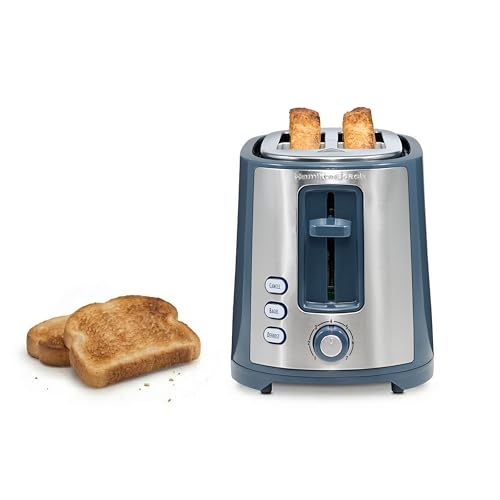
A pop-up toaster stands or falls on its return stroke, and the 22634 is built around improving it twice. Toast Boost raises finished toast higher than the standard pop, which sounds like a small thing until the item is a muffin half, a mini bagel or the short end of a loaf — the foods that ordinary carriages strand at fingertip depth. Auto shutoff guards the stroke’s failure mode: if a slice wedges and the carriage cannot rise, the cycle ends itself instead of smouldering until a human intervenes. Together they make this the most mechanism-aware design in the guide — a pop-up that has thought hardest about what popping involves.
The specification around the mechanism is complete in the classic manner: seven shades, extra-wide slots, bagel and defrost buttons, and a slide-out tray that keeps the slot shafts clean so the carriage travels freely. That last detail is more mechanical than it sounds; crumb build-up is the enemy of smooth carriage travel, and a tray designed for seconds-long emptying is a mechanism feature disguised as a cleaning one.
The honest limitations are the bold blue finish and the absence of a named reheat. Neither touches the mechanism. For households whose toast is small, thick or frozen — and whose mornings are distracted — this is the pop-up that has done the most thinking about the pop itself.
Best for: Small-slice households and anyone who has ever fished for a muffin / Not suited for: Kitchens that need a quiet, neutral finish

bella Fits-Anywhere Slim Toaster, 4 Slice
Badge: Best Long-Slot Pop-Up
Strengths
- The pop-up mechanism stretched lengthwise: four slices along one extra long and wide slot line.
- Slim Fits-Anywhere body brings pop-up capacity to narrow counters.
- Long slices pop whole — no trimming, no half-toasted overhang.
Trade-offs
- The listing states no shade count and names no bagel or defrost functions, so its cycle controls are unverified.
- No crumb tray design is described.
- Long-slot popping behaves differently from the twin-slot pattern for standard slices.
Mini spec box
- Format: 4 slice pop-up, slim body, extra long and wide slot
- Design line: Fits-Anywhere
- Colour: Oatmilk
- Controls and functions: not stated in the listing title
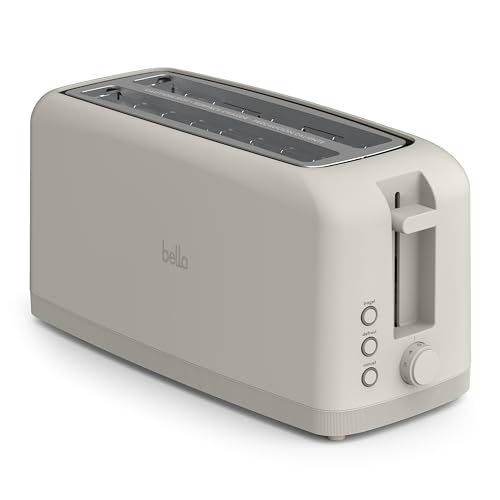
Every format deserves a mutation that tests its limits, and the bella is the pop-up’s. Instead of two slots side by side, it runs the mechanism along a single extra long and wide slot line in a slim body, so four standard slices pop in a row — or a long artisan slice pops whole, end to end, which no twin-slot machine in this guide can offer. For a family in a narrow galley kitchen, that geometry converts the pop-up from a two-slice ritual into a round-serving appliance without surrendering counter depth to a conventional four-slice box.
The Oatmilk finish suits the mutation’s spirit: this is the pop-up redesigned for the kitchens that actually exist now — narrow, visible, multi-purpose — rather than the generous counters the format was born on. Readers researching the four-slice branch specifically will find its wider field in our guide to Best Ratd American Made 4 Slice Toasters and the capacity comparisons linked from this guide’s Quick Picks.
The honest limitation is documentation: no shade count, no named functions and no tray description appear in the listing title, so the cycle side of its pop is unverified where its geometry is plain. Confirm the panel on the listing page before buying it for anything beyond capacity and loaf shape. As the long-slot pop-up, it earns its badge on the mechanism’s own terms.
Best for: Narrow kitchens needing four-slice rounds or whole long loaves / Not suited for: Buyers who want the control set documented in advance
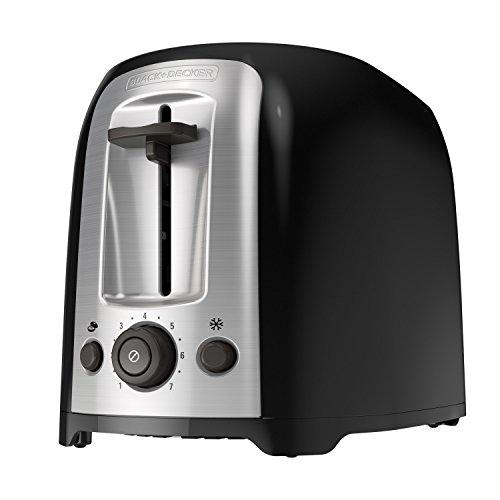
BLACK+DECKER 2-Slice Toaster with Extra-Wide Slots
Badge: Best Traditional Pop-Up
Strengths
- Extra lift lever — the traditional answer to the return stroke, stated plainly.
- Removable crumb tray keeps the carriage’s world clean.
- Seven shade settings and a bagel mode complete the classic pop-up panel.
Trade-offs
- No defrost function is stated in the listing.
- No auto shutoff or cord storage is described.
- No display feedback; the pop arrives on the mechanism’s timing, as it always has.
Mini spec box
- Format: 2 slice pop-up, extra-wide slots
- Shade settings: 7
- Details: extra lift lever, removable crumb tray
- Mode stated: bagel mode
This is the pop-up as its makers refined it over generations and as this guide’s purists will want it preserved: a lever you press, a carriage that travels, an extra lift you raise for the short slices, a tray that slides out to be emptied, a dial with seven honest settings, and one modern mode — bagel — admitted because bagels earned it. The mechanism needs no narration and offers none; the pop is the feedback. In households where the toaster is operated by everyone from children to grandparents, that wordless legibility is the format’s deepest virtue, and this pick embodies it most completely.
Its extra-wide slots are the one geometric concession to the present, and they are the right one: the pop now serves the thick bakery slice and the bagel half that the format’s early slots would have refused. Nothing else about the machine pretends to be new, and nothing about it needs to be.
The honest limitation is the unstated defrost, the modern cycle this traditional panel leaves unclaimed, plus the absence of a stated shutoff. Freezer households should verify the panel on the listing page or choose a neighbour that states defrost outright. As the traditional pop-up, complete in its own terms, it closes the ranking where the format began.
Best for: Traditionalists wanting the pure pop-up mechanism, properly specified / Not suited for: Households that toast from frozen daily
Comparison Table
| Pick | Format | Shades | Pop-up strength | Listing |
|---|---|---|---|---|
| Hommater Smart Toaster | 2 slice pop-up, wide slot | 9 | Countdown display and four functions | Check on Amazon |
| Amazon Basics | 2 slice pop-up, extra-wide | 6 | Complete specification, tray and cord wrap | Check on Amazon |
| Elite Gourmet ECT1027B | 2 slice pop-up, 1.25 in slots | 6 | Cool-touch housing | Check on Amazon |
| Hamilton Beach 22634 | 2 slice pop-up, extra-wide | 7 | Toast Boost and auto shutoff | Check on Amazon |
| bella Fits-Anywhere Slim | 4 slice pop-up, slim long slot | Not stated | Long-slot capacity in a slim body | Check on Amazon |
| BLACK+DECKER | 2 slice pop-up, extra-wide | 7 | Extra lift lever and removable tray | Check on Amazon |
How to Choose a Pop Up Toaster
Judge the pop itself first. The return stroke decides daily satisfaction, so look for stated lift help — an extra lift lever or a boost feature — if your household toasts anything shorter than a full slice, which is to say if your household toasts muffins, crumpets, mini bagels or loaf ends. Then judge the load: slots stated as wide or extra-wide, ideally with a dimension, because the pop-up’s evenness depends on the slice sitting centred between its elements, neither rattling in an oversized slot nor wedged in a narrow one.
Judge the timing next. Shade range in this pool runs from six settings to nine, and the right number is the one that parks your bread’s ideal point mid-dial. Special cycles retime the pop for its modern jobs — bagel mode for one-sided toasting, defrost for frozen slices, reheat for interrupted toast, cancel for every mistake — and each should be present by name if your household needs it, because a pop-up’s panel is its whole personality. Finally, judge the aftermath: a tray that removes or slides out, because crumbs are the mechanism’s natural enemy, accumulating around the carriage until travel, timing and taste all degrade together.
Format variations deserve a conscious choice rather than a default. Twin slots are the classic arrangement and suit standard loaves; the long slot suits artisan bread and four-slice rounds in narrow kitchens. Neither is a better pop in the abstract — each is the right pop for a particular loaf and a particular counter, and the reviews above are written to make that match explicit.
How the Pop-Up Mechanism Works, and How to Care for It
Understanding the pop makes its care obvious. Pressing the lever lowers a spring-loaded carriage and latches it; the latch holds the bread between glowing elements for a timed interval set by the shade control; at the end of the interval the latch releases and the spring raises the carriage — the pop. Bagel and defrost modes alter the interval and, for bagels, the balance between the slot’s faces. Everything that degrades a pop-up attacks one of those stages: crumbs jam the carriage’s travel and foul the latch, grease and sugar films insulate elements, and a forced lever strains the one moving assembly the machine has.
- Unplug and cool the toaster before cleaning; never reach into the slots of a plugged-in machine.
- Empty the crumb tray weekly — slide or lift it out, tip, wipe, dry, refit — so crumbs never reach the carriage path.
- Monthly, turn the cooled, unplugged toaster over a bin and shake gently to clear what the tray missed.
- Never force the lever down or hold it down; if it will not latch, clear crumbs from its path first.
- Use the lift lever or boost for small items instead of tilting the machine while it is hot.
- Wipe the exterior with a soft damp cloth; do not immerse the toaster, and keep kettle steam away from the slots.
- Run two empty medium cycles when the machine is new, in a ventilated kitchen, to clear element residue.
Troubleshooting. Problem: the pop arrives unevenly browned → clean the tray and interior; crumbs insulating one element are the usual cause. Problem: the lever will not stay down → check the outlet, press the carriage fully, and clear the latch path of crumbs before suspecting the spring. Problem: a slice jams and the toast smoulders → cancel or unplug at once; a model with auto shutoff ends such cycles itself, and no slice is worth reaching into a live slot.
Pop-Up vs Toaster Oven: The Honest Comparison
The pop-up’s rival is not another pop-up but the countertop oven, and the honest comparison favours each in its own territory. For sliced bread, bagels and frozen waffles, the pop-up wins on speed, evenness and footprint: the slice sits millimetres from its elements, centred by the slot, in a machine a fraction of the oven’s size. For everything with height or a dish — melts, casseroles, reheated pizza, a tray of anything — the oven wins by geometry, because a slot cannot hold what a cavity can. Households that mostly make toast should buy the specialist and spend the saved counter on nothing at all; households that genuinely bake small should buy the oven and accept its slower toast. The mistake is the compromise purchase — an oven bought for toast, or a pop-up expected to melt cheese — and this guide’s pool, all true pop-ups, exists for readers who have made the toast-first decision on purpose.
The Return Stroke, in Detail
No part of the pop-up deserves a closer look than its final ten millimetres. When the latch releases, the spring raises the carriage to its rest position — and there, at the top of the travel, the designs in this guide divide. A standard carriage parks the toast with its top edge just clear of the slots, which is fine for a full slice and genuinely awkward for anything shorter: the muffin half sits at fingertip depth, the mini bagel hides, the loaf end taunts. The tradition’s first answer was the extra lift lever, stated on the BLACK+DECKER here, which lets the user raise the carriage beyond its rest position by hand. The modern answer is the Hamilton Beach’s Toast Boost, which builds the extra height into the cycle itself. Both answers concede the same truth: a pop-up is a delivery mechanism, and delivery is not complete until the food is in your hand, unburned and unhurried.
The return stroke also explains two ownership habits worth forming. First, let the pop finish: interrupting the carriage mid-travel, or fishing before it rises, teaches nothing except impatience, and a cycle that seems slow is usually a defrost or bagel timing doing its job. Second, if the return ever weakens — toast rising lower, a latch that hesitates — clean before you conclude. Crumbs accumulate exactly where the carriage travels and the latch engages, and a tray-and-shake routine restores more “broken” pop-ups than any repair. The mechanism is simple enough that its maintenance is simple too, which is the deepest reason the format has outlived every rival.
Breakfast Scenarios: Matching the Pop to the Morning
The weekday solo breakfast — one person, one loaf, one setting, kettle racing the slots — belongs to the Amazon Basics and the BLACK+DECKER: complete, legible machines whose pop needs no thought. The family breakfast, with its frozen waffles, abandoned cycles and small hands, belongs to the Elite Gourmet’s cool walls and the Hamilton Beach’s shutoff and boost, the two designs that assume chaos and forgive it. The enthusiast’s breakfast — three breads, two bagels, one reheated slice, opinions about all of them — belongs to the Hommater, the only pop here with the range and the narration to run it. The narrow-kitchen breakfast, served in rounds from a counter measured in centimetres, belongs to the bella, whose long slot turns the pop into a production line. Same mechanism, four mornings, four correct machines: that is why this guide badges by household rather than pretending a single pop fits every kitchen, and why the comparison that matters is not between these six but between each of them and your actual routine, written down honestly before you shop.
Slot Geometry: Why Width and Centring Decide Evenness
A pop-up browns by radiation at close range, so the geometry of the slot is the geometry of the result. A slice that sits centred between its elements, at an even distance from each, browns evenly; a slice that leans, rattles or wedges browns in patches. Width is therefore a compromise engineered per machine: wide enough to accept bagel halves and thick bakery cuts without wedging, close enough to keep a standard slice upright and centred. Every pick in this guide states wide or extra-wide slots, and the Elite Gourmet states the actual width — 1.25 inches — which lets a buyer compare their thickest regular slice against a number instead of an adjective. Long slots change the compromise rather than breaking it: the bella’s extra long and wide slot centres a row of slices or one long one, trading the twin slot’s isolation between pairs for length the twin format cannot offer.
Users control more of this geometry than they think. Evenly sliced bread centres itself; the ragged hand-cut wedge leans and toasts like a hillside, dark at the thin edge and pale at the thick one. A single slice should be centred in its slot rather than pushed to one side. Frozen slices should go in frozen — thawing on the counter warps them — and let the defrost cycle, where stated, handle the timing. These are not fussy refinements; they are the difference between blaming a sound mechanism for geometry it never had and giving the pop the load it was designed around.
The Pop-Up in Small and Shared Spaces
The pop-up’s footprint is its quiet superpower: it asks for a small square of counter and a little headroom, and in return it asks for nothing else — no door swing, no rack storage, no preheating ritual. That economy makes it the default toaster of dorm rooms, office kitchens, rentals and holiday lets, and it reorders this guide’s virtues for those settings. In a dorm, the stated power draw and a shutoff behaviour matter, because the wiring is old and the operators are many. In an office, legibility matters most — the lever-and-dial machines in this pool can be operated correctly by a colleague who has never seen them — and a removable tray matters because shared machines are cleaned by whoever cares first, so cleaning must be easy enough to happen. In a rental, cord storage and a compact square decide whether the machine lives out or in a cupboard, and a pop-up that lives out gets used, cleaned and kept. None of these settings rewards a display or a ninth shade setting, and all of them reward the complete classic specification, which is why the benchmark picks in this guide are the simple ones and the specialist picks are badged by the specific chaos they forgive.
Signals: Learning to Read Your Pop-Up
A pop-up talks, in its limited way, and experienced owners listen. The latch click at the start confirms the carriage has engaged; a cycle that will not latch is the machine reporting a crumb in its path or a cord unplugged, in that order of likelihood. The glow through the slots reports the elements working, and an uneven glow — one side bright, one side dim — is the earliest visible sign of crumb insulation or element ageing, worth a cleaning before it becomes a complaint about browning. The pop itself reports timing: a pop that arrives suspiciously early on a familiar setting usually means a hot machine on its second or third consecutive batch, not a failing timer. And smell reports before sight does — the first wisp of scorch is crumbs announcing themselves, and the correct response is the weekly tray routine performed immediately rather than at the weekend. None of this requires instruments or expertise; it requires only the habit of treating a simple machine’s few signals as information, which is the same habit that kept its ancestors in service for decades. Learn your own machine’s signals in its first week — its latch sound, its glow, its pop timing on your bread — and you will catch every problem it ever has at the stage where the cure is a cloth and a crumb tray rather than a replacement. That habit, more than any single feature compared in this guide, is what separates the pop-ups that serve a household for years from the ones replaced early in frustration, usually for faults that a weekly tray routine would have prevented entirely.
Common Buying Mistakes
- Ignoring the return stroke. Lift help decides whether small slices come back gracefully; check for it by name.
- Buying an oven for a toast job. Slots brown sliced bread faster and more evenly than any cavity; match the format to the food.
- Assuming every pop-up has defrost. Two picks here leave it unstated — verify the cycle your freezer needs.
- Neglecting the tray until the pop degrades. Crumbs attack carriage travel and browning alike; weekly emptying is mechanism care.
- Forcing the lever. A carriage that will not latch is usually crumb-blocked; forcing it strains the one assembly everything depends on.
Final Recommendation
Start with the Hommater 2 Slice Smart Toaster for the instrumented pop — countdown, nine settings, four functions — or the Amazon Basics 2 Slice Toaster for the complete standard specification. Choose the Elite Gourmet ECT1027B for a family counter, the Hamilton Beach for the mechanism-perfected return stroke, the bella for the long-slot mutation, and the BLACK+DECKER for the tradition intact. Every one of them does the essential thing — bread down, toast up, evenly and on time — and the differences are in how each has chosen to honour, instrument or stretch the most durable idea in the breakfast kitchen.
A final note on why this format endures, because the endurance is itself evidence. The pop-up has survived every appliance fashion of the modern kitchen — the oven combo, the smart counter, the multi-cooker — not through nostalgia but through a ruthless fit between mechanism and job: sliced bread wants close, even, brief heat and an automatic return, and no rival format delivers that combination at this size. The six machines in this guide are the current state of that idea, variously instrumented, civilised and stretched, and any of them will make the case again tomorrow morning, one pop at a time.
Frequently Asked Questions
What makes a toaster a true pop-up toaster?
A spring-loaded carriage that lowers bread into slots between elements and raises it automatically at the end of a timed cycle. All six picks in this guide work that way; toaster ovens, which cook behind a door on racks, are a different format and are not included here.
Why does lift height matter so much in a pop-up toaster?
Because the pop’s job is not finished until the toast is in your hand. Standard carriages can strand short items — muffin halves, mini bagels, loaf ends — at fingertip depth. Extra lift levers and boost features raise the return stroke so those items come out by hand, which is why they headline two reviews in this guide.
Do pop-up toasters brown more evenly than toaster ovens?
For sliced bread, generally yes: the slot centres the slice at a fixed, small distance from the elements on both faces, while an oven cavity places toast on a rack at a greater, less controlled distance. The oven wins for dishes and melts; the pop-up wins for the slice it was designed around.
How many shade settings does a pop-up need?
Enough to place your bread’s ideal point mid-range — six settings serve a single-preference household, while seven to nine serve mixed households and multiple breads. This pool spans that whole range, and the reviews note which picks sit at each end of it.
What should I do when a slice jams mid-cycle?
Cancel the cycle or unplug immediately, let the machine cool, and retrieve the slice without metal utensils. A model with auto shutoff, like the Hamilton Beach in this guide, ends a jammed cycle on its own. Afterwards, empty the crumb tray — jams and crumb build-up are frequent companions.
How long does a pop-up cycle take, and can I hurry it?
A standard cycle runs a few minutes depending on the shade setting, with defrost and bagel modes running their own adjusted timings. You cannot hurry a cycle without under-toasting the bread, but you can stop one at any time with the cancel control where stated — and you should, rather than forcing the lever, if a cycle needs to end early. The countdown display on the Hommater exists precisely to remove the uncertainty that makes cycles feel long.
Why does the second batch pop up darker?
Because the elements and slot walls are already hot, so the second load starts browning from a warmer baseline than the first. Step one shade setting lighter for repeat batches, especially when toasting several rounds for a group, and the pops will match. The effect is normal physics in every pop-up, not a fault in any of the machines in this guide.
Can a pop-up toaster handle artisan and long loaves?
Twin-slot models handle thick slices through their extra-wide slots, but genuinely long slices are the long slot’s territory: the bella in this guide pops four standard slices in a row or long slices whole, in a slim body. Match the slot geometry to the loaf you actually buy.