Disclosure: topratedkitchenware.com is reader-supported. When you buy through links on our site, we may earn an affiliate commission from Amazon and other retailers, at no extra cost to you.
Where to buy
All six machines below are verified portable countertop models whose listings name — or plainly suit — camping and RV life, and each carries a direct link so you can check the latest price on Amazon and confirm the machine’s power requirements against your hookup, generator, or inverter setup before the trip. Read the power section of this guide before you buy: at a campsite, electricity is the whole ballgame.
- Silonn Nugget Ice Maker Countertop with Carry Handle — Check on Amazon
- Kismile Nugget Ice Maker Countertop
- Frigidaire 26 Lbs per Day Portable Compact Maker
- EUHOMY Ice Maker Countertop with Carry Handle
- EUHOMY Countertop Ice Maker Machine with Handle
- Euhomy 2026 Upgraded Countertop Nugget Ice Maker
Read the full guide ↓
The best portable ice makers for camping solve the oldest problem in outdoor life: ice is heavy, it melts, the camp store’s bags are expensive and half water by the second day, and the cooler is always emptier than the trip is long. A countertop machine at a hookup site changes the arithmetic completely. It turns the site’s electricity and a carrier of water into a fresh batch of ice every few minutes — enough to keep the cooler honest, the drinks cold, and the fish story plausible — for as many days as you stay. It is not backpacking equipment and this guide will not pretend otherwise. It is for the campground with power, the RV, the camper van, the tailgate with a generator, the lake house dock, and the basecamp from which the adventures radiate.
We rank the verified portable pool for outdoor duty with campsite eyes: carry handles and compact bodies for the load-in, bullet ice for the cooler (it packs densely and melts slowest of the countertop styles), nugget ice for the camp-table drinks that make an evening, self-cleaning for machines that live hard and store long, and honest treatment of the two constraints that decide everything outdoors — power and heat. Every machine here is manual-fill and outlet-powered; where a pick’s listing names camping or RV outright, we say so, and where it merely suits the life, we say that instead.
Key Takeaways
- Camping ice makers need real outlet-class power: hookups are ideal, and generator or inverter setups must be sized to the machine’s stated requirements with headroom.
- Bullet ice is the camper’s working ice — it packs a cooler densely and endures. Nugget ice is the camper’s pleasure ice — make it at camp, serve it at the table.
- Two picks name camping/RV in their verified listings (both EUHOMY bullet models); the handled Silonn nugget is the only pick combining a handle, compact size, and chewable ice.
- Heat is the tax: shade, airflow, and level ground are worth more output than any spec on the box.
- Drain before you drive, rest the machine upright on arrival, self-clean at homecoming — the three rituals that make a machine a multi-season companion.
- Bank ice in the cooler during the cool morning; let the machine top up through the hot afternoon when its output matters most.
In this guide
Quick Picks
| Pick | Badge | Ice type | Output | First batch | Link |
|---|---|---|---|---|---|
| Silonn Nugget with Carry Handle | Best for Camp-Table Drinks | Nugget, soft chewable | 36 lbs/24H | 5 mins | Check on Amazon |
| Kismile Nugget | Best for Quiet Campgrounds | Nugget (pebble) | 35 lbs/day | 7 mins | Check on Amazon |
| Frigidaire Portable Compact | Best Brand-Name Camper | Not stated in listing | 26 lbs/day | Not stated | Check on Amazon |
| EUHOMY with Carry Handle | Best Cooler Workhorse | Bullet, 2 sizes | 26 lbs/24H | 9 in 6 mins | Check on Amazon |
| EUHOMY Machine with Handle | Best Pure Camping Pick | Bullet | 26 lbs/24H | 9 in 6 mins | Check on Amazon |
| Euhomy 2026 Upgraded Nugget | Best for Long Stays | Nugget (sonic crushed) | 35 lbs | 5 mins | Check on Amazon |
How These Picks Were Chosen
The verified portable pool — every model checked against Amazon Creators API listing data on 2026-11-20 — was re-ranked for outdoor duty. The screens, in order: portable countertop format with manual fill (all six); a stated carry handle or compact travel format (four of six state one or the other); explicit camping or RV positioning where a listing offers it (the two EUHOMY bullet models name both, and the wider pool’s travel language was weighed); self-cleaning for storage resilience (five of six state it); and an ice-style spread that respects how camps actually drink — bullet machines for the cooler fleet, nugget machines for the table. This is a research-led guide built on verified data, not field testing, and it invents no specifications: where a listing is silent (the Frigidaire’s ice style and cleaning, notably), the gap is printed, not filled.
One honesty note before the reviews: no countertop machine in this class runs on batteries or 12-volt power by itself, and none is weatherproof. Camping with one means powered sites and a sheltered, level spot — a picnic table under the awning, the RV galley, the tailgate’s shaded side. Within that truth, these six are the verified best tools for the job. The broader portable field is compared in our Best Portable Countertop Ice Makers guide, and the nugget specialists among these picks are ranked on texture terms in Best Portable Nugget Ice Makers.
The 6 Best Portable Ice Makers for Camping

Silonn Nugget Ice Maker Countertop with Carry Handle
Badge: Best for Camp-Table Drinks
Strengths
- Carry handle and compact countertop size — the easiest nugget machine to load, site, and stow.
- First ice in 5 minutes: drinks are happening while the tent is still going up.
- 36 lbs per 24 hours is the strongest output in this guide, and self-cleaning handles the homecoming.
Trade-offs
- Nugget ice melts fastest in a cooler — it is table ice, not storage ice.
- Compact basket needs regular transfer to the cooler or a bowl during a gathering.
- A nugget mechanism deserves gentler transport than a bullet machine; pack it padded and upright.
Spec box
- Output: 36 lbs per 24 hours
- First ice: 5 minutes
- Ice type: nugget, soft and chewable
- Cleaning: self-cleaning
- Design: compact countertop, carry handle
Every campsite has a moment the first evening when the day’s work is done and the drinks come out — and this Silonn is built to own that moment. Five minutes after it is sited and filled, it is dropping soft nuggets into its basket; by the time chairs are arranged, there is chewable ice for sodas, lemonades, and the camp cocktail hour, at a picnic table, in the woods. Its daily rating is the guide’s highest, which matters at camp because consumption is social and constant, and its handle and compact body mean it rides in the gear load without negotiation.
Use it as the table machine and let bullet ice work the cooler — the division of labor this whole guide recommends — and the Silonn turns a powered site into the campsite everyone drifts toward by evening.
Best for: powered sites and RVs where drinks at the table are the point / Not suited for: stocking coolers for multi-day storage

Kismile Nugget Ice Maker Countertop
Badge: Best for Quiet Campgrounds
Strengths
- Stated 43 dB operation — the considerate machine for close-quarters campgrounds and quiet hours.
- 35 lbs per day of nugget ice with first ice in 7 minutes.
- One-touch self-cleaning and a stainless build that wipes down after dusty duty.
Trade-offs
- No carry handle is stated; it travels two-handed and padded.
- Premium tier — its virtues are indoor-leaning, and rough sites may not repay them.
- Nugget melt rules apply: table ice, not cooler ice.
Spec box
- Output: 35 lbs per day
- First ice: 7 minutes
- Noise: 43 dB (stated)
- Ice type: nugget / pebble (sonic style)
- Cleaning: one-touch self-cleaning
- Finish: Stainless steel
Campgrounds have neighbors, and the better ones have quiet hours. The Kismile is the nugget machine for the camper who keeps both in mind: a published quiet figure no rival in this guide matches, full 35-pound output, and a stainless shell that shrugs off a dusty weekend with a wipe. In an RV — where the machine runs inside your own thin walls, feet from the bed — its manners are worth even more. Site it in the galley, let it work through the day, and it will be the only appliance at the campground nobody hears about.
Best for: RV interiors and neighborly campgrounds / Not suited for: rugged, dusty, carry-it-far sites

Frigidaire 26 Lbs per Day Portable Compact Maker
Badge: Best Brand-Name Camper
Strengths
- Established appliance brand in a portable, compact, stainless body.
- 26 lbs per day covers a campsite’s drinks and a modest cooler top-up rhythm.
- Simple operation — few modes to misunderstand by lantern light.
Trade-offs
- Verified listing states no ice style, self-cleaning cycle, or first-batch time — plan conservatively: manual cleaning, early starts.
- Class-standard output; big groups should pair it with bagged ice for the cooler.
- No carry handle is stated.
Spec box (as verified)
- Output: 26 lbs per day
- Format: portable, compact countertop
- Finish: Stainless
- Size class: Medium
- Ice style / self-cleaning / first batch: not stated in verified listing data
The Frigidaire camps the way its brand suggests: plainly, competently, without novelty. For the camper who wants a known name making straightforward ice at a powered site — drinks for the family, a cooler kept honest — it does the job with a minimum of ceremony, and its stainless body cleans up well after a dusty weekend. Because its verified data is sparse, camp with margin: start it early, bank ice in the cooler through the morning, and treat its output as the day’s supply line rather than a last-minute rescue. Within those honest terms, it is a perfectly serviceable camp appliance from the most familiar name on this page.
Best for: brand-loyal campers at powered sites with modest groups / Not suited for: campers who want stated self-cleaning and fast first batches

EUHOMY Ice Maker Countertop with Carry Handle
Badge: Best Cooler Workhorse
Strengths
- Nine bullet cubes every 6 minutes — the fastest cooler-filling rhythm in this guide.
- Two bullet sizes, carry handle, basket and scoop included, self-cleaning.
- Bullet ice packs a cooler densely and outlasts every other countertop style in it.
Trade-offs
- Bullet ice only — the camp-table nugget experience belongs to the Silonn and its kin.
- 26 lbs per 24 hours is the standard class; a large group’s cooler still wants a head start.
- The basket fills fast at nine cubes a cycle — someone must play ice tender.
Spec box
- Output: 26 lbs per 24 hours
- Batch: 9 cubes ready in 6 minutes
- Ice sizes: 2 bullet sizes
- Cleaning: self-cleaning
- Design: portable with carry handle; basket and scoop included
- Stated uses: home, kitchen, office
A camping ice maker’s hardest job is not the evening’s drinks; it is the cooler that must stay cold through tomorrow’s hike, tomorrow night’s dinner, and the drive home. This EUHOMY is the cooler machine: nine-at-a-time bullet cycles that refill a cooler in passes, two sizes so the big pieces line the bottom and the small ones fill the gaps, and a handle that gets it from vehicle to picnic table without drama. Run it through the cool morning, bank every basket into the cooler, and by the heat of the day the food is sitting in a deep, dense cold that bagged ice alone rarely achieves by day two.
It is also the machine to lend the neighboring site, because its virtues are legible in one cycle. Bring it home, press the self-cleaning cycle, and it stores without a grudge.
Best for: cooler-centric camping — food, fish, and multi-day cold / Not suited for: nugget texture seekers
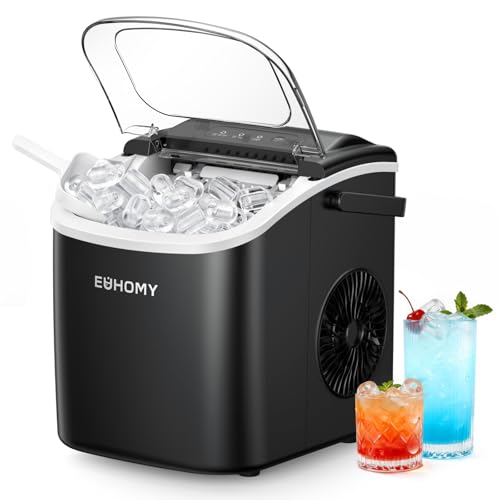
EUHOMY Countertop Ice Maker Machine with Handle
Badge: Best Pure Camping Pick
Strengths
- The only pick whose verified listing names camping and RV outright — this is its stated brief.
- Nine cubes in 6 minutes, auto-cleaning, carry handle, basket and scoop included.
- Simple bullet mechanism: the most forgiving design for travel, dust, and storage.
Trade-offs
- Bullet ice only.
- 26 lbs in 24 hours is a family rating, not a festival rating.
- Black finish shows campsite dust readily — cosmetic, but constant.
Spec box
- Output: 26 lbs in 24 hours
- Batch: 9 ice cubes ready in 6 minutes
- Ice type: bullet
- Cleaning: auto-cleaning
- Design: portable with handle; basket and scoop included
- Stated uses: home, kitchen, camping, RV
- Finish: Black
If one machine in this guide was briefed by a camper, it is this one. Its listing says camping and RV in plain words; its kit is the campsite kit (handle, basket, scoop, auto-cleaning); its mechanism is the simple, tolerant bullet design that shrugs off being moved, stored, and run on campground power season after season. It will not produce the evening’s chewable showpiece ice — that is the Silonn nugget’s department — but it will keep a family’s food cold and drinks honest from Friday to Sunday, and it will do the same next year.
For the buyer who wants one machine, bought for camping first and the kitchen second, this is the most direct answer in the verified pool — the same conclusion our Best Prices On Commercial Ice Makers research reaches from the value side when camps graduate to group scale.
Best for: dedicated campers and RVers who want the stated camping brief / Not suited for: nugget fans

Euhomy 2026 Upgraded Countertop Nugget Ice Maker
Badge: Best for Long Stays
Strengths
- Dual-pump self-cleaning and a detachable lid — the best defense against campground water of variable quality.
- True nugget ice, ready in 5 minutes, 35 lbs across the day.
- Cleaner included in the box (4 packs): a long-stay maintenance kit from day one.
Trade-offs
- The most featured machine here is also the one to pack most carefully.
- Nugget melt rules: table ice, served fresh.
- Grey finish and feature set aim it at basecamps and long stays rather than one-night stops.
Spec box
- Output: 35 lbs
- First ice: ready in 5 minutes
- Ice type: nugget, sonic crushed / pebble
- Cleaning: dual-pump self-cleaning, detachable lid
- Included: basket, scoop, 4 packs cleaner
- Finish: Grey
Long stays change the camping equation: a week at the lake or a season in the RV park is not a trip, it is a temporary address, and its water may be hard, its days hot, its ice habit daily. The upgraded Euhomy is the long-stay machine because its design answers the long-stay problem — mineral buildup from unfamiliar water — with the strongest cleaning system in the verified pool: dual-pump flushing, a lid that comes off for real wiping, and cleaner in the box. Its nuggets arrive in five minutes, its output is a full 35 pounds a day, and week three tastes like day one if the rhythm is kept.
Pack it like the precision appliance it is, site it in the RV or the awning’s shade, and it repays the care by being the machine that makes a long stay feel catered.
Best for: week-plus stays, seasonal RVers, and hard-water campgrounds / Not suited for: rough one-night stops
Comparison Table
| Model | Ice type | Output | First batch | Camping/RV stated | Link |
|---|---|---|---|---|---|
| Silonn Nugget with Handle | Nugget | 36 lbs/24H | 5 mins | Handle + compact | Check on Amazon |
| Kismile Nugget | Nugget | 35 lbs/day | 7 mins | Not stated | Check on Amazon |
| Frigidaire Portable Compact | Not stated | 26 lbs/day | Not stated | Portable format | Check on Amazon |
| EUHOMY with Handle (B0DCJ78D27) | Bullet, 2 sizes | 26 lbs/24H | 9 in 6 mins | Handle stated | Check on Amazon |
| EUHOMY Machine with Handle (B0BWHZJHPL) | Bullet | 26 lbs/24H | 9 in 6 mins | Yes — camping, RV | Check on Amazon |
| Euhomy Upgraded Nugget | Nugget | 35 lbs | 5 mins | Not stated | Check on Amazon |
How to Choose a Camping Ice Maker
Power first, machine second. Confirm what your camping actually provides: full hookups run any pick here happily; a generator or inverter must be sized above the machine’s stated draw with surge headroom — check the requirement on the product page and do the arithmetic at home. No hookup and no generator means no countertop ice maker, and the honest purchase is a better cooler.
Assign the machine a job. Cooler duty → bullet, ideally the nine-cube EUHOMY models. Table duty → nugget, with the handled Silonn for mobility and the Kismile for quiet. Long-stay duty → the Euhomy’s cleaning system. Mixed duty on a budget of space → one bullet machine, nuggets forgone, is the classic and correct compromise.
Respect heat like a specification. Output ratings assume temperate rooms; a machine on a sunlit picnic table in August is working against its own weather. Awning shade, airflow, and morning banking are worth more than the difference between any two ratings in this guide.
Plan water as a supply line. A collapsible carrier, a filter pitcher for long stays, and a rule — good-tasting water in, good ice out — cover every campground in the country. Our Best Portable Ice Makers With Water Line research explains why none of these machines can simply be plumbed to a campsite spigot, and why that is fine.
How to Run a Campsite Ice Station
- Before leaving home: self-clean the machine, drain it, dry it, and pack it upright with the scoop and basket inside, padded against the road.
- On arrival: site it level and shaded with vent clearance; let it rest upright while camp is pitched.
- Fill with the best water available; discard the first batch after the drive.
- Bank aggressively in the cool morning: every basket into the cooler or the RV freezer.
- Through the day: top the reservoir when you empty the basket; keep the lid closed against dust and curious wildlife between servings.
- Evenings: serve nugget ice fresh at the table if you brought a nugget machine; let the bullet machine keep the cooler deep.
- Departure: switch off, drain fully, wipe down, and transport upright and dry. At home, run the self-cleaning cycle before storing.
Troubleshooting
Problem: output is much slower than at home → heat and sun are the usual cause; move the machine into shade with airflow and bank ice in the morning instead.
Problem: the machine trips the site’s power or a generator strains → too many loads on one circuit; give the ice maker the primary outlet and move heaters and chargers elsewhere, or run it during off-peak hours and bank the ice.
Problem: ice tastes like the campground → the water is the message; switch to jug or filtered water and run a cleaning cycle.
Cooler Strategy: Making Camp Ice Last
The machine replaces the ice run, not the laws of the cooler. Pre-chill the cooler with a sacrificial first batch the night before or morning of; pack bullet ice in layers with the food rather than in a single stratum on top; keep the cooler shaded, closed, and drained of meltwater on a rhythm (a waterlogged cooler melts its ice from within); and reserve the nugget machine’s output for glasses, where its fast melt is a feature. Run this way, a 26-pound-class bullet machine sustains a family cooler indefinitely at a powered site — the trip’s ice budget becomes a fixed asset instead of a daily errand, which is the entire economic point of bringing the machine. Groups scaling beyond family size should look at the step-up analysis in our Best Residential Under Counter Ice Makers research before assuming a second countertop unit is the answer.
Tailgates, Dock Boxes, and Festival Basecamps
The powered-site family is bigger than the campground. The tailgate with a generator is a one-day campsite with better food: site the machine on the shaded side of the vehicle, start it when the grill is lit, and bank bullet ice into the drinks cooler while the nugget machine — if you brought the Silonn — waits for its evening role at the table. The dock box and the lake house extend the season rather than the day: a bullet machine living at the lake, self-cleaned and dried between weekends, ends the ritual of hauling bagged ice down the dock, and its ice goes straight into the boat cooler in the cool of the morning. Festival and event basecamps — the RV row at the race, the reunion’s rented field kitchen — reward the long-stay logic of the upgraded Euhomy: unfamiliar water, heavy daily use, and a cleaning system built to be run by whoever is on kitchen duty. In every variant the pattern is the one this guide teaches: honest power, shade, banking, and a machine matched to its job rather than to its brochure.
A Camper’s Packing List Around the Machine
The machine travels best with a small supporting kit, most of which weighs nothing: a non-slip mat for picnic tables and RV counters; a collapsible water carrier sized to your reservoir routine; a filter pitcher for stays beyond a weekend; a dedicated towel that lives under the machine; freezer bags for banking; and a short, heavy-duty extension cord rated for appliance use where the site’s outlet is a post rather than a wall — used singly and directly, never daisy-chained. Add the habit of photographing your setup the first time it works — cord route, machine position, shade line at noon — and every subsequent trip starts from a proven diagram instead of a fresh improvisation. Campers who run this kit describe the ice maker as the easiest appliance they travel with; campers who skip it describe the same machine as fiddly. The machine is not the variable.
Wildlife, Dust, and Other Outdoor Manners
Outdoor ice has admirers beyond the campsite’s humans. Keep the lid closed between servings — a discipline that also keeps dust and pine needles out of the basket — and never leave a sweet-drink station’s ice exposed at dusk in bear or raccoon country; the machine belongs inside the vehicle or the hard-sided RV overnight in serious wildlife areas, exactly like the food it chills. Dust is the slower adversary: a machine that camps often should get its exterior wiped at every homecoming and its vents kept clear of the grit that accumulates in a gear load, because airflow is output. None of this is burdensome; it is the ordinary outdoor courtesy owed to any appliance asked to work in the wild, and the bullet EUHOMYs in particular repay it with the indifference of simple mechanisms to hard living.
When Camping Ice Should Stay Bought
Honesty requires the counter-case. For the unpowered backcountry, the answer is no machine at all — carry a better cooler and buy ice at the last town. For the one-night powered stop on a long drive, the machine’s setup-and-rest rhythm may not repay itself against a single bag from the camp store. For the group trip where one volunteer hauls a commercial-scale solution, countertop machines are the supporting act, not the headline. The countertop camping machine owns the wide middle — powered sites, multi-day stays, families and small groups, RVs and basecamps — and within that middle it is transformative. Buy it for the trips you actually take, in the numbers you actually take them, and it will be the most praised box in the vehicle.
The Economics of Camp Ice, Honestly Totaled
Run the trip arithmetic the way campers actually experience it. A multi-day stay consumes cooler ice daily — melt is relentless in summer — plus the drinks themselves, and the bought alternative is a procession of camp-store bags, each purchased at vacation prices, each half-surrendered to the cooler by the second day, each requiring a drive or a walk at exactly the wrong hour. Against that stands a machine bought once, powered by a hookup already paid for, drinking water from a carrier. The machine does not need many trips to justify itself in pure errand terms, and campers consistently report the true return as something else: the evening nobody had to leave. Ice stops being a supply problem discussed at breakfast and becomes part of the site’s furniture — which, on the trips people remember best, is what every supply should be.
Teaching the Crew: Ice Duty Without the Friction
Shared camps run on small assigned kindnesses, and ice duty is the easiest to teach because the machine does the work: whoever passes the table tops the reservoir; whoever takes the last of the basket starts the transfer from the cooler reserve; the person who closes the camp kitchen at night checks that the lid is shut and the machine is cycling or off as the site prefers. Post the three rules where the machine sits the first trip — a note card under the lid works — and by the second trip they are camp culture. The failure mode to design against is the tragedy of the commons in miniature: a basket left full pauses production, a reservoir left empty stops it, and both are cured by the same sentence — ice is a flow, and everyone at the table is the riverkeeper.
Winter Camping and Shoulder Seasons
Cold-weather camping inverts the ice problem without eliminating it: drinks still want ice, coolers become refrigerators that nature assists, and the machine’s job shrinks to the table and the evening. The shoulder-season disciplines are about protection rather than production. Never let a filled machine sit in freezing conditions — water expands, and a reservoir or line left wet in a hard freeze is the one genuinely destructive mistake in this category’s outdoor life. Drain fully before any night that might freeze, and store the machine in the heated space between trips. Run this way, a camping ice maker is a four-season appliance; the campers who lose machines to winter lose them in storage, not in service, and the twenty-minute drain-and-dry ritual is the entire difference.
Fishing Trips and the Bait-Cooler Question
Anglers ask a specific version of the camping question: can the machine keep a bait and catch cooler honest across a long weekend? The workflow is the family workflow with sterner hygiene — the drinks cooler and the catch cooler are separate boxes, served by the same machine, and the scoop discipline is absolute: the scoop that touches the catch cooler never touches a glass. Bullet ice is the only serious candidate here (dense, slow, packable around the catch), and the nine-cube EUHOMY models are the natural picks; run the machine at the cabin, the RV, or the dock box in the morning, load the boat cooler deep, and let the day’s fishing happen on banked cold. Nugget machines stay at the table where they belong — the evening’s drinks, at the cabin, over ice that was flaked an hour ago. Divided this way, one or two countertop machines quietly replace the marina ice run for an entire season.
A closing observation from the way these machines actually get used outdoors: the ice maker becomes the campsite’s clock. It starts when the camp wakes, it is banked before the hike, it hums at the edge of the evening’s conversation, and its last basket marks the hour the kitchen closes. Appliances that achieve that status at camp are rare — the good stove, the trusted lantern — and they share the traits this guide has ranked all along: simple mechanisms, honest specifications, and owners who keep the small rituals. Choose the machine that fits your site and your crew, keep its rituals, and it will keep your camp’s hours for years.
Group Camps and Scout-Style Logistics
Scale the party and the machine’s role changes from appliance to infrastructure. For a group site — the troop, the reunion, the multi-family circle of RVs — the winning pattern is centralized: one bullet machine at the kitchen shelter running the cooler line from dawn, its output logged by nothing more formal than the cooler’s visible level, and a second machine if the group’s table drinks justify it. Assign the ice to a named person per day, exactly as you assign the stove; infrastructure without an owner is a rumor. The machines in this guide top out at family-plus scale individually, and two of them run in parallel beat one hypothetical larger unit for a simple reason: redundancy. A group that loses its only ice machine on day two has a problem; a group that loses one of two has a slightly busier morning.
Common Buying Mistakes
- Buying for an unpowered campsite. These machines need outlet-class power. No hookup, no generator, no machine — buy the cooler instead.
- Undersizing the generator. Compressor start-up surge is real; size with headroom and verify against the machine’s stated requirements.
- Siting the machine in the sun. The most common and most correctable output killer in camping.
- Transporting it full of water. Drain before every drive — for the machine’s sake and your vehicle’s interior.
- Expecting nugget ice to store the cooler. Nuggets are for the table. Bullets are for the box.
Final Recommendation
For camping first and everything else second, the EUHOMY countertop machine with handle is the direct answer: camping and RV in its own listing, a bullet mechanism that tolerates the life, auto-cleaning, and a complete kit. If the cooler is the mission, its sibling — the EUHOMY with two bullet sizes — fills it fastest. Bring a nugget machine when the table matters: the handled Silonn for mobility and speed, the Kismile for quiet sites and RV interiors, the upgraded Euhomy for long stays on unfamiliar water. The Frigidaire serves brand-loyal campers at powered sites with modest needs. Whichever rides with you, shade it, feed it good water and honest power, and drain it before the drive — it will keep your camp in ice for seasons.
Frequently Asked Questions
Can the machine keep up during a heat wave at camp?
It will work harder and yield less than its temperate-room rating — every compressor does — which is why the heat disciplines in this guide exist: deepest shade, maximum airflow, morning banking while the air is cool, and a cooler that is opened on a rhythm rather than at whim. Crews who run that system through a hot weekend report the machine as the least of their problems; crews who site it in the sun report the opposite about the same machine.
What is the best first trip to take a new camping ice maker on?
A short, powered, low-stakes one: a single night at a familiar campground where a failure costs you one bag of store ice and nothing else. Run the full rhythm — rest, fill, bank, serve, drain — learn your machine’s pace and your crew’s habits, and write the setup photo into your phone. Every longer expedition after that is a variation on a rehearsed theme.
How do I keep insects and debris out of the ice at an outdoor site?
Lid discipline is the whole answer: the lid opens to serve and closes immediately after, the scoop lives on its saucer rather than in the open basket, and the machine sits up on a table rather than at ground level where splash and dust travel. A machine sited in the kitchen shelter’s lee, away from the fire’s ash drift, will serve clean ice all weekend with nothing more exotic than that routine.
Should the machine live in the RV permanently or travel from home?
If the RV camps monthly or more, a dedicated machine that lives aboard — stored drained, dry, and secured — saves the load-in friction that quietly kills good intentions, and the handled bullet EUHOMY is the natural resident. Occasional campers do better carrying the home machine, provided the drain-rest-start rhythm is honored at both ends of every trip.
What is the first thing to check when we arrive at a new site?
The outlet and the shade, in that order: confirm the site’s power works and where its circuit stands, then choose the machine’s spot for level ground, vent room, and a shade line that will still be shade at 3 p.m. Everything else in the arrival routine — resting, filling, first batch, banking — follows from those two decisions.
How do I keep the machine level on uneven ground?
Start with the flattest surface the site offers — a leveled picnic table, the RV’s counter once the vehicle itself is leveled, a stable camp table shimmed with care. A small bubble level or phone app settles arguments. A machine a few degrees off will usually still work, but level is kinder to its pump and its ice formation, and at camp the difference between “works” and “works all season” is usually exactly this kind of care.
Is it worth bringing a nugget machine AND a bullet machine?
For groups that camp in one place for days — the family reunion site, the fishing cabin crew — yes, and the pairing is this guide’s recurring theme: the bullet machine works the cooler from breakfast, the nugget machine owns the table from late afternoon, and neither is asked to do the other’s job badly. For overnight stops and small parties of two, one machine chosen for your dominant job is the wiser load.
What size machine does a family of four need at a powered site?
Any pick in this guide, run with the banking workflow. A family’s drinks plus cooler top-ups across a day sit comfortably inside the 26-pound class when the morning’s production goes straight into the cooler; step up to the nugget models’ 35–36 pound class if the table drinks are constant, or add the second machine only when two venues — cooler and table — must be served at once, all day.
Can I run the ice maker from my car’s outlet while driving?
Standard vehicle accessory outlets do not supply household-class power, and the machine should travel drained and off, then run at the destination on hookup or a properly sized inverter setup. Making ice is a parked activity in this category — bank it before the drive and at the next stop.
Can a countertop ice maker run on a campsite hookup?
Yes — hookup power is exactly what these machines are built for. Plug into the site’s outlet as you would at home, keep the machine level and shaded, and it will produce on its normal rhythm.
What about a generator or inverter?
Possible, with arithmetic: the source must exceed the machine’s stated power requirement with headroom for compressor start-up. Check the requirement on the product page, size generously, and avoid sharing the circuit with heating appliances.
Can these machines run on 12-volt vehicle power directly?
No. They are household-outlet appliances. Vehicle use requires an appropriately sized inverter, which is a power-system decision to make deliberately, not an accessory to improvise.
Which ice is best for a multi-day cooler?
Bullet ice, banked in layers, in a pre-chilled, shaded cooler. Nugget ice is best reserved for drinks at the table, where it is made and served fresh.
How do I protect the machine from dust and weather?
Keep it under the awning or in the RV, lid closed between uses, and never in rain — these are countertop appliances, not outdoor-rated equipment. A dry cover during transport and storage completes the protection.
What water should I use at a campground?
The best-tasting water available: if the site’s water tastes good, use it; if not, jug or filtered water. On hard-water sites, shorten the cleaning interval and run the self-cleaning cycle at homecoming.
How much ice can one machine really make on a camping day?
Work with the daily rating discounted for heat — plan on steady production across the day with morning banking, rather than the full printed figure in August sun. For a family at a powered site, a 26-pound-class machine comfortably sustains drinks plus cooler top-ups run this way.